ISSN Online: 2327-5227 ISSN Print: 2327-5219
DOI: 10.4236/jcc.2017.513002 Nov. 10, 2017 9 Journal of Computer and Communications
Dynamic Self-Adaptive Double Population
Particle Swarm Optimization Algorithm Based
on Lorenz Equation
Yan Wu, Genqin Sun, Keming Su, Liang Liu, Huaijin Zhang, Bingsheng Chen, Mengshan Li
Gannan Normal University, Ganzhou, China
Abstract
In order to improve some shortcomings of the standard particle swarm opti-mization algorithm, such as premature convergence and slow local search speed, a double population particle swarm optimization algorithm based on Lorenz equation and dynamic self-adaptive strategy is proposed. Chaotic se-quences produced by Lorenz equation are used to tune the acceleration coeffi-cients for the balance between exploration and exploitation, the dynamic self-adaptive inertia weight factor is used to accelerate the converging speed, and the double population purposes to enhance convergence accuracy. The experiment was carried out with four multi-objective test functions compared with two classical multi-objective algorithms, non-dominated sorting genetic algorithm and multi-objective particle swarm optimization algorithm. The results show that the proposed algorithm has excellent performance with fast-er convfast-ergence rate and strong ability to jump out of local optimum, could use to solve many optimization problems.
Keywords
Improved Particle Swarm Optimization Algorithm, Double Populations, Multi-Objective, Adaptive Strategy, Chaotic Sequence
1. Introduction
Particle swarm optimization (PSO) algorithm, which is an intelligent optimiza-tion algorithm, has many characteristics such as simple structure, less parameter, easy description and realization, strong global search ability and no need for gradient information, widely used in many fields, such as function optimization, multi-objective problem solving, pattern recognition, etc., especially applicable
How to cite this paper: Wu, Y., Sun, G.Q., Su, K.M., Liu, L., Zhang, H.J., Chen, B.S. and Li, M.S. (2017) Dynamic Self-Adaptive Double Population Particle Swarm Opti-mization Algorithm Based on Lorenz Equ-ation. Journal of Computer and Commu-nications, 5, 9-20.
https://doi.org/10.4236/jcc.2017.513002
Received: October 11, 2017 Accepted: November 7, 2017 Published: November 10, 2017
Copyright © 2017 by authors and Scientific Research Publishing Inc. This work is licensed under the Creative Commons Attribution International License (CC BY 4.0).
http://creativecommons.org/licenses/by/4.0/
DOI: 10.4236/jcc.2017.513002 10 Journal of Computer and Communications
to solving the problem of nonlinear, multi-extreme value and non-differentiable
and multivariable complexity optimization [1] [2] [3][4]. However, similar to
other intelligent algorithms, the standard PSO algorithm also has shortcomings
such as precocious convergence and local search capability [5][6]. For example,
when it is used in the high dimensional complex optimization problems, popula-tion may when no search to the global optimal point form the premature con-vergence problem, then can’t guarantee the algorithm can converge to the global extreme value point. At the same time, in the search process, when the particle is approaching or entering the most advantageous area, the convergence speed is obviously slow.
For the lack of PSO algorithm, the researchers propose many improvement
strategies [7][8][9]. At present, the improvement of PSO algorithm mainly
fo-cuses on the adjustment of the algorithm parameters and the updating of the
particle structure and trajectory [10] [11] [12], aiming to make the algorithm
solve or improve the problem of local search slow, precocious convergence, and improve the convergence speed and precision of the algorithm to improve the
performance of the algorithm [13][14]. Among them, the introduction of inertia
weight factor [15], shrinkage factor and adaptive mutation operator is the most
representative, such as a linear gradient method [16], the fuzzy adaptive method
[17] [18] and distance information such as inertia coefficient adaptive control
method [19], the compression factor of PSO algorithm, PSO algorithm of
adap-tive mutation operator, etc. In addition, standard PSO algorithm and the hybrid
PSO algorithm combined with collaborative strategy [20], chaos theory [21] and
other algorithms are also attracted by researchers [22][23], such as the quantum
PSO algorithm with chaotic mutation operator [24]. Besides, There are also
many researches on discrete PSO algorithm, multi-objective PSO algorithm and so on [25][26].
Although the improved PSO algorithm improves both performance and effi-ciency, it is difficult to improve the local search ability of the algorithm while avoiding precocious convergence. There are many academics and industry re-searchers have been exploring and experimenting with new approaches to pro-vide better performance, higher efficiency and lower cost particle swarm
opti-mization [27] [28]. Therefore, in this paper, a self-adaptive double population
PSO algorithm based on Lorenz equation was proposed, called LSA-DPSO. In the LSA-DPSO algorithm, Lorenz equation and the dynamic adaptive weight adjustment strategy were introduced. In order to verify the feasibility and effec-tiveness of the proposed algorithm, the convergence speed and accuracy are discussed compared with standard PSO algorithm and classical multi-objective algorithm.
2. LSA-DPSO Algorithm
2.1. Standard PSO
Ken-DOI: 10.4236/jcc.2017.513002 11 Journal of Computer and Communications
nedy [29]. In the process of particle optimization, the potential solution of the
problem is assumed to be a “particle” in the n-dimensional space, and the par-ticle will fly at a certain speed and direction in the solution space. In the iterative process, all particles are represented by two global variables to represent the best position of the particle itself (pbest) and the best position of all particles (gbest), Let’s say in a n dimensional search space, The population of m particles is
(
)
T1, 2, , n
X = x x x , The position of the ith particle is expressed
(
)
T,1, ,2, , ,
i i i i n
x = x x x , The velocity is expressed as vi=
(
v vi,1, i,2,,vi n,)
T. Itsin-dividual extremum is represented as
(
)
T,1, ,2, , ,
i i i i n
p = p p p ,The global
extre-mum of the particle population is
(
)
T,1, ,2, , ,
g g g g n
p = p p p , during the k + 1
iteration, the particle updates its speed and position through formula (1) and (2).
(
) (
)
1
, , 1 , , 2 , ,
k k k k k k
i d i d i d i d g d i d
v+ =ωv +c p −x +c p −x (1)
1 1
, , ,
k k k
i d i d i d
x + =x +v + (2)
where i=1,M; ω is called an inertial weight factor, which keeps the
par-ticles in motion and has the ability to expand the search space. c1 and c2 are the
learning factors, which represent the weight of each particle to the extreme
posi-tion statistical acceleraposi-tion item. ,
k i d
v , ,
k i d
x are respectively the velocity and
posi-tion of the d dimension in the kth iteration of the particle i; ,
k i d
p is the position
of the individual extremum of particle i in d dimension, ,
k g d
p is the position of
the population in the global extreme value of d dimension.
2.2. LSA-DPSO
There are three factors that determine the change in particle velocity in PSO al-gorithm. 1) Inertial weight factor, instruct the speed information of the previous moment which compares current speed with front speed. 2) Cognitive factors, which is the development capacity factor, not only the optimal error of the ticle itself, but also the partial excavation and development capability of the par-ticle. 3) Exploration factor, the social sharing ability coefficient, expresses its er-ror that distances the best and how the particle share and cooperate. Under the circumstances, the inertia coefficient determines the search step length, which is better for global search and smaller for local exploration. Cognitive factors and exploration factors are collectively called learning factors, which represent the optimal and global optimal proportion of particles themselves. By adjusting the learning factors properly, the global and local search steps of the particles can be weighed and the exploration factors can be changed to realize the local optimal algorithm, when the algorithm is in precocious convergence.
Based on the above, the authors developed LSA-DPSO algorithm by mixing She mixed Lorenz equation and dynamic adaptive strategy into a dual popula-tion PSO algorithm. LSA-DPSO using adaptive evolupopula-tionary inertia weight ad-justment strategy, improve the convergence speed, chaotic sequence produced
by Lorenz equation optimizing algorithm of learning factor c1 and c2, jump out
DOI: 10.4236/jcc.2017.513002 12 Journal of Computer and Communications
population to improve the diversity of it. The inertial weight factor is dynami-cally adjusted by formula (3).
( )
(
)
max Pgbest k Plbestave max min k kmax
ω ω= − − ω −ω × (3)
Among them, omega max and omega min respectively indicate the maximum
and minimum value of the inertial weight; Pgbest(k) represents the global
opti-mum of the k-th iteration; Plbestave represents the local optimal average of all
particles; kmax represents the maximum number of iterations and k is the current
iteration number.
The learning factor c1 and c2 produce chaotic sequences through the typical
Lorenz equation, as shown in formula (4).
(
)
d
d d d d
d x
a x y
t y
rx y xz
t z
xy bz t
= − −
= − −
= −
(4)
In the formula, the parameters a, b and r are the positive control parameters,
which are respectively 10, 8/3, and 28, and the learning factor (c1, c2) has a
chao-tic state, which is defined as:
( )
( )
1
2
c x t
c y t
=
=
(5)
Because of the randomness and regularity, the change of chaotic variables making the algorithm can maintain the diversity of the population, improve the problem of premature convergence and improve the global search performance.
The steps of LSA-DPSO algorithm are as follows: 1) Initialize the particle group
The particles are initialized to two subpopulations A and B, and the positions
and velocities of all the particles of A and B are initialized, and the initial
posi-tions and velocities of the particles are randomly generated. The current position of each particle is used as the maximum value of the particle, and the optimal
value of the subgroup A and B is selected as the global optimal value of subgroup
A and B.
2) Calculate the adaptive value of population particles.
3) Compare the adaptive value of each particle with the adaptive value of the best position of its own, and make the better current position as the best position of the particle.
4) The adaptive value of each particle is compared with the adaptive value of the global best position, and the better current position is the best position.
DOI: 10.4236/jcc.2017.513002 13 Journal of Computer and Communications
global extreme value of group B.
6) Obtain the learning factor c1, c2 and inertial weight respectively, and update
the velocity and position of the particles.
7) If the end condition of the algorithm is satisfied, the global best position is the optimal solution, saving the result and ending. Otherwise return steps (2).
3. Numerical Experiments
3.1. Experiment Functions and Evaluation
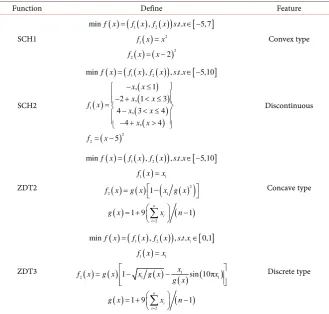
Multi-objective optimization is the most typical optimization problem. As the goals are often contradictory and constrained, it is difficult to achieve optimal simultaneous optimization, which means that one of the objectives must be op-timized at the expense of other goals. The solution to such a problem is usually not unique, but the existence of a series of optimal solutions, known as non-inferior solutions, which are often referred to as Pareto optimal solutions. Because swarm intelligence algorithm can parallel search multiple solutions in the search space, some classical multi-objective optimization problem can verify the performance of the algorithm very well. In this paper, the multi-objective
optimization test function proposed by Schaffer [30] and Deb [31] is used as an
experimental case, and the test function is shown in Table 1.
The advantages and disadvantages of non-inferior solutions are evaluated by means of convergence and distribution indicators:
Convergence index (GD) [32], which is used to describe the distance between
the non-dominant solution and the optimal front end of the real Pareto algo-rithm.
2
1
N i I
d GD
N
=
=
∑
(6)Among them, N represents the number of ungoverned solutions that the
algo-rithm searches for, di Represents the shortest Euclidean distance of all
solu-tions in the optimal front end of the true Pareto and the i-th pare to solutions.
Distribution index (SP) [33], SP is used to evaluate the uniformity of
distribu-tion of ungoverned soludistribu-tion concentrated soludistribu-tions. Among them, the algorithm parameters are set to:
(
)
2 1 2 11 n i i
d d
n SP
d
=
−
=
∑
(7)1 1 n
i i
d d
n =
=
∑
(8)Among then, N is the number of ungoverned solutions, di Represents the
shortest distance between the i th non-inferior solution in the target space and
DOI: 10.4236/jcc.2017.513002 14 Journal of Computer and Communications Table 1. Experimental test function.
Function Define Feature
SCH1
( )
(
1( ) ( )2)
[
]
minf x = f x ,f x s t x. . ∈ −5, 7
( )
2 1f x =x
( ) ( )2
2 2
f x = x−
Convex type SCH2 ( )
(
( ) ( ))
[
]
( ) ( ) ( ) ( ) ( ) ( ) 1 2 1 2 2min , , . . 5,10
, 1
2 , 1 3
4 , 3 4
4 , 4
5
f x f x f x s t x
x x x x f x x x x x f x = ∈ − − ≤
− + < ≤
= − < ≤
− + >
= −
Discontinuous
ZDT2
( )
(
1( ) ( )2)
[
]
minf x = f x ,f x , . .s t x∈ −5,10
( )
1 1
f x =x
( ) ( )
(
( )2)
2 1 1
f x =g x − x g x
( ) ( )
2
1 9 1
n
i i
g x x n
= = + −
∑
Concave type ZDT3( )
(
1( ) ( )2)
[ ]
minf x = f x ,f x , . .s t xi∈0,1
( )
1 1
f x =x
( ) ( ) ( ) ( ) (1 )
2 1 1 sin 10π1
x
f x g x x g x x g x = − − ( ) ( ) 2
1 9 1
n
i i
g x x n
=
= + −
∑
Discrete type
3.2. Experimental Results
It proposed the LSA-DPSO algorithm to simulate the multi-objective test func-tion SCH1, SCH2, ZDT2 and ZDT3. The populafunc-tion size is 60; the maximum iteration number is set to 500; the maximum and minimum values of inertia weight are 0.9 and 0.3 respectively. Pareto non-inferior solution was obtained by algorithm, and the distribution of Pareto non-inferior solutions of each function
was plotted in Figures 1-4.
To solve the multi-objective function, the optimal target domain is the boun-dary of the fitness value region, which is called the effective interface. As can be seen from the Pareto non-inferior solution drawn from the graph, the four test functions accurately give the effective interface, and the complete Pareto non-inferior solution can be obtained. It can be seen from the distribution of solution that the solution distribution of each function is even.
When solving complex multi-objective functions such as discrete and discon-tinuities, the algorithm also gives an accurate and non-inferior solution set, such as SCH2 and ZDT3.
DOI: 10.4236/jcc.2017.513002 15 Journal of Computer and Communications Figure 1. Pareto non-inferior solution of SCH1.
Figure 2.Pareto non-inferior solution of SCH2.
[image:7.595.253.494.511.707.2]DOI: 10.4236/jcc.2017.513002 16 Journal of Computer and Communications Figure 4. Pareto non-inferior solution of ZDT3.
In order to further verify the robustness and stability of the algorithm, each test function with the LSA-DPSO algorithm run 5 times, statistics of each test function index of the convergence of GD, SP distribution index and calculating the average time of CT, and four statistical evaluation index of the test function,
and the results are shown in Table 2.
The data show that the LSA-DPSO algorithm performs well in solving mul-ti-objective problems that confirms the feasibility, accuracy and efficiency of LSA-DPSO algorithm. GD indicates that noninferior-solutions are very close to the real Pareto. And through the data of SP, noninferior-solutions are well dis-tributed. Meanwhile, from the differentia of CT index, the difference between functions is within acceptable limits.
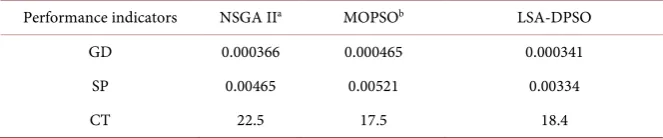
To compare the advantages of each algorithm. We contrast LSA-DPSO algo-rithm with the NSGA-II algoalgo-rithm and the MOPSO algoalgo-rithm by decomposing each algorithm five times using various target test functions. The statistical
re-sults are shown in Table 3.
In terms of convergence accuracy and distribution, the LSA-DPSO algorithm is superior. At the point of GD and SP, The optimal front-end distance that is obtained through the LSA-DPSO algorithm is closer than other two algorithms, what indicates LSA-DPSO has better convergence and accuracy. At the point of CT, the execution time of LSA-DPSO algorithm is lower than NSGA II rithm but higher than that of MOPSO. The reason is that the LSA-DPSO algo-rithm is dynamically adjusted with the flight process of the particle, which will surely consume more time than the standard PSO algorithm, which is long and single-directional flight search. As an inevitable result, the convergence and dis-tribution of the non-inferior solutions obtained by the LSA-DPSO algorithm are better than those of the other two algorithms.
DOI: 10.4236/jcc.2017.513002 17 Journal of Computer and Communications Table 2. Performance statistics of LSA-DPSO optimization test functions.
Performance indicators SCH1 SCH2 ZDT2 ZDT3 Average GD 0.000335 0.000336 0.000353 0.000340 0.000341 SP 0.00338 0.00335 0.00336 0.00325 0.00334 CTa 17.7 17.6 18.4 19.8 18.4
aComputation time.
Table 3. The comparison results of three algorithms are optimized
Performance indicators NSGA IIa MOPSOb LSA-DPSO GD 0.000366 0.000465 0.000341
SP 0.00465 0.00521 0.00334
CT 22.5 17.5 18.4
anon-inferior classification multi-objective genetic algorithm, bmulti-target particle swarm optimization
al-gorithm.
sequence to improve the premature convergence problem of PSO algorithm, through dynamic adaptive mechanism of multiple species and improve the algo-rithm convergence speed and accuracy.
4. Conclusion
This paper presents an algorithm that is based on the dynamic adaptive dual population particle swarm of Lorenz equation. By using the chaos sequence generated by Lorenz equation, the learning factor is optimized and the dynamic adaptive adjustment strategy is adjusted to the inertia weight, it improved the convergence speed, accuracy and the problem that the convergence of PSO rithm is premature. Through the test function experiment, the proposed algo-rithm is used to solve the multi-target problem, and the obtained non-inferiority solution can approach the optimal solution set of Pareto very well, and the dis-tribution is even. It indicates the performance of LSA-DPSO algorithm is better. In this paper, the algorithm is used to solve the problem of complex optimiza-tion problems such as non-linear, multipolar and multivariable, which can pro-vide references for many practical engineering applications.
Acknowledgements
The authors gratefully acknowledge the support from the National Natural Science Foundation of China (Grant Numbers: 51663001, 51463015, 51377025) and the science and technology research project of the education department of Jiangxi province (Grant Numbers: GJJ150983, GJJ151012).
References
[image:9.595.207.539.206.275.2]DOI: 10.4236/jcc.2017.513002 18 Journal of Computer and Communications https://doi.org/10.1016/j.ins.2014.02.143
[2] Neri, F., Mininno, E. and Lacca, G. (2013) Compact Particle Swarm Optimization.
Information Sciences, 239, 96-121. https://doi.org/10.1016/j.ins.2013.03.026
[3] Zitzler, E., Thiele, L., Laumanns, M., Fonseca, C.M. and da Fonseca, V.G. (2003) Performance Assessment of Multiobjective Optimizers: An Analysis and Review.
Ieee Transactions On Evolutionary Computation, 7, 117-132.
https://doi.org/10.1109/TEVC.2003.810758
[4] Zhao, X.L., Turk, M., Li, W., Lien, K.C. and Wang, G.Z. (2016) A Multilevel Image Thresholding Segmentation Algorithm Based on Two-Dimensional K-L Divergence and Modified Particle Swarm Optimization. Applied Soft Computing, 48, 151-159.
https://doi.org/10.1016/j.asoc.2016.07.016
[5] Tsekouras, G.E. and Tsimikas, J. (2013) On Training RBF Neural Networks Using Input-Output Fuzzy Clustering and Particle Swarm Optimization. Fuzzy Sets and Systems, 221, 65-89. https://doi.org/10.1016/j.fss.2012.10.004
[6] del Valle, Y., Venayagamoorthy, G.K., Mohagheghi, S., Hernandez, J.C. and Harley, R.G. (2008) Particle Swarm Optimization: Basic Concepts, Variants and Applica-tions in Power Systems. Ieee Transactions On Evolutionary Computation, 12, 171-195. https://doi.org/10.1109/TEVC.2007.896686
[7] Akay, B. (2013) A Study on Particle Swarm Optimization and Artificial Bee Colony Algorithms for Multilevel Thresholding. Applied Soft Computing, 13, 3066-3091.
https://doi.org/10.1016/j.asoc.2012.03.072
[8] He, G. and Huang, N.J. (2012) A Modified Particle Swarm Optimization Algorithm with Applications. Applied Mathematics and Computation, 219, 1053-1060.
https://doi.org/10.1016/j.amc.2012.07.010
[9] Taghiyeh, S. and Xu, J. (2016) A New Particle Swarm Optimization Algorithm for Noisy Optimization Problems. Swarm Intelligence, 10, 161-192.
https://doi.org/10.1007/s11721-016-0125-2
[10] Lynn, N. and Suganthan, P.N. (2015) Heterogeneous Comprehensive Learning Par-ticle Swarm Optimization with Enhanced Exploration and Exploitation. Swarm and
Evolutionary Computation, 24, 11-24. https://doi.org/10.1016/j.swevo.2015.05.002
[11] Jiang, S.J., Shi, J.J., Zhang, Y.M. and Han, H. (2015) Automatic Test Data Genera-tion Based on Reduced Adaptive Particle Swarm OptimizaGenera-tion Algorithm.
Neuro-computing, 158, 109-116.
[12] Esmin, A.A.A., Coelho, R.A. and Matwin, S. (2015) A Review on Particle Swarm Optimization Algorithm and Its Variants to Clustering High-Dimensional Data.
Artificial Intelligence Review, 44, 23-45.https://doi.org/10.1007/s10462-013-9400-4
[13] Gandomi, A.H., Yun, G.J., Yang, X.S. and Talatahari, S. (2013) Chaos-Enhanced Accelerated Particle Swarm Optimization. Communications in Nonlinear Science
and Numerical Simulation, 18, 327-340.
[14] Nickabadi, A., Ebadzadeh, M.M. and Safabakhsh, R. (2011) A Novel Particle Swarm Optimization Algorithm with Adaptive Inertia Weight. Applied Soft Computing, 11, 3658-3670.
[15] Zhan, Z.H., Zhang, J., Li, Y. and Chung, H.S.H. (2009) Adaptive Particle Swarm Optimization. IEEE Transactions on Systems Man and Cybernetics Part
B-Cybernetics, 39, 1362-1381.https://doi.org/10.1109/TSMCB.2009.2015956
[16] Shang, L., Zhou, Z. and Liu, X. (2016) Particle Swarm Optimization-Based Feature Selection in Sentiment Classification. Soft Computing, 20, 3821-3834.
DOI: 10.4236/jcc.2017.513002 19 Journal of Computer and Communications
[17] Valdez, F., Melin, P. and Castillo, O. (2011) An Improved Evolutionary Method with Fuzzy Logic for Combining Particle Swarm Optimization and Genetic Algo-rithms. Applied Soft Computing, 11, 2625-2632.
[18] Thong, P.H. and Son, L.H. (2016) A Novel Automatic Picture Fuzzy Clustering Method Based on Particle Swarm Optimization and Picture Composite Cardinality.
Knowledge-Based Systems, 109, 48-60.
[19] Marinakis, Y. and Marinaki, M. (2013) Particle Swarm Optimization with Expand-ing Neighborhood Topology for the Permutation Flowshop SchedulExpand-ing Problem.
Soft Computing, 17, 1159-1173.https://doi.org/10.1007/s00500-013-0992-z
[20] Sinha, A.K., Zhang, W.J. and Tiwari, M.K. (2012) Co-Evolutionary Immu-no-Particle Swarm Optimization with Penetrated Hyper-Mutation for Distributed Inventory Replenishment. Engineering Applications of Artificial Intelligence, 25, 1628-1643.
[21] Cheng, M.Y., Huang, K.Y. and Chen, H.M. (2012) K-Means Particle Swarm Opti-mization with Embedded Chaotic Search for Solving Multidimensional Problems.
Applied Mathematics and Computation, 219, 3091-3099.
[22] Liu, J.H., Mei, Y. and Li, X.D. (2016) An Analysis of the Inertia Weight Parameter for Binary Particle Swarm Optimization. IEEE Transactions on Evolutionary
Com-putation, 20, 666-681.https://doi.org/10.1109/TEVC.2015.2503422
[23] Harrison, K.R., Engelbrecht, A.P. and Ombuki-Berman, B.M. (2016) Inertia Weight Control Strategies for Particle Swarm Optimization. Swarm Intelligence, 10, 267-305.https://doi.org/10.1007/s11721-016-0128-z
[24] Mohiuddin, M.A., Khan, S.A. and Engelbrecht, A.P. (2016) Fuzzy Particle Swarm Optimization Algorithms for the Open Shortest Path First Weight Setting Problem.
Applied Intelligence, 45, 598-621.https://doi.org/10.1007/s10489-016-0776-0
[25] Zheng, Y.J. and Chen, S.Y. (2013) Cooperative Particle Swarm Optimization for Multiobjective Transportation Planning. Applied Intelligence, 39, 202-216. https://doi.org/10.1007/s10489-012-0405-5
[26] Qasem, S.N., Shamsuddin, S.M., Hashim, S.Z.M., Darus, M. and Al-Shammari, E. (2013) Memetic Multiobjective Particle Swarm Optimization-Based Radial Basis Function Network for Classification Problems. Information Sciences, 239, 165-190. [27] Civicioglu, P. (2013) Backtracking Search Optimization Algorithm for Numerical
Optimization Problems. Applied Mathematics and Computation, 219, 8121-8144. [28] Tsekouras, G.E. (2013) A Simple and Effective Algorithm for Implementing Particle
Swarm Optimization in RBF Network’s Design using Input-Output Fuzzy Cluster-ing. Neurocomputing, 108, 36-44.
[29] Kennedy, J. and Eberhart, R. (1995) Particle Swarm Optimization. IEEE
Interna-tional Conference on Neural Networks Proceedings, Proceedings of International
Conference on Neural Networks, IEEE Australia Council, Perth, 1942-1948.
https://doi.org/10.1109/ICNN.1995.488968
[30] Schaffer, J.D. (1985) Multiple Objective Optimization with Vector Evaluated Ge-netic Algorithms. International Conference on Genetic Algorithms, Lawrence Erl-baum Associates, 93-100.
[31] Deb, K. (1999) Multi-Objective Genetic Algorithms: Problem Difficulties and Con-struction of Test Problems. Evolutionary Computation, 7, 205-230.
https://doi.org/10.1162/evco.1999.7.3.205
DOI: 10.4236/jcc.2017.513002 20 Journal of Computer and Communications
Particle Swarm Optimization with or without Constraints Handling. Applied Soft
Computing, 47, 370-388.
[33] Qiu, C.Y., Wang, C.L. and Zuo, X.Q. (2013) A Novel Multi-Objective Particle Swarm Optimization with K-Means Based Global Best Selection Strategy. Interna-tional Journal of ComputaInterna-tional Intelligence Systems, 6, 822-835.