Munich Personal RePEc Archive
The Scope, Scale and Locational
Preferences of Spanish Multinationals
Mainer Casado, Carolina and Fariñas, José C. and Moreno,
Lourdes
Universidad Complutense de Madrid and GRIPICO, Universidad
Complutense de Madrid and GRIPICO, Universidad Complutense
de Madrid and GRIPICO
6 April 2018
1
The Scope, Scale and Locational Preferences of Spanish Multinationals
Carolina Mainer Casado, José C. Fariñas and Lourdes Moreno1
Universidad Complutense de Madrid and GRIPICO 10 April 2018
Abstract
This paper examines the relationship between firms’ heterogeneity and their multinational activity. We examine the scope and the scale of multinational firms following the insights of Yeaple’s (2009) model. The goal of the paper is to contribute to a better understanding of the activity of Spanish multinationals using a sample of Spanish multinational firms. Our dataset is built from two databases, SABI and ORBIS, both from the Bureau van Dijk. Our results confirm that more productive firms have a greater multinational activity in terms of both the scope (the number of foreign markets where they invest) and the scale (the volume of local sales by subsidiaries in foreign markets). The structure of Spanish multinational firms’ activity is also analysed from the perspective of host country characteristics (GDP, population, distance and language) using standard gravity equations. Country characteristics that are positively associated (GDP and common language) with the volume of multinational activity are negatively related to the productivity of firms that go abroad. This asymmetry also holds for bilateral characteristics as distance that appears negatively associated with the level of multinational activity.
Keywords: Multinational firms, heterogeneity, productivity.
JEL Codes: F10, F23, L25, R30
1 This research has been partially funded by the Spanish Ministry of Economy and Competitiveness
(project ECO2014-52051-R and ECO2017-82445-R) and by the Autonomous Region of Madrid through project S2015HUM-3417 (INNCOMCON-CM), co-funded by the European Social Fund (European Union). The authors benefited from presentations at the 4th PhD-Student Workshop on Industrial and
Public Economics (Reus, 2016), the Conference on International Economics (La Coruña, 2016) and
2
1. Introduction
Spanish firms have become important actors in the process of international foreign investment that has taken place in global markets in the last two decades. Guillén (2005) and García-Canal and Guillén (2010) refer to the “rise of Spanish multinationals” to characterise this process. The last World Investment Report (UNCTAD, 2017) confirms this position of Spanish multinationals. Spain appears in the top 10 group of home countries with the highest outflow of foreign direct investment (FDI) at the world level. As Guillen (2005) indicates, among the group of countries with an average income level at the beginning of the second half of the last century, Spain has been, together with South Korea and Taiwan, one of the countries where the largest number of truly global multinationals have been established. An important feature of this process is that around 90% of the FDI is destined for Europe and Latin America, and 80% is concentrated in infrastructure and financial services companies (García-Canal and Guillén, 2010). According to this evidence, the Spanish case is a significant episode of the recent expansion of multinational activity at the world level. Our analysis is a first attempt to examine a set of general characteristics concerning the multinational activity of Spanish firms.
3 To organise our empirical analysis, we rely on models of multinational activity and heterogeneous firms initiated by Helpman, Melitz and Yeaple (2004). This literature combines two elements. The first one is the proximity-concentration model of Brainard (1997), where firms face a trade-off between exporting and foreign investment as two different ways to have access to foreign markets. The second element is Melitz’s (2003) model, where heterogeneous firms are identified by different levels of productivity that reflect differences in management ability, human capital, technology and the large set of resources that drive firm levels of productivity.
Helpman, Melitz and Yeaple (2004) show the existence of a sorting pattern between purely domestic firms, exporters and firms that go abroad through investment decisions. The latter group of firms dominates the other two in terms of their level of productivity. Yeaple (2009) extends this sorting to the scope and scale of multinational activity for the firms of a given country. We take both predictions as a reference to estimate the scale and scope elasticities of Spanish multinationals.
An additional element we are interested in examining with empirical evidence for Spanish multinationals derives from an important feature of the models of Helpman, Melitz and Yeaple (2004) and Yeaple (2009): country characteristics determine the productivity cutoff that drives the investment entry decision in foreign markets. One important consequence of this result is that the productivity composition of firms is determined by the characteristics of the countries where they invest. The size of the host market and the distance between the home and the host country of the investment decision, for example, are well-known factors that influence the amount of FDI positively or negatively (see Head and Mayer, 2014, for a review article, and Kleinard and Toubal, 2010, for an application). Therefore, we test whether country characteristics that are associated positively or negatively with the volume of FDI activity, in terms of both the number of firms and their volume of sales, are also related to the sign opposite to the productivity levels of parent firms that invest abroad.
4 manufacturing has 600 parent firms, which operate in 59 different host countries, and the service sample has 3,503 parent firms, which operate in 155 host countries. For the same results presented in this paper, we are able to identify 11,840 subsidiaries that are in both the manufacturing and service sectors and immediately owned by a Spanish parent firm. This number can be compared with the OECD figure for the total number of subsidiaries that are immediately owned by parent firms operating in Spain (Inward and Outward activity of subsidiaries by industrial sector; OECD.Stat for the year 2013): 11,255 subsidiaries. Both numbers are quite similar. Therefore, we consider that our analysis almost fully reflects the characteristics and the properties of the population of Spanish multinationals.
A further contribution of this paper concerns the empirical literature on models of heterogeneous multinational firms, in particular, the prediction concerning the selection of MNEs from the perspective of the scope and scale of their international activity. The relationship between the scale and scope of subsidiaries, on one hand, and the productivity of their parent firms, on the other, has already been examined empirically by a number of papers. The list includes the following: Aw and Lee (2008) for Taiwanese firms, Yeaple (2009) for US multinationals, Geishecker, Görg and Taglione (2009) for firms from 12 EU countries, Chen and Moore (2010) for French companies, Damijan, Kostevc and Rojec (2016) for nine new EU member states from Central and Eastern Europe, Nishiyama and Tamaguchi (2013) and Tanaka (2012, 2015) for Japanese firms, Shao and Shang (2016) for Chinese firms and Fariñas, Martín-Marcos and Velazquez (2018) for a multi-country examination of 30 European countries. Most of these papers refer to the manufacturing sector. Our paper contributes to this literature by offering empirical evidence for an additional country and particularly by using a sample of service firms that have been considered for analysis rather exceptionally.
5 multi-country analysis for 30 European countries. Therefore, we add the evidence of an additional country to this short list of previously considered cases.
The paper is organised as follows. Section 2 presents the theoretical framework and the details of the main hypothesis to be analysed in section 4. Section 3 presents the characteristics of the dataset used in the paper along with the measurement issues and the definition of the variables. Section 4 reports the results: first, the results concerning the estimates of scope elasticities; second, the estimates of the relationship between the scale of subsidiaries and the productivity of their parent firms; third, the results related to the asymmetric effect hypothesis between the scale of multinational firms and their productivity based on the estimation of gravity equations. Section 5 concludes.
2. Theoretical framework and hypothesis
This section presents the theoretical framework and the main hypothesis used to organise our empirical work. There are many approaches to and theories about multinational enterprise. To contextualise the one used here, we briefly summarise the main elements of this literature.
A large group of theories focuses on the analysis of the international business strategy conducted by firms. In fact, most of them are theories of managerial choice (Kano and Verbeke, 2017). Stephen Hymer launched the first core theoretical perspective of the MNE and it was based on the concept of ownership advantage (Forsgren, 2003). Multinational firms have some advantages (new technology, managerial resources, internal economies of scale, etc.) to balance out the disadvantages (distance, cultural differences, higher risk, etc.) of entering foreign markets.
6 Direct Investment (FDI) originates in this theory. Since its origins, the internalisation approach has been reformulated in various different ways. One of the most popular is the eclectic paradigm of FDI proposed by Dunning (1979). A specific contribution of this theory is that it links the reasons for firms to enter a foreign market and the mode of entry (exports, FDI and licensing). It considers that a firm needs to have three advantages to open a subsidiary in a foreign market: organisation, location and internalisation (OLI paradigm). This OLI framework relates the determinants of FDI to firm-, industry- and country-specific factors.
Forsgren (2013) proposes three additional perspectives of MNEs within the area of international business strategy: the organisational capabilities literature rooted in the resourced-based view of the firm; the business network theory popularised by the Uppsala model, which considers internationalisation to be driven by the market knowledge of the firm; and, finally, the institutionalisation theory. Kano and Verbeke (2017) review the microfoundations of all these approaches (see Dabic, Gonzalez-Loureiro and Furrer (2014) for a more comprehensive review of the field of MNEs’ strategy).
New trade theory (Helpman and Krugman, 1985) offers an alternative framework for the analysis of MNEs, building on industrial organisation models and the tradition of trade theory. As suggested by Faeth (2008), it incorporates ideas of the OLI eclectic paradigm with knowledge capital as the ownership advantage of an MNE and considers country size a potential location advantage for the firm. Next, we summarise the main ingredients of this approach.
7 differences in factor endowments between countries. These differences translate into factor price differences across countries and vertically integrated firms exploit them with geographically fragmented production. Markusen (1984, 2002) complements these models by integrating both the horizontal and the vertical stream of the literature in the so-called knowledge-capital model of FDI. Therefore, in this literature, horizontal FDI is associated with the proximity-concentration approach while vertical FDI is linked to differences in factor prices across countries.
Revisions of empirical studies that focus on the analysis of determinants of FDI suggest that models of horizontal and vertical FDI are relatively robust in their predictions. In particular, Faeth (2008) summarises the empirical literature by concluding that “market size, transport cost and trade barriers increased FDI, while factor endowments were only relevant in some cases”. These results indirectly confirm the idea that MNEs have some kind of ownership advantages as they have to overcome obstacles related to trade barriers, transport costs, etc. that non-MNEs do not have to confront.
Previous approaches use analytical frameworks in which there is no firm heterogeneity within industries. A consequence of this, as Helpman (2011) writes, is that “all firms make the same choices, either all choose to export or either all choose to serve a foreign market with subsidiary sales”. This is a limitation of conventional models as they contradict empirical evidence. Helpman, Melitz and Yeaple (2004) were among the first to introduce firm heterogeneity in previous theories. Models of multinationals with firm heterogeneity have become popular in recent years. Given that this approach integrates many features that come from previous theories, we would take into consideration the set of factors and the main hypothesis that come out of these models of heterogeneous MNEs. We would take these hypotheses as a reference to examine the multinational activity of Spanish firms. The literature we rely on starts with Helpman, Melitz and Yeaple (2004). This combines two approaches to the analysis of multinational activity:
first, the proximity-concentration model of Brainard (1993, 1997), where firms face a trade-off between transport costs when they trade, and fixed investment costs when they decide to invest abroad; and second, the heterogeneity model of Melitz (2003), where firms differ in their productivity levels.
8 country-specific cutoff productivity level determines, according to these models, both the number of foreign affiliates a firm opens in foreign markets (scope) and the size of the operations of these affiliates (scale). The second set of predictions refers to the host country characteristics that influence the productivity cutoff and therefore the decisions that characterise the structure of multinational activity that we observe across destination countries.
With respect to the first set of predictions, Helpman, Melitz and Yeaple (2004) have shown the existence of a sorting pattern between exporting firms and firms that engage in FDI, the latter being the most productive group relative to both exporters and firms that serve only the domestic market. Yeaple (2009) shows that this kind of sorting also extends to the scope and scale of multinationals from a given country: more productive parent firms operate in a higher number of foreign markets and at a higher scale in terms of the average sales of their subsidiaries.
9 If this happens, country characteristics that positively affect the volume of multinational activity, defined in terms of the value of affiliates’ production in foreign markets across two countries, should be negatively associated with the level of productivity of the least productive parent firm that enters the host country.
We summarise these predictions in terms of the following four hypotheses:
H1: the number (scope) of subsidiaries in a given foreign market is larger the higher the productivity of their parent firms is.
H2: the volume of the subsidiary’s sales (scale) in a given foreign market is positively affected by the productivity of its parent firms.
To test H1, we estimate the relationship between the probability of investing in a foreign market and parent firms’ productivity. We called this the scope elasticity with respect to firm productivity. With respect to H2, we estimate the relationship between the subsidiary’s sales in foreign markets and parent firms’ productivity. We called this the scale elasticity of multinational activity. In both cases, the estimations control for both industry and host country effects.
H3: the scale of operations of subsidiaries increases (decreases) the more (less) attractive the characteristics of the host country are.
H4: country characteristics that positively (negatively) affect the scale of operations of subsidiaries should be negatively (positively) associated with the average productivity of parent firms that enter abroad.
To test H3 and H4, we estimate gravity equations that include standard variables like host country GDP, a proxy of market size, distance, contiguity and other institutional variables that capture host and bilateral home-host country characteristics.
Before proceeding with sections 3 and 4, devoted respectively to the dataset used in the estimation and the main results obtained, we briefly summarise the empirical literature on FDI in Spain.
10 Rodríguez and Pallás (2008), Bajo-Rubio, Diaz-Mora and Diaz Roldan (2010) and Villaverde and Maza (2012), among others. In general terms, they confirm that a large part of foreign capital inflows has relied, to a large extent, on previously resident Spanish companies through the acquisition of shares from these firms. With respect to the determinants of theses flows, the level of domestic GDP, as a proxy of the size of the local market, the level of trade barriers and a favorable level of relative labour costs are the main factors.
FDI by multinational firms channels not only investment but also the inflow of new foreign knowledge and technology. This element of FDI may lead to spillovers to the local economy that are as important as the investment itself (Görg, 2016). This relevant question of research has been analysed in Spain by Alvarez and Molero (2005), who concluded that FDI induces positive effects on Spanish domestic firms operating in low-content technological industries. In addition, Sanchez-Sellero, Rosell-Martínez and García-Vazquez (2014) examine the factors that influence the absorptive capacity of Spanish manufacturing firms.
The interest in the empirical evidence on Spanish FDI outflows is more recent. Guillen (2005) has analysed what he calls the rise of the new Spanish multinationals. Spain, a country that at the beginning of the 1990s lacked companies of international size, has been able to generate a large number of truly global multinationals. Recent analysis that illustrates this interest in outflow FDI investment by Spanish multinationals includes Delgado, Ramírez and Espitia (2004), Gordo, Martín and Tello (2008a, 2008b), García-Canal and Guillen (2010) and Myro (2014).
Other issues that are more specific and also have attracted the attention of research: the choice of entry mode, Lopez-Duarte and García-Canal (2002), the relationship between foreign activities and productivity, Merino (2004) and Fariñas and Martín-Marcos (2007) and the strategic typology of firms as determinants of FDI investment, Almodovar, Navas López and Huerta Riveros (2009), among others.
3. Data
11 multinationals. The data used is based on firm-level information from SABI and ORBIS. Both datasets come from Bureau van Dijk, which provides company information based on company financial accounts and ownership structure. The SABI database contains information on Spanish firms and ORBIS provides business records on almost 200 million companies around the world. The ownership information for each firm refers to both the distribution of shareholders and the composition of their affiliated companies.
From SABI we construct a sample of parent firms with a productive activity in Spain. These firms are immediate owners of at least one affiliate firm in a foreign market. From ORBIS we complete information on affiliated firms that were identified as participated by a Spanish firm in SABI. We link both parent and subsidiary firms using the identification number (id) provided by Bureau van Dijk for each firm in both datasets.
To determine whether an investment can be considered FDI from a given country, the OECD (2005) recommends classifying the enterprise on the basis of the presence or absence of effective foreign participation in its capital. If a majority of ordinary shares (more than 50 percent of the capital) is held by a single foreign investor, then we refer to this as FDI. Following this consideration, we define links between a parent firm and its foreign affiliates in terms of the notion of “immediate property”. According to this criterion, a parent-multinational company is a firm that is the direct or immediate owner of at least one affiliate in a foreign country. Similarly, an affiliate firm is defined as an enterprise in which a non-resident investor owns more than 50 percent of the capital.
The notion of “ultimate control” (OECD, 2005) is an alternative to the previous criterion. In this case, the affiliate company is under the ultimate control of a parent firm. The condition for defining the link between the affiliate company and its ultimate owner is that the parent firm owns more than 50% of the capital of the subsidiary at every step in the path of consecutive capital participations between the parent and the affiliate firm.
12 given that a certain proportion of firms are controlled by foreign capital. Our analysis uses both criteria.
An additional criterion that has been used to identify the link between the parent and the affiliate firm refers to the main activity performed by both firms. The sample of firms only includes parents and subsidiaries that have the same main activity. For parent firms that operate in the manufacturing sector, we only consider subsidiaries that have a manufacturing as their main activity. We apply a similar criterion for a parent and their affiliates that operate in the service sector.
Table 1 summarises the characteristics of the sample of parents firms and countries used in the analysis. It reports information from the sample based on the criteria of both immediate owner and ultimate owner. Considering first the criterion of immediate property (sample 1a), SABI identifies a total number of 600 parent multinational manufacturing firms that have at least one subsidiary manufacturing firm. These subsidiaries operate in 59 different host countries. With respect to parent multinationals of the service sector that are immediate owners of subsidiaries in the service sector, SABI provides a total number of 3,503 firms operating in 153 host countries. Manufacturing and service activities combined total 4,103 firms.
SABI identifies links between firms, but in some cases, there is no complete financial information for the firms themselves. The last two rows of Table 1 (sample 1b) report the number of firms in the sample conditional on the fact that the value of TFP for the parent firm can be estimated with the information available. The total number of parent multinationals for both manufacturing and services is 3,283, approximately 80% of the observations with respect to the baseline sample.
13 owners of their subsidiaries. We are interested in controlling for the differential effect that comes from this consideration.
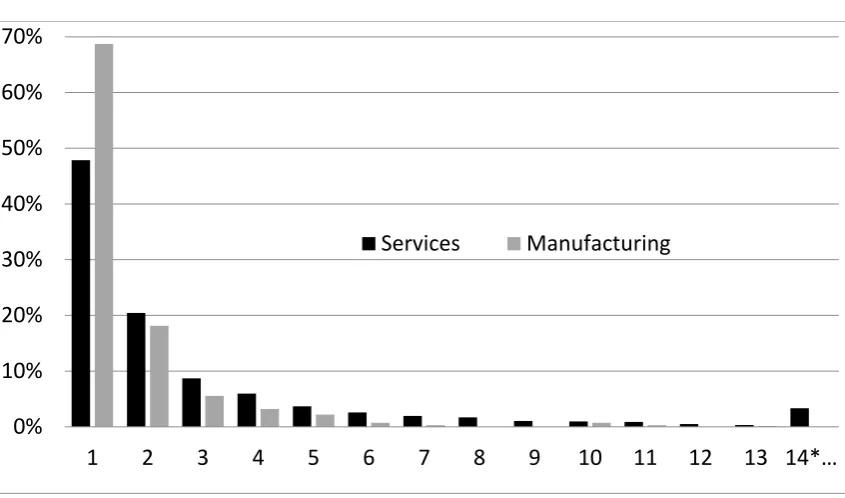
Figure 1 shows the distribution of the number of subsidiaries that correspond to the baseline sample. Almost 50% of multinational firms that operate in the service sector and almost 70% in the manufacturing sector have one subsidiary firm. About 20% of parent firms have two subsidiaries.
To test hypothesis H2, we combine the information from the SABI and ORBIS databases. In particular, subsidiaries’ sales are obtained from ORBIS. Sample 2 in Table 2 summarises the characteristics of this combined sample used in the analysis. To take into account the fact that some parent firms have more than one subsidiary and following Yeaple (2009), we define two samples. The first one, called a non-aggregated sample, considers each subsidiary located in the same country as the same parent firm a different observation. The second one, an aggregated sample, combines the sales of subsidiaries operating in the same country as the same parent and generates a single observation. Unfortunately, a large number of subsidiary firms listed in SABI are not available in ORBIS, which reduces the sample considerably.
To deal with this problem, we also test hypothesis H2 using operation revenue turnover as a proxy for the sales of subsidiaries. In this case, it is not necessary to combine the SABI and ORBIS databases, because SABI gives information about this variable. Sample 3 in Table 2 provides information about this complementary sample. The total number of subsidiary firms for both manufacturing and services in 2013 is 11,840.
14 this as evidence that our sample of parent/subsidiaries is close to the population of reference.
Concerning the variables used in the analysis, a first set of results refers to the scope and scale of multinational firms (hypotheses H1 and H2). The basic sources of this analysis are SABI and ORBIS, and the set of variables includes employment, sales or operating revenue turnover, and added value and tangible assets to estimate the TFP (see Table 3 for definitions).
To test hypotheses H3 and H4, we estimate gravity equations that include host country GDP, (GDP per capita), distance, and common language, among other country characteristics, as explanatory variables (see Table 3 for definitions). The basic source is the World Bank database.
4. Results
This section presents three sets of results. The first refers to the estimation of the scope elasticity of multinational activity. Scope elasticity is a measure that summarises the expected positive relationship between the probability of observing a subsidiary in a given foreign market and the productivity of its parent firm. The second refers to scale elasticity, which measures the intensity of the positive relationship between the affiliate’s local sales in foreign markets and the level of productivity of its parent firm. In sections 4.1 and 4.2, we offer various measures of the intensity of both relationships. The third set of results, presented in section 4.3, concerns the relationship between country characteristics and the structure of multinational activity. This analysis would be based on the estimation of gravity equations.
4.1. Scope of Spanish multinationals and their productivity
First, we provide estimations of parent multinational firms’ propensity to invest abroad as a function of their productivity. The specification is:
1 2
fj fj fj j j s s fj
j s
15 where SUBfj is a variable equal to one if a Spanish parent firm f is the immediate owner of one or more subsidiaries in country j and zero otherwise. lnTFPfjis the natural logarithm of TFP of parent firm f. DSUOfj is a dummy variable equal to one if the ultimate owner of the subsidiary is a Spanish parent firm (all ultimate owners are also immediate owners; therefore, this group of firms is a subsample of SUBfj) and zero when the ultimate owner is from the rest of the world. Countryj is a set of host country fixed effects and Industrys is a set of industry effects captured by industry dummies defined at the four-digit level of the NACE (rev 2) classification.
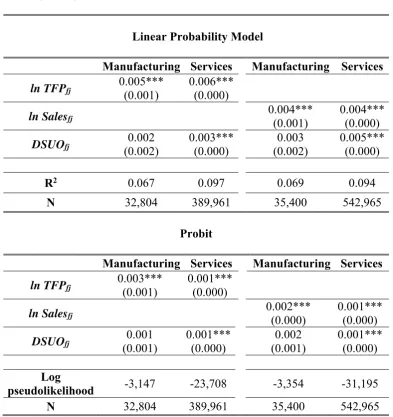
We start estimating the linear probability model (LPM) for ease of comparison to previous literature that has used the same estimation approach (see, for example, Yeaple, 2009). The upper part of Table 4 presents the results of the estimation of equation (1) by OLS. As expected, for the manufacturing sector, the coefficient associated with the level of parent firms’ TFP is positive and significant, indicating that more productive firms are more likely to own a manufacturing affiliate in a given foreign market. The magnitude of the coefficient, 0.005, indicates that a 1% increase in the level of TFP increases the probability of opening a subsidiary by 0.00005. To put this magnitude in context, given that a Spanish manufacturing parent firm’s average probability of owning a subsidiary in a given market is 2.47% (see Figure 2), an increase of 10% in the level of TFP increases the probability by 2% (0.0005/0.0247). The coefficient is slightly lower than the coefficient provided by Yeaple (2009) for US manufacturing multinationals, 0.01. However, in a recent analysis of manufacturing multinational firms from 30 European countries, the impact of an increase of TFP on the probability of opening a subsidiary in a given market is similar to the impact reported here for Spanish manufacturing multinationals (see Fariñas, Martín-Marcos and Velazquez, 2018).
The coefficient obtained for multinational firms that operate in the service sector, 0.006, is higher than the coefficient obtained for manufacturing. Given that the average probability that a Spanish parent firm operating in the service sector owns a subsidiary in a given market is 1.47%, an increase of 10% in the level of TFP increases the probability by 4% (0.0006/0.0147).
16 relationship between firm size (sales) and the probability of investing abroad. Table 4 reports the coefficients, similar for both manufacturing and services, and equal to 0.004. Evaluated at the mean probability, this coefficient implies that doubling the size of the firm increases the probability by 16% and 27% for firms operating in manufacturing and service sectors, respectively.
The variable DSUOfj, a dummy that indicates that the ultimate owner of the subsidiary
is a Spanish parent firm, is also included in the estimation. For firms that operate in the services industry, the coefficient is positive and significant. These results indicate that the probability of opening a subsidiary in the service sector is between 0.003 and 0.005 percentage points bigger if the ultimate owner is Spanish.However, the nationality of the ultimate owner does not affect the probability for firms that operate in the manufacturing sector.
The lower panel of Table 4 reports probit estimations of equation [1]. Results are quite similar to those obtained from the linear probability model. Productivity positively affects the probability of a parent firm’s investing abroad. In general terms, the magnitude of the elasticity is slightly lower with the probit estimation. In the case of manufacturing, an increase of 10% of TFP increases the probability by 0.0003 points,
which means a 1.2% increase in the average probability (0.0003/0.0247). In the case of services, the increase in the average probability is 0.68% for a 10% change in TFP (0.0001/0147). Finally, the impact of size on the probability is again lower with the probit estimation relative to the LPM, and the coefficients for either manufacturing or services are quite similar.
Figure 2 reproduces histograms of the number of subsidiaries a parent firm has in a given market for both the manufacturing and the service sectors. The variable is concentrated in a small range of values, mainly 0, 1 and 2, since most of the companies have a small number of foreign subsidiaries. In the case of manufacturing, 97.5% are zeros (no single subsidiary of the parent firm in country j), 2.3% correspond to firms with a subsidiary and 0.3% correspond to two subsidiaries. The rest of the observations correspond to a few additional integers. These numbers are quite similar for the service sector.
17 complementing the previous analysis is to use count data models like Poisson. Therefore, using a similar specification to equation [1]:
1 2
fj fj fj j j s s fj
j s
NSUB exp ln TFP ln DSUO Country Industry [2]
where NSUBfj is the number of subsidiaries a parent firm f has in country j , and the rest of the variables are as in equation [1].
We consider two issues associated with the estimation of equation [2] (see Fariñas, Martín-Marcos and Velazquez (2018) for a similar application to European multinational firms). The first one refers to the assumption the Poisson regression makes: the mean and the variance are the same. In many circumstances with count data, the variance exceeds the mean, a feature called over-dispersion. The consequence of over-dispersion is the underestimation of standard errors (Cameron and Trevidi, 2005). A strategy for addressing this problem is to modify the Poisson model, estimating a Negative Binomial regression. The second issue is termed the excess zeros problem,
when there are more zeros in the data than the Poisson predicts. In this case, a modified model is called the inflated model in the Poisson version (ZIP) and the zero-inflated Negative Binomial (ZINB). These latter models complement a count density with a binary process. If the binary process takes the value 0, then our count variable is
N = 0, and if the binary process takes the value 1, then variable N = 1, 2… (Cameron
and Trevidi, 2005). Both models, ZIP and ZIBN, are estimated in two stages. In the first one, a binary logit model with the decision to open a subsidiary abroad or not is estimated. In the second stage, the discrete variable is examined, taking into account only the zeros that are the consequence of a do/not-to-do decision. This stage is modeled by a Poisson in the ZIP model and a Negative Binomial in the ZINB model. To interpret the coefficients of both the ZIP and the ZIBN, it is necessary to calculate the incidence ratios when the explanatory variable is dichotomous, as well as in the case of . Coefficients are interpreted directly as elasticities when the variable is continuous in logarithms, as is the case for TFP and sales.
18 against the Negative Binomial model and the second test compares the "zero-inflated" against the simple regression models (Poisson or Negative Binomial).
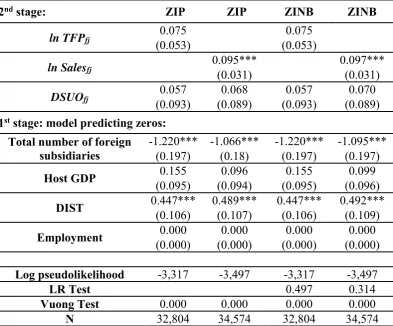
Table 5 reports various estimations for the manufacturing sector. Statistical tests comparing zero-inflated versions against the normal ones point to the zero-inflated versions as the preferred ones (see Vuong tests). For this reason, Table 5 only reports results for ZIP and ZINB estimators. Concerning the hypothesis of no over-dispersion, LR tests do not reject the null hypothesis and the ZIP is preferred in both equations (TFP and sales).
Concerning the first stage, the variables used to predict the zeros of the second stage are the number of foreign subsidiaries owned by the parent company, the GDP of the host country, the distance to the host country and the number of employees of the parent company. We expect the number of foreign subsidiaries, the GDP of the host country and the level of employment of the parent firms to have a negative effect on the probability of not observing a subsidiary in a given foreign market. With respect to the distance to the host country, we expect that it positively affects the probability of observing a zero.
The results of the first stage for firms that operate in the manufacturing sector are reported in the lower panel of Table 5. As can be seen, the total number of foreign subsidiaries and the distance to the host country are significant determinants of the decision to open a manufacturing subsidiary in a given foreign country. The negative coefficient of the number of subsidiaries indicates that the probability that the company does not consider opening a company in any given country decreases as the total number of subsidiaries increases. On the contrary, the greater the distance to the country, the greater the probability that the parent firm does not consider opening a subsidiary in that country. Both coefficients have the expected sign. The GDP of the host country and the number of employees have no significant effect.
19 increase in the size of the parent firm increases the number of subsidiaries abroad by almost 1%.
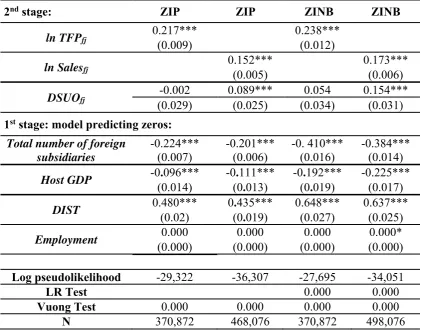
Table 6 present the results for multinationals of the service sector. As in the case of manufacturing, statistical tests comparing zero-inflated versions against the normal ones point to the zero-inflated versions as the preferred ones (see Vuong tests). Concerning the hypothesis of no over-dispersion, the LR test rejects the null hypothesis and the ZINB is preferred in both equations (TFP and sales). Therefore, columns 3 and 4 of Table 6 are the relevant ones.
As expected, the estimations of the first stage (lower panel of Table 6) suggest that the number of subsidiaries of the parent firm and the GDP of the host country have a negative and significant impact on the probability of observing zero subsidiaries abroad. The variable distance has the expected positive sign. Employment has no significant effect. The result that the GDP of the host country is relevant in the decision to invest abroad in the case of services may be reflecting the fact that, in these activities, horizontal rather than vertical FDI motives are more relevant. The main objective of opening a subsidiary abroad is, in the case of services, related to the size and the sales in that market rather that the reduction of production costs.
Concerning the second stage, both TFP and sales of the parent firm have a positive and significant effect on the number of subsidiaries abroad. Specifically, the estimated elasticity implies that an increase of 10% in TFP increases the probability of entering an additional subsidiary in a given market by 2.4%. In the case of sales, the equivalent elasticity is 1.7%.
20
4.2 Scale of Spanish multinationals and their productivity
A second set of results that this section presents concerns the scale of multinational activity.In models of multinational activity and heterogeneity (see Yeaple, 2009), it is assumed that the most productive companies not only have subsidiaries in more countries, but that these subsidiaries are more productive and, for this reason, they have a higher scale than the less productive ones. Our objective in this second part of the section is to examine the relationship between the scale of operations of multinationals, measured by the volume of sales of their subsidiaries in a given host country and the productivity of their parent firms (hypothesis H2). As in the case of the scope elasticity, we consider both TFP and sales as measures of productivity of parent multinationals.
The specification used is:
1
fj fj j j s s fj
j s
ln S ln TFP Country Industry [3]
where ln Sfj is the log of subsidiary sales a parent firm f has in country j, and the rest of the variables are as in previous equations.
As we have explained in Section 3, we combine the SABI and ORBIS databases because we need the information about subsidiary firms provided by ORBIS. In addittion, two samples are considered. The first one, a non-aggregated sample, considers each subsidiary located in the same country as the same parent firm to be a different observation. The second sample, an aggregated sample, adds the sales of subsidiaries from the same parent firm operating in the same country into a single observation.
21 is lower than for the manufacturing sector. For services, the elasticity is 0.3 and 0.2 when the productivity of the parent firm is proxied by its TFP or sales, respectively. Estimated coefficients are similar when taking the aggregated sample as a reference.
Our results are quite similar to those obtained by Yeaple (2009) for US manufacturing companies: he obtains an expected increase of 0.8% (0.5%) in sales of subsidiaries when TFP (sales) of the parent company increases by 1%.
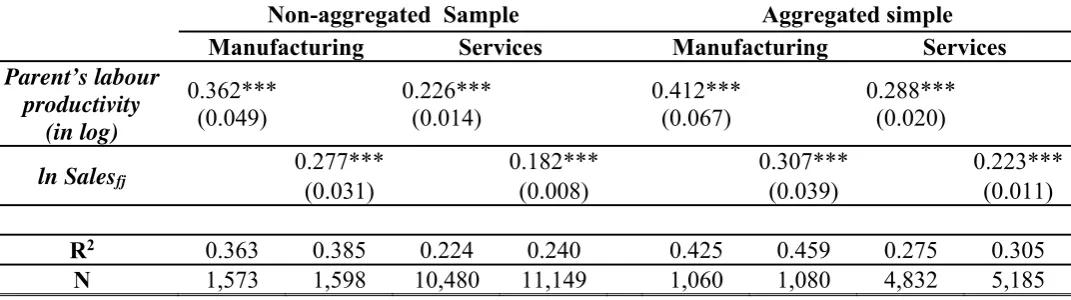
As we explained in section 3, the use of the ORBIS database limits the sample considerably. For this reason, and with the aim of expanding the sample as much as possible, we repeated the exercise of estimating scale elasticities using operating revuenues turnover of the subsidiaries instead of sales, and labour productivity of the parent firm instead of TFP as our basic variables of analysis. The number of observations in the new sample is from 9 to 13 times the original one, as can be observed by comparing the number of observations in Tables 7 and 8.
Table 8 presents the main results. We include both estimates from the aggregated and the non-aggregated samples. They are very similar in their results. The coefficients are statistically significant and confirm a positive relationship between the size of subsidiaries and their parent’s productivity. The magnitude of scale elasticities is slightly lower compared with elasticities measured in terms of TFP, although the size of the samples in both cases is very different and the results are not comparable.
Overall, the results presented in this section suggest that the size (scale) of Spanish multinational firms’ affiliate firms is positively influenced by the size and the productivity of their parent firms. These results are similar to those previously reported in the literature.
4.3 Country characteristics and the asymmetric hypothesis of multinational activity
22 heterogeneity, in particular Yeaple’s (2009), predict that the more attractive the characteristics of the host country are from the perspective of the investment decision, the greater the scale of operations of subsidiaries entering the host country is and, simultaneously, the lower the average productivity of the parent firms that invest in the host country. Therefore, a country characteristic that positively affects the level of multinational activity should be negatively associated with the average productivity of parent firms that enter that country (hypotheses H3 and H4). This asymmetry in the sign of both effects also holds for those characteristics that negatively affect the level of multinational activity.
To test the previous predictions, we estimate gravity equations. We use the following specification:
ln Xj
0 1lnGDPj
2lnGDPpcj
3ln DISTj
4COMLANGj
j [4]where Xj measures both the intensity of Spanish multinational activity in host country j
and the average level of productivity of Spanish parent firms investing in host country j.
With respect to the intensity of multinational activity, we use two alternative measures: 1) variable Sj, which measures the aggregate sales of subsidiaries in country j owned by Spanish parent firms; and 2) the variable Nj, which is the aggregate number of firms that enter country j. With respect to the level of productivity of parent firms, we also use two different measures: 1) the average level of TFP of parent firms that enter country j
and 2) a threshold which is the productivity of the least productive firm that enters country j.
23 should be positively associated with horizontal FDI motivations (market size of the host country) and negatively associated with vertical FDI motivations, as the level of per capita GDP is positively associated with the level of relative factor costs in the host country. The net effect remains ambiguous. Distance is included to control for fixed costs of investment associated with FDI. Subsidiaries located in distant markets are likely to require larger monitoring costs and therefore higher fixed costs of investment. These costs negatively affect the intensity of MNCs’ investment decisions. On the other hand, longer distance implies higher transport costs, and this gives more room to FDI relative to exporting. The net effect of distance is ambiguous from a theoretical point of view, although from an empirical point of view, the evidence is strongly in favour of a negative association. The last variable we consider, the existence of a common language, can be associated with lower fixed costs of investment, and we expect it to be positively associated with multinational activity.
The testing strategy is based on comparing the signs associated in gravity equations with country characteristics. The model predicts a direct relationship between scale measures of multinational activity and the variables that make a country more attractive (higher GDP, less bilateral distance and sharing a common language). At the same time, it predicts an inverse relationship between these variables and the productivity measures of parent firms that invest abroad. The "hierarchical order" hypothesis predicted by Yeaple (2009) implies that countries with more attractive characteristics attract successively less productive companies. In aggregate terms, this greater attraction will increase the number of companies that enter a given foreign market and, therefore, the average productivity of the incoming companies will decrease. Consequently, we expect that, in gravity equations, certain country characteristics will be associated with opposite signs for the scale of multinational operations and for the average productivity of parent companies that enter abroad.
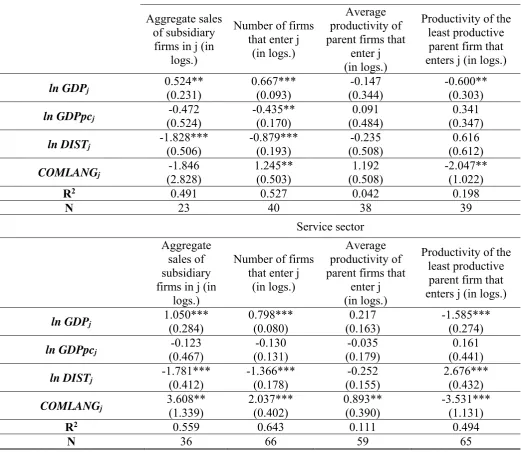
24 The scale of multinational activity for manufacturing activities, as expected, is positively associated with the level of host country GDP, negatively associated with the bilateral distance between Spain and the host country, and is higher with countries that share a common language (in this case only when the scale of multinational activity is measured by the number of firms that enter country j). Per capita GDP is negatively associated with the number of firms in destination countries (not significant if the scale of operations is measured by the sales of subsidiaries in destination countries). None of these variables in the set of country characteristics have a significant relationship with the average level of productivity of parent firms that enter host countries. However, when we proxy the productivity distribution of firms that enter foreign markets by the level of the least productive firm, we are able to identify some significant relationships. In particular, Table 9 indicates that host country GDP and common language have a negative relationship with productivity. This pattern is in the opposite direction with respect to the sign between both country characteristics and the scale of multinational activity. Therefore, we confirm the asymmetry predicted by models of firm heterogeneity. Per capita GDP and bilateral distance also have opposite signs but they are not statistically significant in the productivity equation.
Our results are similar to those found by Yeaple (2009). However, we also find some differences. For example, the estimated scale elasticity for Spanish multinationals is smaller when this scale is measured by the sales of subsidiaries. This elasticity is larger for Spanish multinationals when the scale is proxied by the number of firms that enter country j. The impact of the common language (Spanish) on the level of the least productive firm is almost double the impact of sharing English in the Yeaple sample.
25 Concerning the magnitude of coefficients, for firms operating in the service sector, an increase of 1% of the host country’s GDP implies that expected sales of the subsidiary increase by 1.1% and that the number of Spanish parent companies that invest abroad will increase by 0.8%. The estimated elasticities are smaller in the manufacturing sector. Bilateral distance has a negative effect on both variables: an increase of 1% in the distance implies a decrease of 1.8% (1.4%) in the sales (number) of subsidiaries in the service sector. Sharing a common language has a much greater impact on the service sector than on manufacturing. It influences not only the number of firms as in the manufacturing sector but also the sales of subsidiaries: the sales are on average 3.6% higher than subsidiaries’ in the rest of the world, and the number of firms that enter a country j is 2% higher. Regarding productivity, the results obtained are statistically significant when the productivity distribution of entering firms is the minimum level of productivity. In this case, an increase of 1% of a host country's GDP reduces the threshold by 1.6%, an increase of 1% in bilateral distance increases the threshold by 2.7% and, finally, the fact that the host country is Spanish-speaking reduces the threshold by 3.5%.
Overall, the pattern of signs we obtain with various country characteristics is consistent with the prediction of asymmetric effects between the scale and the distribution of productivity of parent firms that go abroad. We have to add two qualifications to this result. First, this consistency with predictions of models of FDI and heterogeneity is greater in the service sector than in the manufacturing sector. Second, the distribution of productivity of entering firms needs to be defined in terms of the threshold for the least productive firm to confirm the hypothesis of Yeaple’s (2009) model.
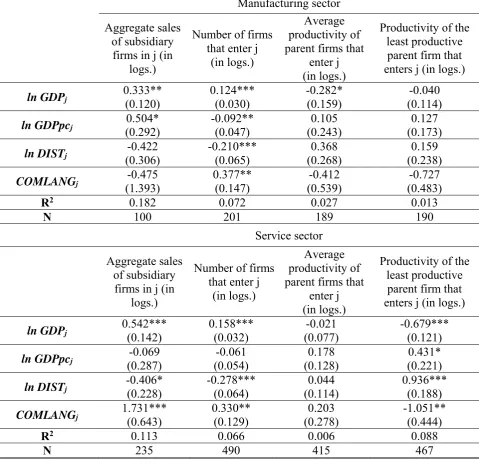
For the purposes of robustness, we offer additional results to control for heterogeneity at the sectoral level. We estimate equation [4], taking the country-sector unit of observation as a reference. Sectors are defined at the two-digit level. Consequently, the new variables used in the estimation have dimension js, where j is the country of
destination and s is the sector defined at the two-digit level. Apart from expanding the
overall number of observations substantially, in this way we also control for differences across industries.
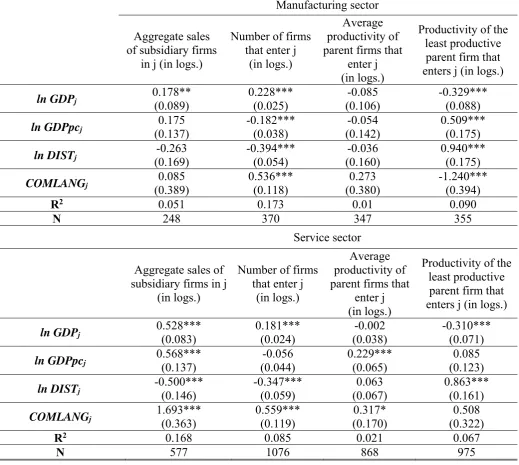
26 we disaggregate the sample of observations by country-sector. The pattern of signs we obtain confirms that country characteristics that positively (negatively) affect the volume of multinational activity induce the entry of successively less (more) productive firms.
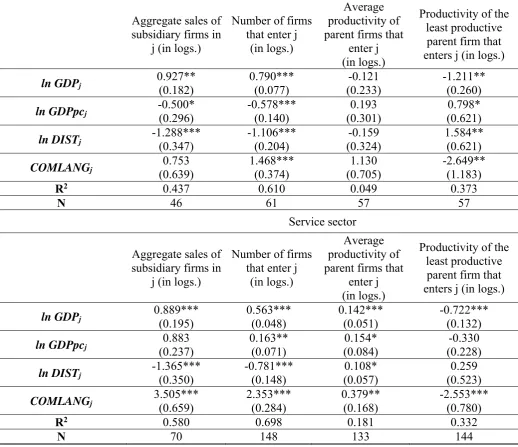
Finally, for the purposes of robustness, we have estimated the gravity equations reported in Tables 9 and 10 taking the SABI database exclusively as areference. As in section 4.2, we take the operating revenue turnover of the subsidiaries as the measure of sales and labor productivity of the parent firm as the measure of productivity as a reference. These estimations complement results reported in Tables 9 and 10 and are included in the Appendix as Tables A1 and A2.
We confirm previous results for the services sector. The pattern of signs is again consistent with the prediction of asymmetric effects for the relationship between country characteristics and the scale of subsidiaries, on one hand, and the relationship between country characteristics and the distribution of productivity of parent firms that go abroad, on the other hand. Additionally, with this sample, the predictions also apply to the manufacturing sector.
5. Conclusions
This paper examines the relationship between a firm’s heterogeneity and its multinational activity. The empirical analysis refers to Spanish multinational firms and it is based on two datasets: SABI and ORBIS. The sample links information from parent-subsidiary pairs of firms. The number of links in the sample is close to the number of firms provided by the OECD in its statistics on outward and inward activity of MNEs. Therefore, inferences in this paper are based on a sample that is representative of the population of Spanish multinational firms.
27 the scope elasticity is similar if we estimate it by the probit and the linear probability models. Elasticity estimates obtained using count models are not statistically significant for the manufacturing sector.
As we can identify the link between the parent and the affiliate firm in terms of who the ultimate owner is, we restrict the sample to subsidiaries that have a Spanish parent firm as the ultimate owner. A variable that captures this characteristic has a positive impact on the probability of operating in a given foreign market through a subsidiary with the same activity as the parent firm. This applies to Spanish multinationals in the service sector but not in the manufacturing sector.
Section 4.2 reports estimates of the scale elasticity of Spanish multinationals. For the manufacturing sector, the estimated elasticity implies that an increase in TFP of the parent firm increases the size of the subsidiary, in terms of sales, by 0.8%. For the service sector, the elasticity is slightly lower, 0.3%. There is no previous evidence of this kind for the service sector. For the manufacturing sector, the scale elasticity for Spanish MNEs is identical to the estimate for US multinationals, 0.8%, reported by Yeaple (2009).
28
[image:29.595.40.559.189.636.2]Appendix
Table A1
Country characteristics, degree of multinational activity and productivity of parent multinational firms. Complementary sample (SABI).
Notes: Robust standard errors to heterocedasticity in parentheses. Coefficients significant at 1%***,
5%**, 10%*. All regressions include host countries and 4-digit industrydummies.
Manufacturing sector
Aggregate sales of subsidiary firms in
j (in logs.)
Number of firms that enter j
(in logs.)
Average productivity of parent firms that
enter j (in logs.)
Productivity of the least productive parent firm that enters j (in logs.)
ln GDPj 0.927** (0.182) 0.790*** (0.077) (0.233) -0.121 -1.211** (0.260)
ln GDPpcj -0.500* (0.296) -0.578*** (0.140) (0.301) 0.193 (0.621) 0.798*
ln DISTj -1.288*** (0.347) -1.106*** (0.204) (0.324) -0.159 1.584** (0.621)
COMLANGj (0.639) 0.753 1.468*** (0.374) (0.705) 1.130 -2.649** (1.183)
R2 0.437 0.610 0.049 0.373
N 46 61 57 57
Service sector
Aggregate sales of subsidiary firms in
j (in logs.)
Number of firms that enter j
(in logs.)
Average productivity of parent firms that
enter j (in logs.)
Productivity of the least productive parent firm that enters j (in logs.)
ln GDPj 0.889*** (0.195) 0.563*** (0.048) 0.142*** (0.051) -0.722*** (0.132)
ln GDPpcj (0.237) 0.883 0.163** (0.071) (0.084) 0.154* (0.228) -0.330
ln DISTj -1.365*** (0.350) -0.781*** (0.148) (0.057) 0.108* (0.523) 0.259
COMLANGj 3.505*** (0.659) 2.353*** (0.284) 0.379** (0.168) -2.553*** (0.780)
R2 0.580 0.698 0.181 0.332
29 Table A2
Country characteristics, degree of multinational activity and productivity of parent multinational firms (unit of observation is country-sector).
Complementary sample (SABI).
Notes: Robust standard errors to heterocedasticity in parentheses. Coefficients significant at 1%***, 5%**, 10%*. All regressions include host countries and 4-digit industry dummies.
Manufacturing sector
Aggregate sales of subsidiary firms
in j (in logs.)
Number of firms that enter j
(in logs.)
Average productivity of parent firms that
enter j (in logs.)
Productivity of the least productive parent firm that enters j (in logs.)
ln GDPj 0.178** (0.089) 0.228*** (0.025) (0.106) -0.085 -0.329*** (0.088)
ln GDPpcj (0.137) 0.175 -0.182*** (0.038) (0.142) -0.054 0.509*** (0.175)
ln DISTj (0.169) -0.263 -0.394*** (0.054) (0.160) -0.036 0.940*** (0.175)
COMLANGj (0.389) 0.085 0.536*** (0.118) (0.380) 0.273 -1.240*** (0.394)
R2 0.051 0.173 0.01 0.090
N 248 370 347 355
Service sector
Aggregate sales of subsidiary firms in j
(in logs.)
Number of firms that enter j
(in logs.)
Average productivity of parent firms that
enter j (in logs.)
Productivity of the least productive
parent firm that enters j (in logs.)
ln GDPj 0.528*** (0.083) 0.181*** (0.024) (0.038) -0.002 -0.310*** (0.071)
ln GDPpcj 0.568*** (0.137) (0.044) -0.056 0.229*** (0.065) (0.123) 0.085
ln DISTj -0.500*** (0.146) -0.347*** (0.059) (0.067) 0.063 0.863*** (0.161)
COMLANGj 1.693*** (0.363) 0.559*** (0.119) (0.170) 0.317* (0.322) 0.508
R2 0.168 0.085 0.021 0.067
30
References
Almodovar, P., J. E. Navas López and P. Huerta Riveros (2009): “La tipología estratégica como factor determinante de la empresa conjunta internacional”,
Investigaciones Económicas 33(3), 407-438.
Alvarez I. and J. Molero (2005): “Technology and the generation of international knowledge spillovers: An application to Spanish manufacturing firms”,
Research Policy 34, 1440-1452.
Aw, B. and Y. Lee (2008): “Firm heterogeneity and location choice of Taiwanese multinationals”, Journal of International Economics 76, 403-415.
Bajo-Rubio, O. and S. Sosvilla-Rivero (1994): “An econometric analysis of Foreign Direct Investment in Spain, 1964-89”, Southern Economic Journal 61, 104-120.
Bajo-Rubio, O., C. Diaz-Mora and C. Diaz-Roldan (2010): “Foreign Direct Investment and Regional Growth: An Analysis of the Spanish case”, Regional Studies 44,
373-382.
Brainard, S. L. (1993): “A simple theory of multinational corporations and trade with a trade-off between proximity and concentration”, National Bureau of Economic Research, Working Paper No. 4269.
Brainard, S. L. (1997): “An Empirical Assessment of the Proximity-Concentration Trade-off between Multinational Sales and Trade”, American Economic Review
87 (4), 520-544.
Buckley, P. J. and M. Casson (1976): The Future of the Multinational Enterprise.
Macmillan, London.
Cameron, A.C. and P. Trivedi (2005): Microeconometrics: Methods & Applications,
Cambridge University Press.
Chen M. and M. Moore (2010): “Location decision on heterogeneous multinational firms”, Journal of International Economics 80(2), 188-199.
Dabic, M., M. Gonzalez-Loureiro and O. Furrer (2014): “Research on the Strategy of multinational enterprises: Key approaches and new venus”, Business Research Quarterly 17, 129-148.
Damijan, J., C. Kostevc and M. Rojec (2016): “Not Every Kind of Outward FDI Increases Parent Firm Productivity: the Case of New EU Members”, Emerging Markets Finance and Trade 53, I, 397-422.
31 Dunning, J. H. (1979): “Explaining changing patterns of International Production: In
defence of the Eckectic Theory”, Oxford Bulletin of Economics and Statistics 41,
269-295.
Faeth, I. (2008): “Determinants of Foreign Direct Investment - A Tale of Nine Theoretical Models”, Journal of Economic Surveys 23 (1), 165-196.
Fariñas, J. C. and A. Martín-Marcos (2007): “Exporting and Economic Performance: Firm‐level Evidence of Spanish Manufacturing”, World Economy 30(4),
618-626.
Fariñas, J.C., A. Martín-Marcos and F. J. Velázquez (2018): “Multinational Activity of
European Firms and Heterogeneity”, The World Economy, forthcoming.
DOI:10.1111/twec.12613
Forsgren, M. (2013): Theories of the Multinational Firms: SA Multidimensional
Creature in the Global Economy, Edward Elgar Publishing: Cheltenham, UK.
García-Canal, E. and M. Guillen (2010): The New Multinationals: Spanish Firms in a Global Market. Cambridge University Press. Cambridge and New York.
Geishecker, I., H. Görg and D. Taglione (2009): “Characterising Euro Area Multinationals”, The World Economy 32(1), 49-76.
Gordo, E, C. Martín and P. Tello (2008a): “La internacionalización de las empresas españolas a través de la Inversión Extranjera Directa”, Boletín Económico,
Enero 2008, Banco de España, 92-103.
Gordo, E. and P. Tello (2008b): “Determinantes microeconómicos de la Decisión de Localización en la Inversión Directa en el Exterior de las Empresas Españolas”,
Boletín Económico, Septiembre 2008, Banco de España, 62-74.
Görg. H. (2016): Multinational Enterprises and the Host Country Development. World
Scientific, New Jersey and London.
Guillen, M. (2005): The Rise of Spanish Multinationals: European Business in the Global Economy, Cambridge University Press. Cambridge and New York.
Head, K. and T. Mayer (2014): “Gravity Equations: Workhorse, Toolkit, and Cookbook”, in Gopinah, Helpman and Rogoff, Handbook of International Economics. Volume 4.
Helpman, E. (1984) “A Simple Theory of International Trade with Multinational Corporations”, Journal of Political Economy 92, 451-471.
Helpman, E. (2011): Understanding Global Trade, Harvard University Press, Boston.
Helpman and Krugman (1985): Market Structure and Foreign Trade, MIT Press,
32 Helpman, E., J. Melitz and S. R. Yeaple (2004): “Export versus FDI with
Heterogeneous Firms”, The American Economic Review 94 (1), 300-316.
Kano, L. and A. Verbeke (2017): “Theories of the Multinational Firm: A Microfoundational Perspective”, mimeo.
Kleinard and Toubal (2010): “Gravity for FDI”, Review of International Economics
18(1), 1-13.
Levinsohn, J., and Petrin, A. (2003): “Estimating Production Functions Using Inputs to Control for Unobservables”. The Review of Economic Studies, 70 (2), 317-341.
Lopez-Duarte, C. and E. García-Canal (2002): “The Effect of Firm and Host Country Characteristics on the Choice of Entry Mode: Empirical Evidence from Spanish Firms”, Journal of Management and Governance 6, 153-168.
Markusen, J. R. (1984): “Multinationals, Multi-Plant Economies and the Gains from Trade”, Journal of International Economics 16, 205-216.
Markusen, J. R. (2002): Multinational Firms and the Theory of International Trade,
MIT Press, Cmbridge, MA.
Melitz, M. J. (2003): “The Impact of Trade on Intra-Industry Reallocations and Aggregate Industry Productivity”, Econometrica 71 (6), 1695-1725.
Merino, F. (2004): “Firms’ productivity and internationalization: a statistical dominance test”, Applied Economic Letters 11, 851-854. ***
Myro, R. (dir) (2014): España en la Inversión Directa Internacional, Instituto de
Estudios Económicos, Madrid, España.
Myro, R. and J. A. Martínez Serrano (1992): “La penetración del capital extranjero en la industria española”, Moneda y Crédito 194, 149-198.
Nishiyama, H. and M. Tamaguchi (2013): “Technological Constraints, Firm Heterogeneity and Location Choice of Multinational firms”, Review of International Economics 21 (5), 996-1005.
Rodríguez, X. A. and J. Pallás (2008): “Determinants of Foreign Direct Investment in Spain”, Applied Economics 40, 2443-2450.
Sanchez-Sellero, P., J. Rosell-Martínez and J. M. García-Vázquez (2014): “Absorptive Capacity from Foreign Direct Investment in Spanish Manufacturing Firms”,
International Business Review 23, 429-439.
Shao, Y. and Y. Shang (2016): “Decisions of Outward FDI Engagement and Location for Heterogeneous Multinational Firms: Evidence from Chinese Firms”,
33 Tanaka, A. (2012): “Firm Productivity and the Number of FDI Destinations: Evidence
from a Non-parametric Test”, Economics Letters 117, 1-3.
Tanaka, K. (2015): “Firm Heterogeneity and FDI in Distribution Services”, The World Economy 38 (8), 1295-1311.
Tomiura, E. (2007): “Foreign outsourcing, exporting, and FDI: A productivity comparison at the firm level”. Journal of International Economics , 72, 113-127.
Villaverde, J. and A. Maza (2012): “Foreign Direct Investment in Spain: Regional Distribution and Determinants”, International Business Review 21, 722-733.
Yeaple, S. R. (2003). “The Role of Skill Endowments in the Structure of U.S. Outward Foreign Direct Investment”. Review of Economics and Statistics , 85 (2),
726-734.
34 Table 1
Sample: number of parent firms
Sample: Activity: immediate owners of Parent firms that are subsidiaries abroad
Parent firms that are ultimate owners of subsidiaries abroad
Number of host countries*
(1a) Manufacturing Services 3503 600 2605 385 155 59
(1b) Manufacturing Services 2727 556 2031 412 143 59
Notes:
* corresponds to the sample of immediate owners (1a) initial sample
(1b) sample requiring that the variable TFP be available.
Table 2
Sample: number of parents and subsidiary firms
Sample: Activity: Subsidiary firms
Parents - Subsidiary firms
Non-aggregated sample
Aggregated sample
(2) Manufacturing Services 177 871 178 983 171 824
(3) Manufacturing Services 10,287 1,553 11,149 1,598 1,080 5,185
Notes:
(2) Combined sample (SABI / ORBIS) (3) Complementary sample (SABI)
[image:35.595.111.493.350.465.2]35 Table 3: Variables definitions
COMLANGj Dummy variable which takes the value 1 if the host country j
shares a common language with Spain.
DISTj Bilateral distance between Spain and the host country j. It is
calculated following the great circle formula, which uses the latitudes and longitudes of the most important cities/agglomerations.
Employment Total number of employees of the parent and subsidiary firms.
GDPj Gross Domestic Product of the country j where the subsidiary
firm is located.
GDPpcj Gross Domestic Product per capita of the host country j where
the subsidiary firm is located.
Labour productivity Operating revenue turnover per employee.
Sales Two approaches are used: sales and operating revenues
turnover.
TFPi (Total Factor
Productivity)
, where, for firm i, denotes added value, is the book value of tangible assets and is employment. The coefficients and are obtained from the estimation of the production function separately for each industry at the two-digit level, using the methodology developed by Levinsohn and Petrin (2003).
36 Table 4
Scope of Spanish multinationals: Probability of entry in a foreign market
Linear Probability Model
Manufacturing Services Manufacturing Services
ln TFPfj 0.005*** (0.001) 0.006***(0.000)
ln Salesfj 0.004*** (0.001) 0.004*** (0.000)
DSUOfj (0.002) 0.002 0.003***(0.000) (0.002) 0.003 0.005*** (0.000)
R2 0.067 0.097 0.069 0.094
N 32,804 389,961 35,400 542,965
Probit
Manufacturing Services Manufacturing Services
ln TFPfj 0.003*** (0.001) 0.001*** (0.000)
ln Salesfj 0.002*** (0.000) 0.001*** (0.000)
DSUOfj (0.001) 0.001 0.001***(0.000) (0.001) 0.002 0.001*** (0.000)
Log
pseudolikelihood -3,147 -23,708 -3,354 -31,195
N 32,804 389,961 35,400 542,965