TRIZ: The Enlightenment of the Training Mode of
Excellent Chinese Engineers
Yiyang Fan, Yuting Qiu, Xing Zhang
Business School, University of Shanghai for Science and Technology, Shanghai, China Email: [email protected], [email protected], [email protected]
Received October 10, 2012; revised November 11, 2012; accepted November 22,2012
ABSTRACT
China has been the largest country in terms of the scale of higher engineering education in the world. The training plan of excellent engineers (TPEE) that launched in 2010 is to train various types of high-quality engineers and technical personnel who have strong innovative abilities and meet the need of economic and social development. The theory of inventive problem solving (TRIZ), as a scientific methodology to solve innovation problems, provides a theoretical ba- sis and practical guideline for the training of excellent engineers. This paper analyzes the teaching philosophy and methods for the training of excellent engineers within TRIZ framework from the demand perspective, and then dis- cusses the enlightenment of disseminating TRIZ in the following aspects, such as TRIZ application in science, technol- ogy, engineering, and mathematics (STEM) education, faculty development, platform development of innovative edu- cation and so on.
Keywords: TRIZ; Excellent Engineer; Training Mode; Engineering Education
1. Introduction
In order to implement the national medium and long- term educational reform and development plan and talent development program, Ministry of Education of PRC launched the training plan of excellent engineers (TPEE). The main objective is to train a large number and various types of high-quality engineers and technical personnel who have strong innovative abilities and meet the need of economic and social development.
The number of full-time postgraduates and doctoral candidates in Chinese colleges and universities is nearly 1.54 million at present. And the number of full-time un- dergraduates in school is over 22.31 million [1], among which more than one-third of students major in engi- neering [2]. China has been the largest country in terms of the scale of higher engineering education in the world. Since the founding of New China, especially since the re- form and opening up, higher engineering education that has already trained tens of millions of engineering sci- ence and technology talents, strongly support the forma- tion and development of China’s industrial system, sup- ports 30 years of rapid economic growth since China’s reform and opening up, and makes important contribu- tions to China’s socialist modernization.
Nowadays science and technology is developing rap- idly, the cycle of industrial upgrading and transformation is increasingly shortened and the frequency is increas-
ingly accelerated. Redistribution of resources and Indus- trial regrouping which are caused by economic order changes under the economic globalization have proposed new requirements for the demand for engineering and technical personnel in the future. In this context, China needs diversified engineers [3] that the innovative and entrepreneurial engineers who target to creative and de- sign, the implementation engineers who target to manu-facture, and the service engineers who target to operation management. China’s TPEE is the major reform of high- er engineering education implemented in order to meet the above requirements.
2. The Training of Excellent Engineers
Requires Innovative Methods of TRIZ
2.1. The Origin of TRIZ
2.2. Application of TRIZ to Innovative Education
TRIZ methodology consists of a generic spectrum of so- lutions for innovation, procedures and tools for technical inventions such as eight patterns of evolution, 39 para- meters of the contradiction table (Matrix) and 40 princi- ples of invention. It is feasibly applied in technical indu- stries such as machinery, electronics, biology, chemistry and military engineering, and then extended to a broader application in non-technical areas such as management, marketing, education and psychology. TRIZ, as an inno- vative methods and philosophy, is the key to innovative education. Many countries have introduced TRIZ into the curriculum and encouraged teachers to innovate teaching methods, inspire students’ inventive thinking and deve- lop students’ creativity.
Czech and Britain mechanical engineering designers broke out of existing heat exchanger conceptual para- digms by using TRIZ’s Ideal Final Result (IFR) method, and optimized key functional relationships to produce a novel design solution. This TRIZ work was easy to oper- ate and teach. According to the case study, B. Busov [4] regarded TRIZ as a good mode in engineering education and innovative education in 21th century.
Within the University of Twente, the Netherlands, TR- IZ was presented as an 84 or 140 hours master course. Wessel W. Wits [5] found that students showed a lot of interest and was capable of finding inventive solutions for both small parts and big project design throughout the course.
Students in Pennsylvania State University increased their creative output by using TRIZ methods to design ice dispenser. M. Ogot and G.E. Okudan [6] recom- mended TRIZ as a systematic creativity methods and in- novative learning styles in engineering education.
Toru Nakagawa [7] in Osaka Gakuin University laun- ched a Six-Box Scheme of TRIZ training seminars for graduate students. The study showed that TRIZ method- ology encouraged students’ structured inventive thinking to derive creative engineering works.
In 2009, Ministry of Science and Technology in China carried out TRIZ theory training nationwide. TRIZ me- thodology has applied in engineering education as a new way to explore innovative higher engineering education, to develop students’ creativity and train excellent engi- neers in the future. Changzhou engineering vocational and technical college [8] ran TRIZ courses and original- ity competition to push through education reform and promote students’ creativity. Tsinghua University, Si- chuan University and Southwest Jiaotong University [9] have placed TRIZ on the curriculum for the graduate students to improve their creativity and innovative abili- ties. According to the overseas experiences of introduc- ing TRIZ into curriculum, implementing TRIZ method-
ology in China’s higher engineering education is an ef- fective way to develop students’ creativity and innova- tive abilities.
2.3. The Training of Excellent Engineers Needs Innovative Education of TRIZ
In the era of information and technology explosion, in- dustries accelerate upgrading and transformation, modern engineering trends towards systematization, intelligence and humanity, technological innovation leads to inter-in- dustrial diffusion of knowledge and technology, and con- sumers need better products and services. In order to construct an innovative country, support industrial deve- lopment, enhance the comprehensive national strength, and respond to the challenges of economic globalization, China need urgently to train a large number of innovative engineering talents and excellent teams of engineers.
What is the standard of excellent engineers? This seems to be very difficult to define. Only the employers have the most power to define whether he (or she) is outstand- ing. And what is the definition of innovative ability? Some explicit index of innovative ability is very easy to distinguish and define, for example, a person holds the patent on an invention or designs some new products. But implicit standards of innovative competency are dif-ficult to define. Universities train talents for the future. Whether he (she) has innovative capability, or the possi- bility to become a good engineer, depends on such things as: the ability to think independently and solve problems based on basic professional techniques and skills, to solve the ever new technical problems, to solve the non-own professional technical problems, a healthy mind, a spirit to cooperate with others and so on. All in all, people with a certain learning ability and innovative ability can be- come a good engineer.
The university’s main task is to impart knowledge and skills which are always not able to meet the requirements for the job. The person only with self-learning ability and ingenuity can adapt to the changing work environment, qualify for the job requirements, and achieve high per- formance. Therefore, it is a more important and difficult task to improve students’ inventive thinking and creative abilities than imparting knowledge and skills.
3. Training Mode of Excellent Engineers
within TRIZ Framework
Currently China’s higher engineering education face se- rious problems [2] that a huge mismatch between sup- ply and demand, the convergence of training objectives and mode, the absence of pragmatic teaching contents, the maladaptive teaching system for the characteristics of engineering, and the lack of initiative on the part of stu- dents. Introducing TRIZ into higher engineering educa- tion is worthy of reference and enlightenment in both innovating management model and philosophy in higher engineering education and reforming curriculum system.
3.1. TRIZ Inspires New Teaching Philosophy and Methods for Educators
The innovative way of thinking and solutions for inven- tions and problems within TRIZ framework, show strong logicality for knowledge cognition and feasibility of in- novative approaches and provide useful guideline on in- novation and entrepreneurship education. TRIZ is a sum- mary of inventions and innovative practice and there are many choices of teaching methods to develop students’ inventive thinking and creative abilities within the TRIZ framework.
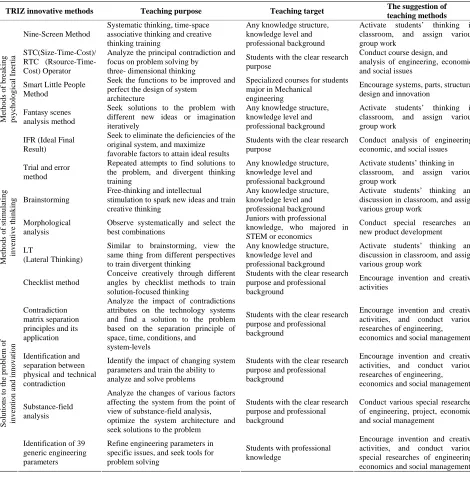
[image:3.595.59.529.262.741.2]As shown in Table 1, TRIZ system develops many
Table 1. TRIZ guide to innovative teaching methods.
TRIZ innovative methods Teaching purpose Teaching target The suggestion of teaching methods
Nine-Screen Method
Systematic thinking, time-space associative thinking and creative thinking training
Any knowledge structure, knowledge level and professional background
Activate students’ thinking in classroom, and assign various group work
STC(Size-Time-Cost)/ RTC (Rsource-Time- Cost) Operator
Analyze the principal contradiction and focus on problem solving by three- dimensional thinking
Students with the clear research purpose
Conduct course design, and analysis of engineering, economic, and social issues
Smart Little People Method
Seek the functions to be improved and perfect the design of system
architecture
Specialized courses for students major in Mechanical engineering
Encourage systems, parts, structural design and innovation
Fantasy scenes analysis method
Seek solutions to the problem with different new ideas or imagination iteratively
Any knowledge structure, knowledge level and professional background
Activate students’ thinking in classroom, and assign various group work M ethods of br eaking psychol ogical I n ertia
IFR (Ideal Final Result)
Seek to eliminate the deficiencies of the original system, and maximize favorable factors to attain ideal results
Students with the clear research purpose
Conduct analysis of engineering, economic, and social issues
Trial and error method
Repeated attempts to find solutions to the problem, and divergent thinking training
Any knowledge structure, knowledge level and professional background
Activate students’ thinking in classroom, and assign various group work
Brainstorming
Free-thinking and intellectual stimulation to spark new ideas and train creative thinking
Any knowledge structure, knowledge level and professional background
Activate students’ thinking and discussion in classroom, and assign various group work
Morphological analysis
Observe systematically and select the best combinations
Juniors with professional knowledge, who majored in STEM or economics
Conduct special researches and new product development
LT
(Lateral Thinking)
Similar to brainstorming, view the same thing from different perspectives to train divergent thinking
Any knowledge structure, knowledge level and professional background
Activate students’ thinking and discussion in classroom, and assign various group work
M ethods of stim ulating inventive thinki ng Checklist method
Conceive creatively through different angles by checklist methods to train solution-focused thinking
Students with the clear research purpose and professional background
Encourage invention and creative activities
Contradiction matrix separation principles and its application
Analyze the impact of contradictions attributes on the technology systems and find a solution to the problem based on the separation principle of space, time, conditions, and
system-levels
Students with the clear research purpose and professional background
Encourage invention and creative activities, and conduct various researches of engineering,
economics and social management
Identification and separation between physical and technical contradiction
Identify the impact of changing system parameters and train the ability to analyze and solve problems
Students with the clear research purpose and professional background
Encourage invention and creative activities, and conduct various researches of engineering,
economics and social management
Substance-field analysis
Analyze the changes of various factors affecting the system from the point of view of substance-field analysis, optimize the system architecture and seek solutions to the problem
Students with the clear research purpose and professional background
Conduct various special researches of engineering, project, economics and social management
Solutions to the pr
oblem
of
invention an
d inno
vation
Identification of 39 generic engineering parameters
Refine engineering parameters in specific issues, and seek tools for problem solving
Students with professional knowledge
types of methods for breaking psychological inertia and stimulating inventive thinking, and some of them are fa- miliar to people, such as brainstorming. Teachers can use these methods in many teaching aspects, which are ap- plicable to the general population and not restricted by their background knowledge. Some innovative ways of thinking, such as morphological analysis and checklist method, are more suitable for the professionals. TRIZ’s solutions to the problem of invention and innovation, for example, 39 general engineering parameter matrix and 40 inventive principles can be ideally used for instructing students in inventions, innovation activities, and in vari- ous monographic studies.
3.2. Apply TRIZ to STEM Education for Thinking Training and Practices
The essence of TRIZ is seeking for solutions to the in- novation problems by innovative way of thinking and specialized methodology. In 2009, Ministry of Science and Technology of PRC began to introduce TRIZ to training, and the aim is to improve the innovative capa- bility of China’s scientific and technical personnel. The experiences of TRIZ practices in foreign universities and industrial applications indicated that TRIZ has played a catalytic role in shortening the development cycle of new products and original R&D and in improving the effi- ciency of innovation.
STEM education, as a cradle of future engineers, is ne- cessary to integrate with TRIZ in terms of the general education or professional education. The TRIZ practices in graduation design of hydraulics in Heilongjiang insti- tute of science and technology [10] indicated that the number of design proposals increased 25%, and the ef- fective high-level scheme accounted for 12%, which im- proved the quality of graduation design [10].
Almost all the STEM courses in Chinese universities contain 39 general engineering parameters and 40 inven- tion principles. Therefore, launching TRIZ education early can train more excellent engineers and innovative talent for China’s industrial development. Currently in China’s higher education, STEM occupy more than half the pro- portion of a wide variety of scientific specialties, most STEM colleges offer electronic engineering, mechanical engineering, engineering thermal physics and materials engineering. The process of training excellent engineers is shown in Figure 1. Acquiring fundamental and pro- fessional knowledge and applying theory to practice can equip the students with the excellent quality of engineers. The education of excellent engineers can be proved suc- cessful when a graduated STEM student has invention patents, great innovative achievements, high-quality the- sis or problem-solving abilities and so on.
The TRIZ methodology is most likely to be accepted by STEM students. Figures 1 and 2 look very similar.
The former process is to improve the excellent quality and ingenuity of engineers by learning, accumulation of knowledge, and practical skills. The latter one is to util- ize the fundamental knowledge of operation and profes- sional knowledge to identify problems, and then use spe- cialized techniques and tools to solve the problem direct- ly and attain innovative and creative achievement. There- fore, promoting the TRIZ application in STEM education is an effective way of carrying out the training plan of excellent engineers.
3.3. Enhance Faculty Development for Innovative Education of TRIZ
University faculties’ innovative capability and philosophy determine the effect of innovative education. But many of STEM teachers in China’s universities don’t under- stand the innovative theory of TRIZ, and could hardly integrate it with professional courses. Accordingly uni- versities should attach importance to carrying out resear- ches and training classes of TRIZ, and encourage teach- ers to participate in TRIZ practice, interdisciplinary re- search activities and industrial technological innovation through the innovative platform of TRIZ and university- industry research cooperation.
[image:4.595.320.526.415.549.2]First of all, extend application of TRIZ among STEM teachers and integrate innovative methods and philosophy
Figure 1. The process of training excellent engineers.
[image:4.595.318.531.572.720.2]of TRIZ with professional education. Then, build a TRIZ education team with multidisciplinary teachers which mainly consist of STEM teachers and partly seek the sup- port of enterprises’ TRIZ tutors.
3.4. Develop a Cooperative and Resource-Sharing Platform for TRIZ Education
TRIZ originated in the exploration of industrial innova- tion and technical inventions in engineering fields. Since 2009, the Chinese government, enterprises, universities and research institutions have embarked on promoting the application of TRIZ, but that is not enough to meet the great demand of China’s higher engineering educa- tion. The main reason is the lack of training facilities for the technological innovation, teachers with innovative spirit and feasible teaching methods.
The principle of China’s training plan of excellent en- gineers is to provide guidance for industry, enhance co- operation between universities and enterprises, imple- ment systematically, and diversify in forms. Developing a cooperative and resource-sharing platform for TRIZ education, is not only to provide a continuing education platform to improve the R&D capabilities of scientific and technical personnel in enterprises, but also to offer the innovative education and training opportunities which closely integrated with enterprises for teachers and stu- dents in universities.
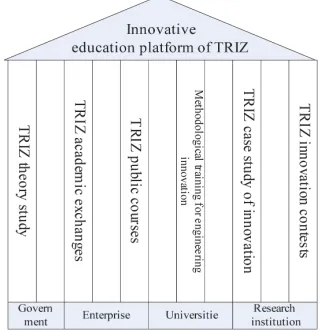
[image:5.595.92.254.555.720.2]As shown in Figure 3, the government, enterprises, universities and research institutions establish the TRIZ education platform together. This TRIZ platform provides many types of educational resources, including the the- ory study, academic exchanges, public courses, methodo- logical training for engineering innovation, case study and innovation contests. And the platform also offers public re- sources, such as dissemination of TRIZ, professional trai- ning, open courses and innovation competitions, for en- terprises, research institutions, technology service firms
Figure 3. Innovative education platform of TRIZ.
and universities.
4. Conclusions
The practice of applying TRIZ to higher engineering edu- cation indicates that TRIZ methodology significantly im- proves the engineering and innovative abilities of stu- dents.
Because of the scientific, pragmatic, and operable at-tributes, TRIZ can be an effective way to develop the in- novative abilities, professional competence, and engineer- ing capabilities of students, and also a great starting point for the implementation of China’s TPEE.
At present, China has 194 colleges and universities launching the TPEE as pilot study of teaching reform. And the practices that integrate TRIZ with the teaching form of excellent engineers training afford valuable les- sons for the college and university educators.
From the perspective of teaching reform, there are some recommendations for the application of TRIZ: Go out of colleges and universities, and cooperate with
the industry. Learn from the enterprises which im- plement TRIZ currently, participate in their R&D and new product development activities, and employ cor- porate engineers to guide the TRIZ teaching reform. Carry out the TRIZ teaching reform step by step. De-
velop different forms of TRIZ courses for different levels of students, such as junior college, undergradu- ate, graduate and doctoral students, and different de- pths for different subjects.
Give full play to the role of professional teachers. The STEM courses consist of the engineering parameters of TRIZ, and the STEM teachers are the front-line communicators and initiators.
Carry out TRIZ education combined with one’s own characteristics of TPEE. According to schools’ tradi- tional expertise, location, educational resources, ex- plore the compatible teaching mode of TRIZ. Develop a standard teaching and training system for
TRIZ. TRIZ has its own logic and regularity. Thus de- veloping a standard training system, such as the train- ing platform and software, can greatly improve the ef- ficiency of the dissemination of knowledge and the effectiveness of teaching.
5. Acknowledgements
This research was financially supported by the NSFC under Grant Nos. 71171134/G012, China Shanghai Mu- nicipal Research Project of Education and Science 2011 (B11041).
REFERENCES
http://www.moe.edu.cn/publicfiles/business/htmlfiles/mo e/moe_633/201208/141305.html
[2] G. F. Zhu, “Current Status and Prospects of Engineering Education in China,” Research in Higher Education of Engineering, Vol. 22, No. 6, 2011, pp. 1-4.
[3] P. G. Li, X. D. Xu and G.S. Chen, “On Practical Teaching of Undergraduate Engineering Education in China: Prob- lems and Causes,” Research in Higher Education of Engi- neering, Vol. 23, No. 3, 2012, pp. 1-6.
[4] B. Busov, D. L. Mann and P. Jirman, “TRIZ and Inven- tion Machine: Methods and Systems For Creative Engi- neering and Education in the 21st Century,” 1st Interna- tional Conference on Advanced Engineering Design, Pra- gue, May 1999, pp. 1-10.
[5] W. W. Wits, T. H. J. Vaneker and V. Souchkov, “Full Immersion TRIZ in Education,” Proceedings of the TRIZ Future Conference 2010, Bergamo, 3-5 November 2010, pp. 269-276.
[6] M. Ogot and G. E. Okudan, “Systematic Creativity Meth- ods in Engineering Education: A Learning Styles Per-
spective,” International Journal of Engineering, Vol. 22, No. 3, 2006, pp. 566-576.
doi:10.1080/03043790600797335
[7] T. Nakagawa, “Education and Training of Creative Prob- lem Solving Thinking with TRIZ/USIT,” Procedia Engi- neering, Vol. 9, 2011, pp. 582-595.
doi:10.1016/j.proeng.2011.03.144
[8] D.-Z. Xu and W. Xiong, “Research and Exploration of Introducing TRIZ into Innovation Education of Institu- tions of Higher Vocational Education,” Journal of Shen- yang Institute of Engineering (Social Sciences), Vol. 6, No. 1, 2010, pp. 93-99.
[9] X. F. Zhang, “TRIZ Tactics into Classroom Teaching,” Journal of Tianjin Normal University (Elementary Edu- cation Edition), Vol. 12, No. 2, 2011, pp. 32-35.