Grounding Semantics in Olfactory Perception
Douwe Kiela, Luana Bulat and Stephen Clark
Computer Laboratory University of Cambridge
douwe.kiela,ltf24,[email protected]
Abstract
Multi-modal semantics has relied on fea-ture norms or raw image data for per-ceptual input. In this paper we examine grounding semantic representations in ol-factory (smell) data, through the construc-tion of a novel bag of chemical compounds model. We use standard evaluations for multi-modal semantics, including measur-ing conceptual similarity and cross-modal zero-shot learning. To our knowledge, this is the first work to evaluate semantic sim-ilarity on representations grounded in ol-factory data.
1 Introduction
Distributional semantics represents the meanings of words as vectors in a “semantic space”, rely-ing on thedistributional hypothesis: the idea that words that occur in similar contexts tend to have similar meanings (Turney and Pantel, 2010; Clark, 2015). Although these models have been success-ful, the fact that the meaning of a word is repre-sented as a distribution over other words implies they suffer from thegrounding problem (Harnad, 1990); i.e. they do not account for the fact that human semantic knowledge is grounded in phys-ical reality and sensori-motor experience (Louw-erse, 2008).
Multi-modal semantics attempts to address this issue and there has been a surge of recent work on perceptually grounded semantic models. These models learn semantic representations from both textual and perceptual input and outperform language-only models on a range of tasks, includ-ing modellinclud-ing semantic similarity and relatedness, and predicting compositionality (Silberer and La-pata, 2012; Roller and Schulte im Walde, 2013; Bruni et al., 2014). Perceptual information is ob-tained from either feature norms (Silberer and La-pata, 2012; Roller and Schulte im Walde, 2013;
Hill and Korhonen, 2014) or raw data sources such as images (Feng and Lapata, 2010; Leong and Mi-halcea, 2011; Bruni et al., 2014; Kiela and Bottou, 2014). The former are elicited from human anno-tators and thus tend to be limited in scope and ex-pensive to obtain. The latter approach has the ad-vantage that images are widely available and easy to obtain, which, combined with the ready avail-ability of computer vision methods, has led to raw visual information becoming the de-facto percep-tual modality in multi-modal models.
However, if our objective is to ground seman-tic representations in perceptual information, why stop at image data? The meaning of lavender is probably more grounded in its smell than in the visual properties of the flower that produces it. Olfactory (smell) perception is of particular in-terest for grounded semantics because it is much more primitive compared to the other perceptual modalities (Carmichael et al., 1994; Krusemark et al., 2013). As a result, natural language speak-ers might take aspects of olfactory perception “for granted”, which would imply that text is a rel-atively poor source of such perceptual informa-tion. A multi-modal approach would overcome this problem, and might prove useful in, for ex-ample, metaphor interpretation (the sweet smell of success; rotten politics) and cognitive modelling, as well as in real-world applications such as au-tomatically retrieving smells or even producing smell descriptions. Here, we explore grounding semantic representations in olfactory perception.
We obtain olfactory representations by con-structing a novel bag of chemical compounds (BoCC) model. Following previous work in multi-modal semantics, we evaluate on well known con-ceptual similarity and relatedness tasks and on zero-shot learning through induced cross-modal mappings. To our knowledge this is the first work to explore using olfactory perceptual data for grounding linguistic semantic models.
Olfactory-Relevant Examples
MEN sim SimLex-999 sim
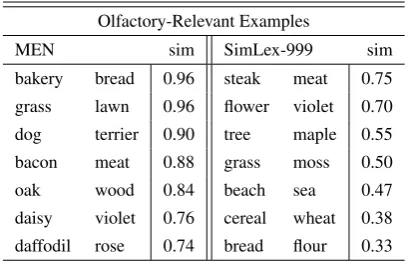
bakery bread 0.96 steak meat 0.75 grass lawn 0.96 flower violet 0.70 dog terrier 0.90 tree maple 0.55 bacon meat 0.88 grass moss 0.50 oak wood 0.84 beach sea 0.47 daisy violet 0.76 cereal wheat 0.38 daffodil rose 0.74 bread flour 0.33
Table 1: Examples of pairs in the evaluation datasets where olfactory information is relevant, together with the gold-standard similarity score.
2 Tasks
Following previous work in grounded semantics, we evaluate performance on two tasks: conceptual similarity and cross-modal zero-shot learning.
2.1 Conceptual similarity
We evaluate the performance of olfactory multi-modal representations on two well-known similar-ity datasets: SimLex-999 (Hill et al., 2014) and the MEN test collection (Bruni et al., 2014). These datasets consist of concept pairs together with a human-annotated similarity score. Model perfor-mance is evaluated using the Spearmanρs corre-lation between the ranking produced by the cosine of the model-derived vectors and that produced by the gold-standard similarity scores.
Evidence suggests that the inclusion of visual representations only improves performance for certain concepts, and that in some cases the in-troduction of visual information is detrimental to performance on similarity and relatedness tasks (Kiela et al., 2014). The same is likely to be true for other perceptual modalities: in the case of a comparison such aslily-rose, the olfactory modal-ity certainly is meaningful, while this is probably not the case forskateboard-swimsuit. Some exam-ples of relevant pairs can be found in Table 1.
Hence, we had two annotators rate the two datasets according to whether smell is relevant to the pairwise comparison. The annotation criterion was as follows: if both concepts in a pairwise com-parison have a distinctive associated smell, then the comparison is relevant to the olfactory modal-ity. Only if both annotators agree is the com-parison deemed olfactory-relevant. This annota-tion leads to a total of four evaluaannota-tion sets: the
MEN test collection MEN (3000 pairs) and its olfactory-relevant subsetOMEN(311pairs); and the SimLex-999 datasetSLex (999pairs) and its olfactory-relevant subset OSLex (65 pairs). The inter-annotator agreement on the olfactory rele-vance judgments was high (κ= 0.94for the MEN test collection andκ= 0.96for SimLex-999).1
2.2 Cross-modal zero-shot learning
Cross-modal semantics, instead of being con-cerned with improving semantic representations through grounding, focuses on the problem of ref-erence. Using, for instance, mappings between visual and textual space, the objective is to learn which words refer to which objects (Lazaridou et al., 2014). This problem is very much related to the object recognition task in computer vision, but instead of using just visual data and labels, these cross-modal models also utilize textual informa-tion (Socher et al., 2014; Frome et al., 2013). This approach allows forzero-shot learning, where the model can predict how an object relates to other concepts just from seeing an image of the object, but without ever having seen the object previously (Lazaridou et al., 2014).
We evaluate cross-modal zero-shot learning performance through the average percentage cor-rect at N (P@N), which measures how many of the test instances were ranked within the topN high-est ranked nearhigh-est neighbors. A chance baseline is obtained by randomly ranking a concept’s nearest neighbors. We use partial least squares regression (PLSR) to induce cross-modal mappings from the linguistic to the olfactory space and vice versa.2
Due to the nature of the olfactory data source (see Section 3), it is not possible to build olfac-tory representations for all concepts in the test sets. However, cross-modal mappings yield an addi-tional benefit: since linguistic representations have full coverage over the datasets, we can project from linguistic space to perceptual space to also obtain full coverage for the perceptual modalities. This technique has been used to increase coverage for feature norms (Fagarasan et al., 2015). Con-sequently, we are in a position to compare percep-tual spaces directly to each other, and to linguistic
1To facilitate further work in multi-modal semantics
be-yond vision, our code and data have been made publicly available at http://www.cl.cam.ac.uk/˜dk427/aroma.html.
2To avoid introducing another parameter, we set the
[image:2.595.79.284.62.194.2]Chemical Compound
Pheneth
yl
acetate
Isoamyl
butyrate
Anisyl
butyrate
Myrcene Syring
aldeh
yde
Melon 3 3
Pineapple 3 3
Licorice 3
Anise 3 3
Smell
label
[image:3.595.311.530.63.151.2]Beer 3 3
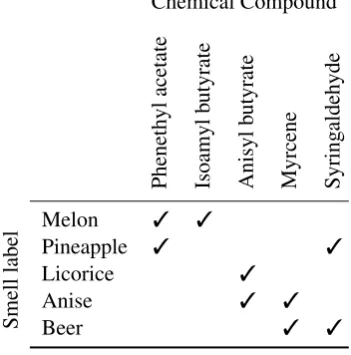
Table 2: A BoCC model.
space, over the entire dataset, as well as on the rel-evant olfactory subsets. When projecting into such a space and reporting results, the model is prefixed with an arrow (→) in the corresponding table.
3 Olfactory Perception
The Sigma-Aldrich Fine Chemicals flavors and fragrances catalog3 (henceforth SAFC) is one of the largest publicly accessible databases of se-mantic odor profiles that is used extensively in fragrance research (Zarzo and Stanton, 2006). It contains organoleptic labels and the chemical compounds—or more accurately the perfume raw materials (PRMs)—that produce them. By auto-matically scraping the catalog we obtained a total of 137 organoleptic smell labels from SAFC, with a total of 11,152 associated PRMs. We also exper-imented with Flavornet4 and the LRI and odour database5, but found that the data from these were more noisy and generally of lower quality.
For each of the smell labels in SAFC we count the co-occurrences of associated chemical com-pounds, yielding a bag of chemical compounds (BoCC) model. Table 2 shows an example sub-space of this model. Although the SAFC cata-log is considered sufficiently comprehensive for fragrance research (Zarzo and Stanton, 2006), the fact that PRMs usually occur only once per smell label means that the representations are rather sparse. Hence, we apply dimensionality reduc-tion to the original representareduc-tion to get denser
3
http://www.sigmaaldrich.com/industries/flavors-and-fragrances.html
4http://www.flavornet.org 5http://www.odour.org.uk
Figure 1: Performance of olfactory representa-tions when using SVD to reduce the number of dimensions.
Dataset Linguistic BoCC-Raw BoCC-SVD
OMEN (35) 0.40 0.42 0.53
Table 3: Comparison of olfactory representations on the covered OMEN dataset.
vectors. We call the model without any dimen-sionality reduction BOCC-RAW and use
singu-lar value decomposition (SVD) to create an ad-ditional BOCC-SVD model with reduced
dimen-sionality. Positive pointwise mutual information (PPMI) weighting is applied to the raw space be-fore performing dimensionality reduction.
The number of dimensions in human olfactory space is a hotly debated topic in the olfactory chemical sciences (Buck and Axel, 1991; Zarzo and Stanton, 2006). Recent studies involving multi-dimensional scaling on the SAFC catalog revealed approximately32dimensions in olfactory perception space (Mamlouk et al., 2003; Mamlouk and Martinetz, 2004). We examine this finding by evaluating the Spearmanρs correlation on the pairs ofOMENthat occur in the SAFC database (35 pairs). The coverage on SimLex was not suffi-cient to also try that dataset (only 5 pairs). Figure 1 shows the results. It turns out that the best olfac-tory representations are obtained with 30 dimen-sions. In other words, our findings appear to cor-roborate recent evidence suggesting that olfactory space (at least when using SAFC as a data source) is best modeled using around30dimensions.
3.1 Linguistic representations
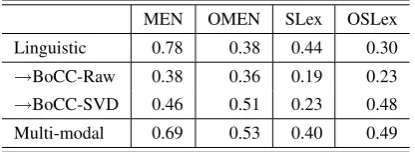
[image:3.595.93.269.68.246.2]MEN OMEN SLex OSLex Linguistic 0.78 0.38 0.44 0.30 →BoCC-Raw 0.38 0.36 0.19 0.23 →BoCC-SVD 0.46 0.51 0.23 0.48 Multi-modal 0.69 0.53 0.40 0.49
Table 4: Comparison of linguistic, olfactory and multi-modal representations.
Mapping P@1 P@5 P@20 P@50
Chance 0.0 3.76 13.53 36.09
Olfactory⇒Ling. 1.51 8.33 24.24 47.73 Ling.⇒Olfactory 4.55 15.15 43.18 67.42
Table 5: Zero-shot learning performance for BoCC-SVD.
Word2vec website.6
3.2 Conceptual Similarity
Results on the35covered pairs ofOMENfor the two BoCC models are reported in Table 3. Ol-factory representations outperform linguistic resentations on this subset. In fact, linguistic rep-resentations perform poorly compared to their per-formance on the whole ofMEN. The SVD model performs best, improving on the linguistic and raw models with a 33% and 26% relative increase in performance, respectively.
We use a cross-modal PLSR map, trained on all available organoleptic labels in SAFC, to ex-tend coverage and allow for a direct compari-son between linguistic representations and cross-modally projected olfactory representations on the entire datasets and relevant subsets. The results are shown in Table 4. As might be expected, lin-guistic performs better than olfactory on the full datasets. On the olfactory-relevant subsets, how-ever, the projected BOCC-SVD model
outper-forms linguistic for both datasets. Performance in-creases even further when the two representations are combined into a multi-modal representation by concatenating the L2-normalized linguistic and ol-factory (→BOCC-SVD) vectors.
3.3 Zero-shot learning
We learn a cross-modal mapping between the two spaces and evaluate zero-shot learning. We use all 137 labels in the SAFC database that have corre-sponding linguistic vectors for the training data.
6https://code.google.com/p/word2vec/
apple bacon brandy cashew
pear smoky rum hazelnut
banana roasted whiskey peanut melon coffee wine-like almond apricot mesquite grape hawthorne pineapple mossy fleshy jam chocolate lemon cheese caramel cocoa citrus grassy nutty sweet geranium butter roasted coffee grapefruit oily maple licorice tart creamy butterscotch roasted floral coconut coffee
Table 6: Example nearest neighbors for BoCC-SVD representations.
For each term, we train the map on all other la-bels and measure whether the correct instance is ranked within the top N neighbors. We use the BOCC-SVD model for the olfactory space, since
it performed best on the conceptual similarity task. Table 5 shows the results. It appears that mapping linguistic to olfactory is easier than mapping olfac-tory to linguistic, which may be explained by the different number of dimensions in the two spaces. One could say that it is easier to find the chemical composition of a “smelly” word from its linguistic representation, than it is to linguistically represent or describe a chemical composition.
3.4 Qualitative analysis
We also examined the BoCC representations qual-itatively. As Table 6 shows, the nearest neigh-bors are remarkably semantically coherent. The nearest neighbors for bacon and cheese, for ex-ample, accurately sum up how one might describe those smells. The model also groups together nuts and fruits, and expresses well whatchocolateand caramelsmell (or taste) like.
4 Conclusions
[image:4.595.78.286.63.139.2]This work opens up interesting possibilities in analyzing smell and even taste. It could be applied in a variety of settings beyond semantic similarity, from chemical information retrieval to metaphor interpretation to cognitive modelling. A specula-tive blue-sky application based on this, and other multi-modal models, would be an NLG applica-tion describing a wine based on its chemical com-position, and perhaps other information such as its color and country of origin.
Acknowledgements
DK is supported by EPSRC grant EP/I037512/1. LB is supported by an EPSRC Doctoral Train-ing Grant. SC is supported by ERC Start-ing Grant DisCoTex (306920) and EPSRC grant EP/I037512/1. We thank the anonymous review-ers for their helpful comments and Flaviu Bulat for providing useful feedback.
References
Elia Bruni, Nam-Khanh Tran, and Marco Baroni. 2014. Multimodal distributional semantics. Journal of Artifical Intelligence Research, 49:1–47.
Linda Buck and Richard Axel. 1991. A novel multi-gene family may encode odorant receptors: a molec-ular basis for odor recognition. Cell, 65(1):175–187. S. Thomas Carmichael, M.-C. Clugnet, and Joseph L. Price. 1994. Central olfactory connections in the macaque monkey. Journal of Comparative Neurol-ogy, 346(3):403–434.
Stephen Clark. 2015. Vector Space Models of Lexical Meaning. In Shalom Lappin and Chris Fox, editors,
Handbook of Contemporary Semantics, chapter 16. Wiley-Blackwell, Oxford.
Luana Fagarasan, Eva Maria Vecchi, and Stephen Clark. 2015. From distributional semantics to fea-ture norms: grounding semantic models in human perceptual data. InProceedings of the 11th Inter-national Conference on Computational Semantics (IWCS 2015), pages 52–57, London, UK.
Yansong Feng and Mirella Lapata. 2010. Visual infor-mation in semantic representation. InProceedings of NAACL, pages 91–99.
Andrea Frome, Gregory S. Corrado, Jonathon Shlens, Samy Bengio, Jeffrey Dean, Marc’Aurelio Ranzato, and Tomas Mikolov. 2013. DeViSE: A Deep Visual-Semantic Embedding Model. InProceedings of NIPS, pages 2121–2129.
Stevan Harnad. 1990. The symbol grounding problem.
Physica D, 42:335–346.
Felix Hill and Anna Korhonen. 2014. Learning ab-stract concept embeddings from multi-modal data: Since you probably can’t see what I mean. In Pro-ceedings of EMNLP, pages 255–265.
Felix Hill, Roi Reichart, and Anna Korhonen. 2014. SimLex-999: Evaluating semantic mod-els with (genuine) similarity estimation. CoRR, abs/1408.3456.
Douwe Kiela and L´eon Bottou. 2014. Learning image embeddings using convolutional neural networks for improved multi-modal semantics. InProceedings of EMNLP, pages 36–45.
Douwe Kiela, Felix Hill, Anna Korhonen, and Stephen Clark. 2014. Improving multi-modal representa-tions using image dispersion: Why less is sometimes more. InProceedings of ACL, pages 835–841.
Elizabeth A Krusemark, Lucas R Novak, Darren R Gitelman, and Wen Li. 2013. When the sense of smell meets emotion: anxiety-state-dependent olfac-tory processing and neural circuitry adaptation. The Journal of Neuroscience, 33(39):15324–15332.
Angeliki Lazaridou, Elia Bruni, and Marco Baroni. 2014. Is this a wampimuk? Cross-modal map-ping between distributional semantics and the visual world. InProceedings of ACL, pages 1403–1414.
Chee Wee Leong and Rada Mihalcea. 2011. Going beyond text: A hybrid image-text approach for mea-suring word relatedness. InProceedings of IJCNLP, pages 1403–1407.
Max M. Louwerse. 2008. Symbol interdependency in symbolic and embodied cognition.Topics in Cogni-tive Science, 59(1):617–645.
Amir Madany Mamlouk and Thomas Martinetz. 2004. On the dimensions of the olfactory perception space.
Neurocomputing, 58:1019–1025.
Amir Madany Mamlouk, Christine Chee-Ruiter, Ul-rich G Hofmann, and James M Bower. 2003. Quan-tifying olfactory perception: Mapping olfactory per-ception space by using multidimensional scaling and self-organizing maps. Neurocomputing, 52:591– 597.
Tomas Mikolov, Kai Chen, Greg Corrado, and Jeffrey Dean. 2013. Efficient estimation of word repre-sentations in vector space. InProceedings of ICLR, Scottsdale, Arizona, USA.
Stephen Roller and Sabine Schulte im Walde. 2013. A multimodal LDA model integrating textual, cog-nitive and visual modalities. In Proceedings of EMNLP, pages 1146–1157.
Richard Socher, Andrej Karpathy, Quoc V. Le, Christo-pher D. Manning, and Andrew Y. Ng. 2014. Grounded compositional semantics for finding and describing images with sentences. Transactions of ACL, 2:207–218.
Peter D. Turney and Patrick Pantel. 2010. From Frequency to Meaning: vector space models of se-mantics. Journal of Artifical Intelligence Research, 37(1):141–188, January.
Manuel Zarzo and David T. Stanton. 2006. Identi-fication of latent variables in a semantic odor pro-file database using principal component analysis.