4996
How multilingual is Multilingual BERT?
Telmo Pires∗ Eva Schlinger Dan Garrette
Google Research
{telmop,eschling,dhgarrette}@google.com
Abstract
In this paper, we show that Multilingual BERT (M-BERT), released by Devlin et al. (2019) as a single language model pre-trained from monolingual corpora in 104 languages, is surprisingly good at zero-shot cross-lingual model transfer, in which task-specific annota-tions in one language are used to fine-tune the model for evaluation in another language. To understand why, we present a large number of probing experiments, showing that transfer is possible even to languages in different scripts, that transfer works best between typologically similar languages, that monolingual corpora can train models for code-switching, and that the model can find translation pairs. From these results, we can conclude that M-BERT does create multilingual representations, but that these representations exhibit systematic deficiencies affecting certain language pairs.
1 Introduction
Deep, contextualized language models provide powerful, general-purpose linguistic represen-tations that have enabled significant advances among a wide range of natural language process-ing tasks (Peters et al.,2018b;Devlin et al.,2019). These models can be pre-trained on large corpora of readily available unannotated text, and then fine-tuned for specific tasks on smaller amounts of supervised data, relying on the induced language model structure to facilitate generalization beyond the annotations. Previous work on model prob-ing has shown that these representations are able to encode, among other things, syntactic and named entity information, but they have heretofore fo-cused on what models trained on English capture about English (Peters et al.,2018a;Tenney et al., 2019b,a).
∗
Google AI Resident.
In this paper, we empirically investigate the degree to which these representations generalize across languages. We explore this question us-ing Multilus-ingual BERT (henceforth, M-BERT), re-leased byDevlin et al.(2019) as a single language model pre-trained on the concatenation of mono-lingual Wikipedia corpora from 104 languages.1 M-BERTis particularly well suited to this probing study because it enables a very straightforward ap-proach to zero-shot cross-lingual model transfer: we fine-tune the model using task-specific super-vised training data from one language, and evalu-ate that task in a different language, thus allowing us to observe the ways in which the model gener-alizes information across languages.
Our results show that M-BERT is able to perform cross-lingual generalization surprisingly well. More importantly, we present the results of a number of probing experiments designed to test various hypotheses about how the model is able to perform this transfer. Our experiments show that while high lexical overlap between languages im-proves transfer, M-BERT is also able to transfer between languages written in different scripts— thus havingzero lexical overlap—indicating that it captures multilingual representations. We fur-ther show that transfer works best for typolog-ically similar languages, suggesting that while M-BERT’s multilingual representation is able to map learned structures onto new vocabularies, it does not seem to learn systematic transformations of those structures to accommodate a target lan-guage with different word order.
2 Models and Data
Like the original English BERT model (hence-forth, EN-BERT), M-BERT is a 12 layer trans-former (Devlin et al., 2019), but instead of
Fine-tuning\Eval EN DE NL ES
EN 90.70 69.74 77.36 73.59
[image:2.595.79.287.63.113.2]DE 73.83 82.00 76.25 70.03 NL 65.46 65.68 89.86 72.10 ES 65.38 59.40 64.39 87.18
Table 1: NERF1 results on the CoNLL data.
ing trained only on monolingual English data with an English-derived vocabulary, it is trained on the Wikipedia pages of 104 languages with a shared word piece vocabulary. It does not use any marker denoting the input language, and does not have any explicit mechanism to encourage translation-equivalent pairs to have similar representations.
For NER and POS, we use the same sequence tagging architecture asDevlin et al.(2019). We to-kenize the input sentence, feed it to BERT, get the last layer’s activations, and pass them through a fi-nal layer to make the tag predictions. The whole model is then fine-tuned to minimize the cross en-tropy loss for the task. When tokenization splits words into multiple pieces, we take the prediction for the first piece as the prediction for the word.
2.1 Named entity recognition experiments
We perform NER experiments on two datasets: the publicly available CoNLL-2002 and -2003 sets, containing Dutch, Spanish, English, and Ger-man (Tjong Kim Sang,2002;Sang and Meulder, 2003); and an in-house dataset with 16 languages,2 using the same CoNLL categories. Table1shows M-BERT zero-shot performance on all language pairs in the CoNLL data.
2.2 Part of speech tagging experiments
We performPOSexperiments using Universal De-pendencies (UD) (Nivre et al., 2016) data for 41 languages.3 We use the evaluation sets from Ze-man et al.(2017). Table 2 shows M-BERT zero-shot results for four European languages. We see that M-BERT generalizes well across languages, achieving over80%accuracy for all pairs.
2Arabic, Bengali, Czech, German, English, Spanish, French, Hindi, Indonesian, Italian, Japanese, Korean, Por-tuguese, Russian, Turkish, and Chinese.
3
Arabic, Bulgarian, Catalan, Czech, Danish, German, Greek, English, Spanish, Estonian, Basque, Persian, Finnish, French, Galician, Hebrew, Hindi, Croatian, Hungarian, In-donesian, Italian, Japanese, Korean, Latvian, Marathi, Dutch, Norwegian (Bokmaal and Nynorsk), Polish, Portuguese (Eu-ropean and Brazilian), Romanian, Russian, Slovak, Slove-nian, Swedish, Tamil, Telugu, Turkish, Urdu, and Chinese.
Fine-tuning\Eval EN DE ES IT
EN 96.82 89.40 85.91 91.60
[image:2.595.313.522.63.113.2]DE 83.99 93.99 86.32 88.39 ES 81.64 88.87 96.71 93.71 IT 86.79 87.82 91.28 98.11
Table 2: POSaccuracy on a subset of UD languages.
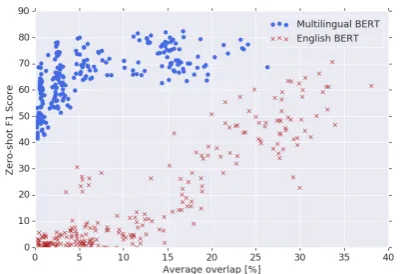
Figure 1: Zero-shotNER F1 score versus entity word piece overlap among 16 languages. While performance using EN-BERT depends directly on word piece over-lap, M-BERT’s performance is largely independent of overlap, indicating that it learns multilingual represen-tations deeper than simple vocabulary memorization.
3 Vocabulary Memorization
Because M-BERT uses a single, multilingual vo-cabulary, one form of cross-lingual transfer occurs when word pieces present during fine-tuning also appear in the evaluation languages. In this sec-tion, we present experiments probing M-BERT’s dependence on this superficial form of generaliza-tion: How much does transferability depend on lexical overlap? And is transfer possible to lan-guages written in different scripts (nooverlap)?
3.1 Effect of vocabulary overlap
If M-BERT’s ability to generalize were mostly due to vocabulary memorization, we would expect zero-shot performance onNERto be highly depen-dent on word piece overlap, since entities are of-ten similar across languages. To measure this ef-fect, we computeEtrainandEeval, the sets of word pieces used in entities in the training and evalu-ation datasets, respectively, and define overlap as the fraction of common word pieces used in the entities:overlap=|Etrain∩Eeval|/|Etrain∪Eeval|. Figure1plotsNERF1 score versus entity over-lap for zero-shot transfer between every language pair in an in-house dataset of 16 languages, for both M-BERT and EN-BERT.4 We can see that
[image:2.595.316.517.140.277.2]Model EN DE NL ES
[image:3.595.313.522.62.104.2]Lample et al.(2016) 90.94 78.76 81.74 85.75 EN-BERT 91.07 73.32 84.23 81.84
Table 3: NERF1 results fine-tuning and evaluating on thesamelanguage (not zero-shot transfer).
performance using EN-BERTdepends directly on word piece overlap: the ability to transfer dete-riorates as word piece overlap diminishes, and F1 scores are near zero for languages written in differ-ent scripts. M-BERT’s performance, on the other hand, is flat for a wide range of overlaps, and even for language pairs with almost no lexical overlap, scores vary between40% and70%, showing that M-BERT’s pretraining on multiple languages has enabled a representational capacity deeper than simple vocabulary memorization.5
To further verify that EN-BERT’s inability to generalize is due to its lack of a multilingual rep-resentation and not an inability of its English-specific word piece vocabulary to represent data in other languages, we evaluate onnon-cross-lingual NERand see that it performs comparably to a pre-vious state of the art model (see Table3).
3.2 Generalization across scripts
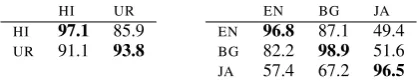
M-BERT’s ability to transfer between languages that are written in different scripts, and thus have effectivelyzerolexical overlap, is surprising given that it was trained on separate monolingual cor-pora and not with a multilingual objective. To probe deeper into how the model is able to per-form this generalization, Table4 shows a sample ofPOSresults for transfer across scripts.
Among the most surprising results, an M-BERT model that has been fine-tuned using only POS-labeled Urdu (written in Arabic script), achieves 91% accuracy on Hindi (written in Devanagari script), even though it has never seen a single POS-tagged Devanagari word. This provides clear ev-idence of M-BERT’s multilingual representation ability, mapping structures onto new vocabularies based on a shared representation induced solely from monolingual language model training data.
However, cross-script transfer is less accurate for other pairs, such as English and Japanese, indi-cating that M-BERT’s multilingual representation is not able to generalize equally well in all cases. A possible explanation for this, as we will see in section4.2, is typological similarity. English and Japanese have a different order of subject, verb
5Individual language trends are similar to aggregate plots.
HI UR HI 97.1 85.9 UR 91.1 93.8
EN BG JA EN 96.8 87.1 49.4 BG 82.2 98.9 51.6 JA 57.4 67.2 96.5
Table 4:POSaccuracy on the UD test set for languages with different scripts. Row=fine-tuning, column=eval.
and object, while English and Bulgarian have the same, and M-BERTmay be having trouble gener-alizing across different orderings.
4 Encoding Linguistic Structure
In the previous section, we showed that M-BERT’s ability to generalize cannot be attributed solely to vocabulary memorization, and that it must be learning a deeper multilingual representation. In this section, we present probing experiments that investigate the nature of that representation: How does typological similarity affect M-BERT’s abil-ity to generalize? Can M-BERT generalize from monolingual inputs to code-switching text? Can the model generalize to transliterated text without transliterated language model pretraining?
4.1 Effect of language similarity
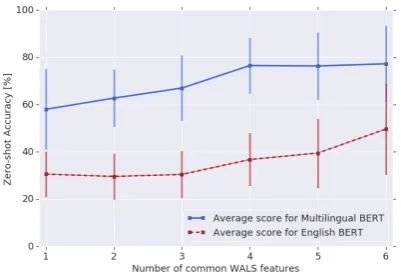
FollowingNaseem et al.(2012), we compare lan-guages on a subset of the WALS features (Dryer and Haspelmath, 2013) relevant to grammatical ordering.6 Figure2plotsPOSzero-shot accuracy against the number of common WALS features. As expected, performance improves with similar-ity, showing that it is easier for M-BERT to map linguistic structures when they are more similar, although it still does a decent job for low similar-ity languages when compared to EN-BERT.
4.2 Generalizing across typological features
Table5shows macro-averagedPOSaccuracies for transfer between languages grouped according to two typological features: subject/object/verb or-der, and adjective/noun order7(Dryer and Haspel-math, 2013). The results reported include only zero-shot transfer, i.e. they do not include cases
6
81A (Order of Subject, Object and Verb), 85A (Order of Adposition and Noun), 86A (Order of Genitive and Noun), 87A (Order of Adjective and Noun), 88A (Order of Demon-strative and Noun), and 89A (Order of Numeral and Noun).
7
Figure 2: Zero-shot POS accuracy versus number of common WALS features. Due to their scarcity, we ex-clude pairs with no common features.
SVO SOV SVO 81.55 66.52 SOV 63.98 64.22
(a) Subj./verb/obj. order.
AN NA AN 73.29 70.94 NA 75.10 79.64
[image:4.595.307.528.65.134.2](b) Adjective/noun order.
Table 5: Macro-average POS accuracies when trans-ferring between SVO/SOV languages or AN/NA lan-guages. Row = fine-tuning, column = evaluation.
training and testing on the same language. We can see that performance is best when transferring between languages that share word order features, suggesting that while M-BERT’s multilingual rep-resentation is able to map learned structures onto new vocabularies, it does not seem to learn sys-tematic transformations of those structures to ac-commodate a target language with different word order.
4.3 Code switching and transliteration
Code-switching (CS)—the mixing of multi-ple languages within a single utterance—and transliteration—writing that is not in the lan-guage’s standard script—present unique test cases for M-BERT, which is pre-trained on monolingual, standard-script corpora. Generalizing to code-switching is similar to other cross-lingual trans-fer scenarios, but would benefit to an even larger degree from a shared multilingual representation. Likewise, generalizing to transliterated text is sim-ilar to other cross-script transfer experiments, but has the additional caveat that M-BERT was not pre-trained on text that looks like the target.
We test M-BERTon the CS Hindi/English UD corpus from Bhat et al. (2018), which provides texts in two formats: transliterated, where Hindi words are written in Latin script, and corrected, where annotators have converted them back to De-vanagari script. Table6shows the results for
mod-Corrected Transliterated Train on monolingualHI+EN
M-BERT 86.59 50.41
Ball and Garrette(2018) — 77.40
Train on code-switchedHI/EN
M-BERT 90.56 85.64
Bhat et al.(2018) — 90.53
Table 6: M-BERT’sPOSaccuracy on the code-switched Hindi/English dataset from Bhat et al. (2018), on script-corrected and original (transliterated) tokens, and comparisons to existing work on code-switchPOS.
els fine-tuned using a combination of monolingual Hindi and English, and using the CS training set (both fine-tuning on the script-corrected version of the corpus as well as the transliterated version).
For script-corrected inputs, i.e., when Hindi is written in Devanagari, M-BERT’s performance when trained only on monolingual corpora is com-parable to performance when training on code-switched data, and it is likely that some of the remaining difference is due to domain mismatch. This provides further evidence that M-BERTuses a representation that is able to incorporate infor-mation from multiple languages.
However, M-BERT is not able to effectively transfer to a transliterated target, suggesting that it is the language model pre-training on a particu-lar language that allows transfer to that language. M-BERT is outperformed by previous work in both the monolingual-only and code-switched su-pervision scenarios. Neither Ball and Garrette (2018) nor Bhat et al.(2018) use contextualized word embeddings, but both incorporate explicit transliteration signals into their approaches.
5 Multilingual characterization of the feature space
In this section, we study the structure of M-BERT’s feature space. If it is multilingual, then the transformation mapping between the same sentence in2languages should not depend on the sentence itself, just on the language pair.
5.1 Experimental Setup
Figure 3: Accuracy of nearest neighbor translation for EN-DE,EN-RU, andHI-UR.
e.g. (v(ENl)i, v(DEl)i), we compute the vector point-ing from one to the other and average it over all pairs: v¯(ENl)→DE =
1
M P
i
v(DEl)i−v
(l) ENi
, whereM
is the number of pairs. Finally, we translate each sentence, v(ENl)i, by v¯
(l)
EN→DE, find the closest
Ger-man sentence vector8, and measure the fraction of times the nearest neighbour is the correct pair, which we call the “nearest neighbor accuracy”.
5.2 Results
In Figure 3, we plot the nearest neighbor accu-racy forEN-DE(solid line). It achieves over50% accuracy for all but the bottom layers,9 which seems to imply that the hidden representations, al-though separated in space, share a common sub-space that represents useful linguistic information, in a language-agnostic way. Similar curves are ob-tained for EN-RU, and UR-HI (in-house dataset), showing this works for multiple languages.
As to the reason why the accuracy goes down in the last few layers, one possible explanation is that since the model was pre-trained for language mod-eling, it might need more language-specific infor-mation to correctly predict the missing word.
6 Conclusion
In this work, we showed that M-BERT’s ro-bust, often surprising, ability to generalize cross-lingually is underpinned by a multilingual repre-sentation, without being explicitly trained for it. The model handles transfer across scripts and to code-switching fairly well, but effective transfer to typologically divergent and transliterated targets
8
In terms of`2distance.
9Our intuition is that the lower layers have more “token level” information, which is more language dependent, par-ticularly for languages that share few word pieces.
will likely require the model to incorporate an ex-plicit multilingual training objective, such as that used by Lample and Conneau (2019) or Artetxe and Schwenk(2018).
As to why M-BERT generalizes across lan-guages, we hypothesize that having word pieces used in all languages (numbers, URLs, etc) which have to be mapped to a shared space forces the co-occurring pieces to also be mapped to a shared space, thus spreading the effect to other word pieces, until different languages are close to a shared space.
It is our hope that these kinds of probing exper-iments will help steer researchers toward the most promising lines of inquiry by encouraging them to focus on the places where current contextualized word representation approaches fall short.
7 Acknowledgements
We would like to thank Mark Omernick, Livio Baldini Soares, Emily Pitler, Jason Riesa, and Slav Petrov for the valuable discussions and feedback.
References
Mikel Artetxe and Holger Schwenk. 2018. Mas-sively multilingual sentence embeddings for zero-shot cross-lingual transfer and beyond. arXiv preprint arXiv:1812.10464.
Kelsey Ball and Dan Garrette. 2018. Part-of-speech tagging for code-switched, transliterated texts with-out explicit language identification. InProceedings of EMNLP.
Irshad Bhat, Riyaz A. Bhat, Manish Shrivastava, and Dipti Sharma. 2018. Universal dependency parsing for Hindi-English code-switching. InProceedings of NAACL.
Ondˇrej Bojar, Yvette Graham, Amir Kamran, and Miloˇs Stanojevi´c. 2016. Results of the WMT16 metrics shared task. InProceedings of the First Con-ference on Machine Translation: Volume 2, Shared Task Papers.
Jacob Devlin, Ming-Wei Chang, Kenton Lee, and Kristina Toutanova. 2019. BERT: Pre-training of deep bidirectional transformers for language under-standing. InProceedings of NAACL.
Matthew S. Dryer and Martin Haspelmath, edi-tors. 2013. WALS Online. Max Planck In-stitute for Evolutionary Anthropology, Leipzig.
https://wals.info/.
Neural architectures for named entity recognition. InProceedings of NAACL.
Guillaume Lample and Alexis Conneau. 2019. Cross-lingual language model pretraining. arXiv preprint arXiv:1901.07291.
Tahira Naseem, Regina Barzilay, and Amir Globerson. 2012. Selective sharing for multilingual dependency parsing. InProceedings of ACL.
Joakim Nivre, Marie-Catherine de Marneffe, Filip Ginter, Yoav Goldberg, Jan Hajic, Christopher D. Manning, Ryan T. McDonald, Slav Petrov, Sampo Pyysalo, Natalia Silveira, Reut Tsarfaty, and Daniel Zeman. 2016. Universal dependencies v1: A mul-tilingual treebank collection. In Proceedings of LREC.
Matthew Peters, Mark Neumann, Luke Zettlemoyer, and Wen-tau Yih. 2018a. Dissecting contextual word embeddings: Architecture and representation. InProceedings of EMNLP.
Matthew E. Peters, Mark Neumann, Mohit Iyyer, Matt Gardner, Christopher Clark, Kenton Lee, and Luke Zettlemoyer. 2018b. Deep contextualized word rep-resentations. InProceedings of NAACL.
Erik F. Tjong Kim Sang and Fien De Meulder. 2003. Introduction to the CoNLL-2003 shared task: Language-independent named entity recognition. In Proceedings of CoNLL.
Ian Tenney, Dipanjan Das, and Ellie Pavlick. 2019a. BERT rediscovers the classical NLP pipeline. In Proceedings of ACL.
Ian Tenney, Patrick Xia, Berlin Chen, Alex Wang, Adam Poliak, R Thomas McCoy, Najoung Kim, Benjamin Van Durme, Sam Bowman, Dipanjan Das, and Ellie Pavlick. 2019b. What do you learn from context? Probing for sentence structure in contex-tualized word representations. In Proceedings of ICLR.
Erik F. Tjong Kim Sang. 2002. Introduction to the CoNLL-2002 shared task: Language-independent named entity recognition. In Proceedings of CoNLL.
Daniel Zeman, Martin Popel, Milan Straka, Jan Ha-jic, Joakim Nivre, Filip Ginter, Juhani Luotolahti, Sampo Pyysalo, Slav Petrov, Martin Potthast, Fran-cis Tyers, Elena Badmaeva, Memduh Gokirmak, Anna Nedoluzhko, Silvie Cinkova, Jan Hajic jr., Jaroslava Hlavacova, V´aclava Kettnerov´a, Zdenka Uresova, Jenna Kanerva, Stina Ojala, Anna Mis-sil¨a, Christopher D. Manning, Sebastian Schuster, Siva Reddy, Dima Taji, Nizar Habash, Herman Le-ung, Marie-Catherine de Marneffe, Manuela San-guinetti, Maria Simi, Hiroshi Kanayama, Valeria de-Paiva, Kira Droganova, H´ector Mart´ınez Alonso, C¸ a˘grı C¸ ¨oltekin, Umut Sulubacak, Hans Uszkor-eit, Vivien Macketanz, Aljoscha Burchardt, Kim Harris, Katrin Marheinecke, Georg Rehm, Tolga
Kayadelen, Mohammed Attia, Ali Elkahky, Zhuoran Yu, Emily Pitler, Saran Lertpradit, Michael Mandl, Jesse Kirchner, Hector Fernandez Alcalde, Jana Str-nadov´a, Esha Banerjee, Ruli Manurung, Antonio Stella, Atsuko Shimada, Sookyoung Kwak, Gustavo Mendonca, Tatiana Lando, Rattima Nitisaroj, and Josie Li. 2017. CoNLL 2017 shared task: Multi-lingual parsing from raw text to universal dependen-cies. InProceedings of CoNLL.
A Model Parameters
All models were fine-tuned with a batch size of 32, and a maximum sequence length of 128 for 3 epochs. We used a learning rate of 3e−5 with learning rate warmup during the first 10% of steps, and linear decay after-wards. We also applied 10% dropout on the last layer. No parameter tuning was performed. We used the BERT-Base, Multilingual Cased checkpoint from https://github. com/google-research/bert.
B CoNLL Results for EN-BERT
Fine-tuning\Eval EN DE NL ES
EN 91.07 24.38 40.62 49.99
[image:6.595.316.519.363.416.2]DE 55.36 73.32 54.84 50.80 NL 59.36 27.57 84.23 53.15 ES 55.09 26.13 48.75 81.84
Table 7: NER results on the CoNLL test sets for EN-BERT. The row is the fine-tuning language, the column the evaluation language. There is a big gap between this model’s zero-shot performance and M-BERT’s, showing that the pre-training is helping in cross-lingual transfer.
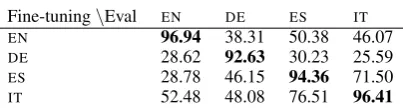
C SomePOSResults for EN-BERT
Fine-tuning\Eval EN DE ES IT
EN 96.94 38.31 50.38 46.07
DE 28.62 92.63 30.23 25.59 ES 28.78 46.15 94.36 71.50 IT 52.48 48.08 76.51 96.41
[image:6.595.316.518.529.583.2]