4020
Does It Make Sense? And Why? A Pilot Study for
Sense Making and Explanation
Cunxiang Wang1,4, Shuailong Liang2, Yue Zhang1, Xiaonan Li3and Tian Gao4 1School of Engineering, Westlake University, China
2Singapore University of Technology and Design, Singapore 3School of Computer Science and Technology, Xidian University, China 4College of Computer Science and Technology, Zhejiang University, China
[email protected],[email protected] shuailong [email protected]
lixiaonan [email protected],[email protected]
Abstract
Introducing common sense to natural language understanding systems has received increasing research attention. It remains a fundamental question on how to evaluate whether a system has a sense making capability. Existing bench-marks measures commonsense knowledge in-directly and without explanation. In this pa-per, we release a benchmark to directly test whether a system can differentiate natural lan-guage statements that make sense from those that do not make sense. In addition, a system is asked to identify the most crucial reason why a statement does not make sense. We evalu-ate models trained over large-scale language modeling tasks as well as human performance, showing that there are different challenges for system sense making.
1 Introduction
Natural Language Understanding (NLU) has re-ceived increasing research attention in recent years. With language models trained on large cor-pora (Peters et al., 2018;Devlin et al.,2018), al-gorithms show better performance than humans on some benchmarks (Group,2017;Devlin et al.,
2018). Compared to humans, however, most end-to-end trained systems are rather weak on common sense. For example, it is straightforward for a hu-man to understand thatsomeone can put a turkey into a fridgebuthe can never put an elephant into a fridgewith basic commonsense reasoning, but it can be non-trivial for a system to tell the differ-ence. Arguably, commonsense reasoning should be a central capability in a practical NLU system (Davis,2017); it is, therefore, important to be able to evaluate how well a model can do for sense making.
[image:1.595.308.526.233.501.2]Existing datasets test common sense indirectly through tasks that require extra knowledge, such
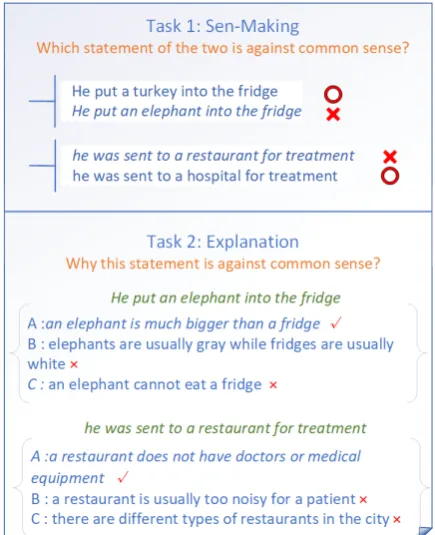
Figure 1: Samples of our dataset
as co-reference resolution (Levesque et al.,2012;
Morgenstern and Ortiz, 2015), subsequent event prediction (Roemmele et al., 2011; Zhang et al.,
2017;Zellers et al.,2018), or reading comprehen-sion (Mostafazadeh et al.,2016;Ostermann et al.,
2018b). They verify whether a system is equipped with common sense by testing whether it can give a correct answer where the input does not contain such knowledge. However, there are two limita-tions to such benchmarks. First, they do not give a direct metric to quantitatively measure sense mak-ing capability. Second, they do not explicitly iden-tify the key factors required in a sense making pro-cess.
benchmark consists of two subtasks. The first task is to choose from two natural language statements with similar wordings which one makes sense and which one does not make sense; The second task is to find the key reason why a given statement does not make sense. Version 1.0 of our dataset, which will be released with this paper, contains 2021 in-stances for each subtask, manually labeled by 7 annotators. Human performance on the bench-mark is 99.1% for the Sen-Making task and 97.3% for the Explanation task.
In the Sen-Making task, we use statement pair classification rather than labelling each statement ‘true’ or ‘false’ in the absolute sense because it is easy to cite a counterexample for any single ‘true’ or ‘false’ statement. For example, ‘toy elephant’ for ‘he put an elephant into fridge’. But it is ap-parent that ‘he put a turkey into fridge’ is more reasonable than ‘he put an elephant into fridge’.
In this pilot study, we evaluate contextualized representations trained over large-scale language modeling tasks on our benchmark. Results show that there is still a large gap behind human per-formance despite that the models are trained over 100 million natural language sentences. Detailed examination shows that inference remains a chal-lenge for such systems. To our knowledge, our dataset has the most direct decision-making pro-cess in commonsense reasoning and is the first one asking reasons behind the decision making pro-cess.
Note that there has been dataset which fo-cus on non-linguistic world knowledge plausibil-ity (Wang et al., 2018) or only limited attributes or actions of physical knowledge like verbphysics (Forbes and Choi,2017). They are related to our dataset but serve robotic research mainly. Our dataset is the first benchmark for direct linguis-tic sense making and explanation. We hope this benchmark can promote commonsense reason-ing by the NLP community, and further applied on other applications such as machine transla-tion and dialogue. Besides, we also expect that this work could be instructive on enhancing in-terpretability on commonsense reasoning research and other NLP tasks and on combining expla-nation with language generation. Our dataset is released at https://github.com/wangcunxiang/Sen-Making-and-Explanation.
2 Related Work
There has been datasets which focus on non-linguistic world knowledge validation (Wang et al., 2018) or only limited attributes or actions of world knowledge (Forbes and Choi,2017)
A widely used and important task is the Wino-grad Schema Challenge (WSC) (Levesque et al.,
2012; Morgenstern and Ortiz, 2015) that needs more commonsense knowledge. For example,
“The trophy would not fit in the brown suitcase because it was too big (small). What was too big (small)?” “Answer 0: the trophy”,“Answer 1: the suitcase”. However, WSC estimates common sense indirectly and it does not consider explana-tion on why one opexplana-tion is true while the other is wrong.
Choice of Plausible Alternatives (COPA) (Roemmele et al.,2011) puts emphasis on events and consequences. Each question of COPA asks to find the suitable cause or result of the premise from two given alternatives. All premises and alternatives are simple sentences. For exam-ple, “Premise: The man broke his toe. What was the CAUSE of this?” “1: He got a hole in his sock.”, “2: He dropped a hammer on his foot.”. Several subsequent datasets are inspired by COPA. The JHU Ordinal Common-sense In-ference (JOCI) (Zhang et al.,2017) aims to label the plausibility from 5 (very likely) to 1 (impos-sible) of human response after a certain situation. Situations with Adversarial Generations (SWAG) (Zellers et al., 2018) requests to choose the most likely-to-happen alternative after a specific situ-ation. Those datasets put emphasis on the pre-situations and/or the after-pre-situations of certain sit-uations, but not on the reasons why they occur or lead.
Some datasets are inspired by reading com-prehension, providing some textual materials and questions, asking to find suitable answers from the provided materials. The Story Cloze Test and ROCStories Corpora (Mostafazadeh et al., 2016;
want as long as they will help in the task.
Some other datasets are evolved from QA prob-lems and care more about factual commonsense knowledge. SQUABU (Davis, 2016) provides a small hand-constructed test of commonsense and scientific questions. CommonsenseQA ( Tal-mor et al., 2018) asks crowd workers to create questions from ConceptNet (Speer et al., 2017), which is a large knowledge graph of common-sense knowledge, where each question discrimi-nates its answer candidates between three target concepts that all share the same relationship to a single source drawn from ConceptNet Open-BookQA (Mihaylov et al., 2018) provides ques-tions and answer candidates, as well as thousands of diverse facts about elementary level science that are related to the questions. The AI2 Reason-ing Challenge (ARC) (Clark et al., 2018) gives thousands of questions with different knowledge types, as well as a relevant 14M-sentence corpus, mixed with science facts and other narrative sen-tences. Those questions are not easy to answer without specializing certain knowledge while our questions are easy for both adults and children.
In contrast, to our work, the tasks above do not directly estimate common sense or ask the logical reasons behind the correct answers and questions.
In recent years, some large-scale common-sense inference knowledge resources have been released, which may be helpful in commonsense reasoning tasks. Atomic (Sap et al.,2018) presents a huge everyday commonsense reasoning knowl-edge graph, which has nineif-thenrelations with variables, including causes, effects, and so on. Event2Mind (Rashkin et al., 2018) proposes a new corpus and task, aiming to find out men-tioned/unmentioned people’s intents and reactions under various daily circumstances. These datasets are not directly useful for our benchmark since they focus only on a small domain. ConceptNet is a prestigious knowledge graph that has been up-graded over a long time (Liu and Singh, 2004;
Havasi et al.,2007;Speer and Havasi,2013;Speer et al., 2017). ConceptNet constructs triples us-ing labeled edges as relations and various words and/or phrases as entities. It also has the sen-tences describing the corresponding triples. Thus we consider using ConceptNet knowledge for fine-tuning our models.
3 Testset
Task. Formally, each instance in our dataset is composed of 5 sentences: {s1,s2,r1,r2,r3}. s1 ands2are two similar sentences which in the same syntactic structure and differ by only few words, but only one of them makes sense while the other does not. They are used on our first subtask called
Sen-Making, which requires the model to identify which one is valid. For the invalid sentence, we have three optional reasons r1, r2 and r3 to ex-plain why the sentence is invalid. Our subtask 2, namedExplanation, requires that the only one cor-rect reason be identified from two other confusing ones. We use the accuracy score to evaluate both subtasks.
Data. For version 1.0 of our dataset, we have created 2,021 samples. Task 1 has 2,021 against-common-sense sentences, 2,021 correct sentences; Task 2 has 2,021 true reasons and 4,042 confusing reasons. We plan to release a dataset with more tasks and samples in the future.
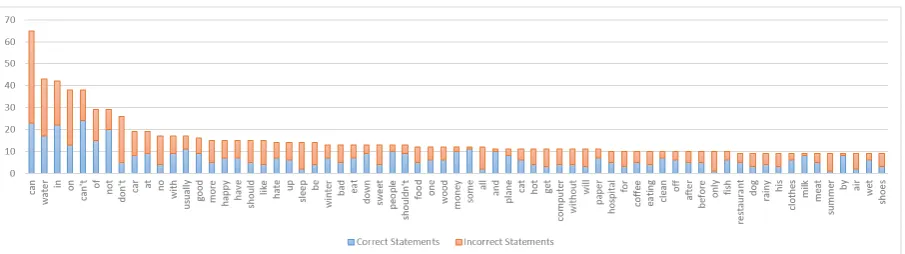
Figure 2: Number of ‘Different Words’
sentence, making the incorrect statement nearly as long as the correct statement, and the right rea-son neither too long nor too short among the three reasons. However, those principles are all soft re-strictions; some samples are still good ones even without obeying those principles.
Annotation process. We ask data annotators to write samples by themselves. Then other re-searchers (the first and second author of this pa-per) will examine those samples case by case. We also provide them with external sources to stim-ulate inspiration, such as the raw English sen-tences of ConceptNet5.5 (Speer et al.,2017), but those inspirational sentences should not be used directly. For example,“he was sent to a (restau-rant)/(hospital) for treatment after a car crash”
were inspired by the two sentences “restaurants provide food” and “hospitals provide medical care”However, those corpus may have incorrect and one-sided knowledge, we do not use those sentences. Besides, we also let them get inspira-tion from existing commonsense reasoning ques-tions like WSC (Levesque et al., 2012; Morgen-stern and Ortiz, 2015), COPA (Roemmele et al.,
2011) and SQUABU (Davis,2016).
Cautions when using the data.1. Researchers are encouraged to use what they deemed appro-priate for the tasks to train their model, and use our testset for evaluation. 2. Please do not use the three optional reasons when performing Sen-Makingtask, or the task will be artificially easy.
3.1 Corpus Analysis
The average length of two statements in the Sen-Making task are both 8.26, exactly the same. The average length of true reasons is 7.63, slightly smaller than the confusing reasons’ aver-age length, which is 7.77.
We analyse the different words between cor-rect statements and incorcor-rect statements, like in
“He put (an elephant)/(a turkey) into the fridge”, ‘an elephant’ is ‘different word’ in incorrect state-ments and ‘a turkey’ is ‘different word’ in correct statements. From ‘different words’, we can get an overview about how correct statements and incor-rect statements differ from each other.
We select the words which appear more than 9 times in the ‘different words’ and remove stop-words like ‘a’,‘an’ and ‘the’ to draw Figure 2. blue lines are the words appear in correct state-ments but do not appear in incorrect statestate-ments, while orange lines are opposite. We find that in-correct statements have much the same negative different words compared with correct statements. The incorrect statements have 53 ‘don’t’ or ‘can’t’ or ‘not’ or ‘no’ as different words, while the cor-rect statements have 55. That can illustrate that the corpus do not use negative words to construct incorrect statements or correct statements.
4 Experiments
We choose state-of-the-art language models trained over large texts as our baselines, assuming that common sense knowledge are encoded over texts. For the sense making task, we calculate per-plexities of both statements, choosing the one with lower scores as the correct one. For explanation, we first concatenate the statement with the each reason and then use the three concatenated sen-tences to calculate perplexities. For example, we concatenate “he put an elephant into the fridge”
with its optional reasons to be“he put an elephant into the fridge” is against common sense because an elephant cannot eat a fridge”.
Model Sen-Making Explanation
Random 50.0% 33.3%
ELMo 69.4% 33.4%
BERT 70.1% 45.6%
fine-tuned ELMo 74.1% 34.6%
[image:5.595.181.416.62.147.2]Human Performance 99.1% 97.8%
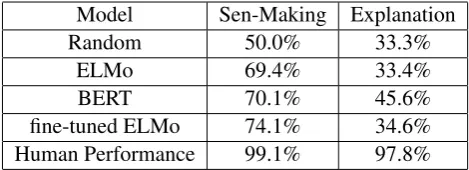
Table 1: Experimental Results
will keep it and record it in results.
4.1 Results & Analysis
As shown in Table 1, ELMo and BERT have a significant advantage over random results in Sen-Making. We conjure that both of them have the ability to judge whether a sentence is with or against common sense. For Sen-Making, ELMo does better than BERT; However, BERT beats ELMo in Explanation. ELMo does poorly in
Explanation, much the same as a random guess, which shows that ELMo cannot handle the casual relationship between the incorrect statements and the reasons. In contrast, BERT is significantly bet-ter than random guess in Explanation. This can be attributed to BERT’s training onNext Sentence Prediction (Devlin et al.,2018), which can assist to handle the logic relationship between two sen-tences.
Fine-tuned ELMo has an obvious improve-ment inSen-Makingand a non-obvious improve-ment inExplanation, probably because introduc-ing knowledge will help models to identify com-mon sense but cannot help them in inference. However, fine-tuning makes BERT perform the same inSen-Makingand even worse in Explana-tion. It is likely because the original BERT models trained on BookCorpus (Zhu et al.,2015) and En-glish Wikipedia contain sufficient common knowl-edge and the fine-tune operation may be useless or even makes the models be specific in the fine-tuning corpora; Besides, fine-fine-tuning may corrupt the structure formed byNext Sentence Prediction. How to overcome the weaknesses of fine-tuning operation may be an interesting topic in represen-tation learning.
The method of fine-tuning can be viewed as a way to make use of human labelled knowledge base for common sense, however, a thorough in-vestigation along this direction takes significant research effort, which is beyond the scope of this paper. It is also important to note that human labelled commonsense knowledge bases are
in-evitably limited by the scope. Therefore, glean-ing knowledge from large raw text is still a more promising direction.
Note also that unlike reading comprehension tasks (Rajpurkar et al., 2016), where machines can surpass human performance by careful fine-tuning, it remains a big challenge for systems to reach human performance, which is near 100% for sense making. When the human testee is asked to look at the mistakes that they make, we find that most human errors are due to reduced concentra-tion rather than conceptual issues.
4.2 Case Study
We find an interesting case illustrating that fine-tuning operation can help model identify common sense but cannot help much in inference. The ex-ample is“New York is located in the northeastern part of USA”vs“the USA is located in the north-eastern part of New York”. The original ELMo is incorrect in bothSen-MakingandExplanation. After fine-tuning with a corpora which contains that “New York is a city” and “the USA is a coun-try”, the ELMo can figure out the incorrect sen-tence but still cannot pick out the correct reason.
We find that LM-based techniques cannot han-dle commonsense Sen-Making problems which need inference, such as the case“I’m too full for lunch, so I’m going (for a walk)/(to eat more).”
and its explanation, no matter fine-tuned or not. This is likely because it remains difficult for LSTM language models for making multi-step in-ference.
5 Conclusion
Acknowledgement
We thank the anonymous reviewers for construc-tive suggestions, and the non-author data annota-tors Run’ge Yan, Chenyan Du, Zinqun Zhou and Qikui Feng. The work is supported by NSFC grant number 61572245. Yue Zhang is the correspond-ing author.
References
Peter Clark, Isaac Cowhey, Oren Etzioni, Tushar Khot, Ashish Sabharwal, Carissa Schoenick, and Oyvind Tafjord. 2018. Think you have solved question answering? try arc, the AI2 reasoning challenge.
CoRR, abs/1803.05457.
Ernest Davis. 2016. How to write science questions that are easy for people and hard for computers. AI Magazine, 37:13–22.
Ernest Davis. 2017. Logical formalizations of com-monsense reasoning: a survey. Journal of Artificial Intelligence Research, 59:651–723.
Jacob Devlin, Ming-Wei Chang, Kenton Lee, and Kristina Toutanova. 2018. Bert: Pre-training of deep bidirectional transformers for language understand-ing. arXiv preprint arXiv:1810.04805.
Maxwell Forbes and Yejin Choi. 2017. Verb physics: Relative physical knowledge of actions and objects. InACL.
Natural Language Computing Group. 2017. R-net: Machine reading comprehension with self-matching networks.
Catherine Havasi, Robert Speer, and Jason Alonso. 2007. Conceptnet 3: a flexible, multilingual seman-tic network for common sense knowledge. InRecent advances in natural language processing, pages 27– 29. Citeseer.
Hector J. Levesque, Ernest Davis, and Leora Morgen-stern. 2012. The winograd schema challenge. In
Proceedings of the Thirteenth International Con-ference on Principles of Knowledge Representa-tion and Reasoning, KR’12, pages 552–561. AAAI Press.
Hugo Liu and Push Singh. 2004. Conceptnet—a prac-tical commonsense reasoning tool-kit. BT technol-ogy journal, 22(4):211–226.
Todor Mihaylov, Peter Clark, Tushar Khot, and Ashish Sabharwal. 2018. Can a suit of armor conduct elec-tricity? a new dataset for open book question an-swering. In Proceedings of the 2018 Conference on Empirical Methods in Natural Language Pro-cessing, pages 2381–2391. Association for Compu-tational Linguistics.
Leora Morgenstern and Charles L. Ortiz. 2015. The winograd schema challenge: Evaluating progress in commonsense reasoning. In Proceedings of the Twenty-Ninth AAAI Conference on Artificial Intelli-gence, AAAI’15, pages 4024–4025. AAAI Press.
Nasrin Mostafazadeh, Nathanael Chambers, Xiaodong He, Devi Parikh, Dhruv Batra, Lucy Vanderwende, Pushmeet Kohli, and James F. Allen. 2016. A cor-pus and cloze evaluation for deeper understanding of commonsense stories. InHLT-NAACL.
Simon Ostermann, Ashutosh Modi, Michael Roth, Ste-fan Thater, and Manfred Pinkal. 2018a. Mcscript: A novel dataset for assessing machine comprehen-sion using script knowledge. In Proceedings of the Eleventh International Conference on Language Resources and Evaluation (LREC-2018). European Language Resource Association.
Simon Ostermann, Michael Roth, Ashutosh Modi, Ste-fan Thater, and Manfred Pinkal. 2018b. Semeval-2018 task 11: Machine comprehension using com-monsense knowledge. InProceedings of The 12th International Workshop on Semantic Evaluation, pages 747–757. Association for Computational Lin-guistics.
Matthew E. Peters, Mark Neumann, Mohit Iyyer, Matt Gardner, Christopher Clark, Kenton Lee, and Luke Zettlemoyer. 2018. Deep contextualized word rep-resentations. InProc. of NAACL.
Pranav Rajpurkar, Jian Zhang, Konstantin Lopyrev, and Percy Liang. 2016. Squad: 100,000+ questions for machine comprehension of text. InProceedings of the 2016 Conference on Empirical Methods in Nat-ural Language Processing, pages 2383–2392. Asso-ciation for Computational Linguistics.
Hannah Rashkin, Maarten Sap, Emily Allaway, Noah A. Smith, and Yejin Choi. 2018.Event2mind: Commonsense inference on events, intents, and re-actions. InProceedings of the 56th Annual Meet-ing of the Association for Computational LMeet-inguistics (Volume 1: Long Papers), pages 463–473. Associa-tion for ComputaAssocia-tional Linguistics.
Melissa Roemmele, Cosmin Adrian Bejan, and An-drew S. Gordon. 2011. Choice of Plausible Alterna-tives: An Evaluation of Commonsense Causal Rea-soning. InAAAI Spring Symposium on Logical For-malizations of Commonsense Reasoning, Stanford University.
Maarten Sap, Ronan LeBras, Emily Allaway, Chan-dra Bhagavatula, Nicholas Lourie, Hannah Rashkin, Brendan Roof, Noah A. Smith, and Yejin Choi. 2018. ATOMIC: an atlas of machine commonsense for if-then reasoning.CoRR, abs/1811.00146.
Natural Language Learning (CoNLL 2017), pages 15–25. Association for Computational Linguistics.
Rishi Sharma, James Allen, Omid Bakhshandeh, and Nasrin Mostafazadeh. 2018. Tackling the story end-ing biases in the story cloze test. InProceedings of the 56th Annual Meeting of the Association for Com-putational Linguistics (Volume 2: Short Papers), pages 752–757. Association for Computational Lin-guistics.
Robert Speer and Catherine Havasi. 2013. Conceptnet 5: A large semantic network for relational knowl-edge. InThe People’s Web Meets NLP, pages 161– 176. Springer.
Robyn Speer, Joshua Chin, and Catherine Havasi. 2017. Conceptnet 5.5: An open multilingual graph of general knowledge.
Alon Talmor, Jonathan Herzig, Nicholas Lourie, and Jonathan Berant. 2018. Commonsenseqa: A ques-tion answering challenge targeting commonsense knowledge. CoRR, abs/1811.00937.
Su Wang, Greg Durrett, and Katrin Erk. 2018. Model-ing semantic plausibility by injectModel-ing world knowl-edge. arXiv preprint arXiv:1804.00619.
Rowan Zellers, Yonatan Bisk, Roy Schwartz, and Yejin Choi. 2018. Swag: A large-scale adversarial dataset for grounded commonsense inference. In Proceed-ings of the 2018 Conference on Empirical Methods in Natural Language Processing (EMNLP).
Sheng Zhang, Rachel Rudinger, Kevin Duh, and Ben-jamin Van Durme. 2017.Ordinal common-sense in-ference. Transactions of the Association for Com-putational Linguistics, 5:379–395.