4442
Language Modeling with Shared Grammar
Yuyu Zhang
College of Computing Georgia Institute of Technology
Le Song
College of Computing Georgia Institute of Technology
Abstract
Sequential recurrent neural networks have achieved superior performance on language modeling, but overlook the structure informa-tion in natural language. Recent works on structure-aware models have shown promis-ing results on language modelpromis-ing. However, how to incorporate structure knowledge on corpus without syntactic annotations remains an open problem. In this work, we propose neural variational language model (NVLM), which enables the sharing of grammar knowl-edge among different corpora. Experimen-tal results demonstrate the effectiveness of our framework on two popular benchmark datasets. With the help of shared grammar, our language model converges significantly faster to a lower perplexity on new training corpus.
1 Introduction
Language modeling has been a long-standing fun-damental task in natural language processing. In recent years, sequential recurrent neural networks (RNNs) based language models have made aston-ishing progress, which achieve remarkable results on various benchmark datasets (Mikolov et al.,
2010a;Jozefowicz et al.,2016;Melis et al.,2017;
Elbayad et al., 2018; Gong et al., 2018; Takase et al., 2018;Dai et al., 2019). Despite the huge success, the structure information in natural lan-guage is largely overlooked due to the structural limit of sequential RNN-based language models.
Recently, researchers have explored to ex-plicitly exploit the latent structures in natu-ral language, such as recurrent neunatu-ral network grammars (RNNGs; Dyer et al., 2016; Kuncoro et al.,2017) and parsing-reading-predict networks (PRPNs; Shen et al., 2017). These structure-aware models have shown promising results on language modeling, demonstrating that the latent nested structure in language indeed helps improve
sequential language models. Models like RNNG exploit treebank data with syntactic annotations to learn grammar, which is then used to improve language model performance by a significant mar-gin. This is definitely intriguing, but we have to pay the cost: accurate syntactic annotation is very costly, and treebank data such as the Penn Tree-bank (Marcus et al.,1993) is typically small-scale and not open to the public for free.
On new corpus which has no syntactic anno-tations, how to improve language modeling with grammar knowledge? This is an important and challenging open problem. As a motivating ex-ample, we conduct a simple experiment by train-ing a RNN language model on one corpus and testing it on another, and report the results in Ta-ble 1. The RNN language model performs terri-bly when training and testing on different datasets, which is reasonable since the data distribution may vary dramatically on different corpora. Training from scratch on every new corpus is obviously not good enough: 1) it is computationally expensive and not data-efficient; 2) the size of target cor-pus may be too small to train a decent RNN-based language model; 3) the common grammar is not leveraged. Some recent works on transfer learn-ing have made attempts on language model adap-tation (Yoon et al., 2017; Ma et al., 2017; Chen et al.,2015), however, none of them explicitly ex-ploits the common grammar knowledge shared be-tween corpora.
Train on PTB Train on OBWB
Test on PTB 112.3 419.9
Test on OBWB 242.2 139.3
Table 1: Test perplexity of RNN language model, which performs terribly when training and testing on different datasets.
available, we can separately train both compo-nents. On new corpus without tree annotations, we fix the pre-trained parser and train the gen-erative model either from scratch or with warm-up. The pre-trained parser is armed with grammar knowledge, thus it boosts up our language model to land on new corpus. Our proposed frame-work also supports end-to-end joint training of the two components, so that we can fine-tune the language model. Experimental results show that our proposed framework is effective in all lean-ing schemes, which achieves good performance on two popular benchmark datasets. With the help of shared grammar, our language model converges significantly faster to a lower perplexity on new corpus.
Our contributions in this paper are summarized as follows:
• Grammar-sharing framework: We propose a framework for grammar-sharing language modeling, which incorporates the common grammar knowledge into language model-ing. With the shared grammar, our frame-work helps language model efficiently trans-fer to new corpus with better performance and using shorter time.
• End-to-end learning: Our framework can be end-to-end trained without syntactic annota-tions. To tackle the technical challenges in end-to-end learning, we use variational meth-ods that exploit policy gradient algorithm for joint training.
• Efficient software package: We provide a highly efficient implementation of our work on GPUs. Our parser is capable of parsing one million sentences per hour on a single GPU. See AppendixDfor details.
2 Model
In this section, we first provide an overview of the proposed framework, then briefly introduce how
components work together, and finally present the probabilistic formulation of each component.
2.1 Framework
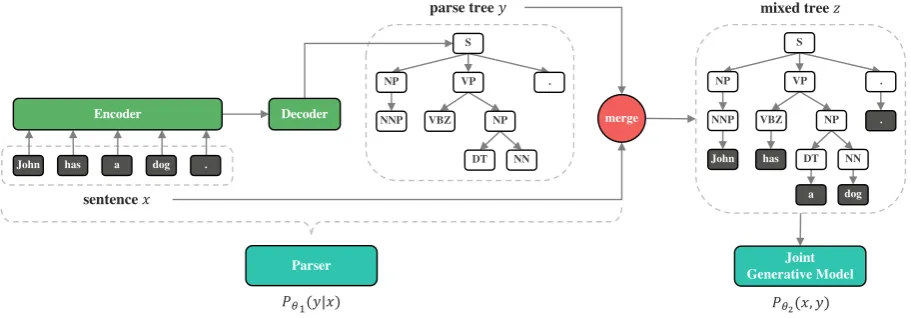
As shown in Figure1, neural variational language model (NVLM) consists of two probabilistic com-ponents: 1) a constituency parserP✓1(y|x)which
models the conditional probability of the parse tree
y(a syntax tree without terminal tokens) given the
input sentencex(a sequence of terminal tokens);
2) a joint generative modelP✓2(x, y)which
mod-els the joint probability of the sentence and the parse tree.
Constituency Parsing.Our parser can work inde-pendently, which takes as input a sentencex and
parsesxaccording to
argmax
y02Y(x) P✓1(y
0|x), (1)
whereY(x)denotes the collection of all possible
parses ofx. Our parser can also cooperate with the joint generative model as
argmax
y0⇠P✓
1(y|x)
P✓2(x, y0), (2)
where the parsing candidates y0 sampled from P✓1(y|x) are fed into the generative model P✓2(x, y)to be reranked.
Language Modeling.Statistical language models are typically formulated as
P(x) =P(x1, x2, . . . , xLx)
=
Lx
Y
t=1
P(xt|x<t), (3)
where xt denotes the t-th token in the sentence
x, the length of x is denoted as Lx, and x<t in-dicates all tokens before xt. To evaluate NVLM as a language model, we need to marginalize the joint probability as P(x) = Py02Y(x)P(x, y0). This is extremely hard to compute due to the ex-ponentially large space ofY(x). We use
impor-tance sampling technique to overcome this com-putational intractability, which is detailed in Sec-tion4.
With treebank data such as Penn Tree-bank (Marcus et al.,1993), we have pairs of(x, y)
sentence !
parse tree "
#$%(!, ") #$)("|!)
mixed tree +
John has a dog .
. S
NP VP
NNP VBZ NP
DT NN
Encoder Decoder
Joint Generative Model merge
Parser
. S
NP VP
NNP VBZ NP
DT NN
has John
a dog
[image:3.595.72.528.62.221.2].
Figure 1: Overall framework of neural variational language model (NVLM). It consists of two probabilistic compo-nents: a constituency parserP✓1(y|x)and a joint generative modelP✓2(x, y). The parser takes as input a sentence xand predicts the corresponding parse treey. Specifically, we use an encoder-decoder structure to parameterize the parser. The joint generative model defines a joint distribution on parse trees (y) and sentences (x). When tree-bank data is available, we can learn the parameters✓1and✓2for each component respectively. To train language
model on new corpus, we fix the pre-trained✓1and only update✓2. Our framework can also be end-to-end jointly
trained to fine-tune the language model, where✓1and✓2are co-updated together.
treebank data is typically scarce. For new corpus without parsing annotations, our proposed frame-work can still leverage the parser to train high-quality language model adapted to the new corpus. Also, we can co-train the two components together to fine-tune the language model on new corpus.
In the rest of this section, we present our param-eterization of the two probabilistic components
P✓1(y|x)andP✓2(x, y). To avoid notational
clut-ter, we use standard RNN as the basic building block in the rest of this section.1
2.2 Constituency Parser
To parameterize the constituency parserP✓1(y|x),
it is natural to first encode the input sentence x
into an embedding vector, then pass the vector to a decoder to generate the parse tree y. There
are quite a few choices for both encoder and decoder, among which recurrent neural network (RNN) and convolutional neural network (CNN) are the most popular ones, since they are power-ful to capture the structural patterns in natural lan-guage (Sutskever et al.,2014;Zhang et al.,2015).
Vinyals et al. (2015) have found that the RNN-powered sequence-to-sequence (Seq2Seq) archi-tecture with attention mechanism achieves state-of-the-art parsing performance. This architecture
1The proposed neural variational language model is
in-dependent of any specific implementation of the recurrent unit such as LSTM (Hochreiter and Schmidhuber, 1997), GRU (Cho et al.,2014) and SRU (Lei and Zhang,2017), and can be directly applied to their deep and bi-directional vari-ants.
is conceptually simple yet powerful and of large model capacity.
In this paper, we adapt the sequence-to-sequence architecture for NVLM. We linearize a parse tree as a bracket representation (a se-quence of nodes and brackets ordered by a pre-order traversal of the tree), which is a one-to-one mapping of the tree structure. For exam-ple, the parse tree shown in Figure 1 can be linearized as (S (NP NNP ) (VP VBZ (NP DT NN ) ) . ). Interestingly, the parser is now similar to a neural translation model ( Bah-danau et al., 2014), which translates a sentence into a linearized parse tree. Next we show how the parser computesP✓1(y|x)in detail.
Formally, the input sentence x is fed into the
encoder, and is encoded as a sequence of hid-den states H = {h1, h2, . . . , hLx}, where Lx
is the length of x, and hi = RNNenc xi, hi 1
where xi is first embedded into a vector (word embedding) and then fed into the recurrent unit, andh0 is a learnable vector for the special
start-of-sentence token <SOS>. The decoder uses a separate RNN to calculate the hidden states
sj =RNNdec [yj 1;cj], sj 1 , wherey0 is set as <SOS>, s0 is set ashLx (the last hidden state of
the encoder), and yj 1 is the decoder’s previous
to serve as the RNN input. The context cj is calculated as cj = PiL=1x ↵i,jhi, where ↵i,j =
exp
⇣
h>
i sj 1
⌘
PLx i0=1exp
⇣
h>
i0sj 1
⌘.This is a simplified version of
the conventional attention mechanism (Bahdanau et al.,2014) used in the Seq2Seq parser (Vinyals et al.,2015). Our parser is designed to be lighter and faster so that it can efficiently work together with the NVLM joint generative model.
Finally, the likelihoodP✓1(y|x)is computed as
P✓1(y|x) =
Ly
Y
t=1
P(yt|x, y<t)
=
Ly
Y
t=1
"
softmax⇣f [st;ct]
⌘#
yt
, (4)
wheref(·) refers to a fully-connected layer with tanh activation, and the subscript yt is to select its probability in the categorical distribution. Ly denotes the length ofy, which is determined by the
decoder itself. Once the decoder emits the special end-of-sentence token<EOS>, the decoding phase is terminated.
The trainable parameters✓1 in the parser
com-ponentP✓1(y|x)include the weights (and biases)
in RNNencand RNNdec, and all word embeddings.
We use separate weights and word embeddings for the encoder and the decoder.
2.3 Joint Generative Model
Similar to the parser, the joint generative model
P✓2(x, y) can also be parameterized in various
ways. For example, Choe and Charniak (2016) uses a LSTM language model trained on the parser output (with terminal words), which is then used to rerank an existing parser and achieves state-of-the-art parsing performance. Inspired by that, we parameterize the joint generative model as
P✓2(x, y) =P(z) =
Lz
Y
t=1
P(zt|z<t), (5)
wherezis the mixed parse tree ofxandy, which is
then mapped to a sequential representation follow-ing a pre-order traversal. Figure1illustrates how a sentencexand its parse treeycan be merged into
a mixed tree. We use another RNNgen to compute
the likelihoodP(zt|z<t), and finally getP✓2(x, y)
using Eq. (5).
Algorithm 1:Sentence word attaching input :sentencex; parser output tokensy
output:mixed tree tokensz 1 ifyis not balancedthen 2 y BalanceTree(y)
3 z Ø
4 j 1
5 Lx Length ofx 6 Ly Length ofy 7 fori 1, . . . , Lydo
8 ifyi2LeafNode(y)^j <=Lxthen
9 z z[{“(”+yi}
10 z z[{xj}
11 z z[{“)”+yi}
12 j j+ 1
13 else
14 z z[{yi}
The trainable parameters✓2 in the joint
genera-tive modelP✓2(x, y)include the weights (and
bi-ases) in RNNgenand all word embeddings.
In Choe and Charniak (2016), the parser is fixed and well-trained before training the gen-erative model. Unlike that, our parser can be jointly trained with the generative model, where the parser may not be fully trained yet. Therefore, the generated parse tree can be malformed, which mismatches the sentence with incorrect number of leaves. An even worse case is when the parser’s output is not balanced and not able to form a le-gitimate tree. To handle these cases, we propose a sentence word attaching algorithm, which guaran-tees to generate a well-formed mixed tree. We de-scribe our algorithm for mixed tree generation in Algorithm1. This algorithm takes as input a sen-tence and its parse tree, and generates a mixed tree by attaching the sentence words to the leaf nodes of the parse tree. To handle unbalanced parse tree, which is rare case but happens due to the nature of sequential parser, we simply add brackets to either the head or tail to make the parse tree balanced.
3 Learning
3.1 Learning Schemes
NVLM can be trained in three different schemes: 1)fully supervised learning, where sentences (x)
and their corresponding parse trees (y) are
avail-able; 2) distant-supervised learning, where we have a pre-trained parser and a new corpus without parsing annotations; 3)semi-supervised learning, where we have no parsing annotations available.
Let DXY = {(x(i), y(i))}n
i=1 denote the
anno-tated training data, where each sentence is paired with a parse tree. LetDX ={x(i)}m
i=1denote the
unannotated training data, where only sentences are available. Next, we show how to train NVLM under each setting respectively.
Supervised: In the fully supervised setting, we useDXY to separately train the parser and the gen-erative model, by maximizing their respective data log likelihood
J✓1(DXY) =
1
n
n
X
i=1
logP✓1(y
(i)|x(i)), (6)
J✓2(DXY) =
1
n
n
X
i=1
logP✓2(x
(i), y(i)), (7)
whereP✓1(·)andP✓2(·)are defined in Eq. (4) and
Eq. (5). We obtain the gradientsr✓1J1andr✓2J2
by chain rule, and iteratively update✓1and✓2with
standard optimizers.
Distant-supervised: In distant-supervised learn-ing, we have pre-trained the parser on corpus DXY, and fix the parser to train the joint gener-ative model on new corpus DX. The generative model can be either trained from scratch on DX or warmed-up onDXY. This setting is of practical importance, since we often need a language model on new corpus without annotations, and the parser pre-trained on treebank data can help since it en-codes common grammar knowledge of the lan-guage.
Under this setting, the pre-trained parser gen-erates parse trees using Eq. (4) for unannotated sentences, and form(x, y) pairs to train the joint
generative model throughr✓2J2. The parser’s
pa-rameters✓1remain fixed.
Semi-supervised: NVLM can be end-to-end trained with only unannotated data DX. This is extremely hard if we train everything from scratch. However, it is very useful to fine-tune the language model on new corpus. Unlike distant-supervised learning, we now train the parser and the joint gen-erative model together, and co-update the
param-Algorithm 2:Semi-supervised learning input :annotated training dataDXY;
unannotated training dataDX; optimizerG(·)
1 Initialize✓1withDXY using Eq. (6) 2 Initialize✓2withDXY using Eq. (7) 3 whilemodel not convergeddo 4 Sample a sentencex(i)fromDX
5 Sample a parse treey(i)fromP✓1(y|x(i)) 6 Standardize the signalA(x(i), y(i))
7 Update the baseline function withb(x(i)) 8 ✓1 ✓1+G r✓1J˜(DX) using Eq. (12) 9 ✓2 ✓2+G r✓2J˜(DX) using Eq. (10)
eters✓1 and✓2. Here we also maximize the data
log likelihood
J(DX) = 1
m
m
X
i=1
log X
y2Y(x(i)) P✓2(x
(i), y)
!
.
(8) Unfortunately, the derivative of J(DX) is com-putationally intractable due to the large space of Y. To tackle this challenge, we use variational methods to maximize the lower bound ofJ(DX),
and exploit policy gradient algorithm to update the parser’s parameters. Details are described in Sec-tion3.2and Section3.3. Our algorithm for semi-supervised learning is summarized in Algorithm2, where we assume mini-batch size as 1 to avoid no-tational clutter.
3.2 Variational EM
As described above, to overcome the compu-tational intractability of maximizing J(DX)
directly, we use variational expectation-maximization (EM) algorithm to maximize the evidence lower bound (ELBO):
˜
J(DX) =1
m
m
X
i=1
EP✓1(y|x(i)) h
logP✓2(x
(i), y) logP
✓1(y|x (i))i,
(9)
where we use our parser as the variational poste-rior P✓1(y|x). For readability, from now on we
assume m = 1and omit summing over training
ob-tain the unbiased gradient
r✓2J˜(DX) =EP✓1(y|x) h
r✓2P✓2(x, y)
i
. (10)
3.3 Policy Gradient
To get the gradient of J˜(DX) w.r.t. the parser
parameters ✓1, we need more work since y is
sampled from a series of categorical distributions. Here we use policy gradient algorithm (Williams,
1992) to get an unbiased estimator of the gradient
r✓1J˜(DX) =EP✓1(y|x)
h
r✓1P✓1(y|x)A(x, y)
i
,
(11)
whereA(x, y) = logP✓2(x, y) logP✓1(y|x)is
used as the learning signal. Due to the limit of space, we provide detailed derivation of Eq. (11) in Appendix E. In order to stabilize the learning process, we use standard variance reduction tech-niques to reduce the variance of gradient ( Green-smith et al.,2004;Mnih and Gregor,2014;Zhang et al.,2017). Specifically, we first standardize the signal (rescaling it to zero mean and unit variance) and then subtract a baseline function b(x). Then
we use a separate GRU as the baseline function and fit the centered signal by minimizing the mean square loss. Finally, the gradient can be approxi-mated as
r✓1J˜(DX)⇡EP✓1(y|x)
"
r✓1P✓1(y|x)
✓
A(x, y) µ˜
˜ b(x)
◆#
, (12)
whereµ˜ is the sample mean and ˜ is the sample
standard deviation, which estimate the mean and standard deviation of the learning signalA(x, y).
4 Inference
With the two components in NVLM, a parser
P✓1(y|x) and a joint generative model P✓2(x, y),
we can do three types of inference:
• Parsing, where we sample the parser with greedy decoding to generate the parse tree for input sentence;
• EvaluatingP✓2(x, y), which is obtained from
the joint generative model, and can be used to help rerank parsing candidates;
• Estimating P(x) = Py02Y(x)P(x, y0) and evaluating the model perplexity, which is in-tractable due to the exponentially large space ofY(x). Similar to Dyer et al. (2016), we use importance sampling technique to esti-mateP(x).
Specifically, we use our parserP✓1(y|x) as the
proposal distribution. The estimator ofP(x)is
de-rived as
P(x) = X
y02Y(x)
P✓1(y0|x)
P✓2(x, y0) P✓1(y0|x)
=EP✓
1(y0|x)
P✓2(x, y0) P✓1(y0|x)
. (13)
5 Experiments 5.1 Settings
Datasets. We conduct experiments on two pop-ular datasets for language modeling: Penn Tree-bank (PTB;Marcus et al.,1993) and One Billion Word Benchmark (OBWB;Chelba et al.,2013).2 The PTB dataset has parsing annotations, while OBWB dataset has no annotations. For the PTB dataset, we adopt the standard train / validation / test split. We build the vocabulary based on PTB, using one unknown token for singleton words. For the OBWB dataset, we use the original train/test split, and subsample each to have similar size of PTB (50K sentences for training, and 2.5K sen-tences for test). The subsampling is for the effi-ciency of evaluating perplexity using importance sampling, which requires to sample multiple (we use 100) parse trees for each sentence. The train-ing of our framework is actually much more scal-able than the perplexity evaluation, and not re-stricted to the size of downsampled dataset. Note that our data preprocessing scheme follows what is standard in parsing instead of language modeling, since parsing typically requires more information (such as capital letters) and larger vocabulary. The vocabulary size for text is 26,620, and we have a separate vocabulary of size 74 for nonterminal nodes of parsing, such as(NPandNNP. Refer to AppendixAfor more data preprocessing details. Tasks.We work on three different tasks: 1) super-vised learning: we separately train both the parser
2The treebank data is publicly available through
and the joint generative model on PTB; 2) distant-supervised learning: we pre-train the parser on PTB, and then fix the parser to train the joint gen-erative model on OBWB either from scratch or with PTB warmed-up model; 3) semi-supervised learning: we jointly train the parser and the gen-erative model together on OBWB to fine-tune the language model.
Evaluation.We mainly focus on language model-ing, and use per-word perplexity to evaluate our framework and competitor models. As for the parser, we compare with state-of-the-art parsers in terms of training and testing speed.
Baselines. On the PTB dataset, we compare our language model with the following baselines: 1) Kneser-Ney 5-gram language model; 2) LSTM language model; 3) GRU language model im-plemented by ourselves; 4) recent state-of-the-art language models that also incorporate grammar to improve language modeling, including RNNG, SO-RNNG and GA-RNNG (Dyer et al., 2016;
Kuncoro et al., 2017). On OBWB dataset, since there is no parsing annotations available, we com-pare with GRU language model as a strong base-line.
Optimization. All our models are trained on a single NVIDIA GTX 1080 GPU. For all NVLM models, we use Adam optimizer (Kingma and Ba,
2014) for the parser, and standard SGD for the joint generative model. Gradients are clipped at 0.25. See AppendixBfor more details.
5.2 Supervised Learning
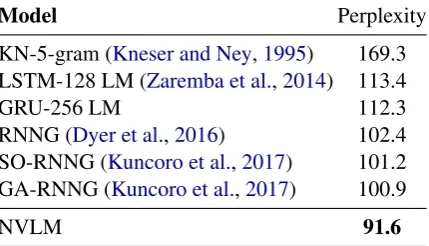
We first experiment on PTB dataset in the super-vised learning setting. We separately train our parser and joint generative model on PTB train-ing dataset, and then evaluate our language model on PTB test dataset. Table 2 lists the perfor-mance of our framework and competitor models. GRU-256 LM is our implemented language model using 2-layer GRU with hidden size 256, which is also used in other experiments. Parsing an-notations are used by RNNG, SO-RNNG, GA-RNNG and NVLM. These grammar-aware models achieve significantly better performance compared to state-of-the-art sequential RNN-based language models, showing that grammar indeed helps lan-guage modeling. NVLM substantially improves over the current state of the art, by 10% reduction on test perplexity.
With respect to our parser, instead of
pursu-Model Perplexity
KN-5-gram (Kneser and Ney,1995) 169.3 LSTM-128 LM (Zaremba et al.,2014) 113.4
GRU-256 LM 112.3
RNNG (Dyer et al.,2016) 102.4 SO-RNNG (Kuncoro et al.,2017) 101.2 GA-RNNG (Kuncoro et al.,2017) 100.9
[image:7.595.310.525.65.188.2]NVLM 91.6
Table 2: Test perplexity on PTB §23. KN-5-gram refers to Kneser-Ney 5-gram LM. Note that, since pars-ing typically requires more information (e.g., capi-tal letters), we follow the standard data preprocessing of syntax-aware language modeling as in Dyer et al.
(2016), thus the vocabulary size (⇠27K) is much larger than the capped vocabulary size (10K) in standard lan-guage modeling setting. Therefore, all the perplexity results reported in this paper are not directly compara-ble to that achieved by syntax-agnostic language mod-els with a much smaller vocabulary, such as the per-plexity 57.3 reported inMerity et al.(2017) and 54.5 reported inDai et al.(2019). This also applies to the perplexity results on the OBWB dataset.
ing state-of-the-art parsing performance, it is de-signed to be light and fast to efficiently work to-gether with the NVLM joint generative model. Our parser achieves 90.7 F1accuracy on PTB test
dataset, which is comparable to state-of-the-art parsers. Due to the page limit, we report the de-tailed parsing performance in AppendixC.
5.3 Distant-supervised Learning
silver-standard parse trees.
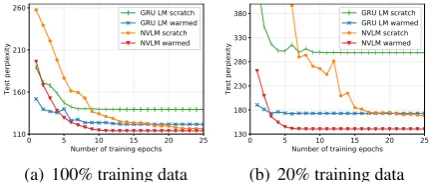
Figure 2(a) shows the test perplexity curves along with number of training epochs. In both from-scratch and warmed-up settings, NVLM per-forms significantly better than GRU LM by 22.7 and 7.8 points in perplexity reduction. The warmed-up NVLM converges fast and achieves the lowest perplexity. Even when trained from scratch, NVLM achieves better performance than the warmed-up GRU LM, though it takes longer to converge. Note that the warm-up of GRU LM is directly training P(x) with more data, while
the warm-up of NVLM is only forP(x, y). This explains why GRU LM seems to benefit more from warm-up at beginning, and why NVLM from scratch takes longer to converge.
Unlike the supervised learning setting, NVLM can now be trained on new corpus without pars-ing annotations, and still leverages the common grammar knowledge. To further study the adap-tation speed of NVLM on new corpus, we train NVLM with variant proportion of training data in both from-scratch and warmed-up settings. We also train GRU LM as a strong baseline. Results are reported in Table3.
As shown in Table 3, with smaller amount of data, NVLM outperforms GRU LM even more significantly. We find that with only 20% of train-ing data, the warmed-up NVLM achieves test per-plexity 140.6, which is comparable to GRU LM trained with full data from scratch (139.3). This demonstrates that our framework is data-efficient, and can quickly adapt to new corpus without pars-ing annotations. Moreover, we notice that even without looking at the new corpus (0% train-ing data), the warmed-up NVLM achieves rea-sonable perplexity (151.8) which is substantially lower than the warmed-up GRU LM (242.2). This agrees with our conjecture that grammar knowl-edge is sharable among different corpora. Fig-ure2(b)plots the test perplexity curves using 20% OBWB training data. The warmed-up NVLM quickly converges, and achieves much lower per-plexity compared to the warmed-up GRU LM.
5.4 Semi-supervised Learning
In distant-supervised setting, the parser is fixed when training NVLM on new corpus. We can ac-tually continue training the parser together with the generative model, so that the language model can be fine-tuned in end-to-end fashion. This is
es-(a) 100% training data (b) 20% training data
Figure 2: Test perplexity curves on the subsampled OBWB dataset. Models are trained respectively on 100% and 20% training data. Models randomly initial-ized are marked as “scratch”, while models pre-trained on the PTB dataset are marked as “warmed”.
Training
Data scratch warmed scratch warmedGRU LM NVLM
0% >1000 242.2 >1000 151.8
20% 298.8 173.1 168.2 140.6
40% 210.3 147.3 143.3 138.5
60% 177.6 136.5 135.8 133.5
80% 152.5 130.5 128.6 125.6
100% 139.3 121.7 116.6 113.9
Table 3: Test perplexity on the subsampled OBWB dataset. Models are trained on variant proportion of training data. Models randomly initialized are marked as “scratch”, while models pre-trained on the PTB dataset are marked as “warmed”.
sentially semi-supervised learning: the parser has to be updated without parsing annotations, and the generative model will be updated together. Due to the exponentially large space of parse trees, such joint training is computationally intractable. To tackle the challenge, we use variational EM (Section 3.2) and exploit policy gradient (Sec-tion3.3) algorithm to co-update both components of NVLM.
[image:8.595.308.524.66.157.2]Model Perplexity
GRU LM – from scratch 139.3
GRU LM – warmed-up on PTB 121.7
NVLM – from scratch 116.6
NVLM – warmed-up on PTB 113.9
[image:9.595.73.292.64.160.2]NVLM – fine-tuned by joint training 110.2
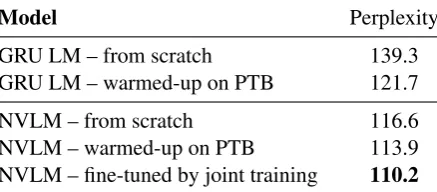
Table 4: Test perplexity on the subsampled OBWB dataset. All models are trained with 100% training data.
been fine-tuned on new corpus, and we have no annotations to evaluate the parser on new corpus.
6 Related Work and Discussion
Due to the remarkable success of RNN-based lan-guage models (Mikolov et al., 2010b,a; Jozefow-icz et al., 2016;Yang et al., 2017;Merity et al.,
2017; Elbayad et al., 2018; Gong et al., 2018;
Takase et al., 2018; Dai et al., 2019), not too much attention has been paid to incorporate syn-tactic knowledge into language model. Although RNN-based models achieve impressive results on language modeling and other NLP tasks such as machine translation (Cho et al., 2014; Bahdanau et al.,2014;Xia et al.,2016) and parsing (Vinyals et al., 2015; Dyer et al., 2015; Choe and Char-niak,2016), it is far from perfect since it overlooks the language structure and simply generates sen-tence from left to right. The words in natural lan-guage are largely organized in latent nested struc-tures rather than simple sequential order ( Chom-sky,2002).
Our work is related to syntactic language mod-els, which has a long history. Traditional syn-tactic language models jointly generate synsyn-tactic structure with words using either bottom-up ( Je-linek and Lafferty, 1991; Emami and Jelinek,
2004,2005;Henderson,2004), or top-down strat-egy (Charniak, 2000; Roark, 2001). Recently, some studies show the benefits of incorporat-ing language structure into RNN-based language model, such as RNNG (Dyer et al.,2016;Kuncoro et al.,2017). Different from our work, these mod-els mainly focus on parsing instead of language modeling, and cannot be trained without parsing annotations. Works on programming code gener-ation (Rabinovich et al., 2017; Yin and Neubig,
2017) demonstrate that grammar is the key of ef-fective code generation. Compared to natural
lan-guage, programming code is more regulated and typically has well-defined grammar, thus it is more challenging to exploit the grammar knowledge in natural language.
Our work is also related to transfer learning of deep learning models (Bengio, 2012). There are some recent studies on neural language model adaptation (Yoon et al., 2017; Ma et al., 2017;
Chen et al., 2015). However, none of them ex-ploits grammar knowledge. There exists other lines of work on a broad field of general text generation (not for language modeling), such as GAN-based methods (Guo et al., 2017;Li et al.,
2017) and VAE-based ones (Hu et al., 2017). It is a promising direction to incorporate syntac-tic knowledge into these generative models. Our work is also inspired by works on syntactical structured RNNs, such as tree LSTM (Tai et al.,
2015), hierarchical RNNs (Chung et al., 2016) and doubly RNNs (Alvarez-Melis and Jaakkola,
2016).
Language models are widely used in a broad range of applications. We believe that a high-quality language model can benefit many down-stream tasks, such as machine translation, dia-logue systems, and speech recognition. We con-sider to explore whether our framework can be seamlessly used in those applications, and leave it as future work.
7 Conclusion
In this work, we aim to improve language model-ing with shared grammar. Our framework contains two probabilistic components: a constituency parser and a joint generative model. The parser encodes grammar knowledge in natural language, which helps language model quickly land on new corpus. We also propose algorithms for jointly training the two components to fine-tune the lan-guage model on new corpus without parsing anno-tations. Experiments demonstrate that our method improves language modeling on new corpus in terms of both convergence speed and perplexity.
Acknowledgements
References
David Alvarez-Melis and Tommi S Jaakkola. 2016. Tree-structured decoding with doubly-recurrent neural networks.
Dzmitry Bahdanau, Kyunghyun Cho, and Yoshua Ben-gio. 2014. Neural machine translation by jointly learning to align and translate. arXiv preprint arXiv:1409.0473.
Yoshua Bengio. 2012. Deep learning of representa-tions for unsupervised and transfer learning. In Pro-ceedings of ICML Workshop on Unsupervised and Transfer Learning, pages 17–36.
Eugene Charniak. 2000. A maximum-entropy-inspired parser. In Proceedings of the 1st North American chapter of the Association for Computational Lin-guistics conference, pages 132–139. Association for Computational Linguistics.
Eugene Charniak and Mark Johnson. 2005. Coarse-to-fine n-best parsing and maxent discriminative reranking. InProceedings of the 43rd annual meet-ing on association for computational lmeet-inguistics, pages 173–180. Association for Computational Lin-guistics.
Ciprian Chelba, Tomas Mikolov, Mike Schuster, Qi Ge, Thorsten Brants, Phillipp Koehn, and Tony Robin-son. 2013. One billion word benchmark for measur-ing progress in statistical language modelmeasur-ing. arXiv preprint arXiv:1312.3005.
Xie Chen, Tian Tan, Xunying Liu, Pierre Lanchantin, Moquan Wan, Mark JF Gales, and Philip C Wood-land. 2015. Recurrent neural network language model adaptation for multi-genre broadcast speech recognition. InSixteenth Annual Conference of the International Speech Communication Association.
Kyunghyun Cho, Bart Van Merri¨enboer, Caglar Gul-cehre, Dzmitry Bahdanau, Fethi Bougares, Holger Schwenk, and Yoshua Bengio. 2014. Learning phrase representations using rnn encoder-decoder for statistical machine translation. arXiv preprint arXiv:1406.1078.
Do Kook Choe and Eugene Charniak. 2016. Parsing as language modeling. InProceedings of the 2016 Conference on Empirical Methods in Natural Lan-guage Processing, pages 2331–2336.
Noam Chomsky. 2002.Syntactic structures. Walter de Gruyter.
Junyoung Chung, Sungjin Ahn, and Yoshua Bengio. 2016. Hierarchical multiscale recurrent neural net-works. arXiv preprint arXiv:1609.01704.
Zihang Dai, Zhilin Yang, Yiming Yang, William W Cohen, Jaime Carbonell, Quoc V Le, and Ruslan Salakhutdinov. 2019. Transformer-xl: Attentive lan-guage models beyond a fixed-length context. arXiv preprint arXiv:1901.02860.
Chris Dyer, Miguel Ballesteros, Wang Ling, Austin Matthews, and Noah A Smith. 2015. Transition-based dependency parsing with stack long short-term memory.arXiv preprint arXiv:1505.08075. Chris Dyer, Adhiguna Kuncoro, Miguel Ballesteros,
and Noah A Smith. 2016. Recurrent neural network grammars. In Proceedings of NAACL-HLT, pages 199–209.
Maha Elbayad, Laurent Besacier, and Jakob Verbeek. 2018. Token-level and sequence-level loss smooth-ing for RNN language models. InProceedings of the 56th Annual Meeting of the Association for Compu-tational Linguistics (Volume 1: Long Papers), pages 2094–2103, Melbourne, Australia. Association for Computational Linguistics.
Ahmad Emami and Frederick Jelinek. 2004. Exact training of a neural syntactic language model. In Acoustics, Speech, and Signal Processing, 2004. Proceedings.(ICASSP’04). IEEE International Con-ference on, volume 1, pages I–245. IEEE.
Ahmad Emami and Frederick Jelinek. 2005. A neural syntactic language model. Machine learning, 60(1-3):195–227.
Chengyue Gong, Di He, Xu Tan, Tao Qin, Liwei Wang, and Tie-Yan Liu. 2018. Frage: frequency-agnostic word representation. InAdvances in Neural Infor-mation Processing Systems, pages 1334–1345. Evan Greensmith, Peter L Bartlett, and Jonathan
Bax-ter. 2004. Variance reduction techniques for gradi-ent estimates in reinforcemgradi-ent learning. Journal of Machine Learning Research, 5(Nov):1471–1530. Jiaxian Guo, Sidi Lu, Han Cai, Weinan Zhang, Yong
Yu, and Jun Wang. 2017. Long text generation via adversarial training with leaked information. arXiv preprint arXiv:1709.08624.
James Henderson. 2004. Discriminative training of a neural network statistical parser. InProceedings of the 42nd Annual Meeting on Association for Compu-tational Linguistics, page 95. Association for Com-putational Linguistics.
Sepp Hochreiter and J¨urgen Schmidhuber. 1997. Long short-term memory. Neural computation, 9(8):1735–1780.
Zhiting Hu, Zichao Yang, Xiaodan Liang, Ruslan Salakhutdinov, and Eric P Xing. 2017. Toward con-trolled generation of text. InInternational Confer-ence on Machine Learning, pages 1587–1596. Frederick Jelinek and John D Lafferty. 1991.
Compu-tation of the probability of initial substring genera-tion by stochastic context-free grammars. Computa-tional Linguistics, 17(3):315–323.
Diederik P Kingma and Jimmy Ba. 2014. Adam: A method for stochastic optimization. arXiv preprint arXiv:1412.6980.
Nikita Kitaev and Dan Klein. 2018. Constituency parsing with a self-attentive encoder. In Proceed-ings of the 56th Annual Meeting of the Association for Computational Linguistics (Volume 1: Long Pa-pers), pages 2676–2686, Melbourne, Australia. As-sociation for Computational Linguistics.
Dan Klein and Christopher D Manning. 2003. Accu-rate unlexicalized parsing. In Proceedings of the 41st annual meeting of the association for compu-tational linguistics.
Reinhard Kneser and Hermann Ney. 1995. Improved backing-off for m-gram language modeling. In Acoustics, Speech, and Signal Processing, 1995. ICASSP-95., 1995 International Conference on, vol-ume 1, pages 181–184. IEEE.
Lingpeng Kong and Noah A Smith. 2014. An empiri-cal comparison of parsing methods for stanford de-pendencies. arXiv preprint arXiv:1404.4314.
Adhiguna Kuncoro, Miguel Ballesteros, Lingpeng Kong, Chris Dyer, Graham Neubig, and Noah A. Smith. 2017. What do recurrent neural network grammars learn about syntax? In Proceedings of the 15th Conference of the European Chapter of the Association for Computational Linguistics: Volume 1, Long Papers, pages 1249–1258, Valencia, Spain. Association for Computational Linguistics.
Tao Lei and Yu Zhang. 2017. Training rnns as fast as cnns. arXiv preprint arXiv:1709.02755.
Jiwei Li, Will Monroe, Tianlin Shi, Alan Ritter, and Dan Jurafsky. 2017. Adversarial learning for neural dialogue generation. arXiv preprint arXiv:1701.06547.
Min Ma, Michael Nirschl, Fadi Biadsy, and Shankar Kumar. 2017. Approaches for neural-network lan-guage model adaptation. Proc. Interspeech 2017, pages 259–263.
Mitchell P Marcus, Mary Ann Marcinkiewicz, and Beatrice Santorini. 1993. Building a large annotated corpus of english: The penn treebank. Computa-tional linguistics, 19(2):313–330.
G´abor Melis, Chris Dyer, and Phil Blunsom. 2017. On the state of the art of evaluation in neural language models. arXiv preprint arXiv:1707.05589.
Stephen Merity, Nitish Shirish Keskar, and Richard Socher. 2017. Regularizing and optimizing lstm lan-guage models. arXiv preprint arXiv:1708.02182.
Tom´aˇs Mikolov, Martin Karafi´at, Luk´aˇs Burget, Jan ˇCernock`y, and Sanjeev Khudanpur. 2010a. Re-current neural network based language model. In Eleventh Annual Conference of the International Speech Communication Association.
Tomas Mikolov, Martin Karafi´at, Lukas Burget, Jan Cernock`y, and Sanjeev Khudanpur. 2010b. Recur-rent neural network based language model. In Inter-speech, volume 2, page 3.
Andriy Mnih and Karol Gregor. 2014. Neural vari-ational inference and learning in belief networks. arXiv preprint arXiv:1402.0030.
Adam Paszke, Sam Gross, Soumith Chintala, Gre-gory Chanan, Edward Yang, Zachary DeVito, Zem-ing Lin, Alban Desmaison, Luca Antiga, and Adam Lerer. 2017. Automatic differentiation in pytorch. Slav Petrov, Leon Barrett, Romain Thibaux, and Dan
Klein. 2006. Learning accurate, compact, and inter-pretable tree annotation. InProceedings of the 21st International Conference on Computational Lin-guistics and the 44th annual meeting of the Associa-tion for ComputaAssocia-tional Linguistics, pages 433–440. Association for Computational Linguistics.
Maxim Rabinovich, Mitchell Stern, and Dan Klein. 2017. Abstract syntax networks for code gen-eration and semantic parsing. arXiv preprint arXiv:1704.07535.
Brian Roark. 2001. Probabilistic top-down parsing and language modeling. Computational linguistics, 27(2):249–276.
Yikang Shen, Zhouhan Lin, Chin-Wei Huang, and Aaron Courville. 2017. Neural language model-ing by jointly learnmodel-ing syntax and lexicon. arXiv preprint arXiv:1711.02013.
Richard Socher, John Bauer, Christopher D Manning, et al. 2013. Parsing with compositional vector gram-mars. InProceedings of the 51st Annual Meeting of the Association for Computational Linguistics (Vol-ume 1: Long Papers), volume 1, pages 455–465. Ilya Sutskever, Oriol Vinyals, and Quoc V Le. 2014.
Sequence to sequence learning with neural net-works. InAdvances in neural information process-ing systems, pages 3104–3112.
Jun Suzuki, Sho Takase, Hidetaka Kamigaito, Makoto Morishita, and Masaaki Nagata. 2018. An empir-ical study of building a strong baseline for con-stituency parsing. In Proceedings of the 56th An-nual Meeting of the Association for Computational Linguistics (Volume 2: Short Papers), pages 612– 618, Melbourne, Australia. Association for Compu-tational Linguistics.
Kai Sheng Tai, Richard Socher, and Christopher D Manning. 2015. Improved semantic representations from tree-structured long short-term memory net-works. arXiv preprint arXiv:1503.00075.
Oriol Vinyals,Łukasz Kaiser, Terry Koo, Slav Petrov, Ilya Sutskever, and Geoffrey Hinton. 2015. Gram-mar as a foreign language. InAdvances in Neural Information Processing Systems, pages 2773–2781.
Ronald J Williams. 1992. Simple statistical gradient-following algorithms for connectionist reinforce-ment learning. In Reinforcement Learning, pages 5–32. Springer.
Yingce Xia, Di He, Tao Qin, Liwei Wang, Nenghai Yu, Tie-Yan Liu, and Wei-Ying Ma. 2016. Dual learning for machine translation. arXiv preprint arXiv:1611.00179.
Zhilin Yang, Zihang Dai, Ruslan Salakhutdinov, and William W Cohen. 2017. Breaking the softmax bot-tleneck: a high-rank rnn language model. arXiv preprint arXiv:1711.03953.
Pengcheng Yin and Graham Neubig. 2017. A syntactic neural model for general-purpose code generation. arXiv preprint arXiv:1704.01696.
Seunghyun Yoon, Hyeongu Yun, Yuna Kim, Gyu-tae Park, and Kyomin Jung. 2017. Efficient transfer learning schemes for personalized language model-ing usmodel-ing recurrent neural network. arXiv preprint arXiv:1701.03578.
Wojciech Zaremba, Ilya Sutskever, and Oriol Vinyals. 2014. Recurrent neural network regularization. arXiv preprint arXiv:1409.2329.
Xiang Zhang, Junbo Zhao, and Yann LeCun. 2015. Character-level convolutional networks for text clas-sification. In Advances in neural information pro-cessing systems, pages 649–657.
Yuyu Zhang, Hanjun Dai, Zornitsa Kozareva, Alexan-der J Smola, and Le Song. 2017. Variational reason-ing for question answerreason-ing with knowledge graph. arXiv preprint arXiv:1709.04071.