ORIGINAL RESEARCH
Diffusion Tensor Imaging Characteristics of the
Corpus Callosum in Mild, Moderate, and Severe
Traumatic Brain Injury
D.R. Rutgers P. Fillard G. Paradot M. Tadie´ P. Lasjaunias D. Ducreux
BACKGROUND AND PURPOSE:The corpus callosum is an important predilection site for traumatic axonal injury but may be unevenly affected in head trauma. We hypothesized that there were local differences in axonal injury within the corpus callosum as investigated with diffusion tensor imaging (DTI), varying among patients with differing severity of traumatic brain injury (TBI).
MATERIALS AND METHODS: Ethics committee approval and informed consent were obtained. Ten
control subjects (7 men, 3 women; mean age, 37⫾9 years) and 39 patients with TBI (27 men, 12 women; 34⫾12 years) were investigated, of whom 24 had mild; 9, moderate; and 6, severe TBI. Regions of interest were selected in the callosal genu, body, and splenium to calculate fractional anisotropy (FA), apparent diffusion coefficient (ADC), and the number of fibers passing through. Statistical comparison was made through analysis of variance with the Scheffe´ post hoc analysis. RESULTS: Compared with controls, patients with mild TBI investigated⬍3 months posttrauma (n⫽ 12) had reduced FA (P⬍.01) and increased ADC (P⬍.05) in the genu, whereas patients with mild TBI investigated ⱖ3 months posttrauma (n ⫽ 12) showed no significant differences. Patients with moderate and severe TBI, all investigated⬍3 months posttrauma, had reduced FA (P⬍.001) and increased ADC (P⬍.01) in the genu compared with controls and reduced FA in the splenium (P⬍.001) without significant ADC change.
CONCLUSION:Mild TBI is associated with DTI abnormalities in the genu⬍3 months posttrauma. In more severe TBI, both the genu and splenium are affected. DTI suggests a larger contribution of vasogenic edema in the genu than in the splenium in TBI.
T
raumatic axonal injury is a frequent cause of impaired clin-ical outcome in patients with traumatic brain injury (TBI).1The location and severity of traumatic axonal injury isrelated to various factors,2,3including the characteristics of
acceleration/deceleration forces during the trauma incident and differences in attenuation and rigidity between adjacent cerebral structures. One of the predilection sites of traumatic axonal injury is the corpus callosum.2,4This structure forms
the largest commissural white matter bundle in the brain. Its genu connects orbitofrontal and frontal cortices, whereas its body and splenium connect temporal, parietal, and occipital regions.5CT and MR imaging studies have indicated that the
corpus callosum is unevenly affected in TBI in the sense that the splenium more commonly shows traumatic axonal injury than the genu and body.2-4,6,7However, the frequency of
ax-onal injury is underestimated with CT and various MR imag-ing techniques, such as fluid-attenuated inversion recovery (FLAIR), T2-weighted fast spin-echo, and T2*-weighted gra-dient-echo (GE) sequences.7,8Diffusion tensor imaging (DTI)
has evolved in recent years as a valuable complementary tech-nique to investigate traumatic axonal injury.9-15DTI allows quantification of tissue architecture through an extensive
de-scription of water diffusion.16,17DTI parameters such as frac-tional anisotropy (FA) describe the level of structural integrity of the tissue that is investigated.16Traumatic axonal injury is
associated with FA reduction and changes of the apparent dif-fusion coefficient (ADC).9-15Fiber tracking algorithms can be
used to reconstruct white matter fibers in 3D and may dem-onstrate reduction of fiber attenuation in TBI.9
Several DTI studies have investigated the corpus callosum in head trauma.9,11,13-15The extent of traumatic axonal injury
in the corpus callosum and its relation to trauma severity are not clear from these studies. First, a number of studies inves-tigated only the genu and/or splenium rather than genu, body, and splenium.11,13-15Second, various studies included only patients with mild or severe TBI, instead of patients with a range of trauma severities.9,11,15
The purpose of the present study was to investigate DTI characteristics of the corpus callosum in patients with mild, moderate, and severe TBI. We hypothesized that there were local differences in DTI characteristics within the corpus cal-losum, which varied among patients with different TBI severities.
Materials and Methods
Patients and Control Subjects
The study was approved by our local ethics committee. Informed consent was obtained from each patient or from the patient’s first-degree relatives. We prospectively investigated 39 patients with TBI (27 men, 12 women; mean age, 34⫾12 years). They were selected from 46 consecutive patients who were referred to our neuroradiol-ogy department for DTI evaluation of TBI between June 2006 and June 2007 and who had no known history or MR imaging evidence of
Received March 7, 2008; accepted after revision May 16.
From the Departments of Neuroradiology (D.R.R., P.L., D.D.) and Neurosurgery (G.P., M.T.), Le Centre hospitalier universitaire (CHU) de Biceˆtre, Le Kremlin Biceˆtre, France; and Institut National de la Recherche en Informatique et Automatique (P.F.), Sophia Antipolis, France. This work was supported by the Institut pour la Recherche sur la Moelle e´pinie`re et l’Ence´phale, Paris, France. D.R. Rutgers was supported by a grant from the Catharijne Stichting Utrecht and Sara Lee International.
Please address correspondence to Denis Ducreux, Department of Neuroradiology, CHU de Biceˆtre, 78 rue du Ge´ne´ral Leclerc, 94270 Le Kremlin Biceˆtre, France; e-mail: [email protected]
additional central nervous system disease. Patients with movement artifacts on MR images (n⫽7) were excluded. Of the 39 included patients, 24 had mild; 9, moderate; and 6, severe TBI, defined as trau-matic head injury with an initial Glasgow Coma Scale scoreⱖ13 (mild), 9 –12 (moderate), orⱕ8 (severe). We investigated 10 age-matched control subjects (7 men, 3 women; mean age, 37⫾9 years) for reference values. They were volunteers from our department who gave informed consent to participate in the study and who had no known history or MR imaging evidence of central nervous system disease.
MR Imaging Protocol
Investigations were performed on a 1.5T system (Sonata scanner, Sie-mens, Erlangen, Germany). Straight head positioning without tilt was aimed at in each patient and control subject. The MR imaging proto-col consisted of an axial 3D T1-weighted scan (TR/TE, 11/4 ms), a FLAIR scan (TR/TE/TI, 9480/112/2390 ms), an axial T2*-weighted GE scan (TR/TE, 1330/33 ms), and an axial echo-planar imaging (EPI) DTI scan (TR/TE, 5700/110 ms; FOV, 24⫻24 cm; image ma-trix, 128⫻128; number of sections, 30; section thickness, 4 mm; nominal voxel size, 1.875⫻1.875⫻4 mm; number of signal intensity averages, 3) with diffusion gradients set in 25 noncollinear directions by using 2 b-values (b⫽0 and 1000 s/mm2). The DTI scanning took 7 minutes 30 seconds
DTI Data Processing
DTI data were processed on a voxel-by voxel basis with dedicated software (DPTools [http://www.fmritools.org]). A correction algo-rithm was applied to the DTI dataset to account for distortions that were related to eddy currents induced by the large diffusion-sensitiz-ing gradients. It relied on a 3-parameter distortion model includdiffusion-sensitiz-ing scale, shear, and linear translation in the phase-encoding direction.18 The 25 elements for each voxel, calculated from the images that were obtained by applying diffusion-sensitizing gradients in the 25 noncol-linear directions, in addition to a non-diffusion-weighted image, were diagonalized to compute the eigenvalues (1,2,3) of the diffusion tensor matrix. The ADC was given by ADC⫽(1⫹2⫹3) / 3, and FA by
FA⫽
冑
3 2䡠冑
共1⫺兲2⫹共2⫺兲2⫹共3⫺兲2冑
12⫹22⫹32,
where
⫽1⫹2⫹3
3 .
FA values were visualized in 2D color maps.
Fiber Tracking
Fiber tracking was performed with dedicated software (MedINRIA [http://www-sop.inria.fr/asclepios/software/MedINRIA]). White mat-ter fiber tracts were created in 3D on the basis of similarities between neighboring voxels in shape (quantitative diffusion anisotropy mea-sures) and orientation (principal eigenvector map) of the diffusion ellipsoid and coregistered on the FA map by using a special algorithm previously described.19,20The principal diffusion direction meth-od20-22was used, in which the eigenvector corresponding to the larg-est eigenvalue is extracted from the diffusion tensor field generated from the DTI datasets in the region where the diffusion is linear. The FA threshold value was 0.20; and the angulation threshold, 45° to prevent fibers from sudden transition and to keep tracking based on
the connectivity of the neighborhood, as described elsewhere.20,21 The 3D fiber reconstructions were color-coded so that blue repre-sented the superior-inferior; green, the anteroposterior; and red, the left-right direction.
Measurements
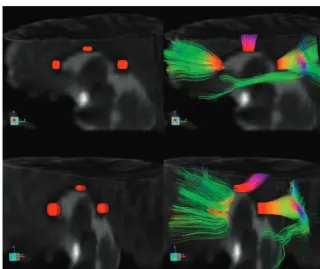
Measurements were performed by 1 investigator (D.R.R.) with the software packages described in the previous paragraphs. After realign-ment and spatial normalization of the DTI scans, 3 midline regions of interest were manually drawn in the corpus callosum on the FA map of each individual: a region of interest of 4⫻4⫻2 (x⫻y⫻z) voxels (7.5⫻7.5⫻8 mm⫽450 mm3) in the genu, a region of interest of 3⫻ 5⫻1 voxels (5.625⫻9.375⫻4 mm⫽211 mm3) in the body, and a region of interest of 4⫻5⫻2 voxels (7.5⫻9.375⫻8 mm⫽562.5 mm3) in the splenium (Fig 1). Visual comparison was made with the corresponding low b-value diffusion, T1, and FLAIR sections to con-firm region-of-interest localization in the corpus callosum without including CSF. For each region of interest, the presence of FLAIR hyperintensities was scored, as well as the presence of hypointensities on the low b-value EPI diffusion and the T2*-weighted scan. Regions of interest that contained such hypointensities, which were consid-ered indicative of hemorrhage, were excluded. For all other regions of interest, FA and ADC were calculated. Fiber tracking software allowed reconstruction of fibers that passed through a given region of interest (Fig 2). The number of fibers passing through was calculated for each region of interest. All patient measurements were performed blinded to the clinical status of the patient.
Statistical Analysis
Analysis of variance (ANOVA) with Scheffe´ post hoc analysis, the2 test, and the nonparametric Kruskal-Wallis test were used to analyze differences in baseline characteristics between patient groups. Differ-ences in DTI and fiber tracking parameters between groups were an-alyzed through ANOVA with the Scheffe´ post hoc analysis. A P value ⬍.05 was considered to indicate a statistically significant difference.
Results
Patient groups showed no statistically significant differences in age and sex (Table 1). The time period between the trauma incident and the MR image was longer in patients with mild TBI than in patients with moderate or severe TBI, who were all investigated⬍3 months posttrauma. However, the difference among groups was not statistically significant (P ⫽ .2, Kruskal-Wallis test). The frequency of FLAIR hyperintensities in the genu, body, and splenium regions of interest and the frequency of EPI/GE hypointensities in the body and splenium regions of interest were higher in patients with severe TBI than in the other 2 patient groups. However, only the difference in FLAIR hyperintensities in the splenium showed statistical sig-nificance (P⬍.05). In 1 patient with severe TBI, the region of interest in the callosal body contained EPI/GE hypointensities indicative of hemorrhage. The splenium region of interest contained such hypointensities in 1 patient with mild TBI and in 1 patient with severe TBI. These regions of interest were excluded from further analyses.
Compared with control subjects, patients with mild TBI showed no significant difference in FA, ADC, and number of fibers for the genu, body, and splenium (Table 2).
Patients with moderate TBI (Table 2) had significantly
FUNCTIONAL
ORIGINAL
Fig 1.Localization of regions of interest. The upper row of images shows axial color-coded maps of FA with region-of-interest localization in the genu (left image), body (middle image), and splenium (right image) of the corpus callosum. Regions of interest are shown in white. The lower row of images shows the corresponding axial FLAIR scans.
[image:3.594.55.534.43.381.2] [image:3.594.134.454.426.695.2]lower FA and significantly higher ADC in the genu compared with control subjects (FA,P⬍.001; ADC,P⬍.01) and with patients with mild TBI (P⬍.05). The number of genu fibers in patients with moderate TBI was significantly lower than that in patients with mild TBI (P⬍.05). In the callosal body of patients with moderate TBI, FA and ADC were not signifi-cantly different from those in the other groups, whereas the number of fibers passing through was significantly lower than that in control subjects (P⬍.05). In the splenium of patients with moderate TBI, FA was significantly lower than that in control subjects (P⬍.001) and in patients with mild TBI (P⬍ .01), whereas ADC did not differ significantly from that in other groups. The number of splenium fibers in patients with moderate TBI was significantly lower than that in patients with mild TBI (P⬍.05).
Patients with severe TBI (Table 2) had significantly lower FA and significantly higher ADC in the genu compared with control subjects (FA,P⬍.001; ADC,P⬍.01) and with pa-tients with mild TBI (FA,P⬍.05; ADC,P⬍.01). The number of genu fibers in patients with severe TBI did not differ signif-icantly from that in other groups. DTI and fiber tracking char-acteristics of the callosal body in patients with severe TBI were not significantly different from those in other groups. In the splenium of patients with severe TBI, FA was significantly lower than that in control subjects (P⬍.001) and in patients with mild TBI (P⬍.001), whereas ADC did not differ signif-icantly from that in other groups. The number of splenium fibers in patients with severe TBI was significantly lower than that in control subjects (P⬍.01) and in patients with mild TBI (P⬍.001). There were no significant differences in DTI and fiber tracking characteristics between patients with moderate and severe TBI.
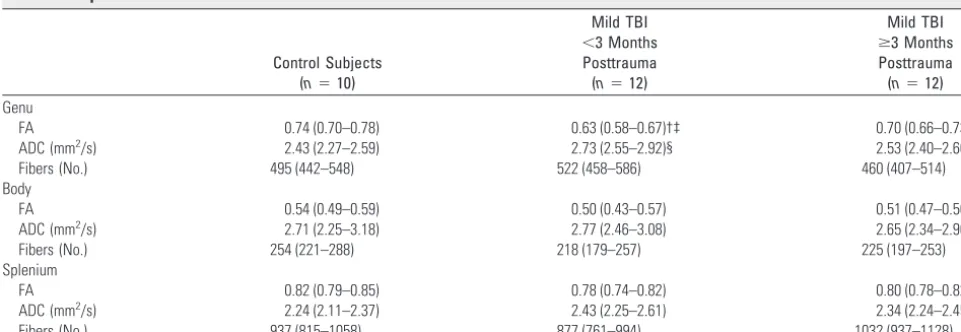
Because the time period between the trauma incident and the MR image was longer in patients with mild TBI than in the other 2 patient groups, we divided the group of patients with mild TBI into those investigated⬍3 months andⱖ3 months posttrauma. In patients with mild TBI who were investigated ⬍3 months posttrauma, the median time interval between the
trauma incident and the MR imaging was 0.4 months (first quartile, 0.2 months; third quartile, 0.5 months) compared with 25 months in patients with mild TBI who were investi-gatedⱖ3 months posttrauma (first quartile, 8; third quartile, 42 months;P⬍.001; Mann-WhitneyUtest). Patients with Mild TBI who were investigated⬍3 months posttrauma had significantly lower FA in the genu compared with control subjects (P⬍.01; Table 3) and with patients with mild TBI investigatedⱖ3 months posttrauma (P⬍.05), whereas ADC in the genu was significantly higher than that in control sub-jects (P⬍.05). DTI and fiber tracking characteristics of the body and splenium in patients with mild TBI investigated⬍3 months posttrauma showed no significant differences com-pared with those in control subjects and patients with mild TBI investigatedⱖ3 months posttrauma. In the latter patient group, DTI and fiber tracking characteristics of the genu, body, and splenium did not differ significantly from those in the control subjects.
Discussion
The most important findings of this study are threefold. First, patients with mild TBI investigated⬍3 months posttrauma showed reduced FA and increased ADC in the genu of the corpus callosum. Second, patients with mild TBI investigated ⱖ3 months posttrauma showed no DTI abnormalities in the corpus callosum. Third, patients with moderate and severe TBI had DTI abnormalities in the genu similar to those in patients with mild TBI investigated⬍3 months posttrauma and showed reduced FA in the splenium without significant ADC change.
We found that patients with mild TBI investigated ⬍3 months posttrauma primarily showed DTI abnormalities in the genu, without significant DTI changes in the body and splenium. Possibly, DTI abnormalities in the genu are revers-ible in mild TBI, because we found no abnormalities in pa-tients investigatedⱖ3 months posttrauma. In more severe TBI, DTI shows that the splenium is affected in addition to the genu. In all patient groups, we found that FA reduction in the genu was accompanied by significant ADC increase, whereas FA reduction in the splenium occurred in the absence of sig-nificant ADC change. This indicates that the type of micro-structural change was different in both locations. The ADC increase in the genu may imply a larger contribution of vaso-genic edema23in this location than in the splenium.
Conven-tional imaging and pathologic-anatomic study have indicated that the posterior corpus callosum is more susceptible to fiber disruption than the anterior corpus callosum.2-4,24In
conse-quence, it may be hypothesized that the DTI pattern we ob-served in the splenium is associated with more irreversible traumatic lesions than the DTI pattern in the genu, which in turn may reflect more reversible abnormalities. This should be investigated in a longitudinal study.
The body of the corpus callosum showed no statistically significant FA and ADC change in any of our patient groups. Still, this part of the corpus callosum can show axonal injury in particular in severe head trauma.4The relative absence of body
[image:4.594.53.284.68.243.2]abnormalities in our patients may indicate that head trauma was not severe enough to cause lesions in the body of the corpus callosum. We cannot fully exclude DTI abnormalities in the callosal body outside the regions of interest. However, Table 1: Patient baseline characteristics and MR Imaging
abnormalities in regions of interest in patients with TBI
Mild TBI (n⫽24)
Moderate TBI (n⫽9
Severe TBI (n⫽6) Patient baseline characteristics
Age (yr, mean⫾SD) 33⫾10 34⫾15 36⫾22 M:W (No.) 16:8 6:3 5:1 Months between trauma and
MRI scan (median, Q1–Q3)
2.8 (0.4–26.2) 0.5 (0.3–1.2) 1.4 (0.4–2.4)
MRI abnormalities in ROIs FLAIR hyperintensities (No., %)
Genu 1 (4) 0 1 (17)
Body 0 0 1 (17)
Splenium 1 (4) 1 (11) 2 (34)* EPI diffusion/GE hypointensities
(No., %)
Genu 0 0 0
Body 0 0 1 (17)
Splenium 1 (4) 0 1 (17)
Note:—M indicates man; W, woman; Q1, first quartile; Q3, third quartile; MRI, MR imaging; ROIs, regions of interest; TBI, traumatic brain injury; FLAIR, fluid-attenuated inversion recovery; EPI, echo-planar imaging.
we believe that our region-of-interest size and position in-cluded a considerable and representative part of the central body. A larger region of interest would have caused partial volume effects with inclusion of CSF and gray matter.
Patients with moderate and severe TBI had relatively few fibers passing through the regions of interest in the corpus callosum. The number of body fibers in moderate TBI and the number of splenium fibers in severe TBI showed a statistically significant reduction compared with that in controls. This ap-parent fiber loss is probably not explained by secondary axonal loss or degeneration. These phenomena are only supposed to manifest 3 months postinjury,25,26 which is considerably
longer than the time interval after which our patients with moderate and severe TBI were investigated. Alternative expla-nations for the low number of fibers may be fiber disruption or edema within the region of interest or variability in the region of interest placement in the callosal body accounting for some of the fiber data variations.
The exact cause of posttraumatic DTI changes in white matter remains to be elucidated. Generally, FA reduction is
attributed to a change in parenchymal structure.9,11,13-15This may include misalignment of fibers, edema, fiber disruption, or axonal degeneration. Previous studies of the corpus callo-sum in TBI report varying DTI findings. In a study of 2 groups of patients with mild TBI who were investigated on average 4 days and 68 months after injury, the genu was normal, whereas the splenium showed reduced FA with increased ADC.11In
another study of mild TBI, FA was reduced in both the genu and splenium within 24 hours after injury.15The body of the corpus callosum was not investigated in these studies of mild TBI. In severe TBI investigated on average 14 months after injury, FA reductions were found in the genu, body, and sple-nium.9ADC values were not reported in that study. In 2 stud-ies that investigated various trauma severitstud-ies within 7 days after injury, reduced FA was found in the genu and spleni-um.13,14Splenium ADC was reduced in 1 of these studies,13
suggesting the presence of cytotoxic edema. The callosal body was not investigated in these articles.
It is difficult to explain discrepancies of these earlier studies compared with our study because there are essential differ-Table 2: DTI and fiber tracking characteristics of the corpus callosum in control subjects and patients with TBI*
Control Subjects (n⫽10)
Mild TBI (n⫽24)
Moderate TBI (n⫽9)
Severe TBI (n⫽6) Genu
FA 0.74 (0.70–0.78) 0.66 (0.63–0.69) 0.56 (0.47–0.65)†‡ 0.53 (0.43–0.64)†‡ ADC (mm2/s) 2.43 (2.27–2.59) 2.63 (2.52–2.74) 3.10 (2.76–3.45)§‡ 3.24 (2.67–3.81)§ Fibers (No.) 495 (442–548) 491 (451–532) 368 (273–462)‡ 372 (236–508) Body
FA 0.54 (0.49–0.59) 0.51 (0.47–0.55) 0.46 (0.42–0.51) 0.48 (0.41–0.55) ADC (mm2/s) 2.71 (2.25–3.18) 2.71 (2.51–2.92) 2.92 (2.51–3.32) 3.00 (2.38–3.62) Fibers (No.) 254 (221–288) 221 (199–243) 171 (133–210)‡ 172 (70–275) Splenium
FA 0.82 (0.79–0.85) 0.79 (0.77–0.81) 0.70 (0.65–0.75)† 0.63 (0.55–0.71)†㛳 ADC (mm2/s) 2.24 (2.11–2.37) 2.39 (2.29–2.48) 2.41 (2.11–2.71) 2.58 (2.35–2.81) Fibers (No.) 937 (815–1058) 958 (882–1035) 766 (660–873)‡ 508 (273–744)§㛳
Note:—DTI indicates diffusion tensor imaging; TBI, traumatic brain injury; FA, fractional anisotropy; ADC, apparent diffusion coefficient. * Values are given as mean (95% confidence intervals).
†P⬍.001, versus control subjects. ‡P⬍.05.
§P⬍.01.
[image:5.594.52.535.57.204.2]㛳P⬍.001, versus mild TBI.
Table 3: DTI and fiber tracking characteristics of the corpus callosum in control subjects and patients mild TBI who were investigated<3 or
>3 months posttrauma*
Control Subjects (n⫽10)
Mild TBI ⬍3 Months Posttrauma (n⫽12)
Mild TBI
ⱖ3 Months Posttrauma (n⫽12) Genu
FA 0.74 (0.70–0.78) 0.63 (0.58–0.67)†‡ 0.70 (0.66–0.73) ADC (mm2/s) 2.43 (2.27–2.59) 2.73 (2.55–2.92)§ 2.53 (2.40–2.66) Fibers (No.) 495 (442–548) 522 (458–586) 460 (407–514) Body
FA 0.54 (0.49–0.59) 0.50 (0.43–0.57) 0.51 (0.47–0.56) ADC (mm2/s) 2.71 (2.25–3.18) 2.77 (2.46–3.08) 2.65 (2.34–2.96) Fibers (No.) 254 (221–288) 218 (179–257) 225 (197–253) Splenium
FA 0.82 (0.79–0.85) 0.78 (0.74–0.82) 0.80 (0.78–0.82) ADC (mm2/s) 2.24 (2.11–2.37) 2.43 (2.25–2.61) 2.34 (2.24–2.45) Fibers (No.) 937 (815–1058) 877 (761–994) 1032 (937–1128)
Note:—DTI indicates diffusion tensor imging; TBI, traumatic brain injury; FA, fractional anisotropy; ADC, apparent diffusion coefficient. * Values are given as mean (95% confidence interval).
[image:5.594.53.534.284.450.2]ences in methods. First, the time interval between injury and imaging varied considerably. This variance implies that the contribution of acute, subacute, and chronic posttraumatic changes inevitably differs between studies. Second, trauma se-verity differed among studies. Third, the DTI method in pre-vious studies often included 6 diffusion directions,9,11,13 as
opposed to the 25 directions we used. This can result in differ-ent estimations of anisotropy and diffusivity.27
A clinically relevant aspect of our study is that we found the genu to be primarily affected early on in mild TBI. This is somewhat different from the general view that primarily the posterior corpus callosum is affected in TBI.3,6,7,28
Further-more, our results show that there are different types of micro-structural injuries within the corpus callosum, as indicated by FA and ADC findings in the genu and splenium. A limitation of our study is the absence of neuropsychological correlations and long-term follow-up of our DTI findings. In addition to neuropsychological investigations and follow-up studies, his-tologic correlation would allow further interpretation of our DTI results. However, for obvious reasons, this may be diffi-cult to obtain, in particular in patients with mild TBI. Further-more, the number of patients with moderate and severe TBI was relatively small. This may limit the comparison with pa-tients with the mild TBI in our study, who formed a larger group. Finally, our study group did not comprise patients with moderate and severe TBI who were investigatedⱖ3 months posttrauma. Long-term DTI changes in the corpus callosum in these patient groups remain to be investigated.
Conclusion
Our study shows that there are local differences in DTI char-acteristics within the corpus callosum, which are related to the clinical severity of head trauma. Mild TBI is associated with DTI abnormalities in the genu⬍3 months posttrauma. In more severe TBI, both the genu and splenium are affected. DTI shows different types of microstructural injuries within the corpus callosum, suggesting a larger contribution of vaso-genic edema in the genu than in the splenium.
References
1. McAllister TW.Neuropsychiatric sequelae of head injuries.Psychiatr Clin North Am1992;15:395– 413
2. Adams JH, Graham DI, Murray LS, et al.Diffuse axonal injury due to nonmis-sile head injury in humans: an analysis of 45 cases.Ann Neurol1982;12:557– 63 3. Parizel PM, O¨ zsarlak O¨, Van Goethem JW, et al.Imaging findings in diffuse
axonal injury after closed head trauma.Eur Radiol1998;8:960 – 65 4. Gentry LR, Godersky JC, Thompson B.MR imaging of head trauma: review of
the distribution and radiopathologic features of traumatic lesions.AJR Am J Roentgenol1988;150:663–72
5. Abe O, Masutani Y, Aoki S, et al.Topography of the human corpus callosum using diffusion tensor tractography.J Comput Assist Tomogr2004;28:533–39 6. Gentry LR.Imaging of closed head injury.Radiology1994;191:1–17 7. Parizel PM, Van Goethem JW, O¨ zsarlak O¨, et al.New developments in the
neuroradiological diagnosis of craniocerebral trauma. Eur Radiol
2005;15:569 – 81
8. Schaefer PW, Huisman TA, Sorensen AG, et al.Diffusion-weighted MR imag-ing in closed head injury: high correlation with initial Glasgow coma scale score and score on modified Rankin scale at discharge.Radiology2004;233:58 – 66. Epub 2004 Aug 10
9. Nakayama N, Okumura A, Shinoda J, et al.Evidence for white matter disrup-tion in traumatic brain injury without macroscopic lesions.J Neurol Neuro-surg Psychiatry2006;77:850 –55
10. Salmond CH, Menon DK, Chatfield DA, et al.Diffusion tensor imaging in chronic head injury survivors: correlations with learning and memory indi-ces.Neuroimage2006;29:117–24
11. Inglese M, Makani S, Johnson G, et al.Diffuse axonal injury in mild traumatic brain injury: a diffusion tensor imaging study.J Neurosurg2005;103:298 –303 12. Ducreux D, Huynh I, Fillard P, et al.Brain MR diffusion tensor imaging and fibre tracking to differentiate between two diffuse axonal injuries. Neuroradi-ology2005;47:604 – 08. Epub 2005 Jun 23
13. Huisman TA, Schwamm LH, Schaefer PW, et al.Diffusion tensor imaging as potential biomarker of white matter injury in diffuse axonal injury.AJNR Am J Neuroradiol2004;25:370 –76
14. Ptak T, Sheridan RL, Rhea JT, et al.Cerebral fractional anisotropy score in trauma patients: a new indicator of white matter injury after trauma.AJR Am J Roentgenol2003;181:1401– 07
15. Arfanakis K, Haughton VM, Carew JD, et al.Diffusion tensor MR imaging in diffuse axonal injury.AJNR Am J Neuroradiol2002;23:794 – 802
16. Basser PJ.Inferring microstructural features and the physiological state of tissues from diffusion-weighted images.NMR Biomed1995;8:333– 44 17. Beaulieu C.The basis of anisotropic water diffusion in the nervous system: a
technical review.NMR Biomed2002;15:435–55
18. Haselgrove JC, Moore JR.Correction for distortion of echo-planar images
used to calculate the apparent diffusion coefficient. Magn Reson Med
1996;36:960 – 64
19. Fillard P, Gerig G.Analysis tool for diffusion tensor MRI.In: Ellis RE, Peters TM, eds.Medical Image Computing and Computer-Assisted Intervention-MIC-CAI 2003. Berlin: Springer; 2003;2879:967– 68
20. Westin CF, Maier SE, Mamata H, et al.Processing and visualization for diffu-sion tensor MRI.Med Image Anal2002;6:93–108
21. Xu D, Mori S, Solaiyappan M, et al.A framework for callosal fiber distribution analysis.Neuroimage2002;17:1131– 43
22. Mori S, Crain BJ, Chacko VP, et al.Three-dimensional tracking of axonal
projections in the brain by magnetic resonance imaging. Ann Neurol
1999;45:265– 69
23. Hergan K, Schaefer PW, Sorensen AG, et al.Diffusion-weighted MRI in diffuse axonal injury of the brain.Eur Radiol2002;12:2536 – 41
24. Leclercq PD, McKenzie JE, Graham DI, et al.Axonal injury is accentuated in
the caudal corpus callosum of head-injured patients. J Neurotrauma
2001;18:1–9
25. Maxwell WL, Povlishock JT, Graham DL.A mechanistic analysis of nondisrup-tive axonal injury: a review.J Neurotrauma1997;14:419 – 40
26. Tomaiuolo F, Carlesimo GA, Di PM, et al.Gross morphology and morphomet-ric sequelae in the hippocampus, fornix, and corpus callosum of patients with severe non-missile traumatic brain injury without macroscopically
detect-able lesions: a T1 weighted MRI study.J Neurol Neurosurg Psychiatry
2004;75:1314 –22
27. Jones DK.The effect of gradient sampling schemes on measures derived from diffusion tensor MRI: a Monte Carlo study.Magn Reson Med2004;51:807–15 28. Gentry LR, Thompson B, Godersky JC.Trauma to the corpus callosum: MR