Phrase Table Pruning via Submodular Function Maximization
Masaaki Nishino and Jun Suzuki and Masaaki Nagata
NTT Communication Science Laboratories, NTT Corporation 2-4 Hikaridai, Seika-cho, Soraku-gun, Kyoto, 619-0237, Japan
{nishino.masaaki,suzuki.jun,nagata.masaaki}@lab.ntt.co.jp
Abstract
Phrase table pruning is the act of re-moving phrase pairs from a phrase table to make it smaller, ideally removing the least useful phrases first. We propose a phrase table pruning method that formu-lates the task as a submodular function maximization problem, and solves it by using a greedy heuristic algorithm. The proposed method can scale with input size and long phrases, and experiments show that it achieves higher BLEU scores than state-of-the-art pruning methods.
1 Introduction
A phrase table, a key component of phrase-based statistical machine translation (PBMT) systems, consists of a set of phrase pairs. A phrase pair is a pair of source and target language phrases, and is used as the atomic translation unit. Today’s PBMT systems have to store and process large phrase ta-bles that contain more than 100M phrase pairs, and their sheer size prevents PBMT systems for running in resource-limited environments such as mobile phones. Even if a computer has enough resources, the large phrase tables increase turn-around time and prevent the rapid development of MT systems.
Phrase table pruning is the technique of remov-ing ineffective phrase pairs from a phrase table to make it smaller while minimizing the perfor-mance degradation. Existing phrase table pruning methods use different metrics to rank the phrase pairs contained in the table, and then remove low-ranked pairs. Metrics used in previous work are frequency, conditional probability, and Fisher’s exact test score (Johnson et al., 2007). Zens et al. (2012) evaluated many phrase table pruning methods, and concluded that entropy-based
prun-ing method (Lprun-ing et al., 2012; Zens et al., 2012) offers the best performance. The entropy-based pruning method uses entropy to measure the re-dundancy of a phrase pair, where we say a phrase pair is redundant if it can be replaced by other phrase pairs. The entropy-based pruning method runs in time linear to the number of phrase-pairs. Unfortunately, its running time is also exponential to the length of phrases contained in the phrase pairs, since it contains the problem of finding an optimal phrase alignment, which is known to be NP-hard (DeNero and Klein, 2008). Therefore, the method can be impractical if the phrase pairs consist of longer phrases.
In this paper, we introduce a novel phrase ta-ble pruning method that formulates and solves the phrase table pruning problem as a submodu-lar function maximization problem. A submodusubmodu-lar function is a kind of set function that satisfies the submodularity property. Generally, the submod-ular function maximization problem is NP-hard, however, it is known that(1−1/e)optimal solu-tions can be obtained by using a simple greedy al-gorithm (Nemhauser et al., 1978). Since a greedy algorithm scales with large inputs, our method can be applicable to large phrase tables.
One key factor of the proposed method is its carefully designed objective function that evalu-ates the quality of a given phrase table. In this pa-per, we use a simple monotone submodular func-tion that evaluates the quality of a given phrase table by its coverage of a training corpus. Our method is simple, parameter free, and does not cause exponential explosion of the computation time with longer phrases. We conduct experiments with two different language pairs, and show that the proposed method shows higher BLEU scores than state-of-the-art pruning methods.
2 Submodular Function Maximization LetΩbe a base set consisting ofMelements, and
g: 2Ω 7→Rbe a set function that upon the input of
X ⊆Ωreturns a real value. Ifgis a submodular function, then it satisfies the condition
g(X∪ {x})−g(X)≥g(Y ∪ {x})−g(Y),
whereX, Y ∈ 2Ω,X ⊆Y, andx∈ Ω\Y. This
condition represents the diminishing return prop-erty of a submodular function, i.e., the increase in the value of the function due to the addition of item x toY is always smaller than that obtained by addingxto any subsetX ⊆Y. We say a sub-modular function is monotone if g(Y) ≥ g(X) for any X, Y ∈ 2Ω satisfying X ⊆ Y. Since a
submodular function has many useful properties, it appears in a wide range of applications (Kempe et al., 2003; Lin and Bilmes, 2010; Kirchhoff and Bilmes, 2014).
The maximization problem of a monotone sub-modular function under cardinality constraints is formulated as
Maximizeg(X)
Subject toX ∈2Ωand|X| ≤K ,
where g(X) is a monotone submodular function andKis the parameter that defines maximum car-dinality. This problem is known to be NP-hard, but a greedy algorithm can find an approximate solu-tion whose score is certified to be(1−1/e) opti-mal (Nemhauser et al., 1978). Algorithm 1 shows a greedy approximation method the can solve the submodular function maximization problem under cardinality constraints. This algorithm first sets
X ← ∅, and adds itemx∗ ∈ Ω\X that
maxi-mizesg(X∪ {x∗})−g(X)toXuntil|X|=K.
Assuming that the evaluation of g(X) can be performed in constant time, the running time of the greedy algorithm isO(MK)because we need
O(M) evaluations of g(X) for selecting x∗ that
maximizesg(X∪ {x∗})−g(X), and these
eval-uations are repeatedKtimes. If we naively apply the algorithm to situations whereM is very large, then the algorithm may not work in reasonable running time. However, an accelerated greedy algorithm can work with large inputs (Minoux, 1978; Leskovec et al., 2007), since it can dras-tically reduce the number of function evaluations fromMK. We applied the accelerated greedy al-gorithm in the following experiments, and found it
Algorithm 1Greedy algorithm for maximizing a submodular function
Input:Base setΩ, cardinalityK
Output:X ∈2Ωsatisfying|X|=K.
1: X← ∅
2: while|X|< Kdo
3: x∗ ←arg max
x∈Ω\X g(X∪ {x})−g(X)
4: X←X∪ {x∗} 5: outputX
could solve the problems in 24 hours. Moreover, further enhancement can be achieved by apply-ing distributed algorithms (Mirzasoleiman et al., 2013) and stochastic greedy algorithms (Mirza-soleiman et al., 2015).
3 Phrase Table Pruning
We first define some notations. Let Ω = {x1, . . . , xM}be a phrase table that hasM phrase
pairs. Each phrase pair, xi, consists of a source
language phrase,pi, and a target language phrase, qi, and is written asxi = hpi, qii. Phrasespi and qi are sequences of words pi = (pi1, . . . , pi|pi|)
andqi = (qi1, . . . , qi|qi|), wherepij represents the j-th word of pi and qij represents the j-th word
ofqi. Letti be the i-th translation pair contained
in the training corpus, namelyti =hfi, eii, where fi andei are source and target sentences,
respec-tively. LetN be the number of translation pairs contained in the corpus. fi andeiare represented
as sequences of words fi = (fi1, . . . , fi|fi|) and
ei= (ei1, . . . , ei|ei|), wherefij is thej-th word of
sentencefiandeij is thej-th word of sentenceei.
Definition 1. Let xj = hpj, qji be a phrase pair
andti = hfi, eiibe a translation pair. We sayxj
appearsin ti if pj is contained infi as a
subse-quence andqj is contained ineias a subsequence.
We say phrase pairxj coversword fik ifxj
ap-pears inhfi, eiiandfik is contained in the
subse-quence that equalspj. Similarly, we sayxjcovers eikifxj appears inhfi, eiiandeikis contained in
the subsequence that equalsqj.
X ⊆ Ω that maximizes objective functiong(X) while satisfying the condition |X| = K, where
K is the size of pruned phrase table. Ifg(X) is a monotone submodular function, we can apply Algorithm 1 to obtain an(1−1/e) approximate solution. We use the following objective function.
g(X) =
N X
i=1
|fi|
X
k=1
log [c(X, fik) + 1]
+XN
i=1
|ei|
X
k=1
log [c(X, eik) + 1],
wherec(X, fik)is the number of phrase pairs
con-tained inXthat coverfik, thek-th word of thei
-th source sentencefi. Similarly, c(X, eik) is the
number of phrase pairs that covereik.
Example 1. Consider phrase table X holding phrase pairs x1 = h(das Haus),(the house)i,
x2 = h(Haus),(house)i, and x3 =
h(das Haus),(the building)i. If a corpus consists of a pair of sentencesf1 =“das Haus ist
klein” ande1 =“this house is small”, thenx1and
x2 appear in hf1, e1i and word f12 = “Haus” is
covered byx1andx2. Hencec(X, f12) = 2.
This objective function basically gives high scores toXif it contains many words of the train-ing corpus. However, since we take the logarithm of cover countsc(X, fik)andc(X, eik),g(X)
be-comes high whenXcovers many different words. This objective function prefers to select phrase pairs that frequently appear in the training corpus but with low redundantly. This objective function prefers pruned phrase tableXthat contains phrase pairs that frequently appear in the training corpus, with no redundant phrase pairs. We prove the sub-modularity of the objective function below. Proposition 1. g(X) is a monotone submodular function.
Proof. Apparently, everyc(X, fik) andc(X, eik)
is a monotone function ofX, and it satisfies the di-minishing return property sincec(X∪ {x}, fik)− c(X, fik) = c(Y ∪ {x}, fik)−c(Y, fik)for any X ⊆ Y andx 6∈ Y. If functionh(X)is mono-tone and submodular, thenφ(h(X))is also mono-tone and submodular for any concave function
φ : R 7→ R. Since log(X) is concave, every log[c(X, fik)+1]andlog[c(X, eik)+1]is a
mono-tone submodular function. Finally, if h1, . . . , hn
are monotone and submodular, thenPihiis also
monotone and submodular. Thusg(X)is mono-tone and submodular.
Computation costs If we know all counts
c(X, fik)andc(X, eik)for allfik,eik, theng(X∪
{x})can be evaluated in time linear with the num-ber of words contained in the training corpus1.
Thus our algorithm does not cause exponential explosion of the computation time with longer phrases.
4 Evaluation 4.1 Settings
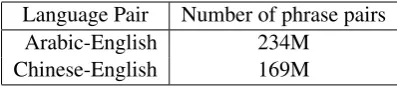
We conducted experiments on the Chinese-English and Arabic-Chinese-English datasets used in NIST OpenMT 2012. In each experiment, English was set as the target language. We used Moses (Koehn et al., 2007) as the phrase-based machine transla-tion system. We used the 5-gram Kneser-Ney lan-guage model trained separately using the English GigaWord V5 corpus (LDC2011T07), a monolin-gual corpus distributed at WMT 2012, and Google Web 1T 5-gram data (LDC2006T13). Word alignments are obtained by running giza++ (Och and Ney, 2003) included in the Moses sys-tem. As the test data, we used 1378 segments for the Arabic-English dataset and 2190 seg-ments for the Chinese-English dataset, where all test segments have 4 references (LDC2013T07, LDC2013T03). The tuning set consists of about 5000 segments gathered from MT02 to MT06 evaluation sets (LDC2010T10, LDC2010T11, LDC2010T12, LDC2010T14, LDC2010T17). We set the maximum length of extracted phrases to 7. Table 1 shows the sizes of phrase tables. Follow-ing the settFollow-ings used in (Zens et al., 2012), we reduce the effects of other components by using the same feature weights obtained by running the MERT training algorithm (Och, 2003) on full size phrase tables and tuning data to all pruned tables. We run MERT for 10 times to obtain 10 differ-ent feature weights. The BLEU scores reported in the following experiments are the averages of the results obtained by using these different fea-ture weights.
We adopt the entropy-based pruning method used in (Ling et al., 2012; Zens et al., 2012) as the baseline method, since it shows best BLEU
1Running time can be further reduced if we compute the
set of words covered by each phrase pairxibefore executing
Language Pair Number of phrase pairs Arabic-English 234M
[image:4.595.81.280.62.108.2]Chinese-English 169M Table 1: Phrase table sizes.
scores as per (Zens et al., 2012). We used the pa-rameter value of the entropy-based method sug-gested in (Zens et al., 2012). We also compared with the significance-based method (Johnson et al., 2007), which uses Fisher’s exact test to calcu-late significance scores of phrase pairs and prunes less-significant phrase pairs.
[image:4.595.309.515.64.199.2]4.2 Results
Figure 1 and Figure 2 show the BLEU scores of pruned tables. The horizontal axis is the number of phrase pairs contained in a table, and the vertical axis is the BLEU score. The values in the figure are difference of BLEU scores between the pro-posed method and the baseline method that shows higher score. In the experiment with the Arabic-English dataset, both methods can remove 80% of phrase pairs without losing 1 BLEU point, and the proposed method shows better performance than the baseline methods for all table sizes. The differ-ence in BLEU scores becomes larger when table sizes are small. In the experiment on the Chinese-English dataset, both methods can remove 80% of phrase pairs without losing 1 BLEU point, and the proposed method also shows comparable or better performance. The difference in BLEU scores also becomes larger when table sizes are small.
Figure 3 shows phrase table sizes in the bina-rized and compressed phrase table format used in Moses (Junczys-Dowmunt, 2012). The horizon-tal axis is the number of phrase pairs contained in the table, and the vertical axis is phrase table size. We can see that there is a linear relationship be-tween phrase table sizes and the number of phrase pairs. The original phrase table requires 2.8GB memory. In contrast, the 90% pruned table only requires 350MB of memory. This result shows the effectiveness of phrase table pruning on reducing resource requirements in practical situations.
5 Related Work
Previous phrase table pruning methods fall into two groups. Self-contained methods only use resources already used in the MT system, e.g., training corpus and phrase tables. Entropy-based
100 101 102 103
Phrase pairs [M]
32 34 36 38 40
BLEU[%]
0.87 0.87
0.49 0.19
0.02 0.12 0.05
0.00
Proposed Entropy Fisher
Figure 1: BLEU score as a function of the number of phrase pairs (Arabic-English).
100 101 102 103
Phrase pairs [M]
18 20 22 24 26 28
BLEU[%]
0.40 0.39
0.32 0.09
0.10 -0.14 -0.03 0.00
Proposed Entropy Fisher
Figure 2: BLEU score as a function of the number of phrase pairs (Chinese-English).
methods (Ling et al., 2012; Zens et al., 2012), a significance-based method (Johnson et al., 2007), and our method are self-contained methods. Non self-contained methods exploit usage statistics for phrase pairs (Eck et al., 2007) and additional bilin-gual corpora (Chen et al., 2009). Since self con-tained methods require additional resources, it is easy to apply to existing MT systems.
Effectiveness of the submodular functions max-imization formulation is confirmed in various NLP applications including text summarization (Lin and Bilmes, 2010; Lin and Bilmes, 2011) and training data selection for machine transla-tion (Kirchhoff and Bilmes, 2014). These methods are used for selecting a subset that contains impor-tant items but not redundant items. This paper can be seen as applying the subset selection formula-tion to the phrase table pruning problem.
6 Conclusion
[image:4.595.311.516.249.383.2]cardinal-100 101 102 103
Phrase pairs [M]
101 102 103 104
Tab
le
siz
e[MB]
Proposed Entropy Fisher
Figure 3: Moses compact phrase table size as a function of the number of phrase pairs (Arabic-English).
ity constraints. Finding an optimal solution of the problem is NP-hard, so we apply a scalable greedy heuristic to find (1−1/e) optimal solu-tions. Experiments showed that our greedy al-gorithm, which uses a relatively simple objec-tive function, can achieve better performance than state-of-the-art pruning methods.
Our proposed method can be easily extended by using other types of submodular functions. The objective function used in this paper is a simple one, but it is easily enhanced by the addition of metrics used in existing phrase table pruning tech-niques, such as Fisher’s exact test scores and en-tropy scores. Testing such kinds of objective func-tion enhancements is an important future task.
References
Yu Chen, Martin Kay, and Andreas Eisele. 2009. In-tersecting multilingual data for faster and better sta-tistical translations. InProceedings of Human Lan-guage Technologies: The 2009 Annual Conference of the North American Chapter of the Association for Computational Linguistics (NAACL-HLT), pages 128–136.
John DeNero and Dan Klein. 2008. The
complex-ity of phrase alignment problems. InProceedings
of the 46th Annual Meeting of the Association for Computational Linguistics: Human Language Tech-nologies (ACL-HLT), pages 25–28.
Matthias Eck, Stephan Vogel, and Alex Waibel. 2007. Translation model pruning via usage statistics for
statistical machine translation. InHuman Language
Technologies 2007: The Conference of the North American Chapter of the Association for Computa-tional Linguistics (NAACL-HLT), pages 21–24.
Howard Johnson, Joel Martin, George Foster, and Roland Kuhn. 2007. Improving translation
qual-ity by discarding most of the phrasetable. In
Pro-ceedings of the 2007 Joint Conference on Empirical Methods in Natural Language Processing and Com-putational Natural Language Learning (EMNLP-CoNLL), pages 967–975.
Marcin Junczys-Dowmunt. 2012. Phrasal
rank-encoding: Exploiting phrase redundancy and trans-lational relations for phrase table compression. The Prague Bulletin of Mathematical Linguistics, 98:63– 74.
David Kempe, Jon Kleinberg, and ´Eva Tardos. 2003. Maximizing the spread of influence through a social
network. InProceedings of the 9th ACM SIGKDD
international conference on Knowledge discovery and data mining (KDD), pages 137–146.
Katrin Kirchhoff and Jeff Bilmes. 2014. Submod-ularity for data selection in machine translation. In Proceedings of the 2014 Conference on Em-pirical Methods in Natural Language Processing (EMNLP), pages 131–141.
Philipp Koehn, Hieu Hoang, Alexandra Birch, Chris Callison-Burch, Marcello Federico, Nicola Bertoldi, Brooke Cowan, Wade Shen, Christine Moran, Richard Zens, Chris Dyer, Ondrej Bojar, Alexan-dra Constantin, and Evan Herbst. 2007. Moses: Open source toolkit for statistical machine
transla-tion. InProceedings of the 45th Annual Meeting of
the Association for Computational Linguistics Com-panion Volume Proceedings of the Demo and Poster Sessions, pages 177–180.
Jure Leskovec, Andreas Krause, Carlos Guestrin, Christos Faloutsos, Jeanne VanBriesen, and Natalie Glance. 2007. Cost-effective outbreak detection in
networks. InProceedings of the 13th ACM SIGKDD
International Conference on Knowledge Discovery and Data Mining (KDD), pages 420–429.
Hui Lin and Jeff Bilmes. 2010. Multi-document sum-marization via budgeted maximization of
submod-ular functions. InHuman Language Technologies:
The 2010 Annual Conference of the North American Chapter of the Association for Computational Lin-guistics (NAACL-HLT), pages 912–920.
Hui Lin and Jeff Bilmes. 2011. A class of
submodu-lar functions for document summarization. In
Pro-ceedings of the 49th Annual Meeting of the Associ-ation for ComputAssoci-ational Linguistics: Human Lan-guage Technologies (ACL-HLT), pages 510–520. Wang Ling, Jo˜ao Grac¸a, Isabel Trancoso, and Alan
Black. 2012. Entropy-based pruning for
phrase-based machine translation. In Proceedings of
the 2012 Joint Conference on Empirical Meth-ods in Natural Language Processing and Com-putational Natural Language Learning (EMNLP-CoNLL), pages 962–971.
Michel Minoux. 1978. Accelerated greedy algorithms
for maximizing submodular set functions. In
Baharan Mirzasoleiman, Amin Karbasi, Rik Sarkar, and Andreas Krause. 2013. Distributed submodular maximization: Identifying representative elements
in massive data. InAdvances in Neural Information
Processing Systems (NIPS), pages 2049–2057. Baharan Mirzasoleiman, Ashwinkumar Badanidiyuru,
Amin Karbasi, Jan Vondr´ak, and Andreas Krause.
2015. Lazier than lazy greedy. InProceedings of
the 29th AAAI Conference on Artificial Intelligence (AAAI), pages 1812–1818.
George L Nemhauser, Laurence A Wolsey, and Mar-shall L Fisher. 1978. An analysis of approximations
for maximizing submodular set functionsi.
Mathe-matical Programming, 14(1):265–294.
Franz Josef Och and Hermann Ney. 2003. A sys-tematic comparison of various statistical alignment
models. Computational Linguistics, 29(1):19–51.
Franz Josef Och. 2003. Minimum error rate training in statistical machine translation. InProceedings of the 41st Annual Meeting of the Association for Com-putational Linguistics (ACL), pages 160–167. Richard Zens, Daisy Stanton, and Peng Xu. 2012. A
systematic comparison of phrase table pruning
tech-niques. In Proceedings of the 2012 Joint