Building a Semantic Parser Overnight
Yushi Wang∗ Stanford University
Jonathan Berant∗ Stanford University
Percy Liang Stanford University
Abstract
How do we build a semantic parser in a new domain starting with zero training ex-amples? We introduce a new methodol-ogy for this setting: First, we use a simple grammar to generate logical forms paired with canonical utterances. The logical forms are meant to cover the desired set of compositional operators, and the canon-ical utterances are meant to capture the meaning of the logical forms (although clumsily). We then use crowdsourcing to paraphrase these canonical utterances into natural utterances. The resulting data is used to train the semantic parser. We fur-ther study the role of compositionality in the resulting paraphrases. Finally, we test our methodology on seven domains and show that we can build an adequate se-mantic parser in just a few hours.
1 Introduction
By mapping natural language utterances to exe-cutable logical forms, semantic parsers have been useful for a variety of applications requiring pre-cise language understanding (Zelle and Mooney, 1996; Zettlemoyer and Collins, 2005; Liang et al., 2011; Berant et al., 2013; Kwiatkowski et al., 2013; Artzi and Zettlemoyer, 2013; Kushman and Barzilay, 2013). Previous work has focused on how to train a semantic parser given input utter-ances, but suppose we wanted to build a seman-tic parser for a new domain—for example, a natu-ral language interface into a publications database. Since no such interface exists, we do not even have a naturally occurring source of input utterances that we can annotate. So where do we start?
In this paper, we advocate a
functionality-driven process for rapidly building a semantic
∗Both authors equally contributed to the paper.
Domain
Seed lexicon
article →TypeNP[article] publication date→RelNP[publicationDate] cites →VP/NP[cites]
...
Logical forms and canonical utterances
article that has the largest publication date
argmax(type.article,publicationDate)
person that is author of the most number of article
argmax(type.person,R(λx.count(type.articleuauthor.x))) ...
Paraphrases
what is the newest published article?
who has published the most articles?
...
Semantic parser
(1) by builder (∼30 minutes)
(2) via domain-general grammar
(3) via crowdsourcing (∼5 hours)
[image:1.595.310.539.197.492.2](4) by training a paraphrasing model
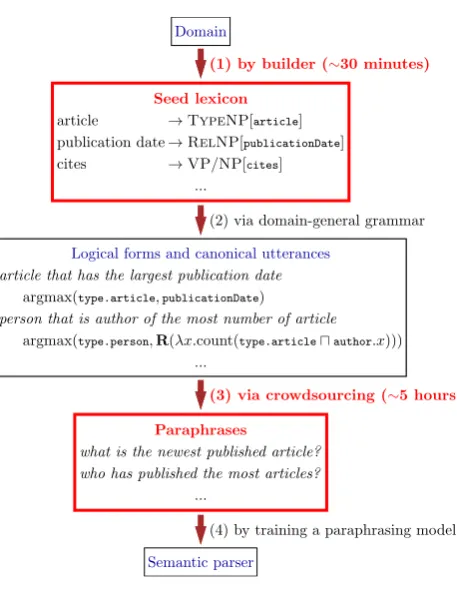
Figure 1: Functionality-driven process for build-ing semantic parsers. The two red boxes are the domain-specific parts provided by the builder of the semantic parser, and the other two are gener-ated by the framework.
parser in a new domain. At a high-level, we seek to minimize the amount of work needed for a new domain by factoring out the domain-general aspects (done by our framework) from the domain-specific ones (done by the builder of the semantic parser). We assume that the builder already has the desired functionality of the semantic parser in mind—e.g., the publica-tions database is set up and the schema is fixed. Figure 1 depicts the functionality-driven process: First, the builder writes a seed lexicon specifying a canonical phrase (“publication date”) for
each predicate (publicationDate). Second,
our framework uses a domain-general grammar, along with the seed lexicon and the database, to automatically generate a few hundred canonical
utterances paired with their logical forms (e.g.,
“article that has the largest publication date”and
arg max(type.article,publicationDate)).
These utterances need not be the most elegant, but they should retain the semantics of the logical forms. Third, the builder leverages crowdsourcing to paraphrase each canonical utterance into a
few natural utterances(e.g., “what is the newest
published article?”). Finally, our framework uses
this data to train a semantic parser.
Practical advantages. There are two main ad-vantages of our approach: completenessandease
of supervision. Traditionally, training data is
collected in a best-effort manner, which can re-sult in an incomplete coverage of functionality. For example, the WebQuestions dataset (Berant et al., 2013) contains no questions with numeric answers, so any semantic parser trained on that dataset would lack that functionality. These bi-ases are not codified, which results in an idiosyn-cratic and mysterious user experience, a major drawback of natural language interfaces (Rangel et al., 2014). In contrast, our compact grammar precisely specifies the logical functionality. We enforce completeness by generating canonical ut-terances that exercise every grammar rule.
In terms of supervision, state-of-the-art seman-tic parsers are trained from question-answer pairs (Kwiatkowski et al., 2013; Berant and Liang, 2014). Although this is a marked improvement in cost and scalability compared to annotated logical forms, it still requires non-trivial effort: the an-notator must (i) understand the question and (ii) figure out the answer, which becomes even harder with compositional utterances. In contrast, our main source of supervision is paraphrases, which only requires (i), not (ii). Such data is thus cheaper and faster to obtain.
Linguistic reflections. The centerpiece of our framework is a domain-general grammar that con-nects logical forms with canonical utterances. This connection warrants further scrutiny, as the structural mismatch between logic and language is the chief source of difficulty in semantic pars-ing (Liang et al., 2011; Kwiatkowski et al., 2013; Berant and Liang, 2014).
There are two important questions here. First, is it possible to design a simple grammar that simul-taneously generates both logical forms and canon-ical utterances so that the utterances are under-standable by a human? In Section 3, we show how to choose appropriate canonical utterances to max-imize alignment with the logical forms.
Second, our grammar can generate an infinite number of canonical utterances. How many do we need for adequate coverage? Certainly, single relations is insufficient: just knowing that
“pub-lication date of X” paraphrases to “when X was
published”would offer insufficient information to
generalize to“articles that came after X”mapping
to“article whose publication date is larger than
publication date of X”. We call this phenomena
sublexical compositionality—when a short lexical
unit (“came after”) maps onto a multi-predicate logical form. Our hypothesis is that the sublexi-cal compositional units are small, so we only need to crowdsource a small number of canonical utter-ances to learn about most of the language variabil-ity in the given domain (Section 4).
We applied our functionality-driven process to seven domains, which were chosen to explore par-ticular types of phenomena, such as spatial lan-guage, temporal lanlan-guage, and high-arity rela-tions. This resulted in seven new semantic parsing datasets, totaling 12.6K examples. Our approach, which was not tuned on any one domain, was able to obtain an average accuracy of 59% over all do-mains. On the day of this paper submission, we created an eighth domain and trained a semantic parser overnight.
2 Approach Overview
In our functionality-driven process (Figure 1), there are two parties: the builder, who provides domain-specific information, and the framework, which provides domain-general information. We assume that the builder has a fixed database w, represented as a set of triples(e1, p, e2), wheree1
ande2are entities (e.g.,article1,2015) andpis
a property (e.g.,publicationDate). The database
wcan be queried using lambda DCS logical forms, described further in Section 2.1.
The builder supplies a seed lexicon L, which contains for each database property p (e.g.,
publicationDate) a lexical entry of the form
cat-egory (e.g., RELNP). In addition, L contains two typical entities for each semantic type in the database (e.g., halice→NP[alice]i for the type person). The purpose of L is to simply connect
each predicate withsomerepresentation in natural language.
The framework supplies a grammar G, which specifies the modes of composition, both on log-ical forms and canonlog-ical utterances. Formally, G is a set of rules of the form hα1. . . αn→s[z]i, where α1. . . αn is a sequence of tokens or cate-gories, sis a syntactic category andzis the log-ical form constructed. For example, one rule in GishRELNP[r]ofNP[x]→ NP[R(r).x]i, which constructs z by reversing the binary predicate r and joining it with a the unary predicate x. We use the rules G ∪ L to generate a set of
(z, c) pairs, where z is a logical form (e.g., R(publicationDate).article1), and c is the corresponding canonical utterance (e.g., “publica-tion date of article 1”). The set of(z, c)is denoted by GEN(G∪L). See Section 3 for details.
Next, the builder (backed by crowdsourcing) paraphrases each canonical utterance c output above into a set of natural utterances P(c) (e.g.,
“when was article 1 published?”). This defines a
set of training examplesD ={(x, c, z)}, for each
(z, c) ∈GEN(G∪L)andx ∈P(c). The crowd-sourcing setup is detailed in Section 5.
Finally, the framework trains a semantic parser onD. Our semantic parser is a log-linear distribu-tionpθ(z, c|x, w)over logical forms and canon-ical utterances specified by the grammarG. Note that the grammarGwill in general not parsex, so the semantic parsing model will be based on para-phrasing, in the spirit of Berant and Liang (2014). To summarize, (1) the builder produces a seed lexicon L; (2) the framework produces logical forms and canonical utterances GEN(G∪L) = {(z, c)}; (3) the builder (via crowdsourcing) uses P(·)to produce a datasetD={(x, c, z)}; and (4) the framework uses D to train a semantic parser pθ(z, c|x, w).
2.1 Lambda DCS
Our logical forms are represented in lambda DCS, a logical language where composition operates on sets rather than truth values. Here we give a brief description; see Liang (2013) for details.
Every logical form z in this paper is either a
unary(denoting a set of entities) or abinary
(de-noting a set of entity-pairs). In the base case, each entitye(e.g.,2015) is a unary denoting the
single-ton set: JeKw = {e}; and each property p (e.g.,
publicationDate) is a binary denoting all
entity-pairs(e1, e2) that satisfy the propertyp. Unaries
and binaries can be composed: Given a binaryb and unaryu, the joinb.udenotes all entitiese1for
which there exists ane2 ∈ JuKw with (e1, e2) ∈ JbKw. For example, publicationDate.2015 de-note entities published in 2015.
The intersectionu1 uu2, unionu1 tu2,
com-plement ¬u denote the corresponding set op-erations on the denotations. We let R(b) de-note the reversal of b: (e1, e2) ∈ JbKw iff
(e2, e1) ∈ JR(b)Kw. This allows us to define
R(publicationDate).article1 as the
publica-tion date of article 1. We also include aggregapublica-tion operations (count(u), sum(u) and average(u, b)), and superlatives (argmax(u, b)).
Finally, we can construct binaries using lambda abstraction: λx.udenotes a set of (e1, e2)where
e1 ∈ Ju[x/e2]Kw andu[x/e2]is the logical form
where free occurrences ofxare replaced withe2.
For example,R(λx.count(R(cites).x))denotes the set of entities(e1, e2), wheree2 is the number
of entities thate1cites.
3 Generation and canonical compositionality
Our functionality-driven process hinges on having a domain-general grammar that can connect logi-cal forms with canonilogi-cal utterances composition-ally. The motivation is that while it is hard to write a grammar that parsesallutterances, it is possible to write one that generatesonecanonical utterance for each logical form. To make this explicit: Assumption 1 (Canonical compositionality) Using a small grammar, all logical forms ex-pressible in natural language can be realized compositionally based on the logical form. Grammar. We target database querying appli-cations, where the parser needs to handle superla-tives, comparasuperla-tives, negation, and coordination. We define a simple grammar that captures these forms of compositionality using canonical utter-ances in a domain-general way. Figure 2 illustrates a derivation produced by the grammar.
NP[type.articleupublicationDate.1950]
NP[type.article]
TypeNP[article]
article
whoseRelNP[publicationDate]
publication date
isEntityNP[1950]
1950
Figure 2: Deriving a logical form z (red) and a canonical utterance c (green) from the grammar G. Each node contains a syntactic category and a logical form, which is generated by applying a rule. Nodes with only leaves as children are pro-duced using the seed lexicon; all other nodes are produced by rules in the domain-general grammar.
alice) are ENTITYNP’s. Unary predicates are realized as verb phrases VP (e.g., “has a private
bath”). The builder can choose to represent
bina-ries as either relational noun phrases (RELNP) or generalized transitive verbs (VP/NP). RELNP’s are usually used to describe functional proper-ties (e.g., “publication date”), especially numer-ical properties. VP/NP’s include transitive verbs
(“cites”) but also longer phrases with the same
syntactic interface (“is the president of”). Table 1 shows the seed lexicon for the SOCIALdomain.
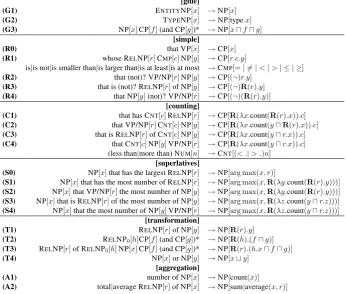
From the seed lexicon, the domain-general grammar (Table 2) constructs noun phrases (NP), verbs phrases (VP), and complementizer phrase (CP), all of which denote unary logical forms. Broadly speaking, the rules(R1)–(R4),(C1)–(C4) take a binary and a noun phrase, and compose them (optionally via comparatives, counting, and negation) to produce a complementizer phrase CP representing a unary (e.g., “that cites article 1”
or “that cites more than three article”). (G3)
combines these CP’s with an NP (e.g.,“article”). In addition,(S0)–(S4)handle superlatives (we in-clude argmin in addition to argmax), which take an NP and return the extremum-attaining subset of its denotation. Finally, we support transformations such as join(T1)and disjunction(T4), as well as aggregation(A1)–(A2).
Rendering utterances for multi-arity predicates was a major challenge. The predicate in-stances are typically reified in a graph database, akin to a neo-Davidsonian treatment of events: There is an abstract entity with binary predi-cates relating it to its arguments. For exam-ple, in the SOCIAL domain, Alice’s education can be represented in the database as five triples:
birthdate →RELNP[birthdate]
person|university|field →TYPENP[person| · · ·] company|job title →TYPENP[company| · · ·]
student|university|field of study →RELNP[student| · · ·]
employee|employer|job title →RELNP[employee| · · ·]
start date|end date →RELNP[startDate| · · ·] is friends with →VP/NP[friends| · · ·] Table 1: The seed lexicon for the SOCIAL do-main, which specifies for each predicate (e.g.,
birthdate) a phrase (e.g.,“birthdate”) that real-izes that predicate and its syntactic category (e.g., RELNP).
(e17,student,alice),(e17,university,ucla),
(e17,fieldOfStudy,music),
(e17,startDate,2005),(e17,endDate,2009).
All five properties here are represented as RELNP’s, with the first one designated as the sub-ject (RELNP0). We support two ways of querying
multi-arity relations: “student whose university is
ucla”(T2)and“university of student Alice whose
start date is 2005”(T3).
Generating directly from the grammar in Ta-ble 2 would result in many uninterpretaTa-ble canon-ical utterances. Thus, we perform type checking on the logical forms to rule out“article that cites
2004”, and limit the amount of recursion, which
keeps the canonical utterances understandable. Still, the utterances generated by our grammar are not perfectly grammatical; we do not use de-terminers and make all nouns singular. Nonethe-less, AMT workers found most canonical utter-ances understandable (see Table 3 and Section 5 for details on crowdsourcing). One tip for the builder is to keep the RELNP’s and VP/NP’s as context-independent as possible; e.g., using
“pub-lication date”instead of “date”. In cases where
more context is required, we use parenthetical re-marks (e.g.,“number of assists (over a season)” → RELNP[...]) to pack more context into the
confines of the part-of-speech.
Limitations. While our domain-general gram-mar covers most of the common logical forms in a database querying application, there are sev-eral phenomena which are out of scope, notably nested quantification (e.g., “show me each
au-thor’s most cited work”) and anaphora (e.g.,
“au-thor who cites herself at least twice”). Handling
[glue]
(G1) ENTITYNP[x] →NP[x]
(G2) TYPENP[x] →NP[type.x]
[image:5.595.127.474.66.360.2](G3) NP[x]CP[f](and CP[g])* →NP[xufug] [simple]
(R0) that VP[x] →CP[x]
(R1) whose RELNP[r]CMP[c]NP[y] →CP[r.c.y]
is|is not|is smaller than|is larger than|is at least|is at most →CMP[=| 6=|<|>| ≤ | ≥] (R2) that (not)? VP/NP[r]NP[y] →CP[(¬)r.y]
(R3) that is (not)? RELNP[r]of NP[y] →CP[(¬)R(r).y] (R4) that NP[y](not)? VP/NP[r] →CP[(¬)(R(r).y)]
[counting]
(C1) that has CNT[c]RELNP[r] →CP[R(λx.count(R(r).x)).c] (C2) that VP/NP[r]CNT[c]NP[y] →CP[R(λx.count(yuR(r).x)).c] (C3) that is RELNP[r]of CNT[c]NP[y] →CP[R(λx.count(yur.x)).c] (C4) that CNT[c]NP[y]VP/NP[r] →CP[R(λx.count(yur.x)).c]
(less than|more than) NUM[n] →CNT[(< .|> .)n] [superlatives]
(S0) NP[x]that has the largest RELNP[r] →NP[arg max(x, r)]
(S1) NP[x]that has the most number of RELNP[r] →NP[arg max(x,R(λy.count(R(r).y)))] (S2) NP[x]that VP/NP[r]the most number of NP[y] →NP[arg max(x,R(λy.count(R(r).y)))] (S3) NP[x]that is RELNP[r]of the most number of NP[y] →NP[arg max(x,R(λz.count(yur.z)))] (S4) NP[x]that the most number of NP[y]VP/NP[r] →NP[arg max(x,R(λz.count(yur.z)))]
[transformation]
(T1) RELNP[r]of NP[y] →NP[R(r).y]
(T2) RELNP0[h]CP[f](and CP[g])* →NP[R(h).(fug)] (T3) RELNP[r]of RELNP0[h]NP[x]CP[f](and CP[g])* →NP[R(r).(h.xufug)]
(T4) NP[x]or NP[y] →NP[xty]
[aggregation]
(A1) number of NP[x] →NP[count(x)] (A2) total|average RELNP[r]of NP[x] →NP[sum|average(x, r)]
Table 2: The domain-general grammar which is combined with the seed lexicon to generate logical forms and canonical utterances that cover the supported logical functionality.
4 Paraphrasing and bounded non-compositionality
While the canonical utterance c is generated compositionally along with the logical form z, natural paraphrases x ∈ P(c) generally devi-ate from this compositional structure. For ex-ample, the canonical utterance “NP[number of
NP[article CP[whose publication date is larger
than NP[publication date of article 1]]]]”might
get paraphrased to“How many articles were pub-lished afterarticle 1?”. Here,“published after” non-compositionally straddles the inner NP, intu-itively responsible for both instances of
“publica-tion date”. But how non-compositional can
para-phrases be? Our framework rests on the assump-tion that the answer is “not very”:
Assumption 2 (Bounded non-compositionality) Natural utterances for expressing complex logical forms are compositional with respect to fragments of bounded size.
In the above example, note that while“published
after” is non-compositional with respect to the
grammar, the rewriting of “number of” to“how
many”is compositional. The upshot of
Assump-tion 2 is that we only need to ask for paraphrases of canonical utterances generated by the grammar up to some small depth to learn about all the non-compositional uses of language, and still be able generalize (compositionally) beyond that.
We now explore the nature of the possible para-phrases. Broadly speaking, most paraphrases in-volve some sort ofcompression, where the clunky but faithful canonical utterance is smoothed out into graceful prose.
Alternations of single rules. The most basic paraphrase happens at the single phrase level with synonyms (“block” to “brick”), which preserve the part-of-speech. However, many of our prop-erties are specified using relational noun phrases, which are more naturally realized using preposi-tions (“meeting whose attendee is alice⇒
meet-ingwithalice”) or verbs (“author of article 1⇒
who wrote article 1”). If the RELNP is com-plex, then the argument can become embedded:
“player whose number of points is 15 ⇒ player
relation has enough context, then the relation is elided completely: “housing unit whose housing
type is apartment⇒apartment”.
Multi-arity predicates are compressed into a single frame: “university of student alice whose
field of study is music” becomes “At which
uni-versity did Alice study music?”, where the
se-mantic roles of the verb “study” carry the bur-den of expressing the multiple relations:student, university, andfieldOfStudy. With a different
combination of arguments, the natural verb would change:“Which university did Aliceattend?” Sublexical compositionality. The most interest-ing paraphrases occur across multiple rules, a phe-nomenon which we calledsublexical
composition-ality. The idea is that common, multi-part
con-cepts are compressed to single words or simpler constructions. The simplest compression is a lex-ical one: “parent of alice whose gender is female ⇒ mother of alice”. Compression often occurs when we have the same predicate chained twice in a join: “person that is author of paper whose
author is X⇒co-author of X”or“person whose
birthdate is birthdate of X⇒ person born on the
same day as X”. When two CP’s combined via
coordination have some similarity, then the co-ordination can be pushed down (“meeting whose
start time is 3pm and whose end time is 5pm ⇒
meetings between 3pm and 5pm”) and sometimes
even generalized (“that allows cats and that
al-lows dogs⇒that allows pets”). Sometimes,
com-pression happens due to metonymy, where people stand in for their papers:“author of article that
ar-ticle whose author is X cites⇒who does X cite”.
5 Crowdsourcing
We tackled seven domains covering various lin-guistic phenomena. Table 3 lists the domains, their principal phenomena, statistics about their predi-cates and dataset, and an example from the dataset. We use Amazon Mechanical Turk (AMT) to paraphrase the canonical utterances generated by the domain-general grammar. In each AMT task, a worker is presented with four canonical utter-ances and is asked to reformulate them in natu-ral language or state that they are incomprehensi-ble. Each canonical utterance was presented to 10 workers. Over all domains, we collected 18,032 responses. The average time for paraphrasing one utterance was 28 seconds. Paraphrases that share the same canonical utterance are collapsed, while
identical paraphrases that have distinct canonical utterances are deleted. This produced a total of 12,602 examples over all domains.
To estimate the level of noise in the data, we manually judged the correctness of 20 examples in each domain, and found that 17% of the utterances were inaccurate. There are two main reasons: lex-ical ambiguity on our part (“player that has the
least number of team ⇒ player with the lowest
jersey number”), and failure on the worker’s part
(“restaurant whose star rating is 3 stars⇒ hotel
which has a 3 star rating”).
6 Model and Learning
Our semantic parsing model defines a distribu-tion over logical forms given by the domain-general grammar G and additional rules trig-gered by the input utterance x. Specifically, given an utterance x, we detect numbers, dates, and perform string matching with database en-tities to recognize named enen-tities. This results in a set of rules T(x). For example, if x
is “article published in 2015 that cites article
1”, then T(x) contains h2015→ NP[2015]i and harticle 1→NP[article1]i. LetLx be the rules
in the seed lexiconLwhere the entity rules (e.g., halice→NP[alice]i) are replaced byT(x).
Our semantic parsing model defines a log-linear distribution over candidate pairs (z, c) ∈ GEN(G∪Lx):
pθ(z, c|x, w)∝exp(φ(c, z, x, w)>θ), (1) whereφ(z, c, x, w) ∈ Rd is a feature vector and θ∈Rdis a parameter vector.
To generate candidate logical forms, we use a simple beam search: For each search state, which includes the syntactic category s (e.g., NP) and the depth of the logical form, we generate at most K = 20 candidates by applying the rules in Ta-ble 2. In practice, the lexical rulesT(x) are ap-plied first, and composition is performed, but not constrained to the utterance. For example, the ut-terance“article”would generate the logical form count(type.article). Instead, soft
paraphras-ing features are used to guide the search. This rather unorthodox approach to semantic parsing can be seen as a generalization of Berant and Liang (2014) and is explained in more detail in Pasupat and Liang (2015).
Domain # pred. # ex. Phenomena Example
CALENDAR 22 837 temporal language x:“Show me meetings after the weekly standup day”
c:“meeting whose date is at least date of weekly standup”
z:type.meetingudate. >R(date).weeklyStandup BLOCKS 19 1995 spatial language x:“Select the brick that is to the furthest left.”
c:“block that the most number of block is right of”
z:argmax(type.block,R(λx.count(R(right).x)))
HOUSING 24 941 measurement units x:“Housing that is 800 square feet or bigger?”
c:“housing unit whose size is at least 800 square feet”
z:type.housingUnituarea. > .800
RESTAURANTS 32 1657 long unary relations x:“What restaurant can you eat lunch outside at?”
c:“restaurant that has outdoor seating and that serves lunch”
z:type.restaurantuhasOutdoorSeatinguserveslunch PUBLICATIONS 15 801 sublexical compositionality x:“Who has co-authored articles with Efron?”
c:“person that is author of article whose author is efron”
z:type.personuR(author).(type.articleuauthor.efron)
SOCIAL 45 4419 multi-arity relations x:“When did alice start attending brown university?”
c:“start date of student alice whose university is brown university”
z:R(date).(student.Aliceuuniversity.Brown)
BASKETBALL 24 1952 parentheticals x:“How many fouls were played by Kobe Bryant in 2004?”
c:“number of fouls (over a season) of player kobe bryant whose season is 2004”
[image:7.595.73.545.61.275.2]z: count(R(fouls).(player.KobeBryantuseason.2004)
Table 3: We experimented on seven domains, covering a variety of phenomena. For each domain, we show the number of predicates, number of examples, and a(c, z)generated by our framework along with a paraphrased utterancex.
Category Description
Basic #words and bigram matches in(x, c) #words and bigram PPDB matches in(x, c) #unmatched words inx
#unmatched words inc
size of denotation ofz, (|JzKw|) pos(x0:0)conjoined with type(JzKw) #nodes in tree generatingz
Lexical ∀(i, j)∈ A.(xi:i, cj:j)
∀(i, j)∈ A.(xi:i, cj:j+1)
∀(i, j)∈ A.(xi:i, cj−1:j)
∀(i, j),(i+ 1, j+ 1)∈ A.(xi:i+1, cj:j+1)
all unaligned words inxandc
(xi:j, ci0:j0)if in phrase table
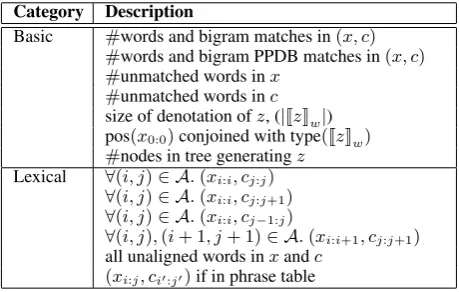
Table 4: Features for the paraphrasing model. pos(xi:i)is the POS tag; type(JzKw)is a coarse se-mantic type for the denotation (an entity or a num-ber). Ais a maximum weight alignment between xandc.
P
(x,c,z)∈Dlogpθ(z, c | x, w)−λkθk1. To
opti-mize, we use AdaGrad (Duchi et al., 2010). Features Table 4 describes the features. Our basic features mainly match words and bigrams in x andc, if they share a lemma or are aligned in the PPDB resource (Ganitkevitch et al., 2013). We count the number of exact matches, PPDB matches, and unmatched words.
To obtain lexical features, we run the Berkeley Aligner (Liang et al., 2006) on the training set and compute conditional probabilities of aligning one word type to another. Based on these probabilities we compute a maximum weight alignmentA
be-tween words inxandc. We define features overA (see Table 4). We also use the word alignments to construct a phrase table by applying the consistent phrase pair heuristic (Och and Ney, 2004). We de-fine an indicator feature for every phrase pair of xandcthat appear in the phrase table. Examples from the PUBLICATIONSdomain includefewest–
least number and by–whose author is. Note that
we do not build a hard lexicon but only use A and the phrase table to define features, allowing the model to learn useful paraphrases during train-ing. Finally, we define standard features on logical forms and denotations (Berant et al., 2013). 7 Experimental Evaluation
We evaluated our functionality-driven process on the seven domains described in Section 5 and one new domain we describe in Section 7.3. For each domain, we held out a random 20% of the exam-ples as the test set, and performed development on the remaining 80%, further splitting it to a train-ing and development set (80%/20%). We created a database for each domain by randomly generating facts using entities and properties in the domain (with type-checking). We evaluated using accu-racy, which is the fraction of examples that yield the correct denotation.
[image:7.595.73.533.62.276.2] [image:7.595.73.303.340.486.2]Method CALENDAR BLOCKS HOUSING RESTAURANTS PUBLICATIONS RECIPES SOCIAL BASKETBALL Avg.
FULL 74.4 41.9 54.0 75.9 59.0 70.8 48.2 46.3 58.8
NOLEX 25.0 35.3 51.9 64.6 50.6 32.3 15.3 19.4 36.8
NOPPDB 73.2 41.4 54.5 73.8 56.5 68.1 43.6 44.5 56.9
[image:8.595.75.503.62.113.2]BASELINE 17.3 27.7 45.9 61.3 46.7 26.3 9.7 15.6 31.3
Table 5: Test set results on all domains and baselines.
phenomena. To corroborate this, we compare our full system to NOLEX, a baseline that omits all lexical features (Table 4), but uses PPDB as a domain-general paraphrasing component. We per-form the complementary experiment and compare to NOPPDB, a baseline that omits PPDB match features. We also run BASELINE, where we omit both lexical and PPDB features.
Table 5 presents the results of this experiment. Overall, our framework obtains an average accu-racy of 59% across all eight domains. The per-formance of NOLEX is dramatically lower than FULL, indicating that it is important to learn domain-specific paraphrases using lexical fea-tures. The accuracy of NOPPDB is only slightly lower than FULL, showing that most of the re-quired paraphrases can be learned during training. As expected, removing both lexical and PPDB fea-tures results in poor performance (BASELINE).
Analysis. We performed error analysis on 10 er-rors in each domain. Almost 70% of the erer-rors are due to problems in the paraphrasing model, where the canonical utterance has extra material, is missing some content, or results in an incorrect paraphrase. For example, “restaurants that have
waiters and you can sit outside”is paraphrased to
“restaurant that has waiter service and that takes
reservations”. Another 12.5% result from
reorder-ing issues, e.g, we paraphrase “What venue has
fewer than two articles” to“article that has less
than two venue”. Inaccurate paraphrases provided
by AMT workers account for the rest of the errors. 7.2 Bounded non-compositionality
We hypothesized that we need to obtain para-phrases of canonical utterances corresponding to logical forms of only small depth. We ran the following experiment in the CALENDAR domain to test this claim. First, we define by NP0, NP1,
and NP2 the set of utterances generated by an NP
that has exactly zero, one, and two NPs embed-ded in it. We define the training scenario0→1, where we train on examples from NP0 and test
on examples from NP1; 0∪1→1, 0∪1→2,
and0∪1∪2→2 are defined analogously. Our
Scenario Acc. Scenario Acc.
0→1 22.9 0∪1→2 28.1
[image:8.595.318.516.147.190.2]0∪1→1 85.8 0∪1∪2→2 47.5
Table 6: Test set results in the CALENDARdomain on bounded non-compositionality.
hypothesis is that generalization on 0∪1→2
should be better than for 0→1, since NP1
ut-terances have non-compositional paraphrases, but training on NP0does not expose them.
The results in Table 6 verify this hypothesis. The accuracy of0→1is almost 65% lower than
0∪1→1. On the other hand, the accuracy of
0∪1→2is only 19% lower than0∪1∪2→2.
7.3 An overnight experiment
To verify the title of this paper, we attempted to create a semantic parser for a new domain (RECIPES) exactly 24 hours before the submission deadline. Starting at midnight, we created a seed lexicon in less than 30 minutes. Then we gener-ated canonical utterances and allowed AMT work-ers to provide paraphrases overnight. In the morn-ing, we trained our parser and obtained an accu-racy of 70.8% on the test set.
7.4 Testing on independent data
Geo880. To test how our parser generalizes to utterances independent of our framework, we cre-ated a semantic parser for the domain of US ge-ography, and tested on the standard 280 test ex-amples from GEO880 (Zelle and Mooney, 1996). We did not use the standard 600 training examples. Our parser obtained 56.4% accuracy, which is sub-stantially lower than state-of-the-art (∼90%).
the correct derivation tree exceeds the maximum depth used for our parser. Another 17.5% of the errors are caused by problems in the paraphrasing model. For example, in the utterance“what is the
size of california”, the model learns that “size”
corresponds to “population” rather than “area”. Errors related to reordering and the syntactic struc-ture of the input utterance account for 7.5% of the errors. For example, the utterance “what is the
area of the largest state”is paraphrased to“state
that has the largest area”.
Calendar. In Section 7.1, we evaluated on ut-terances obtained by paraphrasing canonical utter-ances from the grammar. To examine the cover-age of our parser on independently-produced ut-terances, we asked AMT workers to freely come up with queries. We collected 186 such queries; 5 were spam and discarded. We replaced all entities (people, dates, etc.) with entities from our seed lexicon to avoid focusing on entity detection.
We were able to annotate 52% of the utterances with logical forms from our grammar. We could not annotate 20% of the utterances due to relative time references, such as “What time is my next
meeting?”. 14% of the utterances were not
cov-ered due to binary predicates not in the grammar
(“What is the agenda of the meeting?”) or missing
entities (“When is Dan’s birthday?”). Another 2% required unsupported calculations (“How much
free time do I have tomorrow?”), and the rest are
out of scope for other reasons (“When does my
Verizon data plan start over?”).
We evaluated our trained semantic parser on the 95 utterances annotated with logical forms. Our parser obtained an accuracy of 46.3% and oracle accuracy of 84.2%, which measures how often the correct denotation is on the final beam. The large gap shows that there is considerable room for im-provement in the paraphrasing model.
8 Related work and discussion
Much of current excitement around semantic pars-ing emphasizes large knowledge bases such as Freebase (Cai and Yates, 2013; Kwiatkowski et al., 2013; Berant et al., 2013). However, despite the apparent scale, the actual question answering datasets (Free917 and WebQuestions) are limited in compositionality. Moreover, specialized do-mains with specialized jargon will always exist, e.g., in regular expressions (Kushman and Barzi-lay, 2013) or grounding to perception (Matuszek
et al., 2012; Tellex et al., 2011; Krishnamurthy and Kollar, 2013). Therefore, we believe build-ing a targeted domain-specific semantic parser for a new website or device is a very practical goal.
Recent work has made significant strides in reducing supervision from logical forms (Zettle-moyer and Collins, 2005; Wong and Mooney, 2007) to denotations (Clarke et al., 2010; Liang et al., 2011) and to weaker forms (Artzi and Zettle-moyer, 2011; Reddy et al., 2014). All of these works presuppose having input utterances, which do not exist in a new domain. Our methodol-ogy overcomes this hurdle by exploiting a very lightweight form of annotation: paraphrasing.
Paraphrasing has been applied to single-property question answering (Fader et al., 2013) and semantic parsing (Berant and Liang, 2014). We not only use paraphrasing in the semantic parser, but also for data collection.
Table 2 might evoke rule-based systems (Woods et al., 1972; Warren and Pereira, 1982) or con-trolled natural languages (Schwitter, 2010). How-ever, there is an important distinction: the gram-mar need only connect a logical form to one canonical utterance; it is not used directly for pars-ing. This relaxation allows the grammar to be much simpler. Our philosophy is to use the simple domain-general grammar to carry the torch just to the point of being understandable by a human, and let the human perform the remaining correction to produce a natural utterance.
In summary, our contributions are two-fold: a new functionality-driven process and an explo-ration of some of its linguistic implications. We believe that our methodology is a promising way to build semantic parsers, and in future work, we would like to extend it to handle anaphora and nested quantification.
Acknowledgments. We gratefully acknowledge the support of the Google Natural Language Un-derstanding Focused Program and the DARPA Deep Exploration and Filtering of Text (DEFT) Program contract no. FA8750-13-2-0040.
Reproducibility. All code,1 data, and
experiments for this paper are avail-able on the CodaLab platform at
https://www.codalab.org/worksheets/ 0x269ef752f8c344a28383240f7bb2be9c/.
1Our system uses the SEMPRE toolkit (http://nlp.
References
Y. Artzi and L. Zettlemoyer. 2011. Bootstrap-ping semantic parsers from conversations. In Em-pirical Methods in Natural Language Processing (EMNLP), pages 421–432.
Y. Artzi and L. Zettlemoyer. 2013. Weakly supervised learning of semantic parsers for mapping instruc-tions to acinstruc-tions. Transactions of the Association for Computational Linguistics (TACL), 1:49–62. J. Berant and P. Liang. 2014. Semantic parsing via
paraphrasing. In Association for Computational Linguistics (ACL).
J. Berant, A. Chou, R. Frostig, and P. Liang. 2013. Semantic parsing on Freebase from question-answer pairs. InEmpirical Methods in Natural Language Processing (EMNLP).
Q. Cai and A. Yates. 2013. Large-scale semantic pars-ing via schema matchpars-ing and lexicon extension. In
Association for Computational Linguistics (ACL). J. Clarke, D. Goldwasser, M. Chang, and D. Roth.
2010. Driving semantic parsing from the world’s re-sponse. InComputational Natural Language Learn-ing (CoNLL), pages 18–27.
J. Duchi, E. Hazan, and Y. Singer. 2010. Adaptive sub-gradient methods for online learning and stochastic optimization. In Conference on Learning Theory (COLT).
A. Fader, L. Zettlemoyer, and O. Etzioni. 2013. Paraphrase-driven learning for open question an-swering. InAssociation for Computational Linguis-tics (ACL).
J. Ganitkevitch, B. V. Durme, and C. Callison-Burch. 2013. PPDB: The paraphrase database. InHuman Language Technology and North American Associ-ation for ComputAssoci-ational Linguistics (HLT/NAACL), pages 758–764.
J. Krishnamurthy and T. Kollar. 2013. Jointly learning to parse and perceive: Connecting natural language to the physical world. Transactions of the Associa-tion for ComputaAssocia-tional Linguistics (TACL), 1:193– 206.
N. Kushman and R. Barzilay. 2013. Using semantic unification to generate regular expressions from nat-ural language. InHuman Language Technology and North American Association for Computational Lin-guistics (HLT/NAACL), pages 826–836.
T. Kwiatkowski, E. Choi, Y. Artzi, and L. Zettlemoyer. 2013. Scaling semantic parsers with the-fly on-tology matching. InEmpirical Methods in Natural Language Processing (EMNLP).
P. Liang, B. Taskar, and D. Klein. 2006. Align-ment by agreeAlign-ment. InNorth American Association for Computational Linguistics (NAACL), pages 104– 111.
P. Liang, M. I. Jordan, and D. Klein. 2011. Learn-ing dependency-based compositional semantics. In
Association for Computational Linguistics (ACL), pages 590–599.
P. Liang. 2013. Lambda dependency-based composi-tional semantics. arXiv.
C. Matuszek, N. FitzGerald, L. Zettlemoyer, L. Bo, and D. Fox. 2012. A joint model of language and perception for grounded attribute learning. In Inter-national Conference on Machine Learning (ICML), pages 1671–1678.
F. J. Och and H. Ney. 2004. The alignment template approach to statistical machine translation. Compu-tational Linguistics, 30:417–449.
P. Pasupat and P. Liang. 2015. Compositional semantic parsing on semi-structured tables. InAssociation for Computational Linguistics (ACL).
R. A. P. Rangel, M. A. Aguirre, J. J. Gonzlez, and J. M. Carpio. 2014. Features and pitfalls that users should seek in natural language interfaces to databases. In
Recent Advances on Hybrid Approaches for Design-ing Intelligent Systems, pages 617–630.
S. Reddy, M. Lapata, and M. Steedman. 2014. Large-scale semantic parsing without question-answer pairs. Transactions of the Association for Compu-tational Linguistics (TACL), 2(10):377–392.
R. Schwitter. 2010. Controlled natural languages for knowledge representation. In International Con-ference on Computational Linguistics (COLING), pages 1113–1121.
S. Tellex, T. Kollar, S. Dickerson, M. R. Walter, A. G. Banerjee, S. J. Teller, and N. Roy. 2011. Un-derstanding natural language commands for robotic navigation and mobile manipulation. In Associa-tion for the Advancement of Artificial Intelligence (AAAI).
D. Warren and F. Pereira. 1982. An efficient easily adaptable system for interpreting natural language queries. Computational Linguistics, 8:110–122.
Y. W. Wong and R. J. Mooney. 2007. Learning synchronous grammars for semantic parsing with lambda calculus. InAssociation for Computational Linguistics (ACL), pages 960–967.
W. A. Woods, R. M. Kaplan, and B. N. Webber. 1972. The lunar sciences natural language information sys-tem: Final report. Technical report, BBN Report 2378, Bolt Beranek and Newman Inc.