Pointing the Unknown Words
Caglar Gulcehre
Universit´e de Montr´eal Universit´e de Montr´ealSungjin Ahn IBM T.J. Watson ResearchRamesh Nallapati
Bowen Zhou
IBM T.J. Watson Research Universit´e de Montr´ealYoshua Bengio CIFAR Senior Fellow
Abstract
The problem of rare and unknown words is an important issue that can potentially effect the performance of many NLP sys-tems, including traditional count-based and deep learning models. We propose a novel way to deal with the rare and unseen words for the neural network models us-ing attention. Our model uses two softmax layers in order to predict the next word in conditional language models: one predicts the location of a word in the source sen-tence, and the other predicts a word in the shortlist vocabulary. At each timestep, the decision of which softmax layer to use is adaptively made by an MLP which is con-ditioned on the context. We motivate this work from a psychological evidence that humans naturally have a tendency to point towards objects in the context or the envi-ronment when the name of an object is not known. Using our proposed model, we ob-serve improvements on two tasks, neural machine translation on the Europarl En-glish to French parallel corpora and text summarization on the Gigaword dataset.
1 Introduction
Words are the basic input/output units in most of the NLP systems, and thus the ability to cover a large number of words is a key to building a ro-bust NLP system. However, considering that (i) the number of all words in a language including named entities is very large and that (ii) language itself is an evolving system (people create new words), this can be a challenging problem.
A common approach followed by the recent neural network based NLP systems is to use a softmax output layer where each of the output
di-mension corresponds to a word in a predefined word-shortlist. Because computing high dimen-sional softmax is computationally expensive, in practice the shortlist is limited to have only
top-Kmost frequent words in the training corpus. All other words are then replaced by a special word, called theunknown word (UNK).
The shortlist approach has two fundamental problems. The first problem, which is known as therare wordproblem, is that some of the words in the shortlist occur less frequently in the train-ing set and thus are difficult to learn a good repre-sentation, resulting in poor performance. Second, it is obvious that we can lose some important in-formation by mapping different words to a single dummy token UNK. Even if we have a very large shortlist including all unique words in the training set, it does not necessarily improve the test perfor-mance, because there still exists a chance to see an unknown word at test time. This is known as the unknown word problem. In addition, increasing the shortlist size mostly leads to increasing rare words due to Zipf’s Law.
These two problems are particularly critical in language understanding tasks such as factoid question answering (Bordes et al., 2015) where the words that we are interested in are often named en-tities which are usually unknown or rare words.
In a similar situation, where we have a limited information on how to call an object of interest, it seems that humans (and also some primates) have an efficient behavioral mechanism of drawing at-tention to the object: pointing (Matthews et al., 2012). Pointing makes it possible to deliver in-formation and to associate context to a particular object without knowing how to call it. In partic-ular, human infants use pointing as a fundamental communication tool (Tomasello et al., 2007).
In this paper, inspired by the pointing behav-ior of humans and recent advances in the
tion mechanism (Bahdanau et al., 2014) and the pointer networks (Vinyals et al., 2015), we pro-pose a novel method to deal with the rare or un-known word problem. The basic idea is that we can see many NLP problems as a task of predict-ing target text given context text, where some of the target words appear in the context as well. We observe that in this case we can make the model learn to pointa word in the context and copy it to the target text, as well aswhen to point. For exam-ple, in machine translation, we can see the source sentence as the context, and the target sentence as what we need to predict. In Figure 1, we show an example depiction of how words can be copied from source to target in machine translation. Al-though the source and target languages are differ-ent, many of the words such as named entities are usually represented by the same characters in both languages, making it possible to copy. Similarly, in text summarization, it is natural to use some words in the original text in the summarized text as well.
Specifically, to predict a target word at each timestep, our model first determines the source of the word generation, that is, whether to take one from a predefined shortlist or to copy one from the context. For the former, we apply the typical softmax operation, and for the latter, we use the attention mechanism to obtain the pointing soft-max probability over the context words and pick the one of high probability. The model learns this decision so as to use the pointing only when the context includes a word that can be copied to the target. This way, our model can predict even the words which are not in the shortlist, as long as it appears in the context. Although some of the words still need to be labeled as UNK, i.e., if it is neither in the shortlist nor in the context, in ex-periments we show that this learning when and where to point improves the performance in ma-chine translation and text summarization.
Guillaumeet Cesaront une voiture bleue a Lausanne.
Guillaumeand Cesar have a blue car in Lausanne.
Copy Copy Copy
French:
English:
Figure 1: An example of how copying can happen for machine translation. Common words that ap-pear both in source and the target can directly be copied from input to source. The rest of the un-known in the target can be copied from the input after being translated with a dictionary.
The rest of the paper is organized as follows. In the next section, we review the related works in-cluding pointer networks and previous approaches to the rare/unknown problem. In Section 3, we review the neural machine translation with atten-tion mechanism which is the baseline in our ex-periments. Then, in Section 4, we propose our method dealing with the rare/unknown word prob-lem, called thePointer Softmax (PS). The exper-imental results are provided in the Section 5 and we conclude our work in Section 6.
2 Related Work
The attention-based pointing mechanism is intro-duced first in the pointer networks (Vinyals et al., 2015). In the pointer networks, the output space of the target sequence is constrained to be the obser-vations in the input sequence (not the input space). Instead of having a fixed dimension softmax out-put layer, softmax outout-puts of varying dimension is dynamically computed for each input sequence in such a way to maximize the attention probability of the target input. However, its applicability is rather limited because, unlike our model, there is no option to choose whether to point or not; it al-ways points. In this sense, we can see the pointer networks as a special case of our model where we always choose to point a context word.
Several approaches have been proposed towards solving the rare words/unknown words problem, which can be broadly divided into three categories. The first category of the approaches focuses on improving the computation speed of the softmax output so that it can maintain a very large vocabu-lary. Because this only increases the shortlist size, it helps to mitigate the unknown word problem, but still suffers from the rare word problem. The hierarchical softmax (Morin and Bengio, 2005), importance sampling (Bengio and Sen´ecal, 2008; Jean et al., 2014), and the noise contrastive esti-mation (Gutmann and Hyv¨arinen, 2012; Mnih and Kavukcuoglu, 2013) methods are in the class.
soft-max output over the relative pointing range (e.g., -7, . . . , -1, 0, 1, . . . , 7), their model (the Posi-tional All model) has a limitation in applying to more general problems such as summarization and question answering, where, unlike machine trans-lation, the length of the context and the pointing locations in the context can vary dramatically. In question answering setting, (Hermann et al., 2015) have used placeholders on named entities in the context. However, the placeholder id is directly predicted in the softmax output rather than predict-ing its location in the context.
The third category of the approaches changes the unit of input/output itself from words to a smaller resolution such as characters (Graves, 2013) or bytecodes (Sennrich et al., 2015; Gillick et al., 2015). Although this approach has the main advantage that it could suffer less from the rare/unknown word problem, the training usually becomes much harder because the length of se-quences significantly increases.
Simultaneously to our work, (Gu et al., 2016) and (Cheng and Lapata, 2016) proposed models that learn to copy from source to target and both papers analyzed their models on summarization tasks.
3 Neural Machine Translation Model with Attention
As the baseline neural machine translation sys-tem, we use the model proposed by (Bahdanau et al., 2014) that learns to (soft-)align and translate jointly. We refer this model as NMT.
The encoder of the NMT is a bidirectional RNN (Schuster and Paliwal, 1997). The forward RNN reads input sequence x = (x1, . . . , xT)
in left-to-right direction, resulting in a sequence of hidden states (−→h1, . . . ,−→hT). The backward
RNN readsxin the reversed direction and outputs (←h−1, . . . ,←h−T). We then concatenate the hidden
states of forward and backward RNNs at each time step and obtain a sequence ofannotationvectors (h1, . . . ,hT) where hj =
h−→
hj||←h−j
i
. Here, || denotes the concatenation operator. Thus, each an-notation vectorhj encodes information about the j-th word with respect to all the other surrounding words in both directions.
In the decoder, we usually use gated recur-rent unit (GRU) (Cho et al., 2014; Chung et al., 2014). Specifically, at each time-stept, the soft-alignment mechanism first computes the relevance
weight etj which determines the contribution of
annotation vector hj to the t-th target word. We
use a non-linear mapping f (e.g., MLP) which takeshj, the previous decoder’s hidden statest−1
and the previous outputyt−1as input:
etj =f(st−1,hj, yt−1).
The outputsetjare then normalized as follows:
ltj= PTexp(etj)
k=1exp(etk). (1)
We callltj as the relevance score, or the
align-ment weight, of thej-th annotation vector. The relevance scores are used to get thecontext vectorctof thet-th target word in the translation:
ct= T
X
j=1
ltjhj ,
The hidden state of the decoderstis computed
based on the previous hidden statest−1, the
con-text vectorctand the output word of the previous
time-stepyt−1:
st=fr(st−1, yt−1,ct), (2)
wherefris GRU.
We use a deep output layer (Pascanu et al., 2013) to compute the conditional distribution over words:
p(yt=a|y<t,x)∝
expψa
(Wo,bo)fo(st, yt−1,ct)
, (3)
where W is a learned weight matrix and b is a bias of the output layer. fo is a single-layer
feed-forward neural network.ψ(Wo,bo)(·)is a function
that performs an affine transformation on its input. And the superscriptainψaindicates thea-th
col-umn vector ofψ.
The whole model, including both the encoder and the decoder, is jointly trained to maximize the (conditional) log-likelihood of target sequences given input sequences, where the training corpus is a set of (xn,yn)’s. Figure 2 illustrates the
ar-chitecture of the NMT.
4 The Pointer Softmax
lt
wt
st-1
ct
... st
h0 ... hk
... st+1
[image:4.595.93.274.62.196.2]Encoder
Figure 2: A depiction of neural machine transla-tion architecture with attentransla-tion. At each timestep, the model generates the attention weights lt. We
useltthe encoder’s hidden state to obtain the
con-textct. The decoder usesctto predict a vector of
probabilities for the wordswtby using softmax.
applicable approach to many NLP tasks, because it resolves the limitations about unknown words for neural networks. It can be used in parallel with other existing techniques such as the large vocabu-lary trick (Jean et al., 2014). Our model learns two key abilities jointly to make the pointing mech-anism applicable in more general settings: (i) to predict whether it is required to use the pointing or not at each time step and (ii) to point any lo-cation of the context sequence whose length can vary widely over examples. Note that the pointer networks (Vinyals et al., 2015) are in lack of the ability (i), and the ability (ii) is not achieved in the models by (Luong et al., 2015).
To achieve this, our model uses two softmax output layers, the shortlistsoftmax and the loca-tion softmax. The shortlist softmax is the same as the typical softmax output layer where each dimension corresponds a word in the predefined word shortlist. The location softmax is a pointer network where each of the output dimension cor-responds to the location of a word in the context sequence. Thus, the output dimension of the loca-tion softmax varies according to the length of the given context sequence.
At each time-step, if the model decides to use the shortlist softmax, we generate a wordwtfrom
the shortlist. Otherwise, if it is expected that the context sequence contains a word which needs to be generated at the time step, we obtain the loca-tion of the context wordltfrom the location
soft-max. The key to making this possible is decid-ing when to use the shortlist softmax or the
lo-cation softmax at each time step. In order to ac-complish this, we introduce a switching network to the model. The switching network, which is a multilayer perceptron in our experiments, takes the representation of the context sequence (similar to the input annotation in NMT) and the previous hidden state of the output RNN as its input. It out-puts a binary variableztwhich indicates whether
to use the shortlist softmax (whenzt = 1) or the location softmax (whenzt = 0). Note that if the
word that is expected to be generated at each time-step is neither in the shortlist nor in the context se-quence, the switching network selects the shortlist softmax, and then the shortlist softmax predicts UNK. The details of the pointer softmax model can be seen in Figure 3 as well.
lt
wt
st-1
ct
p 1 - p
ft
... st
h0 ... hk
Encoder
Figure 3: A simple depiction of the Pointer Soft-max(PS) architecture. At each timestep as usuallt,
ctand thewtfor the words over the limited
vocab-ulary(shortlist) is being generated. We have an ad-ditional switching variableztthat decides whether
to usewtor copy the word from the input via lt.
The final word prediction will be performed via pointer softmaxftwhich can either copy the word
from the source or predict the word from the short-list vocabulary.
More specifically, our goal is to maximize the probability of observing the target word sequence y = (y1, y2, . . . , yTy) and the word generation
sourcez= (z1, z2, . . . , zTy), given the context
se-quencex= (x1, x2, . . . , xTx):
pθ(y,z|x) = Ty
Y
t=1
[image:4.595.318.505.298.481.2]Note that the word observation yt can be either
a word wt from the shortlist softmax or a
loca-tion lt from the location softmax, depending on the switching variablezt.
Considering this, we can factorize the above equation further
p(y,z|x) = Y
t∈Tw
p(wt, zt|(y, z)<t,x)×
Y
t0∈Tl
p(lt0, zt0|(y, z)<t0,x). (5)
Here,Twis a set of time steps wherezt= 1, andTl
is a set of time-steps wherezt= 0. And,Tw∪Tl =
{1,2, . . . , Ty} and Tw ∩ Tl = ∅. We denote all
previous observations at step tby (y, z)<t. Note
also thatht=f((y, z)<t).
Then, the joint probabilities inside each product can be further factorized as follows:
p(wt, zt|(y, z)<t) = p(wt|zt= 1,(y, z)<t)× p(zt= 1|(y, z)<t) (6)
p(lt, zt|(y, z)<t) = p(lt|zt= 0,(y, z)<t)× p(zt= 0|(y, z)<t) (7)
here, we omitted x which is conditioned on all probabilities in the above.
The switch probability is modeled as a multi-layer perceptron with binary output:
p(zt= 1|(y, z)<t,x) = σ(f(x,ht−1;θ)) (8)
p(zt= 0|(y, z)<t,x) = 1−σ(f(x,ht−1;θ)). (9)
Andp(wt|zt = 1,(y, z)<t,x)is the shortlist soft-max and p(lt|zt = 0,(y, z)<t,x) is the location
softmax which can be a pointer network. σ(·) stands for the sigmoid function,σ(x) = 1
exp(-x)+1.
GivenNsuch context and target sequence pairs, our training objective is to maximize the following log likelihood w.r.t. the model parameterθ
arg max
θ
1
N N
X
n=1
logpθ(yn, zn|xn). (10)
4.1 Basic Components of the Pointer Softmax In this section, we discuss practical details of the three fundamental components of the pointer soft-max. The interactions between these components and the model is depicted in Figure 3.
Location Softmaxlt : The location of the word
to copy from source text to the target is predicted by the location softmax lt. The location
soft-max outputs the conditional probability distribu-tionp(lt|zt= 0,(y, z)<t,x). For models using the
attention mechanism such as NMT, we can reuse the probability distributions over the source words in order to predict the location of the word to point. Otherwise we can simply use a pointer network of the model to predict the location.
Shortlist Softmaxwt : The subset of the words
in the vocabulary V is being predicted by the shortlist softmaxwt.
Switching networkdt : The switching network dt is an MLP with sigmoid output function that
outputs a scalar probability of switching between lt and wt, and represents the conditional
prob-ability distribution p(zt|(y, z)<t,x). For NMT
model, we condition the MLP that outputs the switching probability on the representation of the context of the source text ctand the hidden state
of the decoderht. Note that, during the training, dtis observed, and thus we do not have to sample.
The output of the pointer softmax,ftwill be the
concatenation of the the two vectors,dt×wtand
(1−dt)×lt.
At test time, we compute Eqn. (6) and (7) for all shortlist word wt and all locationlt, and pick the word or location of the highest probability.
5 Experiments
In this section, we provide our main experimen-tal results with the pointer softmax on machine translation and summarization tasks. In our ex-periments, we have used the same baseline model and just replaced the softmax layer with pointer softmax layer at the language model. We use the Adadelta (Zeiler, 2012) learning rule for the train-ing of NMT models. The code for pointer softmax model is available athttps://github.com/
caglar/pointer_softmax.
5.1 The Rarest Word Detection
tion which has the form of a geometric distribu-tion. The task is to predict the least frequent word in the sequence according to unigram distribution of the words. During the training, the sequences are generated randomly. Before the training, val-idation and test sets are constructed with a fixed seed.
We use a GRU layer over the input sequence and take the last-hidden state, in order to get the summary ct of the input sequence. The wt, lt
are only conditioned on ct, and the MLP
pre-dicting the dt is conditioned on the latent
repre-sentations of wt and lt. We use minibatches of
size 250 using adam adaptive learning rate algo-rithm (Kingma and Adam, 2015) using the learn-ing rate of8×10−4 and hidden layers with 1000
units.
We train a model with pointer softmax where we assign pointers for the rarest 60 words and the rest of the words are predicted from the shortlist softmax of size 540. We observe that increasing the inverse temperature of the sigmoid output of
dtto 2, in other words making the decisions ofdt
to become sharper, works better, i.e.dt=σ(2x).
At the end of training with pointer softmax we obtain the error rate of 17.4%and by using soft-max over all 600 tokens, we obtain the error-rate of48.2%.
5.2 Summarization
In these series of experiments, we use the anno-tated Gigaword corpus as described in (Rush et al., 2015). Moreover, we use the scripts that are made available by the authors of (Rush et al., 2015) 1 to preprocess the data, which results to approxi-mately 3.8M training examples. This script gen-erates about 400K validation and an equal number of test examples, but we use a randomly sampled subset of 2000 examples each for validation and testing. We also have made small modifications to the script to extract not only the tokenized words, but also system-generated named-entity tags. We have created two different versions of training data for pointers, which we call UNK-pointers data and entity-pointers data respectively.
For the UNK-pointers data, we trim the vocabu-lary of the source and target data in the training set and replace a word by the UNK token whenever a word occurs less than 5 times in either source or target data separately. Then, we create pointers
1https://github.com/facebook/NAMAS
from each UNK token in the target data to the posi-tion in the corresponding source document where the same word occurs in the source, as seen in the data before UNKs were created. It is possible that the source can have an UNK in the matching posi-tion, but we still created a pointer in this scenario as well. The resulting data has 2.7 pointers per 100 examples in the training set and 9.1 pointers rate in the validation set.
In the entity-pointers data, we exploit the named-entity tags in the annotated corpus and first anonymize the entities by replacing them with an integer-id that always starts from 1 for each doc-ument and increments from left to right. Entities that occur more than once in a single document share the same id. We create the anonymization at token-level, so as to allow partial entity matches between the source and target for multi-token en-tities. Next, we create a pointer from the target to source on similar lines as before, but only for exact matches of the anonymized entities. The re-sulting data has 161 pointers per 100 examples in the training set and 139 pointers per 100 examples in the validation set.
If there are multiple matches in the source, either in the UNK-pointers data or the entity-pointers data, we resolve the conflict in favor of the first occurrence of the matching word in the source document. In the UNK data, we model the UNK tokens on the source side using a sin-gle placeholder embedding that is shared across all documents, and in the entity-pointers data, we model each entity-id in the source by a distinct placeholder, each of which is shared across all documents.
exper-iments.
We use the reference data for pointers for the model only at the training time. During the test time, the switch makes a decision at every timestep on which softmax layer to use.
For evaluation, we use full-length Rouge F1 us-ing the official evaluation tool2. In their work, the authors of (Bahdanau et al., 2014) use full-length Rouge Recall on this corpus, since the maximum length of limited-length version of Rouge recall of 75 bytes (intended for DUC data) is already long for Gigaword summaries. However, since full-length Recall can unfairly reward longer sum-maries, we also use full-length F1 in our experi-ments for a fair comparison between our models, independent of the summary length.
The experimental results comparing the Pointer Softmax with NMT model are displayed in Ta-ble 1 for the UNK pointers data and in TaTa-ble 2 for the entity pointers data. As the experiments show, pointer softmax improves over the baseline NMT on both UNK data and entities data. Our hope was that the improvement would be larger for the entities data since the incidence of point-ers was much greater. However, it turns out this is not the case, and we suspect the main reason is anonymization of entities which removed data-sparsity by converting all entities to integer-ids that are shared across all documents. We believe that on de-anonymized data, our model could help more, since the issue of data-sparsity is more acute in this case.
Table 1: Results on Gigaword Corpus when point-ers are used for UNKs in the training data, using Rouge-F1 as the evaluation metric.
[image:7.595.308.527.98.144.2]Rouge-1 Rouge-2 Rouge-L NMT + lvt 34.87 16.54 32.27 NMT + lvt + PS 35.19 16.66 32.51
Table 2: Results on anonymized Gigaword Corpus when pointers are used for entities, using Rouge-F1 as the evaluation metric.
Rouge-1 Rouge-2 Rouge-L NMT + lvt 34.89 16.78 32.37 NMT + lvt + PS 35.11 16.76 32.55
2http://www.berouge.com/Pages/default.
aspx
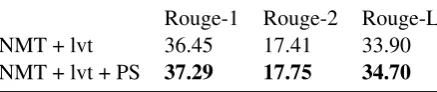
Table 3: Results on Gigaword Corpus for model-ing UNK’s with pointers in terms of recall.
Rouge-1 Rouge-2 Rouge-L NMT + lvt 36.45 17.41 33.90 NMT + lvt + PS 37.29 17.75 34.70
In Table 3, we provide the results for summa-rization on Gigaword corpus in terms of recall as also similar comparison done by (Rush et al., 2015). We observe improvements on all the scores with the addition of pointer softmax. Let us note that, since the test set of (Rush et al., 2015) is not publicly available, we sample2000texts with their summaries without replacement from the valida-tion set and used those examples as our test set.
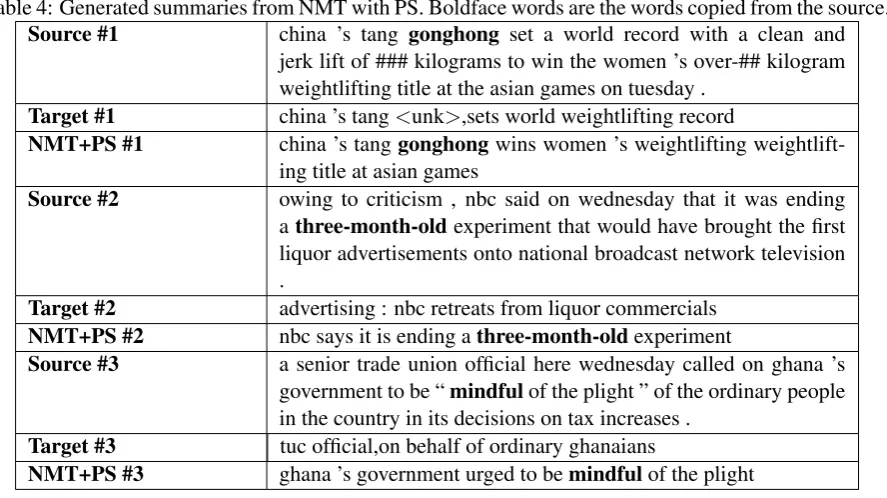
In Table 4 we present a few system gener-ated summaries from the Pointer Softmax model trained on the UNK pointers data. From those ex-amples, it is apparent that the model has learned to accurately point to the source positions whenever it needs to generate rare words in the summary.
5.3 Neural Machine Translation
In our neural machine translation (NMT) experi-ments, we train NMT models with attention over the Europarl corpus (Bahdanau et al., 2014) over the sequences of length up to 50 for English to French translation. 3. All models are trained with early-stopping which is done based on the negative log-likelihood (NLL) on the development set. Our evaluations to report the performance of our mod-els are done onnewstest2011by using BLUE score.4
We use30,000tokens for both the source and the target language shortlist vocabularies (1of the token is still reserved for the unknown words). The whole corpus contains 134,831 unique En-glish words and 153,083 unique French words. We have created a word-level dictionary from French to English which contains translation of 15,953 words that are neither in shortlist vocab-ulary nor dictionary of common words for both the source and the target. There are about49,490 words shared between English and French parallel corpora of Europarl.
3In our experiments, we use an existing code,
pro-vided in https://github.com/kyunghyuncho/
dl4mt-material, and on the original model we only
changed the last softmax layer for our experiments
4We compute the BLEU score using the multi-blue.perl
Table 4: Generated summaries from NMT with PS. Boldface words are the words copied from the source.
Source #1 china ’s tang gonghong set a world record with a clean and
jerk lift of ### kilograms to win the women ’s over-## kilogram weightlifting title at the asian games on tuesday .
Target #1 china ’s tang<unk>,sets world weightlifting record
NMT+PS #1 china ’s tanggonghongwins women ’s weightlifting
weightlift-ing title at asian games
Source #2 owing to criticism , nbc said on wednesday that it was ending
athree-month-oldexperiment that would have brought the first liquor advertisements onto national broadcast network television .
Target #2 advertising : nbc retreats from liquor commercials
NMT+PS #2 nbc says it is ending athree-month-oldexperiment
Source #3 a senior trade union official here wednesday called on ghana ’s government to be “mindfulof the plight ” of the ordinary people in the country in its decisions on tax increases .
Target #3 tuc official,on behalf of ordinary ghanaians
NMT+PS #3 ghana ’s government urged to bemindfulof the plight
During the training, in order to decide whether to pick a word from the source sentence using at-tention/pointers or to predict the word from the short-list vocabulary, we use a simple heuristic. If the word is not in the short-list vocabulary, we first check if the word yt itself appears in the source
sentence. If it is not, we check if the word it-self is in the source sentence by using the shared words lookup table for the source and the target language. If the word is in the source sentence, we then use the location of the word in the source as the target. Otherwise we check if one of the English senses from the cross-language dictionary of the French word is in the source. If it is in the source sentence, then we use the location of that word as our translation. Otherwise we just use the argmax ofltas the target.
For switching networkdt, we observed that
us-ing a two-layered MLP with noisy-tanh activation (Gulcehre et al., 2016) function with residual con-nection from the lower layer (He et al., 2015) ac-tivation function to the upper hidden layers im-proves the BLEU score about 1 points over the
dtusing ReLU activation function. We initialized the biases of the last sigmoid layer of dt to −1
such that ifdtbecomes more biased toward
choos-ing the shortlist vocabulary at the beginnchoos-ing of the training. We renormalize the gradients if the norm of the gradients exceed1(Pascanu et al., 2012).
[image:8.595.85.512.75.319.2]In Table 5, we provided the result of NMT with pointer softmax and we observe about3.6BLEU
Table 5: Europarl Dataset (EN-FR) BLEU-4
NMT 20.19
NMT + PS 23.76
score improvement over our baseline.
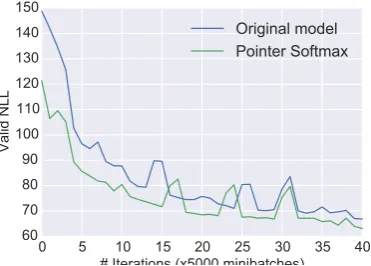
In Figure 4, we show the validation curves of the NMT model with attention and the NMT model with shortlist-softmax layer. Pointer soft-max converges faster in terms of number of mini-batch updates and achieves a lower validation negative-log-likelihood (NLL) (63.91) after200k
updates over the Europarl dataset than the NMT model with shortlist softmax trained for 400k
minibatch updates (65.26). Pointer softmax con-verges faster than the model using the short-list softmax, because the targets provided to the pointer softmax also acts like guiding hints to the attention.
6 Conclusion
mod-0 5 10 15 20 25 30 35 40 # Iterations (x5000 minibatches) 60
70 80 90 100 110 120 130 140 150
Valid NLL
[image:9.595.77.263.73.206.2]Original model Pointer Softmax
Figure 4: A comparison of the validation learning-curves of the same NMT model trained with pointer softmax and the regular softmax layer. As can be seen from the figures, the model trained with pointer softmax converges faster than the reg-ular softmax layer. Switching network for pointer softmax in this Figure uses ReLU activation func-tion.
ification over the NMT, our model is able to gen-eralize to the unseen words and can deal with rare-words more efficiently. For the summarization task on Gigaword dataset, the pointer softmax was able to improve the results even when it is used together with the large-vocabulary trick. In the case of neural machine translation, we observed that the training with the pointer softmax is also improved the convergence speed of the model as well. For French to English machine translation on Europarl corpora, we observe that using the pointer softmax can also improve the training con-vergence of the model.
References
[Bahdanau et al.2014] Dzmitry Bahdanau, Kyunghyun Cho, and Yoshua Bengio. 2014. Neural machine translation by jointly learning to align and translate.
CoRR, abs/1409.0473.
[Bengio and Sen´ecal2008] Yoshua Bengio and Jean-S´ebastien Sen´ecal. 2008. Adaptive importance sampling to accelerate training of a neural
proba-bilistic language model. Neural Networks, IEEE
Transactions on, 19(4):713–722.
[Bordes et al.2015] Antoine Bordes, Nicolas Usunier, Sumit Chopra, and Jason Weston. 2015. Large-scale simple question answering with memory
net-works. arXiv preprint arXiv:1506.02075.
[Cheng and Lapata2016] Jianpeng Cheng and Mirella
Lapata. 2016. Neural summarization by
ex-tracting sentences and words. arXiv preprint
arXiv:1603.07252.
[Cho et al.2014] Kyunghyun Cho, Bart
Van Merri¨enboer, Caglar Gulcehre, Dzmitry Bahdanau, Fethi Bougares, Holger Schwenk,
and Yoshua Bengio. 2014. Learning phrase
representations using rnn encoder-decoder for
statistical machine translation. arXiv preprint
arXiv:1406.1078.
[Chung et al.2014] Junyoung Chung, C¸aglar G¨ulc¸ehre, KyungHyun Cho, and Yoshua Bengio. 2014. Em-pirical evaluation of gated recurrent neural networks
on sequence modeling. CoRR, abs/1412.3555.
[Gillick et al.2015] Dan Gillick, Cliff Brunk, Oriol Vinyals, and Amarnag Subramanya. 2015.
Mul-tilingual language processing from bytes. arXiv
preprint arXiv:1512.00103.
[Graves2013] Alex Graves. 2013. Generating
se-quences with recurrent neural networks. arXiv
preprint arXiv:1308.0850.
[Gu et al.2016] Jiatao Gu, Zhengdong Lu, Hang Li, and Victor OK Li. 2016. Incorporating copying
mechanism in sequence-to-sequence learning. arXiv
preprint arXiv:1603.06393.
[Gulcehre et al.2016] Caglar Gulcehre, Marcin
Moczulski, Misha Denil, and Yoshua Bengio.
2016. Noisy activation functions. arXiv preprint
arXiv:1603.00391.
[Gutmann and Hyv¨arinen2012] Michael U Gutmann and Aapo Hyv¨arinen. 2012. Noise-contrastive esti-mation of unnormalized statistical models, with
ap-plications to natural image statistics. The Journal of
Machine Learning Research, 13(1):307–361. [He et al.2015] Kaiming He, Xiangyu Zhang,
Shao-qing Ren, and Jian Sun. 2015. Deep
resid-ual learning for mage recognition. arXiv preprint
arXiv:1512.03385.
[Hermann et al.2015] Karl Moritz Hermann, Tomas Kocisky, Edward Grefenstette, Lasse Espeholt, Will Kay, Mustafa Suleyman, and Phil Blunsom. 2015.
Teaching machines to read and comprehend. In
Ad-vances in Neural Information Processing Systems, pages 1684–1692.
[Jean et al.2014] S´ebastien Jean, Kyunghyun Cho, Roland Memisevic, and Yoshua Bengio. 2014. On using very large target vocabulary for neural
ma-chine translation. arXiv preprint arXiv:1412.2007.
[Kingma and Adam2015] Diederik P Kingma and Jimmy Ba Adam. 2015. A method for stochastic
optimization. In International Conference on
Learning Representation.
[Luong et al.2015] Minh-Thang Luong, Ilya Sutskever, Quoc V Le, Oriol Vinyals, and Wojciech Zaremba. 2015. Addressing the rare word problem in neural
[Matthews et al.2012] Danielle Matthews, Tanya Behne, Elena Lieven, and Michael Tomasello. 2012. Origins of the human pointing gesture: a
training study. Developmental science, 15(6):817–
829.
[Mnih and Kavukcuoglu2013] Andriy Mnih and Koray Kavukcuoglu. 2013. Learning word embeddings
efficiently with noise-contrastive estimation. In
Ad-vances in Neural Information Processing Systems, pages 2265–2273.
[Morin and Bengio2005] Frederic Morin and Yoshua Bengio. 2005. Hierarchical probabilistic neural
net-work language model. InAistats, volume 5, pages
246–252. Citeseer.
[Pascanu et al.2012] Razvan Pascanu, Tomas Mikolov, and Yoshua Bengio. 2012. On the difficulty of
training recurrent neural networks. arXiv preprint
arXiv:1211.5063.
[Pascanu et al.2013] Razvan Pascanu, Caglar Gulcehre, Kyunghyun Cho, and Yoshua Bengio. 2013. How
to construct deep recurrent neural networks. arXiv
preprint arXiv:1312.6026.
[Rush et al.2015] Alexander M. Rush, Sumit Chopra, and Jason Weston. 2015. A neural attention model
for abstractive sentence summarization. CoRR,
abs/1509.00685.
[Schuster and Paliwal1997] Mike Schuster and
Kuldip K Paliwal. 1997. Bidirectional
recur-rent neural networks. Signal Processing, IEEE
Transactions on, 45(11):2673–2681.
[Sennrich et al.2015] Rico Sennrich, Barry Haddow, and Alexandra Birch. 2015. Neural machine
trans-lation of rare words with subword units. arXiv
preprint arXiv:1508.07909.
[Theano Development Team2016] Theano
Develop-ment Team. 2016. Theano: A Python framework for fast computation of mathematical expressions.
arXiv e-prints, abs/1605.02688, May.
[Tomasello et al.2007] Michael Tomasello, Malinda Carpenter, and Ulf Liszkowski. 2007. A new look at
infant pointing. Child development, 78(3):705–722.
[Vinyals et al.2015] Oriol Vinyals, Meire Fortunato,
and Navdeep Jaitly. 2015. Pointer networks. In
Ad-vances in Neural Information Processing Systems, pages 2674–2682.
[Zeiler2012] Matthew D Zeiler. 2012. Adadelta:
an adaptive learning rate method. arXiv preprint
arXiv:1212.5701.
7 Acknowledgments
We would also like to thank the developers of Theano 5, for developing such a powerful tool
5http://deeplearning.net/software/
theano/