Proceedings of the 55th Annual Meeting of the Association for Computational Linguistics, pages 1946–1958 Vancouver, Canada, July 30 - August 4, 2017. c2017 Association for Computational Linguistics
Proceedings of the 55th Annual Meeting of the Association for Computational Linguistics, pages 1946–1958 Vancouver, Canada, July 30 - August 4, 2017. c2017 Association for Computational Linguistics
Cross-lingual Name Tagging and Linking for 282 Languages
Xiaoman Pan1, Boliang Zhang1, Jonathan May2, Joel Nothman3, Kevin Knight2, Heng Ji1
1Computer Science Department, Rensselaer Polytechnic Institute
{panx2,zhangb8,jih}@rpi.edu
2Information Sciences Institute, University of Southern California
{jonmay,knight}@isi.edu
3Sydney Informatics Hub, University of Sydney
Abstract
The ambitious goal of this work is to de-velop a cross-lingual name tagging and linking framework for 282 languages that exist in Wikipedia. Given a document in any of these languages, our framework is able to identify name mentions, as-sign a coarse-grained or fine-grained type to each mention, and link it to an En-glish Knowledge Base (KB) if it is link-able. We achieve this goal by perform-ing a series of new KB minperform-ing meth-ods: generating “silver-standard” annota-tions by transferring annotaannota-tions from En-glish to other languages through cross-lingual links and KB properties, refining annotations through self-training and topic selection, deriving language-specific mor-phology features from anchor links, and mining word translation pairs from cross-lingual links. Both name tagging and link-ing results for 282 languages are promis-ing on Wikipedia data and on-Wikipedia data. All the data sets, resources and sys-tems for 282 languages are made publicly available as a new benchmark1.
1 Introduction
Information provided in languages which people can understand saves lives in crises. For exam-ple, language barrier was one of the main diffi-culties faced by humanitarian workers responding to the Ebola crisis in 2014. We propose to break language barriers by extracting information (e.g., entities) from a massive variety of languages and ground the information into an existing knowledge base which is accessible to a user in his/her own
1http://nlp.cs.rpi.edu/wikiann
language (e.g., a reporter from the World Health Organization who speaks English only).
Wikipedia is a massively multi-lingual resource that currently hosts 295 languages and contains naturally annotated markups 2 and rich
informa-tional structures through crowd-sourcing for 35 million articles in 3 billion words. Name mentions in Wikipedia are often labeled as anchor links to their corresponding referent pages. Each entry in Wikipedia is also mapped to external knowl-edge bases such as DBpedia3, YAGO (
Mahdis-oltani et al.,2015) and Freebase (Bollacker et al., 2008) that contain rich properties. Figure1shows an example of Wikipedia markups and KB prop-erties. We leverage these markups for
develop-✤Wikipedia Article:
Mao Zedong (d. 26 Aralık 1893 - ö. 9 Eylül 1976), Çinli devrimci ve siyasetçi. Çin Komünist Partisinin (ÇKP) ve Çin Halk Cumhuriyetinin kurucusu.
✤Wikipedia Markup:
[[Mao Zedong]] (d. [[26 Aralık]] [[1893]] - ö. [[9 Eylül]] [[1976]]), Çinli devrimci ve siyasetçi. [[Çin Komünist Partisi]]nin (ÇKP) ve [[Çin Halk Cumhuriyeti]]nin kurucusu.
tr/Çin_Komünist_Partisi Anchor Link
Affix
en/Communist_Party_of_China Cross-lingual Link
e.g.,
[[Çin Komünist Partisi]]nin nin
KB Properties (e.g., DBpedia, YAGO)
formationDate headquarter
ideology …
(Mao Zedong (December 26, 1893 - September 9, 1976) is a Chinese revolutionary and politician. The founder of the Chinese Communist Party (CCP) and the People's Republic of China.)
Ruling Communist parties Chinese Civil War Parties of one-party systems …
tr/Çin_Komünist_Partisi
Anchor Link
en/Communist_Party_of_China
Cross-lingual Link e.g.,
[[Çin Komünist Partisi]]nin
nin
Wikipedia Topic Categories
Ruling Communist parties Chinese Civil War Parties of one-party systems
…
Affix
Figure 1: Examples of Wikipedia Markups and KB Properties
ing a language universal framework to automat-ically extract name mentions from documents in
2https://en.wikipedia.org/wiki/Help:Wiki markup 3http://wiki.dbpedia.org
282 languages, and link them to an English KB (Wikipedia in this work). The major challenges and our new solutions are summarized as follows. Creating “Silver-standard” through cross-lingual entity transfer.The first step is to classify English Wikipedia entries into certain entity types and then propagate these labels to other languages. We exploit the English Abstract Meaning Repre-sentation (AMR) corpus (Banarescu et al.,2013) which includes both name tagging and linking an-notations for fine-grained entity types to train an automatic classifier. Furthermore, we exploit each entry’s properties in DBpedia as features and thus eliminate the need of language-specific features and resources such as part-of-speech tagging as in previous work (Section2.2).
Refine annotations through self-training. The initial annotations obtained from above are too incomplete and inconsistent. Previous work used name string match to propagate labels. In contrast, we apply self-training to label other men-tions without links in Wikipedia articles even if they have different surface forms from the linked mentions (Section2.4).
Customize annotations through cross-lingual topic transfer. For the first time, we propose to customize name annotations for specific down-stream applications. Again, we use a cross-lingual knowledge transfer strategy to leverage the widely available English corpora to choose entities with specific Wikipedia topic categories (Section2.5).
Derive morphology analysis from Wikipedia markups. Another unique challenge for morpho-logically rich languages is to segment each to-ken into its stemming form and affixes. Previ-ous methods relied on either high-cost supervised learning (Roth et al.,2008;Mahmoudi et al.,2013; Ahlberg et al.,2015), or low-quality unsupervised learning (Gr¨onroos et al.,2014;Ruokolainen et al., 2016). We exploit Wikipedia markups to automat-ically learn affixes as language-specific features (Section2.3).
Mine word translations from cross-lingual links. Name translation is a crucial step to gener-ate candidgener-ate entities in cross-lingual entity link-ing. Only a small percentage of names can be di-rectly translated by matching against cross-lingual Wikipedia title pairs. Based on the observation that Wikipedia titles within any language tend to follow a consistent style and format, we propose an effective method to derive word translation
pairs from these titles based on automatic align-ment (Section3.2).
2 Name Tagging
2.1 Overview
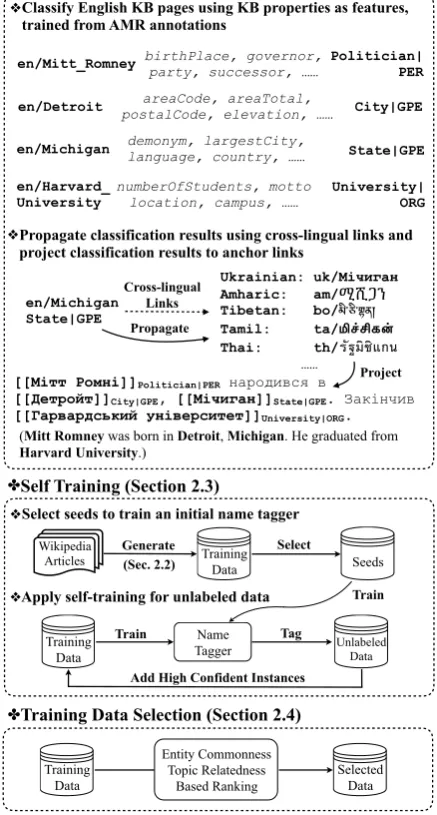
Our first step is to generate “silver-standard” name annotations from Wikipedia markups and train a universal name tagger. Figure2shows our overall procedure and the following subsections will elab-orate each component.
[[Мітт Ромні]]Politician|PER народився в
[[Детройт]]City|GPE, [[Мічиган]]State|GPE. Закінчив
[[Гарвардський університет]]University|ORG. ❖Classify English KB pages using KB properties as features,
trained from AMR annotations
en/Mitt_Romney birthPlace, governor,party, successor, …… Politician| PER
en/Detroit postalCode, elevation, ……areaCode, areaTotal, City|GPE
en/Michigan demonym, largestCity, language, country, …… State|GPE
en/Harvard_
University numberOfStudents, motto location, campus, …… University| ORG
❖Propagate classification results using cross-lingual links and project classification results to anchor links
en/Michigan State|GPE
Ukrainian: uk/Мічиган Amharic: am/ሚሺጋን
Tibetan: bo/མི་ཅི་གྷན། Tamil: ta/!c#க% Thai: th/รัฐมิชิแกน
…… Cross-lingual
Links
❖Apply self-training for unlabeled data
Training Data
Name
Tagger Unlabeled Data
Train Tag
Add High Confident Instances ❖Select seeds to train an initial name tagger
Training
Data Seeds
Select Generate
(Sec. 2.2)
✤Annotation Generation (Section 2.2)
✤Self Training (Section 2.3)
Train
✤Training Data Selection (Section 2.4)
Wikipedia Articles
Training Data
Entity Commonness Topic Relatedness
Based Ranking
Selected Data (Mitt Romney was born in Detroit, Michigan. He graduated from
Harvard University.)
Propagate
[image:2.595.307.526.230.638.2]Project
Figure 2: Name Tagging Annotation Generation and Training
2.2 Initial Annotation Generation
and linked to Wikipedia if it’s linkable. In to-tal we obtain 2,756 entity mentions, along with their AMR entity types, Wikipedia titles, YAGO entity types and DBpedia properties. For each pair of AMR entity type ta and YAGO entity typety, we compute the Pointwise Mutual Infor-mation (PMI) (Ward Church and Hanks, 1990) of mapping ta to ty across all mentions in the AMR corpus. Therefore, each name mention is also assigned a list of YAGO entity types, ranked by their PMI scores with AMR types. In this way, our framework produces three levels of en-tity typing schemas with different granularity: 4 main types (Person (PER), Organization (ORG), Geo-political Entity (GPE), Location (LOC)), 139 types in AMR, and 9,154 types in YAGO.
Then we leverage an entity’s properties in DB-pedia as features for assigning types. For example, an entity with a birth date is likely to be a per-son, while an entity with a population property is likely to be a geo-political entity. Using all DB-pedia entity properties as features (60,231 in to-tal), we train Maximum Entropy models to assign types with three levels of granularity to all English Wikipedia pages. In total we obtained 10 million English pages labeled as entities of interest.
Nothman et al. (2013) manually annotated 4,853 English Wikipedia pages with 6 coarse-grained types (Person, Organization, Location, Other, Non-Entity, Disambiguation Page). Using this data set for training and testing, we achieved 96.0% F-score on this initial step, slightly better than their results (94.6% F-score).
Next, we propagate the label of each English Wikipedia page to all entity mentions in all lan-guages in the entire Wikipedia through mono-lingual redirect links and cross-mono-lingual links.
2.3 Learning Model and KB Derived Features
We use a typical neural network architecture that consists of Bi-directional Long Short-Term Mem-ory and Conditional Random Fields (CRFs) net-work (Lample et al., 2016) as our underlying learning model for the name tagger for each lan-guage. In the following we will describe how we acquire linguistic features.
When a Wikipedia user tries to link an en-tity mention in a sentence to an existing page, she/he will mark the title (the entity’s canon-ical form, without affixes) within the mention
using brackets “[[]]”, from which we can naturally derive a word’s stem and affixes for free. For example, from the Wikipedia markups of the following Turkish sentence: “Kıta
Fransası, g¨uneyde [[Akdeniz]]den kuzeyde
[[Mans¸ Denizi]] ve [[Kuzey Denizi]]ne,
do˘guda [[Ren Nehri]]nden batıda [[Atlas Okyanusu]]na kadar yayılan topraklarda
yer alır.(Metropolitan France extends from the
Mediterranean Sea to the English Channel and the North Sea, and from the Rhine to the Atlantic Ocean.)”, we can learn the following suffixes: “den”, “ne”, “nden” and “na”. We use such affix lists to perform basic word stemming, and use them as additional features to determine name boundary and type. For example, “den” is a noun suffix which indicates ablative case in Turkish.
[[Akdeniz]]denmeans “from Mediterranean
Sea”. Note that this approach can only perform morphology analysis for words whose stem forms and affixes are directly concatenated.
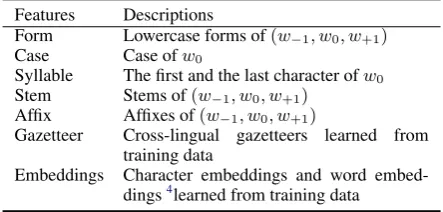
Table1summarizes name tagging features.
Features Descriptions
Form Lowercase forms of(w−1, w0, w+1) Case Case ofw0
Syllable The first and the last character ofw0 Stem Stems of(w−1, w0, w+1)
Affix Affixes of(w−1, w0, w+1)
Gazetteer Cross-lingual gazetteers learned from training data
Embeddings Character embeddings and word embed-dings4learned from training data
Table 1: Name Tagging Features
2.4 Self-Training to Enrich and Refine Labels The name annotations acquired from the above procedure are far from complete to compete with manually labeled gold-standard data. For exam-ple, if a name mention appears multiple times in a Wikipedia article, only the first mention is la-beled with an anchor link. We apply self-training to propagate and refine the labels.
We first train an initial name tagger using seeds selected from the labeled data. We adopt an idea from (Guo et al., 2014) which com-putes Normalized Pointwise Mutual Information (NPMI) (Bouma,2009) between a tag and a token:
4For languages that don’t have word segmentation, we
[image:3.595.306.528.378.484.2]N P M I(tag, token) = ln
p(tag,token)
p(tag)p(token)
−lnp(tag, token) (1)
Then we select the sentences in which all annota-tions satisfyN P M I(tag, token)> τ as seeds5.
For all Wikipedia articles in a language, we cluster the unlabeled sentences intonclusters6by collecting sentences with low cross-entropy into the same cluster. Then we apply the initial tagger to the first unlabeled cluster, select the automati-cally labeled sentences with high confidence, add them back into the training data, and then re-train the tagger. This procedure is repeatedntimes until we scan through all unlabeled data.
2.5 Final Training Data Selection for Populous Languages
For some populous languages that have many mil-lions of pages in Wikipedia, we obtain many sen-tences from self-training. In some emergent set-tings such as natural disasters it’s important to train a system rapidly. Therefore we develop the following effective methods to rank and select high-quality annotated sentences.
Commonness: we prefer sentences that in-clude common entities appearing frequently in Wikipedia. We rank names by their frequency and dynamically set the frequency threshold to select a list of common names. We first initialize the name frequency thresholdS to 40. If the number of the sentences is more than a desired sizeDfor train-ing7, we set the thresholdS =S + 5, otherwise
S =S−5. We iteratively run the selection
algo-rithm until the size of the training set reachesD for a certainS.
Topical Relatedness: Various criteria should be adopted for different scenarios. Our previous work on event extraction (Li et al., 2011) found that by carefully select 1/3 topically related train-ing documents for a test set, we can achieve the same performance as a model trained from the entire training set. Using an emergent disaster setting as a use case, we prefer sentences that include entities related to disaster related topics. We run an English name tagger (Manning et al., 2014) and entity linker (Pan et al., 2015) on the Leidos corpus released by the DARPA LORELEI
5τ = 0in our experiment. 6n= 20in our experiment. 7D= 30,000 in our experiment.
program 8. The Leidos corpus consists of
doc-uments related to various disaster topics. Based on the linked Wikipedia pages, we rank the fre-quency of Wikipedia categories and select the top 1% categories (4,035 in total) for our experiments. Some top-ranked topic labels include “ Interna-tional medical and health organizations”, “Human rights organizations”, “International development agencies”, “Western Asian countries”, “Southeast African countries”and “People in public health”. Then we select the annotated sentences including names (e.g., “World Health Organization”) in all languages labeled with these topic labels to train the final model.
3 Cross-lingual Entity Linking
3.1 Overview
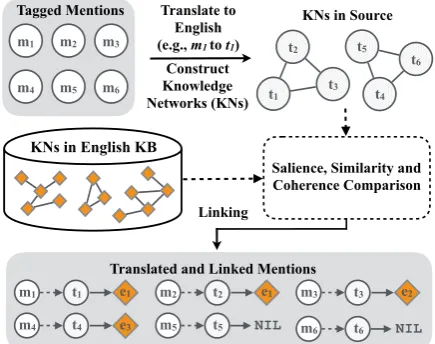
After we extract names from test documents in a source language, we translate them into English by automatically mined word translation pairs (Sec-tion 3.2), and then link translated English men-tions to an external English KB (Section3.3). The overall linking process is illustrated in Figure3.
m1 m2 m3
m4 m5 m6
t5
t1 t3 t4
t6
t2 Translate to
English (e.g., m1 to t1)
Construct Knowledge Networks (KNs)
KNs in English KB
Salience, Similarity and Coherence Comparison Tagged Mentions
Linking
KNs in Source
Translated and Linked Mentions
e1
t1
m1 m2 t2 e1 m3 t3 e2
e3
t4
[image:4.595.308.526.407.579.2]m4 m5 t5 NIL m6 t6 NIL
Figure 3: Cross-lingual Entity Linking Overview
3.2 Name Translation
The cross-lingual Wikipedia title pairs, generated through crowd-sourcing, generally follow a con-sistent style and format in each language. From Table2we can see that the order of modifier and head word keeps consistent in Turkish and English titles.
8
Extracted Cross-lingual Wikipedia Title Pairs “Pekin”
Pekin Beijing Pekinmetrosu Beijing Subway
PekinUlusal Stadyumu Beijing National Stadium “Teknoloji”
N¨ukleerteknoloji Nuclear technology Teknolojitransferi Technology transfer Teknolojie˘gitimi Technology education
“Enstit¨us¨u”
TorchwoodEnstit¨us¨u Torchwood Institute HudsonEnstit¨us¨u Hudson Institute SmolnyEnstit¨us¨u Smolny Institute
“Pekin Teknoloji”[NONE]
“Teknoloji Enstit¨us¨u” Kraliyet Teknoloji
En-stit¨us¨u Royal Institute of Technol-ogy Karlsruhe Teknoloji
En-stit¨us¨u KarlsruheTechnology Institute of Georgia Teknoloji
En-stit¨us¨u Georgia Institute of Tech-nology “Pekin Teknoloji Enstit¨us¨u”[NONE]
Mined Word Translation Pairs
Word Translation Alignment
Confidence
pekin Beijingbeijing Exact Match0.5263
peking 0.3158
teknoloji technologicaltechnology 0.88330.0167 singularity 0.0167
enstit¨us¨u instituteof 0.27650.2028
[image:5.595.72.290.63.432.2]for 0.0221
Table 2: Word Translation Mining from Cross-lingual Wikipedia Title Pairs
For each name mention, we generate all pos-sible combinations of continuous tokens. For example, no Wikipedia titles contain the Turk-ish name “Pekin Teknoloji Enstit¨us¨u (Beijing In-stitute of Technology)”. We generate the fol-lowing 6 combinations: “Pekin”, “Teknoloji”, “Enstit¨us¨u”, “Pekin Teknoloji”, “Teknoloji En-stit¨us¨u” and “Pekin Teknoloji Enstit¨us¨u”, and then extract all cross-lingual Wikipedia title pairs containing each combination. Finally we run GIZA++ (Josef Och and Ney, 2003) to extract word for word translations from these title pairs, as shown in Table2.
3.3 Entity Linking
Given a set of tagged name mentions M =
{m1, m2, ..., mn}, we first obtain their English
translations T = {t1, t2, ..., tn} using the
ap-proach described above. Then we apply an un-supervised collective inference approach to linkT
to the KB, similar to our previous work (Pan et al., 2015). The only difference is that we construct knowledge networks (KNs) g(ti) for T based on
their co-occurrence within a context window9
in-stead of their AMR relations, because AMR pars-ing is not available for foreign languages. For each translated name mentionti, an initial list of
candi-date entitiesE(ti) = {e1, e2, ..., ek}is generated
based on a surface form dictionary mined from KB properties (e.g., redirects, names, aliases). If no surface form can be matched then we determine the mention as unlinkable. Then we construct KNs g(ej)for each entity candidateejinti’s entity
can-didate list E(ti). We compute the similarity
be-tween g(ti) and g(ej) based on three measures:
salience, similarity and coherence, and select the candidate entity with the highest score.
4 Experiments
4.1 Performance on Wikipedia Data
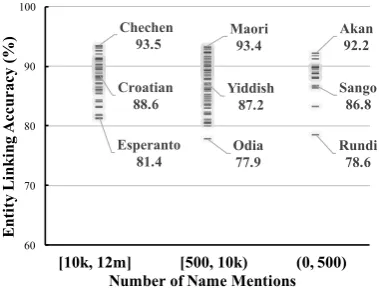
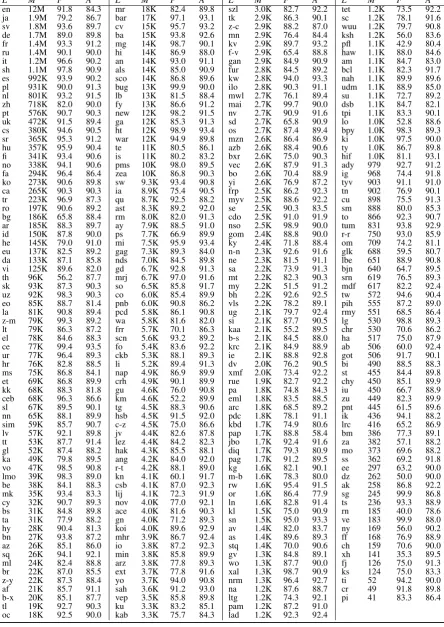
We first conduct an evaluation using Wikipedia data as “silver-standard”. For each language, we use 70% of the selected sentences for training and 30% for testing. For entity linking, we don’t have ground truth for unlinkable mentions, so we only compute linking accuracy for linkable name men-tions. Table3presents the overall performance for three coarse-grained entity types: PER, ORG and GPE/LOC, sorted by the number of name men-tions. Figure 4and Figure 5summarize the per-formance, with some example languages marked for various ranges of data size.
Japanese 79.2
Thai 56.2 Tamil
77.9 Kannada
60.1 Kabyle
75.7
Burmese
51.5 Rundi 40.0 Nyanja
56.0
Xhosa 35.3
20 40 60 80 100
N
am
e T
aggi
ng F
-s
cor
e
[image:5.595.316.512.515.660.2](%)
[10k, 12m] [500, 10k) (0, 500) Number of Name Mentions
Figure 4: Summary of Name Tagging F-score (%) on Wikipedia Data
Not surprisingly, name tagging performs better for languages with more training mentions. The
9In our experiments, we use the previous four and next
F-score is generally higher than 80% when there are more than 10K mentions, and it significantly drops when there are less than 250 mentions. The languages with low name tagging performance can be categorized into three types: (1) the number of mentions is less than 2K, such as Atlantic-Congo (Wolof), Berber (Kabyle), Chadic (Hausa), Oceanic (Fijian), Hellenic (Greek), Igboid (Igbo), Mande (Bambara), Kartvelian (Georgian, Mingre-lian), Timor-Babar (Tetum), Tupian (Guarani) and Iroquoian (Cherokee) language groups; Precision is generally higher than recall for most of these languages, because the small number of linked mentions is not enough to cover a wide variety of entities. (2) there is no space between words, in-cluding Chinese, Thai and Japanese; (3) they are not written in latin script, such as the Dravidian group (Tamil, Telugu, Kannada, Malayalam).
The training instances for various entity types are quite imbalanced for some languages. For ex-ample, Latin data includes 11% PER names, 84% GPE/LOC names and 5% ORG names. As a re-sult, the performance of ORG is the lowest, while GPE and LOC achieve higher than 75% F-scores for most languages.
Esperanto 81.4 Chechen
93.5
Croatian 88.6
Maori 93.4
Yiddish 87.2
Odia 77.9
Akan 92.2
Sango 86.8
Rundi 78.6
60 70 80 90 100
E
nt
it
y
L
in
ki
ng
A
cc
ur
ac
y (
[image:6.595.82.272.421.567.2]%)
[10k, 12m] [500, 10k) (0, 500) Number of Name Mentions
Figure 5: Summary of Entity Linking Accuracy (%) on Wikipedia Data
The linking accuracy is higher than 80% for most languages. Also note that since we don’t have perfect annotations on Wikipedia data for any language, these results can be used to esti-mate how predictable our “silver-standard” data is, but they are not directly comparable to tradi-tional name tagging results measured against gold-standard data annotated by human.
10The mapping to language names can be found at
http://nlp.cs.rpi.edu/wikiann/mapping
4.2 Performance on Non-Wikipedia Data In order to have more direct comparison with state-of-the-art name taggers trained from human annotated gold-standard data, we conduct experi-ments on non-Wikipedia data in 9 languages for which we have human annotated ground truths from the DARPA LORELEI program. Table 4 shows the data statistics. The documents are from news sources and discussion fora.
For fair comparison, we use the same learn-ing method and feature set as described in Sec-tion 2.3 to train the models using gold-standard data. Therefore the results of our models trained from gold-standard data are slightly different from some previous work such as (Tsai et al., 2016), mainly due to different learning algorithms and different features sets. For example, the gazetteers we used are different from those in (Tsai et al., 2016), and we did not use brown clusters as addi-tional features.
The name tagging results on LORELEI data set are presented in Table 5. We can see that our approach advances state-of-the-art language-independent methods (Zhang et al., 2016a; Tsai et al., 2016) on the same data sets for most lan-guages, and achieves 6.5% - 17.6% lower F-scores than the models trained from manually annotated gold-standard documents that include thousands of name mentions. To fill in this gap, we would need to exploit more linguistic resources.
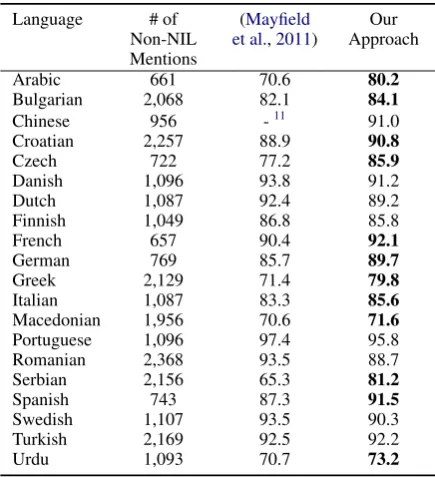
Mayfield et al. (2011) constructed a cross-lingual entity linking collection for 21 languages, which covers ground truth for the largest number of languages to date. Therefore we compare our approach with theirs that uses a supervised name transliteration model (McNamee et al.,2011). The entity linking results on non-NIL mentions are presented in Table 6. We can see that except Romanian, our approach outperforms or achieves comparable accuracy as their method on all lan-guages, without using any additional resources or tools such as name transliteration.
4.3 Analysis
Impact of KB-derived Morphological Features We measured the impact of our affix lists derived from Wikipedia markups on two morphologically-rich languages: Turkish and Uzbek. The
morphol-11McNamee et al.(2011) did not develop a model for
L M F A L M F A L M F A L M F A
en 12M 91.8 84.3 mr 18K 82.4 89.8 szl 3.0K 82.7 92.2 tet 1.2K 73.5 92.2 ja 1.9M 79.2 86.7 bar 17K 97.1 93.1 tk 2.9K 86.3 90.1 sc 1.2K 78.1 91.6 sv 1.8M 93.6 89.7 cv 15K 95.7 93.2 z-c 2.9K 88.2 87.0 wuu 1.2K 79.7 90.8 de 1.7M 89.0 89.8 ba 15K 93.8 92.6 mn 2.9K 76.4 84.4 ksh 1.2K 56.0 83.6 fr 1.4M 93.3 91.2 mg 14K 98.7 90.1 kv 2.9K 89.7 93.2 pfl 1.1K 42.9 80.4 ru 1.4M 90.1 90.0 hi 14K 86.9 88.0 f-v 2.9K 65.4 88.8 haw 1.1K 88.0 84.6 it 1.2M 96.6 90.2 an 14K 93.0 91.1 gan 2.9K 84.9 90.9 am 1.1K 84.7 83.0 sh 1.1M 97.8 90.9 als 14K 85.0 90.9 fur 2.8K 84.5 89.2 bcl 1.1K 82.3 91.7 es 992K 93.9 90.2 sco 14K 86.8 89.6 kw 2.8K 94.0 93.3 nah 1.1K 89.9 89.6 pl 931K 90.0 91.3 bug 13K 99.9 90.0 ilo 2.8K 90.3 91.1 udm 1.1K 88.9 85.0 nl 801K 93.2 91.5 lb 13K 81.5 88.4 mwl 2.7K 76.1 89.4 su 1.1K 72.7 89.2 zh 718K 82.0 90.0 fy 13K 86.6 91.2 mai 2.7K 99.7 90.0 dsb 1.1K 84.7 82.1 pt 576K 90.7 90.3 new 12K 98.2 91.5 nv 2.7K 90.9 91.6 tpi 1.1K 83.3 90.1
uk 472K 91.5 89.4 ga 12K 85.3 91.3 sd 2.7K 65.8 90.9 lo 1.0K 52.8 88.6
cs 380K 94.6 90.5 ht 12K 98.9 93.4 os 2.7K 87.4 89.4 bpy 1.0K 98.3 89.3 sr 365K 95.3 91.2 war 12K 94.9 89.8 mzn 2.6K 86.4 86.9 ki 1.0K 97.5 90.0 hu 357K 95.9 90.4 te 11K 80.5 86.1 azb 2.6K 88.4 90.6 ty 1.0K 86.7 89.8 fi 341K 93.4 90.6 is 11K 80.2 83.2 bxr 2.6K 75.0 90.3 hif 1.0K 81.1 93.1 no 338K 94.1 90.6 pms 10K 98.0 89.5 vec 2.6K 87.9 91.3 ady 979 92.7 91.2
fa 294K 96.4 86.4 zea 10K 86.8 90.3 bo 2.6K 70.4 88.9 ig 968 74.4 91.8
ko 273K 90.6 89.8 sw 9.3K 93.4 90.8 yi 2.6K 76.9 87.2 tyv 903 91.1 91.0 ca 265K 90.3 90.3 ia 8.9K 75.4 90.5 frp 2.5K 86.2 92.3 tn 902 76.9 90.1 tr 223K 96.9 87.3 qu 8.7K 92.5 88.2 myv 2.5K 88.6 92.2 cu 898 75.5 91.3 ro 197K 90.6 89.2 ast 8.3K 89.2 92.0 se 2.5K 90.3 83.5 sm 888 80.0 85.3 bg 186K 65.8 88.4 rm 8.0K 82.0 91.3 cdo 2.5K 91.0 91.9 to 866 92.3 90.7 ar 185K 88.3 89.7 ay 7.9K 88.5 91.0 nso 2.5K 98.9 90.0 tum 831 93.8 92.9 id 150K 87.8 90.0 ps 7.7K 66.9 89.9 gom 2.4K 88.8 90.0 r-r 750 93.0 85.9
he 145K 79.0 91.0 mi 7.5K 95.9 93.4 ky 2.4K 71.8 88.4 om 709 74.2 81.1
eu 137K 82.5 89.2 gag 7.3K 89.3 84.0 n-n 2.3K 92.6 91.6 glk 688 59.5 80.7 da 133K 87.1 85.8 nds 7.0K 84.5 89.8 ne 2.3K 81.5 91.1 lbe 651 88.9 90.8 vi 125K 89.6 82.0 gd 6.7K 92.8 91.3 sa 2.2K 73.9 91.3 bjn 640 64.7 89.5 th 96K 56.2 87.7 mrj 6.7K 97.0 91.6 mt 2.2K 82.3 90.3 srn 619 76.5 89.3
sk 93K 87.3 90.3 so 6.5K 85.8 91.7 my 2.2K 51.5 91.2 mdf 617 82.2 92.4
uz 92K 98.3 90.3 co 6.0K 85.4 89.9 bh 2.2K 92.6 92.5 tw 572 94.6 90.4
eo 85K 88.7 81.4 pnb 6.0K 90.8 86.2 vls 2.2K 78.2 89.1 pih 555 87.2 89.0 la 81K 90.8 89.4 pcd 5.8K 86.1 90.8 ug 2.1K 79.7 92.4 rmy 551 68.5 86.4
z-m 79K 99.3 89.2 wa 5.8K 81.6 82.0 si 2.1K 87.7 90.5 lg 530 98.8 89.3
lt 79K 86.3 87.2 frr 5.7K 70.1 86.3 kaa 2.1K 55.2 89.5 chr 530 70.6 86.2 el 78K 84.6 88.3 scn 5.6K 93.2 89.2 b-s 2.1K 84.5 88.0 ha 517 75.0 87.9
ce 77K 99.4 93.5 fo 5.4K 83.6 92.2 krc 2.1K 84.9 88.9 ab 506 60.0 92.4
ur 77K 96.4 89.3 ckb 5.3K 88.1 89.3 ie 2.1K 88.8 92.8 got 506 91.7 90.1
hr 76K 82.8 88.5 li 5.2K 89.4 91.3 dv 2.0K 76.2 90.5 bi 490 88.5 88.3
ms 75K 86.8 84.1 nap 4.9K 86.9 89.9 xmf 2.0K 73.4 92.2 st 455 84.4 89.8 et 69K 86.8 89.9 crh 4.9K 90.1 89.9 rue 1.9K 82.7 92.2 chy 450 85.1 89.9
kk 68K 88.3 81.8 gu 4.6K 76.0 90.8 pa 1.8K 74.8 84.3 iu 450 66.7 88.9
ceb 68K 96.3 86.6 km 4.6K 52.2 89.9 eml 1.8K 83.5 88.5 zu 449 82.3 89.9 sl 67K 89.5 90.1 tg 4.5K 88.3 90.6 arc 1.8K 68.5 89.2 pnt 445 61.5 89.6 nn 65K 88.1 89.9 hsb 4.5K 91.5 92.0 pdc 1.8K 78.1 91.1 ik 436 94.1 88.2 sim 59K 85.7 90.7 c-z 4.5K 75.0 86.6 kbd 1.7K 74.9 80.6 lrc 416 65.2 86.9
lv 57K 92.1 89.8 jv 4.4K 82.6 87.8 pap 1.7K 88.8 58.4 bm 386 77.3 89.1
tt 53K 87.7 91.4 lez 4.4K 84.2 82.3 jbo 1.7K 92.4 91.6 za 382 57.1 88.2 gl 52K 87.4 88.2 hak 4.3K 85.5 88.1 diq 1.7K 79.3 80.9 mo 373 69.6 88.2 ka 49K 79.8 89.5 ang 4.2K 84.0 92.0 pag 1.7K 91.2 89.5 ss 362 69.2 91.8
vo 47K 98.5 90.8 r-t 4.2K 88.1 89.0 kg 1.6K 82.1 90.1 ee 297 63.2 90.0
lmo 39K 98.3 89.0 kn 4.1K 60.1 91.7 m-b 1.6K 78.3 80.0 dz 262 50.0 90.0
be 38K 84.1 88.3 csb 4.1K 87.0 92.3 rw 1.6K 95.4 91.5 ak 258 86.8 92.2
mk 35K 93.4 83.3 lij 4.1K 72.3 91.9 or 1.6K 86.4 77.9 sg 245 99.9 86.8
cy 32K 90.7 89.3 nov 4.0K 77.0 92.1 ln 1.6K 82.8 91.4 ts 236 93.3 88.9
bs 31K 84.8 89.8 ace 4.0K 81.6 90.3 kl 1.5K 75.0 90.9 rn 185 40.0 78.6
ta 31K 77.9 88.2 gn 4.0K 71.2 89.3 sn 1.5K 95.0 93.3 ve 183 99.9 88.0
hy 28K 90.4 81.3 koi 4.0K 89.6 92.9 av 1.4K 82.0 83.7 ny 169 56.0 90.2
bn 27K 93.8 87.2 mhr 3.9K 86.7 92.4 as 1.4K 89.6 89.3 ff 168 76.9 88.9
az 26K 85.1 86.0 io 3.8K 87.2 92.3 stq 1.4K 70.0 90.6 ch 159 70.6 90.0
sq 26K 94.1 92.1 min 3.8K 85.8 89.9 gv 1.3K 84.8 89.1 xh 141 35.3 89.5
ml 24K 82.4 88.8 arz 3.8K 77.8 89.3 wo 1.3K 87.7 90.0 fj 126 75.0 91.3
br 22K 87.0 85.5 ext 3.7K 77.8 91.6 xal 1.3K 98.7 90.9 ks 124 75.0 83.3
z-y 22K 87.3 88.4 yo 3.7K 94.0 90.8 nrm 1.3K 96.4 92.7 ti 52 94.2 90.0
af 21K 85.7 91.1 sah 3.6K 91.2 93.0 na 1.2K 87.6 88.7 cr 49 91.8 89.8
b-x 20K 85.1 87.7 vep 3.5K 85.8 89.8 ltg 1.2K 74.3 92.1 pi 41 83.3 86.4 tl 19K 92.7 90.3 ku 3.3K 83.2 85.1 pam 1.2K 87.2 91.0
[image:7.595.76.521.70.698.2]oc 18K 92.5 90.0 kab 3.3K 75.7 84.3 lad 1.2K 92.3 92.4
Table 3: Performance on Wikipedia Data (L: language ID10;M: the number of name mentions;F: name
Language GoldTraining SilverTraining Test
Bengali 8,760 22,093 3,495
Hungarian 3,414 34,022 1,320
Russian 2,751 35,764 1,213
Tamil 7,033 25,521 4,632
Tagalog 4,648 15,839 3,351
Turkish 3,067 37,058 2,172
Uzbek 3,137 64,242 2,056
Vietnamese 2,261 63,971 987
[image:8.595.72.289.206.332.2]Yoruba 4,061 9,274 3,395
Table 4: # of Names in Non-Wikipedia Data
Language Training from
Gold
Training from
Silver
(Zhang
et al.,
2016a)
(Tsai
et al.,
2016)
Bengali 61.6 44.0 34.8 43.3
Hungarian 63.9 47.9 -
-Russian 61.8 49.4 -
-Tamil 42.2 35.7 26.0 29.6
Tagalog 70.7 58.3 51.3 65.4
Turkish 66.0 51.5 43.6 47.1
Uzbek 56.0 44.2 -
-Vietnamese 54.3 44.5 -
-Yoruba 55.1 37.6 36.0 36.7
Table 5: Name Tagging F-score (%) on Non-Wikipedia Data
Language # of Non-NIL Mentions
(Mayfield
et al.,2011) ApproachOur
Arabic 661 70.6 80.2
Bulgarian 2,068 82.1 84.1
Chinese 956 -11 91.0
Croatian 2,257 88.9 90.8
Czech 722 77.2 85.9
Danish 1,096 93.8 91.2
Dutch 1,087 92.4 89.2
Finnish 1,049 86.8 85.8
French 657 90.4 92.1
German 769 85.7 89.7
Greek 2,129 71.4 79.8
Italian 1,087 83.3 85.6
Macedonian 1,956 70.6 71.6
Portuguese 1,096 97.4 95.8
Romanian 2,368 93.5 88.7
Serbian 2,156 65.3 81.2
Spanish 743 87.3 91.5
Swedish 1,107 93.5 90.3
Turkish 2,169 92.5 92.2
Urdu 1,093 70.7 73.2
Table 6: Entity Linking Accuracy (%) on Non-Wikipedia Data
ogy features contributed 11.1% and 7.1% absolute name tagging F-score gains to Turkish and Uzbek LORELEI data sets respectively.
Impact of Self-Training
Using Turkish as a case study, the learning curves of self-training on Wikipedia and non-Wikipedia
test sets are shown in Figure 6. We can see that self-training provides significant improve-ment for both Wikipedia (6% absolute gain) and non-Wikipedia test data (12% absolute gain). As expected the learning curve on Wikipedia data is more smooth and converges more slowly than that of non-Wikipedia data. This indicates that when the training data is incomplete and noisy, the model can benefit from self-training through iter-ative label correction and propagation.
Figure 6: Learning Curve of Self-training
Impact of Topical Relatedness
We also found that the topical relatedness measure proposed in Section2.5 not only significantly re-duces the size of training data and thus speeds up the training process for many languages, but also consistently improves the quality. For example, the Turkish name tagger trained from the entire data set without topic selection yields 49.7% F-score on LORELEI data set, and the performance is improved to 51.5% after topic selection.
5 Related Work
Wikipedia markup based silver standard gen-eration: Our work was mainly inspired from pre-vious work that leveraged Wikipedia markups to train name taggers (Nothman et al.,2008;Dakka and Cucerzan,2008;Mika et al., 2008;Ringland et al., 2009; Alotaibi and Lee, 2012; Nothman et al., 2013; Althobaiti et al., 2014). Most of these previous methods manually classified many English Wikipedia entries into pre-defined entity types. In contrast, our approach doesn’t need any manual annotations or language-specific fea-tures, while generates both coarse-grained and fine-grained types.
Many fine-grained entity typing
[image:8.595.309.525.209.355.2] [image:8.595.72.290.379.618.2]2009; Ekbal et al., 2010; Ling and Weld, 2012; Yosef et al.,2012;Nakashole et al.,2013;Gillick et al., 2014; Yogatama et al., 2015; Del Corro et al., 2015) also created annotations based on Wikipedia anchor links. Our framework performs both name identification and typing and takes advantage of richer structures in the KBs. Pre-vious work on Arabic name tagging (Althobaiti et al., 2014) extracted entity titles as a gazetteer for stemming, and thus it cannot handle unknown names. We developed a new method to derive generalizable affixes for morphologically rich language based on Wikipedia markups.
Wikipedia as background features for IE: Wikipedia pages have been used as addi-tional features to improve various Informa-tion ExtracInforma-tion (IE) tasks, including name tag-ging (Kazama and Torisawa, 2007), coreference resolution (Paolo Ponzetto and Strube, 2006), re-lation extraction (Chan and Roth,2010) and event extraction (Hogue et al.,2014). Other automatic name annotation generation methods have been proposed, including KB driven distant supervi-sion (An et al.,2003;Mintz et al.,2009;Ren et al., 2015) and cross-lingual projection (Li et al.,2012; Kim et al., 2012; Che et al., 2013; Wang et al., 2013; Wang and Manning, 2014; Zhang et al., 2016b).
Multi-lingual name tagging: Some recent re-search (Zhang et al., 2016a; Littell et al., 2016; Tsai et al., 2016) under the DARPA LORELEI program focused on developing name tagging techniques for low-resource languages. These ap-proaches require English annotations for projec-tion (Tsai et al.,2016), some input from a native speaker, either through manual annotations (Littell et al.,2016), or a linguistic survey (Zhang et al., 2016a). Without using any manual annotations, our name taggers outperform previous methods on the same data sets for many languages.
Multi-lingual entity linking: NIST TAC-KBP Tri-lingual entity linking (Ji et al.,2016) focused on three languages: English, Chinese and Span-ish. (McNamee et al.,2011) extended it to 21 lan-guages. But their methods required labeled data and name transliteration. We share the same goal as (Sil and Florian,2016) to extend cross-lingual entity linking to all languages in Wikipedia. They exploited Wikipedia links to train a supervised linker. We mine reliable word translations from cross-lingual Wikipedia titles, which enables us
to adopt unsupervised English entity linking tech-niques such as (Pan et al., 2015) to directly link translated English name mentions to English KB.
Efforts to save annotation cost for name tag-ging: Some previous work including (Ji and Gr-ishman, 2006; Richman and Schone, 2008; Al-thobaiti et al., 2013) exploited semi-supervised methods to save annotation cost. We observed that self-training can provide further gains when the training data contains certain amount of noise.
6 Conclusions and Future Work
We developed a simple yet effective framework that can extract names from 282 languages and link them to an English KB. This framework follows a fully automatic training and testing pipeline, without the needs of any manual anno-tations or knowledge from native speakers. We evaluated our framework on both Wikipedia arti-cles and external formal and informal texts and ob-tained promising results. To the best of our knowl-edge, our multilingual name tagging and linking framework is applied to the largest number of lan-guages. We release the following resources for each of these 282 languages: “silver-standard” name tagging and linking annotations with mul-tiple levels of granularity, morphology analyzer if it’s a morphologically-rich language, and an end-to-end name tagging and linking system. In this work, we treat all languages independently when training their corresponding name taggers. In the future, we will explore the topological structure of related languages and exploit cross-lingual knowl-edge transfer to enhance the quality of extraction and linking. The general idea of deriving noisy an-notations from KB properties can also be extended to other IE tasks such as relation extraction.
Acknowledgments
This work was supported by the U.S. DARPA
LORELEI Program No. HR0011-15-C-0115,
References
Malin Ahlberg, Markus Forsberg, and Mans Hulden.
2015. Paradigm classification in supervised
learn-ing of morphology. In Proceedings of the
2015 Conference of the North American Chap-ter of the Association for Computational Linguis-tics: Human Language Technologies. Association for Computational Linguistics, pages 1024–1029. https://doi.org/10.3115/v1/N15-1107.
Fahd Alotaibi and Mark Lee. 2012. Mapping
ara-bic wikipedia into the named entities taxonomy. In Proceedings of COLING 2012: Posters. The COL-ING 2012 Organizing Committee, pages 43–52. http://aclweb.org/anthology/C12-2005.
Maha Althobaiti, Udo Kruschwitz, and Massimo
Poe-sio. 2013. A semi-supervised learning approach to
arabic named entity recognition. In Proceedings
of the International Conference Recent Advances in Natural Language Processing RANLP 2013. IN-COMA Ltd. Shoumen, BULGARIA, pages 32–40. http://aclweb.org/anthology/R13-1005.
Maha Althobaiti, Udo Kruschwitz, and Massimo
Poe-sio. 2014. Automatic creation of arabic named
entity annotated corpus using wikipedia. In
Pro-ceedings of the Student Research Workshop at the 14th Conference of the European Chapter of the As-sociation for Computational Linguistics. Associa-tion for ComputaAssocia-tional Linguistics, pages 106–115. https://doi.org/10.3115/v1/E14-3012.
Joohui An, Seungwoo Lee, and Gary Geunbae Lee.
2003.Automatic acquisition of named entity tagged
corpus from world wide web. In The Companion
Volume to the Proceedings of 41st Annual Meeting of the Association for Computational Linguistics. http://aclweb.org/anthology/P03-2031.
Laura Banarescu, Claire Bonial, Shu Cai, Madalina Georgescu, Kira Griffitt, Ulf Hermjakob, Kevin Knight, Philipp Koehn, Martha Palmer, and
Nathan Schneider. 2013. Abstract meaning
representation for sembanking. In
Proceed-ings of the 7th Linguistic Annotation Workshop and Interoperability with Discourse. Association for Computational Linguistics, pages 178–186. http://aclweb.org/anthology/W13-2322.
Kurt Bollacker, Colin Evans, Praveen Paritosh,
Tim Sturge, and Jamie Taylor. 2008.
Free-base: A collaboratively created graph database
for structuring human knowledge. In
Proceed-ings of the 2008 ACM SIGMOD International Conference on Management of Data. ACM, New York, NY, USA, SIGMOD ’08, pages 1247–1250. https://doi.org/10.1145/1376616.1376746.
Gerlof Bouma. 2009. Normalized (pointwise) mutual
information in collocation extraction. In
Proceed-ings of the Biennial GSCL Conference 2009.
Seng Yee Chan and Dan Roth. 2010. Exploiting
background knowledge for relation extraction. In
Proceedings of the 23rd International Conference on Computational Linguistics (Coling 2010). Col-ing 2010 OrganizCol-ing Committee, pages 152–160. http://aclweb.org/anthology/C10-1018.
Wanxiang Che, Mengqiu Wang, D. Christopher
Man-ning, and Ting Liu. 2013. Named entity
recog-nition with bilingual constraints. In Proceedings
of the 2013 Conference of the North American Chapter of the Association for Computational Lin-guistics: Human Language Technologies. Associ-ation for ComputAssoci-ational Linguistics, pages 52–62. http://aclweb.org/anthology/N13-1006.
Wisam Dakka and Silviu Cucerzan. 2008.
Augment-ing wikipedia with named entity tags. In
Pro-ceedings of the Third International Joint Confer-ence on Natural Language Processing: Volume-I. http://aclweb.org/anthology/I08-1071.
Luciano Del Corro, Abdalghani Abujabal, Rainer
Gemulla, and Gerhard Weikum. 2015. Finet:
Context-aware fine-grained named entity typing. In Proceedings of the 2015 Conference on Empirical Methods in Natural Language Processing. Associa-tion for ComputaAssocia-tional Linguistics, pages 868–878. https://doi.org/10.18653/v1/D15-1103.
Asif Ekbal, Eva Sourjikova, Anette Frank, and
Simone Paolo Ponzetto. 2010. Assessing the
challenge of fine-grained named entity
recog-nition and classification. In Proceedings of
the 2010 Named Entities Workshop. Associa-tion for ComputaAssocia-tional Linguistics, pages 93–101. http://aclweb.org/anthology/W10-2415.
Michael Fleischman and Eduard Hovy. 2002. Fine grained classification of named
enti-ties. In COLING 2002: The 19th
Interna-tional Conference on ComputaInterna-tional Linguistics. http://aclweb.org/anthology/C02-1130.
Dan Gillick, Nevena Lazic, Kuzman Ganchev, Jesse
Kirchner, and David Huynh. 2014.
Context-dependent fine-grained entity type tagging. CoRR
abs/1412.1820. http://arxiv.org/abs/1412.1820.
Claudio Giuliano. 2009. Fine-grained classification of
named entities exploiting latent semantic kernels. In Proceedings of the Thirteenth Conference on Com-putational Natural Language Learning (CoNLL-2009). Association for Computational Linguistics,
pages 201–209.
http://aclweb.org/anthology/W09-1125.
Stig-Arne Gr¨onroos, Sami Virpioja, Peter Smit, and
Mikko Kurimo. 2014. Morfessor flatcat: An
hmm-based method for unsupervised and
semi-supervised learning of morphology. In
Jiang Guo, Wanxiang Che, Haifeng Wang, and Ting
Liu. 2014. Revisiting embedding features for
simple semi-supervised learning. In Proceedings
of the 2014 Conference on Empirical Methods in Natural Language Processing (EMNLP). Associa-tion for ComputaAssocia-tional Linguistics, pages 110–120. https://doi.org/10.3115/v1/D14-1012.
Alexander Hogue, Joel Nothman, and James R.
Cur-ran. 2014. Unsupervised biographical event
extraction using wikipedia traffic. In
Pro-ceedings of the Australasian Language Technol-ogy Association Workshop 2014. pages 41–49. http://aclweb.org/anthology/U14-1006.
Heng Ji and Ralph Grishman. 2006. Analysis and
re-pair of name tagger errors. InProceedings of the
COLING/ACL 2006 Main Conference Poster Ses-sions. Association for Computational Linguistics,
pages 420–427.
http://aclweb.org/anthology/P06-2055.
Heng Ji, Joel Nothman, and Hoa Trang Dang. 2016. Overview of tac-kbp2016 tri-lingual edl and its
im-pact on end-to-end kbp. InProceedings of the Text
Analysis Conference.
Franz Josef Och and Hermann Ney. 2003. A systematic
comparison of various statistical alignment models. Computational Linguistics, Volume 29, Number 1, March 2003http://aclweb.org/anthology/J03-1002.
Jun’ichi Kazama and Kentaro Torisawa. 2007.
Ex-ploiting wikipedia as external knowledge for
named entity recognition. In Proceedings of
the 2007 Joint Conference on Empirical Meth-ods in Natural Language Processing and Com-putational Natural Language Learning (EMNLP-CoNLL).http://aclweb.org/anthology/D07-1073.
Sungchul Kim, Kristina Toutanova, and Hwanjo Yu.
2012. Multilingual named entity recognition using
parallel data and metadata from wikipedia. In
Pro-ceedings of the 50th Annual Meeting of the Associa-tion for ComputaAssocia-tional Linguistics (Volume 1: Long Papers). Association for Computational Linguistics,
pages 694–702.
http://aclweb.org/anthology/P12-1073.
Guillaume Lample, Miguel Ballesteros, Sandeep Sub-ramanian, Kazuya Kawakami, and Chris Dyer. 2016. Neural architectures for named entity recognition. InProceedings of the 2016 Conference of the North American Chapter of the Association for Computa-tional Linguistics: Human Language Technologies. Association for Computational Linguistics, pages
260–270. https://doi.org/10.18653/v1/N16-1030.
Hao Li, Heng Ji, Hongbo Deng, and Jiawei Han. 2011. Exploiting background information networks to en-hance bilingual event extraction through topic
mod-eling. InProceedings of International Conference
on Advances in Information Mining and Manage-ment (IMMM2011).
Qi Li, Haibo Li, Heng Ji, Wen Wang, Jing Zheng,
and Fei Huang. 2012. Joint bilingual name
tag-ging for parallel corpora. In Proceedings of
the 21st ACM International Conference on Infor-mation and Knowledge Management. ACM, New York, NY, USA, CIKM ’12, pages 1727–1731. https://doi.org/10.1145/2396761.2398506.
Xiao Ling and Daniel S. Weld. 2012. Fine-grained
en-tity recognition. InProceedings of the Twenty-Sixth
AAAI Conference on Artificial Intelligence. AAAI Press, AAAI’12, pages 94–100.
Patrick Littell, Kartik Goyal, R. David Mortensen, Alexa Little, Chris Dyer, and Lori Levin. 2016. Named entity recognition for linguistic rapid re-sponse in low-resource languages: Sorani
kur-dish and tajik. In Proceedings of COLING 2016,
the 26th International Conference on Computa-tional Linguistics: Technical Papers. The COL-ING 2016 Organizing Committee, pages 998–1006. http://aclweb.org/anthology/C16-1095.
Farzaneh Mahdisoltani, Joanna Biega, and Fabian M. Suchanek. 2015. Yago3: A knowledge base from
multilingual wikipedias. InProceedings of the
Con-ference on Innovative Data Systems Research.
Alireza Mahmoudi, Mohsen Arabsorkhi, and
Hes-haam Faili. 2013. Supervised morphology
gen-eration using parallel corpus. In Proceedings of
the International Conference Recent Advances in Natural Language Processing RANLP 2013. IN-COMA Ltd. Shoumen, BULGARIA, pages 408–
414. http://aclweb.org/anthology/R13-1053.
Christopher Manning, Mihai Surdeanu, John Bauer, Jenny Finkel, Steven Bethard, and David
Mc-Closky. 2014. The stanford corenlp natural
lan-guage processing toolkit. In Proceedings of 52nd
Annual Meeting of the Association for Computa-tional Linguistics: System Demonstrations. Associ-ation for ComputAssoci-ational Linguistics, pages 55–60. https://doi.org/10.3115/v1/P14-5010.
James Mayfield, Dawn Lawrie, Paul McNamee, and Douglas W. Oard. 2011. Building a cross-language entity linking collection in twenty-one languages. InMultilingual and Multimodal Information Access Evaluation: Second International Conference of the Cross-Language Evaluation Forum.
Paul McNamee, James Mayfield, Dawn Lawrie, Douglas Oard, and David Doermann. 2011.
Cross-language entity linking. In Proceedings
of 5th International Joint Conference on Nat-ural Language Processing. Asian Federation of Natural Language Processing, pages 255–263. http://aclweb.org/anthology/I11-1029.
Peter Mika, Massimiliano Ciaramita, Hugo Zaragoza, and Jordi Atserias. 2008. Learning to tag and
tag-ging to learn: A case study on wikipedia. IEEE
Mike Mintz, Steven Bills, Rion Snow, and Daniel
Ju-rafsky. 2009. Distant supervision for relation
ex-traction without labeled data. InProceedings of the
Joint Conference of the 47th Annual Meeting of the ACL and the 4th International Joint Conference on Natural Language Processing of the AFNLP. Asso-ciation for Computational Linguistics, pages 1003–
1011.http://aclweb.org/anthology/P09-1113.
Ndapandula Nakashole, Tomasz Tylenda, and Gerhard
Weikum. 2013. Fine-grained semantic typing of
emerging entities. In Proceedings of the 51st
An-nual Meeting of the Association for Computational Linguistics (Volume 1: Long Papers). Association for Computational Linguistics, pages 1488–1497. http://aclweb.org/anthology/P13-1146.
Joel Nothman, R. James Curran, and Tara Murphy.
2008. Transforming wikipedia into named entity
training data. In Proceedings of the Australasian
Language Technology Association Workshop 2008.
pages 124–132.
http://aclweb.org/anthology/U08-1016.
Joel Nothman, Nicky Ringland, Will Radford, Tara
Murphy, and James R. Curran. 2013.
Learn-ing multilLearn-ingual named entity recognition from
wikipedia. Artificial Intelligence 194:151–175.
https://doi.org/10.1016/j.artint.2012.03.006.
Xiaoman Pan, Taylor Cassidy, Ulf Hermjakob, Heng Ji,
and Kevin Knight. 2015. Unsupervised entity
link-ing with abstract meanlink-ing representation. In
Pro-ceedings of the 2015 Conference of the North Amer-ican Chapter of the Association for Computational Linguistics: Human Language Technologies. Asso-ciation for Computational Linguistics, pages 1130–
1139.https://doi.org/10.3115/v1/N15-1119.
Simone Paolo Ponzetto and Michael Strube. 2006. Exploiting semantic role labeling, wordnet and
wikipedia for coreference resolution. In
Pro-ceedings of the Human Language Technology Conference of the NAACL, Main Conference. http://aclweb.org/anthology/N06-1025.
Xiang Ren, Ahmed El-Kishky, Chi Wang, Fangbo Tao,
Clare R. Voss, and Jiawei Han. 2015. Clustype:
Effective entity recognition and typing by
rela-tion phrase-based clustering. In Proceedings of
the 21th ACM SIGKDD International Conference on Knowledge Discovery and Data Mining. ACM, New York, NY, USA, KDD ’15, pages 995–1004. https://doi.org/10.1145/2783258.2783362.
E. Alexander Richman and Patrick Schone. 2008.
Min-ing wiki resources for multilMin-ingual named entity
recognition. In Proceedings of ACL-08: HLT.
As-sociation for Computational Linguistics, pages 1–9. http://aclweb.org/anthology/P08-1001.
Nicky Ringland, Joel Nothman, Tara Murphy, and
R. James Curran. 2009. Classifying articles
in english and german wikipedia. In
Pro-ceedings of the Australasian Language Technol-ogy Association Workshop 2009. pages 20–28. http://aclweb.org/anthology/U09-1004.
Ryan Roth, Owen Rambow, Nizar Habash, Mona Diab,
and Cynthia Rudin. 2008. Arabic
morphologi-cal tagging, diacritization, and lemmatization
us-ing lexeme models and feature rankus-ing. In
Pro-ceedings of ACL-08: HLT, Short Papers. Associa-tion for ComputaAssocia-tional Linguistics, pages 117–120. http://aclweb.org/anthology/P08-2030.
Teemu Ruokolainen, Oskar Kohonen, Kairit Sirts, Stig-Arne Gr¨onroos, Mikko Kurimo, and Sami Virpioja. 2016. A comparative study of minimally supervised
morphological segmentation. Computational
Lin-guistics.
Avirup Sil and Radu Florian. 2016. One for all:
Towards language independent named entity link-ing. In Proceedings of the 54th Annual Meet-ing of the Association for Computational Lin-guistics (Volume 1: Long Papers). Association for Computational Linguistics, pages 2255–2264. https://doi.org/10.18653/v1/P16-1213.
Chen-Tse Tsai, Stephen Mayhew, and Dan Roth. 2016. Cross-lingual named entity recognition via
wikifica-tion. InProceedings of The 20th SIGNLL
Confer-ence on Computational Natural Language Learning. Association for Computational Linguistics, pages
219–228. https://doi.org/10.18653/v1/K16-1022.
Mengqiu Wang, Wanxiang Che, and D.
Christo-pher Manning. 2013. Joint word alignment and
bilingual named entity recognition using dual
de-composition. In Proceedings of the 51st Annual
Meeting of the Association for Computational Lin-guistics (Volume 1: Long Papers). Association for Computational Linguistics, pages 1073–1082. http://aclweb.org/anthology/P13-1106.
Mengqiu Wang and D. Christopher Manning. 2014. Cross-lingual projected expectation regularization
for weakly supervised learning. Transactions of the
Association of Computational Linguistics 2:55–66. http://aclweb.org/anthology/Q14-1005.
Kenneth Ward Church and Patrick Hanks. 1990.Word
association norms mutual information, and
lexicog-raphy.Computational Linguistics, Volume 16,
Num-ber 1, March 1990 http://aclweb.org/anthology/J90-1003.
Dani Yogatama, Daniel Gillick, and Nevena Lazic.
2015. Embedding methods for fine grained
entity type classification. In Proceedings of
Amir Mohamed Yosef, Sandro Bauer, Johannes Hof-fart, Marc Spaniol, and Gerhard Weikum. 2012. Hyena: Hierarchical type classification for entity
names. InProceedings of COLING 2012: Posters.
The COLING 2012 Organizing Committee, pages
1361–1370. http://aclweb.org/anthology/C12-2133.
Boliang Zhang, Xiaoman Pan, Tianlu Wang, Ashish Vaswani, Heng Ji, Kevin Knight, and Daniel Marcu.
2016a. Name tagging for low-resource incident
lan-guages based on expectation-driven learning. In Proceedings of the 2016 Conference of the North American Chapter of the Association for Computa-tional Linguistics: Human Language Technologies. Association for Computational Linguistics, pages
249–259. https://doi.org/10.18653/v1/N16-1029.
Dongxu Zhang, Boliang Zhang, Xiaoman Pan, Xi-aocheng Feng, Heng Ji, and Weiran XU. 2016b. Bitext name tagging for cross-lingual entity
an-notation projection. In Proceedings of COLING