J. Range Manage.
56: 227-233 May 2003
Runoff
andsoil loss
inundisturbed
androller-seeded
shrublands of semiarid ArgentinaMANUEL 0. AGUILERA, DIEGO F. STEINAKER, AND MANUEL R. DEMARIA
Authors are Range Scientist, Biologist, and Wildlife Ecologist, San Luis Experimental Station, Instituto Nacional de Tecnologia Agropecuaria (INTA), CC 17, Villa Mercedes, 5730, San Luis, Argentina.
Abstract
Vegetation influences runoff and soil losses in semiarid environ- ments. In shrublands of Central Argentina, grazing has resulted in a reduction of plant cover, an increase in the proportion of bare soil, and eroded soils. Patterns of runoff and soil losses affected by seeding cultivated grasses were evaluated. We investi- gated the effects of roller-seeding of Cenchrus ciliaris L and the influence of microsite cover-type on the dynamics of water ero- sion. Evaluated cover-types were: bare soil, shortgrass cover, and tallgrass cover. Evaluations were performed 2 growing seasons after roller-seeding. The experimental design was a split-plot, replicated 3 times using a portable rainfall simulator. After simu- lation runs of 45 min at an average rate of 110 mm hour 1, runoff of tallgrass cover was the least, whereas bare soil and shortgrass cover had similar values (ca. 60%). However, both types of grass cover reduced soil splash compared to the bare soil cover-type.
An exponential function between runoff and soil loss suggested that increasing runoff beyond 60% produced an abrupt rising of sediment loss. Roller-seeding did not influence runoff or sediment loss at the microsite-scale. Nevertheless, roller-seeding reduced the proportion of area covered by microsites prone to erosion (bare soil and shortgrass cover-types) at the whole plot level. We propose that any management tool that promotes the replacement of bare soil and shortgrasses by tallgrasses should reduce runoff and increase forage productivity via amelioration of hydrologic conditions of the rangeland site. Conversely, overgrazing will result in more bare soil, increasing runoff, and further intensify- ing the loss of sediments by detachment.
Key Words: rainfall simulator, runoff, semiarid shrublands, soil erosion, vegetation cover
Resumen
La vegetacion afecta los patrones de escorrentia y perdida de suelo en los ambientes semiaridos. En arbustales del Centro de Argentina, el pastoreo ha producido reducciones en la cobertura vegetal, aumento del suelo desnudo, y erosion. Se evaluaron los
patrones de escorrentia y perdida de suelo afectados por tratamientos de siembra de pastos cultivados mediante el rolado.
Nuestro estudio examino los efectos del rolado y siembra de Cenchus ciliaris L y la influencea del tipo de micrositio en la dinamica de la erosion hidrica. Los tipos de cobertura evaluados fueron: suelo desnudo, cobertura de pastos cortos, y cobertura de pastos altos. Las evaluaciones se realizaron 2 estaciones de crec- imiento despues del tratamiento de rolado y siembra. El diseno experimental fue de parcelas divididas, replicado 3 veces uti- lizando un micro simulador de lluvia movil. Despues de simula- ciones de 45 min a una tasa promedio de 110 mm h-1, la escor-
rentia en pastos altos fue la menor, mientras que en suelo desnudo y en pastos cortos fue similar (aprox. 60%). Sin embar- go, ambos tipos de cobertura de pastos redujeron el desprendimiento de sedimentos comparando con el caso de suelo desnudo. La relacion entre escorrentia y perdida de suelo fue exponencial. La perdida de sedimentos aumento abruptamente cuando la escorrentia superaba 60 %. El tratamiento de rolado y siembra no afecto la escorrentia ni la perdida de sedimentos a la escala de micrositio. De todas maneras, el rolado redujo la pro- porcion de micrositios mas sensibles a ser afectados por erosion (suelo desnudo y cobertura de pastos cortos). Nosotros pro- ponemos que cualquier herramienta de manejo que promueva el reemplazo de suelo desnudo y de pastos cortos por pastos altos debe reducir la escorrentia a incrementar la productividad forra- jera mediante el mejoramiento de las condiciones hidrologicas del sitio. A la inversa, una mayor degradacion con mayor pro- porcion de suelo desnudo llevara los valores de escorrentia a mas del 60%, desencadenando el proceso de desprendimiento de sedi- mentos.
Research was funded by the National Institute of Agricultural Technology of Argentina (INTA). Authors thank Andrew Mack and Eleni A. Kalitsis, scholars of the Association of Canadian Community Colleges (ACCC), for their help in data collection. Other important contributors to this study were: A. Belgrano Rawson who permitted this study at Estancia Lomas Blancas, S. Sayavedra who carried out the construction of the rainfall simulator, and N. Maceira who promoted the inter- ship program in San Luis. The manuscript was improved by comments from C.
Mario Rostagno, David L. Anderson, Carlos B. Passera, and two anonymous reviewers.
Manuscript accepted 25 Aug. 02.
In semiarid and arid regions vegetation causes spatial hetero- geneity at the microsite level, changing the pattern of water flux, therefore affecting runoff and soil losses (Weixelman et al. 1997, Cammeraat and Imeson 1999, Cerda 1999, Reid et al. 1999, Valentin et al. 1999). Grazing can affect the pattern of vegetation cover, resulting in greater soil erosion (Wood and Blackburn 1981, 1984, Braunack and Walker 1985, Naeth et al. 1990, Chanasyk and Naeth 1995). The effects of grazing include:
reduction of plant biomass, compaction of soil, reduction of litter, and undesiderable successional trends. These unfavorable trends
JOURNAL OF RANGE MANAGEMENT 56(3) May 2003 227
often result in the replacement of bunch- grasses by sodgrasses affecting water infil- tration responses (Knight et al. 1984, McCalla et al. 1984, Eckert et al. 1986, Blackburn et al. 1992).
In Central Argentina (provinces of San Luis, Cordoba and La Rioja), livestock grazing is widespread resulting in undesir- able vegetation changes and soil erosion (Baez 1946, Morello 1958, Cabido et al.
1994). Adjusting livestock rates and allow- ing rest to grazed paddocks have resulted in positive changes of range condition (Anderson et al. 1980). Improvement of range condition is associated with the replacement of colonist shortgrasses for more productive tallgrasses (Anderson et al. 1980). Additionally, the incorporation of Cenchrus ciliaris L (Buffel grass) is primarily a management strategy to pro- vide rapid, initial establishment of a grass cover on denuded areas. Buffel grass is recommended because it is a perennial species that establishes rapidly, produces palatable forage, and is tolerant to drought (Namur 1985, Skousen and Call 1987).
However, Buffel grass has a high percent failure for colonization due to lack of run- ners and poor competitive ability of seedlings (Gardener and Mclvor 1986, Hacker 1989). Buffel grass would also be effective in areas where there is a lack of vegetation recovery because of reduced local seed sources and seed banks (Basher and Lynn 1996). The most common equip- ment used to incorporate Buffel grass is a roller-chopper with the addition of a seed- ing device.
Some studies have been conducted in Argentina simulating roller disturbance to determine the percent recovery of shrubs and grasses (Passera et al. 1992, 1996).
However, the effects of the roller equip- ment on runoff, soil loss, and Buffel grass establishment have not been studied.
Passera et al. (1992) found that after shrub removal, litter cover was 60% greater and establishment of native grasses was aug- mented in treated areas. A later study on the effects of shrub control showed that reduction without elimination of woody plants and site disturbance allowed the reappearance of early successional
species, native forbs and grasses (Passera et al. 1996). However, in areas with high grass cover, shrub removal did not result in significant increases of forage species (Passera et al. 1996). This suggested that shrub removal would only be advisable in denuded pastures and overgrazed areas.
No studies have been conducted to determine the effects of revegetating Buffel grass using the roller technique on
L 3 3 L
Ii- 4, V L I
i
N L41J
m 4, L
4, f,1
0
L
4)
4)
a a I-
0)
E
0
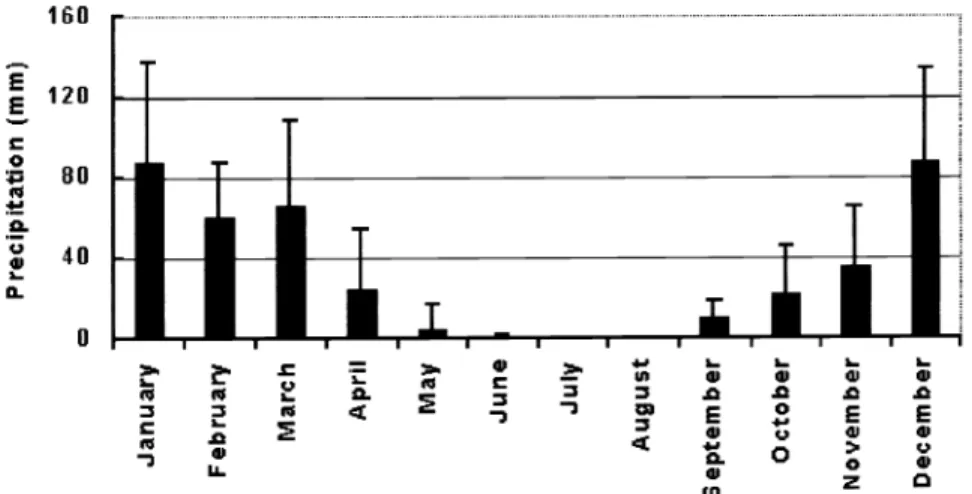
Fig. 1. Monthly average precipitation (X ± SD) at Ea. Lomas Blancas, San Luis (1990-1999).
Annual average precipitation = 399.9 ± 75.
the reduction of soil erosion. The objective of this experiment was to provide further knowledge on the hydrological conse- quences of roller-seeding eroded shrub- land sites. In addition, we estimated soil erosion and runoff for different types of microsites. Evaluated microsites were: a) soil denuded of vegetation, b) areas cov- ered with shortgrasses, and c) areas cov- ered with tallgrasses. In Central Argentina, degraded rangelands usually have a high proportion of bare soil and shortgrass microsites. After revegetation, these
microsites are colonized by vigorous tall- grasses. Runoff and soil losses were evalu- ated in roller-seeded plots, and in undis- turbed controls using a portable rainfall simulator.
Study site
The study site is located in northern San Luis Province, Argentina, in the ecotone between the Monte to the west and the arid Chaco to the northeast (Morello 1958). The ecotone is an open woodland with an uneven cover of trees and a mostly continuous herbaceous layer (Mares et al.
1985). Dominant genera of woody plants are: Acacia, Aspidosperma, Geoffroea, Larrea, and Prosopis (Anderson et al.
1970, Cabrera 1971, Pena Zubiate et al.
1998). Perennial grasses dominate the herbaceous layer in areas with mean annu- al precipitation > 300 mm (Cabido et al.
1993). Aristida, Chloris, Digitaria, Eragrostis, Neobouteloua, Pappophorum, Setaria, and Trichloris are typical warm- season-grass genera (Anderson et al. 1970, Pena Zubiate et al. 1998).
The study was conducted at Estancia Lomas Blancas (32°43'54"S 66°44'32"W).
The ranch is approximately 80 km north- west of the city of San Luis. The elevation is 600 m asl and the region receives on the average 400 mm of rain per year, with the majority falling in the summer (Fig. 1).
Storms are frequently torrential, lasting short periods but with high intensity. These events may be responsible for sharp changes in the dynamics of water erosion which so dramatically affect soil loss.
Unfortunately, data on precipitation intensi- ty is lacking for the site. Our study focussed on the dynamics of erosion in response to rainfall events of high intensity.
The soil at the study site is a Typic Haplocalcid (Pena Zubiate, personal com- munication), with signs of sheet erosion (Table 1). Typic Haplocalcids are com- mon in desert areas of the world (Soil Survey Staff 1999). At Lomas Blancas, the subsoil is often at the surface. The over- all slope is 1%. The microtopography is undulating with some evidence of erosion.
Table 1. Soil characteristics before the experiment. Horizon depth, organic matter, total N, texture and CaCO3 of the study area: Typic Haplocalcid, Lomas Blancas series (Pena Zubiate C., per- sonal communication).
Depth Organic matter Total N Sand
(cm) (%) (%) (%)
0-15 1.5 0.08 66.4
15-35 1.1 0.06 69.8
35-70 0.9 0.06 55.3
> 70 0.6 0.04 50.1
Silt Clay CaCO3
(%) (%) (%)
30.6 3.0 --
27.7 2.5 --
35.5 9.2 10
45.2 4.7 15
228 JOURNAL OF RANGE MANAGEMENT 56(3) May 2003
Fig. 2. Location of San Luis Province in Argentina, paddocks at Lomas Blancas Ranch, and experimental plots (white areas = controls, shaded areas = roller-seeded). Microsite cover- types were considered sub-plots according to a split-plot design.
Most ranches in the area utilize these woodland sites as grazinglands for live- stock (cows and goats). In areas not pro- tected from grazing, vegetation is patchily distributed with areas of bare soil as large as 100 m2 in the intershrub spaces. The most conspicuous tree is Prosopis flexu- osa (Lag.) DC, algarrobo. The shrub Larrea divaricata Cav, jarilla, is the domi- nant species. Sites physognomy is charac-
terized as jarillales, creosote scrub, (Morello 1958, Cabido et al. 1994).
Materials and Methods
Runoff and soil losses were estimated in July 1999, about 18 months after roller- seeding. For this study, only 3 of the 4 blocks were sampled (n = 3). Time con- straints in data collection and change in environmental conditions caused this reduction in replicates. Within treated and control areas, microsites that accounted for a determined set of characteristics were selected in the following manner.
Three types of microsites were evaluated (Fig. 2) for each block and treatment com- bination (N = 18; 3 blocks x 2 treatments x 3 microsite-types): (a) bare soil, (b) shortgrass cover (Neobouteloua
The experimental area was divided into 4 blocks. Blocking was applied across a gra- dient in the abundance of creosote bush (Fig. 2). One half of each block was ran- domly selected and treated with a tractor driven roller-chopper on 15 January 1998.
Controls and rolled-seeded areas were of 2-4 ha each. The roller weighs approxi- mately 6000 kg. Buffel grass seed was simultaneously incorporated into the soil at a rate of 5 kg ha'. Adult Prosopis-trees were left intact. On the other hand, shrubs were cut and chopped into pieces. Seedling emergence was satisfactory; not only for Buffel grass, but also for native grasses, resulting in a mixture of introduced and native species growing in the treated area.
However, seedling mortality reduced Buffel grass density, as it is usually observed in these types of seedings (M.O. Aguilera, per- sonnal observation). At the time of erosion evaluation, cover was estimated (Table 2) using the point quadrat method (Daget and Poissonet 1971) modified for the Monte region by Passera et al. (1983).
loposthachya [Gris.) Gould), and (c) tall- grass cover (Aristida mendocina Phil).
Both species were the most abundant grasses in undisturbed and treated areas (Table 2). A point was randomly located 10 m beyond the boundaries of control and
treated areas to avoid edge effects.
Microsite types, nearest to the selected point, were chosen for locations to be evaluated using a portable rainfall simula- tor. Erosion plots were located away from
influence of woody-species cover by determining a minimum distance of 2 m from the plot to the edge of surrounding canopies. In addition, 2 erosion plots under the influence of Prosopis-trees were evaluated. These were not included in the analysis of variance because of a lack of adequate replication, besides the unrealis- tic situation of responses to simulated rainfall under the tree canopy. However, these estimates provided valid responses for a non-eroded condition and were included in the correlation analyses (N =
18+2=20).
In determining plot locations, flat areas with no slope were selected. Accounting for slope was a critical factor because of the small dimensions of the erosion plot (625 cm2) so that microsite-type and treat- ment were the only influencing factors.
More than 90% of the plot corresponded to the cover-type evaluated. Plots were always located in areas with similar topog- raphy, at the top of the catena. Circular areas of bare soil microsites with at least a
1 m radius were selected to avoid the
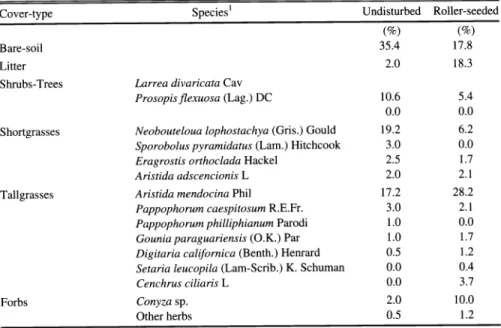
Table 2. Relative cover (%) of undisturbed and roller-seeded shrublands, after 18 months of imposing treatments, in Ea. Lomas Blancas, San Luis, Argentina (Steinaker D.F., personnal communication). Note: 0.0 % cover indicates cover values less than 0.1 %.
Cover-type Species' Undisturbed
Bare-soil 35.4 17.8
Litter 2.0 18.3
Shrubs-Trees Larrea divaricata Cav Prosopis flexuosa (Lag.) DC
0.0 0.0
Shortgrasses Neobouteloua lophostachya (Gris.) Gould 19.2
Sporobolus pyramidatus (Lam.) Hitchcook 3.0 0.0
Eragrostis orthoclada Hackel 2.5 1.7
Aristida adscencionis L 2.0 2.1
Tallgrasses Aristida mendocina Phil 17.2
Pappophorum caespitosum R.E.Fr. 3.0 2.1
Pappophorum philliphianum Parodi 1.0 0.0
Gounia paraguariensis (O.K.) Par 1.0 1.7
Digitaria californica (Benth.) Henrard 0.5 1.2 Setaria leucopila (Lam-Scrib.) K. Schuman 0.0 0.4
Cenchrus ciliaris L 0.0 3.7
Forbs Conyza sp. 2.0
Other herbs 0.5 1.2
Nomenclature follows Anderson et al. (1970).
JOURNAL OF RANGE MANAGEMENT 56(3) May 2003 229
interference of the surrounding vegetation.
Four bulk density samples (0-5 cm depth) were taken, one in each corner, outside the erosion plot. Bulk density was analyzed using the core method (Black 1965).
Statistical analyses were performed for plot means (n = 3), and no differences were found between microsites or treat- ments. The overall mean of bulk density suggested that superficial soil was com- pacted in all microsites (1.59 g cm 3).
Samples collected under the influence of Prosopis-trees with higher organic matter, showed significantly lower bulk density values (1.36 g cm 3). Most of the cover of each treatment was represented by the tested microsites (Table 2).
Rainfall was applied with a portable drop-forming rainfall simulator. This is a 150-cm high mobile simulator built of acrylic with a square base (internal side = 25 cm) driven into the soil (Irurtia and Mon 1994). The rainfall chamber has 49 tubing tips of 0.5 mm inside diameter.
According to Irurtia and Mon (1994) gener- ated raindrops are 5.1 mm in diameter and achieve a final velocity of 5.09 m sec',
delivering a kinetic energy of 15 J m 2 mm'.
Sufficient rainfall was applied to ensure runoff from all microsites at a nominal rate of 110 mm hour'.
Runoff was collected at 5-min intervals during 45-min simulated rainfall events.
Runoff (%) was defined as the ratio
between the runoff and the simulated rain- fall volumes for a given period. The soil was dry previous to the simulations. Depth of the wetting front was measured by excavating in the soil after each simulated rainfall. Estimates per plot were the aver- age of three measurements that were recorded over the plot area using a mea- surement tape. Soil loss was estimated from the total runoff collected by filtering through a # 1 Whatman filter, drying at 105° C for 24 hours, weighting and con- verting the obtained sediment to soil detachment in g m -2.
A split-plot design (Fig. 2) was used to determine the significance of blocks (3), whole plots = treatment (undisturbed or roller-seeded areas), subplots = microsite- type (bare soil, shortgrass cover, or tall- grass cover), and the interaction term (treatment x microsite). Runoff (%) was arc-sine transformed to satisfy assump- tions of normality and homoscedasticity.
Arc-sine transformation is often recom- mended for rates (Snedecor and Cochran 1980). For similar purposes, logarithmic transformation was applied to soil loss (g m 2). Repeated-measure analysis of the transformed variables was considered at 5,
10, 15, 20, 25, 30, 35, 40, and 45 min of the elapsed time of the simulated rainfall event. Actual application rate was 109.7 ± 8.29 mm hour' (mean ± SD, CV = 7.5%), so runoff rates were adjusted by the water application rate for each recorded time (Frasier et al. 1998). Final accumulated runoff (%) and soil loss (g m 2) were ana- lyzed separately as steady-state erosion parameters. Steady-state condition was defined at 45 min because no significant time-based differences were observed after 40 min. Analyses of variance were based on restricted likelihood estima- tion and Satterthwaite's procedure for approximating F-tests, particularly suited for split-plot analysis (Schabenberger, 0. 1996. "Some tricks about analyzing split-plot designs", http://www.stat.vt.edu/-oliver/Split-
Plot.html).
80
20
0 0
I00
80
60
20
0 0
Tallgrass
--f-' Shortgrass
--iBare soil
a
10 20 30 40 50
Elapsed time (min)
10 20 30 40 50
Elapsed time (mm)
Fig. 3. Runoff (%) under undisturbed (a) and roller-seeded (b) sites in semiarid shrublands of Argentina. Runoff simulation runs lasted 45 min at a nominal average rain intensity of 110 mm hour'. The only significant time- x factor- interactions was time x microsite because differences increased over time (P < 0.0001).
Results and Discussion Runoff
Microsite cover-type was the most important factor influencing runoff.
Differences for microsite-type were highly significant (P < 0.001) (Fig. 3). In turn, roller-seeding was not significant. The interaction between microsite type and treatment was significant (P < 0.004).
Tallgrass microsites of undisturbed areas showed significant higher runoff than tall- grass microsites of roller-seeded plots.
This reduction in runoff in roller-seeded tallgrass microsites could be associated with the observed vigorous growth of the grass Aristida mendocina. The overall result is similar to the differences in infil- tration rates found between shortgrass communities and bunchgrass communities in southern Idaho, western Utah and the Rolling Plains of Texas (Knight et al.
1984, Eckert et al. 1986, Thurow et al.
1986, Blackburn et al. 1992).
230 JOURNAL OF RANGE MANAGEMENT 56(3) May 2003
100
0
0
80
60
20
250
0 50
D
Tafgrasses Shortgrasses
b
w
b
Digitaria californica [Benth.] Henrard, Diplachne dubia [H.B.K.] Scribn., and Setaria leucopila [Lam-Scrib.] K.Schuman).
If tallgrasses are already abundant in the site, little is attained by roller-seeding in terms of forage production (Passera et al. 1996).
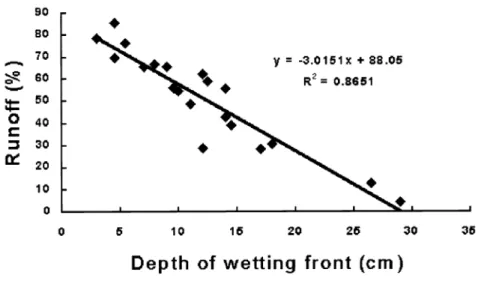
Roller-seeding changed the proportion of microsite-cover types (Table 2) reduc- ing bare soil and shortgrasses of scant bio- mass, and increasing tallgrasses. Rolling did not affect infiltration patterns at the microsite-scale, but may reduce runoff at larger scales. Runoff (%) was closely related to depth of the wetting front (cm), providing a good field estimate of runoff
for large rainfall events (Fig. 5).
Soil loss
The scale of our study provides informa- tion on soil detached through raindrop impacts, the first stage in the process of soil erosion. Slope gradient and length were not considered. Although observed values were only a fraction of probable total soil loss, significant effects on sedi- ment loss by vegetation cover were observed at the microsite-scale. The high- est sediment loss by splash was in bare soil microsites (Fig. 4). Areas covered by Neobouteloua lophostachya, colonizer shortgrass of overgrazed sites, provided sufficient soil protection to reduce sedi- ment detachment (Fig. 4). Singer et al.
(1981) found that biomass cover reduced more transported than splash sediment, so vegetation effects are probably augmented at larger spatial scales. In shortgrass domi- nated sites, if plant cover were further degraded resulting in increased bare soil Tallgrasses Shortgrasses
Bare sail
D
Bare soil
Fig. 4. Effect of treatment (undisturbed or roller-seeded) and microsite (tallgrass, shortgrass and bare soil cover-types) on runoff and soil loss after simulation runs of 45 min at an average rain intensity of 110 mm hour 1. Different letters indicate significant differences between cover-types at 5 % level. Treatment and treatmeant x microsite interaction was not significant. Vertical lines on top of bars are SD.
The repeated-measure analysis of vari- ance yielded a non-significant time x treatment interaction, but microsite differ- ences increased over time (significant time- x microsite- interaction, P < 0.0001).
At the end of the 45-min period of simu- lated rainfall, runoff from tallgrass microsites was significantly lower than shortgrass and bare soil microsites (Fig. 4).
Shortgrass and bare soil microsites had sim- ilar runoff, about 60%. These estimates cor- responded to 64-66 mm hour 1 of observed runoff. Consequently, improvement of infil- tration is expected, when management tools are used to promote the replacement of short low-productive pioneer grasses (e.g.
Neobouteloua lophostachya [Gris.] Gould, Aristida adscencionis L, Sporobolus pyrami- datus [Lam.] Hitchoock, and Michrochloa indica [L.F.] Beauv), by highly-productive tallgrasses (e.g. Aristida mendocina L, Trichloris crinita [Lag.] L.R. Parodi, Pappophorum caespitosum R.E.Fr.,
Depth of wetting front (cm)
Fig. 5. Runoff related to depth of wetting front after simulation runs of 45 min at an average intensity of 110 mm hour' (N = 20).
JOURNAL OF RANGE MANAGEMENT 56(3) May 2003 231
2500
2000
1500 1000
500
Runoff (%)
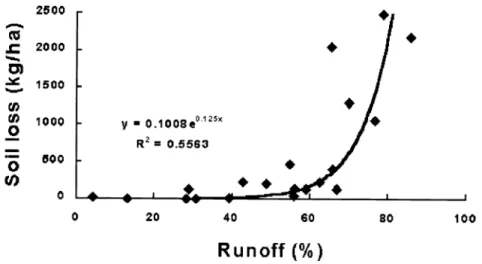
Fig. 6. Exponential relationship of sediment splash (kg ha') with runoff for simulation runs of 45 min at an average intensity of 110 mm hour 1(N = 20).
cover, erosion would greatly accelerate.
The relationship between runoff (%) and sediment loss by splash (kg ha 1) demon- strated that beyond 60% (values of runoff for shortgrass cover-types), soil losses increased sharply (Fig. 6).
Tallgrass cover-types registered negligi- ble soil loss, even after 45 min of rainfall at about 110 mm hour 1. The present eval- uation is relevant because most soil loss is often determined by high-intensity rainfall events under natural conditions (Castillo et al. 1997, Coronato and del Valle 1993, Rostagno et al. 1999). Consequences of high rainfall intensity events on aggregate breakdown and sediment transport have recently been determined for denuded and vegetated plots in a semiarid environment (Martinez-Mena et al. 1999). Although our comparative study did not evaluate sedi- ment transported in rills or large concen- trated flows, it shows the importance of vegetation cover to reduce the impact of rain splash. Besides, it is the first estimate of sediment losses for the semiarid Chaco.
Well-managed rangelands (adequate livestock rates and satisfactory rest peri- ods) commonly posses stands with a high proportion of tallgrasses (Anderson et al.
1980). Increasing tallgrass cover may result in further increases of forage pro- ductivity via amelioration of hydrologic conditions of the rangeland site. We hypothesize that control of erosion should result in improvements of infiltration rates, thereby triggering a positive feed- back mechanism resulting in higher prima- ry productivity of the herbaceous vegeta- tion layer.
Management implications
Caution should be taken to extrapolate results from microsites to the dynamics of landscape hydrology (Bergkamp 1998, Cammeraat and Imeson 1999). However, vegetation patch types are responsible for substantial transfer of water and sediments at small scales, of ecological significance in semiarid conditions (Reid et al. 1999).
Cover-type of microsites appeared to determine runoff and soil losses in situ, more than overall disturbances per se in the shrublands studied in central Argentina. The evaluated roller-seeding treatment evaluated herein, reduced the proportion of microsites more exposed to erosion (bare soil and shortgrass cover- types). Reduction of runoff and soil loss are expected after using management tech- niques that result in vegetation dynamics promoting accumulation of litter, reduc- tion of bare soil, and successional changes
associated with the replacement of colonist shortgrasses by productive tall- grasses. This successional process must provide better condition ranges, resulting from more water infiltrated in the soil and increased forage production.
Literature Cited
Anderson, D.L., J. del Aguila, and A.
Bernardon. 1970. Las formaciones vege- tates en la provincia de San Luis. (In Spanish). Revista de Investigaciones Agropecuarias. INTA, Buenos Aires. Series 2:154-183.
Anderson, D.L., J.A. del Aguila, A. Marchi, J.C. Vera, E.L. Orionte, and A.E.
Bernardon. 1980. Manejo Racional de un Campo en la Region Arida de Los Lianos de
La Rioja. (In Spanish). Instituto Nacional de Tecnologia Agropecuaria, Buenos Aires, 90 PP.
Baez, J.R. 1946. Dos aspectos de la vegetacion del norte de San Luis. II. Con mencion sobre forrajeras y malezas. (In Spanish). Revista Argentina de Agronomia 13:69-95.
Basher, L.R. and I.H. Lynn. 1996. Soil changes associated with cessation of sheep grazing in the Canterbury High Country, New Zealand. New Zealand J. Ecol.
20:179-189.
Bergkamp, G. 1998. A hierarchical view of the interactions of runoff and infiltration with vegetation and microtopography in semiarid shrublands. Catena 33:201-220.
Black, C.A. 1965. Methods of Soil Analysis.
Amer. Soc. of Agron. Series No. 9, Madison, Wis.
Blackburn, W.H., F.B. Pierson, C.L.
Hanson, T.L. Thurow, and A.L. Hanson.
1992. The spatial and temporal influence of vegetation on surface soil factors in semiarid rangelands. Trans. ASAE 35:479-486.
Braunack, M.V. and J. Walker. 1985.
Recovery of some surface soil properties of ecological interest after sheep grazing in a
semi-arid woodland. Aust. J. Ecol.
10:451-460.
Cabido, M., C. Gonzalez, A. Acosta, and S.
Diaz.1993. Vegetation changes along a pre- cipitation gradient in Central Argentina.
Vegetatio 109:5-14.
Cabido, M., A. Manzur, L. Carranza, and C.
Gonzalez Albarracin. 1994. La vegetacion y el medio fisico del Chaco Arido en la provincia de Cordoba, Argentina Central. (In
Spanish). Phytocoenologia 24:423-460.
Cabrera, A.L. 1971. Fitogeografia de la Republica Argentina. (In Spanish). Boletin de la Sociedad Argentina de Botanica
14:1-42.
Cammeraat, L.H. and A.C. Imeson. 1999.
The evolution and significance of soil-vege- tation patterns following land abandonment and fire in Spain. Catena 37:107-127.
Castillo, V.M., M. Martinez-Mena, and J.
Albadalejo. 1997. Runoff and soil loss response to vegetation removal in a semiarid envieronment. Soil Sci. Soc. Amer. J.
61:1116-1121.
Cerda, A. 1999. Parent material and vegetation affect soil erosion in eastern Spain. Soil Sci.
Soc. Amer. J. 63: 362-368.
Chanasyk, D.S. and M.A. Naeth. 1995.
Grazing impacts on bulk density and soil strength in the foothills fescue grasslands of Alberta, Canada. Can. J. Soil Sci.
75:551-557.
Coronato, F.R. and H.F. del Valle. 1993.
Methodological comparison in the estimate of fluvial erosion in an and closed basin of northeastern Patagonia. J. Arid Environ.
24:231-239.
Daget, P. and J. Poissonet. 1971. Une meth- ode d'analyse phytologique des prairies (In French). Annales Agronomiques 22:5-41.
Eckert, R.E., F.F. Peterson, and J.T. Belton.
1986. Relation between ecological-range condition and proportion of soil-surface types. J. Range Manage. 39:409-414.
232 JOURNAL OF RANGE MANAGEMENT 56(3) May 2003