Abstract
A 10-year riparian grazing study was conducted on a cold, mountain meadow riparian system in central Idaho in response to cattle grazing-salmonid fisheries conflicts. Six pastures were established along Stanley Creek to study the effects on riparian habitat of no grazing, light grazing (20–25% utilization), and medium grazing (35–50%) during late June. Stream channels narrowed, stream width-depth ratios were reduced, and channel bottom embeddedness decreased under all 3 grazing treatments as the area respond- ed to changes from heavier historic grazing use. Streambank stability increased and streamside willow communities (Salix spp. L.) increased in both height and cover under all 3 treat- ments. Plant species richness increased on both streamside and dry meadow areas during the years of grazing and mod- erate drought. The numbers of species receded to near origi- nal levels in the ungrazed and light grazed pastures in 1996, a wet post-grazing year, primarily due to a decrease in forb species. Streamside graminoid height growth was similar among treatments after 1 year of rest. Most measurements of streamside variables moved closer to those beneficial for salmonid fisheries when pastures were grazed to 10 cm of graminoid stubble height; virtually all measurements improved when pastures were grazed to 14 cm stubble height, or when pastures were not grazed. Many improvements were similar under all 3 treatments indicating these riparian habi- tats are compatible with light to medium late spring use by cattle.
Key Words: riparian, mountain meadow, streambank stabili- ty, width/depth ratio, willow, species richness, salmonid, fish- eries, livestock management
Riparian areas are among the most important features of nat- ural landscapes. Their biotic productivity and diversity stand out within the surrounding mosaic of terrestrial habitats (Kondolf et al. 1996). They typically function to moderate flood intensity, store water, and maintain water quality by act- ing as nutrient and sediment sinks (Hawkins 1994). These ecological attributes make riparian areas and the included
streams highly valued for many human uses. One of these uses is livestock grazing. Major concerns about the impacts of grazing on riparian areas have been raised in the last 2 decades (Swanson 1988, US GAO 1988, Armour et al. 1994).
In earlier years, livestock grazing practices rarely addressed
J. Range Manage.
52:218–227 May 1999
Stream channel and vegetation responses to late spring cattle grazing
WARREN P. CLARY
Author is project leader, Forestry Sciences Laboratory, Rocky Mountain Research Station, USDA Forest Service, 316 E. Myrtle St., Boise, Ida.
83702.
Support by personnel of the Sawtooth National Recreation Area and the Sawtooth National Forest made this study possible. Appreciation is expressed to John W. Kinney and various field crew members assisting in field data collection, and to Rodger L. Nelson for instruction and assistance in stream channel measure- ments. Livestock were provided by the Stanley Basin Grazing Association.
Manuscript accepted 8 Aug. 1998.
Resumen
Se condujo un estudio de apacentamiento de áreas ribereñas con una duración de 10 años. El estudio se llevó a cabo en la región central de Idaho en un sistema ribereño frío de pradera de montaña y fue motivado por los conflictos surgidos entre el apacentamiento de ganado y las pesqueras de salmones. Se establecieron 6 potreros a lo largo del arroyo Stanley para estudiar los efectos que el no apacentamiento, apacentamiento ligero (20–25% de utilización) y apacen- tamiento moderado (35–50%) a fines de junio tienen sobre el hábitat ribereño. Los canales del arroyo se estrecharon, las relaciones ancho-profundidad de los arroyos se redujeron y los depósitos en el fondo del canal decrecieron, esto ocurrió bajo los 3 tratamientos de apacentamiento conforme el área cambio de un uso histórico de pastoreo fuerte. La estabilidad del banco del arroyo se incrementó y las comunidades de
"willow" (Salix spp. L.) presentes a los lados del arroyo se incrementaron tanto en altura como cobertura, esta respues- ta se obtuvo en los 3 tratamientos de apacentamiento.
Durante los años de apacentamiento y sequía moderada, la riqueza de especies vegetales se incrementó tanto a lado del arroyo como en las áreas de pradera seca. En 1996, un año húmedo después de la estación de apacentamiento, el número de especies vegetales de los potreros que recibieron apacen- tamiento ligero o no apacentamiento regresó a niveles cer- canos a los originales, esta respuesta se debió principalmente a una disminución de las especies de hierbas. Después de un año de descanso, el crecimiento en altura de las gramíneas de los lados del arroyo fue similar entre tratamientos. Cuando los potreros se apacentaron a 10 cm de altura del rastrojo remanente, la mayoría de las mediciones de las variables tomadas a los lados del arroyo se movieron a niveles cercanos de los que son benéficos para las pesqueras de salmones.
Cuando los potreros se apacentaron a 14 cm de altura del rastrojo remanente o no se apacentaron, virtualmente todas las mediciones mejoraron. Muchas de las mejorías fueron similares bajo todos los tratamientos, indicando que estos hábitats son compatibles con el uso ligero o moderado por el ganado durante la primavera.
the needs of riparian areas (Winward 1994). Conflicting reports over the effects of livestock grazing on riparian areas have pointed to a critical need to examine grazing practices that can potentially permit livestock production while simultaneously preserving the riparian characteristics needed for wildlife habitat, native fisheries, and water quality (Waters 1995). Despite the need for objective management strate- gies, most current recommendations for improvement of riparian grazing are based on collective experiences and case studies. Experimental examination of specific management hypotheses has occurred at only a limited number of sites, including locations in Colorado (Schulz and Leininger 1990), Montana (Marlow and Pogacnik 1986), Oregon (Bryant 1985, Green and Kauffman 1995), and Wyoming (Siekert et al.
1985).
The need for more grazing manage- ment information has been apparent in the Pacific Northwest as concern for the dwindling numbers of anadromous salmonids heightened riparian habitat issues. A review of the Sawtooth National Recreation Area by the Chief of the Forest Service and representatives of The Wildlife Society, American Fisheries Society, and other concerned parties defined several courses of action to improve fish reproduction and migra- tion, including development of improved riparian grazing systems (Peek and Gebhardt 1980). The present study was initiated in response to the identified concerns about grazing-fish- eries conflicts in the Sawtooth National Recreation Area. This study spanned a 10-year period and examined the response of a cold mountain meadow riparian system to 3 intensities of con- trolled late June cattle grazing.
Study Area
The grazing study was initiated on Stanley Creek, Sawtooth National Recreation Area, Sawtooth National Forest, central Idaho in 1987. The study area is about 6 km northwest of Stanley, Ida., in portions of sections 19, 29, and 30 T11N, R13E (Lat 44°15'46''N, Long 114°59'02''W) where Stanley Creek flows through a broad, flat valley with a westerly aspect at an elevation of 1,950
m. Stanley Creek is a 3rd order, C4 stream (Rosgen 1994). Soils are Typic Cryaquepts formed in alluvium and lacustrine sediments derived from gran- ite. They have moderately slow to moderate permeability. The upper 23 cm is typically a silty clay loam overlying a sandy to coarse sandy clay loam. Below 76 cm the profile contains 60% pebbles, cobbles, and stones (Personal communi- cation, D.R. Gilman). National Weather Service records are incomplete, but annu- al precipitation during the treatment years (1987–1995) appeared to have been approximately 20–25% below the 389 mm average. This below average precipi- tation period is referred to as a drought in the current study. The post-grazing year (1996), when final measurements were taken, precipitation was 570 mm or approximately 46% above average.
Average temperature during the June grazing period is 11°C; average annual temperature is 2°C (Personal communi- cation, Idaho Climate Services).
The area is representative of the mountain meadows ecosystem in the forest zone of the mountain West con- taining wet to intermittently wet sites (Garrison et al. 1977). Typical stream- side plant species included: Kentucky bluegrass (Poa pratensis L.), tufted hair- grass (Deschampsia cespitosa [L.]
Beauv.), water sedge (Carex aquatilis Wahl.), beaked sedge (C. rostrata Stokes), Baltic rush (Juncus balticus Willd.), foxtail (Alopecurus spp. L.), timber danthonia (Danthonia interme- dia Vasey), thick-stemmed aster (Aster integrifolius Nutt.), cinquefoil (Potentilla spp. L.), gentian (Gentiana spp. L.), Lemmon’s willow (Salix lem- monii Bebb), and Drummond willow (S.
drummondiana Barratt). The streamside area, 7% of the pastures (Clary and Booth 1993), was incised an average of 0.38 m below the surrounding drier meadow and averaged 16 m in width.
Idaho fescue (Festuca idahoensis Elmer), western needlegrass (Stipa occi- dentalis Thurb.), and mountain big sage- brush (Artemisia tridentata Nutt. ssp.
vaseyana (Rydb.) Beetle) were common in the portion of the area away from the stream. These areas, referred to as the
“dry meadow,” were typically dry from about mid July into fall, but bog-like areas and other areas of excess moisture were present in all years.
Stanley Creek and the surrounding meadows have had a long history of use
and disturbance by European man.
Placer gold was discovered in Stanley Basin in 1863 (Van Noy et al. 1986).
Mining in the upper portion of Stanley Creek began in the early 1870’s by ground sluicing. Dredge mining was conducted from 1900 to 1914. Various forms of placer mining occurred from 1933 to 1938 (Choate 1962). Obvious signs of mining activity are still present immediately upstream from the study pastures. Other indications are also pre- sent that suggest heavy use by early set- tlers. Water diversion ditches and trail roads are apparent in a number of loca- tions. A log-supported stream crossing is still present within the boundaries of 1 study pasture.
Sheep grazing began by 1879 and up to 200,000 sheep grazed during sum- mers in the Sawtooth Valley, although there is no current sheep use of the study area. Cattle grazing in Stanley Basin apparently started in 1899, but records of grazing use are not available earlier than 1939 and little attention was given to grazing management until the 1970s (Sawtooth mountain area study: history.
1965. Copy on file Sawtooth National Recreation Area, Ketchum, Ida.) (Environmental analysis report: Stanley Basin revegetation and rehabilitation project. 1974. Copy on file Sawtooth National Recreation Area, Stanley, Ida.).
Until fenced at the beginning of this study, the study area was grazed as part of the Stanley Basin cattle allotment.
Limited utilization records suggested a 60–65% utilization rate of the dry mead- ow, tufted hairgrass sites, but no infor- mation was available on utilization rates for streamside locations (Personal com- munication, L. Burton). Streamside uti- lization rates were assumed to have been high because some cattle usually had access to Stanley Creek throughout the summer (Personal communication, B.
Webster). No significant utilization by wild herbivores was apparent during the study.
Methods
Field Procedure
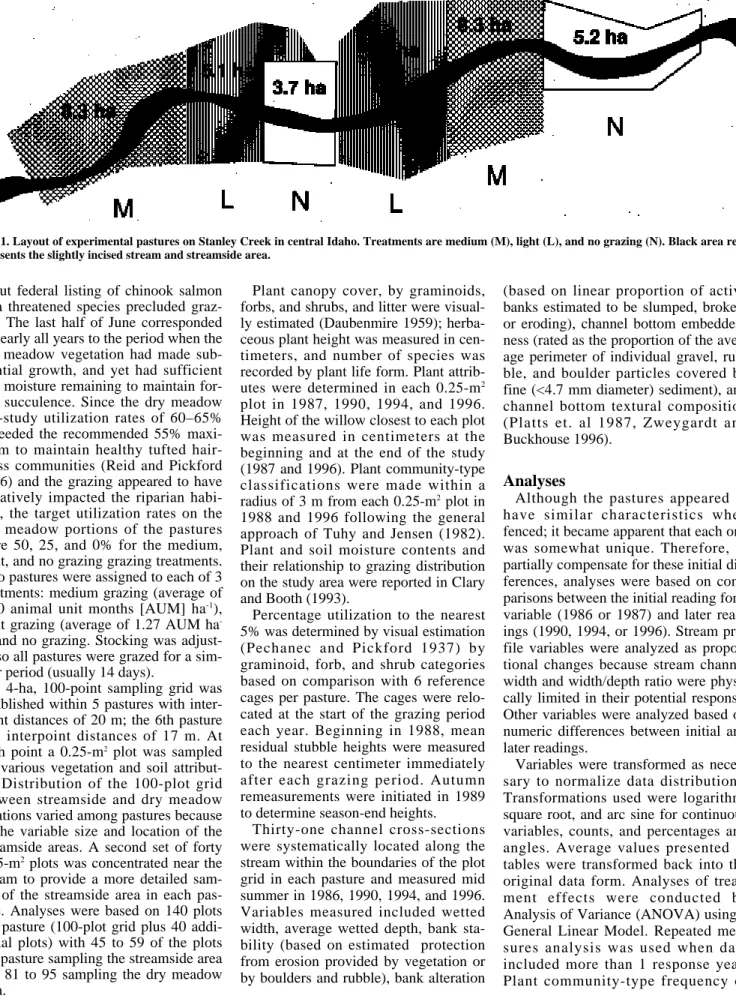
Six experimental pastures, 3.7 to 9.0 ha, were established along Stanley Creek in fall 1986 (Fig. 1). Grazing was conducted annually with cow-calf pairs in the last half of June from 1987 to 1995; except for 1993 when concerns
about federal listing of chinook salmon as a threatened species precluded graz- ing. The last half of June corresponded in nearly all years to the period when the dry meadow vegetation had made sub- stantial growth, and yet had sufficient soil moisture remaining to maintain for- age succulence. Since the dry meadow pre-study utilization rates of 60–65%
exceeded the recommended 55% maxi- mum to maintain healthy tufted hair- grass communities (Reid and Pickford 1946) and the grazing appeared to have negatively impacted the riparian habi- tats, the target utilization rates on the dry meadow portions of the pastures were 50, 25, and 0% for the medium, light, and no grazing grazing treatments.
Two pastures were assigned to each of 3 treatments: medium grazing (average of 2.20 animal unit months [AUM] ha-1), light grazing (average of 1.27 AUM ha-
1), and no grazing. Stocking was adjust- ed so all pastures were grazed for a sim- iliar period (usually 14 days).
A 4-ha, 100-point sampling grid was established within 5 pastures with inter- point distances of 20 m; the 6th pasture had interpoint distances of 17 m. At each point a 0.25-m2plot was sampled for various vegetation and soil attribut- es. Distribution of the 100-plot grid between streamside and dry meadow locations varied among pastures because of the variable size and location of the streamside areas. A second set of forty 0.25-m2plots was concentrated near the stream to provide a more detailed sam- ple of the streamside area in each pas- ture. Analyses were based on 140 plots per pasture (100-plot grid plus 40 addi- tional plots) with 45 to 59 of the plots per pasture sampling the streamside area and 81 to 95 sampling the dry meadow area.
Plant canopy cover, by graminoids, forbs, and shrubs, and litter were visual- ly estimated (Daubenmire 1959); herba- ceous plant height was measured in cen- timeters, and number of species was recorded by plant life form. Plant attrib- utes were determined in each 0.25-m2 plot in 1987, 1990, 1994, and 1996.
Height of the willow closest to each plot was measured in centimeters at the beginning and at the end of the study (1987 and 1996). Plant community-type classifications were made within a radius of 3 m from each 0.25-m2plot in 1988 and 1996 following the general approach of Tuhy and Jensen (1982).
Plant and soil moisture contents and their relationship to grazing distribution on the study area were reported in Clary and Booth (1993).
Percentage utilization to the nearest 5% was determined by visual estimation (Pechanec and Pickford 1937) by graminoid, forb, and shrub categories based on comparison with 6 reference cages per pasture. The cages were relo- cated at the start of the grazing period each year. Beginning in 1988, mean residual stubble heights were measured to the nearest centimeter immediately after each grazing period. Autumn remeasurements were initiated in 1989 to determine season-end heights.
Thirty-one channel cross-sections were systematically located along the stream within the boundaries of the plot grid in each pasture and measured mid summer in 1986, 1990, 1994, and 1996.
Variables measured included wetted width, average wetted depth, bank sta- bility (based on estimated protection from erosion provided by vegetation or by boulders and rubble), bank alteration
(based on linear proportion of active banks estimated to be slumped, broken, or eroding), channel bottom embedded- ness (rated as the proportion of the aver- age perimeter of individual gravel, rub- ble, and boulder particles covered by fine (<4.7 mm diameter) sediment), and channel bottom textural composition (Platts et. al 1987, Zweygardt and Buckhouse 1996).
Analyses
Although the pastures appeared to have similar characteristics when fenced; it became apparent that each one was somewhat unique. Therefore, to partially compensate for these initial dif- ferences, analyses were based on com- parisons between the initial reading for a variable (1986 or 1987) and later read- ings (1990, 1994, or 1996). Stream pro- file variables were analyzed as propor- tional changes because stream channel width and width/depth ratio were physi- cally limited in their potential response.
Other variables were analyzed based on numeric differences between initial and later readings.
Variables were transformed as neces- sary to normalize data distributions.
Transformations used were logarithm, square root, and arc sine for continuous variables, counts, and percentages and angles. Average values presented in tables were transformed back into the original data form. Analyses of treat- ment effects were conducted by Analysis of Variance (ANOVA) using a General Linear Model. Repeated mea- sures analysis was used when data included more than 1 response year.
Plant community-type frequency of
Fig. 1. Layout of experimental pastures on Stanley Creek in central Idaho. Treatments are medium (M), light (L), and no grazing (N). Black area rep- resents the slightly incised stream and streamside area.
occurrence was examined by Chi-square analysis. Significant differences among means in the ANOVA tests were identi- fied using a protected Fisher’s Least Significance Difference (LSD). Additional T-tests were conducted to determine if responses within individual treatments differed from the initial readings in 1986 or 1987. This was used as an aid in interpretations of treatment trends, even when no significant differences were defined among treatments. Probabilities of 0.05 or less were considered signifi- cant in all analyses. The analysis of changes for most data are presented in 2 periods: 1990 and 1994 during the grazed drought years compared with ini- tial year (1986 or 1987); and 1996 the post-grazing, high precipitation year compared with the initial year.
Results
Graminoid utilization averaged 35.2%
at streamside and 51.8% in the dry meadow for the medium grazing treat- ment; 21.6% at streamside and 25.0% in the dry meadow for the light grazing treatment. The residual stubble heights for graminoids immediately following grazing were 10.5 cm (4.1 in) at stream- side and 7.1 cm (2.8 in) on dry meadow for medium grazing and 14.1 cm (5.6 in) at streamside and 13.4 cm (5.3 in) on dry meadow for light grazing. Season- end streamside stubble heights were 12.9 cm (5.1 in) for medium, 16.4 cm (6.5 in) for light grazing, and 26.2 cm (10.3 in) for no grazing. These utiliza- tion levels were less severe and the sea- son of grazing more restricted than had been the situation on the study site for most of this century.
Stream Channel
Stream Channel Profile and Streambank Ratings
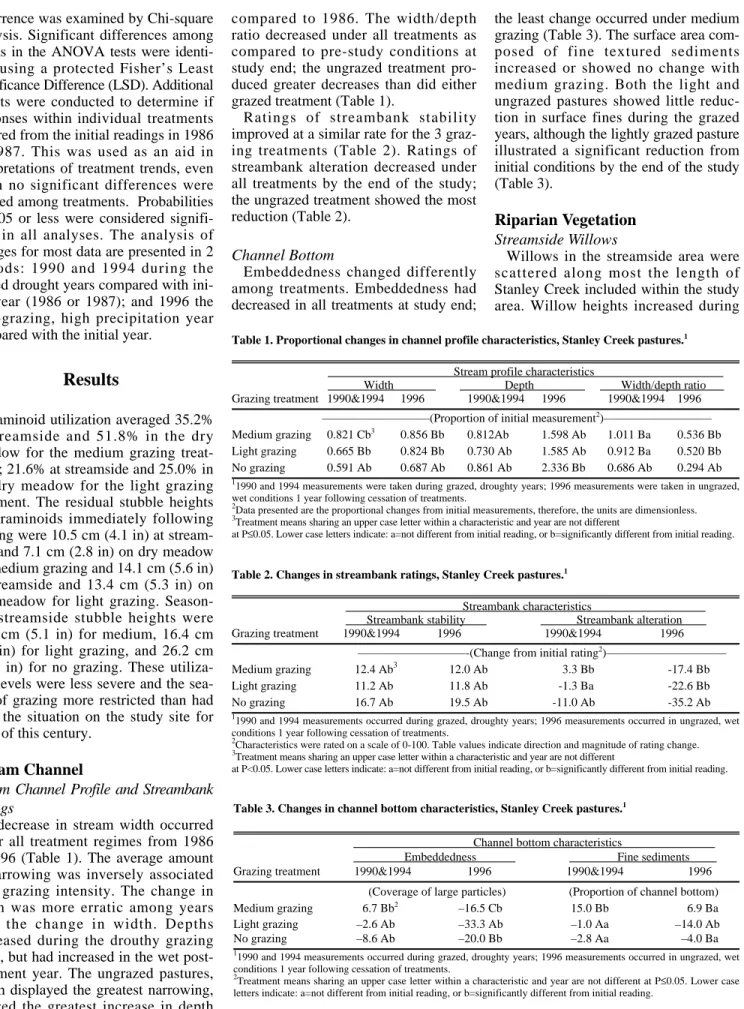
A decrease in stream width occurred under all treatment regimes from 1986 to 1996 (Table 1). The average amount of narrowing was inversely associated with grazing intensity. The change in depth was more erratic among years than the change in width. Depths decreased during the drouthy grazing years, but had increased in the wet post- treatment year. The ungrazed pastures, which displayed the greatest narrowing, showed the greatest increase in depth
compared to 1986. The width/depth ratio decreased under all treatments as compared to pre-study conditions at study end; the ungrazed treatment pro- duced greater decreases than did either grazed treatment (Table 1).
Ratings of streambank stability improved at a similar rate for the 3 graz- ing treatments (Table 2). Ratings of streambank alteration decreased under all treatments by the end of the study;
the ungrazed treatment showed the most reduction (Table 2).
Channel Bottom
Embeddedness changed differently among treatments. Embeddedness had decreased in all treatments at study end;
the least change occurred under medium grazing (Table 3). The surface area com- posed of fine textured sediments increased or showed no change with medium grazing. Both the light and ungrazed pastures showed little reduc- tion in surface fines during the grazed years, although the lightly grazed pasture illustrated a significant reduction from initial conditions by the end of the study (Table 3).
Riparian Vegetation Streamside Willows
Willows in the streamside area were scattered along most the length of Stanley Creek included within the study area. Willow heights increased during
Table 1. Proportional changes in channel profile characteristics, Stanley Creek pastures.1
Stream profile characteristics Width Depth Width/depth ratio Grazing treatment 1990&1994 1996 1990&1994 1996 1990&1994 1996
—————————(Proportion of initial measurement2)—————————
Medium grazing 0.821 Cb3 0.856 Bb 0.812Ab 1.598 Ab 1.011 Ba 0.536 Bb Light grazing 0.665 Bb 0.824 Bb 0.730 Ab 1.585 Ab 0.912 Ba 0.520 Bb
No grazing 0.591 Ab 0.687 Ab 0.861 Ab 2.336 Bb 0.686 Ab 0.294 Ab
11990 and 1994 measurements were taken during grazed, droughty years; 1996 measurements were taken in ungrazed, wet conditions 1 year following cessation of treatments.
2Data presented are the proportional changes from initial measurements, therefore, the units are dimensionless.
3Treatment means sharing an upper case letter within a characteristic and year are not different
at P≤0.05. Lower case letters indicate: a=not different from initial reading, or b=significantly different from initial reading.
Table 2. Changes in streambank ratings, Stanley Creek pastures.1
Streambank characteristics Streambank stability Streambank alteration
Grazing treatment 1990&1994 1996 1990&1994 1996
—————————-(Change from initial rating2)——————————
Medium grazing 12.4 Ab3 12.0 Ab 3.3 Bb -17.4 Bb
Light grazing 11.2 Ab 11.8 Ab -1.3 Ba -22.6 Bb
No grazing 16.7 Ab 19.5 Ab -11.0 Ab -35.2 Ab
11990 and 1994 measurements occurred during grazed, droughty years; 1996 measurements occurred in ungrazed, wet conditions 1 year following cessation of treatments.
2Characteristics were rated on a scale of 0-100. Table values indicate direction and magnitude of rating change.
3Treatment means sharing an upper case letter within a characteristic and year are not different
at P<0.05. Lower case letters indicate: a=not different from initial reading, or b=significantly different from initial reading.
Table 3. Changes in channel bottom characteristics, Stanley Creek pastures.1
Channel bottom characteristics Embeddedness Fine sediments
Grazing treatment 1990&1994 1996 1990&1994 1996
(Coverage of large particles) (Proportion of channel bottom)
Medium grazing 6.7 Bb2 –16.5 Cb 15.0 Bb 6.9 Ba
Light grazing –2.6 Ab –33.3 Ab –1.0 Aa –14.0 Ab
No grazing –8.6 Ab –20.0 Bb –2.8 Aa –4.0 Ba
11990 and 1994 measurements occurred during grazed, droughty years; 1996 measurements occurred in ungrazed, wet conditions 1 year following cessation of treatments.
2Treatment means sharing an upper case letter within a characteristic and year are not different at P≤0.05. Lower case letters indicate: a=not different from initial reading, or b=significantly different from initial reading.
the study period, but the changes did not differ among treatments (Table 4).
Willow cover increased with all treat- ments; the greatest increase occurred in the absence of grazing.
Plant Species Richness
The grazed pastures increased in graminoid species in all years compared to the initial reading (Table 5). The grazed pastures also showed an increase in forb species during the grazed years.
The year after grazing ceased and precipi- tation was high all pastures lost forb species richness. The average number of shrub species per plot increased slightly from the initial readings; the response was similar among treatments. Overall, the grazed treatments experienced a greater increase in total plant species during the period of grazing than did the ungrazed treatment. In the year following the end of grazing when a general reduction of forb species occurred, only the medium grazed treatment maintained a significant increase in total species richness com- pared to initial readings (Table 5).
Plant Community-Types
No significant changes occurred in fre- quencies of individual plant community-
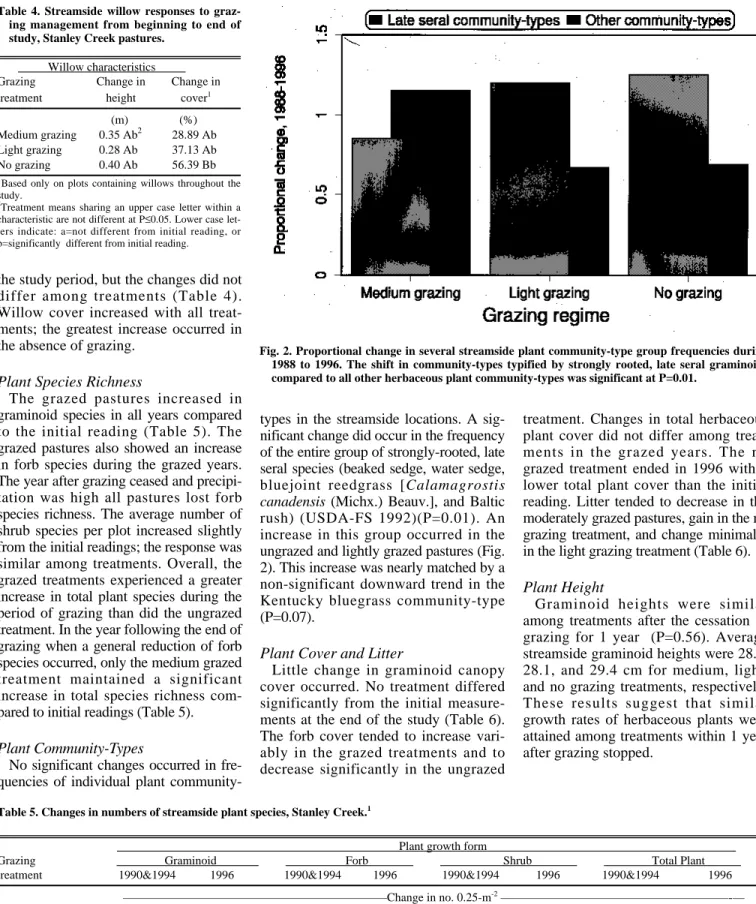
types in the streamside locations. A sig- nificant change did occur in the frequency of the entire group of strongly-rooted, late seral species (beaked sedge, water sedge, bluejoint reedgrass [Calamagrostis canadensis (Michx.) Beauv.], and Baltic rush) (USDA-FS 1992)(P=0.01). An increase in this group occurred in the ungrazed and lightly grazed pastures (Fig.
2). This increase was nearly matched by a non-significant downward trend in the Kentucky bluegrass community-type (P=0.07).
Plant Cover and Litter
Little change in graminoid canopy cover occurred. No treatment differed significantly from the initial measure- ments at the end of the study (Table 6).
The forb cover tended to increase vari- ably in the grazed treatments and to decrease significantly in the ungrazed
treatment. Changes in total herbaceous plant cover did not differ among treat- ments in the grazed years. The no grazed treatment ended in 1996 with a lower total plant cover than the initial reading. Litter tended to decrease in the moderately grazed pastures, gain in the no grazing treatment, and change minimally in the light grazing treatment (Table 6).
Plant Height
Graminoid heights were similar among treatments after the cessation of grazing for 1 year (P=0.56). Average streamside graminoid heights were 28.2, 28.1, and 29.4 cm for medium, light, and no grazing treatments, respectively.
These results suggest that similar growth rates of herbaceous plants were attained among treatments within 1 year after grazing stopped.
Fig. 2. Proportional change in several streamside plant community-type group frequencies during 1988 to 1996. The shift in community-types typified by strongly rooted, late seral graminoids compared to all other herbaceous plant community-types was significant at P=0.01.
Table 4. Streamside willow responses to graz- ing management from beginning to end of study, Stanley Creek pastures.
Willow characteristics
Grazing Change in Change in
treatment height cover1
(m) (%) Medium grazing 0.35 Ab2 28.89 Ab Light grazing 0.28 Ab 37.13 Ab
No grazing 0.40 Ab 56.39 Bb
1Based only on plots containing willows throughout the study.
2Treatment means sharing an upper case letter within a characteristic are not different at P≤0.05. Lower case let- ters indicate: a=not different from initial reading, or b=significantly different from initial reading.
Table 5. Changes in numbers of streamside plant species, Stanley Creek.1
Plant growth form Grazing Graminoid Forb Shrub Total Plant
treatment 1990&1994 1996 1990&1994 1996 1990&1994 1996 1990&1994 1996
——————————————————————Change in no. 0.25-m-2———————————————————-—
Medium grazing 0.73 Bb2 0.64 Bb 0.59 Bb -0.01 Aa 0.08 Ab 0.09 Ab 1.40 Bb 0.72 Bb
Light grazing 0.65 Bb 0.35 ABb 0.47 Bb -0.45 Ab 0.13 Ab 0.20 Ab 1.25 Bb 0.10 ABa
No grazing 0.14 Aa 0.06 Aa 0.04 Aa -0.45 Ab 0.12 Ab 0.18 Ab 0.30 Ab -0.21 Aa
11990 and 1994 measurements were taken during grazed, droughty years; 1996 measurements were taken in ungrazed, wet conditions 1 year following cessation of treatments.
2Treatment means sharing an upper case letter within a characteristic and year are not different at P≤0.05. Lower case letters indicate: a=not different from initial reading, or b=signifi- cantly different from initial reading.
Dry Meadow Vegetation Species Richness
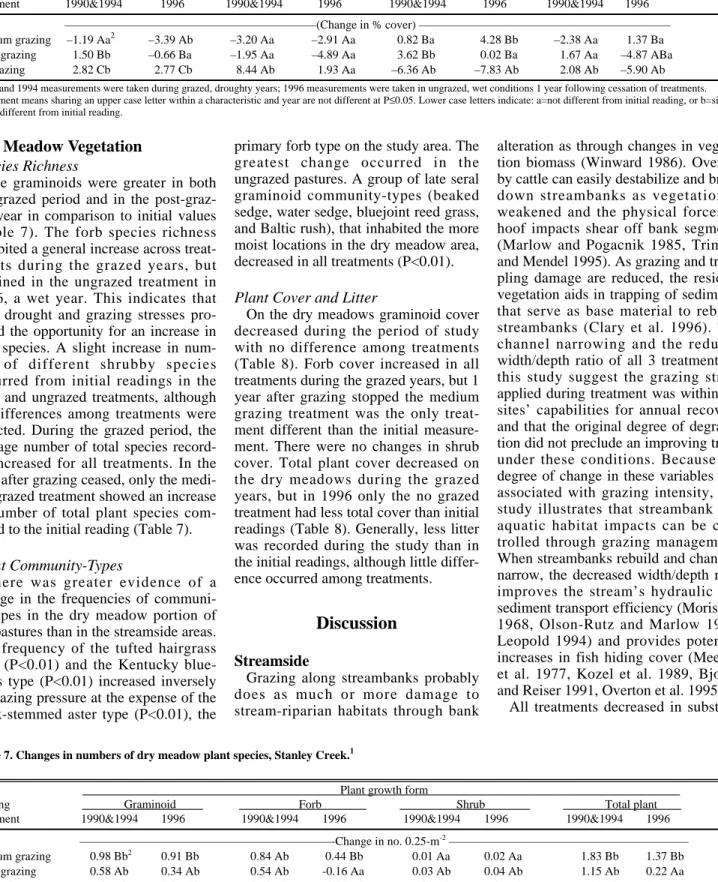
The graminoids were greater in both the grazed period and in the post-graz- ing year in comparison to initial values (Table 7). The forb species richness exhibited a general increase across treat- ments during the grazed years, but declined in the ungrazed treatment in 1996, a wet year. This indicates that both drought and grazing stresses pro- vided the opportunity for an increase in forb species. A slight increase in num- ber of different shrubby species occurred from initial readings in the light and ungrazed treatments, although no differences among treatments were detected. During the grazed period, the average number of total species record- ed increased for all treatments. In the year after grazing ceased, only the medi- um grazed treatment showed an increase in number of total plant species com- pared to the initial reading (Table 7).
Plant Community-Types
There was greater evidence of a change in the frequencies of communi- ty-types in the dry meadow portion of the pastures than in the streamside areas.
The frequency of the tufted hairgrass type (P<0.01) and the Kentucky blue- grass type (P<0.01) increased inversely to grazing pressure at the expense of the thick-stemmed aster type (P<0.01), the
primary forb type on the study area. The greatest change occurred in the ungrazed pastures. A group of late seral graminoid community-types (beaked sedge, water sedge, bluejoint reed grass, and Baltic rush), that inhabited the more moist locations in the dry meadow area, decreased in all treatments (P<0.01).
Plant Cover and Litter
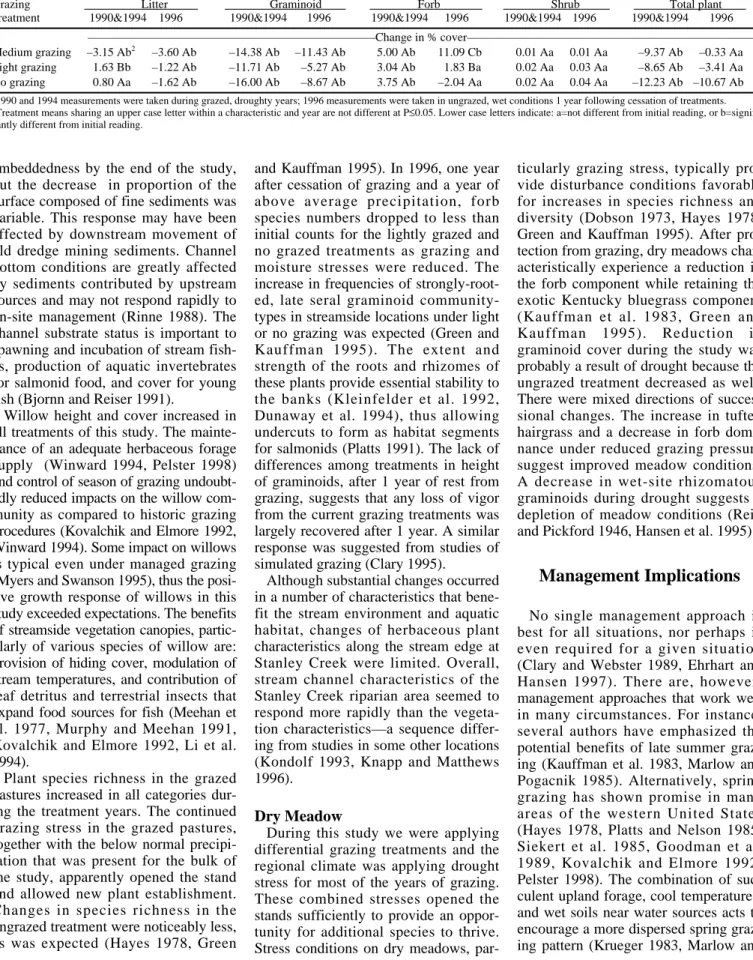
On the dry meadows graminoid cover decreased during the period of study with no difference among treatments (Table 8). Forb cover increased in all treatments during the grazed years, but 1 year after grazing stopped the medium grazing treatment was the only treat- ment different than the initial measure- ment. There were no changes in shrub cover. Total plant cover decreased on the dry meadows during the grazed years, but in 1996 only the no grazed treatment had less total cover than initial readings (Table 8). Generally, less litter was recorded during the study than in the initial readings, although little differ- ence occurred among treatments.
Discussion
Streamside
Grazing along streambanks probably does as much or more damage to stream-riparian habitats through bank
alteration as through changes in vegeta- tion biomass (Winward 1986). Overuse by cattle can easily destabilize and break down streambanks as vegetation is weakened and the physical forces of hoof impacts shear off bank segments (Marlow and Pogacnik 1985, Trimble and Mendel 1995). As grazing and tram- pling damage are reduced, the residual vegetation aids in trapping of sediments that serve as base material to rebuild streambanks (Clary et al. 1996). The channel narrowing and the reduced width/depth ratio of all 3 treatments in this study suggest the grazing stress applied during treatment was within the sites’ capabilities for annual recovery and that the original degree of degrada- tion did not preclude an improving trend under these conditions. Because the degree of change in these variables was associated with grazing intensity, this study illustrates that streambank and aquatic habitat impacts can be con- trolled through grazing management.
When streambanks rebuild and channels narrow, the decreased width/depth ratio improves the stream’s hydraulic and sediment transport efficiency (Morisawa 1968, Olson-Rutz and Marlow 1992, Leopold 1994) and provides potential increases in fish hiding cover (Meehan et al. 1977, Kozel et al. 1989, Bjornn and Reiser 1991, Overton et al. 1995).
All treatments decreased in substrate
Table 6. Changes in streamside litter and herbaceous plant cover, Stanley Creek pastures.1
Plant growth form Grazing Litter Graminoid Forb Total herbaceous plant
treatment 1990&1994 1996 1990&1994 1996 1990&1994 1996 1990&1994 1996
—————————————————————(Change in % cover) —————————————————————
Medium grazing –1.19 Aa2 –3.39 Ab –3.20 Aa –2.91 Aa 0.82 Ba 4.28 Bb –2.38 Aa 1.37 Ba
Light grazing 1.50 Bb –0.66 Ba –1.95 Aa –4.89 Aa 3.62 Bb 0.02 Ba 1.67 Aa –4.87 ABa
No grazing 2.82 Cb 2.77 Cb 8.44 Ab 1.93 Aa –6.36 Ab –7.83 Ab 2.08 Ab –5.90 Ab
11990 and 1994 measurements were taken during grazed, droughty years; 1996 measurements were taken in ungrazed, wet conditions 1 year following cessation of treatments.
2Treatment means sharing an upper case letter within a characteristic and year are not different at P≤0.05. Lower case letters indicate: a=not different from initial reading, or b=signifi- cantly different from initial reading.
Table 7. Changes in numbers of dry meadow plant species, Stanley Creek.1
Plant growth form Grazing Graminoid Forb Shrub Total plant
treatment 1990&1994 1996 1990&1994 1996 1990&1994 1996 1990&1994 1996
—————————————————————-Change in no. 0.25-m-2————————————————————
Medium grazing 0.98 Bb2 0.91 Bb 0.84 Ab 0.44 Bb 0.01 Aa 0.02 Aa 1.83 Bb 1.37 Bb
Light grazing 0.58 Ab 0.34 Ab 0.54 Ab -0.16 Aa 0.03 Ab 0.04 Ab 1.15 Ab 0.22 Aa
No grazing 0.46 Ab 0.37 Ab 0.52 Ab -0.23 Ab 0.03 Ab 0.05 Ab 1.01 Ab 0.19 Aa
11990 and 1994 measurements were taken during grazed, droughty years; 1996 measurements were taken in ungrazed, wet conditions 1 year following cessation of treatments.
2Treatment means sharing an upper case letter within a characteristic and year are not different at P≤0.05. Lower case letters indicate: a=not different from initial reading, or b=signifi- cantly different from initial reading.
embeddedness by the end of the study, but the decrease in proportion of the surface composed of fine sediments was variable. This response may have been affected by downstream movement of old dredge mining sediments. Channel bottom conditions are greatly affected by sediments contributed by upstream sources and may not respond rapidly to on-site management (Rinne 1988). The channel substrate status is important to spawning and incubation of stream fish- es, production of aquatic invertebrates for salmonid food, and cover for young fish (Bjornn and Reiser 1991).
Willow height and cover increased in all treatments of this study. The mainte- nance of an adequate herbaceous forage supply (Winward 1994, Pelster 1998) and control of season of grazing undoubt- edly reduced impacts on the willow com- munity as compared to historic grazing procedures (Kovalchik and Elmore 1992, Winward 1994). Some impact on willows is typical even under managed grazing (Myers and Swanson 1995), thus the posi- tive growth response of willows in this study exceeded expectations. The benefits of streamside vegetation canopies, partic- ularly of various species of willow are:
provision of hiding cover, modulation of stream temperatures, and contribution of leaf detritus and terrestrial insects that expand food sources for fish (Meehan et al. 1977, Murphy and Meehan 1991, Kovalchik and Elmore 1992, Li et al.
1994).
Plant species richness in the grazed pastures increased in all categories dur- ing the treatment years. The continued grazing stress in the grazed pastures, together with the below normal precipi- tation that was present for the bulk of the study, apparently opened the stand and allowed new plant establishment.
Changes in species richness in the ungrazed treatment were noticeably less, as was expected (Hayes 1978, Green
and Kauffman 1995). In 1996, one year after cessation of grazing and a year of above average precipitation, forb species numbers dropped to less than initial counts for the lightly grazed and no grazed treatments as grazing and moisture stresses were reduced. The increase in frequencies of strongly-root- ed, late seral graminoid community- types in streamside locations under light or no grazing was expected (Green and Kauffman 1995). The extent and strength of the roots and rhizomes of these plants provide essential stability to the banks (Kleinfelder et al. 1992, Dunaway et al. 1994), thus allowing undercuts to form as habitat segments for salmonids (Platts 1991). The lack of differences among treatments in height of graminoids, after 1 year of rest from grazing, suggests that any loss of vigor from the current grazing treatments was largely recovered after 1 year. A similar response was suggested from studies of simulated grazing (Clary 1995).
Although substantial changes occurred in a number of characteristics that bene- fit the stream environment and aquatic habitat, changes of herbaceous plant characteristics along the stream edge at Stanley Creek were limited. Overall, stream channel characteristics of the Stanley Creek riparian area seemed to respond more rapidly than the vegeta- tion characteristics—a sequence differ- ing from studies in some other locations (Kondolf 1993, Knapp and Matthews 1996).
Dry Meadow
During this study we were applying differential grazing treatments and the regional climate was applying drought stress for most of the years of grazing.
These combined stresses opened the stands sufficiently to provide an oppor- tunity for additional species to thrive.
Stress conditions on dry meadows, par-
ticularly grazing stress, typically pro- vide disturbance conditions favorable for increases in species richness and diversity (Dobson 1973, Hayes 1978, Green and Kauffman 1995). After pro- tection from grazing, dry meadows char- acteristically experience a reduction in the forb component while retaining the exotic Kentucky bluegrass component (Kauffman et al. 1983, Green and Kauffman 1995). Reduction in graminoid cover during the study was probably a result of drought because the ungrazed treatment decreased as well.
There were mixed directions of succes- sional changes. The increase in tufted hairgrass and a decrease in forb domi- nance under reduced grazing pressure suggest improved meadow conditions.
A decrease in wet-site rhizomatous graminoids during drought suggests a depletion of meadow conditions (Reid and Pickford 1946, Hansen et al. 1995).
Management Implications
No single management approach is best for all situations, nor perhaps is even required for a given situation (Clary and Webster 1989, Ehrhart and Hansen 1997). There are, however, management approaches that work well in many circumstances. For instance, several authors have emphasized the potential benefits of late summer graz- ing (Kauffman et al. 1983, Marlow and Pogacnik 1985). Alternatively, spring grazing has shown promise in many areas of the western United States (Hayes 1978, Platts and Nelson 1985, Siekert et al. 1985, Goodman et al.
1989, Kovalchik and Elmore 1992, Pelster 1998). The combination of suc- culent upland forage, cool temperatures, and wet soils near water sources acts to encourage a more dispersed spring graz- ing pattern (Krueger 1983, Marlow and
Table 8. Changes in dry meadow ground cover, Stanley Creek.1
Ground cover characteristics Grazing Litter Graminoid Forb Shrub Total plant treatment 1990&1994 1996 1990&1994 1996 1990&1994 1996 1990&1994 1996 1990&1994 1996
————————————————————————Change in % cover————————————————————————
Medium grazing –3.15 Ab2 –3.60 Ab –14.38 Ab –11.43 Ab 5.00 Ab 11.09 Cb 0.01 Aa 0.01 Aa –9.37 Ab –0.33 Aa
Light grazing 1.63 Bb –1.22 Ab –11.71 Ab –5.27 Ab 3.04 Ab 1.83 Ba 0.02 Aa 0.03 Aa –8.65 Ab –3.41 Aa
No grazing 0.80 Aa –1.62 Ab –16.00 Ab –8.67 Ab 3.75 Ab –2.04 Aa 0.02 Aa 0.04 Aa –12.23 Ab –10.67 Ab
11990 and 1994 measurements were taken during grazed, droughty years; 1996 measurements were taken in ungrazed, wet conditions 1 year following cessation of treatments.
2Treatment means sharing an upper case letter within a characteristic and year are not different at P≤0.05. Lower case letters indicate: a=not different from initial reading, or b=signifi- cantly different from initial reading.
Pogacnik 1986, Kovalchik 1987, Myers 1989, Clary and Booth 1993).
Grazing strategies employed in this study were designed to stay within the annual tolerance of the site for plant or streambank/channel impacts each year.
Even though many riparian forage plants have season-long access to ade- quate soil moisture, their ability to with- stand grazing has limits (Allen and Marlow 1994, Lamman 1994, Clary 1995, Hall and Bryant 1995, Dovel 1996). Willows are notably vulnerable to cattle use in late summer (Kovalchik and Elmore 1992, Lamman 1994, Winward 1994, Myers and Swanson 1995), particularly as the forage supply is reduced (Pelster 1998). Heavy tram- pling on streambanks is typically very damaging (Trimble and Mendel 1995), especially when the banks are moist (Marlow and Pogacnik 1985). The strat- egy in the Stanley Creek study was to limit grazing to the early season when less grazing use occurred near the water’s edge. The Stanley Creek stream- bank substrate composition was amenable to this grazing approach; its relatively permeable streamside soils were not likely as susceptible to spring trampling damage as other more fine textured soils (Chaney et al. 1993) (Personal communication, D. Dallas and C. Marlow). Cattle congregated on the dry meadows during those weeks the forage there was still green and succu- lent, rather than concentrating on the wetter streamside areas (Clary and Booth 1993). Grazing was terminated each year before herbaceous vegetation on the dry meadows had matured.
Riparian grazing recommendations for the recovery of depleted meadow ripari- an systems, presented after initiation of this study, suggested that 10–15 cm of forage stubble height should remain on streamside areas at the end of the grow- ing season, or at the end of the grazing season after fall frost, to limit potential impacts to the herbaceous plant commu- nity, the woody plant community, and streambank stability. Spring or early summer grazing was recommended where feasible (Clary and Webster 1989, 1990). The grazing strategy on the Stanley pastures closely paralleled these recommendations even though the graz- ing rates were originally based on use of the dry meadow sites. Compared to his- toric management patterns, the total for- age utilization in this study was less, and
mid to late season grazing was eliminat- ed. This approach appears to have been successful. Most riparian area changes in grazed pastures were in a similar direction, but in different magnitudes, to those in the ungrazed treatment here and in other ungrazed mountain meadows (Knapp and Matthews 1996). At the end of the study the conditions on Stanley Creek were continuing to improve, but it was not known how much additional change could have been expected under either carefully grazed or ungrazed con- ditions. Stanley Creek appeared to be approaching relatively stable conditions when compared to undisturbed meadow systems (Overton et al. 1995), .
Although changes were slow in this cold mountain valley, these early season grazing regimes allowed improvements in stream channel conditions and streamside vegetation characteristics. Most measure- ments improved to some degree under all 3 treatments; this suggests that early sea- son grazing practices that leave 10 to 14 cm of residual forage stubble height pro- vide an avenue for riparian habitat improvement while maintaining substan- tial livestock use of the meadow area.
Potential changes in other riparian mead- ow situations will vary depending on past grazing management, streambank sub- strates, weather, and other factors.
Literature Cited
Allen, D.R. and C.B. Marlow. 1994. Shoot population dynamics of beaked sedge fol- lowing cattle grazing. J. Range Manage.
47:64–69.
Armour, C., D. Duff, and W. Elmore.
1994. The effects of livestock grazing on western riparian and stream ecosystem.
Fisheries 19:9–12.
Bjornn, T.C. and D.W. Reiser. 1991.
Habitat requirements of salmonids in streams, p. 83–138. In: W.R. Meehan (ed.), Influences of forest and rangeland management on salmonid fishes and their habitats. Amer. Fish. Soc. Spec. Pub. 19.
Bethesda, Md.
Bryant, L.D. 1985. Livestock management in the riparian ecosystem, p.285–289. In:
R.R. Johnson, C.D. Ziebell, D.R. Patton, P.F. Ffolliott, and R.H. Hamre (tech coords.), Riparian ecosystems and their management: reconciling conflicting uses:
first North American conference. USDA Forest Serv. Gen. Tech. Rep. RM-120.
Fort Collins, Colo.
Chaney, E., W. Elmore, and W.S. Platts.
1993. Livestock grazing on western ripari- an areas. Rep. for U.S. Environ. Protection Agency. Northwest Res. Inform. Center, Eagle, Ida.
Choate, R. 1962. Geology and ore deposits of the Stanley area. Idaho Bureau of Mines and Geology Pam. 126. Moscow, Ida.
Clary, W.P. 1995. Vegetation and soil responses to grazing simulations on ripari- an meadows. J. Range Manage. 48:18–25.
Clary, W.P. and G.D. Booth. 1993. Early season utilization of mountain meadow riparian pastures. J. Range Manage.
46:493–497.
Clary, W.P. and B.F. Webster. 1989.
Managing grazing of riparian areas in the Intermountain Region. USDA Forest Serv.
Gen. Tech. Rep. INT-263. Ogden, Ut.
Clary, W.P. and B.F. Webster. 1990.
Riparian grazing guidelines for the Intermountain Region. Rangelands 12:209–212.
Clary, W.P., C.I. Thornton, and S.R. Abt.
1996. Riparian stubble height and recov- ery of degraded streambanks. Rangelands 18:137–140.
Daubenmire, R. 1959. A canopy-coverage method of vegetational analysis.
Northwest Sci. 33:43–64.
Dobson, A.T. 1973. Changes in the structure of a riparian community as the result of graz- ing. Proc. New Zealand Ecol. Soc. 20:58–64.
Dovel, R. L. 1996. Cutting height effects on wetland meadow forage yield and quality.
J. Range Manage. 49:151–156.
Dunaway, D., S.R. Swanson, J. Wendel, and W. Clary. 1994. The effect of herba- ceous plant communities and soil textures on particle erosion of alluvial stream- banks. Geomorph. 9:47–56.
Ehrhart, R.C. and P.L. Hansen. 1997.
Effective cattle management in riparian zones: a field survey and literature review.
USDI Bur. Land Manage. Mont. BLM Riparian Tech. Bull. 3. Missoula, Mont.
Garrison, G.A., A.J. Bjugstad, D.A.
Duncan, M.E. Lewis, and D.R. Smith.
1977. Vegetation and environmental fea- tures of forest and range ecosystems.
USDA Forest Serv. Agr. Handb. 475.
Washington, D.C.
Goodman, T., G.B. Donart, H.E. Kiesling, J.L. Holechek, J.P. Neel, D.
Manzanares, and K.E. Severson. 1989.
Cattle behavior with emphasis on time and activity allocations between upland and riparian habitats, p. 95–102. In: R.E.
Gresswell, B.A. Barton, and J.L. Kershner (eds.), Practical approaches to riparian resource management: an educational workshop. USDI Bur. Land Manage.
Billings, Mont.
Green, D.M. and J.B. Kauffman. 1995.
Succession and livestock grazing in a northeastern Oregon riparian ecosystem. J.
Range Manage. 48:307–313.
Hall, F.C. and L. Bryant. 1995.
Herbaceous stubble height as a warning of impending cattle grazing damage to ripari- an areas. USDA Forest Serv. Gen. Tech.
Rep. PNW-GTR-362. Portland, Ore.
Hansen, P.L., R.D. Pfister, K. Boggs, B.J.
Cook, J. Joy, and D.K. Hinckley. 1995.
Classification and management of Montana’s riparian and wetland sites.
Mont. Forest and Conserv. Exp. Sta. Misc.
Pub. 54. Missoula, Mont.
Hawkins, C.P. 1994. What are riparian ecosystems and why are we worried about them?, p. 1–9. In: G.A. Rasmussen and J.P. Dobrowolski (eds.), Riparian resources: a symposium on the distur- bances, management, economics, and con- flicts associated with riparian ecosystems.
Utah State Univ. Logan, Ut.
Hayes, F.A. 1978. Streambank stability and meadow condition in relation to livestock grazing in mountain meadows of central Idaho. M.S. Thesis, Univ. Idaho. Moscow, Ida.
Kauffman, J.B., W.C. Krueger, and M.
Vavra. 1983. Effects of late season cattle grazing on riparian plant communities. J.
Range Manage. 36:685–691.
Kleinfelder, D., S. Swanson, G. Norris, and W. Clary. 1992. Unconfined com- pressive strength of some streambank soils with herbaceous roots. Soil Sci. Soc.
Amer. J. 56:1920–1925.
Knapp, R.A. and K.R. Matthews. 1996.
Livestock grazing, golden trout, and streams in the Golden Trout Wilderness, California: impacts and management implications. North Amer. J. Fish.
Manage. 16:805–820.
Kondolf, G.M. 1993. Lag in stream channel adjustment to livestock exclosure, White Mountains, California. Restor. Ecol.
1:226–230.
Kondolf, G.M., R. Kattelmann, M.
Embury, and D.C. Erman. 1996. Status of riparian habitat, p. 1009–1030. In:
Sierra Nevada Ecosystem Project Final Report to Congress. Vol II. Wildland Resour. Center Rep. 37. Univ. Calif., Davis, Calif.
Kovalchik, B.L. 1987. Riparian zone associ- ations: Deschutes, Ochoco, Fremont, and Winema National Forests. USDA Forest Serv. Reg. 6. Ecol. Tech. Pap. 279–87.
Portland, Ore.
Kovalchik, B.L. and W. Elmore. 1992.
Effects of cattle grazing systems on wil- low-dominated plant associations in central Oregon, p. 111–119. In: W.P. Clary, E.D.
McArthur, D. Bedunah, and C.L. Wambolt (comps.), Proceedings—symposium on ecology and management of riparian shrub communities. USDA Forest Serv. Gen.
Tech. Rep. INT-289. Odgen, Ut.
Kozel, S.J., W.A. Hubert, and M.G.
Parsons. 1989. Habitat features and trout abundance relative to gradient in some Wyoming streams. Northwest Sci.
63:175–182.
Krueger, W.C. 1983. Cattle grazing in man- aged forests, p. 29–41. In: B.F. Roche, Jr.
and D.M. Baumgartner (comps.), Forestland grazing: symp. proc. Wash.
State Univ. Spokane, Wash.
Lamman, J.S. 1994. Effects of season and intensity of defoliation on two important montane riparian species. M.S. Thesis, Colo. State Univ. Fort Collins, Colo.
Leopold, L.B. 1994. A view of the river.
Harvard University Press, Cambridge, Mass.
Li, H.W., G.A. Lamberti, T.N. Pearsons, C.K. Tait, J.L. Li, and J.C. Buckhouse.
1994. Cumulative effects of riparian dis- turbances along high desert trout streams of the John Day Basin, Oregon. Trans.
Amer. Fish. Soc. 123:627–640.
Marlow, C.B. and T.M. Pogacnik. 1985.
Time of grazing and cattle-induced dam- age to streambanks, p. 279–284. In: R.R.
Johnson, C.D. Ziebell, D.R. Patton, P.F.
Ffolliott, R.H. Hamre (tech. coords.), Riparian ecosystems and their manage- ment: reconciling conflicting uses: first North American conference. USDA Forest Serv. Gen. Tech. Rep. RM-120. Fort Collins, Colo.
Marlow, C.B. and T.M. Pogacnik. 1986.
Cattle feeding and resting patterns in a foothills riparian zone. J. Range Manage.
39:212–217.
Meehan, W.R., F.J. Swanson, and J.R.
Sedell. 1977. Influences of riparian vege- tation on aquatic ecosystems with particu- lar reference to salmonid fishes and their food supply, p. 137–145. In: R.R. Johnson and D.A. Jones (tech. coords.), Impor- tance, preservation and management of riparian habitat: a symposium. USDA Forest Serv. Gen. Tech. Rep. RM-43. Fort Collins, Colo.
Morisawa, M. 1968. Streams: their dynam- ics and morphology. McGraw-Hill Book Co., New York, N.Y.
Murphy, M.L. and W.R. Meehan. 1991.
Stream ecosystems, p. 17-46. In: W.R.
Meehan (ed.), Influences of forest and rangeland management on salmonid fishes and their habitats. Amer. Fish. Soc. Spec.
Pub. 19. Bethesda, Md.
Myers, L.H. 1989. Grazing and riparian management in southwestern Montana, p.117–120. In: R.E. Gresswell, B.A.
Barton, and J.L. Kershner (eds.), Practical approaches to riparian resource manage- ment: an educational workshop. USDI Bur. Land Manage. Billings, Mont.
Myers, T.J. and S. Swanson. 1995. Impact of deferred rotation grazing on stream characteristics in central Nevada: a case study. North Amer. J. Fish. Manage.
15:428–439.
Olson-Rutz, K.M. and C.B. Marlow. 1992.
Analysis and interpretation of stream channel cross-sectional data. North Amer.
J. Fish. Manage. 12:55–61.
Overton, C.K., J.D. McIntyre, R.
Armstrong, S.L. Whitwell, and K.A.
Duncan. 1995. User’s guide to fish habi- tat: descriptions that represent natural con- ditions in the Salmon River Basin, Idaho.
USDA Forest Serv. Gen. Tech. Rep. INT- GTR-322. Ogden, Ut.
Pechanec, J.F. and G.D.Pickford. 1937. A comparison of some methods of determin- ing percentage utilization of range grasses.
J. Agr. Res. 54:753–765.
Peek, J. and J. Gebhardt. 1980. Report on fieldtrip to riparian zones in Sawtooth National Recreation Area and vicinity, Idaho. The Wildlifer 183:56.
Pelster, A. 1998. Steer diets and livestock management in a montane riparian zone.
M.S. Thesis, Colo. State Univ. Fort Collins, Colo.
Platts, W.S. 1991. Livestock grazing, p.389–423. In: W.R. Meehan (ed.), Influences of forest and rangeland man- agement on salmonid fishes and their habi- tats. Amer. Fish. Soc. Spec. Publ. 19.
Bethesda, Md.
Platts, W.S. and R.L. Nelson. 1985.
Impacts of rest-rotation grazing on stream banks in forested watersheds in Idaho.
North Amer. J. Fish. Manage. 5:547–556.
Platts, W.S., C. Armour, G.D. Booth, M.
Bryant, J.L. Bufford, P. Cuplin, S.
Jensen, G.W. Lienkaemper, G.W.
Minshall, S.B. Monsen, R.L. Nelson, J.R. Sedell, and J.S. Tuhy. 1987.
Methods for evaluating riparian habitats with applications to management. USDA Forest Serv. Gen. Tech. Rep. INT-221.
Ogden, Ut.
Reid, E.H. and G.D. Pickford. 1946.
Judging mountain meadow range condi- tion in eastern Oregon and eastern Washington. USDA Circ. 748.
Washington, D.C.
Rinne, J.N. 1988. Grazing effects on stream habitat and fishes: research design consid- erations. North Amer. J. Fish. Manage.
8:240–247.
Rosgen, D.L. 1994. A classification of nat- ural rivers. Catena 22:169–199.
Schulz, T.T. and W.C. Leininger. 1990.
Differences in riparian vegetation structure between grazed areas and exclosures. J.
Range Manage. 43:295–299.
Siekert, R.E., Q.D. Skinner, M.A. Smith, J.L. Dodd, and J.D. Rodgers. 1985.
Channel response of an ephemeral stream in Wyoming to selected grazing treat- ments, p. 276–278. In: R.R. Johnson, C.D.
Ziebell, D.R. Patton, P.F. Ffolliott, R.H.
Hamre (tech. coords.), Riparian ecosys- tems and their management: reconciling conflicting uses: first North American con- ference. USDA Forest Serv. Gen. Tech.
Rep. RM-120. Fort Collins, Colo.
Swanson, S. 1988. Riparian values as a focus for range management and vegeta- tion science, p. 425–445. In: P.T. Tueller (ed.), Vegetation science applications for rangeland analysis and management.
Kluwer Academic Publ., Boston, Mass.
Trimble, S.W. and A.C. Mendel. 1995. The cow as a geomorphic agent—a critical review. Geomorph. 13:233-253.
Tuhy, J.S. and S. Jensen. 1982. Riparian classification for the Upper Salmon/Middle Fork Salmon River Drainages, Idaho. Final Rep. to USDA Forest Serv., Region IV.
White Horse Assoc., Smithfield, Ut.
US General Accounting Office. 1988. Public rangelands: some riparian areas restored but widespread improvement will be slow.
GAO/RCED-88-105. Gaithersburg, Md.
USDA Forest Service. 1992. Integrated riparian evaluation guide. USDA For.
Serv., Intermountain Region. Ogden, Ut.
Van Noy, R.M., J. Ridenour, N.T. Zilka, F.E. Federspiel, R.K. Evans, E.T.
Tuchek, and A.B. McMahan. 1986.
Economic appraisal of the eastern part of the Sawtooth National Recreation Area, ID. US Geol. Surv. Bull. 1545-E.
Washington, D.C.
Waters, T.F. 1995. Sediment in streams:
sources, biological effects and control.
Amer. Fish. Soc. Mongr. 7. Bethesda, Md.
Winward, A.H. 1986. Vegetation character- istics of riparian areas. Trans. West. Sect.
The Wildl. Soc. 22:98–101.
Winward, A.H. 1994. Management of live- stock in riparian areas, p.49–52. In: G.A.
Rasmussen and J.P. Dobrowolski (eds.), Riparian resources: a symposium on the disturbances, management, economics, and conflicts associated with riparian ecosystems. Utah State Univ. Logan, Ut.
Zweygardt, L.R. and J.C. Buckhouse.
1996. Evaluation of a riparian classifica- tion protocol, p. 88. Private rangelands:
stewardship and responsibility. Abstracts 49th Annual Meeting, Soc. Range Manage. Wichita, Kan.