ISSN Online: 1947-394X ISSN Print: 1947-3931
DOI: 10.4236/eng.2017.910053 Oct. 27, 2017 880 Engineering
Energy Optimisation in Wireless Sensor Network
Guy Landry Diety
1, Kouadio Eugène Ali
1, Olivier Asseu
1,2*, Bolou Bi Zehero
1, Soumaya Hamouda
31Institute National Polytechnique Houphouët Boigny (INPHB), Yamoussoukro, Côte d’Ivoire 2Ecole Supérieure Africaine des TIC (ESATIC), Abidjan, Côte d’Ivoire
3Ecole Supérieure des Communications de Tunis (Sup’Com Tunis), Tunis, Tunisie
Abstract
The solution we propose optimizes the energy inside the wireless sensor net-work (WSN) with higher performance. The WSN is composed of many sen-sors nodes which collect the information, treat that information then send it to the base station. The information is received by the base station (BS) then data are sent to the users by that BS. The most important element in sensor node is energy, as the lifetime of wireless sensor network depends on the sen-sor node energy. So many researches had been made in order to improve this energy basing routing protocols. As a result, we are able to propose a solution that optimizes this energy. In this paper, we are presenting a new approach of selecting node sensor base on routing protocol and process to send data to the base station. This ameliorates wireless sensor network lifetime and increases the transmission sensor node to base station.
Keywords
Wireless Sensor Network (WSN), Base Station (BS), Sensor Node (SN), Energy, Routing Protocol, Transmission, Optimisation
1. Introduction
The apparition of internet of things did change many things in the field of tech-nologies. The Internet of Things (IoT) technology permits to connect anything like house, office, hospital, road, car etc. and man to internet. We can find internet of things in many domains which are for example army, medicine, automobile, house, industries and others. It participates in creating smart envi-ronments.
The sensor network, particularly the WSN is a very important thing in this technology. Indeed, WSN is composed of sensors nodes which can receive data, treat the data and send it to the base station (BS), then BS at its turn, sends the How to cite this paper: Diety, G.L., Ali,
K.E., Asseu, O., Bi Zehero, B. and Hamou-da, S. (2017) Energy Optimisation in Wire-less Sensor Network. Engineering, 9, 880- 889.
https://doi.org/10.4236/eng.2017.910053 Received: September 25, 2017
Accepted: October 24, 2017 Published: October 27, 2017
Copyright © 2017 by authors and Scientific Research Publishing Inc. This work is licensed under the Creative Commons Attribution International License (CC BY 4.0).
http://creativecommons.org/licenses/by/4.0/
DOI: 10.4236/eng.2017.910053 881 Engineering information to the users.
Basically, each sensor node comprises sensing, processing, transmission, mo-bilizer, position finding system, and power units (some of these components are optional like the mobilizer). Some popular cluster based routing schemes to-wards achieving the required goal of energy efficiency to prolong network life-time are discussed here in brief: The LEACH [1], introduced by Heizelman et al., is one of the most popular clustering based routing protocols and most of the other clustering schemes proposed in the literature are aimed at enhancing en-ergy efficiency at one or more phases in LEACH. LEACH determines a fraction p of all the sensor nodes that may become cluster heads a priori.
Energy efficient announcement is very important to extend the sensor net-works. In recent times, different routing protocols have been reported concern-ing wireless sensor networks. Many protocols apply sconcern-ingle optimal route in sup-port of data transmission.
The optimal route is selected based on the metrics, such as minimum hop, high remaining energy, minimum broadcast etc. to route the data [2] [3]. Rout-ing is very challengRout-ing in wireless sensor networks. One of the most difficulties that involve the sensor network lifetime refers to sensor nodes in the neighbour-hood of the sensor sink, whose activity affects a high traffic on this sequence of sensor nodes [4].
Nodes in networks are grouped into clusters, and nodes that have higher re-maining energy are selected as the cluster heads (CH). In each cluster, the nominated CH node receives and aggregates data from all the sensor nodes in the cluster. Usually, the sizes of the data off all the sensor nodes are the same, and the aggregated in data at the CH node has the same size with the data of every sensor in the cluster. As the data are aggregated in the CH node before reaching a BS (base station), this technique reduces the amount of information sent to the distant BS, hence saves energy. For example, if each sensor in the cluster sends a message of 100 bits to the CH node, then the CH node sends the aggregated message of 100 bits to the BS [8]. Details are given in [1] [5] [6].
When in LEACH cluster-head are selected randomly, EECS selects a node as a cluster-head with the highest residual energy among all the nodes, competing in order to be a cluster head. Many types of existing routing protocols are devel-oped to save power consumption. In these protocols, cluster based routing pro-tocols are found to be more energy efficient. A cluster head is selected to aggre-gate the data received from rout nodes and forward that data to the base station in cluster based routing [7].
DOI: 10.4236/eng.2017.910053 882 Engineering effective role in wireless sensor network. There are various challenges for de-ploying wireless sensor network like scalability, programmability maintainabil-ity, quality of services, types of service and lifetime of the network [10].
According to the thing we want to follow, several sensors nodes can be de-ployed in perimeter or zone to cooperate on sensing a physical phenomenon. Sen-sor networks hold the promise of revolutionizing sensing in a wide range of appli-cation domains because of their reliability, accuracy, flexibility, cost-effectiveness, and ease of deployment [11]. At network layer, several approaches have already been followed by the researchers towards developing energy efficient routing schemes like viz. flat routing, hierarchical routing, location based routing etc. Among these approaches hierarchical routing sounds to be the most attractive as many algorithms have been developed treating this as a base. It may not always provide any assurance either about the number of cluster head nodes or how well these clusters are [11].
Ravi Tomar did criticize and made an important improvement to EEPSC from LEACH. According to him, although his critics as well as the improvement are valid, we still affirm it is not really sufficient. The difference in terms of life-time between WSN from EEPSC and WSN from Ravi Tomar is very few; it is not sufficient and efficient in transmitting more data to the base station. On the contrary, our approach presented in this paper does obviously help making WSN lifetime longer in order to better transmit data to the base station.
Indeed, our proposed method increases data sent to the base station and make lifetime of WSN better. We select sub-cluster heads among the cluster heads. This avoids the quickly death of the Wireless Sensor Nodes. Its activities are re-duced by delegating transmission to its sub-clusters head according to the event. This improves lifetime of WSN and permits to send more data to the base station.
2. Method and Process
DOI: 10.4236/eng.2017.910053 883 Engineering Nooraldin propose a method based on mathematical model for lifetime of WSN with several parameters to find out optimal solution of the energy problem in the field of WSN using the modified particle swarm optimization and ant colony optimization algorithms [16]. And then Banakar Vinodkumar and Mrs. Geetha N B and Mohamed Rafi consider the cost of sending as well as processing. So, they use short distance path as well as compression of the data to reduce the power consumption. They design and implement TARF, a robust trust-aware routing framework for dynamic WSNs. Without tight time synchronization or know geographic information, TARF provides trustworthy and energy-efficient route [17].
Our approach is very different from all methods mentioned before. Our ap-proach is to improve the protocol LEACH model Ravi Tomar which inspires protocol EEPSC (Energy-Efficient protocol with static clustering).
The selection of the cluster head is made by compared residual energy of all sensor nodes in the sub-area. The sensor node whose energy is higher than the others’ is designed as cluster head. With Ravi Tomar’s protocol, there is a new function added. We must firstly compare residual energy and secondly centralize the sensor node according to all the sensor nodes in the area. After a round, an-other cluster head is selected.
Ravi Tomar’s protocol is an improvement of the protocol EEPSC [1]. Ravi Tamar’s protocol prefers to centralize the cluster head selected. But the incon-venient is the cluster head will be more solicited and will quickly die, because it will be the only one which works every time.
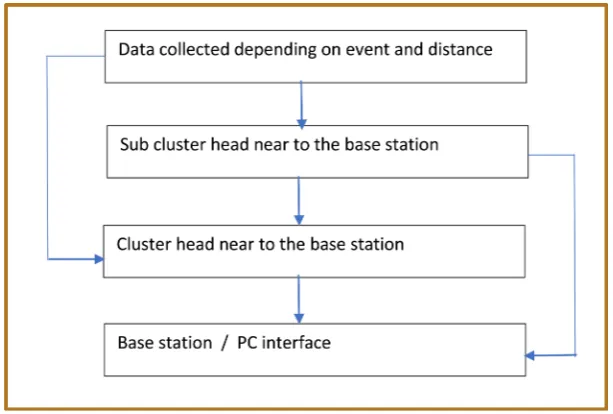
[image:4.595.220.527.501.708.2]To avoid the node quickly death inside the WSN, we propose in Figure 1, to increase lifetime by selecting some sub-cluster head around the cluster heads se-lected. Doing this, we reduce more the activities of the cluster head by delegation of transmission to sub-cluster head to base station. We add a new function which is the distance between the event, cluster head, sub-cluster head and base
DOI: 10.4236/eng.2017.910053 884 Engineering station. According to the event, if the distance between cluster head-base station is more than distance sub-cluster head-base station, then the sub-cluster head transmit to a neighbour and join the base station later.
This ameliorates the WSN lifetime, all sub-cluster heads work together in synchronized time to help cluster head at a periodical time with less energy. We have more transmissions and less dead nodes. Our sending process is described by the follow scheme.
3. Process to Select Cluster Head and Sub-Cluster Head
Our task consists in improving Ravi Tomar’s protocol. So, we should work with he’s same conditions (parameters) and prove that we did a good improve WSN’s lifetime.a) Cluster Head selection
Let *
, ,
n p r∈N
Let A=
{
1, 2,,q}
the set of nodes of zone Ω rectangular of length Xmand width Ym (not Cluster Head).{
}
{
i, 1, 2, , / 1 2 q and i j if}
PΩ= Ω ∈i q Ω ∪Ω ∪∪Ω = Ω Ω ∩Ω = ∅ i≠ j a
partition of Ω.
We denote Ai the set of nodes of zone Ωi
[ ]
{
, 1, , like 1 2 with and if}
A i q i i i j
P = A i∈ q A ∪A ∪∪A =A A∈Ω A∩A = ∅ i≠ j
We denote CHi the cluster head of zone Ωi and SCHi a sub-cluster head of the zone Ωi.
Each node K of Ω generate a random number rn(k) comprise on 0 and 1. The eligibility threshold value of CHi is defined by:
( )
1
1 mod
T k P
P r P
− ∗
= if k∈A and T k
( )
=0 if k∉A (1)where P is the percentage of cluster heads zone, r is the number of rounds. If rn k
( )
≥T k( )
then the node k is eligible.For any CHi and CHj distinct it’s necessary that:
, j m m
i
X Y
d CH CH MSD
Kopt
≥
∗ = (2)
d: distance; MSD ((minimal distance between two clusters head).
where Xm, Ym are the length and width of Ω respectively, Kopt is the optimal number of cluster head, d x y
(
,)
is the distance between x and y.b) Sub-Cluster Head selection
The eligibility threshold value of SCHi is defined by:
( )
1
1 s mod
s s s P T k P r P = ∗ −
if k∈A and T ks
( )
=0 if k∉A (3)DOI: 10.4236/eng.2017.910053 885 Engineering If rn k
( )
≥T ks( )
then the node k is eligible to be sub-cluster head.Let Si be the set of nodes in Ai – {CHi} which verify relation (3). Then the mielements of Si which energies are better are the SCHi.
If Si = ф then the SCHi are the elements of Ai – {CHi} verifying energy condi-tion. Even if Si is empty, we select a few nodes which random value and energy value are the closest to the threshold value.
c) Transmission method
We define the following distance to the Base Station (BS):
(
)
(
) (
2)
2, CHi BS CHi BS
i X X
d CH BS = + + Y +Y (4)
(
i,)
d CH BS the distance from CHi to the BS.
(
)
(
) (
2)
2, SCHi BS SCHi S
i X X B
d SCH BS = + + Y +Y (5)
(
i,)
d SCH BS the distance from SCHi to the BS
Let Ωe be the zone where the event happened. If Ωe is far from the base sta-tion, we choose Ωj zone in the neighbourhood zone of Ωe which contains the cluster head or the sub-cluster head closer to the base station.
The information must firstly be transmitted from Ωe to Ωj. Thus, the cluster head or sub-cluster head nearest to the event transmits the information to the cluster head or sub-cluster of Ωe nearest to the cluster head or sub-cluster head Ωj that is nearest to the base station. The process goes on up to the zone nearest to the base station. Within that last zone, the cluster head or the sub-cluster head nearest to the base station transmits the information to the base station.
If Ωe is the zone nearest to the base station, then the information is transmit-ted by the cluster head or the sub-cluster head of Ωe nearest to the event to the cluster head or the sub-cluster head nearest to the base station. The information is finally sent to the base station by the cluster head or sub-cluster head nearest to that base station.
In Figure 2, we propose a method that permits the cluster head to have a longer lifetime and much more avoid the death of sensor node in the network. With this method, we get a better result than the result from protocol LEACH, protocol EEPSC and Ravi Tomar’s protocol.
4. Simulation and Results
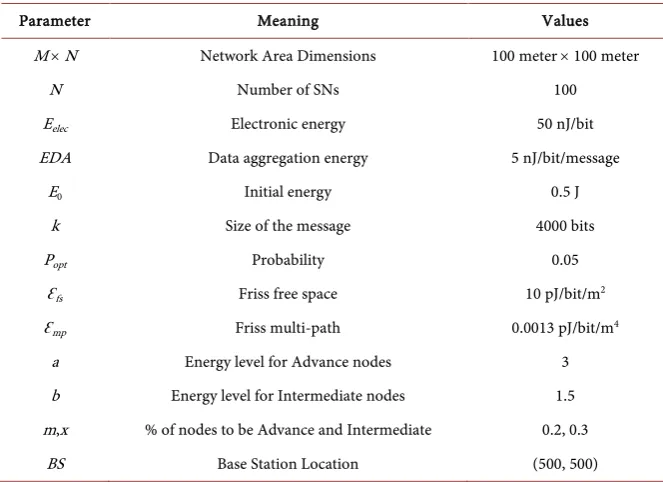
To compare two methods, we must do some experiences with them in the same conditions considering the software used, environment, number of sensor nodes. Table 1 resumes all the parameters used. The simulation gives many re-sults about lifetime of WSN, number of packets transmitted to base station and cluster heads.
a) Network lifetime per round
The simulation gives many results about the WSN lifetime, number of packets transmitted to base station and cluster heads.
DOI: 10.4236/eng.2017.910053 886 Engineering
Figure 2. Transmission process from cluster head and sub-cluster to the base station.
Table 1. Parameter settings.
Parameter Meaning Values
M × N Network Area Dimensions 100 meter × 100 meter
N Number of SNs 100
Eelec Electronic energy 50 nJ/bit
EDA Data aggregation energy 5 nJ/bit/message
E0 Initial energy 0.5 J
k Size of the message 4000 bits
Popt Probability 0.05
Ɛfs Friss free space 10 pJ/bit/m2
Ɛmp Friss multi-path 0.0013 pJ/bit/m4
a Energy level for Advance nodes 3
b Energy level for Intermediate nodes 1.5
m,x % of nodes to be Advance and Intermediate 0.2, 0.3
BS Base Station Location (500, 500)
[image:7.595.207.539.368.609.2]DOI: 10.4236/eng.2017.910053 887 Engineering
Figure 3. Dead nodes comparison DIETY, RAVI T. and LEACH.
Figure 4. Packets transmitted to the base station.
b) Number of packets transmitted to base station
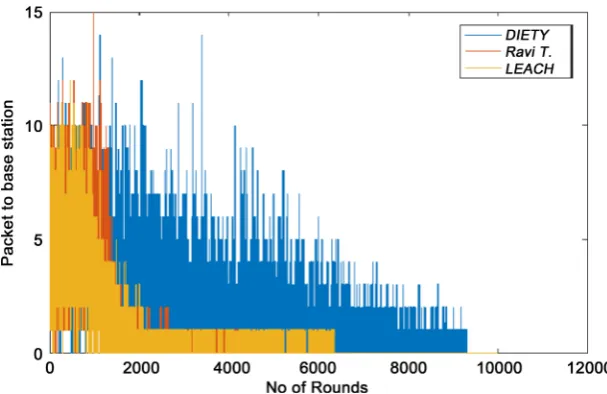
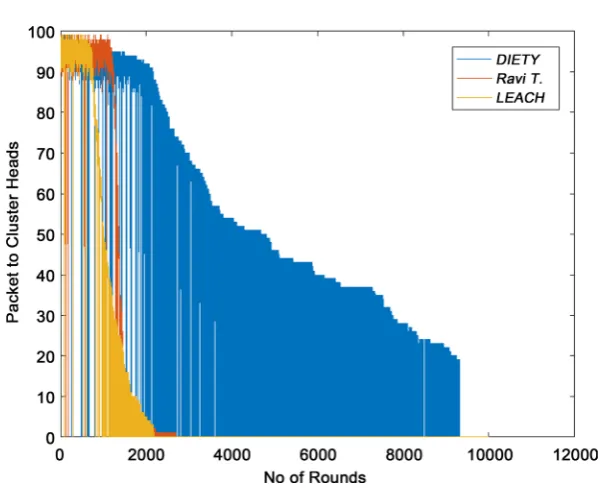
Depending on the lifetime of WSN, with our method, we transmit more data to the base station. The Figure 4 and Figure 5 show the number of packets transmitted to BS per round. It is found that DIETY provides continuous CH and have the highest successful data rate as compared to RAVI T. and LEACH for more number of rounds. LEACH and Ravi T. performed poorly and failed to provide optimal number of CHs due to their distributed nature of selecting CHs. After 2.500 rounds there is no possibility to send packet to BS because of dead sensor node with LEACH and Ravi Tomar’s. DIETY continuous to send packet to BS because of the repartition method between cluster head and sub-clusters heads. Also, to analyse the quality of any routing protocol, the successful data transmission of packets to BS is a very important parameter. So, if BS is receiv-ing high amount of data then that routreceiv-ing protocol is workreceiv-ing properly.
[image:8.595.220.524.288.485.2]DOI: 10.4236/eng.2017.910053 888 Engineering
Figure 5. Packets to cluster head and sub-cluster heads.
shows the negative impact on the handling of network traffic which then results in the loss of packets due to insufficient TDMA slots. Also, DIETY is stable when number of CH varies from 30 - 50, because if we increase the number of CH (included sub-cluster head becomes cluster head to transmits) then it results in that non-CH nodes can easily get CH locally and perform data aggregation.
5. Conclusions
Our method and approach show that we can get better result than Ravi Tomar’s method. According to this approach, all sensor nodes corporate and we have more cluster head (included sub-cluster head) to send more packets to the base station.
The WSN lifetime becomes longer and dead sensor nodes are more reduce. Our method is not the only best one, but it contributes to improve or increase then lifetime of WSN. Having more lifetime of WSN proves that we can get more information about internet of things because sometimes data has been sending by WSN.
References
[1] Heinzelman, W.R., Chandrakasan, A. and Balkrishnan, H. (2000) Energy-Efficient Communication Protocol for Wireless Microsensor Networks. Proceeding of 33rd Hawaii International Conference on System Science, 2, 10
https://doi.org/10.1109/HICSS.2000.926982
[2] Erdene-Ochir, O., et al. (2010) Resilient Routing in Wireless Sensor Networks: Gra-dient-Based Routing in Focus. IEEE of Fourth International Conference on Sensor Technologies and Applications (SENSORCOMM), July 2010, 478-483.
https://doi.org/10.1109/SENSORCOMM.2010.77
DOI: 10.4236/eng.2017.910053 889 Engineering Transmission Multicast Routing Protocol for Wireless Sensor Networks. IEEE 39th International Conference on Parallel Processing (ICPP), 188-197.
[4] Arya, R. and Sharma, S.C. (2015) Analysis and Optimization of Energy of Sensor Node Using ACO in Wireless Sensor Networks. International Conference on Ad-vanced Computing Technologies and Applications (ICACTA), 681-686.
[5] Nguyen, T.T. and Nguyen, V.D. (2012) Optimizing the Operating Time of Wireless Sensor Network. EURASIP Journal on Wireless Communication and Networking. https://doi.org/10.1186/1687-1499-2012-348
[6] Nguyen Thanh, T. (2012) Heuristic Energy-Efficient Routing Solutions to Extend the Lifetime of Wireless Ad-Hoc Sensor Networks. Springer, 487-497.
[7] Khan, Z.A. and Sampalli, S. (2012) AZR-LEACH: An Energy Efficient Routing Protocol for Wireless Sensor Networks. International Journal Communications, Networks and System Sciences, 785-795.
[8] Mehra, P.S., Doja, M.N. and Alam, B. (2015) Energy Efficient Self Organising Load Balanced Clustering Scheme for Heterogeneous WSN. 2015 International Confer-ence on IEEEEnergy Economics and Environment (ICEEE).
[9] El Khediri, S. and Nasri, N. (2014) A New Approach for Clustering in Wireless Sensor Networks Based on LEACH.
[10] Manisha and Mittal, N. (2016) Deterministic Relay Node Based Improved LEACH Protocol for Wireless Network: A Review. International Journal for Innovative Re-search in Science & Technology, 3.
[11] Tomar, R. (2014) Qos Issues in Wireless Sensor Networks: An Energy Efficient Ap-proach. LAP LAMBERT Academic Publishing, Saarbrücken.
[12] Ciullo, D., Celik, G.D. and Modiano, E. (2010) Minimizing Transmission Energy in Sensor Networks via Trajectory Control.
http://www.mit.edu/~modiano/papers/C141.pdf
[13] Bansal, S. and Arora, V.K. (2015) Energy Enhancement Using Area Zoning in Wireless Sensor Networks. 2nd International Conference on Science, Technology
and Management, New Delhi, 27 September 2015.
[14] Naznin, M. and Chowdhury, A.S. (2015) Energy Efficient Zone Based Data Gather-ing in a Wireless Sensor Network.
[15] Alim Al Islam, A.B.M., Hyder, C.S., Kabir, H. and Naznin, M. (2010) Finding the Optimal Percentage of Cluster Heads from a New and Complete Mathematical Model on LEACH. Wireless Sensor Network, 2, 129-140.
https://doi.org/10.4236/wsn.2010.22018
[16] Abbas, N.H., Ismaeel, T.Z. and Ibrahim, R.N. (2013) Optimization of Energy Con-sumption in Wireless Sensor Networks based on Nature-Inspired Algorithms. In-ternational Journal of Computer Applications, 77, 32-39.
https://doi.org/10.5120/13553-1345