Munich Personal RePEc Archive
Economic Operation of Grid-Connected
Microgrid By Multiverse Optimization
Algorithm
Mahdavi, Sadegh and Bayat, Alireza and Mirzaei, Farzad
Electrical and Computer Engineering Department, Azad University
of Shiraz, Shiraz, Iran, Electrical and Computer Engineering
Department, Azad University of Shiraz, Shiraz, Iran, Electrical and
Computer Engineering Department, Azad University of Shiraz,
Shiraz, Iran
2019
Online at
https://mpra.ub.uni-muenchen.de/95893/
Economic Operation of Grid-Connected
Microgrid By Multiverse Optimization
Algorithm
Sadegh Mahdavi, Alireza Bayat, Farzad Mirzaei
Electrical and Computer Engineering Department, Azad University of Shiraz, Shiraz, Iran
Abstract: In this paper, a new optimization algorithm known as the Multiverse
Optimization Algorithm (MOA) is developed for optimal economic operation of the
micrigrid (MG) in the grid-connected mode. Results shows the merit of the proposed
technique.
I. INTRODUCTION
Microgrid (MG) is the summation of the loads and distributed energy resources (DERs) in
a small electricity grids [1-5]. MG has some benefits such as higher reliability, resiliency,
and voltage problem, as well as the less operation cost. This is due to closeness to the
consumers, that can lead to less transmission lines. [6-7]. The energy management of the
MG is a mixed-integer problem, which is hard to solve. This problem is investigated in
some researches so far. However, develop a powerful solution algorithm is vital in the
energy management of the MG [8-11]. This paper proposes a new evolutionary algorithm
known as the multiverse optimization algorithm to overcome the complexity of the energy
management of the grid-connected MG operation. The proposed technique is more
efficient than the well-known techniques, e.g., particle swarm optimization (PSO), teaching
II. MICROGRID GRID-CONNECTED FORMULATIONS
A. Objective function
The main objective is to minimize the total operation cost as
𝑚𝑖𝑛 ∑ [𝐶∀𝑖 𝑖𝑃𝑖𝑡𝐼𝑖𝑡+ 𝑆𝑈𝑖𝑡 + 𝑆𝐷𝑖𝑡] (1)
In which:
I is a binary variable (0 or 1) that controls the status of unit i at time t.
SU and SD are the startup and shutdown costs.
In this paper, the following nomenclature is used:
𝑈𝑇 and 𝐷𝑇 are minimum up and down
𝑇(𝑜𝑛) and 𝑇(𝑜𝑓𝑓) are the number of successive on and off hours
RU and RD are the ramp up and down of the generators.
B. Constraints
There exist some constraints associated with the MG grid-connected energy management
as follows.
1. Generation unit’s capacities
𝑃𝑖𝑡,𝑚𝑖𝑛 ≤ 𝑃𝑖𝑡 ≤ 𝑃𝑖𝑡,𝑚𝑎𝑥 (2)
2. Generation units ramp up and down limitations
𝑃𝑖𝑡 − 𝑃𝑖(𝑡−1) ≤ 𝑅𝑈𝑖 (3)
𝑃𝑖(𝑡−1)− 𝑃𝑖𝑡 ≤ 𝑅𝐷𝑖 (4)
3. Generation units minimum up and down time
𝑇(𝑜𝑛)𝑖𝑡 ≥ 𝑈𝑇𝑖(𝐼𝑖𝑡− 𝐼𝑖(𝑡−1) (5)
III. MULTIVERSE ALGORITHM
This paper utilized a new evolutionary algorithm known as the multiverse evolutionary
algorithm to overcome the complexity of the problem due to the integer variable of the
generation units. This method is taken form [12]. In comparison with the well-known
methods, e.g., particle swarm optimization (PSO) and genetic algorithm (GA), the
proposed technique has higher accuracy and speed. It should be noted that these
techniques have been used in many fields [16-19].
IV. SIMULATION RESULTS
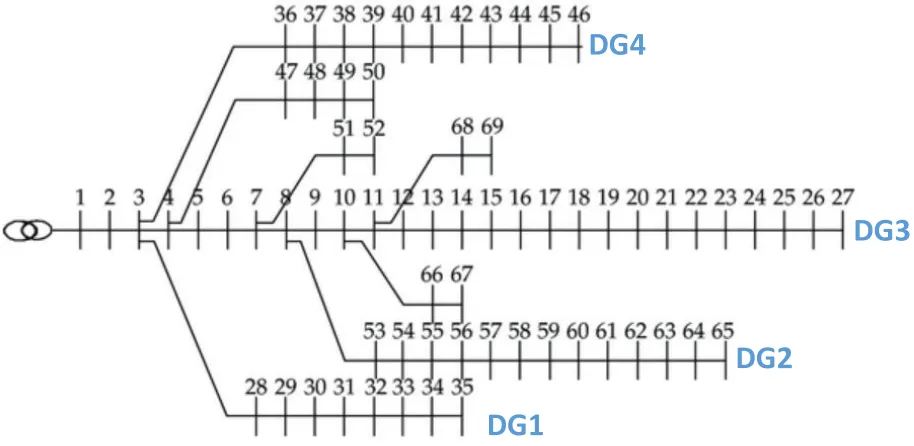
To demonstrate the economic merit of the proposed technique, the modified IEEE 69
[image:4.612.75.532.384.607.2]bus test system is selected and tested. Fig. 1 depicts the single line diagram of the model
Fig. 1. IEEE 69 bus test system diagram
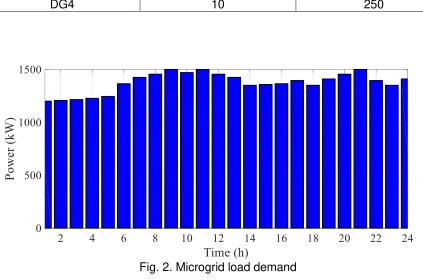
Also, table I presents the DGs features within the grid, followed by the day-ahead load demand in Fig. 2.
DG1
DG2
Table I DGs features
Minimum output power Maximum output power
DG1 20 400
DG2 40 450
DG3 10 250
DG4 10 250
Fig. 2. Microgrid load demand
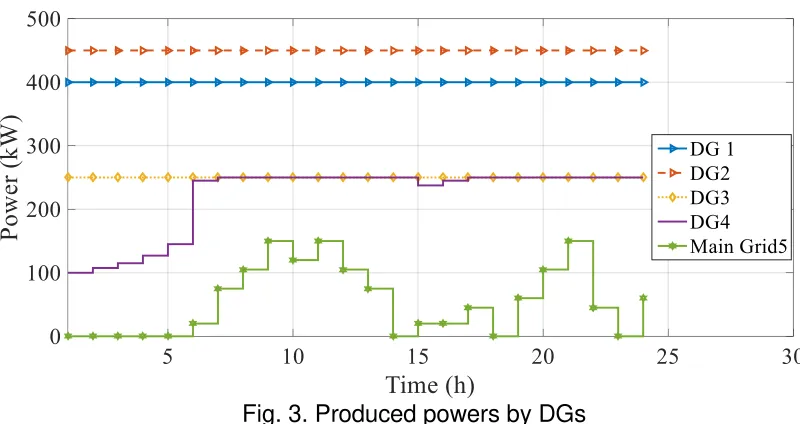
The optimal output powers of the DGs are depicted in Fig. 3. According to the results the
cheapest units are more committed than others. This can prove the economic aspects of
the proposed method. Also, the main grid sell energy to the MG in the hours that the market
[image:5.612.88.511.216.496.2]Fig. 3. Produced powers by DGs
To demonstrates the economic merit, as well as the convergence speed of the algorithm,
it has been compared with the PSO and GA. These are reported in Table II. Based on this
table, the convergence speed and operation cost of the grid-connected MG under the
proposed technique is very lower than others.
Table II
Cost of operation for several methods
cost ($) Convergence (s)
PSO 637335 11.1
GA 623437 9.9
Proposed method 598834 7.6
V. CONCLUSION
In this paper a new optimization algorithm known as the multiverse optimization
algorithm is developed for grid-connected MG energy management. This algorithm is
economic merit and also high convergence speed of the proposed technique, as two main
factor in utilities economic operations.
Reference
[1] Pourbehzadi, Motahareh, Taher Niknam, Jamshid Aghaei, Geev Mokryani, Miadreza Shafie-khah, and João PS Catalão. "Optimal operation of hybrid AC/DC microgrids
under uncertainty of renewable energy resources: A comprehensive
review." International Journal of Electrical Power & Energy Systems 109 (2019): 139-159.
[2] Tajalli, Seyede Zahra, Seyed Ali Mohammad Tajalli, Abdollah Kavousi-Fard, Taher Niknam, Morteza Dabbaghjamanesh, and Shahab Mehraeen. "A Secure Distributed Cloud-Fog Based Framework for Economic Operation of Microgrids." In 2019 IEEE Texas Power and Energy Conference (TPEC), pp. 1-6. IEEE, 2019.
[3] Dabbaghjamanesh, Morteza. "Stochastic Energy Management of Reconfigurable Power Grids in the Presence of Renewable Energy by Considering Practical Limitations." (2019).
[4] Taherzadeh, Erfan, Shahram Javadi, and Morteza Dabbaghjamanesh. "New Optimal
Power Management Strategy for Series Plug-In Hybrid Electric
Vehicles." International Journal of Automotive Technology 19, no. 6 (2018): 1061-1069.
[5] Jiang, Quanyuan, Meidong Xue, and Guangchao Geng. "Energy management of microgrid in grid-connected and stand-alone modes." IEEE transactions on power systems 28, no. 3 (2013): 3380-3389.
[6] Najy, Waleed KA, Hatem H. Zeineldin, and Wei Lee Woon. "Optimal protection coordination for microgrids with grid-connected and islanded capability." IEEE Transactions on industrial electronics 60, no. 4 (2012): 1668-1677.
[7] Al-Saedi, Waleed, Stefan W. Lachowicz, Daryoush Habibi, and Octavian Bass. "Power flow control in grid-connected microgrid operation using Particle Swarm Optimization under variable load conditions." International Journal of Electrical Power & Energy Systems 49 (2013): 76-85.
[8] Savaghebi, Mehdi, Juan C. Vasquez, Alireza Jalilian, Josep M. Guerrero, and Tzung-Lin Lee. "Selective compensation of voltage harmonics in grid-connected microgrids." Mathematics and Computers in Simulation 91 (2013): 211-228.
[10] Chen, Yahong, Changhong Deng, Weiwei Yao, Ning Liang, Pei Xia, Peng Cao, Yiwang Dong et al. "Impacts of stochastic forecast errors of renewable energy generation and load demands on microgrid operation." Renewable Energy 133 (2019): 442-461.
[11] Azizi, S. (2019). Why do migrants remit?. The World Economy, 42(2), 429-452.
[12] Benmessahel, Ilyas, Kun Xie, and Mouna Chellal. "A new evolutionary neural
networks based on intrusion detection systems using multiverse
optimization." Applied Intelligence48, no. 8 (2018): 2315-2327.
[13] Kavousi-Fard, Abdollah, Morteza Dabbaghjamanesh, Jie Zhang, and Omid Avatefipour. "Superconducting Fault Current Limiter Allocation in Reconfigurable Smart Grids." arXiv preprint arXiv:1905.02324 (2019).
[14] Wang, Boyu, Morteza Dabbaghjamanesh, Abdollah Kavousi Fard, and Shahab Mehraeen. "Cybersecurity Enhancement of Power Trading Within the Networked Microgrids Based on Blockchain and Directed Acylic Graph Approach." IEEE Transactions on Industry Applications (2019).
[15] Saberi, Hossein, Shahab Mehraeen, and Boyu Wang. "Stability improvement of microgrids using a novel reduced UPFC structure via nonlinear optimal control." In 2018 IEEE Applied Power Electronics Conference and Exposition (APEC), pp. 3294-3300. IEEE, 2018.
[16] Dabbaghjamanesh, Morteza, Boyu Wang, Shahab Mehraeen, Jie Zhang, and Abdollah Kavousi-Fard. "Networked Microgrid Security and Privacy Enhancement By the Blockchain-enabled Internet of Things Approach." In 2019 IEEE Green Technologies Conference (GreenTech), pp. 1-5. IEEE, 2019.
[17] Dabbaghjamanesh, Morteza, Boyu Wang, Abdollah Kavousi-Fard, Shahab Mehraeen, Nikos D. Hatziargyriou, Dimitris Trakas, and Farzad Ferdowsi. "A Novel Two-Stage Multi-Layer Constrained Spectral Clustering Strategy for Intentional Islanding of Power Grids." IEEE Transactions on Power Delivery (2019).
[18] Azizi, SeyedSoroosh. "Altruism: primary motivation of remittances." Applied Economics Letters 24, no. 17 (2017): 1218-1221.