Munich Personal RePEc Archive
Generalising Conflict Networks
Cortes-Corrales, Sebastián and Gorny, Paul M.
University of Leicester, Universtiy of East Anglia
13 November 2018
Online at
https://mpra.ub.uni-muenchen.de/90001/
Generalising Conflict Networks
†Sebasti´an Cortes-Corrales‡and Paul M. Gorny§
This version: November 13, 2018
Abstract
We investigate the behaviour of agents in bilateral contests within arbitrary network
struc-tures when valuations and efficiencies are heterogenous. These parameters are interpreted as
measures of strength. We provide conditions for when unique, pure strategy equilibria exist.
When a player starts attacking one player more strongly, others join in on fighting the victim.
Different efficiencies in fighting make players fight those of similar strength. Centrality of a
player (having more enemies) makes a player weaker and her opponents are more likely to
attack with more effort.
Keywords: Contest, networks, optimal allocation, games on networks
JEL: C72; D74; D85
†
We would like to thank participants from the CBESS Contest Conference 2016 and 2018 held at the University of East Anglia in Norwich and the Conflict Workshop 2018 at the University of Bath for useful comments. Also, we want to thank Subhasish M. Chowdhury, Sergio Currarini, David Hugh-Jones, Ivan Pastine, David Rojo Arjona and Mich Tvede for useful comments. All remaining errors are our own.
‡
University of Leicester, [email protected]
§
1
Introduction
Competition takes the most vigorous form when the parties involved do not use resources for
production or consumption, but rather to disable, destroy or appropriate resources from others
(Hirshleifer, 1995; Sandler, 2000). The resources employed for these goals, in the form of
sol-diers, military equipment and time spent are sunk, irrespective of the final outcome. This form of
competition can broadly be defined as conflict. It is this wasteful nature and the strategic
consid-erations that spurred the interest of economists and game theorists. The theoretical contributions
in this domain are typically built on models with a single conflict with two or more parties.
Ad-vancements in transportation and information technology allow states and other international,
and potentially militant interest groups to engage in multiple conflicts around the globe. That
has added more complexity in how such agents are related to each other. In most of the existing
models it is impossible to distinguish a fightfora single prize from a fightagainstspecific enemies.
The motivation of agents is not to fight someone specific within the ‘aggregate others’, although
in reality individuals, political groups and nation states typically have a sense of who each of their
opponents are.
The aim of this paper is to develop a framework with multiple interconnected opponents, to
un-derstand how the differences between rivals (i.e position in the conflict structure, efficiency in the
conflict technology and prizes within and across the bilateral conflicts) shape the optimal
strate-gies in conflict games.
Two considerations give rise to the type of model we suggest. On the one hand, conflict is
char-acterised by sunk effort investments aiming at increasing the probability of winning a prize. This
prize can be land, power or natural resources in the case of war or market share and influence
in the case of marketing and lobbying, respectively. This trade-off is frequently modelled by a
contest (e.g. Konrad, 2009; Vojnovic, 2016).
On the other hand, conflicts often have a structure of multiple, simultaneous battlefields between
the different parties involved. Just as much as strength, the degree of centrality mattered when
Germany engaged in battles on multiple fronts in WWI and WWII. These considerations give rise
to a network of conflictual links between agents, where each link represents a bilateral contest.
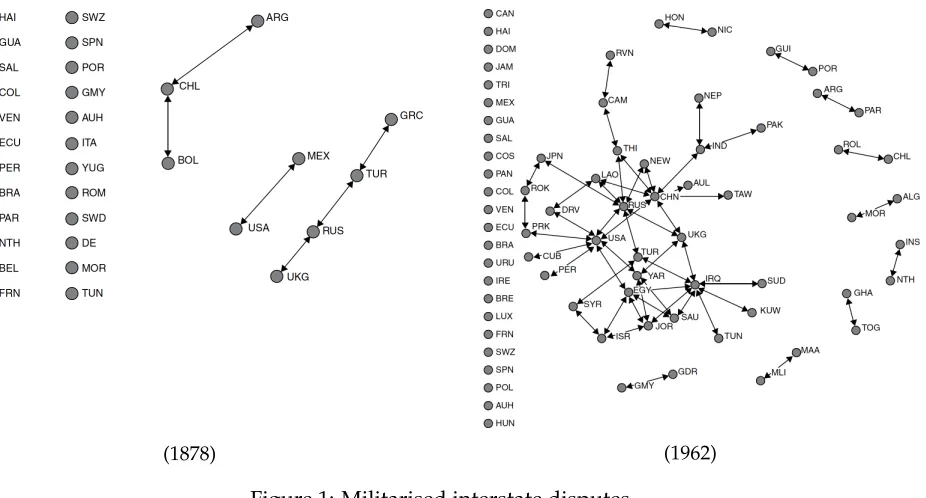
To illustrate this, take a look at the set of Militarised Interstate Disputes between states1in 1878
– the year when the Congress of Berlin ended the Russo-Turkish War – and the type of relations in
(1878) (1962)
Figure 1: Militarised interstate disputes
Source:Networks of Nations: The Evolution, Structure, and Impact of International Networks, 1816-2001, (Maoz, 2010)
1962 – the height of the Cold War–, depicted in Figure 1.
In both periods of time the overall conflict structure within states is represented by networks of
bilateral conflicts. In 1878, the structure of disputes was characterised mainly by a network with
line components in which a state had at most two different conflicts at the same time. In 1962 the
picture is different, whilst there is a non-negligible number of isolated bilateral conflicts, there is
a less trivial cluster of nodes centred around military powerful and/or resource rich states like
the United States, Russia, China, or Iraq among others. It conceptually is hard to judge whether
it was the strength of Russia that made other countries engage in conflict with the US, or whether
they did so in order to oppose the threat that a potential US hegemony meant to them. In the
literature on International Relations, the former is broadly comprised by the termBandwagoning,
while the latter is frequently referred asBalancing(Waltz, 1979). The paper at hand sheds light on
this question in a stylised setting.
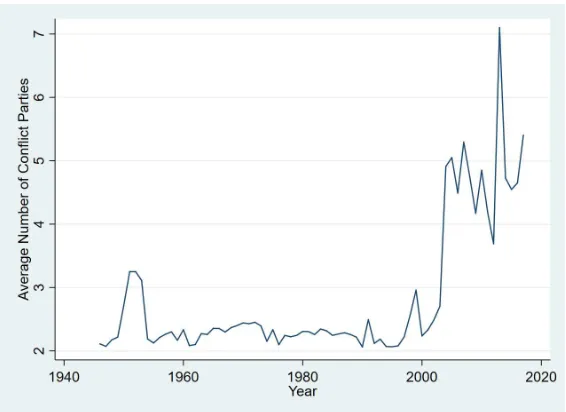
While the number of Militarised Interstate Disputes have declined over the second half of the
20th century, the was a sharp increase in internal and internationalised internal conflict. These
types of conflict are often referred to as civil wars and include recent examples like the Syrian war,
the civil war in Ukraine and the Colombian conflict.2 As figure 2 suggests, the number of parties
in military conflicts has increased on average over time, with the sharpest increase happening
2
Figure 2: Violent Conflicts Involve More Parties Over Time
after 9/11. Since every additional agent can have conflicts with multiple agents in the network,
the increase in conflictual links is likely to be even more pronounced, giving rise to the study at
hand.
We propose a setting in which there is an exogenous structure of bilateral conflicts across n
opponents as in Franke and ¨Ozt ¨urk (2015) (from heron F ¨O). Each link between a pair of players
represents a bilateral conflict. While F ¨O considers cases of symmetric characteristics, we allow
for heterogeneity between opponents in terms of their efficiency of conflict investment and the
valuations of winning, within and between different conflicts. We model conflict using a contest
success function based on the axiomatisation proposed by Skaperdas (1996). Finally, we induce
a trade-off between different conflicts through a budget-constrained cost function – following the
formulation proposed by Kovenock and Roberson (2012a), which can accommodate two canonical
cases already studied in the literature: i) pure cost convex case andii)budget constrained case.
The latter yields to the fact that military budgets can hardly ever be altered in the short run when
conflicts were not anticipated.
We show that a unique and interior Nash Equilibrium exists in the pure cost case, independently of
the model parameters. In contrast, in the budget constrained case the uniqueness and interiority
of the equilibrium rely on the spread of valuations a player holds for the different conflicts she
is involved in and the characteristics of the impact function. In line with F ¨O, we show that a
We thus use implicit methods to investigate some local effects of the asymmetries between the
players’ characteristics. We find that asymmetries in the prizes leads to Bandwagoning behaviour,
mainly driven by the interaction of local network externalities induced by the conflict structure.3
If there are players of different strength, as indicated by their efficiency to transform resources into
winning probabilities, players tend to fight opponents more strongly that are similar with respect
to their strength. Finally, we investigate the changes in the strategies due to heterogeneity in the
number of conflicts of a player’s opponents. We find that more central players tend to be fought
more fiercely.
Related Literature: Modelling conflict on networks is a relatively recent stream of research in
economics (Dziubi ´nski et al., 2016), starting with the model proposed by Franke and ¨Ozt ¨urk
(2015). The authors define a model where players are embedded in a network of bilateral
con-flicts and each player chooses the amount of resources that they want to invest to each conflict.
The conflict is modelled using a lottery success function. The trade-off between different conflicts
is induced through a convex cost function of the total amount of resources employed. They relate
the total conflict investment with the player’s number of conflicts. The article focusses on
ag-gregate behaviour and thus abstracts from individual characteristics by assuming symmetry with
respect to all model parameters.
Beside the seminal paper by Franke and ¨Ozt ¨urk (2015) and the subsequent studies looking at this
type of environment (e.g. K ¨onig et al., 2017; Dziubi ´nski et al., 2017; Matros and Rietzke, 2018)4
there are different fields that are related to the paper at hand. The key distinction between our
paper and the afore-mentioned (among other differences) is that the players choose an effort level
for each opponent they share a link with, rather than choosing a single effort that they employ
against all players.5 Settings with link specific actions, not necessarily conflict or contest though,
are quite recent. To the best of our knowledge in addition to Franke and ¨Ozt ¨urk (2015) the only
models on games on networks that introduce multidimensional strategies are Goyal et al. (2008)
or Bourl`es et al. (2017). In analysing heterogeneity of players and their response with respect to
specific opponents, this characteristic is crucial.
3
Klose and Kovenock (2015) refer to these as identity-dependent externalities. The first formalisation in contest to our knowledge can be found in Linster (1993).
4Huremovic (2016) studies as well conflicts on networks but with a different perspective. He is interested in the endogenous network formation of a network of conflict.
Apart from that, our paper is related to the literature on multi-battle contests based on the
canon-ical Colonel Blotto game. The Colonel Blotto game has been studied extensively since its first
formulation by Borel (1921), where two players need to allocate simultaneously a finite number
of resources overkdifferent battlefields, the outcome over each battlefield is modelled as an
all-pay-auction. This specification is well-researched with characterisations of heterogeneity between
players, complementarity of prizes and other modifications to the standard formulation (Borel
and Ville, 1938; Gross and Wagner, 1950; Laslier, 2002; Roberson, 2006; Hart, 2008; Hortala-Vallve
and Llorente-Saguer, 2012; Weinstein, 2012; Kovenock and Roberson, 2012a; Kovenock et al., 2015;
Macdonell and Mastronardi, 2015; Thomas, 2018).
Using a lottery to determine the outcome in each battlefield following the Tullock (1980)contest
success function, where the probability of winning a specific battlefield is a non-decreasing function
in the own resource allocation and decreasing in the enemy’s allocation, is another approach to
the two player Colonel Blotto problem. Based on thiscontest success function, Friedman (1958) is
able to characterise the equilibrium in pure strategies of the two-player game with symmetric and
asymmetric budgets and battlefield valuations. The main result of that study is that the optimal
allocation is proportional to the valuation of the prizes.6 This result is a special case of our model.
This strand of the literature relies on models with only two players. Our paper is a contribution to
the theory of contests in which we extend the current set of models by considering a multi-player
environment with asymmetric efficiency of resources toward the conflict outcome and conflict
prizes. This variation allow us to find new insights about the effects of the interactions of local
network externalities across different conflicts.
We also add to a debate in the literature of international relations. In a war and many other
con-flictual settings, there is no (strong) institution that allows parties to come to a peaceful agreement.
This state can be referred to as Hobbesian anarchy, due to Hobbes (1998). It is the law of the Jungle
that should determine the winner(s) in such a state. Differences in the parties’ strengths should
thus be crucial to any analysis of conflict. Early on, Waltz (1979) and Walt (1987) coined the terms
BalancingandBandwagoning. Balancingis a behaviour where weaker parties ally to balance the
power of a strong common opponent. Bandwagoningrefers to the case where weak parties rally
behind the strategic goals of the hegemon. There has been an ongoing discussion about which
of these is more likely to occur in situations of armed conflict.7 Our model allows to introduce
a hegemon into the model, using different measures of strength, in order to shed light on the
6
Robson (2005) generalises it by allowing the contest success function to include an effectiveness advantage and idiosyncratic noise.
behaviour of the remaining players.
The rest of the paper is structured as follows. In the next section, we describe the setup of
the model and discuss some its properties. In Section 3, we prove the uniqueness of an interior
Nash Equilibrium, discuss some of its properties and show the non-existence of a general explicit
algebraic solution to the model. In section 3.1, we study the specific family ofk-regular network
structures that enables us to have sharper predictions regarding the equilibrium behaviour. In this
section we also present some comparative statics. In section 3.2, we present results concerning the
asymmetries coming from the network structure. Section 4 concludes.
2
The Model
LetI = {1, . . . , n}be a finite set of players withn ≥ 3. All battlefields are contained inB ⊆ I2
where I2 is the set of unordered pairs of I with typical element (ij). The underlying conflict
network G is represented by the connected graph associated with the pair of sets (I, B).8 We
say that any pair of players i and j is involved in a bilateral conflict on battlefield (ij) if and
only if(ij) ∈ B. The network G is undirected (∀{i, j} : (ij) ∈ B ⇔ (ji) ∈ B) and irreflexive
(∀i ∈ I : (ii) 6∈ B). LetNi = {j ∈ I|(ij) ∈ B} denote the set ofi’s rivals. The total number of
rivals ofiis given bydi =|Ni|. The setN˜i ={1, ..., di}then uses the opponent orderingeij, which
is the row number of each element of the ordered vectorNifromjlow to high. The total number
of battlefields is 12bwith b = P
idi = |B|. Notice, that every player has at most(n−1)rivals and, consequently, the networkG contains at most n(n2−1) battlefields. In each bilateral conflict,
(ij) ∈ B, players i and j fight for a strictly positive exogenous prize. Player i’s valuation of
winning the prize against playerj is denotedvij. This framework can accommodate
constant-sum bilateral conflicts, whenvij =vji, or non constant-sum bilateral conflicts, whenvij 6=vji.9
Each playerican allocate an amount of resourcesxij ∈ R+ in order to increase her probability
of winning battlefield (ij) against playerj. Thus, xi = (xe
ij)j∈Ni is adi-dimensional vector that contains all effort choices of playeri.
The outcome of each bilateral conflict is determined by the total amount of resources allocated to
8 A graphGis connected if for every pair of players iandjinN there exists a path between them. We do not consider disconnected network structures. The results that we are presenting hold for any non-trivial component of any disconnected network. A path in a networkGbetween nodeshandlis a sequence of linksi1i2, i2i3, . . . , ik−1ik
such that everyimim+1∈Bfor eachm∈ {1, . . . , k−1}, withi1=handik=l. Each node in the sequence{i1, . . . , ik}
needs to be distinct. 9
that specific battlefield. Playeri’s probability of winning is determined by acontest success function
(from hereon CSF) p(aixij, ajxji), where ai ∈ R++captures how efficiently player ican employ
her resources to increase this probability. The CSF is increasing and concave inxij and decreasing
and convex inxji.10Further, it does not depend on anyxlkwith(lk)6= (ij). The axiomatised class
of CSFs by Skaperdas (1996) satisfies these properties. Thus, the probability ofiwinning the prize
in the battlefield againstjobtains as
˜
pij = ˜p(aixij, ajxji) =
f(aixij)
f(aixij)+f(ajxji) if (xij +xji)6= 0
pij if (xij +xji) = 0
(CSF)
wherepij ∈(0,1)is the tie breaking rule. The impact functionf(.)is a twice differentiable, positive
and strictly increasing function of its argument withf(0) = 0.
The tie breaking rule is defined exogenously in order to define the CSF at(0,0). Since this might
cause problems for some of the results we intend to show, we use the fact that
˜
p(aixij, ajxji) = lim δ→0
f(aixij) +kδ
f(aixij) +f(ajxji) + (1 +k)δ
The limit of this function coincides with our previous definition at every point. Even the tie rule
can be set flexibly since
lim
δ→0
f(aixij) +kδ
f(aixij) +f(ajxji) + (1 +k)δ
xij=xji=0
= lim
δ→0
kδ (1 +k)δ =
k
1 +k ∈(0,1)
for everyk ∈ (0,∞). This approach is essentially the one suggested in Myerson and W¨arneryd
(2006) with the slight adjustment to accommodate more flexible tie breaking rules. The function
we intend to use as contest success function is thus
p(aixij, ajxji) =
f(aixij) +kδ
f(aixij) +f(ajxji) + (1 +k)δ (1)
for some arbitrarily smallδ >0.11
For ease of notation, throughout the rest of the paper, letω = (v, a)be the combination ofbvalues
collected inv and then population weights collected ina. The space of all such combinations
10
This translates into the following condition onf():f′′(a
ixij)(f(aixij) +f(ajxji))−2f′(aixij)<0. In words,f()
can have any degree of concavity but should not be too convex. 11Note that this impliesp
ij+pji6= 1fork6= 1. Alternatively one could assumek= 1implyingpij=
1
2, resulting in
isΩ ∈ Rb+n
++. We call the case where all valuations across players and battlefields and all
effi-ciencies across all players are the same astrictly symmetricparameterisation and denote itω. Let
Ω ={(λ1111b, λ2111n)|(λ1, λ2)∈R2++}denote the set of all such parameterisations.12
Players incur costs for employing resources which are captured byC(Xi)whereXi =Pj∈Nixij
denotes total resources spent by a player across all her battlefields. We consider abudget-constrained
cost-basedframework as the one proposed by Kovenock and Roberson (2012b) such that for some
R >0, we have
C(Xi) =
c(Xi) if Xi≤R
∞ if Xi> R
(2)
The properties ofc(Xi)determine the magnitude of opportunity costs for playeri. If the function
is strongly increasing at some level ofXi, she will have to withdraw resources from other
battle-fields rather than increasing the total amount of resources spent. In general,c(Xi)is continuous,
non-decreasing and convex. We use c′(0) = 0 for proving our results but they go through for
sufficiently small c′(0) > 0 as well. This definition of the cost function allows the study of two
canonical formulations. In the budget-constrained case(BCC) the cost function is c(Xi) = 0for all
Xi. In this case the opportunity costs across battlefields are mediated solely through the curvature
properties of the CSF. Since the marginal returns on each battlefield are strictly increasing in own
allocated resources, each player exerts the total amountXi =Racross all battlefields.
The second case is thepure cost case (PCC) in whichRis arbitrarily large, such that we can
guar-anteeXi < Rin equilibrium for each playeri. The opportunity costs for each battlefield enter the
model through the positive cross derivatives ofc(Xi)which in this case is assumed to be strictly
convex.
For technical tractability we ignore the mixed case in which there is a non-trivial cost function
c(Xi)and potentially binding constraints for some players but not all players.
For each battlefield(ij)∈B, agenti’s expected pay-off isuij :R+×R+→R+such thatuij =pijvij.
We assume that agents are expected pay-off maximisers with risk-neutral preferences. We
con-12111
sider an additively separable utility function given by13
Ui(xi,x−i,G) =
X
j∈Ni
uij −C(Xi)
The set of players, the network structure, the action spaces and expected payoffs define a
simul-taneous game. Our objective is to study the Nash equilibrium of this game and how the
char-acteristics of the network structure, distribution of values and assumptions on the cost function
influence the equilibrium behaviour.
3
Equilibrium Analysis
Given the above structure, each player faces the following maximisation problem of dimensiondi
determined by the network structureGfor givenx−i,
max xi∈Rdi+
Ui(xi,x−i,G) with a givenx−i∈Rb+−di (3)
In the pure cost case, the equilibrium behaviour is described by the balance of marginal benefits
and marginal costs for each battlefield(ij)∈Band every playeri∈ I
aif′(aixij)f(ajxji)
(f(aixij) +f(ajxji))2
vij =C′(Xi) (PCC)
In the budget-constrained case, when the properties of the cost function induce the opportunity
costs through a fixed budget that needs to be spent, the optimal allocation of resources for each
playeri∈ I for every battlefield(ij)∈B in equilibrium is characterised by
f(aixij) +f(ajxji) P
k∈Ni[f(aixik) +f(akxki)]
=
p
vijf′(aixij)f(ajxji) P
k∈Ni p
vikf′(aixik)f(akxki)
(BCC)
Players’ marginal benefits are shaped by the resource allocation of their direct rivals but also
the rivals of their rivals and so on. This interdependency induced by the cost function determines
how an individual reacts to changes in some of the parameters of the environment. Some of the
behavioural implications thus occur even though a player’s preferences are not directly altered.
F ¨O asserted that a unique equilibrium exists irrespective of the network structure if the players
characteristics in terms of their preferences and technologies are homogenous. In the setting of
convex costs, this homogeneity is not needed to guarantee uniqueness. Under a strict budget
con-straint we can guarantee it by staying in an open neighbourhood around symmetric parameters.
With the CSF as defined in (1), the game is a continuous game with a finite set of players and
com-pact strategy spaces. Thus, we can apply the theorems due to Debreu (1952), Glicksberg (1952)
and Fan (1952) in order to guarantee the existence of a pure-strategy Nash equilibrium. Due to
the continuity of the cost function and the (almost) infinite marginal gains close to(0,0)on each
battlefield, equilibria are strictly interior. If that is given, the system of first order conditions (from
hereon referred to asF) characterises these equilibria. We show that the determinant of that
sys-tem is always strictly larger than zero. This provides us with the following result.
Proposition 1(Pure Cost Case).
For the pure cost case, a unique, interior pure-strategy Nash equilibrium exists. The solution function
x(ω) : Ω7→Rb
++has the following properties:
• It is of classC∞
• Its derivative is given byDx(ω) =−[DxF(x(ω);ω)]−1DωF(x(ω);ω)
The budget-constrained setting is slightly more complicated, as players cannot increase or
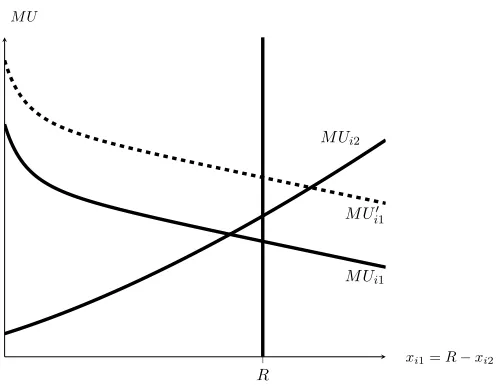
de-crease their total effortsXi to any other level thanR. We need to ensure that every player can
equalise marginal returns across battlefields. Consider Figure 3. A playerifor whichdi = 2can
pin down her decision on both battlefields by choosing onlyxi1 since xi2 = R−xi1. The figure
shows her marginal utilities on both battlefields. Since they are both decreasing in the respective
effort, marginal utility on battlefield 2 is increasing inxi1.
With M Ui1 player ihas enough endowment to balance marginal utilities, that is, to reach the
intersection of the two functions. If we increase the battlefield value fromvi1tovi′1, as is shown by
the dotted lineM Ui′1, it would be optimal to spend all resources on the battlefield with the higher
marginal revenue and we obtain a corner solution.
Since the marginal utilities increase in the valuations and efficiencies, this also restricts the relative
values vi1
vi2 and efficiency parameters (i.e. ai andaj). This mutual restraint can be characterised
R
M Ui1
M U′ i1
M Ui2
xi1=R−xi2
[image:13.612.171.420.70.263.2]M U
Figure 3: Marginal Utilities for a Player with 2 Battlefields
Take some playeri ∈ Iand denote the highest valuation she holds with vih = max{vij|j ∈ Ni}.
The highest marginal utility that playerican get in the battlefield againsthwhenxih=Ris
max
xhi≤R
∂Ui(xi,x−i,G)
∂xih
xih=R
= 1 4
aif′(aiR)
f(aiR) vih if ai ah ≤1 aif′(aiR)f(ahR)
(f(aiR)+f(ahR))2vih if ai ah >1
Since the first order condition of this problem is given by
∂Ui(xi,x−i,G)
∂xih∂xhi
= aiahf
′(a
ixih)f′(ahxhi)(f(aixih)−f(ahxhi))
(f(aixih) +f(ahxhi))3
!
= 0
the argument that solves it isxhi= aahixih, meaning that the highest marginal utility for a specific
battlefield is achieved when winning probabilities are the same for both players.
Equally well, on the battlefield whereiholds the lowest valuationvil = min{vij|j ∈Ni}, we can
find the minimal marginal utility under any profile wherexih=Ras
min
xli≤R
∂Ui(xi,x−i,G)
∂xil
xil=0
= aif
′(0)
f(alR)
vil
When this marginal utility (denote itM Uij for some battlefield(ij)) is larger than the one on
(ih)whenxhi= min{aahixih, R}= min{aahiR, R}, then playerihas an incentive to divert resources
min
xli≤R
∂Ui(xi,x−i,G)
∂xil
xil=0
> max
xhi≤R
∂Ui(xi,x−i,G)
∂xih
xih=R
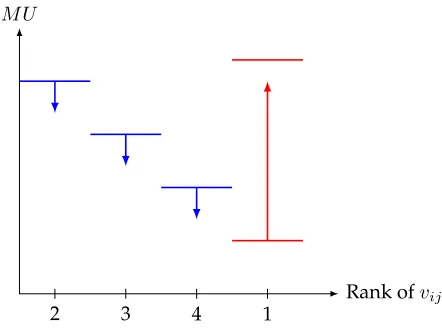
To complete this argument of the proof, one has to notice that forxih = 0andxhi = R, we have
M Uih ≥ M Uik for all k =6 h. This implies that each player can achieve M Uij = M Uik for all
{j, k} ∈Ni.
M U
Rank ofvij
[image:14.612.186.407.219.384.2]2 3 4 1
Figure 4:M Uihcan be equalised with allM Uij
Note: Valuations are ordered from high to low, i.e. 1 represents
If that holds, we can use the same techniques as in the former proof to obtain the following
result.
Proposition 2(Budget-Constrained Case).
If for alli∈ I we have
vil
vih
> 1 4
f(alR)
f(aiR)
f′(aiR)
f′(0) (4)
then for eachω∈Ωa strictly interior, unique pure-strategy Nash equilibrium exists.
The solution functionx(ω) : Ω7→Rb
++has the following properties:14
• It is of classC∞.
• Its derivative is given byDx(ω) =−[DxF(x(ω);ω)]−1DωF(x(ω);ω).
14
This is a slight abuse of notation. Technically, the function isx˜(ω) : Ω7→Rb+n
++. The shadow prices of increasing
the total amount of effortsλis an output of that function for alli ∈ I. Here, we construct the function from theb
Therefore, the interplay of battlefield values, the initial endowment and properties of the the
impact functionf(.)determine whether the game has a unique Nash equilibrium. Note that the
caseai =aj = 1andvij =vji=v >0for all(ij)∈Balways fulfils the condition.
The analytic condition is particularly interesting as a familiar assumption made in economics
could guarantee existence for all kinds of parameters. If we assume that the impact of the first
marginal effort increase is infinitely large, that islimx→0f′(x) =∞, there is no bound on budgets
and valuations anymore. While we do not intend to use this assumption for the rest of the paper, it
relates to common assumptions made in economics like theInada-conditionin production or utility
functions. One could state it as the first marginal unit sent to a battlefield having a large impact
compared to a further unit sent when there are already many on the field.
Games played on networks give rise to a complex set of dependencies. Any attempt to solve for
equilibria should reflect this for the model at hand. The following result tells us that to solve
explicitly the system of first order conditions, we need to express the best response functions of
some playerias functions of a player’s strategies that does not share a link withi.
Lemma 1.
There exists an indirect global dependence where for any pair of agents h and l who are not rivals (i.e.
h6∈Nlandl6∈Nh), the effort levels as characterised by the system of first order conditions can implicitely
be expressed asxh∗(X∗
−{h,l},xl∗)andxl∗(X∗−{l,h},xh∗).
In that sense, the fact that we have a connected network creates indirect relations between all
players throughout the rivals of rivals along any path of the network. This does not mean that
players “respond” to distant players as the word best-response function suggests. It is merely a
mathematical fact that we use to show that an algebraic solution for the equilibria can be obtained
for hardly any network structure. How much any player’s actions affect another player’s effort
levels in equilibrium depends on how long the shortest possible path between them is. Consider
for example a line network with 6 players in a budget constrained setting. In this case the two
players in the ends allocate all their resources in their unique battlefield. Let playeribe one of
the end players in the line. Based on Lemma 1, we can mathematically express any of her best
responses asx∗ij =xij(xjk(xkl(xlp(xpq))))as illustrated by Figure 5.
i j k l p q
Figure 5: Line Network with 6 Players
a sum. Therefore, to find the equilibrium strategies, we require to find the roots of at least one
general polynomial of degree25.
Denoting the length of the longest path in a given network withL, solving the system of first order
conditions for all players, generally requires us to find the roots of at least one general polynomial
of degree2L. This is a mathematical impossibility for any degree greater or equal to 5, according
to the Abel-Ruffini Theorem (1779).
Corollary 1.
The equilibrium strategies of the game do not have a generic algebraic solution if the length of the longest
path between any two players is greater than or equal to3.
By a generic algebraic solution we mean any formula which would express the roots of the
polynomial as functions of the coefficients by means of algebraic operations (i.e+,−,×or/) and
roots of natural degrees. This is the reason for employing more implicit methods when analysing
equilibrium behaviour, or more specifically, changes in equilibrium behaviour that correspond to
changes in parameters. Also, we need to restore some degree of symmetry that we impose on the
network structure.
3.1 k-Regular Networks
Propositions 1 and 2 provide the general form of the matrix of derivatives for any unique
equilib-rium. If we focus our attention on a subset of network structures, it is possible to obtain closed
forms of these matrices to assess comparative statics more precisely. As these expressions appear
more often in the subsequent part of the paper, denotep1ij =p1(aixij, ajxji)as the derivative ofpij
respect to its first argument,p2ij =p2(aixij, ajxji)the derivative ofpij respect to the second
argu-ment. The second and cross-derivatives are equivalently given byp11
ij = p11(aixij, ajxji) = −p22ji andp12ij =p12(aixij, ajxji) =−p21ji. The set of graphs we consider is defined as follows.
Definition.
Ak-regular network is any graph for whichdi=kfor alli∈ Iand somek∈ {2, ..., n−1}.
This family of graphs includes the complete network (k = n−1) and the ring (or minimal
connected) network (k= 2) as well as some networks in between these extreme cases as illustrated
by Figure 6 for the case ofn= 6.
Within these networks it is possible to characterise the equilibrium strategies in case of a
1
2
3 5
6
4
(a)k= 2
1
2
3 5
6
4
(b)k= 3
1
2
3 5
6
4
[image:17.612.118.478.71.202.2](c)k= 5
Figure 6: Examples ofk-Regular Networks forn= 6
class of graphs and the equilibrium efforts exerted. This means that, even though in a relatively
restrictive set of cases, we are able to infer the exact network structure from the strategies played.
Lemma 2.
Ifω∈Ωthe following holds:
The graph isk-regular fork≤n−1if and only if the equilibrium for alli∈ I isxij =xs > 0for all
j ∈ I\{i}.
This equilibrium obtains as
xs= 1 kC
′−1(p1(axs, axs)av)>0
This result might be useful, as often in real world conflicts effort levels, in the form of soldiers or
monetary contributions, are more observable than the underlying network structure. Note that a
symmetric equilibrium in ak-regular network does not necessarily imply thatω∈Ωthough. The
condition for a strategy profilexsto constitute an equilibrium in such a network is
p1(aixs, ajxs)
p1(a
kxs, alxs)
= vkl vij
for all (ij),(kl) ∈ B, which can be satisfied forω /∈ Ω. If we restrict the degrees of freedom
further there is some deductions one can make about the parameters as well.
Corollary 2.
choiceRk ≥xs>0for alli∈ I it follows that
aj =ai ⇔vij =vji ∀i, j∈ I
Probably the most frequently used CSF is the one suggested by Tullock (1980) for whichf(x) =
x. With the above we can have a first glance at potential comparative statics with respect to
pa-rameters.
Example 1(Relative Battlefield Values).
Let every player in ak-regular network have an endowment equal to one and values such thatvij =vjifor
all(ij)∈B. AlsoV =P
j∈Nivij for alli∈ I. In a budget-constrained setting, the equilibrium behaviour
will be given by
For alli∈ I and every(ij)∈Bthe optimal allocation strategy isx∗ij = Pvij
k∈Ni
vik
When instead of facing a budget constraint, the opportunity cost of allocating resources is induced by a
cost function, we observe the same equilibrium strategy if it is of the formC(Xi) = 14XiV. The degree of
convexity of the cost function thus needs to be proportional to the total value of the contest to each player.
Since all involved functions are continuous in their respective arguments, we might infer that increases in
own value increase an agent’s effort, while those values winning over her decrease it.
Notice, that if we have an environment where players are symmetric and all dimensions (i.e. endowment,
battlefield values, number of rivals), our setting collapse to the same equilibrium behaviour already found
previously in the literature by Friedman (1958). In there the network structure starts to be redundant and
only the relative battlefield values will determine the amount of resources allocated to a given conflict. If
all valuations are multiplied by the same constant, strategies do not change. Following up on the notion of
externalities, this illustrates why it does not matter how much individualihates individualj(vij high). If
individualkis hated more (vik > vij), it appears as ifirelatively likesj. This is also in line with observing
conflict even in very cohesive groups like tribes and families.
In a symmetric equilibrium within a k-regular network, the first order conditions are the same
for every player sinceXi =kxs. Thus, we can do a comparative static analysis on the symmetric
equilibriumk-regular effort choice with respect to the parameters. Note that this is different from
change a particular parameter, rather than the joint value for all player for that parameter.
∂xs ∂a <0,
∂xs ∂v >0,
∆xs ∆k <0
The effect of increasing everyones’ valuations should be correctly anticipated. If we move from
one symmetric equilibrium to the next along a linear increase of all efficiencies we do see a
reduc-tion in individual efforts. The same holds if the degree kincreases for all players. The marginal
change in total effort,X=nkxs, is proportional to the first two expressions. Thus, we can say that
it increases in valuations and decreases in efficiencies. Notice though that reduced efforts through
increases in symmetric efficiencies should not be confused with what could be coinedeffective
ef-forts x˜ij = aixij. For instance in a war between countries, although less soldiers are sent to the
battle by each agent, the battle intensity could increase since the weapons got more powerful. We
find the same result as F ¨O related to the degree of the network (i.e. total effort increasing ink),
which should not be too surprising as we are in a strictly symmetric setting.
We stop investigating symmetric changes of parameters here, as this paper is concerned with
asymmetries in networks of conflicts. In Proposition 1 and 2 we already gave an abstract
charac-terisation of the derivatives at any given equilibrium. In the the setting ofk-regular networks, we
can provide general algebraic expressions that allow us to perform comparative statics for which
we know the signs and magnitudes.
Proposition 3.
In ak-regular network the partial derivatives around the equilibrium at an arbitrary symmetric
parametri-sationω∈Ωcan be obtained analytically as
∂xij
∂vij
=−z−(k−1)C ′′(X)
z−kC′′(X)
ap1 z >0 ∂xil
∂vij
= C
′′(X)
z−kC′′(X)
ap1
z <0 for alll6=j ∂xij
∂ai
=− 1 +z z−kC′′(X)
p1v
z + xs
a
IfX→Rwith the cost function defined in 2, these become
∂xij
∂vij
=−k−1
k p1 ap11v >0
∂xil
∂vij
=−1
k p1
ap11v <0 forl6=j
∂xij
∂ai
= 0
Let us consider the comparative statics of valuations first. For this it is more illustrative to
con-sider the budget-constrained case. As expected, a player increases her effort on a battlefield as her
corresponding value increases. In the constrained setting, she must therefore shift resources from
other battlefields. Since these other battlefields are still symmetric with respect to the respective
valuations, the reductions in efforts are symmetric. Intuition would thus let us to believe that ∂xij
∂vij + (k−1) ∂xil
∂vij = 0. That is in fact the case.
If we observe the pure cost case, this trade-off is mediated by the convexity ofC(·). IfC′′(X)→0,
the player just increases her effort on(ij) without reducing it anywhere else. IfC′′(X) → ∞we
do in fact end up with the constrained solution.15
The efficiency parameters cannot make a difference to the effort distribution in the budget-constrained
case since the marginal change applies symmetrically to all battlefields and makes us end up in
the same symmetric equilibrium for a givenkandR. In the pure cost case it is interesting to note
that the sign of the effect of an efficiency increase is not clearly defined for all cases. For the class
of impact functions that are homogenous of degreer(within the class axiomatised by Skaperdas
(1996)) one can show that both signs are indeed possible.
Proposition 4.
Letf(ax) = (ax)rforr∈(0,2)16andC(X) = 1
2X2. Then we have
∂xij
∂ai
<0 for r= 1
∂xij
∂ai
>0 for r→0
∂xij
∂ai
>0 for r→2
15This convergence result assumes thatC′′(X)
is continuously differentiable. Since we obtained the results indepen-dently from solving the constrained optimisation of 3, this is not necessary and just an additional observation.
There are two competing effects that determine the sign: (i) the opportunity to reduce costs
al-lows each player to maintain the same probabilities on each battlefield while lowering total costs
and (ii) the increased efficiency increases marginal probabilities on each battlefield, thus creating
an incentive to increase efforts.
Interestingly, the effect that any change has on the rest of the network seems to be independent
of this sign. This is due to the fact that the slope of the best response functions, implicitly
charac-terised by the FOCs, is proportional to the cross-derivatives of the CSF on that battlefield. Since at
any equilibrium in whichaixij =ajxjiwe havep12ij =−p21ji andp12ij =p21ji, which impliesp12ij = 0.
Since one can show that this is a maximum with respect toxji, playeriwill reduce her effort ifj
changes her effort in either direction.
Proposition 5.
Fix somek-regular networkG. Letω′ =ω+ (0,1iiǫ)for someω ∈ΩandS = (I′, B′)⊆Gsuch thatS
is a complete network. If there exists someǫ > 0such thatω′ ∈V(ω)and the equilibriumx(ω′)satisfies
xij(ω′)≶xsfor all∈ I′\{i}, then
xji(ω′)< xs
xjk(ω′)> xs
Furthermore, if we define∆xlq =xlq−xs, we have
∆xij >∆xji,∆xjk
In words, irrespective of whether she becomes more or less aggressive, the other players in the
network reduce their efforts towards her.
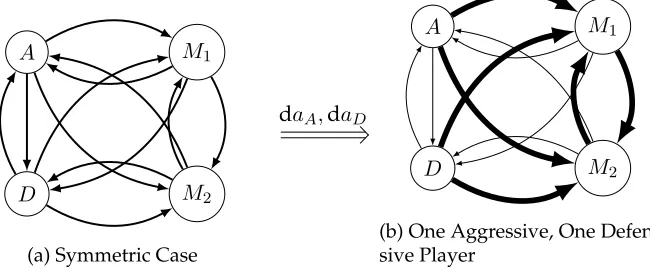
Figure 5 illustrates what happens in case one player becomes more aggressive (playerA), while
another reduces her efforts against her opponents (player D).17 The magnitude of the arrows
between players indicates the relative level of efforts.
Panel (a) of the figure represents the symmetric case in which all efforts (arrows) are of the same
magnitude. Choosing daAand daD such that the indicated changes in A’s andD’s effort follow,
we see in panel (b) that the two remaining players concentrate their efforts against each other.
17
A M1
D M2
(a) Symmetric Case
daA,daD
A M1
D M2
[image:22.612.139.464.80.218.2](b) One Aggressive, One Defen-sive Player
Figure 7: Diagrammatic Representation of Proposition 5 fork= 3
Note: The size of the arrows refers to the relative amount of resources allocated in each bilateral conflict. Throughout the rest of the paper, numbers will indicate numerical observations, while different sizes of arrows indicate actual
results.
Given a specific level of costs that is prohibitive (or a strict budget constraint), efficiencies become
a scaling factor of effective budgets. Since after applying the change it must be that eitheraA> aD
or aA < aD, one can interpret the above figure in terms of the fight of rich against the poor.
The prediction of the model at hand is that conflict intensity contracts towards the mediocrely
endowed individuals and away from the rich and the poor. If efficiency is a measure of strength,
the model suggests that the weaker players will rather fight each other in a situation where a
single player is stronger than the rest. While Bandwagoning in typically needs the weak to rally
behind the strong player who in turns fights them less/ceases to fight them, Balancing (i.e. the
weak teaming up to oppose the strong) is not the strategically optimal behaviour.
While any change in efficiencies bears a certain degree of symmetry with it, since∂ai is the same
for all(ij), a change in valuations induces more asymmetric strategic responses.
Proposition 6.
Fix somek-regular networkG. Letω′ = ω+ (1
ijǫ,0)for someω ∈ ΩandS = (I′, B′) ⊆ Gsuch that
Sis a complete network.18 There exists someǫ >0such thatω′ ∈V(ω)and the equilibriumx(ω′)for all
k∈ I′\{i, j}satisfies
xij(ω′)> xs> xik(ω′)
xjk(ω′)> xs> xji(ω′)
xkj(ω′)> xs> xki(ω′)
(5)
18
In network terms:Sis a subgraph ofGinduced by the cliqueI′
Furthermore, if we define∆xlq =xlq−xs, we have
∆xij >∆xjk,∆xkj (6)
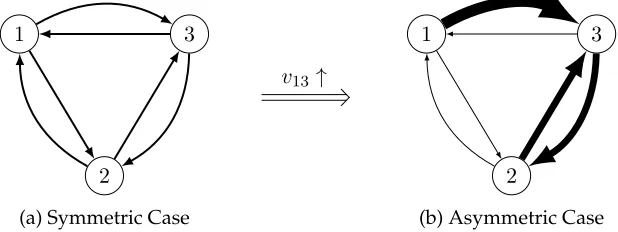
Figure 8 exemplifies this statement for the case of three players.
The effect of increasing player1’s value on her effort level against player 3 is intuitive. The effects
on playerj’s and all playerk’s efforts are less obvious. Roughly speaking, the effect of increasing
vij has a first-order effect only on player i’s effort levels and a second-order effect on all other
players. This is due to how the values feed into the players’ payoffs. While each own valuation
has a direct effect on her payoff, it can only affect other players’ payoffs through the strategic
channel. That is, the fact that even ‘impartial’ players change their equilibrium effort in case of a
change in some other player’s values is a result of the interdependencies of battlefields.
1 3
2
(a) Symmetric Case
v13↑
1 3
2
[image:23.612.143.452.362.478.2](b) Asymmetric Case
Figure 8: Diagrammatic Representation of Proposition 6 fork= 2
The behaviour of the preceding proposition, graphically depicted in Figure 8 is an even clearer
prediction of Bandwagoning behaviour as opposed to Balancing. Player 1 attacks player 2 more
aggressively and thus fights player 2 considerably less. Player two in turn does the same and
so they end up fighting player 3 jointly. Interpreting a high valuation as strength is a common
interpretation in the contest literature.19 This result could equally well be described as a form of
bullying, where one individual decides to bully a peer and so-called bystanders follow the bully
and become hacks. The fact that significant shares of adolescents are observed to behave in that
matter is well-established in social psychology (see for example Craig and Pepler (1998), O’connell
et al. (1999) and Salmivalli et al. (1996)).
3.2 Network Structure and Degree Asymmetry
The preceding comparative statics can be interpreted in terms of a strong player affecting the
whole network. So far we have looked at strength by considering the preference and technology
parameters. The degree centrality of a player ( i.e. the number of links she has to other players) is
another measure we could explore with that interpretation. Though we are leaving the realm ofk
-regular networks here, some of the symmetry features and the associated intuition are important
in these discrete comparative statics as well.
Example 2(Relative Network Structure).
Consider a budget-constrained setting in which every player has an endowment equal to one and faces
battlefields with the same valuev¯in each conflict. We introduce asymmetries solely a single player’s degree.
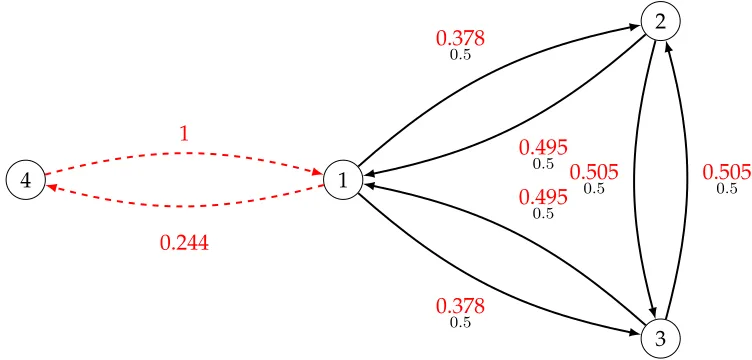
There are4players and one of them faces rivals with different degree.
4 1
2
3 1
0.244
0.378
0.5
0.495
0.5
0.495
0.5
0.378
0.5
0.505
[image:24.612.104.480.342.522.2]0.5 0.5050.5
Figure 9: Example asymmetry due to the network structure with budget constraint
Note: Red figures indicate efforts when player 4 is linked to player 1. Black figures give the efforts when only players 1,2 and 3 are connected to each other.
In this network, player 1 chooses the same efforts against players2 and3. From her perspective these
two players are identical. Player4differs from them as she puts all her resources on(14). For player1this
means that the probabilityp12is bounded by above by1/2. Comparing this to our earlier results, it seems
that the number of rivals is weakening player 1on each battlefield. If the value on(14)is also given byv¯
though, her expected payoff in the 4-player game is higher than in the 3-player game (1.062¯v >v¯).
How many rivals a player’s rival has thus acts as another measure of strength. There is two
a symmetric parametrisation, every player allocates a strictly positive amount of resources to all
her battlefields. That implies that if the amount of battlefields that she is involved in increases,
her efforts can be no greater than with fewer battlefield. However, the way that she is going
to decrease them depends on the characteristics of her rivals and their rivals. To understand
how these forces interact with each other, we consider a simple environment with strict budget
constraint equal to one and a network that exhibit high asymmetry in the players’ degrees. One
such structure is the star network. The periphery players (p) allocate all their resources against the
central player (iorj) and the central player allocate the same amount of resources against all her
rivals, d1i or d1j.
i
p
p p
p
j
p
p p
p
p
0.165
0.25
0.165
0.25
0.165
0.25
0.165
0.25
0.135
0.2
0.135
0.2
0.135
0.2
0.135
0.2 0.135
0.2
0.34
[image:25.612.127.467.263.405.2]0.322
Figure 10: Star networks of order5(left) and6(right).
The effect of the own degree is straightforward. The central players allocate resources inversely
proportional to their degrees. In the star network of order5for allp ∈ Ni we havexip = 14 and
for the star network of order 6 for all p ∈ Nj we have xjp = 15. In order to create some extra
variance in terms of the degree distribution while we keep the setting tractable, we joint the two
stars by adding a link between the two central players, as it is shown in Figure 10 by the dashed
line. In this casexij = 0.34,xip = 0.165,xji = 0.322andxjp = 0.135. Even though playerj has
the opportunity to win a prizes on one more battlefield than playeri, their payoffs are almost the
same (Ui = 1.080 > 1.081 = Uj) compared to the case where both star networks are in isolation
(Ui = 0.800 < 0.833 = Uj). This example shows that the number of battles a player is involved
can weaken her. Indeed, the pressure made by the rivals of my rivals is beneficial orthe enemy of
my enemy is(or at least can be)my friend.
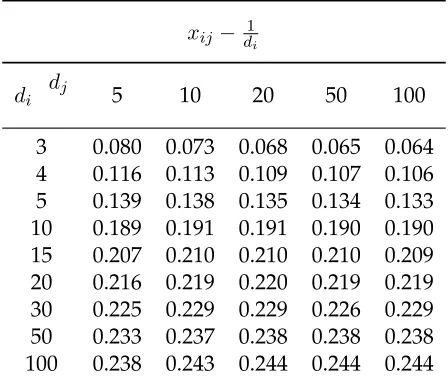
To understand the magnitude of this effect we can compare the equilibrium allocation with the
strategy coming from the heuristic d1i for different combinations ofdianddj, as it is presented in
equilib-xij −d1i
di dj 5 10 20 50 100
[image:26.612.185.409.73.264.2]3 0.080 0.073 0.068 0.065 0.064 4 0.116 0.113 0.109 0.107 0.106 5 0.139 0.138 0.135 0.134 0.133 10 0.189 0.191 0.191 0.190 0.190 15 0.207 0.210 0.210 0.210 0.209 20 0.216 0.219 0.220 0.219 0.219 30 0.225 0.229 0.229 0.226 0.229 50 0.233 0.237 0.238 0.238 0.238 100 0.238 0.243 0.244 0.244 0.244
Table 1: Network comparative statics
rium strategies is always positive. This means that the amount of resources allocated to the rival
(i.e.j) with higher degree is always higher. Indeed, even thoughdiincreases for a givendj we
ob-serve a non-linear relation where the marginal increase has a decreasing effect over the difference.
This exercise suggests that in settings in which we can isolate the effect of own degree and rivals
degree, there is an initial effect related to the opponents’ degree leading playerito allocate more
resources against her. However, the changes in the magnitude are negligible with respect to the
rival’s degree changes.
4
Conclusion
We presented a model of conflict networks, focussing on heterogeneity of parameters and changes
in individual behaviour. Existence and uniqueness are discussed in a framework that
accommo-dates convex costs and budget constraints. In this framework it is possible to obtain comparative
statics with respect to effort efficiency, valuations and – in a more discrete fashion – the degree of
centrality of a player. We interpreted these results in terms of Bandwagoning – following a strong
player against her opponents – and Balancing – many weak(er) players joining forces to oppose a
strong(er) player.
The results seem to advocate Bandwagoning over Balancing, irrespective of the kind of strength
we consider. Since part of these considerations also have to do with threats that are dynamic in
nature, a full discussion of the two phenomena needs a model with multiple periods of
Endogenous network formation seems to be the natural next step, as strength should be at the
heart of the consideration with whom to start a fight. Since for standard methods like backward
induction, this requires to pin down payoffs, this is a technical challenge.
Providing the players with a conflict technology only, makes it hard to talk about the potential for
peace in this framework. Mutli-graph theory allows for two separate networks, one with conflict
and one with cooperative links. The opportunity costs of conflict generated by the opportunity of
cooperation can add a new perspective to this line of research. There is a recent, special interest
in this type of settings, following the work by Jackson and Nei (2015), Hiller (2017), and K ¨onig
et al. (2017). However, due to the complexity of applying multiple networks simultaneously, these
model either focus on endogenous network formation without an explicit allocation stage or on
unidimensional action spaces over an exogenous multi-layer network.
Finally, with sufficiently simple networks, it is possible to test how real entities behave under
cer-tain parameter constellations. First steps have been made in that direction, but there are many
References
BOREL, E. (1921): “La th´eorie du jeu et les ´equations int´egrales `a noyau sym´etrique. Comptes
rendus de l’Acad´emie des Sciences, 173(1304-1308), 58; English translation by Savage, L. (1953)
The theory of play and integral equations with skew symmetric kernels,”Econometrica, 21, 97–
100.
BOREL, E.ANDJ. VILLE(1938):Application de la theorie des probabilities aux jeux de hasard, reprinted in Borel E., Cheron, A.: Theorie mathematique du bridge a la portee de tous, Paris: Gauthier-Villars:
Paris: Editions J. Gabay, 1991 ed.
BOURLES` , R., Y. BRAMOULLE´, ANDE. PEREZ-RICHET(2017): “Altruism in networks,” Economet-rica, 85, 675–689.
CRAIG, W. M.ANDD. J. PEPLER(1998): “Observations of bullying and victimization in the school yard,”Canadian Journal of School Psychology, 13, 41–59.
DEBREU, G. (1952): “A social equilibrium existence theorem,”Proceedings of the National Academy
of Sciences, 38, 886–893.
DZIUBINSKI´ , M., S. GOYAL, AND D. E. MINARSCH (2017): “The Strategy of Conquest,” Cam-bridge Working Papers in Economics 1704.
DZIUBINSKI´ , M., S. GOYAL,ANDA. VIGIER(2016): “Conflict and Networks,” inThe Oxford
Hand-book of the Economics of Networks, ed. by Y. Bramoull´e, A. Galeotti, and B. Rogers, Oxford
Univer-sity Press.
FAN, K. (1952): “Fixed-point and minimax theorems in locally convex topological linear spaces,”
Proceedings of the National Academy of Sciences, 38, 121–126.
FRANKE, J. AND T. ¨OZTURK¨ (2015): “Conflict networks,”Journal of Public Economics, 126, 104 – 113.
FRIEDMAN, L. (1958): “Game-theory models in the allocation of advertising expenditures,” Oper-ations Research, 6, 699–709.
GLICKSBERG, I. L. (1952): “A Further Generalization of the Kakutani Fixed Point Theorem, with
Application to Nash Equilibrium Points,” Proceedings of the American Mathematical Society, 3,
GOCHMAN, C. S. ANDZ. MAOZ(1984): “Militarized interstate disputes, 1816-1976: Procedures, patterns, and insights,”Journal of Conflict Resolution, 28, 585–616.
GOYAL, S., J. L. MORAGA-GONZALEZ´ , AND A. KONOVALOV (2008): “Hybrid R&D,”Journal of
the European Economic Association, 6, 1309–1338.
GROSS, O.ANDR. WAGNER(1950): “A continuous Colonel Blotto game,” Working Paper RM-424. RAND Corporation, Santa Monica.
HARBOM, L., E. MELANDER,ANDP. WALLENSTEEN(2018): “Dyadic Dimensions of Armed
Con-flict, 1946–2007,”Journal of Peace Research, 45, 697–710.
HART, S. (2008): “Discrete Colonel Blotto and general lotto games,”International Journal of Game Theory, 36, 441–460.
HILLER, T. (2017): “Friends and enemies: a model of signed network formation,”Theoretical Eco-nomics, 12, 1057–1087.
HIRSHLEIFER, J. (1995): “Theorizing about conflict,”Handbook of defense economics, 1, 165–189.
HOBBES, T. (1998): “Leviathan,”Oxford: Oxford University Press, 21, 111–143.
HORTALA-VALLVE, R.ANDA. LLORENTE-SAGUER(2012): “Pure strategy Nash equilibria in
non-zero sum colonel Blotto games,”International Journal of Game Theory, 41, 331–343.
HUREMOVIC, K. (2016): “A Noncooperative Model of Contest Network Formation,” AMSE Work-ing Papers 21. Aix-Marseille School of Economics.
JACKSON, M. O. AND S. NEI (2015): “Networks of military alliances, wars, and international
trade,”Proceedings of the National Academy of Sciences, 112, 15277–15284.
KLOSE, B. AND D. KOVENOCK (2015): “The all-pay auction with complete information and
identity-dependent externalities,”Economic Theory, 59, 1–19.
K ¨ONIG, M. D., D. ROHNER, M. THOENIG,ANDF. ZILIBOTTI(2017): “Networks in conflict: The-ory and evidence from the great war of africa,”Econometrica, 85, 1093–1132.
KONRAD, K. A. (2009):Strategy and dynamics in contests, Oxford University Press.
KOVENOCK, D. ANDB. ROBERSON(2012a): “Coalitional Colonel Blotto games with application
——— (2012b): “Conflicts with multiple battlefields,” inOxford Handbook of the Economics of Peace
and Conflict, ed. by M. R. Garfinkel and S. Skaperdas, Oxford University Press, 266–290.
KOVENOCK, D., S. SARANGI, AND M. WISER (2015): “All-pay 2\ times 2 Hex: a multibattle
contest with complementarities,”International Journal of Game Theory, 44, 571–597.
LASLIER, J.-F. (2002): “How two-party competition treats minorities,”Review of Economic Design, 7, 297–307.
LIEBER, K. A.ANDG. ALEXANDER(2005): “Waiting for balancing: Why the world is not pushing
back,”International Security, 30, 109–139.
LINSTER, B. G. (1993): “A generalized model of rent-seeking behavior,”Public choice, 77, 421–435.
MACDONELL, S. T.ANDN. MASTRONARDI(2015): “Waging simple wars: a complete
characteri-zation of two-battlefield Blotto equilibria,”Economic Theory, 58, 183–216.
MAOZ, Z. (2010): Networks of nations: The evolution, structure, and impact of international networks, 1816–2001, Cambridge University Press.
MATROS, ALEXANDER, A. AND D. M. RIETZKE (2018): “Contests on Networks,” Economics
Working Paper Series. Lancaster University.
MYERSON, R. B.ANDK. W ¨ARNERYD(2006): “Population uncertainty in contests,”Economic The-ory, 27, 469–474.
O’CONNELL, P., D. PEPLER, ANDW. CRAIG(1999): “Peer involvement in bullying: Insights and
challenges for intervention,”Journal of adolescence, 22, 437–452.
P ´EREZ-CASTRILLO, J. D. AND T. VERDIER (1992): “A general analysis of rent-seeking games,”
Public Choice, 73, 335–350.
PETTERSSON, T. ANDK. ECK(2018): “Organized violence, 1989–2017,”Journal of Peace Research, 55.
ROBERSON, B. (2006): “The colonel blotto game,”Economic Theory, 29, 1–24.
ROBSON, A. W. (2005): “Multi-item contests,” Working Paper 1885-42587. Australian National
SALMIVALLI, C., K. LAGERSPETZ, K. BJORKQVIST¨ , K. ¨OSTERMAN, ANDA. KAUKIAINEN(1996): “Bullying as a group process: Participant roles and their relations to social status within the
group,”Aggressive behavior, 22, 1–15.
SANDLER, T. (2000): “Economic analysis of conflict,”Journal of Conflict Resolution, 44, 723–729.
SCHWELLER, R. L. (1994): “Bandwagoning for profit: Bringing the revisionist state back in,” In-ternational Security, 19, 72–107.
SKAPERDAS, S. (1996): “Contest success functions,”Economic theory, 7, 283–290.
THOMAS, C. (2018): “N-dimensional Blotto game with heterogeneous battlefield values,” Eco-nomic Theory, 65, 509–544.
TULLOCK, G. (1980): “Efficient rent seeking,” inToward a theory of the rent-seeking society, ed. by
J. M. Buchanan, R. D. Tollison, and G. Tullock, College Station, TX: Texas A&M University Press,
97–113.
UCDP (2018): “Uppsala Conflict Data Program,” Last visited 07/11/2018.
VOJNOVIC, M. (2016):Contest Theory - Incentive Mechanisms and Ranking Methods, Cambridge
Uni-versity Press.
WALT, S. M. (1987):The Origins of Alliance, Cornell University Press.
WALTZ, K. N. (1979):Theory of International Politics, McGraw-Hill.
——— (1997): “Evaluating theories,”American Political Science Review, 91, 913–917.
Appendix
Proofs
For ease of notation, throughout the appendix, let us state the first order conditions and the
corre-sponding Hessian as primitives to the proofs. For eachi∈ I we have
Fij =
∂p(aixij, ajxji)
∂xij
aivij −C′(Xi) = 0 ∀j∈Ni (7)
The HessianH is then a block-symmetric matrix for which each diagonal block associated with
some playeri’s first order condition is given by
Hi= [hi]lq =
∂2p(a
ixij,ajxji)
(∂xij)2 a
2
ivij −C′′(Xi) ifl=q
−C′′(Xi) else
(8)
Each off-diagonal block in rowiand columnjobtains as
Oij = [oij]lq =
∂2
p(aixij,ajxji)
∂xij∂xji aiajvij ifl=i∧q=j
0 else (9)
Note thatOijT =−vij vjiOji.
Proofs from the main text
Proof of Proposition 1. The proof proceeds in three steps. First, we will show that a pure strategy
equilibrium exists for all ω ∈ Ω. Then, by means of contradiction, we show that every such
equilibrium must be strictly interior and thus be defined by the system of first order conditions
F as defined in 7. Finally, we show that the Jacobian of this system has a constant (positive)
sign across Ω. By application of the implicit function theorem (IFT) this implies that an open
neighbourhood around everyω∈Ωexists in whichx(ω)is unique.
Claim 1.
Proof.
Applying the well-known theorems due to Debreu (1952), Fan (1952) and Glicksberg (1952), the
result follows from making the following assertions. The game with the CSF defined in 1 is a
continuous game with a finite set of players. The utility functions are strictly concave (and thus
quasi-concave) if and only if
C′′(Xi)> Q
j∈Nip
11
ijvij P
k∈Ni Q
l6=kp11ilvil
Whenever di is odd, the numerator is negative and the denominator is positive and vice versa
for di even. SinceC′′(Xi) ≥ 0 for all Xi ∈ R+, this conditon is always fulfilled and the claim
follows.
Lemma 3.
In any equilibrium we haveRi> xij >0andRj > xji>0for all(ij)∈B.
Proof.
In the pure cost case we assertedRito be “sufficiently” high. For some playeriwithdi= 1this
meansRiis such that
C′(Ri)> p1ijvij
Such anRi ∈R++always exists.
The rest of the proof of the lemma will proceed in two steps.
Claim 2.
Any strategy profile withxij =xji = 0for any(ij)∈Bcan never be an equilibrium.
Proof.
Playerican increase her utility by a (almost)20discrete amount while increasing her costs by an
infinitesimal increment. This is a profitable deviation.
Claim 3.
Any strategy profile withxij >0andxji= 0for any(ij)∈Bcan never be an equilibrium.
20
Proof.
Suppose not and consider let playeri’s strategy profile be given by Xi = (xi1, ..., xij, ..., xini).
Now consider the alternative profile x′
i which is such that x′ij = xij −ǫ > 0. The probability of winning on (ij) is still (sufficiently close to) 1 and costs have reduced, thus it constitutes a
profitable deviation. A contradiction.
Claim 4.
For everyω∈Ωwe havedet(H)>0.
Proof.
The general formula fordet(Hi)obtains as
det(Hi) =
Y
j∈Ni
p11ijvij
−C′′(Xi)
X
j∈Ni Y
l6=j
p11ilvil
Note that this also applies to any principal minor of Hi (and their principal minors and so on)
simply by summing and taking products over a strict subset ofNi.
Besides the diagonal blocks,His a sparse matrix with only one (potentially) non-zero element in
eachOij. The determinant can thus be expressed as the sum of the determinant of the diagonal
matrix and the additional possible permutations with the respective rows.
In order to do so, let the set of all such permutations be denoted Sn with typical element σ. It
contains all sets of(ij)∈B that correspond to the additional row permutations. As a last piece of
notation we introduce Hi(σ)which is the submatrix ofHi obtained by deleting all cofactors(jj)