Munich Personal RePEc Archive
Should Jurors Deliberate?
Guha, Brishti
Jawaharlal Nehru University
1 June 2017
Online at
https://mpra.ub.uni-muenchen.de/79876/
Should Jurors Deliberate?
Brishti Guha1
Abstract
Does the accuracy of verdicts improve or worsen if individual jurors on a panel are barred from deliberating prior to casting their votes? I study this question in a model where jurors can choose to exert costly effort to improve the accuracy of their individual decisions. I find that, provided the cost of effort is not too large, there is a threshold jury size above which it is better to allow jurors to deliberate. For panels smaller than this threshold, it is more effective to instruct jurors to vote on the basis of their private information, without deliberations, and to use a simple majority rule to determine the collective decision (regardless of the voting rule used with deliberations). The smaller the cost of paying attention, the larger the threshold above which the switch to allowing deliberations becomes optimal. However, if the unanimity rule had to be maintained under the no-deliberations system, it would be better to allow deliberation. The results apply to binary decision making in any committee where the committee members incur some effort in reviewing the evidence. Examples are tenure and promotion committees and some board of director meetings on issues such as whether to dismiss a CEO.
Keywords: Jury deliberations, free riding, costly attention, secret voting, committees.
JEL Classification: D82, D71, D72, H4.
1. Introduction
Jury deliberation is a feature of most modern jury trials. Jurors are given elaborate instructions on how to deliberate, and the process is, at least in theory, shrouded in secrecy. However, there are also instances of jury trials where jurors are explicitly forbidden to deliberate. Instead, they are asked to cast their votes in secret, without consultation, and the collective decision is taken by applying the simple majority rule to the votes cast – much like the procedure followed in elections. This is the case in Brazil – where a panel of seven jurors is used for criminal trials and
1
verdict is based on simple majority (Leib, 2007) – and was also historically the case in classical Athens (Guha 2011, Hansen 1991)2. Each juror was given a hollow disc and a solid one, and cast their votes by choosing which of these discs to insert into a bronze urn, in such a manner that no one could observe which disc they had inserted (the other disc was discarded in a wooden urn so
that other jurors could not infer one’s vote by examining the remaining disc). The judgment was
made through counting the number of solid versus hollow discs in the bronze urn after all votes had been cast, and votes were aggregated using a simple majority rule (in later jury trials, the number of jurors was odd to avoid a hung jury3). The trial was settled in the course of one
working day (nine and a half hours) during which jurors did not communicate or leave the courtroom. Thus, there was scant opportunity to share information and no pressure to do so.
This triggers the question of whether it is better – in terms of the accuracy of the final verdict
– to bar deliberations among the members of the jury, or to allow them. I investigate this question using a simple model that involves costly juror effort; each juror chosen for a panel may simply sit through the trial without paying attention; alternatively, he may pay attention, at a cost, dramatically improving the accuracy of his individual votes. I find that to improve the accuracy of jury verdicts, it is optimal to allow deliberation in large jury panels, but to bar deliberations in smaller panels – provided that when jurors vote without deliberations, the decision rule is simple majority. This result holds provided the cost of paying attention is not too large. The smaller the cost to paying attention, the larger the zone over which deliberations should be barred.
Intuitively, this result stems from an interplay of three forces – the temptation to free ride on
other jurors’ efforts rather than pay attention oneself, the fact that deliberations allow
information pooling for a given probability of paying attention, and the differential rate at which the probability of being pivotal declines in jury size with and without deliberations (it decreases more sharply in the latter regime). As explained in detail in a later sub-section, the first force, free riding, is a more severe problem if deliberations are allowed, while the second and third forces tend to favor permitting deliberations in the interests of a more accurate verdict. The first
2
While McCannon (2011) also examines jury trials in ancient Athens, he does not focus on the secret ballot aspect, but derives optimal jury size assuming that it is costly to assemble jurors.
3
force is stronger than the second and third forces when jury size is below a threshold, and is overwhelmed by them at larger jury sizes, triggering the result.
If, however, a unanimous rule has to be used even when jurors are not allowed to deliberate, I find that deliberations should not be barred. Moreover, it is possible that jurors themselves may prefer deliberations, even if deliberating were to reduce the probability of delivering a correct verdict.
While I focus on the example of jurors, the results of the model also apply to committees where a binary decision has to be made after all the group members review (the same) evidence. Examples could be tenure and promotion committees. Some board of director meetings also involve making binary decisions, such as whether to dismiss or retain a CEO. Moreover, members of such committees have to devote some effort to effectively review the evidence; they may choose to be inattentive at this stage, instead. Then, the question answered by the paper would be whether members of such committees should vote without deliberating, and their votes be aggregated to determine the overall decision, or whether they should consult each other prior to a decision. Obviously, this question is of importance because even after a fixed committee has been finalized, varying the decision procedure by encouraging or barring deliberations is likely to be an option.
Coughlan (2000) shows that jurors receiving private signals will vote sincerely – fully revealing private information – when they can share information prior to casting the final vote, by conducting a non-binding “straw poll”. Thus, Coughlan finds that deliberation in this sense is beneficial. Austen-Smith and Fedderson (2006) show that if jurors have different preferences, deliberation may not lead to sincere voting; though it may do so if a majority voting rule is used, it will not do so if a unanimity rule is used. Intuitively, the jurors have strategic incentives to distort their information because of their different objectives. These two papers are somewhat similar to mine in that they touch, although indirectly, on the issue of barring versus allowing deliberations. However, they differ from my paper in several key respects. First, in neither of them do jurors find it costly to pay attention. By incorporating this motive, I can consider the
differential incentives of the jurors to free ride on other jurors’ efforts in both regimes (with and
without deliberations). Thus, unlike Coughlan, I find that it is better to bar deliberations for a
Fedderson, jurors in my model have identical preferences. Moreover, my result that there is a threshold jury size at which it becomes optimal to switch from a no-deliberations regime to one allowing deliberations, is unique. Neither of these papers relates the optimality of deliberations to the size of the jury panel.
Models with costly juror participation include Mukhopadhyaya (2003) and Guha (2016). The first of these focuses on optimal jury size when deliberation is a part of jury trials, and shows that small panels generally work best. The second derives implications for optimal jury size when ballots are secret and uninformed jurors are more likely than not to make mistakes. Instead of focusing on optimal jury size, the current paper looks at whether, given a certain jury size, allowing or barring deliberations will result in a more accurate verdict. Models where individual decision makers in a group may incur effort or informational costs, affecting group outcomes, include Martinelli (2006), Koriyama and Szentes (2009), Cai (2009), and Triossi (2013). In McCannon and Walker (2016), jurors endogenously choose to invest in acquiring “competence”
and can free ride on each other’s investments. More generally, the Condorcet jury theorem has spawned a vast literature, which does not necessarily consider costly participation. A strand of the literature which examined the assumption that voters may not vote sincerely (but may take their probability of being pivotal into account) includes Austen-Smith and Banks (1996), Fedderson and Pesendorfer (1998), and Persico (2004). The two latter papers looked at the effectiveness of supermajority rules versus simple majority rules when different jurors receive independent signals and vote strategically.
Another strand in the literature has focused on modeling jury deliberation. Neilson and Winter (2008) model a process of protracted deliberations, in which the same jurors can vote several times, and can influence the opinions of other jurors regarding a continuous variable, the strength of evidence against the defendant. Deliberations stop only when further deliberation
does not produce any change in the individual jurors’ beliefs. Luppi and Parisi (2013), while
investigating the effect of jury size on the frequency of hung jury rates, model juror deliberation in terms of information cascades. In their model, each juror sequentially states his opinion, and the next juror places only some weight on his own opinion, while also giving weight to the
average opinion expressed by the jurors who preceded him. The weight given to others’ opinions
(2008) also model jury deliberation and its effect on the optimal size of the jury. Hummel (2012) shows that the Condorcet theorem continues to hold if jurors differ in their preferences, provided each juror shares preferences with a small fraction of other jurors. Helland and Raviv (2008) show that if jurors receive independent signals which they truthfully reveal in an open vote, and jury deliberation follows a random walk, then the number of jurors has no effect on the correctness of the decision. The psychology literature has also studied jury deliberation, with some (eg Salerno and Diamond 2010) arguing that group recall may actually be worse when the group deliberates – because individuals who remember facts wrongly make others with accurate memories unsure – than when individual members of the group vote without deliberation.
Finally, some other work discusses the effects of communication in committees. For example, Buechel and Mechtenburg (2016) show that when some members on a committee are uninformed, while others (experts) receive an imperfect signal and may advise the non-experts; communication prior to voting may actually decrease informational efficiency.
Section 2 contains the models and results. The models without and with deliberations are laid out in sections 2.1 and 2.2, while section 2.3 derives the main result. Section 2.4 contains an intuitive discussion. Section 2.5 shows that the main result is qualitatively unaffected if jurors who pay attention cannot be sure of making the correct decision. Section 2.6 derives results for the unanimity rule, while section 2.7 contains a robustness check. Section 3 concludes.
2. Analysis
There are a total of n jurors on a panel. To eliminate the possibility of a hung jury, I focus on odd-sized panels. Each juror can choose to pay attention at a cost c, where 0<c<0.25. If he does so, he observes a perfectly informative signal that conveys the true state of the defendant’s guilt or innocence (I relax the assumption that the signal is perfectly informative in a later sub-section, section 2.5). The prior probability of the defendant being either guilty or innocent is ½: these priors are known to all jurors.4 An inattentive juror does not incur the cost of attention, but
neither does he receive a signal. Each juror obtains a benefit normalized to 1 if the panel, as a whole, reaches the correct verdict. If jurors are inattentive, and unable to free ride on the informational flows of other jurors, they vote according to the uninformative priors, pronouncing
4
the defendant to be either guilty or innocent with probability ½.5 Each juror’s utility function is given by U=p-σc where σ denote the probability that a juror pays attention, and p denote the probability of the jury panel reaching the correct verdict.
In both models below – with or without deliberation – I focus on symmetric mixed strategy equilibria in which jurors randomize between paying attention and sleeping during the trial (that is, for any two jurors I and J, we have 0<σI=σJ <1). I do this following Mukhopadhyaya (2003),
who argues that if jurors are identical, symmetric outcomes are more likely than asymmetric ones, since the latter would involve the problem of determining which jurors behave asymmetrically. (It can be easily shown that neither model has a symmetric pure strategy equilibrium where all jurors are attentive).
Had we focused instead on asymmetric pure strategy equilibria, we would have found one in the model without deliberation where a bare majority of jurors (exactly (n+1)/2 out of n) pays attention and delivers the correct verdict with probability 1 (see Guha (2016)) and one in the deliberation model where exactly one juror out of n pays attention, again delivering the correct verdict with probability 1. However, equilibrium selection is a real issue in both models. Since jurors do not communicate until after the trial, they have no way of co-ordinating on which juror (or, in the no-deliberation case, which subset of jurors) should pay attention. Even if such co-ordination were possible, this would raise issues of how to compensate the juror(s) paying attention. Thus, under the assumption that jurors do not, indeed, communicate before the trial, we focus on symmetric mixed strategy equilibria in both models.
2.1Secret voting and no deliberations
The model where jurors do not deliberate is adapted from the benchmark model of Guha (2016). For the present, I consider the case where a simple majority rule is used to aggregate the
individual jurors’ votes.
Lemma 1. Suppose there are no juror deliberations, votes are aggregated through simple
majority, and that n is no larger than the largest odd integer n* for which 𝑐 < (𝑛−1)!
(𝑛−12 )!(𝑛−12 )!2𝑛.
5
Then a unique symmetric mixed strategy equilibrium exists with each juror paying attention with
probability σND =√1 − 4𝜅2/(𝑛−1), where 𝜅 = (𝑛−1)!2𝑐
(𝑛−12 )!(𝑛−12 )!
.
Proof. Since jurors do not deliberate, an individual juror can receive the signal only if he pays attention. It is worthwhile for him to incur the cost of doing so only if his probability of being pivotal, and thus changing the collective outcome, is high enough. The probability of any one juror being pivotal is the probability that half of the other n-1 jurors vote correctly, while half vote incorrectly, so that there is a tie. Note that the probability of a juror voting correctly is the
sum of the probability that he pays attention (σ) and the probability that he is inattentive but
guesses correctly (1−𝜎
2 ). This sum is thus ( 1+𝜎
2 ), while the probability of a juror voting
incorrectly is the probability that he is inattentive and guesses incorrectly (1−𝜎
2 ). Thus, the
probability of being pivotal is
(𝑛−1)! (𝑛−12 )!(𝑛−12 )!(
1+𝜎
2 )(𝑛−1)/2( 1−𝜎
2 )(𝑛−1)/2 = 𝑃(𝑛, 𝜎(𝑛)) (1)
In the event of being pivotal, an individual juror would receive a benefit of 1 from paying attention, as by doing so, he votes correctly and ensures that there is a majority of correct votes, guaranteeing the correct verdict. If he does not pay attention, he can still expect a benefit of ½, as this is the probability that his uninformed vote will be correct (and thus also the probability that the verdict is correct). Therefore, his expected benefit from paying attention is ½ times the probability that he is pivotal, while his cost of doing so is c. In a mixed strategy equilibrium, his expected benefit must exactly equal his cost, so that
𝑃(𝑛,𝜎(𝑛))
2 = 𝑐 (2)
Solving (1) and (2), we then obtain the solution for σ, σND =√1 − 4𝜅2/(𝑛−1), given in the statement of the Lemma. Moreover, this solution is well-defined as long as the expression in the square root is non-negative, which is the case if 𝜅2/(𝑛−1) <1
4. From the definition of κ, this is
equivalent to the restriction that 𝑐 < (𝑛−1)!
(𝑛−12 )!(𝑛−12 )!2𝑛. As shown in Guha (2016), the RHS of this
satisfies this restriction. Moreover, this integer is at least 3, because the RHS of the restriction for n = 3 is ¼, and we always have c<1/4. It is clear that given n, σND is unique. QED
The probability that a correct verdict is made by the panel is the probability that at least (n+1)/2 jurors vote correctly, or
∑𝑛 𝑗!(𝑛−𝑗)!𝑛!
𝑗=(𝑛+1)/2 (1+𝜎2𝑁𝐷)𝑗(1−𝜎2𝑁𝐷)𝑛−𝑗 = 𝑝𝑁𝐷(𝑛) (3)
As shown in Guha (2016), and as our numerical examples will illustrate later, both σND and 𝑝𝑁𝐷decrease in jury size, n. Intuitively, a larger panel reduces the probability, fixing σ, that an individual juror will be pivotal, tending to reduce his expected benefit from paying attention below his cost of doing so. To restore the equality, and thereby induce him to pay attention with at least some probability, it is necessary that all the other jurors be less attentive when the panel size goes up, so that the probability that some of them are incorrect, resulting in a tie, increases – thus pushing up the pivotal probability again.
2.2 Jury deliberations
We now turn to the model with jury deliberations. In this model, jurors always pool information, so that having even one informed juror is sufficient to guarantee the correct verdict. This is so regardless of the voting rule – all uninformed jurors have the incentive to agree with the informed juror, as he knows the correct verdict for certain. This is similar to Mukhopadhyaya (2003). However, while he assumes that an incorrect decision is always made when no juror pays attention, I assume – to be consistent with the no-deliberation model – that when the panel lacks information (because all jurors were inattentive) it still deliberates and makes a correct verdict with probability ½, by a collective lucky guess. Thus, the expressions for the probability of
individual jurors’ paying attention, σD, and the probability of a correct verdict, pD, that I derive here differ from those derived in Mukhopadhyaya (2003).
Lemma 2. Suppose there are jury deliberations. Then a unique symmetric mixed strategy
equilibrium exists with 𝜎𝐷 = 1 − (2𝑐)1/(𝑛−1), and 𝑝𝐷 = 1 −1
Proof. Now, a juror expects to be pivotal only if no other juror is paying attention, so that, by paying attention, he can increase the probability of a correct verdict from ½ to 1.6 This pivotal probability is (1 − 𝜎)𝑛−1. Thus, his expected benefit from paying attention is half times this pivotal probability, which is then equated to his cost of paying attention: ½ (1 − 𝜎)𝑛−1 = 𝑐, yielding 𝜎𝐷 = 1 − (2𝑐)1/(𝑛−1). Note that the only event in which the panel makes the wrong verdict is if no juror pays attention and their collective guess is unlucky – an event which happens with probability ½ (1 − 𝜎𝐷)𝑛. Thus, the probability of reaching the correct verdict is 1-½ (1 − 𝜎𝐷)𝑛. Substituting in for 𝜎𝐷, this yields 𝑝𝐷 = 1 −1
2(2𝑐)𝑛/(𝑛−1). Given our restrictions
on c, both expressions are positive and less than 1, and both decrease in jury size, n. QED
Note that Lemma 2 is independent of the voting rule used: as long as one juror pays attention, all jurors pool information and vote according to the (perfectly accurate) information he supplies them with.
2.3A comparison
We now compare the case where jurors deliberate with the case where they do not. First, note that if there were just one juror, the issue is moot as deliberation has no meaning. We, therefore, restrict our attention to odd-sized jury panels with 3 or more jurors.
Proposition 1. The accuracy of a panel’s verdict where jurors are barred from deliberations, and the simple majority rule is used, is higher than the accuracy of the verdict of a panel where
jurors are instructed to deliberate, for panel sizes smaller than a threshold n(c)≥3, provided 0<c≤ .13, while allowing jury deliberations results in a more accurate verdict for larger panels. The threshold is decreasing in c.
Proof. Step 1. Here, we show that 𝑝𝐷 > 𝑝𝑁𝐷 for large n. As noted in Lemma 1, when deliberations are barred, jurors only pay attention for a finite panel, with a maximum of n* members. In a larger panel, no one would pay attention and so 𝑝𝑁𝐷 would fall to .5, the probability of a majority of the jurors guessing correctly. However, lim
𝑛→∞𝑝𝐷 = 1 − 𝑐 > .75
(given c<.25). Since 𝑝𝐷 is decreasing in n, its value is even higher for finite n>n*.
6
Step 2. Next, we show that when n = 3, 𝑝𝐷 < 𝑝𝑁𝐷 provided c≤ .13. Substituting in for the value of n and simplifying, we find that the condition that 𝑝𝐷(3) < 𝑝𝑁𝐷(3) is equivalent to
(1 + 2𝑐)√1 − 4𝑐 + 2𝑐√2𝑐 > 1 (4)
First, note that the two sides of the inequality are equal when c = 0. While the RHS is invariant with respect to c, differentiation reveals that the LHS is strictly increasing in c up to c = 1/12. Therefore, inequality (4) necessarily holds for this range of c. Beyond this value the LHS starts decreasing, but remains above the RHS until c = .13; beyond this value, it dips below the RHS, as shown in Fig 1. Thus, for a panel of 3 jurors, barring deliberations results in a higher probability of an accurate verdict, provided c≤ .13.
Step 3. Steps 1 and 2 establish that 𝑝𝐷 < 𝑝𝑁𝐷 at n = 3 and that 𝑝𝐷 > 𝑝𝑁𝐷 for n > n*. This proves that the functions 𝑝𝐷(𝑛) and 𝑝𝑁𝐷(𝑛) must cross each other an odd number of times.
Step 4. Here, we prove that the functions 𝑝𝐷(𝑛) and 𝑝𝑁𝐷(𝑛) must cross each other just once. Suppose, to the contrary, that they cross an odd number of times greater than 1. Note that the two functions are equal at n = 1(with a perfectly accurate judgment). Since 𝑝𝐷 < 𝑝𝑁𝐷 at n = 3, and since the two functions intersect at least once, by Step 3, the 𝑝𝐷(𝑛) function must have at least one point of inflection (which comes before the first intersection). For multiple odd intersections, the 𝑝𝐷(𝑛) function must have more than one point of inflection – given that 𝑝𝑁𝐷is monotonically decreasing in n. However, solving for 𝑝𝐷"(𝑛𝐼) = 0, where 𝑛𝐼 is a point of inflection, we find that this yields a unique inflection point, for a given value of c:
𝑛𝐼 = 1 + .25log (1
2𝑐) (5)
Thus, the functions must cross just once, proving the existence of a unique threshold, below which barring deliberations is more effective, and above which allowing deliberations results in a more accurate verdict.
function, is decreasing in c. As this function as a whole also shifts to the left with an increase in c, the intersection point also occurs at a lower value of n.
QED
We now look at examples for specific values of c.
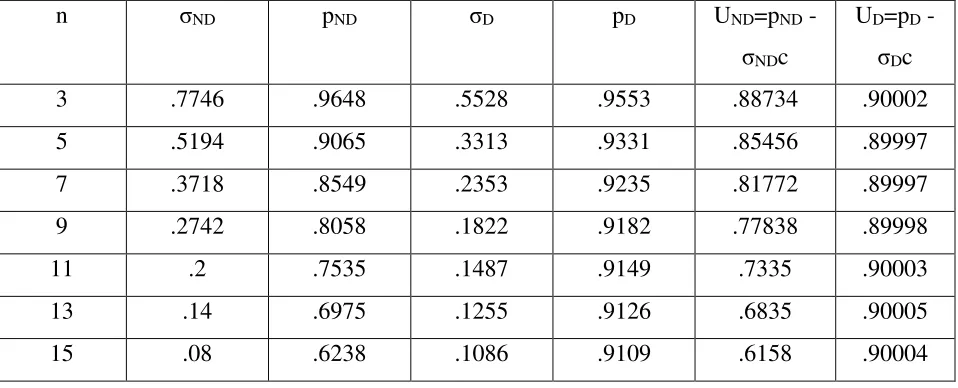
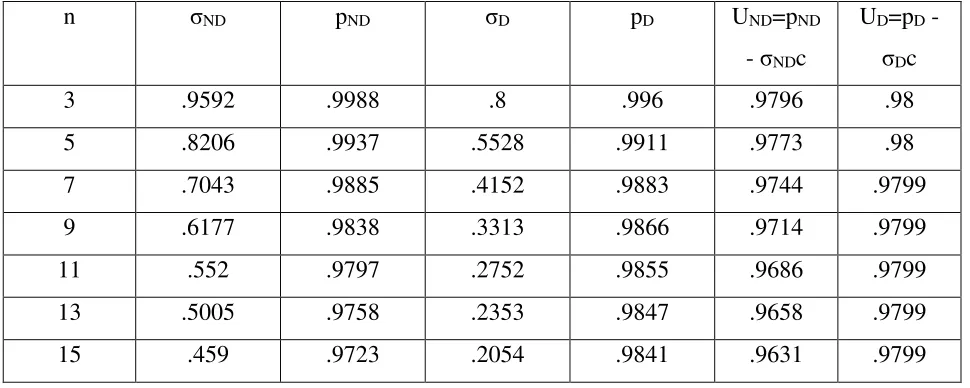
Fig 2 illustrates the behavior of 𝑝𝐷 and 𝑝𝑁𝐷 for c =0.1, while Fig 4 illustrates their behavior for c = 0.02. We see that in the first case, while 𝑝𝐷 < 𝑝𝑁𝐷for n =3, this inequality is reversed for n = 5 upwards, while in the second case the probability of a correct verdict remains higher in the no-deliberation case until the odd-sized jury panel exceeds 7 jurors. The corresponding probabilities of paying attention under deliberation and no deliberation (secret voting) are shown in Figs 3 and 5. Numerical values are given in Tables 1 and 2. The Tables also show U – the utility per juror, defined by U = p –σc – in the two models.
Remark 1. Though barring deliberations for a small panel results in more accurate verdicts in
both examples, jurors are happier (taking the cost of paying attention into account) when
deliberations are allowed.
Remark 2. If c>.13, it is better to allow jury deliberations to achieve a more accurate verdict.
Remark 2 is evident from Figure 1; for relatively high values of c, even at n = 3, we have 𝑝𝐷 >
𝑝𝑁𝐷. By (5), the 𝑝𝐷(𝑛) function has a unique inflection point, and so, if it were to cross the
𝑝𝑁𝐷(𝑛) function, it could only do so once. However, crossing once would imply that 𝑝𝐷 < 𝑝𝑁𝐷
for large n, which contradicts Step 1 of Proposition 1. Thus, the two functions do not cross and the 𝑝𝐷(𝑛) function lies uniformly above the 𝑝𝑁𝐷(𝑛) function for n>1.
2.4 Discussion and Intuition
Three distinct forces are at play in determining whether verdicts are more accurate with or without jury deliberation. First, deliberation opens up the possibility of free riding. This factor
tends to increase jurors’ incentives to pay attention when votes are secret and deliberation is not
to guarantee the correct verdict.7 Increased incentives to pay attention in turn tend to raise the probability of reaching a correct verdict when there is no deliberation. Secondly, there is information pooling with deliberation, but not without. This factor implies that for a given probability of paying attention, allowing deliberation tends to increase the probability of a correct verdict. Third, the probability of being pivotal decreases, for a given probability of paying attention, with a rise in the number of jurors. This is true both when deliberation is allowed – in which case the probability of being pivotal is the probability that the other n-1 jurors are inattentive – and when it is not, in which case the probability of being pivotal is given in equation (1). While this factor means that individual juror probabilities of paying attention decrease in jury size, both with and without deliberation, there is an upper limit n* in the case without deliberation, above which the probability of being pivotal is too small to make paying
attention worthwhile. However, if deliberation is allowed, there is no such upper limit (σD tends
to 0 only as n tends to infinity). Thus, this third factor implies that probabilities of being attentive, and therefore of reaching the correct verdict, decrease more dramatically with expanding jury size when deliberations are barred8.
While the first of these factors increases the effectiveness of panel verdicts when deliberations are barred, the second and third factors imply that allowing deliberation is more effective. We have already seen that the third factor is stronger in large jury panels than in small ones. So is the second. Consider what happens when deliberations are barred. If the jury panel is relatively small, the fact that jurors do not pool information does not matter much for the accuracy of the verdict, specially as, by the first factor, each individual juror has high incentives to be attentive. Thus, barring deliberations works better in small panels. The opposite is true in larger panels; with many jurors, the possibility that some may not acquire enough information to deliver a correct verdict increases, if information is not pooled. The second and third factors dominate the first in large panels. The intuition for the first factor prevailing over a larger jury
size when the cost of paying attention is small, is that in that case, individual jurors’ incentives to
be attentive remain high for a relatively large range of jury sizes. However, if the cost of paying
7
Thus, note that the probability of paying attention is consistently higher in the no-deliberation case in Table 2, and higher until n=13 in Table 1.
8
attention is high enough (as in Remark 2) the first factor is overwhelmed by the other two factors
as jurors’ incentives to pay attention remains relatively small even when there is no possibility of
free riding.
Finally, as Remark 1 shows, jurors themselves may prefer deliberations even when barring deliberations would have resulted in a higher probability of the correct verdict. Intuitively, this follows because deliberation lowers the need to pay attention, thus lowering
jurors’ costs from paying attention to a degree which offsets the lower probability of achieving a
correct verdict. However, it is not certain that jurors’ utility should be used as a criterion to decide whether to allow or bar deliberations, since the jury’s costs are not shared by the general public, while we may argue that society at large benefits from the justice system delivering correct decisions.
2.5Imperfect Signals
In this subsection, we extend the model to the case where even a perfectly attentive juror receives the correct signal only with probability q, where ½<q<1. Following the same reasoning as before, we concentrate on symmetric mixed strategy equilibria. We find that our results are qualitatively unchanged.
A1: c<2𝑞−1
4
With no deliberations, the probability of a juror being correct is now the sum of the probabilities that he is inattentive and makes a lucky guess, and that he is attentive and receives the correct signal. Thus, this sum is now 1+𝜎(2𝑞−1)
2 , while one minus this probability is the
probability that a given juror votes incorrectly. Moreover, if a juror were to be pivotal, being attentive would raise the probability of arriving at a correct verdict from ½ to q. Thus, instead of (1) and (2), we have
(𝑞 −12)(𝑛−1(𝑛−1)! 2 )!(𝑛−12 )!(
1+𝜎(2𝑞−1)
2 )
𝑛−1 2
(1−𝜎(2𝑞−1)2 )
𝑛−1 2
= 𝑐 (6)
Solving this, we find that with no deliberation and imperfect signals, each juror’s probability of paying attention is σND,I = 1
we can show that this is well-defined as long as 𝑐 < (𝑛−1)!(2𝑞−1)
(𝑛−12 )!(𝑛−12 )!2𝑛, and thus that the SMSE exists
up to some finite jury size n**, as the RHS of this restriction is decreasing in n. Moreover, A1 guarantees that n** is at least 3. The probability of reaching an overall correct verdict is now given by
∑𝑛 𝑗!(𝑛−𝑗)!𝑛!
𝑗=(𝑛+1)/2 (1+𝜎𝑁𝐷,𝐼2(2𝑞−1))𝑗(1−𝜎𝑁𝐷,𝐼2(2𝑞−1))𝑛−𝑗 = 𝑝𝑁𝐷,𝐼(𝑛) (7)
Here, the subscript I indicates that attentive jurors receive imperfect signals. Imperfect signals do not change the fact that the probability of paying attention and the probability of reaching an overall correct verdict are both decreasing functions of n.
With deliberations, a juror is pivotal only if none of the other jurors have been both attentive and received an accurate signal. The probability of any one juror being attentive and receiving an accurate signal is σq. Thus, a pivotal juror equates expected benefits and costs of paying attention:
(𝑞 −12) (1 − 𝜎𝑞)𝑛−1= 𝑐 (8)
This yields the probability of any one juror’s paying attention with deliberation and imperfect
signals as 𝜎𝐷,𝐼 = 1
𝑞[1 − ( 2𝑐 2𝑞−1)
1
𝑛−1]
. The probability of an overall correct verdict is one minus the probability that no juror is both attentive and receives the correct signal. Thus, we get 𝑝𝐷,𝐼 = 1 −
(2𝑞−12𝑐 )
𝑛 𝑛−1
. Given A1, both expressions are positive and decreasing in n.
We can now state a result that parallels Proposition 1.
Proposition 2. Suppose that attentive jurors receive imperfect signals. The accuracy of a panel’s
verdict where jurors are barred from deliberations, and the simple majority rule is used, is
higher than the accuracy of the verdict of a panel where jurors are instructed to deliberate, for
panel sizes smaller than a threshold n(c)≥3, provided 0<c≤ 2𝑞−1
6 , while allowing jury
deliberations results in a more accurate verdict for larger panels. The threshold is decreasing in
Proof. Step 1. Mimicking Step 1 of Proposition 1, we find that for large n, 𝑝𝐷,𝐼 > 𝑝𝑁𝐷,𝐼. With no deliberations, jurors stop paying attention when jury size exceeds n**, so that the overall accuracy of the verdict falls to ½, while lim
𝑛→∞𝑝𝐷,𝐼 = 1 − 2𝑐
2𝑞−1> 1/2, given A1.
Step 2. Mimicking Step 2 of Proposition 1, the condition for 𝑝𝐷,𝐼 < 𝑝𝑁𝐷,𝐼 for n = 3 is
2𝑐 2𝑞−1√
2𝑐 2𝑞−1+
1
2[1 + (1 + 2𝑐
2𝑞−1)√1 − 4𝑐
2𝑞−1 >1 (9)
Both sides of the inequality are equal at c = 0. Differentiation of the LHS with respect to c reveals that it is increasing for c≤ 2𝑞−1
6 . The RHS being invariant, (9) holds as a strict inequality
for this range of c.
Step 3. As in Step 3 of Proposition 1, Steps 1 and 2 establish that the functions 𝑝𝐷,𝐼(𝑛) and
𝑝𝑁𝐷,𝐼(𝑛) must cross each other an odd number of times.
Step 4. Mimicking Step 4 of Proposition 1, we establish a unique intersection by showing that the
function 𝑝𝐷,𝐼(𝑛) has a unique inflection point, which solves
𝑛𝐼 = 1 + .5log (2𝑞−1
2𝑐 ) (10)
Step 5. Here we mimic Step 5 of Proposition 1, noting that (10) is decreasing in c.
QED
So far, we have looked at cases where, when jurors vote without deliberations, the collective decision is made using the simple majority rule. What would happen if, instead, the unanimity rule were used in such circumstances? We demonstrate below that if unanimity were a requirement, barring deliberations would be inferior to allowing jurors to deliberate (we return to the benchmark case of perfect signals in the next subsection).
2.6The inferiority of barring deliberations if a unanimity rule is imposed
Proposition 3. Suppose a unanimity rule were used to aggregate individual jurors’ votes when they are barred from deliberating. The accuracy of the verdict of such a panel would then be
lower than the accuracy of a panel where jurors are instructed to deliberate.
Proof. Suppose the unanimity rule were imposed when votes were secret. An individual juror would be pivotal either if all other jurors voted correctly, or if all other jurors voted incorrectly. However, if all other jurors vote incorrectly, the nth juror would not benefit from paying attention: even if he were to do so and vote correctly with probability 1, he would not be able to affect the outcome, as the unanimity rule is used and as he cannot pool information and affect the
other jurors’ votes. Therefore, he would not bother to incur the cost of paying attention in this
event. If, on the other hand, all other jurors vote correctly, which happens with probability
(1+𝜎2 )𝑛−1, (the probability that each of these jurors is either attentive or lucky), the nth juror
expects a benefit of ½ by paying attention: if he does so, he too votes correctly, ensuring the correct outcome, while if he does not do so, he only votes correctly with probability ½. Equating the expected benefit and cost of paying attention, therefore, we have
1 2(
1+𝜎𝑁𝐷,𝑈
2 )𝑛−1= 𝑐 (11)
Here, the subscripts on σ denote the fact that deliberations are not allowed and the unanimity rule
is used. Note that we have 1+𝜎𝑁𝐷,𝑈
2 = 1 − 𝜎𝐷(from (11) and Lemma 2). Next, observe that the
𝑝𝑁𝐷,𝑈 = (1+𝜎2𝑁𝐷,𝑈)𝑛 = (2𝑐)𝑛/(𝑛−1) (12)
From Lemma 2, the probability of reaching the correct verdict when deliberations are allowed is
𝑝𝐷 = 1 −12(2𝑐)𝑛/(𝑛−1). Now, comparing this with (12), it is easy to show that 𝑝𝑁𝐷,𝑈 < 𝑝𝐷 is
equivalent to (2𝑐)𝑛/(𝑛−1) < 2/3. Given that c<0.25, this is always true. QED
2.7Robustness: different priors
In the models above, the prior probability of a defendant being either guilty or innocent is ½. However, it is possible that because of the way the justice system works, the fact that the defendant is up for trial implies a much higher probability of guilt, say r, where r>.5. Suppose, as before, that these priors were known to all jurors. Without including a full analysis of this case, we conjecture that the main results go through qualitatively. In particular, we have verified
that a symmetric mixed strategy equilibrium exists in the no-deliberation case with σND ={−2𝑟 +
1 + √1 − 4µ𝑛−12 } /2(1 − 𝑟), where µ=κ/2(1-r), if n is no larger than the largest odd integer n**
for which 𝑐 <(𝑛−1)!𝑟(𝑛−1)/2(1−𝑟)(𝑛+1)/2
(𝑛−12 )!(𝑛−12 )! . A symmetric mixed strategy equilibrium also exists in the
deliberation case, with 𝜎𝐷 = 1 − ( 𝑐
1−𝑟)1/(𝑛−1) and 𝑝𝐷 = 1 − (1 − 𝑟)( 𝑐
1−𝑟)𝑛/(𝑛−1). For the same
c, the probability of paying attention declines both with and without deliberation, when the prior
3.Conclusion
Using a simple model where jurors on a panel need to decide whether to incur costly effort to improve the quality of their individual decisions, I investigate the effect of allowing or barring deliberation between jurors on the accuracy of jury verdicts. I find that in relatively small jury panels, verdicts are more accurate if deliberations are barred and a simple majority rule is used to aggregate votes. However, in larger panels, it is better to allow deliberation (irrespective of the voting rule used under deliberation). The greater the cost of paying attention, the greater the value of allowing deliberations, and the smaller the threshold jury size above which it is more effective to allow deliberations. If there is a relatively small cost to paying attention, on the other hand, jurors even on a moderately sized panel (for example, one with seven jurors, as in criminal trials in Brazil) – should be instructed not to deliberate. If jurors who do not deliberate are restricted to use an unanimity rule, however, barring deliberations would always be harmful. A similar conclusion would hold if the cost of paying attention were too high. These results carry through to contexts outside jury trials, in particular committees which have to make binary decisions and where the members incur attention costs in reviewing evidence relevant to their decision. Thus barring consultation among the members of such committees may work better if the committee is small, and the cost of paying attention is also relatively low.
References
Austen-Smith, D. and J.S Banks (1996): “Information Aggregation, Rationality, and the Condorcet jury theorem”,
American Political Science Review 90:34-45.
Austen-Smith, D. and T.J Fedderson (2006): “Deliberation, Preference Uncertainty, and Voting Rules”, American Political Science Review 100:209-217.
Buechel, B and L. Mechtenburg (2016) “The Swing Voter’s curse in social networks,”, working paper.
Cai, H (2009): “Costly participation and heterogeneous preferences in informational committees”, RAND Journal of Economics 40:173-189.
Coughlan, P.J. (2000): “In defense of unanimous jury verdicts: mistrials, communication and strategic voting”,
American Political Science Review 94:375-393.
Fedderson, T. and W. Pesendorfer (1998): “Convicting the Innocent: the inferiority of unanimous jury verdicts
Guha, B (2011): “Preferences, prisoners and private information: was Socrates rational at his trial?” European Journal of Law and Economics 31:249-264.
Guha, B. (2016): “Secretballots and costly information gathering: the jury size problem revisited”, MPRA working paper #73048.
Hansen, M.H (1991): The Athenian democracy in the age of Demosthenes: structure, principles and ideology.
Oxford, UK and Cambridge, USA: Blackwell.
Helland, E. and Y. Raviv (2008): “The optimal jury size when jury deliberation follows a random walk”, Public
Choice 134:255-262.
Hummel, P (2012): “Deliberation in large juries with diverse preferences”, Public Choice 150: 595-608.
Koriyama, Y. and B. Szentes (2009): “A resurrection of the Condorcet jury theorem”, Theoretical Economics 4:227-252.
Leib, E.J (2007): “A comparison of criminal jury decision rules in democratic countries”, Ohio State Journal of Criminal Law 5:629-644.
Luppi, B. and F. Parisi (2013): “Jury size and the hung jury paradox”, Journal of Legal Studies 42: 399-422.
Martinelli, C (2006): “Would rational voters acquire costly information?” Journal of Economic Theory 129:225-251.
McCannon, B (2011): “Jury size in classical Athens: an application of the Condorcet jury theorem”, Kyklos 64:106-121.
McCannon, B. and P. Walker (2016): “Endogenous Competence and a Limit to the Condorcet Jury Theorem”, No
(16-12), Department of Economics, West Virginia University.
Mukhopadhyaya, K (2003): “Jury size and the free rider problem”, Journal of Law, Economics and Organization
19:24-44.
Neilson, W. and H. Winter (2008): “Votes based on protracted deliberations”, Journal of Economic Behavior and Organization 67:308-321.
Persico, N (2004): “Committee design with endogenous information”, Review of Economic Studies 71:165-191.
Salerno, J.M and S.S Diamond (2010): “The promise of a cognitive perspective on jury deliberation”, Psychonomic Bulletin and Review 17: 174-179.
Triossi, M (2013): “Costly information acquisition: is it better to toss a coin?” Games and Economic Behavior
Table 1: σ, p and U in the two models with c = 0.1
n σND pND σD pD UND=pND -
σNDc
UD=pD -
σDc
3 .7746 .9648 .5528 .9553 .88734 .90002
5 .5194 .9065 .3313 .9331 .85456 .89997
7 .3718 .8549 .2353 .9235 .81772 .89997
9 .2742 .8058 .1822 .9182 .77838 .89998
11 .2 .7535 .1487 .9149 .7335 .90003
13 .14 .6975 .1255 .9126 .6835 .90005
Table 2: σ, p and U in the two models with c = 0.02
n σND pND σD pD UND=pND
- σNDc
UD=pD -
σDc
3 .9592 .9988 .8 .996 .9796 .98
5 .8206 .9937 .5528 .9911 .9773 .98
7 .7043 .9885 .4152 .9883 .9744 .9799
9 .6177 .9838 .3313 .9866 .9714 .9799
11 .552 .9797 .2752 .9855 .9686 .9799
13 .5005 .9758 .2353 .9847 .9658 .9799