Automatic Semantic Classification of German Preposition Types:
Comparing Hard and Soft Clustering Approaches across Features
Maximilian K¨oper and Sabine Schulte im Walde
Institut f¨ur Maschinelle Sprachverarbeitung Universit¨at Stuttgart, Germany
{maximilian.koeper,schulte}@ims.uni-stuttgart.de
Abstract
This paper addresses an automatic clas-sification of preposition types in Ger-man, comparing hard and soft cluster-ing approaches and various window- and syntax-based co-occurrence features. We show that (i) the semantically most sali-ent preposition features (i.e., subcategor-ised nouns) are the most successful, and that (ii) soft clustering approaches are re-quired for the task but reveal quite differ-ent attitudes towards predicting ambiguity.
1 Introduction
In the last decades, an impressive number of se-mantic classifications has been developed, both regarding manual lexicographic and/or cognitive classifications such asWordNet(Fellbaum, 1998), FrameNet (Fillmore et al., 2003), VerbNet (Kip-per Schuler, 2006) and PrepNet/The Preposition Project (Litkowski and Hargraves, 2005; Saint-Dizier, 2005), as well as regarding computational classifications fornouns(Hindle, 1990; Pereira et al., 1993; Snow et al., 2006), verbs (Merlo and Stevenson, 2001; Korhonen et al., 2003; Schulte im Walde, 2006) andadjectives(Hatzivassiloglou and McKeown, 1993; Boleda et al., 2012).
Semantic classifications are of great interest to computational linguistics, specifically regarding the pervasive problem of data sparseness in the processing of natural language. Such classifica-tions have been used in applicaclassifica-tions such asword sense disambiguation(Dorr and Jones, 1996; Ko-homban and Lee, 2005; McCarthy et al., 2007), parsing (Carroll et al., 1998; Carroll and Fang, 2004),machine translation(Prescher et al., 2000; Koehn and Hoang, 2007; Weller et al., 2014), andinformation extraction(Surdeanu et al., 2003; Venturi et al., 2009).
Regarding prepositions, comparably little ef-fort in computational semantics has gone beyond a specific choice of prepositions (such as spa-tial prepositions), towards a systematic classifica-tion of preposiclassifica-tion senses, as in The Preposition Project (Litkowski and Hargraves, 2005). Dis-tributional approaches towards preposition mean-ing and sense distinction have only recently star-ted to explore salient preposition features, but with few exceptions (such as Baldwin (2006)) these ap-proaches focused on token-based classification of preposition senses (Ye and Baldwin, 2006; O’Hara and Wiebe, 2009; Tratz and Hovy, 2009; Hovy et al., 2010; Hovy et al., 2011).
This paper addresses an automatic classification of preposition types in German, comparing vari-ous clustering approaches. We aim for an unsuper-vised setting that does not require predefined ex-pensive resources, such as a token-based annota-tion of preposiannota-tion senses. Our task is challenging, because (i) prepositions are notoriously ambigu-ous, (ii) the interpretation of out-of-context pre-position type classification is more difficult than context-embedded token interpretation, (iii) there are no established lexical resources for type-based semantic classification other than for English, and (iv) there are no established evaluation measures for ambiguous linguistic classifications. We ac-cept the challenges, identify salient preposition features, and demonstrate the inevitability to ap-ply soft (rather than hard) clustering in order to explore linguistic ambiguity.
2 Experiments
2.1 Preposition Data
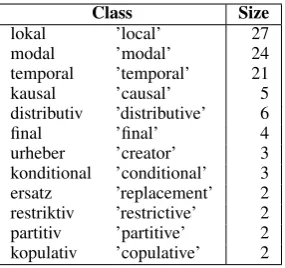
In the absence of any large-scale semantic hier-archical type classification, the German grammar book by Helbig and Buscha (1998) represents our gold standard. We selected those preposition
Class Size
lokal ’local’ 27
modal ’modal’ 24
temporal ’temporal’ 21
kausal ’causal’ 5
distributiv ’distributive’ 6
final ’final’ 4
[image:2.595.111.254.61.195.2]urheber ’creator’ 3 konditional ’conditional’ 3 ersatz ’replacement’ 2 restriktiv ’restrictive’ 2 partitiv ’partitive’ 2 kopulativ ’copulative’ 2 Table 1: Preposition classes.
classes that contained more than one preposition, and deleted prepositions that appeared <10,000 times in our web corpus containing 880 million words (cf. Section 2.2). This selection process resulted in 12 semantic classes covering between 2 and 27 prepositions each (cf. Table 1), and a more fine-grained version that sub-divided the three largest classes ’local’, ’modal’ and ’tem-poral’ into 6/10/7 sub-classes, respectively, and resulted in a total of 32 classes.12 The preposi-tions in the fine-grained version exhibit ambiguity rates of 1 (monosemous) up to 10. Out of the 49 preposition types, 23 are polysemous (46.9%).
2.2 Preposition Features
The corpus-based features for the German pre-positions were induced from the SdeWaC corpus (Faaß and Eckart, 2013), a cleaned version of the German web corpusdeWaC(Baroni et al., 2009) containing approx. 880 million words. We com-pare three categories of distributional features: (1) bag-of-words window co-occurrence
fea-tures: we apply a standard bag-of-words model (BOW) relying on a window of 2 words to the left and to the right, and a continuous bag-of-words model (CBOW) using negative sampling with K=15 (Mikolov et al., 2013); (2) direct syntactic dependency: we compare the
most salient preposition-related dependencies: preposition-subcategorised nouns (nouns-dep, e.g., in Buch ‘in book’), preposition-subcategorising nouns (nouns-gov, e.g., Buch von ‘book by’), and preposition-subcategorising verbs (verbs-gov, e.g.,reisen nach‘to travel to’);
1While we also conducted experiments using the
coarse-grained class distribution in Table 1, the experiments in this paper focus on the fine-grained inventory.
2The gold standard was previously used in Springorum et
al. (2013) and in K¨oper and Schulte im Walde (2014).
(3) 2nd-order syntactic co-occurrence: adject-ives that modify nouns subcategorised by the prepositions, and adverbs that modify verbs subcategorising the prepositions.
The dependency information was extracted from a parsed version of the SdeWaC using Bo-hnet’s MATE dependency parser (Bohnet, 2010; Scheible et al., 2013). All but the CBOW fea-tures were weighted according to positive point-wise mutual information.
2.3 Clustering Approaches
As we wanted to explore hard vs. soft clustering approaches on the same task, we chose k-Means as a standard hard clustering approach (relying on WEKA’s spherical k-Means implementation), and compared it to various soft clustering approaches.
We transfered the hard k-Means cluster ana-lyses to soft cluster anaana-lyses, using two alternat-ive methods. (1) The prep-based soft k-Means method (Springorum et al., 2013) calculated the mean cosine distanced¯for each preposition p to the centroids zc of the clusters c, and assigned
a preposition to a specific cluster if its distance to the respective cluster centroid was below a threshold t multiplied with the mean distance, with t = 0.05,0.1,0.15, . . . ,0.95. Additionally, (2) we propose a hard-to-soft clustering transfer prob-based soft k-Meansthat converts the cosine distances between the prepositions and the hard cluster centroids to membership probabilities.
Instead of transferring a hard clustering to a soft clustering we also directly applied soft clustering approaches: (1) The fuzzyc-Meansalgorithm ex-tends k-means by a cluster membership function for each preposition,fm ∈ [0,1]. (2) We applied
Latent Semantic Clustering (LSC), an instance of the Expectation-Maximisation (EM) algorithm (Baum, 1972) for unsupervised training on un-annotated data (Rooth et al., 1999). The cluster analyses define two-dimensional soft clusters (in our case: preposition–feature clusters) with cluster membership probabilities, which are able to gener-alise over hidden data. (3) We usedNon-negative matrix factorization (NMF), a factorisation ap-proach with an inherent (soft) clustering property (Ding et al., 2005).
All variants of our hard-to-soft clustering approaches and the direct soft clustering ap-proaches (except for k-Means/prep)3resulted in a
preposition–cluster membership matrix with val-ues ∈ [0,1]. We transfered the real member-ship values to binary membermember-ship by applying a threshold t to decide about the cluster member-ship, again witht= 0.05,0.1,0.15, . . . ,0.95. For each clustering approach and for each number of clusterskwe then identified the best threshold.
2.4 Evaluation
We chose the fuzzy extension ofB-Cubed(Bagga and Baldwin, 1998) as evaluation measure, be-cause it is (a) a pair-wise evaluation, which is con-sidered as most suitable for soft clustering eval-uations, and (b) distinguishes between homogen-eity and completeness of a clustering, and thus resembles an evaluation by precision and recall. Amig´o et al. (2009) demonstrated the strengths of B-Cubed, and a similar version has been used in SemEval 2013 for Word Sense Induction (Jurgens and Klapaftis, 2013).
Pair-wise precisionP determines the homogen-eity of a cluster analysis, by calculating for each individual preposition p the amount of preposi-tions p0 in the same cluster c that also belong to the same gold-standard classg, cf. Equation (1). Pair-wise recallRdetermines the completeness of a cluster analysis, by calculating for each indi-vidual prepositionpthe amount of prepositionsp0 in the same gold-standard classgthat also belong to the same clusterc, cf. Equation (2). The over-all B-Cubed precision and recover-all scores are the av-erages over all preposition-wise scores. We com-bined precision and recall by their harmonic mean, the f-score.
P(p, p0) = min(|c(p)∩c(p0)|,|g(p)∩g(p0)|
|c(p)∩c(p0)| (1)
R(p, p0) = min(|c(p)∩c(p0)|,|g(p)∩g(p0)|
|g(p)∩g(p0)| (2)
2.5 Baselines
We created two baselines for our preposition clus-terings: The hard baseline was computed for every number of clusters k=[5,40]. For each k, each preposition was randomly assigned to one of thek clusters, and the resulting hard cluster ana-lysis was evaluated. The hard cluster assignments were repeated 1,000 times for eachk, and the over-all evaluation score for k clusters is the average score of the 1,000 runs. Thesoft baselinewas also created by random assignment across 1,000 runs for eachk, but –integrating the fuzzy component–
each preposition was assigned tonclusters, with n a random number between 1 and the number of gold-standard classes for that specific preposi-tion. Note that this baseline is more informed than an entirely random baseline, because the informa-tion about the number of gold-standard classes for each preposition is very helpful. For example, the baseline assigns monosemous prepositions to only one cluster, and prepositions with three senses to a random integer in[1,3].
3 Results
Figure 1 compares the fuzzy B-Cubed f-score val-ues across the hard and soft clustering approaches, relying on the preposition-subcategorised nouns as one of the best features (cf. Figure 2 below). The plot demonstrates that (i) the hard k-Means clustering approach is the only one resulting in f-scores below the soft baseline, while (ii) the vast majority of soft clustering results lies above the soft baseline. Furthermore, (iii) there is a clear tendency for all soft clustering approaches to provide the best f-scores for similar values ofk
clusters: 15 ≤ k ≤ 19. The overall best result is reached by NMF for a clustering with17clusters. Figure 2 compares the f-scores across feature types, relying on NMF as the best clustering approach. The plot confirms that (i) –across features–, the vast majority of soft clustering res-ults lies above the soft baseline. In addition, (ii) in the previously most successful range for15≤k≤ 19 clusters, the preposition-subcategorised nouns represent the best features. (iii) The best cluster analyses relying on window vs. syntax features are similarly successful, and outperform 2nd-order co-occurrence features.
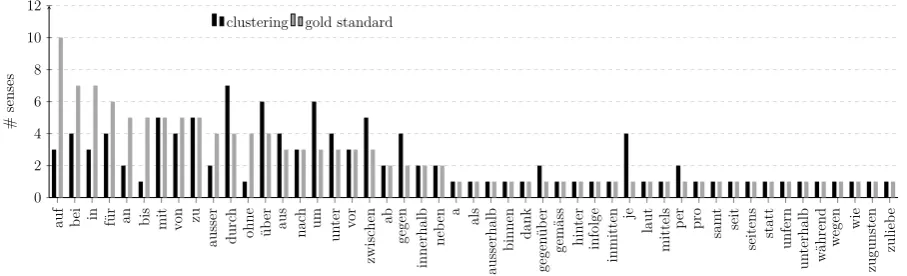
We checked the overall best cluster analysis (NMF,k = 17, nouns-dep) on the predicted de-gree of ambiguity (cf. Figure 3): for 23 out of the 26 monosemous prepositions, we correctly pre-dicted one preposition sense; for 7 out of the 23 polysemous prepositions, we predicted the cor-rect number of senses; for 9 out of the 23 poly-semous prepositions, we predictedlesssenses than the gold standard defines; and for 7 out of the 23 polysemous prepositions, we predicted more senses than the gold standard defines.
6 8 10 12 14 16 18 20 22 24 26 28 30 32 34 36 38 0
0.1 0.2 0.3 0.4 0.5
Number of clusters
Fuzzy
B-Cub
ed
score
hard baseline soft baseline
k-Means
[image:4.595.76.521.72.262.2]k-Means/prop k-Means/prep c-Means LSC NMF
Figure 1: Fuzzy B-Cubed f-score using the subcategorised noun feature set (nouns-dep), across soft clustering approaches.
6 8 10 12 14 16 18 20 22 24 26 28 30 32 34 36 38
0 0.1 0.2 0.3 0.4 0.5
Number of clusters
Fuzzy
B-Cub
ed
score
hard baseline soft baseline
BOW CBOW nouns-dep nouns-gov verbs-gov
[image:4.595.77.520.339.532.2]2nd verb-adv 2nd noun-adj
Figure 2: Fuzzy B-Cubed f-score using NMF soft clustering, across feature sets.
auf bei in für an bis mit von zu ausser durc
h
ohne über aus nac
h
um
un
ter vor
zwisc
hen ab
gegen
innerhalb
neb
en a als
ausserhalb
binnen dank
gegen
üb
er
gemäss hin
ter
infolge
inmitten
je
laut
mittels
per pro samt seit seitens statt unfern
un
terhalb während wegen
wie
zugunsten zulieb
e
0 2 4 6 8 10 12
#
senses
clustering gold standard
[image:4.595.71.525.595.733.2]4 Discussion
While the results in the previous section demon-strate the success of the type-based clustering, we were interested in two specific questions: (i) Where do the differences in the quality of the cluster analyses come from? (ii) Do the best cluster analyses present linguistically reliable and useful semantic classes?
From a quantitative point of view, both ques-tions have been addressed by the evaluation meas-ure, fuzzy B-Cubed, which we chose for reasons outlined in Section 2.4. One should keep in mind, however, that there is an ongoing discussion about cluster comparison and cluster evaluation (Meila, 2007; Rosenberg and Hirschberg, 2007; Vinh and Bailey, 2010; Utt et al., 2014), which demonstrates uncertainty about an optimal measure, and which concerns us, expecially regarding the linguistic as-pects of soft clustering. In the following, we there-fore provide qualitative analyses and discussions of the cluster approaches and analyses.
Ambiguity rate of soft-clustering approaches:
We looked into the best cluster analysis for each soft-clustering approach, and checked the ambi-guities. While the number of preposition types in the cluster analyses is similar across approaches (between 44 and 48), the ambiguity rate (i.e., the number of cluster assignments per preposi-tion type) and the number of ambiguous prepos-ition types (i.e., the number of preposprepos-itions as-signed to more than one cluster) differ strongly. For example, k-Means/prob and NMF perform an average of 3.1/3.7 assignments for each preposi-tion, in comparison to 2.2–2.4 assignments by the other approaches. On the other hand, while k-Means/prob defines almost all preposition types (43 out of 48) as ambiguous, NMF only defines 28 out of 46 prepositions as ambiguous. NMF (best approach) thus shows a high ambiguity rate, but only 60% of the prepositions are ambiguous.
Cluster sizes: Looking into the actual cluster analyses reveals that the sizes and the structures within the individual clusters differ strongly. The best k-Means/prep and k-Means/prob analyses (k = 16,F = 0.33, andk = 19,F = 0.34), for example, each contain 7 large clusters with 10–25 prepositions. All other clusters contain only 1–3 prepositions. In comparison, the best NMF ana-lysis (k= 17,F = 0.43) contains only one cluster with three prepositions, and all other clusters but
one contain ≥ 5 and ≤ 14 prepositions. The cluster sizes of the best NMF analysis are there-fore more homogeneous than for other clustering approaches.
Optimal k: While fuzzy B-Cubed determined the numbers of clusters[15,19]as optimal for the soft-clustering approaches, we also looked into the NMF cluster analysis withk = 32, with NMF as the best approach and 32 as the number of gold standard classes. The clusters are, again, very sim-ilar in size, including only one singleton and only one cluster with9prepositions. All other clusters contain 2−6 prepositions. The smaller cluster sizes allow manual evaluations. We can indeed find reliable semantic clusters, such as {an, auf, hinter, in, mit, nach, neben, um, vor}, where7out of9prepositions belong to the gold-standard class local: not target-orientedcontaining a total of12
prepositions.
5 Conclusion
We presented variants of hard and soft clus-tering approaches across several sets of position features, to automatically classify pre-position types into semantic classes. While type-based classifications for highly ambiguous word classes are a computational challenge, our best approach (NMF-based classification with17
clusters) reached an f-score of 0.43. The clus-tering experiments showed that (i) the semantic-ally most salient preposition features are indeed the most successful, and that (ii) the clustering of highly ambiguous words requires soft rather than hard clustering approaches.
Most interestingly, a qualitative analysis zoomed into the assignment behaviour of the soft clustering approaches, and revealed different attitudes towards predicting ambiguity. NMF as the best approach predicted a high ambiguity rate but only for a restricted proportion of 60% of the preposition types. Furthermore, the distribution of cluster sizes was less skewed than for other approaches.
Acknowledgments
References
Enrique Amig´o, Julio Gonzalo, Javier Artiles, and Fel-isa Verdejo. 2009. A Comparison of Extrinsic Clus-tering Evaluation Metrics Based on Formal Con-straints. Information Retrieval, 12(4):461–486. Amit Bagga and Breck Baldwin. 1998. Entity-based
Cross-document Coreferencing Using the Vector Space Model. In Proceedings of the 36th Annual Meeting of the Association for Computational Lin-guistics and the 17th International Conference on
Computational Linguistics, pages 79–85, Montr´eal,
Canada.
Timothy Baldwin. 2006. Distributional Similar-ity and Preposition Semantics. In Patrick Saint-Dizier, editor,Syntax and Semantics of Prepositions, chapter 1, pages 197–210. Kluwer Academic Pub-lishers, Dordrecht, The Netherlands.
Marco Baroni, Silvia Bernardini, Adriano Ferraresi, and Eros Zanchetta. 2009. The WaCky Wide Web: A Collection of Very Large Linguistically Processed Web-Crawled Corpora. Language Resources and
Evaluation, 43(3):209–226.
Leonard E. Baum. 1972. An Inequality and As-sociated Maximization Technique in Statistical Es-timation for Probabilistic Functions of Markov Pro-cesses. Inequalities, III:1–8.
Bernd Bohnet. 2010. Top Accuracy and Fast Depend-ency Parsing is not a Contradiction. InProceedings of the 23rd International Conference on
Computa-tional Linguistics, pages 89–97, Beijing, China.
Gemma Boleda, Sabine Schulte im Walde, and Toni Badia. 2012. Modelling Regular Polysemy: A Study on the Semantic Classification of Catalan Adjectives. Computational Linguistics, 38(3):575– 616.
John Carroll and Alex C. Fang. 2004. The Auto-matic Acquisition of Verb Subcategorisations and their Impact on the Performance of an HPSG Parser.
InProceedings of the 1st International Joint
Confer-ence on Natural Language Processing, pages 107–
114, Sanya City, China.
John Carroll, Guido Minnen, and Ted Briscoe. 1998. Can Subcategorisation Probabilities Help a Statist-ical Parser? InProceedings of the 6th ACL/SIGDAT
Workshop on Very Large Corpora, pages 118–126,
Montr´eal, Canada.
Chris Ding, Xiaofeng He, and Horst D. Simon. 2005. On the Equivalence of Nonnegative Matrix Factor-ization and Spectral Clustering. In Proceedings of
the SIAM International Conference on Data Mining,
pages 606–610, Newport Beach, CA, USA.
Bonnie J. Dorr and Doug Jones. 1996. Role of Word Sense Disambiguation in Lexical Acquisition: Pre-dicting Semantics from Syntactic Cues. In Proceed-ings of the 16th International Conference on
Com-putational Linguistics, pages 322–327, Copenhagen,
Denmark.
Gertrud Faaß and Kerstin Eckart. 2013. SdeWaC – A Corpus of Parsable Sentences from the Web. In Pro-ceedings of the International Conference of the Ger-man Society for Computational Linguistics and
Lan-guage Technology, pages 61–68, Darmstadt,
Ger-many.
Christiane Fellbaum, editor. 1998.WordNet – An
Elec-tronic Lexical Database. Language, Speech, and
Communication. MIT Press, Cambridge, MA. Charles J. Fillmore, Christopher R. Johnson, and
Miriam R.L. Petruck. 2003. Background to Fra-meNet. International Journal of Lexicography, 16:235–250.
Vasileios Hatzivassiloglou and Kathleen R. McKeown. 1993. Towards the Automatic Identification of Ad-jectival Scales: Clustering Adjectives According to Meaning. InProceedings of the 31st Annual Meet-ing of the Association for Computational LMeet-inguist- Linguist-ics, pages 172–182, Columbus, OH.
Gerhard Helbig and Joachim Buscha. 1998. Deutsche
Grammatik. Langenscheidt – Verlag Enzyklop¨adie,
18th edition.
Donald Hindle. 1990. Noun Classification from Predicate-Argument Structures. In Proceedings of the 28th Annual Meeting of the Association for
Com-putational Linguistics, pages 268–275, Pittsburgh,
PA.
Dirk Hovy, Stephen Tratz, and Eduard Hovy. 2010. What’s in a Preposition? Dimensions of Sense Dis-ambiguation for an Interesting Word Class. In Pro-ceedings of the 23rd International Conference on
Computational Linguistics, pages 454–462, Beijing,
China.
Dirk Hovy, Ashish Vaswani, Stephen Tratz, David Chi-ang, and Eduard Hovy. 2011. Methods and Train-ing for Unsupervised Preposition Sense Disambig-uation. In Proceedings of the 49th Annual Meet-ing of the Association for Computational LMeet-inguist- Linguist-ics, pages 323–328, Portland, OR.
David Jurgens and Ioannis Klapaftis. 2013. SemEval-2013 Task 13: Word Sense Induction for Graded and Non-Graded Senses. InProceedings of the 2nd Joint Conference on Lexical and Computational
Se-mantics, pages 290–299, Atlanta, Georgia, USA.
Karin Kipper Schuler. 2006. VerbNet: A
Broad-Coverage, Comprehensive Verb Lexicon. Ph.D.
thesis, University of Pennsylvania, Computer and Information Science.
Philipp Koehn and Hieu Hoang. 2007. Factored Trans-lation Models. In Proceedings of the Joint Con-ference on Empirical Methods in Natural Language Processing and Computational Natural Language
Upali S. Kohomban and Wee Sun Lee. 2005. Learning Semantic Classes for Word Sense Disambiguation.
InProceedings of the 43rd Annual Meeting on
Asso-ciation for Computational Linguistics, pages 34–41,
Ann Arbor, MI.
Maximilian K¨oper and Sabine Schulte im Walde. 2014. A Rank-based Distance Measure to Detect Polysemy and to Determine Salient Vector-Space Features for German Prepositions. InProceedings of the 9th International Conference on Language
Resources and Evaluation, pages 4459–4466,
Reyk-javik, Iceland.
Anna Korhonen, Yuval Krymolowski, and Zvika Marx. 2003. Clustering Polysemic Subcategorization Frame Distributions Semantically. In Proceedings of the 41st Annual Meeting of the Association for
Computational Linguistics, pages 64–71, Sapporo,
Japan.
Kenneth C. Litkowski and Orin Hargraves. 2005. The Preposition Project. InProceedings of the 2nd ACL-SIGSEM Workshop on The Linguistic Dimensions of Prepositions and their Use in Computational
Lin-guistics Formalisms and Applications, pages 171–
179, Colchester, England.
Diana McCarthy, Rob Koeling, Julie Weeds, and John Carroll. 2007. Unsupervised Acquisition of Pre-dominant Word Senses. Computational Linguistics, 33(4):553–590.
Marina Meila. 2007. Comparing Clusterings – An Information-based Distance. Journal of
Multivari-ate Analysis, 98(5):873–895.
Paola Merlo and Suzanne Stevenson. 2001. Auto-matic Verb Classification Based on Statistical Distri-butions of Argument Structure. Computational
Lin-guistics, 27(3):373–408.
Tomas Mikolov, Ilya Sutskever, Kai Chen, Greg S. Cor-rado, and Jeff Dean. 2013. Distributed Representa-tions of Words and Phrases and their Composition-ality. InAdvances in Neural Information Processing
Systems 26, pages 3111–3119.
Tom O’Hara and Janyce Wiebe. 2009. Exploiting Se-mantic Role Resources for Preposition Disambigu-ation. Computational Linguistics, 35(2):151–184. Special Issue on Prepositions in Applications.
Fernando Pereira, Naftali Tishby, and Lillian Lee. 1993. Distributional Clustering of English Words.
InProceedings of the 31st Annual Meeting of the
As-sociation for Computational Linguistics, pages 183–
190, Columbus, OH.
Detlef Prescher, Stefan Riezler, and Mats Rooth. 2000. Using a Probabilistic Class-Based Lexicon for Lex-ical Ambiguity Resolution. In Proceedings of the 18th International Conference on Computational
Linguistics, pages 649–655, Saarbr¨ucken, Germany.
Mats Rooth, Stefan Riezler, Detlef Prescher, Glenn Carroll, and Franz Beil. 1999. Inducing a Semantic-ally Annotated Lexicon via EM-Based Clustering.
InProceedings of the 37th Annual Meeting of the
As-sociation for Computational Linguistics, pages 104–
111, Maryland, MD.
Andrew Rosenberg and Julia Hirschberg. 2007. V-Measure: A Conditional Entropy-based External Cluster Evaluation Measure. InProceedings of the joint Conference on Empirical Methods in Natural Language Processing and Computational Natural
Language Learning, pages 410–420, Prague, Czech
Republic.
Patrick Saint-Dizier. 2005. An Overview of PrepNet: Abstract Notions, Frame, and Inferential Patterns.
In Proceedings of the 2nd ACL-SIGSEM Workshop
on The Linguistic Dimensions of Prepositions and their Use in Computational Linguistics Formalisms
and Applications, Colchester, England.
Silke Scheible, Sabine Schulte im Walde, Marion Weller, and Max Kisselew. 2013. A Compact but Linguistically Detailed Database for German Verb Subcategorisation relying on Dependency Parses from a Web Corpus: Tool, Guidelines and Resource.
InProceedings of the 8th Web as Corpus Workshop,
pages 63–72, Lancaster, UK.
Sabine Schulte im Walde. 2006. Experiments on the Automatic Induction of German Semantic Verb Classes. Computational Linguistics, 32(2):159– 194.
Rion Snow, Daniel Jurafsky, and Andrew Y. Ng. 2006. Semantic Taxonomy Induction from Heterogenous Evidence. InProceedings of the 45th Annual Meet-ing of the Association for Computational LMeet-inguist- Linguist-ics, pages 801–808, Sydney, Australia.
Sylvia Springorum, Sabine Schulte im Walde, and Jason Utt. 2013. Detecting Polysemy in Hard and Soft Cluster Analyses of German Preposition Vec-tor Spaces. InProceedings of the 6th International
Joint Conference on Natural Language Processing,
pages 632–640, Nagoya, Japan.
Mihai Surdeanu, Sanda Harabagiu, John Williams, and Paul Aarseth. 2003. Using Predicate-Argument Structures for Information Extraction. In Proceed-ings of the 41st Annual Meeting of the Association
for Computational Linguistics, pages 8–15,
Sap-poro, Japan.
Stephen Tratz and Dirk Hovy. 2009. Disambiguation of Preposition Sense using Linguistically Motivated Features. In Proceedings of the NAACL-HLT
Stu-dent Research Workshop and Doctoral Consortium,
pages 96–100, Boulder, CO.
Ambiguous Data. InProceedings of the 9th Interna-tional Conference on Language Resources and
Eval-uation, pages 581–587, Reykjavik, Iceland.
Giulia Venturi, Simonetta Montemagni, Simone Marchi, Yutaka Sasaki, Paul Thompson, John McNaught, and Sophia Ananiadou. 2009. Boot-strapping a Verb Lexicon for Biomedical Informa-tion ExtracInforma-tion. In Alexander Gelbukh, editor,
Lin-guistics and Intelligent Text Processing, pages 137–
148. Springer, Heidelberg.
Nguyen Xuan Vinh and James Bailey. 2010. Inform-ation Theoretic Measures for Clusterings Compar-ison: Variants, Properties, Normalization and Cor-rection for Chance. Journal of Machine Learning
Research, 11:2837–2854.
Marion Weller, Sabine Schulte im Walde, and Alex-ander Fraser. 2014. Using Noun Class Informa-tion to model SelecInforma-tional Preferences for Translat-ing Prepositions in SMT. InProceedings of the 11th Conference of the Association for Machine
Trans-lation in the Americas, pages 275–287, Vancouver,
Canada.
Patrick Ye and Timothy Baldwin. 2006. Semantic Role Labelling of Prepositional Phrases. ACM Transactions on Asian Language Information