Improving Statistical Machine Translation Performance
by Oracle-BLEU Model Re-estimation
Praveen Dakwale Informatics Institute University of Amsterdam
Christof Monz Informatics Institute University of Amsterdam
Abstract
We present a novel technique for train-ing translation models for statistical ma-chine translation by aligning source sen-tences to their oracle-BLEU translations. In contrast to previous approaches which are constrained to phrase training, our method also allows the estimation of re-ordering models along with the translation model. Experiments show an improve-ment of up to 0.8 BLEU for our approach over a competitive Arabic-English base-line trained directly on the word-aligned bitext using heuristic extraction. As an ad-ditional benefit, the phrase table size is re-duced dramatically to only 3% of the orig-inal size.
1 Introduction
In phrase-based SMT, the phrase pairs in the trans-lation model are traditionally trained by applying a heuristic extraction method (Och and Ney, 2000) which extracts phrase pairs based on consistency of word alignments from a word-aligned bilingual training data. The probabilities of the translation model are then calculated based on the relative frequencies of the extracted phrase pairs.
A notable shortcoming of this approach is that the translation model probabilities thus calculated from the training bitext can be unintuitive and un-reliable (Marcu and Wong, 2002; Foster et al., 2006) as they reflect only the distribution over the phrase pairs observed in the training data.
However, from an SMT perspective it is im-portant that the models reflect probability distri-butions which are preferred by the decoding pro-cess, i.e., phrase translations which are likely to be used frequently to achieve better translations should get higher scores and phrases which are
less likely to be used should get low scores. In ad-dition, the heuristic extraction algorithm generates all possible, consistent phrases including overlap-ping phrases. This means that translation proba-bilities are distributed over a very large number of phrase translation candidates most of which never lead to the best possible translation of a sentence.
In this paper, we propose a novel solution which is to re-estimate the models from the best BLEU translation of each source sentence in the bitext. An important contribution of our approach is that unlike previous approaches such as forced align-ment (Wuebker et al., 2010), reordering and lan-guage models can also be re-estimated.
2 Related Work
The forced alignment technique of Wuebker et al. (2010) forms the main motivation for our work. In forced alignment, given a sentence pair (F, E), a decoder determines the best phrase segmentation and alignment which will result in a translation of
F intoE. The best segmentation is defined as the one which maximizes the probability of translat-ing the source sentence into the given target sen-tence. At the end, the phrase table is re-estimated using the phrase pair segmentations obtained from forced decoding. Thus forced alignment is a re-estimation technique where translation probabil-ities are calculated based on their frequency in best-scoring hypotheses instead of the frequencies of all possible phrase pairs in the bitext. However, one limitation of forced alignment is that only the phrase translation model can be re-estimated since it is restricted to align the source sentence to the given target reference, thus fixing the choice of re-ordering decisions.
A similar line of work is proposed by Lambert et al. (2011) and Schwenk et al. (2011) who use a self-enhancing strategy to utilize additional
mose
Mousa
“ “ yese L Tauffir 40 alif kais dam L alfalsteniin
seeks to provide palestnians with 40000 blood bags!
(a)
“ mose Tauffir 40 alif kais dam L alfalsteniin
Mousa provide palestenians with 4000 blood bags ! “ yese L
seeks to
(b)
“ mose “ yese L Tauffir
Mousa
40 alif kais dam L alfalsteniin
seeks to provide 4000 blood bags to palestinians
(c)
Figure 1: (a) : Word alignment from EM training for Arabic (transliterated) -English sentence pair. (b): Phrase segmentations and alignments from forced decoding. (c): Phrase segmentations and alignments from oracle BLEU re-estimation. Blocks represent phrase boundaries.
lingual source language data by aligning it to its target language translation obtained by using an SMT system to rank sentence translation proba-bilities. However, the main focus of their work is translation model adaptation by augmenting the bitext with additional training data and not the re-estimation of the translation models trained on the parallel data.
In this work, we propose that aligning source sentences to their oracle BLEU translations pro-vides a more realistic estimate of the models from the decoding perspective instead of aligning them to high quality human translations as in forced de-coding.
Another relevant line of research relates tun-ing (weight optimisation), where our work lies between forced decoding (Wuebker et al., 2010) and the bold updating approach of (Liang et al., 2006). However, our approach specifically pro-poses a novel method for training models using oracle BLEU translations.
3 Model Re-estimation
The idea of our approach is to re-estimate the models with n-best oracle-BLEU translations and sentence alignments resulting from decoding the source sentence. Given a source and its reference translation, the oracle-BLEU translation is defined as the translation output with highest BLEU score. Oracle BLEU translations have been previously used for different analytical purposes in SMT (Sri-vastava et al., 2011; Dreyer et al., 2007; Wis-niewski et al., 2010).
Figure 1 shows example of word alignment ob-tained from EM training, segmentations and align-ment obtained from forced decoding and
oracle-BLEU re-estimation.
3.1 Oracle BLEU
Ideally, one would like to re-estimate translation models directly from the n-best BLEU transla-tions. However there are two problems in calcu-lating BLEU for individual sentence: First, as dis-cussed in (Chiang et al., 2008), BLEU is not de-signed to be used for sentences in isolation where it can exhibit rather volatile behavior. Hence, fol-lowing their work and (Watanabe et al., 2007), we calculate BLEU for a sentence in the context of a exponentially-weighted moving average of previ-ous translations. We briefly discuss the computa-tion from (Chiang et al., 2008) as follows: Given a source sentence f, and its reference translation
r, for an n-best translation e∗, let c(e) be defined
as the vector of target length |e|, source length |f|, reference length|r|, and the number of n-gram matches betweeneandr, then two pseudo docu-ment parametersOandOf are defined as:
O←0.9·(O+c(e∗)),O
f ←0.9·(Of+|f|) (1)
Ois an exponentially-weighted moving average of the vectors from previous sentences andOf is
the correction of source length with respect to the previous sentences. Then the BLEU score for a sentence pairs (f,r) and translation e∗ is defined
as:
B(e;f, r) = (Of+|f|)·BLEU(O+c(e∗;r)) (2)
[image:2.595.90.507.143.208.2]following them, we use a weighted combination of BLEU and model score to select the n-best list:
e∗=argmax
e(B(e)−µ·(B(e)−h(e).w)) (3)
where B(e) and h(e) are the BLEU and model scores of the candidate translation and w is the optimised weights for the models, µcontrols the preference between BLEU and model scores to determine oracle translations. We set µ=0.5 to balance between BLEU scores almost as high as the max-BLEU translations, while staying close to translations preferred by the model. We also conducted a set of experiments withµ=0 (pure or absolute BLEU) in order to verify the necessity for the optimal combination. The lower scores for this setting as compared to the baseline veri-fied that using only the best BLEU translation in-deed degrades the performance of the re-estimated models. This finding for the optimal value of µ
has also been established in (Chiang et al., 2008) through a series of experiments.
3.2 Training
For obtaining the oracle-BLEU translations, we first train the translation models from the bitext using the standard pipeline of word alignment and heuristic extraction. Along with the phrase translation and language models, we also train a bilingual language model (BiLM) (Niehues et al., 2011; Garmash and Monz, 2014), as well as lexicalized (Tillman, 2004) and hierarchical re-ordering models (Galley and Manning, 2008). We use a BiLM specifically as an instance of a re-ordering model in order to determine the effect of re-estimating re-ordering decisions from oracle-BLEU translations.
We use the decoder trained on these models to translate the training bitext. Along with the 1-best translation (based on model scores), we also store search graphs or lattices generated during the translations process. Using the target sen-tences, we convert the translation lattice to an isomorphic oracle-BLEU lattice which has the same set of nodes but the edges represent BLEU score differences corresponding to each transition. Finally, we extract n-best candidate translations from the graphs ranked on BLEU score as de-fined in Equation (3). Using the word alignments from the initial phrase table, we extract the align-ments between each source sentence and each of their n-best oracle-BLEU translations. Finally, we
re-train the phrase translations, re-ordering and BiLM on these translations and alignments.
3.3 Avoiding over-fitting
Re-estimation of the translation models from the n-best translation of the bitext could re-enforce the probabilities of the low frequency phrase pairs in the re-estimated models leading to over-fitting. Within forced decoding, Wuebker et al. (2010) ad-dress this problem by using a leave-one-out ap-proach where they modify the phrase translation probabilities for each sentence pair by remov-ing the counts of all phrases that were extracted from that particular sentence. However, in our ap-proach, we do not impose a constraint to produce the exact translation, instead we use the highest BLEU translations which may be very different from the references. Thus it is not strictly nec-essary to apply leave-one-out in our approach as a solution to over-fitting. Instead, we handle the problem by simply removing all the phrase pairs below a threshold count which in our case is 2,
φinit =φbaseline−φC(e,f)<2 (4)
therefore removing phrase pairs with high proba-bility but low frequency.
4 Experimental set up
Our experiments are carried out for an Arabic-English parallel corpus of approximately 1 million sentence pairs. We establish a baseline system by training models on this bitext and then compare this to a forced decoding implementation and to oracle-BLEU re-estimation using the same bitext.
4.1 Baseline and forced decoding
The initial training corpus we use is a collection of parallel sentences taken from OpenMT data sources released by the LDC.
Phrase table, distortion models and the lexical BiLM are trained with initial alignments obtained using GIZA++ (Och and Ney, 2003). The En-glish 5-gram target language model is trained with Kneser-Ney smoothing on news data of nearly 1.6B tokens. We use an in-house phrase-based SMT system similar to Moses. For all settings in this paper, weights were optimized on NIST’s MT04 data set using pairwise ranked optimization (Hopkins and May, 2011).
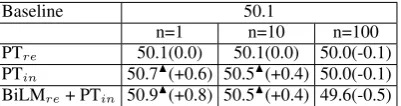
Baseline 50.1
n=1 n=10 n=100
PTre 50.1(0.0) 50.1(0.0) 50.0(-0.1)
PTin 50.7N(+0.6) 50.5N(+0.4) 50.0(-0.1)
[image:4.595.82.283.71.124.2]BiLMre+ PTin 50.9N(+0.8) 50.5N(+0.4) 49.6(-0.5)
Table 1: Performance of our oracle-BLEU re-estimation with varying size n of n-best lists for the MT09 test set.N/Hindicates a statistically sig-nificant gain/drop at p<0.01 andM/Oat p<0.05. Values in brackets show gains over the baseline.
et al., 2007) trained on the baseline phrase trans-lation model. In order to increase the chances of producing the exact reference, we follow Foster and Kuhn (2012) and relax the standard decoding parameters as follows: distortion limit=∞, stack size=2000, beam width=10e-30, and no threshold pruning of the translation model.
4.2 Oracle BLEU re-estimation
To obtain oracle-BLEU translations, we first train an initial SMT system and use it to decode the bitext. This system is identical to the baseline system except for the removal of low-frequency phrase pairs from the baseline phrase table as de-scribed in Section 3.3. To obtain the n-best oracle-BLUE translations, we experiment with differ-ent values of n, where n ∈ {1,10,100}. From these oracle-BLEU translations and alignments all phrases that were used in the derivation of these n-best sentences are extracted and the models are re-estimated by re-calculating the translation proba-bilities. Hierarchical and lexicalized re-ordering models as well as the BiLM are re-trained using the source sentences, oracle-BLEU translations and word alignments. For testing the performance of the re-estimated models, we tune different sys-tems while replacing the baseline models with the corresponding re-estimated models. We also experiment with the interpolation of re-estimated models with the respective baseline models. We evaluate against 4 test sets: MT05, MT06, MT08, and MT09. Case-insensitive 4-gram BLEU (Pa-pineni et al., 2002) is used as evaluation metric. Approximate randomization (Noreen., 1989; Rie-zler and Maxwell, 2005) is used to detect statisti-cally significant differences.
5 Results
We discuss the experimental results of our oracle-BLEU re-estimation approach for different
mod-els and settings and provide a comparison with the baseline (heuristic training) and forced alignment. Re-estimated models with three different values of n ∈ {1,10,100} were evaluated under three settings: phrase table re-estimation, interpolation, and BiLM re-estimation. The best improvements over the baseline are obtained by using only 1-best (n= 1) alignments as shown in Table 1. Surpris-ingly, this is in contrast with forced decoding as discussed in Wuebker et al. (2010), where the best improvements are obtained forn= 100.
Table 2 provides a comparison between BLEU improvements achieved by forced decoding (n= 100best) and our oracle-BLEU re-estimation ap-proach (n= 1best) over the baseline for different models. One can see in Table 2 that while phrase table re-estimation drops substantially for forced decoding for all test sets (up to -1.4 for MT09), oracle-BLEU phrase table re-estimation shows ei-ther slight improvements or negligible drops com-pared to the baseline. For the linear interpola-tion of the re-estimated phrase table with the base-line, forced decoding shows only a slight improve-ment for MT06, MT08 and MT09 and still suffers from a substantial drop for MT05. On the other hand, oracle-BLEU re-estimation shows consis-tent improvements for all test sets with a maxi-mum gain of up to +0.7 for MT06. It is impor-tant to note here that although linear interpolation extinguishes the advantage of a smaller phrase ta-ble size obtained by re-estimation, the improve-ment achieved by interpolation for oracle-BLEU re-estimation are significantly higher as compared to forced decoding.
anal-MT05 MT06 MT08 MT09
Baseline 58.5 47.9 47.3 50.1
FD OB FD OB FD OB FD OB
PTre 57.4H(-1.1) 58.74(+0.2) 46.3(-0.7) 47.8H(-0.1) 46.1H(-1.2) 47.44(+0.1) 48.7H(-1.4) 50.1(0.0)
PTin 58.2O(-0.3) 58.8N(+0.3) 48.0(+0.1) 48.6N(+0.7) 47.5(+0.2) 47.7N(+0.4) 50.44(+0.3) 50.7N(+0.6)
PTin+ BiLMre - 59.2N(+0.7) - 48.5N(+0.6) - 47.7N(+0.4) - 50.9N(+0.8)
[image:5.595.70.525.72.152.2]PTbase+ BiLMre - 58.6(+0.1) - 48.2(+0.3) - 47.2H(-0.1) - 50.6(+0.5) Table 2: BLEU scores for Forced decoding and Oracle BLEU re-estimation. PTre/in = Phrase table re-estimation/interpolation/baseline, PTbase = Baseline Phrase table, BiLMre = BiLM re-estimation, FD=Forced decoding, OB=oracle-BLEU.
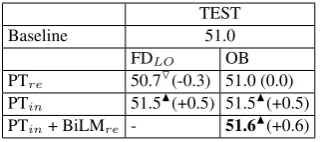
TEST
Baseline 51.0
FDLO OB
PTre 50.7O(-0.3) 51.0 (0.0)
PTin 51.5N(+0.5) 51.5N(+0.5)
[image:5.595.101.263.226.297.2]PTin+ BiLMre - 51.6N(+0.6) Table 3: BLEU scores for Oracle-Bleu and Forced decoding with leave-one-out against concatena-tion of MT03, MT05-MT09.
(% of baseline) OB100 5.07
OB10 4.16
OB1 3.28
[image:5.595.133.226.362.424.2]FD 27.71 FDLO 7.6
Table 4: Phrase table sizes compared to base-line for Oracle-BLUE re-estimation and Forced decoding for different n-best list sizes, FDLO = Forced decoding with leave-one-out.
ysis, we experimented with the interpolation of both the re-estimated phrase table (forced decod-ing and oracle-BLEU) with the baseline. How-ever, improvements achieved with this interpola-tion did not surpass the best result obtained for the oracle-BLEU re-estimation.
Additionally, we also compare oracle-BLEU re-estimation to forced decoding with leave-one-out (Wuebker et al., 2010) by evaluating both on a concatenation of 5 test sets (MT03, MT05-MT09). As shown in Table 3, even with leave-one-out, forced decoding performance drops be-low the baseline by -0.3 BLEU. In contrast, phrase tables re-estimated from oracle-BLEU translation achieves the same performance as the baseline. When interpolated with the baseline phrase ta-ble, both approaches show significant improve-ments over the baseline. This implies that only in combination with the original phrase table does
forced-decoding with leave-one-out outperform the baseline. On the other hand, oracle-BLEU re-estimation by its own not only performs bet-ter than forced decoding, but also gives a perfor-mance equal to forced decoding with leave-one-out when interpolated with baseline phrase table. In addition to the BLEU improvements, our ap-proach also results in a re-estimated phrase table with a significantly reduced size as compared to the baseline. As shown in Table 4, out of all the settings, the minimum phrase table size after oracle-BLEU re-estimation is only 3.28% of base-line (i.e., a reduction of 96.72%) while it is 7.6% for forced decoding.
6 Conclusions
In this paper, we proposed a novel technique for improving the reliability of SMT models by model re-estimation from oracle-BLEU translations of the source sentences in the bitext. Our experimen-tal results show BLEU score improvements of up to +0.8 points for oracle-BLEU re-estimation over a strong baseline along with a substantially re-duced size of the re-estimated phrase table (3.3% of the baseline). An important novelty of our ap-proach is that it also allows for the re-estimation of re-ordering models which can yield further im-provements in SMT performance as demonstrated by the re-estimation of a BiLM.
Acknowledgments
References
David Chiang, Yuval Marton, and Philip Resnik. 2008. Online large-margin training of syntactic and struc-tural translation features. In Proceedings of the Conference on Empirical Methods in Natural Lan-guage Processing. Association for Computational Linguistics.
Markus Dreyer, Keith Hall, and Sanjeev Khudanpur. 2007. Comparing reordering constraints for smt us-ing efficient BLEU oracle computation. In Proceed-ings of 2007 Workshop on Syntax and Structure in Statistical Trans- lation.
George Foster and Roland Kuhn. 2012. Forced decod-ing for phrase extraction. Technical report, Univer-sity of Montreal.
George Foster, Roland Kuhn, and Howard Johnson. 2006. Phrasetable smoothing for statistical machine translation. InProceedings of the 2006 Conference on Empirical Methods in Natural Language Pro-cessing. Association for Computational Linguistics. Michel Galley and Christopher D. Manning. 2008. A simple and effective hierarchical phrase reordering model. InProceedings of the Conference on Empir-ical Methods in Natural Language Processing. As-sociation for Computational Linguistics.
Ekaterina Garmash and Christof Monz. 2014. Dependency-based bilingual language models for reordering in statistical machine translation. In Proceedings of the 2014 Conference on Empir-ical Methods in Natural Language Processing (EMNLP), pages 1689–1700.
Mark Hopkins and Jonathan May. 2011. Tuning as ranking. InProceedings of the 2011 Conference on Empirical Methods in Natural Language Process-ing. Association for Computational Linguistics. Philipp Koehn, Hieu Hoang, Alexandra Birch, Chris
Callison-Burch, Marcello Federico, Nicola Bertoldi, Brooke Cowan, Wade Shen, Christine Moran, Richard Zens, Chris Dyer, Ondˇrej Bojar, Alexandra Constantin, and Evan Herbst. 2007. Moses: Open source toolkit for statistical machine translation. In Proceedings of the 45th Annual Meeting of the ACL on Interactive Poster and Demonstration Sessions. Association for Computational Linguistics.
Patrik Lambert, Holger Schwenk, Christophe Ser-van, and Sadaf Abdul-Rauf. 2011. Investigations on translation model adaptation using monolingual data. InProceedings of the Sixth Workshop on Sta-tistical Machine Translation. Association for Com-putational Linguistics.
Percy Liang, Alexandre Bouchard-Cˆot´e, Dan Klein, and Ben Taskar. 2006. An end-to-end discrimina-tive approach to machine translation. In Proceed-ings of the 21st International Conference on Com-putational Linguistics and 44th Annual Meeting of the Association for Computational Linguistics. As-sociation for Computational Linguistics, July.
Daniel Marcu and William Wong. 2002. A phrase-based, joint probability model for statistical ma-chine translation. In Proceedings of the ACL-02 Conference on Empirical Methods in Natural Lan-guage Processing. Association for Computational Linguistics.
Jan Niehues, Teresa Herrmann, Stephan Vogel, and Alex Waibel. 2011. Wider context by using bilingual language models in machine translation. In Proceedings of the Sixth Workshop on Statisti-cal Machine Translation. Association for Computa-tional Linguistics.
Eric W. Noreen. 1989. Computer Intensive Methods for Testing Hypotheses. An Introduction. Wiley-Interscience.
Franz Josef Och and Hermann Ney. 2000. Improved statistical alignment models. InProceedings of the 38th Annual Meeting on Association for Compu-tational Linguistics. Association for Computational Linguistics.
Franz Josef Och and Hermann Ney. 2003. A sys-tematic comparison of various statistical alignment models.Computational Linguistics, 29.
Kishore Papineni, Salim Roukos, Todd Ward, and Wei-Jing Zhu. 2002. Bleu: a method for automatic eval-uation of machine translation. In Proceedings of 40th Annual Meeting of the Association for Compu-tational Linguistics. Association for Computational Linguistics.
Stefan Riezler and John T. Maxwell. 2005. On some pitfalls in automatic evaluation and significance test-ing for MT. InProceedings of the ACL Workshop on Intrinsic and Extrinsic Evaluation Measures for Machine Translation and/or Summarization. Holger Schwenk, Patrik Lambert, Lo¨ıc Barrault,
Christophe Servan, Haithem Afli, Sadaf Abdul-Rauf, and Kashif Shah. 2011. LIUM’s SMT ma-chine translation systems for WMT 2011. In Pro-ceedings of the Sixth Workshop on Statistical Ma-chine Translation. Association for Computational Linguistics.
Ankit K. Srivastava, Yanjun Ma, and Andy Way. 2011. Oracle-based training for phrase-based statistical machine translation. InProceedings of the 15th an-nual meeting of the European Association for Ma-chine Translation.
Christoph Tillman. 2004. A unigram orientation model for statistical machine translation. In Pro-ceedings of HLT-NAACL. Association for Computa-tional Linguistics.
Natural Language Learning (EMNLP-CoNLL). As-sociation for Computational Linguistics.
Guillaume Wisniewski, Alexandre Allauzen, and Franc¸ois Yvon. 2010. Assessing phrase-based translation models with oracle decoding. In Pro-ceedings of the 2010 Conference on Empirical Methods in Natural Language Processing. Associ-ation for ComputAssoci-ational Linguistics.