A Search-Based Dynamic Reranking Model for Dependency Parsing
Hao Zhou† Yue Zhang‡ Shujian Huang† Junsheng Zhou∗ Xin-Yu Dai† Jiajun Chen†
†State Key Laboratory for Novel Software Technology, Nanjing University, China
‡Singapore University of Technology and Design, Singapore
∗ Nanjing Normal University, China
[email protected], yue [email protected]
{huangshujian,daixinyu,chenjj}@nju.edu.cn, [email protected]
Abstract
We propose a novel reranking method to extend a deterministic neural dependency parser. Different to conventional k-best reranking, the proposed model integrates search and learning by utilizing a dynamic action revising process, using the rerank-ing model to guide modification for the base outputs and to rerank the candidates. The dynamic reranking model achieves an absolute 1.78% accuracy improvement over the deterministic baseline parser on PTB, which is the highest improvement by neural rerankers in the literature.
1 Introduction
Neural network models have recently been ex-ploited for dependency parsing. Chen and Man-ning (2014) built a seminal model by replacing the SVM classifier at the transition-based Malt-Parser (Nivre et al., 2007) with a feed-forward neural network, achieving significantly higher ac-curacies and faster speed. As a local and greedy neural baseline, it does not outperform the best discrete-feature parsers, but nevertheless demon-strates strong potentials for neural network models in transition-based dependency parsing.
Subsequent work aimed to improve the model of Chen and Manning (2014) in two main direc-tions. First, global optimization learning and beam search inference have been exploited to reduce er-ror propagation (Weiss et al., 2015; Zhou et al., 2015). Second, recurrent neural network models have been used to extend the range of neural fea-tures beyond a local window (Dyer et al., 2015; Ballesteros et al., 2015). These methods give ac-curacies that are competitive to the best results in the literature.
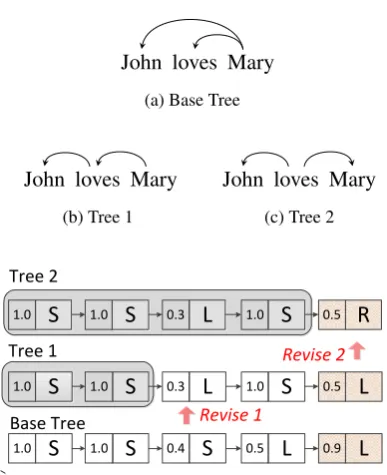
John loves Mary
(a) Base Tree
John loves Mary
(b) Tree 1
John loves Mary
(c) Tree 2
1.0
S
1.0S
0.4S
0.5L
0.9L
0.3L
1.0S
0.5L
Revise 1
Tree 1 Tree 2
Base Tree
Revise 2
1.0
S
1.0S
0.3
L
1.0S
0.5R
1.0S
1.0S
[image:1.595.320.514.222.460.2](d) 2-step action revising process for sentence “John loves Mary”. Numbers before actions are the probabilities for that action.
Figure 1: Example action revising process. S, L, R stand for the SHIFT, LEFT, RIGHT actions,
re-spectively (Section 2).
Another direction to extend a baseline parser is reranking (Collins and Koo, 2000; Charniak and Johnson, 2005; Huang, 2008). Recently, neural network models have been used to con-stituent (Socher et al., 2013; Le et al., 2013) and dependency (Le and Zuidema, 2014; Zhu et al., 2015) parsing reranking. Compared with rerankers that rely on discrete manual features, neural network rerankers can potentially capture more global information over whole parse trees.
Traditional rerankers are based on chart parsers, which can yield exact k-best lists and forests. For reranking, this is infeasible for the transition-based neural parser and neural reranker, which
have rather weak feature locality. In addition, k-best lists from the baseline parser are not necessar-ily the best candidates for a reranker. Our prelim-inary results show that reranking candidates can be constructed by modifying unconfident actions in the baseline parser output, and letting the base-line parser re-decode the sentence from the mod-ified action. In particular, revising two incorrect actions of the baseline parser yields oracle with 97.79% UAS, which increases to 99.74% by revis-ing five actions. Accordrevis-ingly, we design a novel search-based dynamic reranking algorithm by re-vising baseline parser outputs.
For example, the sentence: “John loves Mary”, the baseline parser generates abase tree (Figure 1a) using 5 shift-reduce actions (Figure 1d) of Sec-tion 2. The gold parse tree can be obtained by a 2-step action revising process:
Base Tree−−−−→Revise 1 Tree 1−−−−→Revise 2 Tree 2
As shown in Figure 1d, we first revise the least confident action S of the base tree, running the baseline parser again from the revised action to obtaintree 1. This corrects theJohnxloves de-pendency arc. Then we obtain the gold parsing tree (tree 2) by further revising the least confident action intree 1on the second action sequence.
Rather than relying on the baseline model scores alone for deciding the action to re-vise (static search), we build a neural network model to guide which actions to revise, as well as to rerank the output trees (dynamic search). The resulting model integrates search and learn-ing, yielding the minimum amount of candidates for the best accuracies. Given the extensively fast speed of the baseline parser, the reranker can be executed with high efficiency.
Our dynamic search reranker has two main ad-vantages over the static one: the first is train-ing diversity, the dynamic reranker searches over more different structurally diverse candidate trees, which allows the reranker to distinguish candi-dates more easily; the second isreranking oracle, with the guidance of the reranking model, the dy-namic reranker has a better reranking oracle com-pared to the static reranker.
On WSJ, our dynamic reranker achieved 94.08% and 93.61% UAS on the development and test sets, respectively, at a speed of 16.1 sentences per second. It yields a 0.44% accuracy improve-ment (+1.78%) from the same number of
candi-…
…
… … …
x
h
o
acto
labelW
1W2
W
3 [image:2.595.358.469.68.196.2]Output
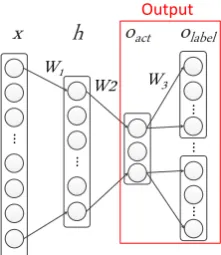
Figure 2: Hierarchical neural parsing model.
dates, compared to a static reranker (+1.34%), ob-taining the largest accuracy improvement among related neural rerankers.
2 Baseline Dependency Parser
Transition-based dependency parsers scan an in-put sentence from left to right, performing a se-quence of transition actions to predict its parse tree (Nivre, 2008). We employ the arc-standard
system (Nivre et al., 2007), which maintains partially-constructed outputs using a stack, and orders the incoming words in the sentence in a
queue. Parsing starts with an empty stack and a queue consisting of the whole input sentence. At each step, atransition actionis taken to consume the input and construct the output.
Formally, aparsing stateis denoted ashj, S, Li, whereS is a stack of subtrees [. . .s2,s1,s0],jis
the head of the queue (i.e. [q0 =wj,q1 = wj+1 · · ·]), and Lis a set of dependency arcs that has been built. At each step, the parser chooses one of the following actions:
• SHIFT(S): move the front wordwj from the
queue onto the stacks.
• LEFT-l(L): add an arc with labell between
the top two trees on the stack (s1←s0), and
removes1from the stack.
• RIGHT-l(R): add an arc with labellbetween
the top two trees on the stack (s1→s0), and
removes0from the stack.
Given the sentence “John loves Mary”, the gold standard action sequence is S, S, L, S, R.
2.1 Model
(2014), which splits the output layer into two hi-erarchical layers: the action layer and dependency label layer. The hierarchical parser determines a action in two steps, first deciding theaction type, and then thedependency label(Figure 2).
At each step of deterministic parsing, the neural model extractsnatomic features from the parsing state. We adopt the feature templates of Chen and Manning (2014). Every atomic feature is repre-sented by a feature embeddingei ∈Rd, Aninput
layeris used to concatenate thenfeature embed-dings into a vectorx = [e1;e2. . . en], wherex ∈
Rd·n. Thenxis mapped to ad
h-dimensional
hid-den layer hby a mapping matrix W1 ∈ Rdh×d·n
and a cube activation function for feature combi-nation:
h= (W1x+b1)3 (1)
Our method is different from Chen and Man-ning (2014) in the output layer. Given the hidden layerh, the action type output layeroact and the label output layer olabel(ai) of the action type ai are computed as
oact =W2h (2)
olabel(ai) =W3ih , (3)
WhereW2 ∈Rda×dh is the mapping matrix from
the hidden layer to the action layer, anddais the number of action types. Wi
3 ∈ Rdlabel×dh is the
mapping matrix from the hidden layer to the cor-responding label layer,dlabelis the number of de-pendency labels.
The probability of a labeled actionyi,jgiven its historyActsand inputxis computed as:
p(yi,j |x, Acts)
= p(ai|x, Acts)×p(lj |x, Acts, ai) (4)
where
p(ai |x, Acts) = e oi
act
Pda
k=1eokact
(5)
p(lj |x, Acts, ai) = e
ojlabel(ai)
Pdlabel
k=1 eo
k
label(ai) , (6)
Hereaiis theithaction in the action layer, andlj is thejthlabel in the label layer forai.
In training, we use the cross-entropy loss to maximum the probability of training dataA:
L(θ) =− X
yi,j∈A
logp(yi,j |x, Acts) (7)
Experiments show that our hierarchical neural parser is both faster and slightly accurate than the original neural parser.
3 Reranking Scorer
We adopt the recursive convolutional neural net-work (RCNN) of Zhu et al. (2015) for scoring full trees. Given a dependency subtree rooted at h, ci (0 < i ≤ L) is the ith child of h. The de-pendency arc(h, ci)is represented by:
zi =tanh(W(h,ci)pi) , (8)
where
pi =wh⊕xci⊕d(h,ci) (9)
Herepi ∈ Rn is the concatenation of head word embedding wh, child phrase representation xci
and the distance embeddings d(h,ci). W(h,ci) ∈
Rm×n is a linear composition matrix, which de-pends on the POS tags of h and ci. The sub-tree phrase representationxh are computed using a max-pooling function on rows, over the matrix of arc representationsZh.
Zh = [z1, z2, . . . , zL] (10) xh
j = maxi Zj,ih ,0< j < m (11)
The subtree with the headhis scored by:
score(h) =XL
i=1
vh,ciz
i (12)
Here,vh,ciis the score vector, which is a vector of
parameters that need to be trained. The score of the whole dependency treeyis computed as:
st(x, y,Θ) =
X
w∈y
score(w), (13)
wherew is the node in treey andΘdenotes the set of parameters in the network.
4 Search-based Dynamic Reranking for Dependency Parsing
Revising Depth UAS LAS
0 92.28 91.15
1 95.76 94.42
2 97.79 96.63
3 98.77 97.55
4 99.39 98.15
[image:4.595.115.249.60.135.2]5 99.74 98.47
Table 1: Oracle of the baseline parser after revis-ing actions. Revisrevis-ing depth is the maximum num-ber of revised actions for one sentence.
Action Type Num Average Probability Gold RightShift 3919419477 99.38%98.90%
Left 19556 99.61% Incorrect RightShift 968746 84.96%85.88%
Left 338 85.03%
Table 2: Average action probabilities.
4.1 Properties of the Baseline Parser
To demonstrate the above three properties, we give some preliminary results for the baseline. To parse the 1,695 sentences in Section 22 of WSJ, our baseline parser needs to perform 78,227 shift-reduce actions. During the process, if we correct every encountered incorrectly determined action and let the baseline parser re-decode the sentence from the point, we need to revise 2,052 actions, av-eraging 1.2 actions per sentence. In other words, the baseline parser can parse the 1,695 sentences correctly with 2,052 action being revised.
Note that the revise operation is required to change the action type (i.e. S, L). After revising the action type, the optimal dependency label will be chosen for parsing by the hierarchical baseline parser. We only modify the action type in the re-vising process. Thus the modified trees are always structurally different instead of only with different dependency labels compared to the original one, which guarantees structured diversity.
Revising Efficiency It can be seen from Table 1 that revising one incorrect action results in 3.5% accuracy improvement. We obtain a 99.74% UAS after a maximum 5 depth revising. Although we only revise the action type, the LAS goes up with the UAS. The property ofrevising efficiency sug-gests that high quality tree candidates can be found with a small number of changes.
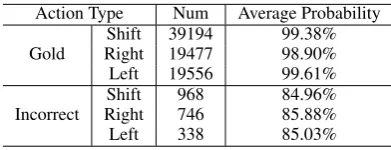
Probability Diversity Actions with lower prob-abilities are more likely to be incorrect. We com-pute the average probabilities of gold and
incor-rect actions in parsing the section 22 of WSJ (Ta-ble 2), finding that most gold actions have very high probabilities. The average probabilities of the gold actions is much higher than that of the incorrectly predicted ones, indicating that revising actions with lower probabilities can lead to better trees.
Search Efficiency The fast speed of the baseline parser allows the reranker to search a large num-ber of tree candidates efficiently. With the graph stack trick (Goldberg et al., 2013), the reranker only needs to perform partial parsing to obtain new trees. This enables a fast reranker in theory.
4.2 Search Strategy
Given an output sequence of actions by the base-line parser, we revise the action with the lowest
probability margin, and start a new branch by tak-ing a new action at this point. The probability mar-gin of an actionais computed as:p(amax)−p(a), where amax is the action taken by the baseline, which has the highest model probability.ais taken instead of amax for this branch, and the baseline parser is executed deterministically until parsing finishes, thus yielding a new dependency tree. We require that the action type must change in the revision and the most probable dependency label among all for the revised action type will be used. Multiple strategies can be used to search for the revised reranking process. For example, one intuitive strategy is best-first, which modifies the action with the lowest probability margin among all sequences of actions constructed so far. Start-ing from the original output of the baseline parser, modifying the action with the lowest probability margin results in a new tree. According to the best-first strategy, the action with the lowest prob-ability margin in the two outputs will be revised next to yield the third output. The search repeats untilkcandidates are obtained, which are used as candidates for reranking.
[image:4.595.82.278.195.270.2]experi-ments confirms this intuition. As a result, we take a beam search strategy, which uses a beam to hold boutputs to modify.
For each tree in beam search, most f actions with the lowest probability margin are modified, leading tob×f new trees. Here, b is the beam size,f is the revising factor. From these trees, the bbest are put to the beam for the next step. Search starts with the beam containing only the original base parse, and repeats forlsteps, wherelis called the revising depth. The best tree will be selected from all the trees constructed. The search process for example in Figure 1 is illustrated in Figure 3, in whichb= 1,f = 3 andl= 2.
At each iteration, the b best candidates can be decided by the baseline parser score alone, which is the product of the probability of each action. We call this thestatic searchreranking. As mentioned in the introduction, the baseline model score might not be the optimal criteria to select candidates for reranking, since they may not reflect the best or-acle or diversity. We introduce adynamic search
strategy instead, using the reranking model to cal-culate heuristic scores for guiding the search.
4.3 Search-Based Dynamic Reranking
Doppa et al. (2013) propose that structured-prediction by learning guide search should main-tain two different scoring functions, a heuristic function for guiding search and a cost function for obtaining the best output. Following Doppa et al. (2013), we use the RCNN in Section 3 to yield two different scores, namely a heuristic score st(x, y,Θh)to guide the search of revising, and a cost scorest(x, y,Θc) to select the best tree out-put.
Denote b(i) as the beam ati-th step of search, k-best candidates in the beam ofi+ 1step is:
b(i+ 1) = argK
c∈c(i)(st(x, c,Θh) +sb(x, c)), (14)
where c(i) denotes the set of newly constructed trees by revising trees inb(i),sb(x, c)is the base-line model score andargKleaves thekbest can-didate trees to the next beam. Finally, the output treeyi of reranking is selected from all searched treesCin the revising process
yi = arg max
c∈C(st(x, c,Θc) +sb(x, c)) (15)
Interpolated Reranker In testing, we also adopt the popular mixture reranking strat-egy (Hayashi et al., 2013; Le and Mikolov, 2014),
Algorithm 1: Training Algorithm for the Search-Based Dynamic Reranking.
Input:Sentencex, Gold Treesy Output:Θh,Θc
foriter←1toNdo Dh= [];
Dk= [];
foreach(x,y)∈(x,y)do bestHScoreT= null; bestCScoreT= null; bestUAST= null;
initTree= BASELINEPARSE(x); b1= [initTree];
b2= [];
ford←1todepthdo foreacht∈b1do
revisedActs= SEEK(t); revisedTrees= REVISE(t, revisedActs);
bestK= SORT(revisedTrees,Θh)
b2.ADD(bestK);
bestHScoreT= MAXSCORE (bestHScoreT,revisedTrees,Θh); bestCScoreT= MAXSCORE (bestCScoreT,revisedTrees,Θc); bestUAST= MAXUAS (bestUAST, revisedTrees,y)
b1=b2; b2= [];
Dh.ADD(x,bestUAST,bestTScoreT);
Dc.ADD(x,y,bestCScoreT);
UPDATE(Dh,Θh);
UPDATE(Dc,Θc);
which obtains better reranking performance by a linear combination of the reranking score and the baseline model score.
yi = arg max
y∈τ(xi)(β(st(xi, y,Θc) +st(x, y,Θh))
+ (1−β)sb(xi, y))
(16)
Here yi is the final output tree for a sentence xi;τ(xi)returns all the trees candidates of the dy-namic reranking;β ∈[0, 1] is a hyper-parameter.
4.4 Training
S
S
S
S
S
S
L
L
L
L
S S
S S
R
L
R
R
S
S
L
S
L
S
S S S L
R
...
beam(0)
L
Action Candidates
0.1
R
0.1R
1.0R
0.06.3
5.2
4.9
S S L
S
S
L
L
beam(1)
S S L S R
beam(2)
[image:6.595.83.535.74.141.2]Tree Candidates
Figure 3: The beam search revising process of the example in Figure 1 withb= 1,f = 3 andl= 2
l2-regularization:
J(Θc) = |D1 c|
X
(xi,yi,yˆi)∈Dc
ri(Θc) +λ2||Θc||
(17) ri(Θc) = max(0, st(xi,yˆi,Θc)
+ ∆(yi,yiˆ)−st(xi, yi,Θc)) (18)
Here, Θc is the model, st(xi, yi,Θc) is the cost reranking score foryi.
∆(yi,yˆi) =
X
d∈yˆi
κ1{d /∈yi} (19)
∆(yi,yˆi)is the structured margin loss betweenyi andyˆi, measured by counting the number of incor-rect dependency arcs in the tree (Goodman, 1998; Zhu et al., 2015).
Given training data Dh =(xi, yi0,yˆ0i)Ni=1for the
heuristic score model, the training objective is to minimize the loss between the tree with the best UASy0
iand the tree with the best heuristic rerank-ing scoreyˆ0
i.
J(Θh) = |D1 h|
X
(xi,y0i,yˆi0)∈Dh
ri(Θh) +λ2||Θh||
(20) ri(Θh) = max(0, st(xi,yˆ0i,Θh))
−st(xi, yi0,Θh) (21)
The detailed training algorithm is given by Al-gorithm 1. AdaGrad (Duchi et al., 2011) updating with subgradient (Ratliff et al., 2007) and mini-batch is adopted for optimization.
5 Experiments 5.1 Set-up
Our experiments are performed using the English Penn Treebank (PTB; Marcus et al., (1993)). We follow the standard splits of PTB3, using sections 2-21 for training, section 22 for development and
section 23 for final testing. Following prior work on reranking, we use Penn2Malt1to convert con-stituent trees to dependency trees. Ten-fold POS jackknifing is used in the training of the baseline parser. We use the POS-tagger of Collins (2002) to assign POS automatically. Because our reranking model is a dynamic reranking model, which gen-erates training instances during search, we train 10 baseline parsing models on the 10-fold jackknifing data, and load the baseline parser model dynami-cally for reranking training .
We follow Chen and Manning (2014), using the set of pre-trained word embeddings with a dictio-nary size of 13,0002 from Collobert et al. (2011). The word embeddings were trained on the entire English Wikipedia, which contains about 631 mil-lion words.
5.2 Hyper-parameters
There are two different networks in our system, namely a hierarchical feed-forward neural net-work for the baseline parsing and a recursive con-volution network for dynamic reranking. The hyper-parameters of the hierarchical parser are set as described by Chen and Manning (2014), with the embedding sized= 50, the hidden layer size dh = 300, the regularization parameterλ=10−8, the initial learning rate of Adagradα = 0.01 and the batch size b = 100,000. We set the hyper-parameters of the RCNN as follows: word embed-ding sizedw
rnn= 25, distance embedding sizeddrnn = 25, initial learning rate of Adagradαrnn = 0.1, regularization parameterλrnn=10−4, margin loss discountκ= 0.1 and revising factorf = 8.
5.3 The Hierarchical Neural Parser
Shown in Table 3, the proposed hierarchical base parser is 1.3 times faster, and obtains a slight ac-curacy improvement (Table 3) upon the parser of Chen and Manning (2014). The reason for the
Parser UASdevLAS UAStestLAS Speed hiero 92.28 91.15 91.83 90.76 884.7 original 92.00 90.89 91.67 90.62 682.3
Table 3: Performance comparison between the hi-erarchical and original neural parsers. Speed: sen-tences per second.
Beam Size 1 2 4 8
[image:7.595.78.287.61.104.2]UAS 93.38 93.45 93.81 93.51 Oracle 96.95 97.29 97.80 97.81 K 22.57 37.16 65.8 118.7
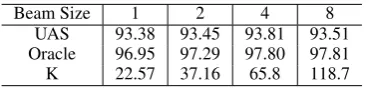
Table 4: Accuracies of the revising reranker with different beam sizes on the development set.
speed gain is that smaller output layer leads to less computation of mapping from the hidden layer to the output layer in neural networks (Morin and Bengio, 2005; Mnih and Hinton, 2009).
5.4 Development Tests
For the beam search dynamic reranking model, the selection of beam sizeband revising depthlaffect the accuracy and efficiency of the reranker. We tune the values on the development set.
Beam Size A proper beam size balances effi-ciency and accuracy in the search process. The reranking accuracies with different beam sizes are listed in Table 4. Here, the oracle is the best UAS among searched trees during reranking. K is the number of searched candidate trees in testing. The UAS and parsing oracle both go up with increas-ing the beam size. Rerankincreas-ing with beam size = 4 gives the best development performance. We set the final beam size as 4 in the next experiments.
Revising Depth As shown in Table 5, with re-vising depth increasing from 1 to 3, the reranker obtains better parsing oracle. The depth of 3 gives the best UAS 93.81% on the development set. The parsing oracle stops improving with deeper revised search. This may because in the fourth search step, the high quality trees begin to fall out the beam, resulting in worse output candi-dates, which make the revising step yield less ora-cle gains. We set the search depth as 3 in the next experiments.
Integrating Search and Learning Shown in Table 6, the dynamic and static rerankers both achieve significant accuracy improvements over the baseline parser. The dynamic reranker gives
Revising Depth 1 2 3 4
UAS 93.22 93.50 93.81 93.53 Oracle 96.31 97.57 97.80 97.81
[image:7.595.314.516.61.105.2]K 8.87 38.45 65.8 90.28
Table 5: Accuracies of the revised reranker with different revising depths on development set.
Search Type UAS +UAS Oracle Dynamic 93.81 +1.53 97.80
[image:7.595.90.275.165.209.2]Static 93.29 +1.01 97.61
Table 6: Comparing dynamic and the static search.
much better improvement, although the oracle of dynamic reranker is only 0.2% higher than the static one. This demostrates the benefit of diver-sity. The candidates are always the same for static search, but the dynamic reranker searches more diverse tree candidates in different iterations of training.
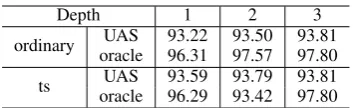
To further explore the impact of training diver-sity to dynamic reranking, we also compare the dynamic search reranker of training and testing with different revising depth. In Table 7, origin
is the results by training and testing with the same depthd. Results oftsis obtained by training with d= 3, and testing with a smallerd. For example, a reranker with training d= 3 and testing d = 2 achieves better performance than with trainingd= 2 and testingd= 2. The testing oracle of the for-mer reranker is lower than the later, yet the forfor-mer learns more from the training instance, obtaining better parsing accuracies. This again indicates that training diversity is very important besides the or-acle accuracy.
Interpolated Reranker Finally, we mix the baseline model score and the reranking score by following Hayashi et al. (2013) and Zhu et al. (2015), and the mixture parameterβ is optimized by searching with the step size of 0.005. With the mixture reranking trick, the dynamic reranker ob-tains an accuracy of 94.08% (Table 8), with an im-provement of 0.28% on the development set.
5.5 Final Results
Depth 1 2 3 ordinary oracleUAS 93.2296.31 93.5097.57 93.8197.80
[image:8.595.93.272.60.114.2]ts oracleUAS 93.5996.29 93.7993.42 93.8197.80
Table 7: Accuracies of the revised reranker with different revising depths on the development set.
Type static dynamic w/o mixture 93.29 93.81
w/ mixture 93.53 94.08
Table 8: Effects of interpolated reranking.
reranking model achieves the highest accuracy im-provement over the baseline parser on both the de-velopment and test sets. We obtain the best perfor-mance on the development set. Zhu et al. (2015) achieved higher accuracy on the test set, but they adopted a better baseline parser than ours, which could not be used in our dynamic reranker because it is not fast enough and will make our reranker slow in practice.
Comparing with Neural Dependency Parsers
We also compare parsing accuracies and speeds with a number of neural network dependency parsers. Dyer et al. (2015) proposed a dependency parser with stack LSTM; Zhou et al. (2015) ap-plied the beam search for structured dependency parsing. Both achieved significant accuracy im-provements over the deterministic neural parser of Chen and Manning (2014). Our dynamic search reranker obtains a 93.61% UAS on the test set, which is higher than most of the neural parsers ex-cept Weiss et al. (2015), who employ a structured prediction model upon the neural greedy baseline, achieving very high parsing accuracy.
5.6 Results on Stanford dependencies
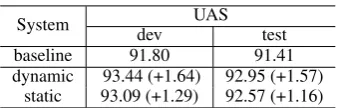
We also evaluate the proposed static and dynamic rerankers on Staford dependency treebank. The main results are consistent with CoNLL depen-dency treebank with the dynamic reranker achiev-ing a 0.41% accuracy improvement upon the static reranker on test data. But the parsing accuracy on Stanford dependency is not the state-of-the-art. We speculate that there may be two reasons. First, the baseline parsing accuracy on Stanford depen-dencies is lower than CoNLL. Second, all the hyper-parameters are tuned on the CoNLL data.
Reranker dev UAS test
Hayashi et al. (2011) N/A 92.87 (+0.97) Hayashi et al. (2013) N/A 93.12 (+0.62) Le and Zuidema (2014) N/A 93.12 (+1.09) (Zhu et al.,
2015) rerankingbaseline 93.50 (+1.05)92.45 93.8392.35(+1.48) This work
(CoNLL)
baseline 92.28 91.83
dynamic 94.08(+1.80) 93.61 (+1.78) static 93.53 (+1.25) 93.17 (+1.34)
Table 9: Comparison of dependency rerankers.
6 Related Work
Neural Networks Reranking A line of work has been proposed to explore reranking using neu-ral networks. Socher et al. (2013) first proposed a neural reranker using a recursive neural net-work for constituent parsing. Le and Zuidema (2014) extended the neural reranker to dependency parsing using a inside-outside recursive neural network (IORNN), which can process trees both bottom-up and top-down. Zhu et al. (2015) pro-posed a RCNN method, which solved the prob-lem of modeling k-ary parsing tree in dependency parsing. The neural rerankers are capable of cap-turing global syntax features across the tree. In contrast, the most non-local neural parser with LSTM (Dyer et al., 2015) cannot exploit global features. Different to previous neural rerankers, our work in this paper contributes on integrat-ing search and learnintegrat-ing for rerankintegrat-ing, instead of proposing a new neural model.
Forest Reranking Forest reranking (Huang, 2008; Hayashi et al., 2013) offers a different way to extend the coverage of reranking candidates, with computing the reranking score in the trees forests by decomposing non-local features with cube-pruning (Huang and Chiang, 2005). In con-trast, the neural reranking score encodes the whole dependency tree, which cannot be decomposed for forest reranking efficiently and accurately.
[image:8.595.306.532.62.166.2]Type System UAS Speed
Neural
Zhou et al. (2015) 93.28 14.3 Dyer et al. (2015)‡ 93.30 105 Weiss et al. (2015)† 93.99 N/A Weiss et al. (2015) semi† 94.26 N/A Pei et al. (2015) 93.29 N/A Chen et al. (2015) 92.60 2.7 Chen and Manning (2014) 92.00 1013
[image:9.595.70.296.60.155.2]This work dynamic 93.61 16.1
Table 10: Comparison with neural parsers. Speed: sentences per second. †: results are reported on Stanford dependencies. ‡: results are run by our-self using their codes.
System dev UAS test
baseline 91.80 91.41
dynamic 93.44 (+1.64) 92.95 (+1.57) static 93.09 (+1.29) 92.57 (+1.16)
Table 11: Dynamic reranking results on Stanford dependencies.
actions from the base output and the search stops in a given revising depth. The dynamic rerank-ing model concentrates on extendrerank-ing the train-ing diversity and testtrain-ing oracle for parstrain-ing rerank-ing, which is built on the transition-based parsing framework.
7 Conclusion
In this paper, we proposed a search-based dy-namic reranking model using a hierarchical ral base parser and a recursive convolutional neu-ral score model. The dynamic model is the first reranker integrating search and learning for de-pendency parsing. It achieves significant accuracy improvement (+1.78%) upon the baseline deter-ministic parser. With the dynamic search process, our reranker obtains a 0.44% accuracy improve-ment upon the static reranker. The code of this pa-per can be downloaded fromhttp://github.
com/zhouh/dynamic-reranker.
Acknowledgments
We would like to thank the anonymous reviewers for their insightful comments. Xin-Yu Dai is the corresponding author of this paper. This work was supported by the Natural Science Foundation of China (61472183, 6130158, 61472191), the 863 program via 2015AA015406 and Singapore Min-istratry of Education Tier 2 Grant T2MOE201301.
References
Miguel Ballesteros, Chris Dyer, and Noah A Smith. 2015. Improved transition-based parsing by model-ing characters instead of words with lstms. In Pro-ceedings of the 2015 Conference on Empirical Meth-ods in Natural Language Processing.
Eugene Charniak and Mark Johnson. 2005. Coarse-to-fine n-best parsing and maxent discriminative
reranking. InProceedings of the 43rd Annual
Meet-ing on Association for Computational LMeet-inguistics,
pages 173–180. Association for Computational Lin-guistics.
Danqi Chen and Christopher D Manning. 2014. A fast and accurate dependency parser using neural
net-works. InEmpirical Methods in Natural Language
Processing (EMNLP).
Xinchi Chen, Yaqian Zhou, Chenxi Zhu, Xipeng Qiu, and Xuanjing Huang. 2015. Transition-based de-pendency parsing using two heterogeneous gated re-cursive neural networks. InProceedings of the 2015 Conference on Empirical Methods in Natural Lan-guage Processing.
Michael Collins and Terry Koo. 2000.
Dis-criminative reranking for natural language parsing.
MACHINE LEARNING-INTERNATIONAL
WORK-SHOP THEN CONFERENCE-, pages 175–182.
Michael Collins. 2002. Discriminative training meth-ods for hidden markov models: Theory and
exper-iments with perceptron algorithms. InProceedings
of the ACL-02 conference on Empirical methods in
natural language processing-Volume 10, pages 1–8.
Association for Computational Linguistics.
Ronan Collobert, Jason Weston, L´eon Bottou, Michael Karlen, Koray Kavukcuoglu, and Pavel Kuksa. 2011. Natural language processing (almost) from
scratch. The Journal of Machine Learning
Re-search, 12:2493–2537.
Janardhan Rao Doppa, Alan Fern, and Prasad Tade-palli. 2012. Output space search for structured pre-diction. InICML.
Janardhan Rao Doppa, Alan Fern, and Prasad Tade-palli. 2013. Hc-search: Learning heuristics and cost functions for structured prediction. In AAAI, vol-ume 2, page 4.
John Duchi, Elad Hazan, and Yoram Singer. 2011. Adaptive subgradient methods for online learning
and stochastic optimization. The Journal of
Ma-chine Learning Research, 12:2121–2159.
Chris Dyer, Miguel Ballesteros, Wang Ling, Austin Matthews, and Noah A Smith. 2015. Transition-based dependency parsing with stack long
short-term memory. In Proceedings of the 53th Annual
[image:9.595.97.268.229.283.2]Yoav Goldberg, Kai Zhao, and Liang Huang. 2013. Efficient implementation of beam-search incremen-tal parsers. InACL (2), pages 628–633.
Joshua Goodman. 1998. Parsing inside-out. arXiv
preprint cmp-lg/9805007.
Katsuhiko Hayashi, Taro Watanabe, Masayuki Asa-hara, and Yuji Matsumoto. 2011. Third-order variational reranking on packed-shared dependency
forests. InProceedings of the Conference on
Em-pirical Methods in Natural Language Processing,
pages 1479–1488. Association for Computational Linguistics.
Katsuhiko Hayashi, Shuhei Kondo, and Yuji Mat-sumoto. 2013. Efficient stacked dependency pars-ing by forest rerankpars-ing. Transactions of the Associ-ation for ComputAssoci-ational Linguistics, 1:139–150. Liang Huang and David Chiang. 2005. Better k-best
parsing. InProceedings of the Ninth International
Workshop on Parsing Technology, pages 53–64.
As-sociation for Computational Linguistics.
Liang Huang. 2008. Forest reranking: Discriminative parsing with non-local features. InACL, pages 586– 594.
Quoc V Le and Tomas Mikolov. 2014. Distributed
representations of sentences and documents. arXiv
preprint arXiv:1405.4053.
Phong Le and Willem Zuidema. 2014. The inside-outside recursive neural network model for
depen-dency parsing. In Proceedings of the 2014
Con-ference on Empirical Methods in Natural Language
Processing (EMNLP), pages 729–739. Association
for Computational Linguistics.
Phong Le, Willem Zuidema, and Remko Scha, 2013.
Proceedings of the Workshop on Continuous Vector
Space Models and their Compositionality, chapter
Learning from errors: Using vector-based composi-tional semantics for parse reranking, pages 11–19. Association for Computational Linguistics.
Mitchell P Marcus, Mary Ann Marcinkiewicz, and Beatrice Santorini. 1993. Building a large
anno-tated corpus of english: The penn treebank.
Compu-tational linguistics, 19(2):313–330.
Andriy Mnih and Geoffrey E Hinton. 2009. A scal-able hierarchical distributed language model. In
Advances in neural information processing systems, pages 1081–1088.
Frederic Morin and Yoshua Bengio. 2005. Hierarchi-cal probabilistic neural network language model. In
Proceedings of the international workshop on artifi-cial intelligence and statistics, pages 246–252. Cite-seer.
Joakim Nivre, Johan Hall, Jens Nilsson, Atanas Chanev, G¨ulsen Eryigit, Sandra K¨ubler, Svetoslav Marinov, and Erwin Marsi. 2007. Maltparser:
A language-independent system for data-driven
de-pendency parsing. Natural Language Engineering,
13(2):95–135.
Joakim Nivre. 2008. Algorithms for deterministic
in-cremental dependency parsing. Computational
Lin-guistics, 34(4):513–553.
Wenzhe Pei, Tao Ge, and Baobao Chang. 2015. An effective neural network model for graph-based de-pendency parsing. InProc. of ACL.
Nathan D Ratliff, J Andrew Bagnell, and Martin A Zinkevich. 2007. (online) subgradient methods for structured prediction.
Richard Socher, John Bauer, Christopher D Manning, and Andrew Y Ng. 2013. Parsing with
composi-tional vector grammars. In In Proceedings of the
ACL conference. Citeseer.
David Weiss, Chris Alberti, Michael Collins, and Slav Petrov. 2015. Structured training for neural net-work transition-based parsing. InProceedings of the 53th Annual Meeting of the Association for Compu-tational Linguistics.
Hao Zhou, Yue Zhang, Shujian Huang, and Jiajun Chen. 2015. A neural probabilistic structured-prediction model for transition-based dependency
parsing. In Proceedings of the 53rd Annual
Meet-ing of the Association for Computational LMeet-inguistics and the 7th International Joint Conference on
Natu-ral Language Processing (Volume 1: Long Papers),
pages 1213–1222, Beijing, China, July. Association for Computational Linguistics.
Chenxi Zhu, Xipeng Qiu, Xinchi Chen, and Xuanjing Huang. 2015. A re-ranking model for dependency parser with recursive convolutional neural network.
In Proceedings of the 48th Annual Meeting of the