Inner Attention based Recurrent Neural Networks for Answer Selection
Bingning Wang, Kang Liu, Jun Zhao
National Laboratory of Pattern Recognition, Institute of Automation Chinese Academy of Sciences, Beijing, China
{bingning.wang, kliu, jzhao}@nlpr.ia.ac.cn
Abstract
Attention based recurrent neural networks have shown advantages in representing natural language sentences (Hermann et al., 2015; Rockt¨aschel et al., 2015; Tan et al., 2015). Based on recurrent neural networks (RNN), external attention infor-mation was added to hidden representa-tions to get an attentive sentence represen-tation. Despite the improvement over non-attentive models, the attention mechanism under RNN is not well studied. In this work, we analyze the deficiency of tradi-tional attention based RNN models quanti-tatively and qualiquanti-tatively. Then we present three new RNN models that add attention information before RNN hidden represen-tation, which shows advantage in repre-senting sentence and achieves new state-of-art results in answer selection task.
1 Introduction
Answer selection (AS) is a crucial subtask of the open domain question answering (QA) problem. Given a question, the goal is to choose the an-swer from a set of pre-selected sentences (Heilman and Smith, 2010; Yao et al., 2013). Traditional AS models are based on lexical features such as parsing tree edit distance. Neural networks based models are proposed to represent the meaning of a sentence in a vector space and then compare the question and answer candidates in this hidden space (Wang and Nyberg, 2015; Feng et al., 2015), which have shown great success in AS. However, these models represent the question and sentence separately, which may ignore the information sub-ject to the question when representing the answer. For example, given a candidate answer:
Michael Jordan abruptly retired from Chicago
Bulls before the beginning of the 1993-94 NBA season to pursue a career in baseball.
For a question: When did Michael Jordan retired from NBA? we should focus onthe be-ginning of the 1993-94 in the sentence; how-ever, when we were asked: Which sports does Michael Jordan participates after his retire-ment from NBA?we should pay more attention topursue a career in baseball.
Recent years, attention based models are pro-posed in light of this purpose and have shown great success in many NLP tasks such as ma-chine translation (Bahdanau et al., 2014; Sutskever et al., 2014), question answering (Sukhbaatar et al., 2015) and recognizing textual entailments (Rockt¨aschel et al., 2015). When building the rep-resentation of a sentence, some attention informa-tion is added to the hidden state. For example, in attention based recurrent neural networks mod-els (Bahdanau et al., 2014) each time-step hidden representation is weighted by attention. Inspired by the attention mechanism, some attention-based RNN answer selection models have been proposed (Tan et al., 2015) in which the attention when com-puting answer representation is from question rep-resentation.
However, in the RNN architecture, at each time step a word is added and the hidden state is up-dated recurrently, so those hidden states near the end of the sentence are expected to capture more information1. Consequently, after adding the at-tention information to the time sequence hidden representations, the near-the-end hidden variables will be more attended due to their comparatively abundant semantic accumulation, which may re-sult in a biased attentive weight towards the later coming words in RNN.
In this work, we analyze this attention bias 1so in many previous RNN-based model use the last
hid-den variable as the whole sentence representation
problem qualitatively and quantitatively, and then propose three new models to solve this prob-lem. Different from previous attention based RNN models in which attention information is added af-ter RNN computation, we add the attention be-fore computing the sentence representation. Con-cretely, the first one uses the question attention to adjust word representation (i.e. word embedding) in the answer directly, and then we use RNN to model the attentive word sequence. However, this model attends a sentence word by word which may ignore the relation between words. For example, if we were asked: what is his favorite food? one answer candidate is: He likes hot dog best. hot
ordogmay be not relate to the question by itself, but they are informative as a whole in the context. So we propose the second model in which every word representation in answer is impacted by not only question attention but also the context repre-sentation of the word (i.e. the last hidden state). In our last model, inspired by previous work on adding gate into inner activation of RNN to con-trol the long and short term information flow, we embed the attention to the inner activation gate of RNN to influence the computation of RNN hid-den representation. In addition, inspired by recent work called Occam’s Gate in which the activation of input units are penalized to be as less as pos-sible, we add regulation to the summation of the attention weights to impose sparsity.
Overall, in this work we make three contribu-tions: (1) We analyze the attention bias problem in traditional attention based RNN models. (2) We propose three inner attention based RNN models and achieve new state-of-the-art results in answer selection. (3) We use Occam’s Razor to regulate the attention weights which shows advantage in long sentence representation.
2 Related Work
Recent years, many deep learning framework has been developed to model the text in a vector space, and then use the embedded representations in this space for machine learning tasks. There are many neural networks architectures for this represen-tation such as convolutional neural networks(Yin et al., 2015), recursive neural networks(Socher et al., 2013) and recurrent neural networks(Mikolov et al., 2011). In this work we propose Inner Attention basedRNN(IARNN) for answer selec-tion, and there are two main works which we are
related to.
2.1 Attention based Models
Many recent works show that attention techniques can improve the performance of machine learning models (Mnih et al., 2014; Zheng et al., 2015). In attention based models, one representation is built with attention (or supervision) from other repre-sentation. Weston et al (2014) propose a neural networks based model called Memory Networks which uses an external memory to store the knowl-edge and the memory are read and written on the fly with respect to the attention, and these attentive memory are combined for inference. Since then, many variants have been proposed to solve ques-tion answering problems (Sukhbaatar et al., 2015; Kumar et al., 2015). Hermann (2015) and many other researchers (Tan et al., 2015; Rockt¨aschel et al., 2015) try to introduce the attention mechanism into the LSTM-RNN architecture. RNN models the input sequence word-by-word and updates its hidden variable recurrently. Compared with CNN, RNN is more capable of exploiting long-distance sequential information. In attention based RNN models, after computing each time step hidden representation, attention information is added to weight each hidden representation, then the hid-den states are combined with respect to that weight to obtain the sentence (or document) representa-tion. Commonly there are two ways to get atten-tion from source sentence, either by the whole sen-tence representation (which they callattentive) or word by word attention (calledimpatient). 2.2 Answer Selection
While these methods show effectiveness, they might suffer from the availability of additional re-sources and errors of many NLP tools such as dependency parsing. Recently there are many works use deep learning architecture to represent the question and answer in a same hidden space, and then the task can be converted into a classi-fication or learning-to-rank problem (Feng et al., 2015; Wang and Nyberg, 2015). With the develop-ment of attention mechanism, Tan et.al(2015) pro-pose an attention-based RNN models which intro-duce question attention to answer representation.
3 Traditional Attention based RNN Models and Their Deficiency
The attention-based models introduce the atten-tion informaatten-tion into the representaatten-tion process. In answer selection, given a question Q =
{q1, q2, q3, ..., qn} whereqi isi-th word, nis the
question length, we can compute its representation in RNN architecture as follows:
X=D[q1, q2, ..., qn]
ht=σ(Wihxt+Whhht−1+bh)
yt=σ(Whoht+bo)
(1)
where D is an embedding matrix that projects word to its embedding space in Rd; Wih, Whh,
Who are weight matrices andbh,bo are bias
vec-tors;σis active function such astanh. Usually we can ignore the output variables and use the hidden variables. After recurrent process, the last hidden variablehnor all hidden states average n1Pnt=1ht
is adopted as the question representationrq.
When modeling the candidate answer sentence with length m:S ={s1, s2, s3, ..., sm}in attention
based RNN model,
instead of using the last hidden state or average hidden states, we use attentive hidden states that are weighted byrq:
Ha= [ha(1),ha(2), ...,ha(m)]
st∝fattention(rq,ha(t)) ˜
ha(t) =ha(t)st
ra= m
X
t=1 ˜
ha(t)
(2)
whereha(t)is hidden state of the answer at time
t. In many previous work (Hermann et al., 2015; Rockt¨aschel et al., 2015; Tan et al., 2015), the
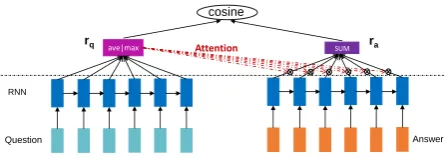
at-Question RNN
Answer
ave|max
rq Attention SUM ra
[image:3.595.310.533.61.140.2]cosine
Figure 1: Traditional attention based RNN answer selection model. Dark blue rectangles represent hidden virable,⊗means gate opperation.
tention functionfattentionwas computed as:
m(t) =tanh(Whmha(t) +Wqmrq)
fattention(rq,ha(t)) =exp(wTmsm(t)) (3)
WhmandWqm are attentive weight matrices and
wms is attentive weight vector. So we can
ex-pect that the candidate answer sentence represen-tationramay be represented in a question-guided
way: when its hidden state ha(t) is irrelevant to
the question (determined by attention weightst),
it will take less part in the final representation; but when this hidden state is relavent to the question, it will contribute more in representingra. We call
this type of attention based RNN model OARNN which stands forOuter Attention based RNN mod-els because this kind of model adds attention in-formation outside the RNN hidden representation computing process. An illustration of traditional attention-based RNN model is in Figure 1.
However, we know in the RNN architecture, the input words are processed in time sequence and the hidden states are updated recurrently, so the current hidden stateht is supposed to contain all
the information up to timet, when we add ques-tion attenques-tion informaques-tion, aiming at finding the useful part of the sentence, these near-the-end hid-den states are prone to be selected because they contains much more information about the whole sentence. In other word, if the question pays atten-tion to the hidden states at timet, then it should also pay attention to those hidden states after t
(i.e{ht0|t0 > t}) as they contain the information
at least as much as ht, but in answer selection
quantita-tively in the experiments.
4 Inner Attention based Recurrent Neural Networks
In order to solve the attention bias problem, we propose an intuition:
Attention before representation
Instead of adding attention information after en-coding the answer by RNN, we add attention be-fore computing the RNN hidden representations. Based on this intuition, we propose three inner at-tention based RNN models detailed below. 4.1 IARNN-WORD
As attention mechanism aims at finding useful part of a sentence, the first model applies the above intuition directly. Instead of using the original answer words to the RNN model, we weight the words representation according to question atten-tion as follows:
αt=σ(rTqMqixt) ˜
xt=αt∗xt (4)
where Mqi is an attention matrix to transform a
question representaion into the word embedding space. Then we use the dot value to determine the question attention strength, σis sigmoid function to normalize the weightαtbetween 0 and 1.
The above attention process can be understood as sentence distillation where the input words are distilled (or filtered) by question attention. Then, we can represent the whole sentence based on this distilled input using traditional RNN model. In this work, we use GRU instead of LSTM as build-ing block for RNN because it has shown advan-tages in many tasks and has comparatively less parameter(Jozefowicz et al., 2015) which is for-mulated as follows:
zt=σ(Wxz˜xt+Whzht−1)
ft=σ(Wxf˜xt+Whfht−1) ˜
ht=tanh(Wxh˜xt+Whh(ftht−1))
ht= (1−zt)ht−1+zt˜ht
(5)
where Wxz,Whz,Wxf,Whh,Wxh are weight
matrices andstands for element-wise multipli-cation. Finally, we get candidate answer represen-tation by average pooling all the hidden state ht.
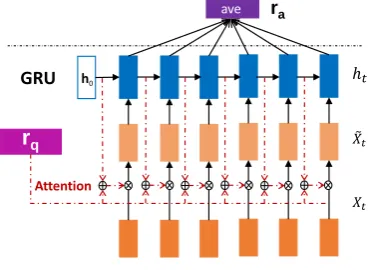
we call this model IARNN-WORD as the atten-tion is paid to the original input words. This model is shown in Figure 2.
rq
Attention
ra
ave
෨ 𝑋𝑡
𝑋𝑡
[image:4.595.316.513.61.182.2]ℎ𝑡 GRU
Figure 2: IARNN-WORD architecture.rqis
ques-tion representaques-tion.
rq
Attention
ra ave
෨ 𝑋𝑡
𝑋𝑡
ℎ𝑡
GRU h0
Figure 3: IARNN-CONTEXT architecture for building candidate answer sentence representa-tion.h0is added for completeness.
4.2 IARNN-CONTEXT
IABRNN-WORD attend input word embedding directly. However, the answer sentence may con-sist of consecutive words that are related to the question, and a word may be irrelevant to ques-tion by itself but relevant in the context of answer sentence.
So the above word by word attention mech-anism may not capture the relationship between multiple words. In order to import contextual in-formation into attention process, we modify the at-tention weights in Equation 4 with additional con-text information:
wC(t) =Mhcht−1+Mqcrq
αt
C =σ(wTC(t)xt) ˜
xt=αtC∗xt
(6)
where we useht−1 as context, Mhc andMqc are
attention weight matrices, wC(t) is the attention
[image:4.595.308.494.219.354.2]4.3 IARNN-GATE
Inspired by the previous work of LSTM (Hochre-iter and Schmidhuber, 1997) on solving the gra-dient exploding problem in RNN and recent work on building distributed word representation with topic information(Ghosh et al., 2016), instead of adding attention information to the original input, we can apply attention deeper to the GRU inner activation (i.eztandft). Because these inner
ac-tivation units control the flow of the information within the hidden stage and enables information to pass long distance in a sentence, we add atten-tion informaatten-tion to these active gates to influence the hidden representation as follows:
zt=σ(Wxzxt+Whzht−1+Mqzrq)
ft=σ(Wxfxt+Whfht−1+Mqfrq)
˜
ht=tanh(Wxhxt+Whh(ftht−1))
ht= (1−zt)ht−1+zt˜ht
(7)
whereMqzandMhzare attention weight matrices.
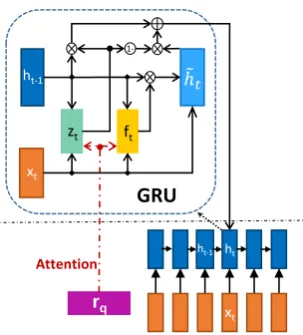
In this way, the update and forget units in GRU can focus on not only long and short term memory but also the attention information from the question. The architecture is shown in Figure 4.
4.4 IARNN-OCCAM
In answer selection, the answer sentence may only contain small number of words that are re-lated to the question. In IARNN-WORD and IARNN-CONTEXT, we calculate each word at-tention weight without considering total weights. Similar with Raiman(2015) who adds regulation to the input gate, we punish the summation of the attention weights to enforce sparsity. This is an application of Occam’s Razor: Among the whole words set, we choose those with fewest number that can represent the sentence. However, assign-ing a pre-defined hyper-parameter for this regula-tion2 is not an ideal way because it punishes all question attention weights with same strength. For different questions there may be different number of snippets in candidate answer that are required. For example, when the question type is When or
Who, answer sentence may only contains a little relavant words so we should impose more sparsity on the summation of the attention. But when the 2For example, in many machine learning problem the
original objective sometimes followed with a L1 or L2
regulation with hyper-parameter λ1 or λ2 to control the tradeoff between the original objective J and the sparsity criterion:J∗=J+ (λ1|λ2)P(L
1|L2norm)
rq
ht
xt ht-1
xt ht-1
zt ft ෨ ℎ𝑡
1-Attention
[image:5.595.339.491.59.227.2]GRU
Figure 4: IABRNN-GATE architecture. We show one time step GRU inner state process within the blue dotted line.
question type isWhyorHow, there may be much more words on the sentence that are relevant to the question so we should set the regulation value small accordingly. In this work, this attention reg-ulation is added as follows: for the specific ques-tionQi and its representationriq, we use a vector
wqpto project it into scalar valuenip, and then we
add it into the original objectiveJias follows:
nip = max{wTqpriq, λq}
J∗
i =Ji+nip mc
X
t=1
αi
t (8)
where αi
t is attention weights in Equation 4 and
Equation 6.λqis a small positive hyper-parameter.
It needs to mention that we do not regulate IARNN-GATE because the attention has been em-bedded to gate activation.
5 Experiments
5.1 Quantify Traditional Attention based Model Bias Problem
In order to quantify the outer attention based RNN model’s attention bias problem in Section 3, we build an outer attention based model similar with Tan (2015). First of all, for the question we build its representation by averaging its hidden states in LSTM, then we build the candidate answer sen-tence representation in an attentive way introduced in Section 3. Next we use the cosine similarity to compare question and answer representation simi-larity. Finally, we adopt max-margin hinge loss as objective:
L=max{0,M −cosine(rq,ra+)
+cosine(rq,ra−)}
position in a sentence
0 1000 2000 3000 4000 5000 6000 7000 8000 9000 10000
attention weight
#10-4
0.8 0.9 1 1.1 1.2 1.3 1.4
Bi-directional OARNN Bi-directional IARNN-WORD
[image:6.595.100.257.62.194.2]start end
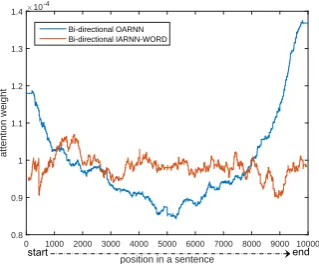
Figure 5: One directional OARNN attention dis-tribution, the horizontal axis is position of word in a sentence that has been normalized from 1 to 10000.
position in a sentence
0 1000 2000 3000 4000 5000 6000 7000 8000 9000 10000
attention weight
#10-4
0.8 0.9 1 1.1 1.2 1.3 1.4
Bi-directional OARNN Bi-directional IARNN-WORD
start end
Figure 6: Bi-directional OARNN attention distri-bution, the horizontal axis is the postion of the word in a sentence that has been normalized from 1 to 10000.
where a+ is ground truth answer candidate and
a−stands for negative one, the scalarM is a
pre-defined margin. When training result saturates af-ter 50 epoches, we get the attention weight distri-bution (i.e. sq in Equation 2). The experiment is
conducted on two answer selection datasets: Wik-iQA (Yang et al., 2015) and TrecQA (Wang et al., 2007). The normalized attention weights is re-ported in Figure 5.
However, the above model use only forward LSTM to build hidden state representation, the at-tention bias problem may attribute to the biased answer distribution: the useful part of the an-swer to the question sometimes may located at the end of the sentence. So we try OARNN in bidi-rectional architecture, where the forward LSTM and backward LSTM are concatenated for hidden representation, The bidirectional attention based LSTM attention distribution is shown in Figure 6. Analysis: As is shown in Figure 5 and 6, for one-directional OARNN, as we move from begin-ning to the end in a sentence, the question
atten-tion gains continuously; when we use bidirecatten-tional OARNN, the hidden representations near two ends of a sentence get more attention. This is consistent with our assumption that for a hidden representa-tion in RNN, the closer to the end of a sentence, the more attention it should drawn from question. But the relevant part may be located anywhere in a answer. As a result, when the sample size is large enough3, the attention weight should be unformly distributed. The traditionalattention after repre-sentation style RNN may suffer from the biased attention problem. Our IARNN models are free from this problem and distribute nearly uniform (orange line) in a sentence.
5.2 IARNN evaluation
Common Setup: We use the off-the-shelf 100-dimension word embeddings from word2vec4, and initiate all weights and attention matrices by fixing their largest singular values to 1 (Pascanu et al., 2013). IARNN-OCCAM base regulation hyper-parameterλqis set to 0.05, we addL2penalty with
a coefficient of10−5 . Dropout (Srivastava et al.,
2014) is further applied to every parameters with probability 30%. We use Adadelta(Zeiler, 2012) withρ= 0.90to update parameters.
We choose three datasets for evaluation: Insur-anceQA, WikiQA and TREC-QA. These datasets contain questions from different domains. Table 1 presents some statistics about these datasets. We adopt a max-margin hinge loss as training objec-tive. The results are reported in terms of MAP and MRR in WikiQA and TREC-QA and accuracy in InsuranceQA.
We use bidirectional GRU for all models. We share the GRU parameter between question and answer which has shown significant improvement on performance and convergency rate (Tan et al., 2015; Feng et al., 2015).
There are two common baseline systems for above three datasets:
• GRU: A non-attentive GRU-RNN that mod-els the question and answer separately.
• OARNN: Outer attention-based RNN mod-els (OARNN) with GRU which is detailed in Section 5.1.
[image:6.595.99.259.260.392.2]Dataset(train / test / dev) InsuranceQA WikiQA TREC-QA # of questions 12887 / 1800x2 /1000 873 / 243 / 126 78 / 68 / 65 # of sentences 24981(ALL) 20360 / 6165 / 2733 5919 / 1442 / 1117 Ave length of question 7.16 7.16 / 7.26 / 7.23 11.39 / 8.63 / 8.00 Ave length of sentence 49.5 25.29 / 24.59 / 24.59 30.39 / 25.61 / 24.9
Table 1: The statistics of three answer selection datasets. For the TREC-QA, we use the cleaned dataset that has been edit by human. For WikiQA and TREC-QA we remove all the questions that has no right or wrong answers.
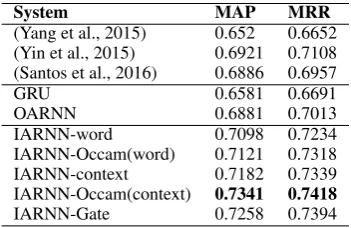
System MAP MRR (Yang et al., 2015) 0.652 0.6652 (Yin et al., 2015) 0.6921 0.7108 (Santos et al., 2016) 0.6886 0.6957
GRU 0.6581 0.6691
OARNN 0.6881 0.7013
IARNN-word 0.7098 0.7234
IARNN-Occam(word) 0.7121 0.7318 IARNN-context 0.7182 0.7339 IARNN-Occam(context) 0.7341 0.7418
[image:7.595.91.267.163.277.2]IARNN-Gate 0.7258 0.7394
Table 2: Performances on WikiQA
dataset in which all answers are collected from Wikipedia. In addition to the original (ques-tion,positive,negative) triplets, we randomly select a bunch of negative answer candidates from answer sentence pool and finally we get a relatively abundant 50,298 triplets. We use cosine similarity to compare the question and candidate answer sentence. The hidden variable’s length is set to 165 and batch size is set to 1. We use
sigmoid as GRU inner active function, we keep word embedding fixed during training. MarginM
was set to 0.15 which is tuned in the development set. We adopt three additional baseline systems applied to WikiQA: (1) A bigram CNN models with average pooling(Yang et al., 2015). (2) An attention-based CNN model which uses an interactive attention matrix for both question and answer(Yin et al., 2015)5 (3) An attention based CNN models which builds the attention matrix after sentence representation(Santos et al., 2016). The result is shown in Table 2.
InsuranceQA (Feng et al., 2015) is a domain specific answer selection dataset in which all ques-tions is related to insurance. Its vocabulary size is comparatively small (22,353), we set the batch size to 16 and the hidden variable size to 145, hinge loss marginM is adjusted to 0.12 by evalu-ation behavior. Word embeddings are also learned during training. We adopt the Geometric mean of Euclidean and Sigmoid Dot (GESD) proposed in (Feng et al., 2015) to measure the similarity
be-5In their experiment some extra linguistic features was
also added for better performance.
System Dev Test1 Test2 (Feng et al., 2015) 65.4 65.3 61.0 (Santos et al., 2016) 66.8 67.8 60.3
GRU 59.4 53.2 58.1
OARNN 65.4 66.1 60.2
IARNN-word 67.2125 67.0651 61.5896 IARNN-Occam(word) 69.9130 69.5923 63.7317 IARNN-context 67.1025 66.7211 63.0656 IARNN-Occam(context) 69.1125 68.8651 65.1396 IARNN-Gate 69.9812 70.1128 62.7965
Table 3: Experiment result in InsuranceQA, (Feng et al., 2015) is a CNN architecture without atten-tion mechanism.
System MAP MRR (Wang and Nyberg, 2015)† 0.7134 0.7913 (Wang and Ittycheriah, 2015)† 0.7460 0.8200 (Santos et al., 2016)† 0.7530 0.8511
GRU 0.6487 0.6991
OARNN 0.6887 0.7491
IARNN-word 0.7098 0.7757
IARNN-Occam(word) 0.7162 0.7916
IARNN-context 0.7232 0.8069
IARNN-Occam(context) 0.7272 0.8191
IARNN-Gate 0.7369 0.8208
Table 4: Result of different systems in Trec-QA.(Wang and Ittycheriah, 2015) propose a ques-tion similarity model to extract features from word alignment between two questions which is suitable to FAQ based QA. It needs to mention that the sys-tem marked with†are learned on TREC-QA orig-inal full training data.
tween two representations:
GESD(x, y) = 1 +||x1−y||×
1
1 +exp(−γ(xyT+c))
(10)
which shows advantage over cosine similarity in experiments.
We report accuracy instead of MAP/MRR be-cause one question only has one right answers in InsuranceQA. The result is shown in Table 3.
[image:7.595.348.524.572.619.2]Q:
how old was monica lewinsky during the affair ?Monica Samille Lewinsky ( born July 23 , 1973 ) is an American woman with whom United States President Bill Clinton admitted to having had an `` improper relationship '' while she worked at the White House in 1995 and 1996 .
Monica Samille Lewinsky ( born July 23 , 1973 ) is an American woman with whom United States President Bill Clinton admitted to having had an `` improper relationship '' while she worked at the White House in 1995 and 1996 .
OARNN:
IARNN-CONTEXT:
Figure 7: An example demonstrates the advantage of IARNN in capturing the informed part of a sentence compared with OARNN.
The effects of relativistic self focusing and preformed plasma channel guiding are analyzed.
Q: what did gurgen askaryan research when he entered the moscow state university?
IARNN-CONTEXT: IARNN-WORD: Answer:
Figure 8: An example illustrates the IARNN-CONTEXT could attend the consecutive words in a sen-tence.
size to 50 and update it during training. It needs to mention that we do not use the original TREC-QA training data but the smaller one which has been edited by human. The result is shown in Table 4.
6 Result and Analysis
We can see from the result tables that the atten-tion based RNN models achieve better results than the non-attention RNN models (GRU). OARNN and IARNN beat the non-attentive GRU in ev-ery datasets by a large margin, which proves the importance of attention mechanism in represent-ing answer sentence in AS. For the non-attentive models, the fixed width of the hidden vectors is a bottleneck for interactive information flow, so the informative part of the question could only propagate through the similarity score which is blurred for the answer representation to be prop-erly learned. But in attention based models, the question attention information is introduced to in-fluence the answer sentence representation explic-itly, in this way we can improve sentence repre-sentation for the specific target (or topic (Ghosh et al., 2016)).
The inner attention RNN models outperform outer attention model in three datasets, this is corresponds to our intuition that the bias atten-tion problem in OARNN may cause a biasd sen-tence representation. An example of the attention heatmap is shown in Figure7. To answer the ques-tion, we should focus on “born July 23 , 1973”
which is located at the beginning of the sentence. But in OARNN, the attention is biases towards the last few last words in the answer. In IARNN-CONTEXT, the attention is paid to the relevant
part and thus results in a more relevant representa-tion.
The attention with context information could also improves the result, we can see that IARNN-CONTEXT and IARNN-GATE outperform WORD in three experiments. IARNN-WORD may ignore the importance of some words because it attends answer word by word, for example in Figure8, the specific wordself or
focusing may not be related to the question by itself, but their combination and the previous word
relativistic is very informative for answering the question. In IARNN-CONTEXT we add attention information dynamically in RNN process, thus it could capture the relationship between word and its context.
who why how when where what 0.131 0.065 0.052 0.103 0.118 0.089
0 0.02 0.04 0.06 0.08 0.1 0.12 0.14
who
why
how
when where
[image:9.595.112.251.64.195.2]what
Figure 9: The Occam’s attention regulation on dif-ferent types of question.
(i.e. who,why,how,when,where,what), and each of them has the same number of samples to avoid data imbalance. We report the Occam’m regula-tion (ni
pin Equation.8) in Figure 9. As we can see
from the radar graph,whoandwhereare regulized severely compared with other types of question, this is correspond to their comparetively less infor-mation in the answer candidate to answer the ques-tion. This emphasize that different types question should impose different amount of regulation on its candidate answers. The experiment result on three AS datasets shows that the improvement of Occam’s attention is significant in WikiQA and in-suranceQA. Because most of the sentence are rel-atively long in these two datasets, and the longer the sentence, the more noise it may contain, so we should punish the summation of the attention weights to remove some irrelevant parts. Our question-specific Occam’s attention punishes the summation of attention and thus achieves a bet-ter result for both WORD and IARNN-CONTEXT.
7 Conclusion and Future Work
In this work we present some variants of tradi-tional attention-based RNN models with GRU. The key idea is attention before representation. We analyze the deficiency of traditional outer attention-based RNN models qualitatively and quantitatively. We propose three models where at-tention is embedded into representation process. Occam’s Razor is further implemented to this at-tention for better representation. Our results on answer selection demonstrate that the inner atten-tion outperforms the outer attenatten-tion in RNN. Our models can be further extended to other NLP tasks such as recognizing textual entailments where at-tention mechanism is important for sentence
rep-resentation. In the future we plan to apply our
inner-attentionintuition to other neural networks such as CNN or multi-layer perceptron.
Acknowledgments
The work was supported by the Natural Science Foundation of China (No.61533018), the National High Technology Development 863 Program of China (No.2015AA015405) and the National Nat-ural Science Foundation of China (No.61272332). And this research work was also supported by Google through focused research awards program.
References
Dzmitry Bahdanau, Kyunghyun Cho, and Yoshua Ben-gio. 2014. Neural machine translation by jointly learning to align and translate. arXiv preprint arXiv:1409.0473.
Minwei Feng, Bing Xiang, Michael R Glass, Lidan Wang, and Bowen Zhou. 2015. Applying deep learning to answer selection: A study and an open task. IEEE Automatic Speech Recognition and Un-derstanding Workshop (ASRU).
Shalini Ghosh, Oriol Vinyals, Brian Strope, Scott Roy, Tom Dean, and Larry Heck. 2016. Contextual lstm (clstm) models for large scale nlp tasks. arXiv preprint arXiv:1602.06291.
Michael Heilman and Noah A Smith. 2010. Tree edit models for recognizing textual entailments, para-phrases, and answers to questions. InHuman Lan-guage Technologies: The 2010 Annual Conference of the North American Chapter of the Association for Computational Linguistics, pages 1011–1019. Association for Computational Linguistics.
Karl Moritz Hermann, Tomas Kocisky, Edward Grefenstette, Lasse Espeholt, Will Kay, Mustafa Su-leyman, and Phil Blunsom. 2015. Teaching ma-chines to read and comprehend. InAdvances in Neu-ral Information Processing Systems, pages 1684– 1692.
Sepp Hochreiter and J¨urgen Schmidhuber. 1997. Long short-term memory. Neural computation, 9(8):1735–1780.
Rafal Jozefowicz, Wojciech Zaremba, and Ilya Sutskever. 2015. An empirical exploration of re-current network architectures. InProceedings of the 32nd International Conference on Machine Learn-ing (ICML-15), pages 2342–2350.
Tom´aˇs Mikolov, Stefan Kombrink, Luk´aˇs Burget, Jan Honza ˇCernock`y, and Sanjeev Khudanpur. 2011. Extensions of recurrent neural network lan-guage model. InAcoustics, Speech and Signal Pro-cessing (ICASSP), 2011 IEEE International Confer-ence on, pages 5528–5531. IEEE.
Volodymyr Mnih, Nicolas Heess, Alex Graves, et al. 2014. Recurrent models of visual attention. In Ad-vances in Neural Information Processing Systems, pages 2204–2212.
Razvan Pascanu, Tomas Mikolov, and Yoshua Bengio. 2013. On the difficulty of training recurrent neural networks. InProceedings of the 30th International Conference on Machine Learning (ICML-13), pages 1310–1318.
Jonathan Raiman and Szymon Sidor. 2015. Occam’s gates. arXiv preprint arXiv:1506.08251.
Tim Rockt¨aschel, Edward Grefenstette, Karl Moritz Hermann, Tom´aˇs Koˇcisk`y, and Phil Blunsom. 2015. Reasoning about entailment with neural attention.
arXiv preprint arXiv:1509.06664.
Cicero dos Santos, Ming Tan, Bing Xiang, and Bowen Zhou. 2016. Attentive pooling networks. arXiv preprint arXiv:1602.03609.
Aliaksei Severyn and Alessandro Moschitti. 2013. Au-tomatic feature engineering for answer selection and extraction. InEMNLP, pages 458–467.
Richard Socher, Alex Perelygin, Jean Y Wu, Jason Chuang, Christopher D Manning, Andrew Y Ng, and Christopher Potts. 2013. Recursive deep mod-els for semantic compositionality over a sentiment treebank. In Proceedings of the conference on empirical methods in natural language processing (EMNLP), volume 1631, page 1642. Citeseer. Nitish Srivastava, Geoffrey Hinton, Alex Krizhevsky,
Ilya Sutskever, and Ruslan Salakhutdinov. 2014. Dropout: A simple way to prevent neural networks from overfitting. The Journal of Machine Learning Research, 15(1):1929–1958.
Sainbayar Sukhbaatar, Jason Weston, Rob Fergus, et al. 2015. End-to-end memory networks. InAdvances in Neural Information Processing Systems, pages 2431–2439.
Ilya Sutskever, Oriol Vinyals, and Quoc V Le. 2014. Sequence to sequence learning with neural net-works. InAdvances in neural information process-ing systems, pages 3104–3112.
Ming Tan, Bing Xiang, and Bowen Zhou. 2015. Lstm-based deep learning models for non-factoid answer selection. arXiv preprint arXiv:1511.04108. Zhiguo Wang and Abraham Ittycheriah. 2015.
Faq-based question answering via word alignment.
arXiv preprint arXiv:1507.02628.
Di Wang and Eric Nyberg. 2015. A long short-term memory model for answer sentence selection in question answering. ACL, July.
Mengqiu Wang, Noah A Smith, and Teruko Mita-mura. 2007. What is the jeopardy model? a quasi-synchronous grammar for qa. In EMNLP-CoNLL, volume 7, pages 22–32.
Jason Weston, Sumit Chopra, and Antoine Bor-des. 2014. Memory networks. arXiv preprint arXiv:1410.3916.
Yi Yang, Wen-tau Yih, and Christopher Meek. 2015. Wikiqa: A challenge dataset for open-domain ques-tion answering. InProceedings of the Conference on Empirical Methods in Natural Language Process-ing. Citeseer.
Xuchen Yao, Benjamin Van Durme, Chris Callison-Burch, and Peter Clark. 2013. Answer extraction as sequence tagging with tree edit distance. In HLT-NAACL, pages 858–867. Citeseer.
Wen-tau Yih, Ming-Wei Chang, Christopher Meek, and Andrzej Pastusiak. 2013. Question answering using enhanced lexical semantic models. InProceedings of ACL.
Wenpeng Yin, Hinrich Sch¨utze, Bing Xiang, and Bowen Zhou. 2015. Abcnn: Attention-based con-volutional neural network for modeling sentence pairs.arXiv preprint arXiv:1512.05193.
Matthew D Zeiler. 2012. Adadelta: an adaptive learn-ing rate method.arXiv preprint arXiv:1212.5701. Yin Zheng, Richard S Zemel, Yu-Jin Zhang, and Hugo