Proceedings of the 55th Annual Meeting of the Association for Computational Linguistics, pages 420–429 Vancouver, Canada, July 30 - August 4, 2017. c2017 Association for Computational Linguistics
Proceedings of the 55th Annual Meeting of the Association for Computational Linguistics, pages 420–429 Vancouver, Canada, July 30 - August 4, 2017. c2017 Association for Computational Linguistics
Time Expression Analysis and Recognition
Using Syntactic Token Types and General Heuristic Rules
Xiaoshi Zhong, Aixin Sun, and Erik Cambria
School of Computer Science and Engineering Nanyang Technological University, Singapore
{xszhong,axsun,cambria}@ntu.edu.sg
Abstract
Extracting time expressions from free text is a fundamental task for many applica-tions. We analyze time expressions from four different datasets and find that only a small group of words are used to express time information and that the words in time expressions demonstrate similar syn-tactic behaviour. Based on the findings, we propose a type-based approach named SynTime1for time expression recognition.
Specifically, we define three main syntac-tic token types, namely time token,
mod-ifier, and numeral, to group time-related
token regular expressions. On the types we design general heuristic rules to rec-ognize time expressions. In recognition, SynTime first identifies time tokens from raw text, then searches their surroundings for modifiers and numerals to form time segments, and finally merges the time seg-ments to time expressions. As a light-weight rule-based tagger, SynTime runs in real time, and can be easily expanded by simply adding keywords for the text from different domains and different text types. Experiments on benchmark datasets and tweets data show that SynTime out-performs state-of-the-art methods.
1 Introduction
Time expression plays an important role in infor-mation retrieval and many applications in natural language processing (Alonso et al.,2011;Campos et al.,2014). Recognizing time expressions from free text has attracted considerable attention since last decade (Verhagen et al., 2007, 2010; UzZa-man et al.,2013).
1Source:https://github.com/zhongxiaoshi/syntime
We analyze time expressions in four datasets: TimeBank (Pustejovsky et al., 2003b), Giga-word (Parker et al.,2011), WikiWars (Mazur and Dale, 2010), and Tweets. From the analysis we make four findings about time expressions. First, most time expressions are very short, with 80% of time expressions containing no more than three tokens. Second, at least 91.8% of time expres-sions contain at least one time token. Third, the vocabulary used to express time information is very small, with a small group of keywords. Fi-nally, words in time expressions demonstrate sim-ilar syntactic behaviour. All the findings relate to the principle of least effort (Zipf,1949). That is, people tend to act under the least effort in order to minimize the cost of energy at both individual level and collective level to language usage (Zipf,
1949). Time expression is part of language and acts as an interface of communication. Short ex-pressions, occurrence, small vocabulary, and sim-ilar syntactic behaviour all reduce the cost of en-ergy required to communicate.
According to the findings we propose a type-based approach named SynTime (‘Syn’ stands for syntactic) to recognize time expressions. Specif-ically, we define three main token types, namely
time token,modifier, andnumeral, to group time-related token regular expressions. Time tokens are the words that explicitly express time information, such as time units (e.g., ‘year’). Modifiers mod-ify time tokens; they appear before or after time tokens, e.g., ‘several’ and ‘ago’ in ‘several years ago.’ Numerals are ordinals and numbers. From free text SynTime first identifies time tokens, then recognizes modifiers and numerals.
Naturally, SynTime is a rule-based tagger. The key difference between SynTime and other rule-based taggers lies in the way of defining token types and the way of designing rules. The defini-tion of token type in SynTime is inspired by
of-speech in which “linguists group some words of language into classes (sets) which show sim-ilar syntactic behaviour.” (Manning and Schutze,
1999) SynTime defines token types for tokens ac-cording to their syntactic behaviour. Other rule-based taggers define types for tokens rule-based on their semantic meaning. For example, SUTime defines 5 semantic modifier types, such as fre-quency modifiers;2 while SynTime defines 5
syn-tactic modifier types, such as modifiers that appear before time tokens. (See Section4.1 for details.) Accordingly, other rule-based taggers design de-terministic rules based on their meanings of to-kens themselves. SynTime instead designs gen-eral rules on the token types rather than on the to-kens themselves. For example, our general rules do not work on tokens ‘February’ nor ‘1989’ but on their token types ‘MONTH’ and ‘YEAR.’ That is why we call SynTime a type-based approach. More importantly, other rule-based taggers design rules in a fixed method, including fixed length and fixed position. In contrast, SynTime designs gen-eral rules in a heuristic way, based on the idea of boundary expansion. The general heuristic rules are quite light-weight that it makes SynTime much more flexible and expansible, and leads SynTime to run in real time.
The heuristic rules are designed on token types and are independent of specific tokens, SynTime therefore is independent of specific domains, spe-cific text types, and even spespe-cific languages that consist of specific tokens. In this paper, we test SynTime on specific domains and specific text types in English. (The test for other lan-guages needs only to construct a collection of to-ken regular expressions in the target language un-der our defined token types.) Specifically, we eval-uate SynTime against three state-of-the-art meth-ods (i.e., HeidelTime, SUTime, and UWTime) on three datasets: TimeBank, WikiWars, and Tweets.3 TimeBank and Tweets are
comprehen-sive datasets while WikiWars is a specific domain dataset about war; TimeBank and WikiWars are the datasets in formal text while Tweets dataset is in informal text. Experiments show that Syn-Time achieves comparable results on WikiWars dataset, and significantly outperforms the three state-of-the-art baselines on TimeBank and Tweets
2https://github.com/stanfordnlp/CoreNLP/tree/
master/src/edu/stanford/nlp/time/rules
3Gigaword dataset is not used in our experiments because the labels in the
dataset are not the ground truth labels but instead are automatically generated by other taggers.
datasets. More importantly, SynTime achieves the best recalls on all three datasets and exceptionally good results on Tweets dataset. To sum up, we make the following contributions.
• We analyze time expressions from four datasets and make four findings. The findings provide evidence in terms of time expression for the principle of least effort (Zipf,1949).
• We propose a time tagger named SynTime to recognize time expressions using syntactic token types and general heuristic rules. Syn-Time is independent of specific tokens, and therefore independent of specific domains, specific text types, and specific languages.
• We conduct experiments on three datasets, and the results demonstrate the effectiveness of SynTime against state-of-the-art baselines.
2 Related Work
Many research works on time expression identifi-cation are reported in TempEval exercises ( Verha-gen et al.,2007,2010;UzZaman et al.,2013). The task is divided into two subtasks: recognition and normalization.
Rule-based Time Expression Recognition. Rule-based time taggers like GUTime, Heidel-Time, and SUHeidel-Time, predefine time-related words and rules (Verhagen et al., 2005; Str¨otgen and Gertz,2010;Chang and Manning,2012). Heidel-Time (Str¨otgen and Gertz,2010) hand-crafts rules with time resources like weekdays and months, and leverages language clues like part-of-speech to identify time expression. SUTime (Chang and Manning, 2012) designs deterministic rules using a cascade finite automata (Hobbs et al.,
1997) on regular expressions over tokens (Chang and Manning, 2014). It first identifies individual words, then expands them to chunks, and finally to time expressions. Rule-based taggers achieve very good results in TempEval exercises.
SynTime is also a rule-based tagger while its key difference from other rule-based taggers is that between the rules and the tokens it introduces a layer of token type; its rules work on token types and are independent of specific tokens. Moreover, SynTime designs rules in a heuristic way.
include character features, word features, syntac-tic features, semansyntac-tic features, and gazetteer fea-tures (Llorens et al.,2010;Filannino et al.,2013;
Bethard, 2013). The statistical models include Markov logic network, logistic regression, sup-port vector machines, maximum entropy, and con-ditional random fields (Llorens et al., 2010; Uz-Zaman and Allen, 2010; Filannino et al., 2013;
Bethard,2013). Some models obtain good perfor-mance, and even achieve the highestF1of 82.71%
on strict match in TempEval-3 (Bethard,2013). Outside TempEval exercises, Angeli et al. lever-age compositional grammar and employ a EM-style approach to learn a latent parser for time expression recognition (Angeli et al., 2012). In the method named UWTime, Lee et al. handcraft a combinatory categorial grammar (CCG) ( Steed-man, 1996) to define a set of lexicon with rules and use L1-regularization to learn linguistic con-text (Lee et al.,2014). The two methods explicitly use linguistic information. In (Lee et al., 2014), especially, CCG could capture rich structure in-formation of language, similar to the rule-based methods. Tabassum et al. focus on resolving the dates in tweets, and use distant supervision to rec-ognize time expressions (Tabassum et al., 2016). They use five time types and assign one of them to each word, which is similar to SynTime in the way of defining types over tokens. However, they focus only on the type of date, while SynTime recoginizes all the time expressions and does not involve learning and runs in real time.
Time Expression Normalization. Methods in TempEval exercises design rules for time ex-pression normalization (Verhagen et al., 2005;
Str¨otgen and Gertz,2010;Llorens et al.,2010; Uz-Zaman and Allen, 2010; Filannino et al., 2013;
Bethard, 2013). Because the rule systems have high similarity, Llorens et al. suggest to construct a large knowledge base as a public resource for the task (Llorens et al.,2012). Some researchers treat the normalization process as a learning task and use machine learning methods (Lee et al., 2014;
Tabassum et al.,2016). Lee et al. (Lee et al.,2014) use AdaGrad algorithm (Duchi et al., 2011) and Tabassum et al. (Tabassum et al.,2016) use a log-linear algorithm to normalize time expressions.
[image:3.595.314.518.97.306.2]SynTime focuses only on the recognition task. The normalization could be achieved by using methods similar to the existing rule systems, be-cause they are highly similar (Llorens et al.,2012).
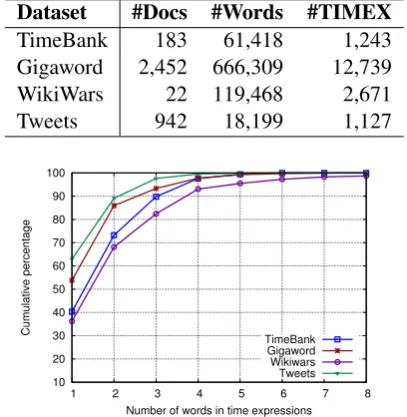
Table 1: Statistics of the datasets (A tweet here is a document.)
Dataset #Docs #Words #TIMEX TimeBank 183 61,418 1,243 Gigaword 2,452 666,309 12,739 WikiWars 22 119,468 2,671 Tweets 942 18,199 1,127
10 20 30 40 50 60 70 80 90 100
1 2 3 4 5 6 7 8
Cumulative percentage
Number of words in time expressions TimeBank Gigaword Wikiwars Tweets
Figure 1: Length distribution of time expressions
3 Time Expression Analysis 3.1 Dataset
We conduct an analysis on four datasets: Bank, Gigaword, WikiWars, and Tweets. Time-Bank (Pustejovsky et al., 2003b) is a benchmark dataset in TempEval series (Verhagen et al.,2007,
2010; UzZaman et al., 2013), consisting of 183 news articles. Gigaword (Parker et al., 2011) is a large automatically labelled dataset with 2,452 news articles and used in TempEval-3. WikiWars dataset is derived from Wikipedia articles about wars (Mazur and Dale,2010). Tweets is our man-ually annotated dataset with 942 tweets of which each contains at least one time expression. Table1
summarizes the datasets. 3.2 Finding
From the four datasets, we analyze their time ex-pressions and make four findings. We will see that despite the four datasets vary in corpus sizes, in text types, and in domains, their time expressions demonstrate similar characteristics.
Finding 1 Time expressions are very short. More than 80% of time expressions contain no more than three words and more than 90% contain no more than four words.
Table 2: The percentage of time expressions that contain at least one time token, and the average length of time expressions
[image:4.595.90.275.225.297.2]Dataset Percent Average Length TimeBank 94.61 2.00 Gigaword 96.44 1.70 WikiWars 91.81 2.38 Tweets 96.01 1.51
Table 3: Number of distinct words and number of distinct time tokens in time expressions
Dataset #Words #Time Tokens
TimeBank 130 64
Gigaword 214 80
WikiWars 224 74
Tweets 107 64
of time expressions follow a similar distribution. In particular, the one-word time expressions range from 36.23% in WikiWars to 62.91% in Tweets. In informal communication people tend to use words in minimum length to express time information. The third column in Table 2 reports the average length of time expressions. On average, time ex-pressions contain about two words.
Finding 2 More than 91% of time expressions contain at least one time token.
The second column in Table 2reports the per-centage of time expressions that contain at least one time token. We find that at least 91.81% of time expressions contain time token(s). (Some time expressions have no time token but depend on other time expressions; in ‘2 to 8 days,’ for ex-ample, ‘2’ depends on ‘8 days.’) This suggests that time tokens account for time expressions. There-fore, to recognize time expressions, it is essential to recognize their time tokens.
Finding 3 Only a small group of time-related key-words are used to express time information.
From the time expressions in all four datasets, we find that the group of keywords used to express time information is small.
Table3reports the number of distinct words and of distinct time tokens. The words/tokens are man-ually normalized before counting and their vari-ants are ignored. For example, ‘year’ and ‘5yrs’ are counted as one token ‘year.’ Numerals in the counting are ignored. Despite the four datasets
vary in sizes, domains, and text types, the num-bers of their distinct time tokens are comparable.
Across the four datasets, the number of distinct words is 350, about half of the simply summing of 675; the number of distinct time tokens is 123, less than half of the simply summing 282. Among the 123 distinct time tokens, 45 appear in all the four datasets, and 101 appear in at least two datasets. This indicates that time tokens, which account for time expressions, are highly overlapped across the four datasets. In other words, time expressions highly overlap at their time tokens.
Finding 4 POS information could not distinguish time expressions from common words, but within time expressions, POS tags can help distinguish their constituents.
For each dataset we list the top 10 POS tags that appear in time expressions, and their percentages over the whole text. Among the 40 tags (10 ×
4 datasets), 37 have percentage lower than 20%; other 3 areCD. This indicates that POS could not provide enough information to distinguish time expressions from common words. However, the most common POS tags in time expressions are
NN*,JJ,RB,CD, andDT. Within time expressions, the time tokens usually haveNN*andRB, the mod-ifiers haveJJandRB, and the numerals haveCD. This finding indicates that for the time expres-sions, their similar constituents behave in similar syntactic way. When seeing this, we realize that this is exactly how linguists define part-of-speech for language.4 The definition of POS for language
inspires us to define a syntactic type system for the time expression, part of language.
The four findings all relate to the principle of least effort (Zipf, 1949). That is, people tend to act with least effort so as to minimize the cost of energy at both individual and collective levels to the language usage (Zipf,1949). Time expression is part of language and acts as an interface of com-munication. Short expressions, occurrence, small vocabulary, and similar syntactic behaviour all re-duce the cost of energy required to communicate.
To summarize: on average, a time expression contains two tokens of which one is time token and the other is modifier/numeral, and the size of time tokens is small. To recognize a time expression, therefore, we first recognize the time token, then recognize the modifier/numeral.
4“linguists group some words of language into classes (sets) which show
General Heuristic Rules
1989, February, 12:55, this year, 3 months ago, ... Time Token, Modifier, Numeral
Rule level
Type level
[image:5.595.76.286.62.130.2]Token level
Figure 2: Layout of SynTime. The layout consists of three levels: token level, type level, and rule level. Token types group the constituent tokens of time expressions. Heuristic rules work on token types, and are independent of specific tokens.
4 SynTime: Syntactic Token Types and General Heuristic Rules
SynTime defines a syntactic type system for the tokens of time expressions, and designs heuristic rules working on the token types. Figure2shows the layout of SynTime, consisting of three levels: Token level, type level, and rule level. Token types at the type level group the tokens of time expres-sions. Heuristic rules lie at the rule level, work-ing on token types rather than on tokens them-selves. That is why the heuristic rules are gen-eral. For example, the heuristic rules do not work on tokens ‘1989’ nor ‘February,’ but on their to-ken types ‘YEAR’ and ‘MONTH.’ The heuristic rules are only relevant to token types, and are in-dependent of specific tokens. For this reason, our token types and heuristic rules are independent of specific domains, specific text types, and even spe-cific languages that consist of spespe-cific tokens. In this paper, we test SynTime on specific domain (i.e., war domain) and specific text types (i.e., for-mal text and inforfor-mal text) in English. The test for other languages simply needs to construct a set of token regular expressions in the target language under our defined token types.
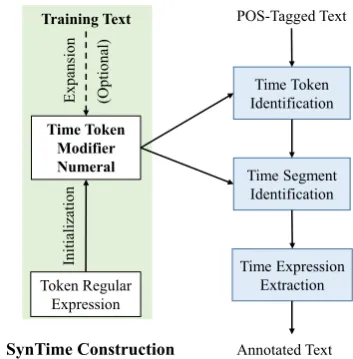
Figure 3 shows the overview of SynTime in practice. Shown on the left-hand side, SynTime is initialized with regular expressions over tokens. After initialization, SynTime can be directly ap-plied on text. On the other hand, SynTime can be easily expanded by simply adding the time-related token regular expressions from training text under each defined token type. The expansion enables SynTime to recognize time expressions in text from different domains and different text types.
Shown on the right-hand side of Figure3, Syn-Time recognizes time expression through three main steps. In the first step, SynTime identifies
Figure 3: Overview of SynTime. Left-hand side shows the construction of SynTime, with initial-ization using token regular expressions, and op-tional expansion using training text. Right-hand side shows the main steps of SynTime recogniz-ing time expressions.
time tokens from the POS-tagged raw text. Then around the time tokens SynTime searches for mod-ifiers and numerals to form time segments. In the last step, SynTime transforms the time segments to time expressions.
4.1 SynTime Construction
We define a syntactic type system for time expres-sion, specifically, 15 token types for time tokens, 5 token types for modifiers, and 1 token type for numeral. Token types to tokens is like POS tags to words; for example, ‘February’ has a POS tag of
NNPand a token type ofMONTH.
Time Token. We define 15 token types for the time tokens and use their names similar to Joda-Time classes:5 DECADE(-),YEAR(-),
SEA-SON (5), MONTH (12), WEEK (7), DATE (-),
TIME(-),DAY TIME(27),TIMELINE(12),HOLIDAY
(20),PERIOD(9),DURATION(-),TIME UNIT(15),
TIME ZONE(6), andERA(2). Number in ‘()’ indi-cates the number of distinct tokens in this token type. ‘-’ indicates that this token type involves changing digits and cannot be counted.
Modifier. We define 3 token types for the modi-fiers according to their possible positions relative to time tokens. Modifiers that appear before time tokens are PREFIX (48); modifiers after time to-kens are SUFFIX(2). LINKAGE(4) link two time
[image:5.595.324.501.64.244.2]tokens. Besides, we define 2 special modifier types,COMMA(1) for comma ‘,’ andIN ARTICLE
(2) for indefinite articles ‘a’ and ‘an.’
TimeML (Pustejovsky et al.,2003a) and Time-Bank (Pustejovsky et al.,2003b) do not treat most prepositions like ‘on’ as a part of time expressions. Thus SynTime does not collect those prepositions. Numeral. Number in time expressions can be a time token e.g., ‘10’ in ‘October 10, 2016,’ or a modifier e.g., ‘10’ in ‘10 days.’ We define NU-MERAL(-) for the ordinals and numbers.
SynTime Initialization. The token regular ex-pressions for initializing SynTime are collected from SUTime,6 a state-of-the-art rule-based
tag-ger that achieved the highest recall in TempEval-3 (Chang and Manning,2012,2013). Specifically, we collect from SUTime only the tokens and the regular expressions over tokens, and discard its other rules of recognizing full time expressions.
4.2 Time Expression Recognition
On the token types, SynTime designs a small set of heuristic rules to recognize time expressions. The recognition process includes three main steps: (1) time token identification, (2) time segment identi-fication, and (3) time expression extraction. 4.2.1 Time Token Identification
Identifying time tokens is simple, through match-ing of strmatch-ing and regular expressions. Some words might cause ambiguity. For example, ‘May’ could be a modal verb, or the fifth month of year. To filter out the ambiguous words, we use POS infor-mation. In implementation, we use Stanford POS Tagger;7 and the POS tags for matching the
in-stances of token types in SynTime are based on our Finding4in Section3.2.
Besides time tokens are identified, in this step, individual token is assigned with one token type of either modifier or numeral if it is matched with token regular expressions. In the next two steps, SynTime works on those token types.
4.2.2 Time Segment Identification
The task of time segment identification is to search the surrounding of each time token identified in previous step for modifiers and numerals, then gather the time token with its modifiers and nu-merals to form a time segment. The searching is
6https://github.com/stanfordnlp/CoreNLP/tree/
master/src/edu/stanford/nlp/time/rules
7http://nlp.stanford.edu/software/tagger.shtml
PREFIX/the PREFIX/last TIME_UNIT/week … said WEEK/Friday
s1 s2
e1 s1
(a) Stand-alone time segment to time expression
s1 s2
s1
PREFIX/the NUMERAL/third TIME_UNIT/quarter PREFIX/of YEAR/1984
(b) Merge adjacent time segments
s1 s2
s1
MONTH/January NUMERAL/13 YEAR/1951
(c) Merge overlapping time segments
s1 s2
s1
MONTH/June NUMERAL/30 COMMA/, YEAR/1990
(d) Merge overlapping time segments
s1 s2
e1 s1
NUMERAL/8 LINKAGE/to NUMERAL/20 TIME_UNIT/days
[image:6.595.311.521.60.306.2](e) Dependent time segment and time segment
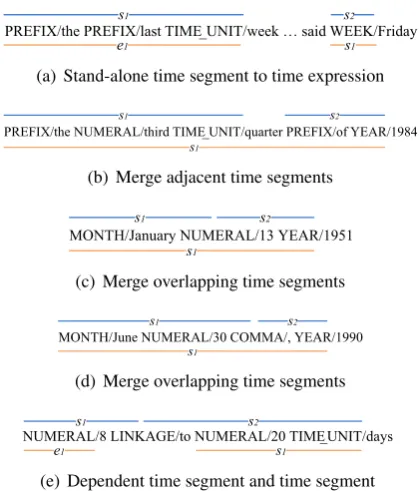
Figure 4: Example time segments and time ex-pressions. The above labels are from time segment identification; the below labels are for time expres-sion extraction.
under simple heuristic rules in which the key idea is to expand the time token’s boundaries.
At first, each time token is a time segment. If it is either aPERIODorDURATION, then no need to further search. Otherwise, search its left and its right for modifiers and numerals. For the left searching, if encounter aPREFIXorNUMERALor
IN ARTICLE, then continue searching. For the right searching, if encounter a SUFFIX or NUMERAL, then continue searching. Both the left and the right searching stop when reaching aCOMMAor LINK-AGE or a non-modifier/numeral word. The left searching does not exceed the previous time to-ken; the right searching does not exceed the next time token. A time segment consists of exactly one time token, and zero or some modifiers/numerals.
A special kind of time segments do not contain any time token; they depend on other time seg-ments next to them. For example, in ‘8 to 20 days,’ ‘to 20 days’ is a time segment, and ‘8 to’ forms a dependent time segment. (See Figure4(e).) 4.2.3 Time Expression Extraction
We scan the time segments in a sentence from beginning to the end. A stand-alone time segment is a time expression. (See Figure4(a).) The fo-cus is to deal with two or more time segments that are adjacent or overlapping. If two time segments
s1ands2are adjacent, merge them to form a new
time segments1. (See Figure4(b).) Consider that s1 ands2 overlap at a shared boundary.
Accord-ing to our time segment identification, the shared boundary could be a modifier or a numeral. If the word at the shared boundary is neither aCOMMA
nor a LINKAGE, then merges1 ands2. (See
Fig-ure4(c).) If the word is aLINKAGE, then extracts1
as a time expression and continue scanning. When the shared boundary is aCOMMA, merges1ands2
only if the COMMA’s previous token and its next token satisfy the three conditions: (1) the previous token is a time token or aNUMERAL; (2) the next token is a time token; and (3) the token types of the previous token and of the next token are not the same. (See Figure4(d).)
Although Figure4shows the examples as token types together with the tokens, we should note that the heuristic rules only work on the token types. After the extraction step, time expressions are ex-ported as a sequence of tokens from the sequence of token types.
4.3 SynTime Expansion
SynTime could be expanded by simply adding new words under each defined token type with-out changing any rule. The expansion requires the words to be added to be annotated manually. We apply the initial SynTime on the time expres-sions from training text and list the words that are not covered. Whether the uncovered words are added to SynTime is manually determined. The rule for determination is that the added words can not cause ambiguity and should be generic. Wiki-Wars dataset contains a few examples like this: ‘The time Arnold reached Quebec City.’ Words in this example are extremely descriptive, and we do not collect them. In tweets, on the other hand, people may use abbreviations and informal vari-ants; for example, ‘2day’ and ‘tday’ are popular spellings of ‘today.’ Such kind of abbreviations and informal variants will be collected.
According to our findings, not many words are used to express time information, the manual ad-dition of keywords thus will not cost much. In addition, we find that even in tweets people tend
to use formal words. In the Twitter word clus-ters trained from 56 million English tweets,8 the
most often used words are the formal words, and their frequencies are much greater than the infor-mal words’. The cluster of ‘today,’9 for example,
its most often use is the formal one, ‘today,’ which appears 1,220,829 times; while its second most of-ten use ‘2day’ appears only 34,827 times. The low rate of informal words (e.g., about 3% in ‘to-day’ cluster) suggests that even in informal envi-ronment the manual keyword addition costs little.
5 Experiments
We evaluate SynTime against three state-of-the-art baselines (i.e., HeidelTime, SUTime, and UW-Time) on three datasets (i.e., TimeBank, Wiki-Wars, and Tweets). WikiWars is a specific domain dataset about war; TimeBank and WikiWars are the datasets in formal text while Tweets dataset is in informal text. For SynTime we report the results of its two versions: SynTime-I and SynTime-E. SynTime-I is the initial version, and SynTime-E is the expanded version of SynTime-I.
5.1 Experiment Setting
Datasets. We use three datasets of which TimeBank and WikiWars are benchmark datasets whose details are shown in Section 3.1; Tweets is our manually labeled dataset that are collected from Twitter. For Tweets dataset, we randomly sample 4000 tweets and use SUTime to tag them. 942 tweets of which each contains at least one time expression. From the remaining 3,058 tweets, we randomly sample 500 and manually annotate them, and find that only 15 tweets contain time ex-pressions. We therefore roughly consider that SU-Time misses about 3% time expressions in tweets. Two annotators then manually annotate the 942 tweets with discussion to final agreement accord-ing to the standards of TimeML and TimeBank. We finally get 1,127 manually labeled time expres-sions. For the 942 tweets, we randomly sample 200 tweets as test set, and the rest 742 as training set, because a baseline UWTime requires training. Baseline Methods. We compare SynTime with methods: HeidelTime (Str¨otgen and Gertz,2010), SUTime (Chang and Manning, 2012), and
UW-8
http://www.cs.cmu.edu/˜ark/TweetNLP/cluster_ viewer.html
9
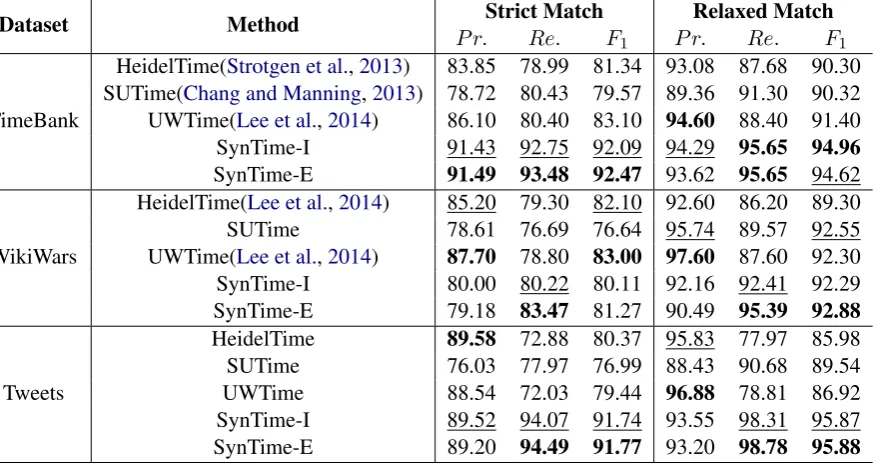
Table 4: Overall performance. The best results are in bold face and the second best are underlined. Some results are borrowed from their original papers and the papers are indicated by the references.
Dataset Method Strict Match Relaxed Match
P r. Re. F1 P r. Re. F1
TimeBank
HeidelTime(Strotgen et al.,2013) 83.85 78.99 81.34 93.08 87.68 90.30 SUTime(Chang and Manning,2013) 78.72 80.43 79.57 89.36 91.30 90.32 UWTime(Lee et al.,2014) 86.10 80.40 83.10 94.60 88.40 91.40 SynTime-I 91.43 92.75 92.09 94.29 95.65 94.96 SynTime-E 91.49 93.48 92.47 93.62 95.65 94.62
WikiWars
HeidelTime(Lee et al.,2014) 85.20 79.30 82.10 92.60 86.20 89.30 SUTime 78.61 76.69 76.64 95.74 89.57 92.55 UWTime(Lee et al.,2014) 87.70 78.80 83.00 97.60 87.60 92.30 SynTime-I 80.00 80.22 80.11 92.16 92.41 92.29 SynTime-E 79.18 83.47 81.27 90.49 95.39 92.88
Tweets
HeidelTime 89.58 72.88 80.37 95.83 77.97 85.98 SUTime 76.03 77.97 76.99 88.43 90.68 89.54 UWTime 88.54 72.03 79.44 96.88 78.81 86.92 SynTime-I 89.52 94.07 91.74 93.55 98.31 95.87 SynTime-E 89.20 94.49 91.77 93.20 98.78 95.88
Time (Lee et al., 2014). HeidelTime and SU-Time both are rule-based methods, and UWSU-Time is a learning method. When training UWTime on Tweets, we try two settings: (1) train with only Tweets training set; (2) train with TimeBank and Tweets training set. The second setting achieves slightly better result and we report that result. Evaluation Metrics. We follow TempEval-3 and use their evaluation toolkit10to reportP recision, Recall, and F1 in terms of strict match and re-laxed match(UzZaman et al.,2013).
5.2 Experiment Result
Table4 reports the overall performance. Among the 18 measures, SynTime-I and SynTime-E achieve 12 best results and 13 second best re-sults. Except the strict match on WikiWars dataset, both SynTime-I and SynTime-E achieveF1above
91%. For the relaxed match on all three datasets, SynTime-I and SynTime-E achieve recalls above 92%. The high recalls are consistent with our finding that at least 91.81% of time expressions contain time token(s). (See Table 2.) This indi-cates that SynTime covers most of time tokens. On Tweets dataset, SynTime-I and SynTime-E achieve exceptionally good performance. TheirF1
reach 91.74% with 11.37% improvement in strict match and 95.87% with 6.33% improvement in
re-10
http://www.cs.rochester.edu/˜naushad/tempeval3/ tools.zip
laxed match. The reasons are that in informal en-vironment people tend to use time expressions in minimum length, (62.91% of one-word time ex-pressions in Tweets; see Figure1.) the size of time keywords is small, (only 60 distinct time tokens; see Table 3.) and even in tweets people tend to use formal words. (See Section4.3for our finding from Twitter word clusters.) For precision, Syn-Time achieves comparable results in strict match and performs slightly poorer in relaxed match.
5.2.1 SynTime-I vs. Baseline Methods
On TimeBank dataset, SynTime-I achievesF1 of
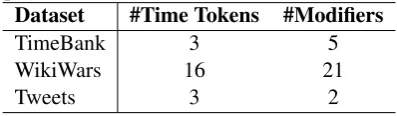
Table 5: Number of time tokens and modifiers for expansion
Dataset #Time Tokens #Modifiers
TimeBank 3 5
WikiWars 16 21
Tweets 3 2
YEAR’ at the level of token type. POS is a kind of type information. But according to our analysis, POS could not distinguish time expressions from common words. Features need carefully design-ing. On WikiWars, SynTime-I achieves competi-tive results in both matches. Time expressions in WikiWars include lots of prepositions and quite a few descriptive time expressions. SynTime could not fully recognize such kinds of time expressions because it follows TimeML and TimeBank.
5.2.2 SynTime-E vs. SynTime-I
Table5lists the number of time tokens and modi-fiers added to SynTime-I to get SynTime-E.
On TimeBank and Tweets datasets, only a few tokens are added, the corresponding results are af-fected slightly. This confirms that the size of time words is small, and that SynTime-I covers most of time words. On WikiWars dataset, relatively more tokens are added, SynTime-E performs much bet-ter than SynTime-I, especially in recall. It im-proves the recall by 3.25% in strict match and by 2.98% in relaxed match. This indicates that with more words added from specific domains (e.g., WikiWars dataset about war), SynTime can signif-icantly improve the performance.
5.3 Limitations
SynTime assumes that words are tokenized and POS tagged correctly. In reality, however, the tok-enized and tagged words are not that perfect, due to the limitation of used tools. For example, Stan-ford POS Tagger assignsVBDto the word ‘sat’ in ‘friday or sat’ while whose tag should beNNP. The incorrect tokens and POS tags affect the result.
6 Conclusion and future work
We conduct an analysis on time expressions from four datasets, and find that time expressions in general are very short and expressed by a small vocabulary, and words in time expressions demon-strate similar syntactic behavior. Our findings pro-vide epro-vidence in terms of time expression for the principle of least effort (Zipf, 1949). Inspired by
part-of-speech, based on the findings, we define a syntactic type system for the time expression, and propose a type-based time expression tagger, named by SynTime. SynTime defines syntactic token types for tokens and on the token types it designs general heuristic rules based on the idea of boundary expansion. Experiments on three datasets show that SynTime outperforms the state-of-the-art baselines, including rule-based time tag-gers and machine learning based time tagger. Be-cause our heuristic rules are quite simple, Syn-Time is light-weight and runs in real time.
Our token types and heuristic rules are indepen-dent of specific tokens, SynTime therefore is in-dependent of specific domains, specific text types, and even specific languages that consist of specific tokens. In this paper, we test SynTime on specific domains and specific text types in English. The test for other languages needs only to construct a collection of token regular expressions in the tar-get language under our defined token types.
Time expression is part of language and follows the principle of least effort. Since language us-age relates to human habits (Zipf,1949;Chomsky,
1986;Pinker,1995), we might expect that humans would share some common habits, and therefore expect that other parts of language would more or less follow the same principle. In the future we will try our analytical method on other parts of lan-guage.
Acknowledgments
The authors would like to thank the three anony-mous reviewers for their insightful comments and constructive suggestions. This research is mainly supported by the Singapore Ministry of Education Research Fund MOE2014-T2-2-066.
References
Omar Alonso, Jannik Strotgen, Ricardo Baeza-Yates, and Michael Gertz. 2011. Temporal information retrieval: Challenges and opportunities. InProceedings of 1st Inter-national Temporal Web Analytics Workshop. pages 1–8. Gabor Angeli, Christopher D. Manning, and Daniel Jurafsky.
2012. Parsing time: Learning to interpret time expres-sions. In Proceedings of 2012 Conference of the North American Chapter of the Association for Computational Linguistics: Human Language Technologies. pages 446– 455.
Ricardo Campos, Gael Dias, Alipio M. Jorge, and Adam Ja-towt. 2014. Survey of temporal information retrieval and related applications. ACM Computing Surveys47(2):15. Angel X. Chang and Christopher D. Manning. 2012. Sutime:
A library for recognizing and normalizing time expres-sions. InProceedings of 8th International Conference on Language Resources and Evaluation. pages 3735–3740. Angel X. Chang and Christopher D. Manning. 2013.
Su-time: Evaluation in tempeval-3. InProceedings of second Joint Conference on Lexical and Computational Seman-tics (SEM). pages 78–82.
Angel X. Chang and Christopher D. Manning. 2014. To-kensregex: Defining cascaded regular expressions over to-kens. Technical report, Department of Computer Science, Stanford University.
Noam Chomsky. 1986. Knowledge of Language: Its Nature, Origin, and Use. New York: Prager.
John Duchi, Elad Hazan, and Yoram Singer. 2011. Adaptive subgradient methods for online learning and stochastic op-timization. The Journal of Machine Learning Research
12:2121–2159.
Michele Filannino, Gavin Brown, and Goran Nenadic. 2013. Mantime: Temporal expression identification and normal-ization in the tempeval-3 challenge. InProceedings of the 7th International Workshop on Semantic Evaluation. Jerry R. Hobbs, Douglas E. Appelt, John Bear, David Israel,
Megumi Kameyama, Mark Stickel, and Mabry Tyson. 1997. Fastus: A cascaded finite-state transducer for ex-tracting information from natrual-language text. InFinite State Devices for Natural Language Processing. pages 383–406.
Kenton Lee, Yoav Artzi, Jesse Dodge, and Luke Zettlemoyer. 2014. Context-dependent semantic parsing for time ex-pressions. In Proceedings of the 52th Annual Meeting of the Association for Computational Linguistics. pages 1437–1447.
Hector Llorens, Leon Derczynski, Robert Gaizauskas, and Estela Saquete. 2012. Timen: An open temporal expres-sion normalisation resource. InProceedings of 8th Inter-national Conference on Language Resources and Evalua-tion. pages 3044–3051.
Hector Llorens, Estela Saquete, and Borja Navarro. 2010. Tipsem (english and spanish): Evaluating crfs and seman-tic roles in tempeval-2. InProceedings of the 5th Interna-tional Workshop on Semantic Evaluation. pages 284–291. Christopher Manning and Hinrich Schutze. 1999. Founda-tions of Statistical Natural Language Processing. Cam-bride: MIT Press.
Pawel Mazur and Robert Dale. 2010. Wikiwars: A new cor-pus for research on temporal expressions. InProceedings of the 2010 Conference on Empirical Methods in Natu-ral Language Processing. Association for Computational Linguistics, pages 913–922.
Robert Parker, David Graff, Junbo Kong, Ke Chen, and Kazuaki Maeda. 2011. Engilish gigaword fifth edition. Steven Pinker. 1995.The language instinct: The new science
of language and mind, volume 7529. Penguin.
James Pustejovsky, Jose Castano, Robert Ingria, Roser Sauri, Robert Gaizauskas, Andrea Setzer, Graham Katz, and Dragomir Radev. 2003a. Timeml: Robust specification of event and temporal expressions in text.New Directions in Question Answering3:28–34.
James Pustejovsky, Patrick Hanks, Roser Sauri, Andrew See, Robert Gaizauskas, Andrea Setzer, Beth Sundheim, Dragomir Radev, David Day, Lisa Ferro, and Marcia Lazo. 2003b. The timebank corpus. Corpus Linguistics
2003:647–656.
Mark Steedman. 1996.Surface Structure and Interpretation. The MIT Press.
Jannik Str¨otgen and Michael Gertz. 2010. Heideltime: High quality rule-based extraction and normalization of tempo-ral expressions. In Proceedings of the 5th International Workshop on Semantic Evaluation (SemEval’10). Asso-ciation for Computational Linguistics, Stroudsburg, PA, USA, pages 321–324.
Jannik Strotgen, Julian Zell, and Michael Gertz. 2013. Hei-deltime: Tuning english and developing spanish resources. InProceedings of second Joint Conference on Lexical and Computational Semantics (SEM). pages 15–19.
Jeniya Tabassum, Alan Ritter, and Wei Xu. 2016. Tweet-ime: A minimally supervised method for recognizing and normalizing time expressions in twitter. InProceedings of the 2016 Conference on Empirical Methods in Natural Language Processing. pages 307–318.
Naushad UzZaman and James F. Allen. 2010. Trips and trios system for tempeval-2: Extracting temporal information from text. InProceedings of the 5th International Work-shop on Semantic Evaluation. pages 276–283.
Naushad UzZaman, Hector Llorens, Leon Derczynski, Marc Verhagen, James Allen, and James Pustejovsky. 2013. Semeval-2013 task 1: Tempeval-3: Evaluating time ex-pressions, events, and temporal relations. InProceedings of the 7th International Workshop on Semantic Evalua-tion. pages 1–9.
Marc Verhagen, Robert Gaizauskas, Frank Schilder, Mark Hepple, Graham Katz, and James Pustejovsky. 2007. Semeval-2007 task 15: Tempeval temporal relation identi-fication. InProceedings of the 4th International Workshop on Semantic Evaluation. pages 75–80.
Marc Verhagen, Inderjeet Mani, Roser Sauri, Robert Knip-pen, Seok Bae Jang, Jessica Littman, Anna Rumshisky, John Phillips, Inderjeet Mani, Roser Sauri, Robert Knip-pen, Seok Bae Jang, Jessica Littman, Anna Rumshisky, John Phillips, and James Pustejovsky. 2005. Automat-ing temporal annotation with tarqi. In Proceedings of the ACL Interactive Poster and Demonstration Sessions.. pages 81–84.
Marc Verhagen, Roser Sauri, Tommaso Caselli, and James Pustejovsky. 2010. Semeval-2010 task 13: Tempeval-2. InProceedings of the 5th International Workshop on Se-mantic Evaluation. pages 57–62.