Proceedings of the 55th Annual Meeting of the Association for Computational Linguistics, pages 985–995 Vancouver, Canada, July 30 - August 4, 2017. c2017 Association for Computational Linguistics
Proceedings of the 55th Annual Meeting of the Association for Computational Linguistics, pages 985–995 Vancouver, Canada, July 30 - August 4, 2017. c2017 Association for Computational Linguistics
Argument Mining with Structured SVMs and RNNs
Vlad Niculae
Cornell University
Joonsuk Park
Williams College
Claire Cardie
Cornell University
Abstract
We propose a novel factor graph model for argument mining, designed for settings in which the argumentative relations in a document do not necessarily form a tree structure. (This is the case in over 20% of the web comments dataset we release.) Our model jointly learns elementary unit type classification and argumentative re-lation prediction. Moreover, our model supports SVM and RNN parametrizations, can enforce structure constraints (e.g., transitivity), and can express dependencies between adjacent relations and proposi-tions. Our approaches outperform unstruc-tured baselines in both web comments and argumentative essay datasets.
1 Introduction
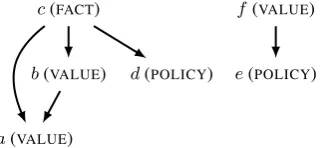
Argument mining consists of the automatic identi-fication of argumentative structures in documents, a valuable task with applications in policy mak-ing, summarization, and education, among others. The argument mining task includes the tightly-knit subproblems of classifying propositions into ele-mentary unit types and detecting argumentative re-lations between the elementary units. The desired output is a document argumentation graph struc-ture, such as the one in Figure 1, where proposi-tions are denoted by letter subscripts, and the asso-ciated argumentation graph shows their types and support relations between them.
Most annotation and prediction efforts in ar-gument mining have focused on tree or forest structures (Peldszus and Stede, 2015; Stab and Gurevych, 2016), constraining argument struc-tures to form one or more trees. This makes the problem computationally easier by enabling the use of maximum spanning tree–style parsing
ap-[Calling a debtor at work is counter-intuitive;]a
[if collectors are continuously calling someone at work, other employees may report it to the debtor’s supervisor.]b[Most companies have es-tablished rules about receiving or making per-sonal calls during working hours.]c [If a col-lector or creditor calls a debtor on his/her cell phone and is informed that the debtor is at work, the call should be terminated.]d[No calls to em-ployers should be allowed,]e[as this jeopardizes the debtor’s job.]f
b(VALUE)
a(VALUE)
d(POLICY)
c(FACT) f(VALUE)
[image:1.595.338.500.363.437.2]e(POLICY)
Figure 1: Example annotated CDCP comment.1
proaches. However, argumentationin the wildcan be less well-formed. The argument put forth in Figure 1, for instance, consists of two compo-nents: a simple tree structure and a more com-plex graph structure (c jointly supportsb andd). In this work, we design a flexible and highly expressive structured prediction model for argu-ment mining, jointly learning to classify elemen-tary units (henceforthpropositions) and to identify the argumentative relations between them (hence-forthlinks). By formulating argument mining as inference in a factor graph (Kschischang et al.,
2001), our model (described in Section4) can ac-count for correlations between the two tasks, can consider second order link structures (e.g., in Fig-ure1,c→b→a), and can impose arbitrary
con-straints (e.g., transitivity).
To parametrize our models, we evaluate two alternative directions: linear structured SVMs
1We describe proposition types (FACT, etc.) in Section3.
(Tsochantaridis et al.,2005), and recurrent neural networks with structured loss, extending ( Kiper-wasser and Goldberg,2016). Interestingly, RNNs perform poorly when trained with classification losses, but become competitive with the feature-engineered structured SVMs when trained within our proposed structured learning model.
We evaluate our approach on two argument mining datasets. Firstly, on our new Cornell eRulemaking Corpus – CDCP,2 consisting of
ar-gument annotations on comments from an eRule-making discussion forum, where links don’t al-ways form trees (Figure 1 shows an abridged example comment, and Section 3 describes the dataset in more detail). Secondly, on the UKP ar-gumentative essays v2 (henceforth UKP), where argument graphs are annotated strictly as multiple trees (Stab and Gurevych, 2016). In both cases, the results presented in Section5confirm that our models outperform unstructured baselines. On UKP, we improve link prediction over the best re-ported result in (Stab and Gurevych,2016), which is based on integer linear programming postpro-cessing. For insight into the strengths and weak-nesses of the proposed models, as well as into the differences between SVM and RNN parameteriza-tions, we perform an error analysis in Section5.1. To support argument mining research, we also re-lease our Python implementation,Marseille.3
2 Related work
Our factor graph formulation draws from ideas previously used independently in parsing and ar-gument mining. In particular, maximum spanning tree (MST) methods for arc-factored dependency parsing have been successfully used by McDon-ald et al. (2005) and applied to argument min-ing with mixed results by Peldszus and Stede
(2015). As they are not designed for the task, MST parsers cannot directly handle proposition classifi-cation or model the correlation between proposi-tion and link predicproposi-tion—a limitaproposi-tion our model addresses. Using RNN features in an MST parser with a structured loss was proposed by Kiper-wasser and Goldberg (2016); their model can be seen as a particular case of our factor graph ap-proach, limited to link prediction with a tree struc-ture constraint. Our models support multi-task learning for proposition classification,
parameter-2Dataset available athttp://joonsuk.org.
3Available athttps://github.com/vene/marseille.
izing adjacent links with higher-order structures (e.g., c → b → a) and enforcing arbitrary
con-straints on the link structure, not limited to trees. Such higher-order structures and logic constraints have been successfully used for dependency and semantic parsing byMartins et al.(2013) and Mar-tins and Almeida(2014); to our knowledge we are the first to apply them to argument mining, as well as the first to parametrize them with neural net-works. Stab and Gurevych (2016) used an inte-ger linear program to combine the output of in-dependent proposition and link classifiers using a hand-crafted scoring formula, an approach simi-lar to our baseline. Our factor graph method can combine the two tasks in a more principled way, as it fully learns the correlation between the two tasks without relying on hand-crafted scoring, and therefore can readily be applied to other argumtation datasets. Furthermore, our model can en-force the tree structure constraint, required on the UKP dataset, using MST cycle constraints used by
Stab and Gurevych(2016), thanks to the AD3 in-ference algorithm (Martins et al.,2015).
Sequence tagging has been applied to the re-lated structured tasks of proposition identifica-tion and classificaidentifica-tion (Stab and Gurevych,2016;
Habernal and Gurevych,2016;Park et al.,2015b); integrating such models is an important next step. Meanwhile, a new direction in argument mining explorespointer networks(Potash et al.,2016); a promising method, currently lacking support for tree structures and domain-specific constraints.
3 Data
We release a new argument mining dataset consist-ing of user comments about rule proposals regard-ing Consumer Debt Collection Practices (CDCP) by the Consumer Financial Protection Bureau col-lected from an eRulemaking website, http:// regulationroom.org.
propo-sition types are split into five fine-grained cate-gories:POLICYandVALUEcontain subjective
judge-ments/interpretations, where only the former spec-ifies a specific course of action to be taken. On the other hand, TESTIMONY and FACT do not
con-tain subjective expressions, the former being about personal experience, or “anecdotal.” Lastly,REFER -ENCEcovers URLs and citations, which are used to
point to objective evidence in an online setting. In comparison, the UKP dataset (Stab and Gurevych, 2016) only makes the syntactic dis-tinction betweenCLAIM,MAJOR CLAIM, andPREMISE
types, but it also includes attacklinks. The per-missible link structure is stricter in UKP, with links constrained in annotation to form one or more disjoint directed trees within each paragraph. Also, since web arguments are not necessarily fully developed, our dataset has many argumenta-tive propositions that are not in any argumentation relations. In fact, it isn’t unusual for comments to have no argumentative links at all: 28% of CDCP comments have no links, unlike UKP, where all essays have complete argument structures. Such comments with no links make the problem harder, emphasizing the importance of capturing thelack
of argumentative support, not only its presence.
3.1 Annotation results
Each user comment was annotated by two anno-tators, who independently annotated the bound-aries and types of propositions, as well as the links among them.4 To produce the final corpus, a third
annotator manually resolved the conflicts,5 and
two automatic preprocessing steps were applied: we take the link transitive closure, and we remove a small number of nested propositions.6 The
re-sulting dataset contains 731 comments, consist-ing of about 3800 sentences (≈4700 propositions) and 88k words. Out of the 43k possible pairs of propositions, links are present between only 1300 (roughly 3%). In comparison, UKP has fewer doc-uments (402), but they are longer, with a total of 7100 sentences (6100 propositions) and 147k
4The annotators used the GATE annotation tool (
Cun-ningham et al.,2011).
5Inter-annotator agreement is measured with Krippen-dorf’sα(Krippendorff,1980) with respect to elementary unit type (α=64.8%) and links (α=44.1%). A separate paper de-scribing the dataset is under preparation.
6When two propositions overlap, we keep the one that re-sults in losing the fewest links. For generality, we release the dataset without this preprocessing, and include code to repro-duce it; we believe that handling nested argumentative units is an important direction for further research.
words. Since UKP links only occur within the same paragraph and propositions not connected to the argument are removed in a preprocessing step, link prediction is less imbalanced in UKP, with 3800 pairs of propositions being linked out of a to-tal of 22k (17%). We reserve a test set of 150 doc-uments (973 propositions, 272 links) from CDCP, and use the provided 80-document test split from UKP (1266 propositions, 809 links).
4 Structured learning for argument mining 4.1 Preliminaries
Binary and multi-class classification have been ap-plied with some success to proposition and link prediction separately, but we seek a way to jointly learn the argument mining problem at the docu-mentlevel, to better model contextual dependen-cies and constraints. We therefore turn to struc-tured learning, a framework that provides the de-sired level of expressivity.
In general, learning from a dataset of documents
xi ∈Xand their associated labelsyi ∈Yinvolves
seeking model parameters wthat can “pick out”
the best label under a scoring functionf:
ˆ
y:= arg maxy∈Yf(x, y;w). (1)
Unlike classification or regression, whereXis
usu-ally a feature spaceRdandY⊆R(e.g., we predict
an integer class index or a probability), in struc-tured learning, more complex inputs and outputs are allowed. This makes the arg max in Equa-tion 1 impossible to evaluate by enumeration, so it is desirable to find models that decompose over smaller units and dependencies between them; for instance, asfactor graphs. In this section, we give a factor graph description of our proposed struc-tured model for argument mining.
4.2 Model description
An input document is a string of words with proposition offsets delimited. We denote the propositions in a document by{a, b, c, ...}and the possible directed link betweenaandbasa → b.
The argument structure we seek to predict consists of the type of each proposition ya ∈ Pand a
bi-nary label for each linkya→b ∈R ={on,off}.7 7For simplicity and comparability, we follow Stab and
a b c a→b a→c b→c
a←b a←c b←c (a) CDCP
a b c
a→b a→c b→c
[image:4.595.100.510.63.240.2]a←b a←c b←c (b) UKP
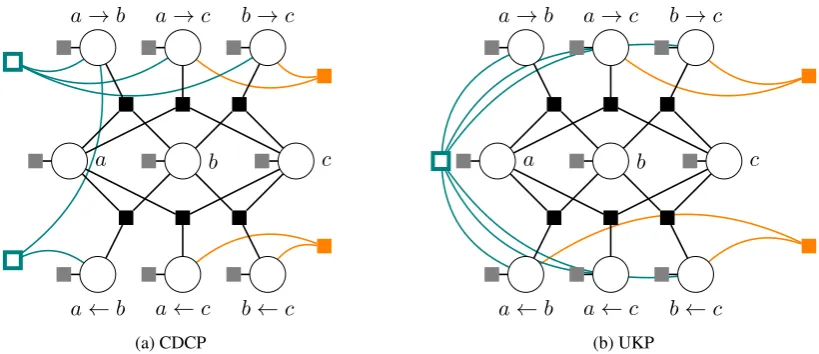
Figure 2: Factor graphs for a document with three propositions (a, b, c) and the six possible edges
be-tween them, and some of the factors used, illustrating differences and similarities bebe-tween our models for the two datasets. Unary factors are light gray; compatibility factors are black. Factors not part of the basic model have curved edges: higher-order factors are orange and on the right; link structure factors are hollow, as that they don’t have any parameters. Strict constraint factors are omitted for simplicity.
The possible proposition typesPdiffer for the two
datasets; such differences are documented in Ta-ble 1. As we describe the variables and factors constituting a document’s factor graph, we shall refer to Figure2for illustration.
Unary potentials. Each propositionaand each link a → bhas a corresponding random variable
in the factor graph (the circles in Figure 2). To encode the model’s belief in each possible value for these variables, we parametrize theunary fac-tors (gray boxes in Figure 2) with unary poten-tials: φ(a) ∈ R|P|is a score ofy
a for each
pos-sible proposition type. Similarly, link unary po-tentialsφ(a→ b) ∈R|R|are scores fory
a→b
be-ingon/off. Without any other factors, this would
amount to independent classifiers for each task.
Compatibility factors. For every possible link
a → b, the variables (a, b, a → b) are bound by a dense factor scoring their joint assignment (the black boxes in Figure 2). Such a factor could automatically learn to encourage links from compatible types (e.g., fromTESTIMONYtoPOLICY)
or discourage links between less compatible ones (e.g., from FACT to TESTIMONY). In the simplest
form, this factor would be parametrized as a ten-sorT ∈R|P|×|P|×|R|, withtijkretaining the score
of a source proposition of type ito be (k = on)
or not to be (k = off) in a link with a
proposi-tion of typej. For more flexibility, we parametrize
this factor withcompatibility featuresdepending
only on simple structure: tijk becomes a vector,
and the score of configuration(i, j, k)is given by
vab⊤tijkwherevabconsists of three binary features:
• bias: a constant value of 1, allowing T to
learn a base score for a label configuration (i, j, k), as in the simple form above,
• adjacency:when there are no other proposi-tions between the source and the target,
• order:when the source precedes the target.
Second order factors. Local argumentation graph structures such as a → b → c might be
modeled better together rather than through sep-arate link factors for a → b and b → c. As in
higher-order structured models for semantic and dependency parsing (Martins et al.,2013;Martins and Almeida,2014), we implement three types of second order factors: grandparent(a→ b→ c), sibling(a ← b → c), andco-parent(a → b ← c). Not all of these types of factors make sense
(bot-tom right), while on UKP we show a co-parent factor (top right) and a grandparent factor (bottom right). We call these factorssecond orderbecause they involve two link variables, scoring the joint assignment of both links beingon.
Valid link structure. The global structure of ar-gument links can be further constrained using do-main knowledge. We implement this using con-straint factors; these have no parameters and are denoted by empty boxes in Figure 2. In general, well-formed arguments should be cycle-free. In the UKP dataset, links form a directed forest and can never cross paragraphs. This particular con-straint can be expressed as a series oftree factors,8
one for each paragraph (the factor connected to all link variables in Figure2). In CDCP, links do not form a tree, but we use logic constraints to enforce transitivity (top left factor in Figure2) and to pre-vent symmetry (bottom left); the logic formulas implemented by these factors are described in Ta-ble1. Together, the two constraints have the desir-able side effect of preventing cycles.
Strict constraints. We may include further domain-specific constraints into the model, to ex-press certain disallowed configurations. For in-stance, proposition types that appear in CDCP data can be ordered by the level of objectivity (Park et al., 2015a), as shown in Table 1. In a well-formed argument, we would want to see links from more objective to equally or less objective propo-sitions: it’s fine to provide FACT as reason for VALUE, but not the other way around. While the
training data sometimes violates this constraint, enforcing it might provide a useful inductive bias.
Inference. Thearg maxin Equation1is a MAP over a factor graph with cycles and many overlap-ping factors, including logic factors. While ex-act inference methods are generally unavailable, our setting is perfectly suited for the Alternat-ing Directions Dual Decomposition (AD3) algo-rithm: approximate inference on expressive factor graphs with overlapping factors, logic constraints, and generic factors (e.g., directed tree factors) de-fined through maximization oracles (Martins et al.,
2015). When AD3 returns an integral solution, it is globally optimal, but when solutions are
frac-8A tree factor regards each bound variable as an edge in a graph and assigns−∞scores to configurations that are not valid trees. For inference, we can use maximum spanning arborescence algorithms such as Chu-Liu/Edmonds.
tional, several options are available. At test time, for analysis, we retrieve exact solutions using the branch-and-bound method. At training time, how-ever, fractional solutions can be used as-is; this makes better use of each iteration and actually in-creases the ratio of integral solutions in future iter-ations, as well as at test time, as proven byMeshi et al. (2016). We also find that after around 15 training iterations with fractional solutions, over 99% of inference calls are integral.
Learning. We train the models by minimizing the structured hinge loss (Taskar et al.,2004):
X
(x,y)∈D
max y′∈Y(f(x, y
′;w) +ρ(y, y′))−f(x, y;w)
(2) where ρ is a configurable misclassification cost. Themaxin Equation2is not the same as the one used for prediction, in Equation1. However, when the cost functionρdecomposes over the variables, cost-augmented inference amounts to regular in-ference after augmenting the potentials accord-ingly. We use a weighted Hamming cost:
ρ(y,yˆ) :=X v
ρ(yv)I[yv = ˆyv]
where v is summed over all variables in a
docu-ment{a} ∪ {a → b}, andρ(yv)is a
misclassifi-cation cost. We assign uniform costsρto 1 for all mistakes except false-negative links, where we use higher cost proportional to the class imbalance in the training split, effectively giving more weight to positive links during training.
4.3 Argument structure SVM
One option for parameterizing the potentials of the unary and higher-order factors is with linear models, using proposition, link, and higher-order features. This gives birth to a linear structured SVM (Tsochantaridis et al., 2005), which, when usingl2regularization, can be trained efficiently in
the dual using the online block-coordinate Frank-Wolfe algorithm ofLacoste-Julien et al.(2013), as implemented in thepystructlibrary (M¨uller and
Behnke,2014). This algorithm is more convenient than subgradient methods, as it does not require tuning a learning rate parameter.
Features. For unary proposition and link fea-tures, we faithfully follow Stab and Gurevych
Model part CDCP dataset UKP dataset
proposition types REFERENCE≻TESTIMONY≻FACT≻VALUE≻POLICY CLAIM,MAJOR CLAIM,PREMISE
links all possible within each paragraph
2ndorder factors siblings, co-parents grandparents, co-parents
link structure transitive acyclic:
• a→b & b→c =⇒ a→c
• ATMOSTONE(a→b,b→a)
directed forest:
• TREEFACTORover each paragraph • zero-potential “root” linksa→ ∗ strict constraints link source must be as least as objective as the target:
a→b =⇒ ab
link source must be premise:
a→b =⇒ a=PREMISE
Table 1: Instantiation of model design choices for each dataset.
lexical (unigrams and dependency tuples), struc-tural (token statistics and proposition location), indicators (from hand-crafted lexicons), contex-tual, syntactic (subclauses, depth, tense, modal, and POS), probability, discourse (Lin et al.,2014), and average GloVe embeddings (Pennington et al.,
2014). Link features are lexical (unigrams), syn-tactic (POS and productions), structural (token statistics, proposition statistics and location fea-tures), hand-crafted indicators, discourse triples, PMI, and shared noun counts.
Our proposed higher-order factors for grandpar-ent, co-pargrandpar-ent, and sibling structures require fea-tures extracted from a proposition triplet a, b, c. In dependency and semantic parsing, higher-order factors capture relationships between words, so sparse indicator features can be efficiently used. In our case, since propositions consist of many words, BOW features may be too noisy and too dense; so for simplicity we again take a cue from the link-specific features used by Stab and Gurevych (2016). Our higher-order factor fea-tures are: same sentence indicators (for all 3 and for each pair), proposition order (one for each of the 6 possible orderings), Jaccard similarity (be-tween all 3 and be(be-tween each pair), presence of any shared nouns (between all 3 and between each pair), and shared noun ratios: nouns shared by all 3 divided by total nouns in each proposition and each pair, and shared nouns between each pair with respect to each proposition. Up to vocabulary size difference, our total feature dimensionality is approximately 7000 for propositions and 2100 for links. The number of second order features is 35.
Hyperparameters. We pick the SVM regular-ization parameterC ∈ {0.001,0.003,0.01,0.03,
0.1,0.3} by k-fold cross validation at document level, optimizing for the average between link and propositionF1scores.
4.4 Argument structure RNN
Neural network methods have proven effective for natural language problems even with minimal-to-no feature engineering. Inspired by the use of LSTMs (Hochreiter and Schmidhuber, 1997) for MST dependency parsing byKiperwasser and Goldberg(2016), we parametrize the potentials in our factor graph with an LSTM-based neural net-work,9 replacing MST inference with the more
general AD3 algorithm, and using relaxed solu-tions for training when inference is inexact.
We extract embeddings of all words with a corpus frequency > 1, initialized with GloVe word vectors. We use a deep bidirectional LSTM to encode contextual information, representing a propositionaas the average of the LSTM outputs
of its words, henceforth denoted↔a.
Proposition potentials. We apply a multi-layer perceptron (MLP) with rectified linear activations to each proposition, with all layer dimensions equal except the final output layer, which has size
|P|and is not passed through any nonlinearities. Link potentials. To score a dependencya→b, Kiperwasser and Goldberg (2016) pass the con-catenation [↔a;↔b] through an MLP. After trying this, we found slightly better performance by first passing each proposition through a slot-specific dense layer a := σsrc(
↔
a),b := σtrg(
↔
b) fol-lowed by abilineartransformation:
φon(a→b) :=a⊤W b+w⊤srca+wtrg⊤b+w0(on).
Since the bilinear expression returns a scalar, but the link potentials must have a value for both the
on and off states, we set the full potential to φ(a → b) := [φon(a → b), w0(off)] where w(off)0
is a learned scalar bias. We initialize W to the
diagonal identity matrix.
Second order potentials. Grandparent poten-tials φ(a → b → c) score two adjacent directed edges, in other words three propositions. We again first pass each proposition representation through a slot-specific dense layer. We implement a multi-linear scorer analogously to the link potentials:
φ(a→b→c) :=X i,j,k
aibjckwijk
where W = (w)ijk is a third-order cube
ten-sor. To reduce the large numbers of parameters, we implicitly represent W as a rank r tensor: wijk = Prs=1u
(1) is u
(2) jsu
(3)
ks. Notably, this model
captures only third-order interactions between the representation of the three propositions. To cap-ture first-order “bias” terms, we could include slot-specific linear terms, e.g., w⊤aa; but to further
capture quadratic backoff effects (for instance, if two propositions carry a strong signal of being siblings regardless of their parent), we would re-quire quadratically many parameters. Instead of explicit lower-order terms, we propose augment-inga,b, andcwith a constant feature of1, which has approximately the same effect, while benefit-ing from the parameter sharbenefit-ing in the low-rank factorization; an effect described byBlondel et al.
(2016). Siblings and co-parents factors are simi-larly parametrized with their own tensors.
Hyperparameters. We perform grid search us-ing k-fold document-level cross-validation, tun-ing the dropout probability in the dense MLP lay-ers over {0.05,0.1,0.15,0.2,0.25} and the opti-mal number of passes over the training data over
{10,25,50,75,100}. We use 2 layers for the LSTM and the proposition classifier, 128 hidden units in all layers, and a multilinear decomposition with rankr = 16, after preliminary CV runs.
4.5 Baseline models
We compare our proposed models to equivalent in-dependent unary classifiers. The unary-only ver-sion of a structured SVM is anl2-regularized
lin-ear SVM.10 For the RNN, we compute unary
po-tentials in the same way as in the structured model, but apply independent hinge losses at each vari-able, instead of the global structured hinge loss. Since the RNN weights are shared, this is a form of multi-task learning. The baseline predictions can
10We train our SVM using SAGA (Defazio et al.,2014) in lightning(Blondel and Pedregosa,2016).
be interpreted as unary potentials, therefore we can simply round their output to the highest scor-ing labels, or we can, alternatively, perform test-time inference, imposing the desired structure.
5 Results
We evaluate our proposed models on both datasets. For model selection and development we used k-fold cross-validation at document level: on CDCP we setk= 3to avoid small validation folds, while on UKP we followStab and Gurevych(2016) set-tingk = 5. We compare our proposed structured learning systems (the linear structured SVM and the structured RNN) to the corresponding baseline versions. We organize our experiments in three in-cremental variants of our factor graph:basic,full, andstrict, each with the following components:11
component basic full strict (baseline)
unaries X X X X
compat. factors X X X
compat. features X X
higher-order X X
link structure X X X
strict constraints X X
FollowingStab and Gurevych(2016), we compute
F1 scores at proposition and link level, and also
report their average as a summary of overall per-formance.12 The results of a single prediction run
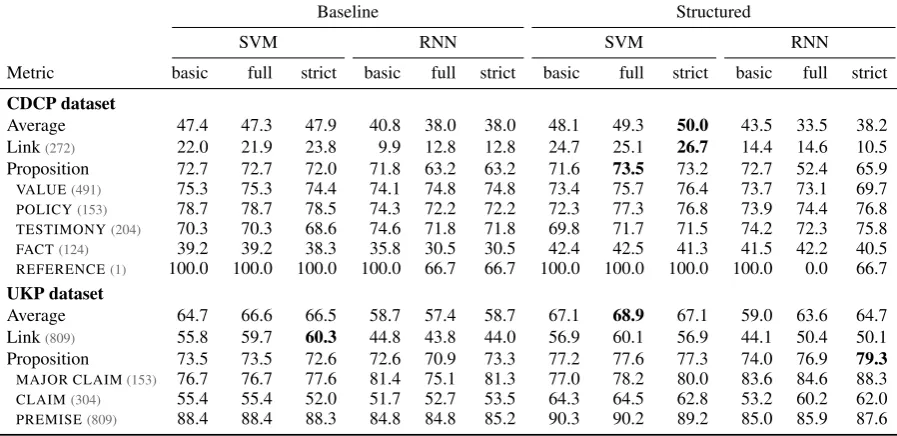
on the test set are displayed in Table2. The over-all trend is that training using a structured objec-tive is better than the baseline models, even when structured inference is applied on the baseline pre-dictions. On UKP, for link prediction, the linear baseline can reach good performance when us-ing inference, similar to the approach ofStab and Gurevych(2016), but the improvement in propo-sition prediction leads to higher overallF1 for the
structured models. Meanwhile, on the more dif-ficult CDCP setting, performing inference on the baseline output is not competitive. While feature engineering still outperforms our RNN model, we find that RNNs shine on proposition classification, especially on UKP, and that structured training can make them competitive, reducing their observed lag on link prediction (Katiyar and Cardie,2016), possibly through mitigating class imbalance.
11Components are described in Section4. The baselines
with inferencesupport only unaries and factors with no pa-rameters, as indicated in the last column.
12For linkF
1 scores, however, we find it more intuitive
Baseline Structured
SVM RNN SVM RNN
Metric basic full strict basic full strict basic full strict basic full strict CDCP dataset
Average 47.4 47.3 47.9 40.8 38.0 38.0 48.1 49.3 50.0 43.5 33.5 38.2
Link(272) 22.0 21.9 23.8 9.9 12.8 12.8 24.7 25.1 26.7 14.4 14.6 10.5
Proposition 72.7 72.7 72.0 71.8 63.2 63.2 71.6 73.5 73.2 72.7 52.4 65.9
VALUE(491) 75.3 75.3 74.4 74.1 74.8 74.8 73.4 75.7 76.4 73.7 73.1 69.7
POLICY(153) 78.7 78.7 78.5 74.3 72.2 72.2 72.3 77.3 76.8 73.9 74.4 76.8
TESTIMONY(204) 70.3 70.3 68.6 74.6 71.8 71.8 69.8 71.7 71.5 74.2 72.3 75.8
FACT(124) 39.2 39.2 38.3 35.8 30.5 30.5 42.4 42.5 41.3 41.5 42.2 40.5
REFERENCE(1) 100.0 100.0 100.0 100.0 66.7 66.7 100.0 100.0 100.0 100.0 0.0 66.7 UKP dataset
Average 64.7 66.6 66.5 58.7 57.4 58.7 67.1 68.9 67.1 59.0 63.6 64.7
Link(809) 55.8 59.7 60.3 44.8 43.8 44.0 56.9 60.1 56.9 44.1 50.4 50.1
Proposition 73.5 73.5 72.6 72.6 70.9 73.3 77.2 77.6 77.3 74.0 76.9 79.3
MAJOR CLAIM(153) 76.7 76.7 77.6 81.4 75.1 81.3 77.0 78.2 80.0 83.6 84.6 88.3
CLAIM(304) 55.4 55.4 52.0 51.7 52.7 53.5 64.3 64.5 62.8 53.2 60.2 62.0
[image:8.595.75.524.65.283.2]PREMISE(809) 88.4 88.4 88.3 84.8 84.8 85.2 90.3 90.2 89.2 85.0 85.9 87.6
Table 2: Test setF1 scores for link and proposition classification, as well as their average, on the two
datasets. The number of test instances is shown in parentheses; best scores on overall tasks are in bold.
5.1 Discussion and analysis
Contribution of compatibility features. The compatibility factor in our model can be visual-ized as conditional odds ratios given the source and target proposition types. Since there are only four possible configurations of the compatibility features, we can plot all cases in Figure3, along-side the basic model. Not using compatibility features, the basic model can only learn whether certain configurations are more likely than others (e.g. a REFERENCE supporting another REFERENCE
is unlikely, while a REFERENCE supporting a FACT
is more likely; essentially a soft version of our domain-specific strict constraints. The full model with compatibility features is finer grained, captur-ing, for example, that links fromREFERENCEtoFACT
are more likely when the reference comes after, or that links from VALUE to POLICY are extremely
likely only when the two are adjacent.
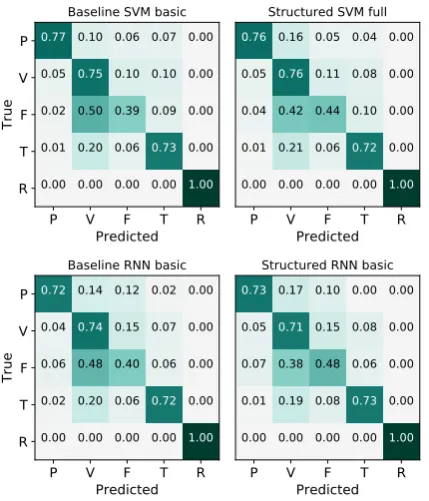
Proposition errors. The confusion matrices in Figure4 reveal that the most common confusion is misclassifyingFACTasVALUE. The strongest
dif-ference between the various models tested is that the RNN-based models make this error less often. For instance, in the proposition:
And the single most frequently used excuse of any debtor is “I didn’t receive the let-ter/invoice/statement”
the pronouns in the nested quote may be mistaken for subjectivity, leading to the structured SVMs
predictions of VALUEor TESTIMONY, while the
ba-sic structured RNN correctly classifies it asFACT. Link errors. While structured inference cer-tainly helps baselines by preventing invalid struc-tures such as cycles, it still depends on local deci-sions, losing to fully structured training in cases where joint proposition and link decisions are needed. For instance, in the following conclusion of an UKP essay, the annotators found no links:
In short, [the individual should finance his or her education]a because [it is a personal choice.]bOtherwise,[it would cause too much cost from taxpayers and the government.]c
Indeed, no reasons are provided, but baseline are misled by the connectives: the SVM baseline out-puts thatbandcarePREMISEs supporting theCLAIM a. The full structured SVM combines the two
P V F T R Target Policy Value Fact Testimony Reference Source
-0.3 -0.1 -0.1 -0.2 -0.1 +0.1 -0.0 -0.1 -0.1 -0.2 -0.0 +0.0 -0.1 -0.2 -0.1 -0.2 -0.1 -0.1 -0.3 +0.1 -0.3 +0.0 +0.6 +0.1 -0.4
Non-adjacent, trg precedes src
P V F T R Target
-0.2 -0.3 -0.0 -0.2 -0.2 -0.4 -0.3 -0.2 -0.1 -0.3 -0.3 -0.1 +0.0 -0.0 -0.3 -0.3 -0.0 -0.1 +0.1 -0.2 -0.2 -0.0 +0.4 +0.1 -0.4
Non-adjacent, src precedes trg
P V F T R Target
+0.6 +0.9 +0.3 +0.1 -0.1
+2.2 +1.7 +1.0+0.9 -0.1
+2.0 +1.7 +1.0+0.6 -0.1
+1.5 +1.5+0.9 +0.9 +0.1 -0.2 +0.1 +0.5 +0.1 -0.8
Adjacent, trg precedes src
P V F T R Target
+0.7 +0.7 +0.3 +0.1 -0.2
+1.7 +1.4+0.9 +0.9 -0.2
+1.7 +1.5 +1.1+0.7 -0.3
+1.4 +1.5+0.9+1.4-0.1 -0.1 +0.1 +0.3 +0.1 -0.9
Adjacent, src precedes trg
P V F T R Target
-0.8 -0.7 -1.1 -1.0 -0.4 +0.9 +0.3 -0.5 -0.5 -0.5 +0.6 +0.6 -0.2 -0.5 -0.3 +0.1 +0.3 -0.3 -0.2 -0.1 -0.7 -0.0+1.3-0.0 -1.0
[image:9.595.80.521.68.178.2]Basic (no compatibility features)
Figure 3: Learned conditional log-oddslogp(p(offon|·|·)), given the source and target proposition types and compatibility feature settings. First four figures correspond to the four possible settings of the compati-bility features in the full structured SVM model. For comparison, the rightmost figure shows the same parameters in the basic structured SVM model, which does not use compatibility features.
P V F T R
Predicted P V F T R True
0.77 0.10 0.06 0.07 0.00
0.05 0.75 0.10 0.10 0.00
0.02 0.50 0.39 0.09 0.00
0.01 0.20 0.06 0.73 0.00
0.00 0.00 0.00 0.00 1.00
Baseline SVM basic
P V F T R
Predicted
0.76 0.16 0.05 0.04 0.00
0.05 0.76 0.11 0.08 0.00
0.04 0.42 0.44 0.10 0.00
0.01 0.21 0.06 0.72 0.00
0.00 0.00 0.00 0.00 1.00
Structured SVM full
P V F T R
Predicted P V F T R True
0.72 0.14 0.12 0.02 0.00
0.04 0.74 0.15 0.07 0.00
0.06 0.48 0.40 0.06 0.00
0.02 0.20 0.06 0.72 0.00
0.00 0.00 0.00 0.00 1.00
Baseline RNN basic
P V F T R
Predicted
0.73 0.17 0.10 0.00 0.00
0.05 0.71 0.15 0.08 0.00
0.07 0.38 0.48 0.06 0.00
0.01 0.19 0.08 0.73 0.00
0.00 0.00 0.00 0.00 1.00
Structured RNN basic
Figure 4: Normalized confusion matrices for proposition type classification.
This is most beneficial for the 856 co-parent struc-tures in the UKP test set: the full structured SVM has 53%F1, while the basic structured SVM and
the basic baseline get 47% and 45% respectively. On CDCP, while higher-order factors help, perfor-mance on siblings and co-parents is below 10%F1
score. This is likely due to link sparsity and sug-gests plenty of room for further development.
6 Conclusions and future work
We introduce an argumentation parsing model based on AD3relaxed inference in expressive fac-tor graphs, experimenting with both linear
struc-[I think the cost of education needs to be re-duced (...) or repayment plans need to be income based.]a [As far as consumer protection, legal aid needs to be made available, affordable and effective,]b [and consumers need to take time to really know their rights and stop complaining about harassment]c[because that’s a completely different cause of action than restitution.]d
a(P)
c(P) b(P) d(V)
(a) Ground truth
a(V) c(V)
b(P) d(V)
(b) Baseline linear strict
a(P) c(V)
b(P) d(V)
(c) Structured linear full
a(P)
c(P) b(P) d(F)
[image:9.595.77.292.268.519.2](d) Structured RNN strict
Figure 5: Predictions on a CDCP comment where the structured RNN outperforms the other models.
tured SVMs and structured RNNs, parametrized with higher-order factors and link structure con-straints. We demonstrate our model on a new argumentation mining dataset with more permis-sive argument structure annotation. Our model also achieves state-of-the-art link prediction per-formance on the UKP essays dataset.
[image:9.595.317.518.358.485.2]Acknowledgements
We are grateful to Andr´e Martins, Andreas M¨uller, Arzoo Katyiar, Chenhao Tan, Felix Wu, Jack Hes-sel, Justine Zhang, Mathieu Blondel, Tianze Shi, Tobias Schnabel, and the rest of the Cornell NLP seminar for extremely helpful discussions. We thank the anonymous reviewers for their thorough and well-argued feedback.
References
Stergos Afantenos and Nicholas Asher. 2014. Counter-argumentation and discourse: A case study. In
Pro-ceedings of ArgNLP.
Mathieu Blondel, Masakazu Ishihata, Akinori Fujino, and Naonori Ueda. 2016. Polynomial networks and factorization machines: New insights and efficient training algorithms. InProceedings of ICML.
Mathieu Blondel and Fabian Pedregosa. 2016.
Lightning: large-scale linear
classifica-tion, regression and ranking in Python.
https://doi.org/10.5281/zenodo.200504.
Hamish Cunningham, Diana Maynard, Kalina Bontcheva, Valentin Tablan, Niraj Aswani, Ian Roberts, Genevieve Gorrell, Adam Funk, Angus Roberts, Danica Damljanovic, Thomas Heitz, Mark A. Greenwood, Horacio Saggion, Johann Petrak, Yaoyong Li, and Wim Peters. 2011. Text
Processing with GATE (Version 6).
Aaron Defazio, Francis Bach, and Simon Lacoste-Julien. 2014. SAGA: A fast incremental gradient method with support for non-strongly convex com-posite objectives. InProceedings of NIPS.
Ivan Habernal and Iryna Gurevych. 2016. Argumenta-tion mining in user-generated web discourse.
Com-putational Linguistics.
Sepp Hochreiter and J¨urgen Schmidhuber. 1997. Long short-term memory. Neural Computation
9(8):1735–1780.
Arzoo Katiyar and Claire Cardie. 2016. Investigating LSTMs for joint extraction of opinion entities and relations. InProceedings of ACL.
Eliyahu Kiperwasser and Yoav Goldberg. 2016. Simple and accurate dependency parsing us-ing bidirectional LSTM feature representations.
arXiv:1603.04351preprint.
Klaus Krippendorff. 1980. Content Analysis: An
Intro-duction to Its Methodology. Commtext. Sage.
Frank R Kschischang, Brendan J Frey, and H-A Loeliger. 2001. Factor graphs and the sum-product algorithm. IEEE Transactions on Information The-ory47(2):498–519.
Simon Lacoste-Julien, Martin Jaggi, Mark Schmidt, and Patrick Pletscher. 2013. Block-coordinate Frank-Wolfe optimization for structural SVMs. In
Proceedings of ICML.
Ziheng Lin, Hwee Tou Ng, and Min-Yen Kan. 2014. A PDTB-styled end-to-end discourse parser. Natural
Language Engineering20(02):151–184.
Andr´e FT Martins and Mariana SC Almeida. 2014. Priberam: A Turbo Semantic Parser with second or-der features. InProceedings of SemEval.
Andr´e FT Martins, Miguel B Almeida, and Noah A Smith. 2013. Turning on the Turbo: Fast third-order non-projective Turbo Parsers. InProceedings
of ACL.
Andr´e FT Martins, M´ario AT Figueiredo, Pedro MQ Aguiar, Noah A Smith, and Eric P Xing. 2015. AD3: Alternating directions dual decomposition for MAP inference in graphical models. Journal of
Ma-chine Learning Research16:495–545.
Ryan McDonald, Fernando Pereira, Kiril Ribarov, and Jan Hajiˇc. 2005. Non-projective dependency pars-ing uspars-ing spannpars-ing tree algorithms. InProceedings
of EMNLP.
Ofer Meshi, Mehrdad Mahdavi, Adrian Weller, and David Sontag. 2016. Train and test tightness of LP relaxations in structured prediction. InProceedings
of ICML.
Andreas C M¨uller and Sven Behnke. 2014. PyStruct: learning structured prediction in Python. Journal of
Machine Learning Research15(1):2055–2060.
Graham Neubig, Chris Dyer, Yoav Goldberg, Austin Matthews, Waleed Ammar, Antonios Anastasopou-los, Miguel Ballesteros, David Chiang, Daniel Clothiaux, Trevor Cohn, Kevin Duh, Manaal Faruqui, Cynthia Gan, Dan Garrette, Yangfeng Ji, Lingpeng Kong, Adhiguna Kuncoro, Gau-rav Kumar, Chaitanya Malaviya, Paul Michel, Yusuke Oda, Matthew Richardson, Naomi Saphra, Swabha Swayamdipta, and Pengcheng Yin. 2017. DyNet: The dynamic neural network toolkit.
arXiv:1701.03980preprint.
Joonsuk Park, Cheryl Blake, and Claire Cardie. 2015a. Toward machine-assisted participation in eRulemak-ing: An argumentation model of evaluability. In
Proceedings of ICAIL.
Joonsuk Park, Arzoo Katiyar, and Bishan Yang. 2015b. Conditional random fields for identifying appropri-ate types of support for propositions in online user comments. In Proceedings of the 2nd Workshop
on Argumentation Mining. Association for
Compu-tational Linguistics, Denver, CO, pages 39–44.
Jeffrey Pennington, Richard Socher, and Christopher D Manning. 2014. GloVe: Global vectors for word representation. InProceedings of EMNLP.
Peter Potash, Alexey Romanov, and Anna Rumshisky. 2016. Here’s my point: Argumentation mining with pointer networks. arXiv:1612.08994preprint.
Christian Stab and Iryna Gurevych. 2016. Pars-ing argumentation structures in persuasive essays.
arXiv:1604.07370preprint.
Ben Taskar, Carlos Guestrin, and Daphne Koller. 2004. Max-margin Markov networks. In Proceedings of
NIPS.
Ioannis Tsochantaridis, Thorsten Joachims, Thomas Hofmann, and Yasemin Altun. 2005. Large margin methods for structured and interdependent output variables. Journal of Machine Learning Research