Munich Personal RePEc Archive
Tranched Value Securities
Zvezdin, Nikolay
19 February 2019
Online at
https://mpra.ub.uni-muenchen.de/92302/
Tranched Value Securities
by
Nikolay Zvezdin1
February 19, 2019
Structured financial products and derivatives were one of the major financial innovations since 18th century, which improve market completeness by transforming risk-sharing mechanisms. Since then, thousands of derivative types were created, and its market has grown to over six-times greater than global GDP, but capital markets still exhibit efficiency only to a limited extent. This paper assesses the potential performance of Tranched Value Securities (patent pending) – a new financial instrument that transforms a single underlying to asymmetrically paying derivative, and has a potential to further improve capital markets by facilitating risk sharing, and satisfy a wide range of investment objectives.
Keywords: tranched value securities; value tranching; derivatives; securitization; risk transfer; financial instrument; structured products; securities; alternative investments; financial innovation
JEL Classification: G, G1, G10, G12, G13, G19
I. Introduction
Since the mid-18th century one of the most significant innovations in the financial world was creation of asset-backed securities (ABS), which were represented by mortgage-backed securities (MBS) in the United States where farm railroad mortgage bonds were issued2. Since then many other types of derivative products were created in
an attempt to enhance risk transfer between market participants by securitizing assets or cash-flows. As a result of the advancements in structured products, global OTC derivatives market (Figure 1) has grown from nearly US$ 80 trillion in 1998 to almost US$ 700 trillion at the peak in 2011, and slightly over US$ 500 trillion in 2017, which is 6x times greater than global GDP according to IMF (January 2019).
Source: Bank for International Settlements (BIS)
Figure 1: Global OTC Derivatives Market (US$ trn).
Despite the importance and size of global derivatives market, and continuous developments, there has been little change to the actual structure of derivatives, as most of them either split various pooled assets or pooled cash-flows from the groups of assets
2 See Riddiough, Timothy J. and Thompson, Howard E. (18/04/2012).
250 500 750
D
er
iv
at
iv
es
O
u
ts
tan
d
in
g
-N
o
tio
n
al
A
m
o
u
n
ts
E:Equity D:Interest rate T:Credit Derivatives
L:Gold U:Other derivatives M:Other precious metals
using different types of combination of forward commitments or contingent claims with slightly modified parameters.
However, with the currently evolved technological environment it is possible to create a new type of financial instrument, that would tranch value of a single asset or a single cash-flow, resulting in creation of multiple instruments of various risk profiles all within the same asset or cash-flow, which would satisfy different types of investors – from sovereign wealth and pension funds who invest only in the safest instruments (or tranches), to speculative hedge funds aiming for high risk, high return investment opportunities. This instrument that effectively tranches a value of a single asset or cash-flow – Tranched Value Security (TVS), is expected to facilitate further improvement of risk-transfer practice, and evolution of financial system.
II. Related Literature
As shown by the various examples by Robert L. Kosowski and Salih N. Neftci (2015), current financial market accommodates different types of structured financial instruments, ranging from traditional futures and options contracts, to Quantos, volatility swaps, swaptions, and other types of hybrid instruments. Don M. Chance, PhD, CFA and Don M. Chance, PhD, CFA (2013) generalize derivative instruments to be either forward commitments, where parties fulfil an obligation in some point in future, or contingent claims which have a value in the future if a specified event occurs or given conditions are met (such as reaching a specific price by an asset). As a result of financial innovation and market development, securitization became a norm of financial practice, when multiple assets or cash-flows are pooled together, tranched and sold as different securities with various risk-return characteristics to multiple investors. Thus, different financial products have emerged, such as asset-backed securities (ABS), cash-flow backed securities, and even future flows securities3.
Moreover, there has been a number of attempts to create innovative financial instruments or include specific contractual provisions that would change the nature of
instruments. Some examples of such are presented by Katarzyna Jakimowicz, David Osimo, and others (2017) that discuss use of co-investment schemes defined as public equity investment in private companies alongside a partner organization; blending instruments, which combine grants with either loans, soft loans, guarantees, or equity; and royalty-based financing instruments, also referred to as revenue-based financing.
Source: Dr. Helke Waelde. KWF
Figure 2: Innovative Financial Instruments.
Another overview of new financial instruments is provided by Dr. Helke Waelde (2013), where instruments can be of three types: additional public funds, which implement taxes and levies on specific activities, government auctions on rights of use,
and allocation of International Monetary Fund’s (IMF) Special Drawing Rights (SDR);
forgiveness mechanisms and debt-for-development swaps. These instruments are summarized on Figure 2, and as can be seen, they are typically modifications of existing instruments or contractual agreements, with hybrid or specialized characteristics and underlying assets. However, such instruments are mostly non-standardized, and are not easily accessible by general investment public, even though they do serve the purpose of risk-transfer when used for narrow purposes.
Besides the above instruments, there are various other equity and debt derivatives and structured products, among which Barriers, Cliquets, Autocallable, Volatility-linked, Equity-linked CDs, Baskets and Rainbow derivatives, and multiple others, all of which modify some of the more common derivative parameters and combine various products or assets under one security with diverse payment and obligation structures. This allows satisfying various risk-return appetites of different investment groups, however, none of currently available instruments is able to do so within a single asset that could serve as underlying for the same class of instrument with various risk-return profile.
This results in market incompleteness and only partial efficiency4, allowing for asset
mispricing, instruments misuse and arbitrage profits for sophisticated investors. At the same time, while return pattern from a securities or derivatives can be either symmetric or asymmetric5, whereas symmetric implies returns that move proportionally in
response to price changes of underlying, and asymmetric being such instrument that does not directly translate returns of underlying into a continuous linear profit-loss pattern of derivative instrument; there is a continuous increase in the demand for financial instruments with asymmetric return patterns, and the currently presented Tranched Value Security (TVS) is one of possible types of such instrument.
III. Tranched Value Securities
This section lays out some of the basic principles and parameters of the proposed new financial instrument – Tranched Value Security. First, general construction model is
4 See Saad E.W., Prokhorov D.V., and Wunsch D.C. (November 1998).
presented with some key attributes of TVS, with later economic valuation model and its advantages and further work required depiction.
A. TVS General Form
In perfect capital markets, TVS, similar to other derivatives would serve no purpose; as the costs of constructing and marketing it would inhibit its creation. However, market perfectness is highly questionable given the currently worsening economic conditions, and various evidences shown by Jegadeesh, N, and Titman, S. (2001), which demonstrated that some investment strategies, such as momentum in particular do produce positive risk-adjusted average returns; by multiple market anomalies, such as Calendar effects (Sell in May principle6, January effect7, January barometer8, Mark Twain
effect9, Weekend effect10, and several others), various asset bubbles11, stock market
crashes, and flash crushes12; and by existence of investors that succeed to continually
outperform markets13. While some of these anomalies do fade away over time, sometimes
they appear again on the market, while others continually persist14, illustrating that
financial markets are not of strong form efficiency, and if not of weak form efficiency – they are at least semi-strong efficient15.
All of this supports a need for further enhancement of market efficiency, which is partially possible with new financial instruments that would improve market completeness, risk transfer practice and sensitivity to new information, and Tranched Value Security is a possible candidate for this role.
6 See Maberly, Edwin D., and Raylene M. Pierce (April 2004).
7 See Haugen, R. A., & Lakonishok, J. (1988).
8 See Christian Felde (January 2011).
9 See Teresa Meek (February 2017).
10 See Kenneth R. French (March 1980).
11 See Michael Simkovic (2009).
12 See Dragos Bozdog, Ionut Florescu, Khaldoun Khashanah, and Jim Wang (October 2018).
13 See John Reeves (May 2009).
14 See Eugene F. Fama and Kenneth R. French (2008).
In addition to the above, recent period of low interest rates16, creates a need for new
instruments that would allow to amplify risk-return profiles of various assets by artificially creating different risk-return levels within the same security, which can satisfy diverse investment groups, without necessarily packaging and repackaging a number of other securities, and increasing use of leverage, as it is currently usually done.
As such, TVS presents an opportunity for market improvement, while combining some of the properties of other currently existing structured products.
The author defines Tranched Value Security (TVS) as: a security whose income payments, and hence value is derived from and collateralized (or "backed") by the value of a single asset, group of assets, stream of cash-flows or any other entity or product possibly having a determinable value (and / or price). Value of TVS is derived either from a value share of a specific underlying, or from a minimum contract value, which can equal to the value share of a specific underlying at the contract initiation, given that a
higher-level (or “prior”) TVSs are satisfied.
Tranching the value of a single asset and creating different products allows TVS to be sold through securitization process, while diversifying underlying-specific risks by creating value tranches of various orders. This is similar to the sequential-pay collateralized mortgage obligations (CMOs), which are structured so that each tranche retires in sequence, where the payment rules for principal payment distribution are known but the exact amounts to be paid are not. TVS offers similar rules for value exercise, where first, all senior value tranches must be paid if requested (similar to exercising a call option contract), followed by the less senior tranches if anything left. Other instruments are also similar in concept to TVS that allow for credit tranching, time tranching, cash-flow tranching, asset pool tranching, with a major distinction, that with the use of TVS, the underlying does not need to be necessarily a pool of assets or a stream of various cash flows – it can be rather anything, what has a value.
The main principles of TVS are depicted on Figure 3, which is a modification of IMF’s illustration of CDO principles (2008), as TVS effectively possesses similar characteristics
to any other ABS (and CDO), but instead of using pooled assets or cash-flows as underlying, is using asset’s value, which is further subordinated.
Source: Modified according to IMF (2008).
Figure 3: TVS General Principle.
In such structure, the highest value tranches are similar to the Planned Amortization Class (PAC) tranche securities, while in the case of TVS, it is rather a Planned Value Class (PVC) tranche securities, which is designed to protect investors from sharp declines of value of their portfolios, allowing to effectively manage idiosyncratic risks. On the other hand, the lowest value tranches can be viewed as support value tranches (SVT), which exhibit the highest risks and highest expected returns. As long as the market value of underlying does not fluctuate significantly from the initial one, values of PVCs and SVTs will remain relatively stable, reducing the risk that investors’ portfolio value will deteriorate significantly, thus allowing all investors to earn relatively same return from
Senior Value Tranche
Secondary Value Tranche
Mezzanine Value Tranche Junior Value Tranche Subordinated Value Tranche
Lower
Yield First Paid Lower Risk
Higher
Yield Last Paid Higher Risk
TVS Payment Structure
the TVSs that are based on the same underlying. However, once the underlying’s value starts to exhibit significant volatility, different tranches of TVS backed by the same underlying start to display very different returns, as will be shown further.
While the main proposed structure of TVS is of perpetual nature in the case of equity instruments (with indefinite life and no expiration date), TVS issued for maturing fixed income instruments or contracts with expiration date, can also have an expiration date.
B. TVS Contractual Relations
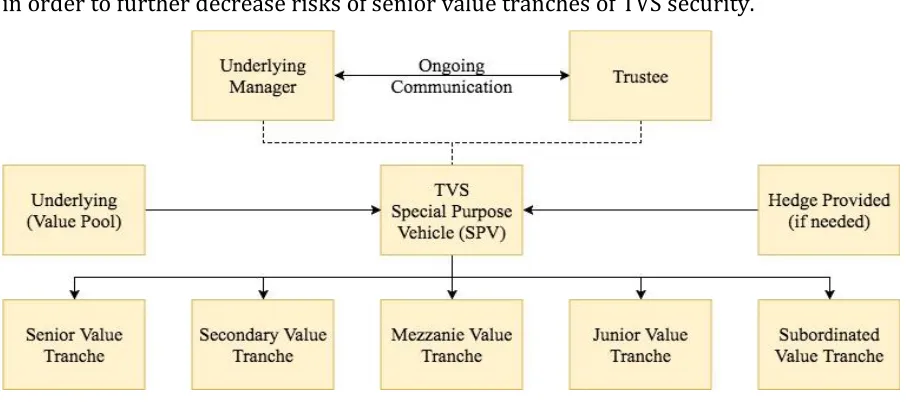
A generic example of the contractual relationships involved in TVS are shown on Figure 4, which is modified from Schorin, C. and S. Weinreich (1998).
The trustee of the TVS is responsible for monitoring the contractual provisions of the TVS and their execution. Manager of the underlying is responsible for selection and purchase of underlying for special purpose vehicle (SPV), with subsequent tranching the value of underlying, creating multiple securities, that are held by SPV. Special purpose vehicle issues multiple securities (TVSs) that correspond to various levels of seniority of the value pool, which are sold to investors. Other roles required in TVS issuance include underwriters that acts as the structurers and arrangers, accountants that would perform a cash-flow tie-out in which the transaction's waterfall is modeled per the priority of value set forth in the transaction documents, and attorneys that ensure compliance with applicable laws and regulations and draft the transaction documents.
mechanisms can be used, such as surety bonds, wrapped securities, and letters of credit, in order to further decrease risks of senior value tranches of TVS security.
[image:11.595.71.524.135.336.2]Source: Modified according to Schorin, C. and S. Weinreich (1998).
Figure 4: TVS Contractual Relationships.
All above, allows for efficient risk transfer and performance transformation, creating from a single instrument a series of different instruments with the same or different (depending on a particular issuance) risks from a single issue.
C. TVS Economics and Valuation
Based on the earlier presented definition and general structure of Tranched Value Securities, unconditional value of each individual TVS unit to investor is displayed by equation ( 1 )
𝑇𝑉𝑆𝑖𝑡 = max(𝑤𝑖𝑆𝑡, 𝑋𝑖) ( 1 )
Where 𝑇𝑉𝑆𝑖𝑡 is the value of Tranched Value Security (𝑇𝑉𝑆𝑖), i.e. 𝑖-th value tranche at time
However, the nature of TVS conditionally tranched on the level of seniority of specific value shares implies that before the current unit of TVS can be satisfied, the previous level (more senior-level) of TVS must be satisfied, implying the model ( 2 )
𝑇𝑉𝑆𝑖𝑡 = min(𝑆𝑡− 𝑇𝑉𝑆𝑖−1𝑡, max(𝑤𝑖𝑆𝑡, 𝑋𝑖)) ( 2 )
Where 𝑇𝑉𝑆𝑖𝑡 is the value of Tranched Value Security (𝑇𝑉𝑆𝑖), i.e. 𝑖-th value tranche at time
𝑡 = 𝑛 of underlying (𝑆𝑡); 𝑆𝑡 is the price of underlying at time 𝑡 = 𝑛; 𝑤𝑖 is the fixed weight of 𝑖-th value share corresponding to the specific underlying (𝑆𝑡) at the contract initiation (𝑡 = 0); 𝑋𝑖 is the minimum corresponding value of 𝑇𝑉𝑆𝑖 share at any time, which is set fixed and equals to 𝑤𝑖𝑆𝑡 during the contract initiation at 𝑡 = 0; 𝑇𝑉𝑆𝑖−1𝑡 is the value of
higher-ranked Tranched Value Security (𝑇𝑉𝑆𝑖), i.e. 𝑖 − 1-th value tranche at time 𝑡 = 𝑛 of underlying (𝑆𝑡), which must be satisfied before any subsequent Tranched Value Security (𝑇𝑉𝑆𝑖+1) can be fulfilled.
Based on this simplistic model, it is possible to illustrate price behavior of such instrument. It can be assumed that value of underlying (𝑆𝑡=0) is US$ 100.00, for which senior value tranche security, and secondary value securities were issued. Senior value tranche security (𝑇𝑉𝑆𝑆𝐸𝑁 ) corresponds to 60.00% value of underlying (𝑤𝑆𝐸𝑁 = 60.00%), which is fixed and equals to 𝑤𝑆𝐸𝑁𝑆𝑡=0= 𝑋𝑆𝐸𝑁 = 𝑈𝑆$60.00 minimum value, or more specifically 𝑇𝑉𝑆𝑆𝐸𝑁= max(60.00% × 𝑆𝑡, 𝑈𝑆$60.00); while the secondary value tranche security (𝑇𝑉𝑆𝑆𝐸𝐶) corresponds to 1 − 𝑤𝑆𝐸𝑁 = 𝑤𝑆𝐸𝐶 = 40.00% value of underlying, which is fixed and equals to US$ 40.00 minimum value, or more specifically 𝑇𝑉𝑆𝑆𝐸𝐶 =
max(40.00% × 𝑆𝑡, 𝑈𝑆$40.00), and can be paid only if the senior value security (𝑇𝑉𝑆𝑆𝐸𝑁) has been fully satisfied.
Based on ( 2 ), and specified initial parameters, during the contract initiation (𝑡 = 0), three securities have such values as: 𝑆𝑡=0= 100.00, 𝑇𝑉𝑆𝑆𝐸𝑁𝑡=0 = 60.00, 𝑇𝑉𝑆𝑆𝐸𝐶𝑡=0 =
40.00. However, once market movements occur and change the price of 𝑆𝑡 to any price different from 𝑆𝑡=0, the two 𝑇𝑉𝑆𝑖𝑡 change their value in a different manner. Assuming the
Figure 5: Sample Values (US$) and Returns (%) of 𝑺𝒕=𝒏, 𝑻𝑽𝑺𝑺𝑬𝑵𝒕=𝒏, and 𝑻𝑽𝑺𝑺𝑬𝑪𝒕=𝒏.
The illustrations above clearly show that a single underlying with an observable or measurable price (and / or value, as used interchangeably in the current context) can be used to create two or more TVSs that will generate various returns even using a simplified pricing formula, which might omit some other possible aspects.
Such value model of TVS suggests the following price patterns based on the value of underlying: if 𝑆𝑡≥ 𝑋𝑖 ⟹ 𝑇𝑉𝑆𝑖𝑡 = min(𝑆𝑡− 𝑇𝑉𝑆𝑖−1𝑡, max(𝑤𝑖𝑆𝑡, 𝑋𝑖)), and if 𝑆𝑡< 𝑋𝑖 ⟹
𝑇𝑉𝑆𝑖𝑡 = 𝑆𝑡− 𝑇𝑉𝑆𝑖−1𝑡, which also imply that if 𝑆𝑡 < 𝑇𝑉𝑆𝑖−1𝑡 ⟹ 𝑇𝑉𝑆𝑖𝑡 = 0.
However, this model omits a price premium that must be paid for receiving a superior claim right on value tranche of a particular security, which on its own is of value to investors. Under this view, the value of has three primary components: intrinsic value, time value and seniority, leading to the following conclusion ( 3 )
∑ 𝑇𝑉𝑆𝑖𝑡 𝑡
𝑖=1
≥ 𝑆𝑡 ( 3 )
𝑇𝑉𝑆𝑖𝑡 ≥ min (𝑆𝑡− 𝑇𝑉𝑆𝑖−1𝑡, 𝑚𝑎𝑥 (𝑤𝑖
𝑆𝑡 (1 + 𝑟)𝑛,
𝑋𝑖
(1 + 𝑟)𝑛)) ( 4.1 )
Or can be extended to ( 4.2 ) in the case of perpetual TVS, which can primarily be used for equities to accommodate time value of TVS.
𝑇𝑉𝑆𝑖𝑡 ≥ min (𝑆𝑡− 𝑇𝑉𝑆𝑖−1𝑡, 𝑚𝑎𝑥 (𝑤𝑖
𝑆𝑡 𝑟 ,
𝑋𝑖
𝑟 )) ( 4.2 )
These values ( 4.1 ), ( 4.2 ) become the lower limits of the Tranched Value Security on a particular underlying, with the term 𝑆𝑡− 𝑇𝑉𝑆𝑖−1𝑡 not being discounted as it already
includes the time value effect.
IV. TVS Applications
This section lays out tests conducted to verify performance of Tranched Value Securities based on the presented earlier model ( 2 ) with equity and debt instruments. First simulated results are assessed, with following case studies evaluation.
A. Simulated Results
A.1. Simulated Results: Equity Security
This section assesses performance of TVS securities issued on the basis of simulated underlying equity security (common stock). For the purpose of modeling the possible price behavior of the equity security (E), it can be assumed that the underlying has a market price of 𝐸𝑡 at time 𝑡.𝐸𝑡 = 𝑈𝑆$100.00 at 𝑡 = 0, and has a mean periodic (expected) rate of return 𝐸(𝑟𝑡) = 𝜇 = 0.10 with standard deviation 𝜎 = 0.50. 𝐸𝑡 follows a lognormal distribution. Based on these inputs, 𝐸𝑡+𝑖 was modelled using Monte Carlo simulation utilizing model ( 5 ) for 1,000 periods
𝑆𝑡 = 𝑆𝑡−1× 𝑒𝑟 ( 5 )
where 𝑟 is ( 6 )
Φ(𝑧) → 𝑝𝑟𝑜𝑏𝑎𝑏𝑖𝑙𝑖𝑡𝑦𝑜𝑓𝑧 𝐹−1(𝑧) → 𝑧
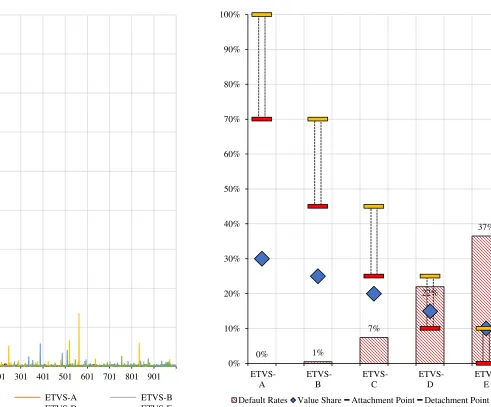
Furthermore, it is assumed that five Tranched Value Securities are issued from 𝐸𝑡 with characteristics presented on Figure 6.A.
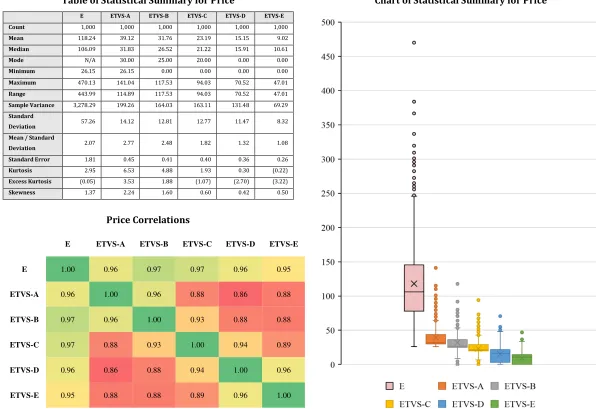
The results presented on Figure 6.A-6.G are obtained for the minimum values of five tranches of TVS and one underlying equity security. As evident, all securities experience various price fluctuations, with ETVS-A being the most stable, while ETVS-E and ETVS-D being the most volatile, at the same time experiencing defaults the most often in 37%, and 22% cases respectively out of 1,000 simulated periods. Default rates are compensated by the highest maximum returns of the three most junior value tranches (ETVS-C, ETVS-D, ETVS-E). This is the result of junior value tranches losing all value (having a market price of zero), when the value of ETVS-A becomes equal to the value of underlying equity security, due to its value seniority. ETVS Senior and ETVS Subordinated almost always have a fixed price floor (Figure 6.C) below which their value barely falls, unless the underlying equity security experiences severe price declines.
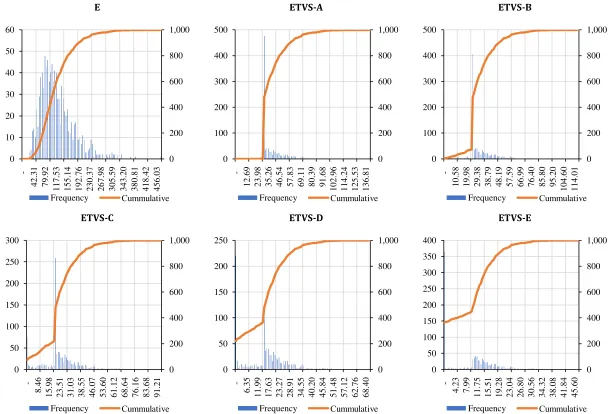
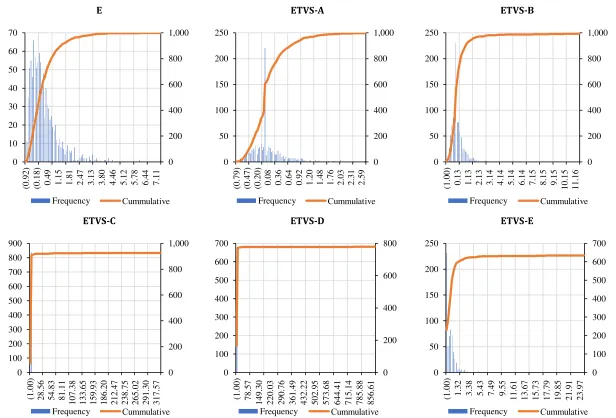
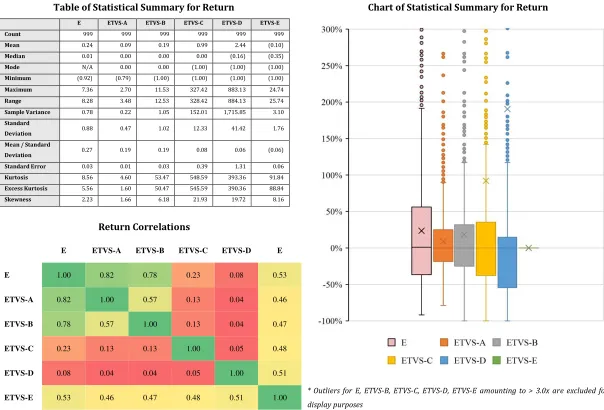
Price value distributions (Figure 6.D) and return distributions (Figure 6.F) illustrate that due to the tranching nature of the securities, and embeded protection in them against the value claim of the lower-level TVS, distribution profiles of TVSs have been transformed and do not follow the initially simulated lognormal distribution, while being highly skewed to the right, with high excess kurtosis on a return-basis, being changed to leptokurtic forms, with only the safest tranche – ETVS Senior, experiencing excess kurtosis of less than that of the underlying equity security.
underlying equity security. Based on the statistical assessment ETVS-D generated the highest mean return, with the value of 244%, while the mean return of the underlying equity security was 24% (10.0x less than the return of ETVS-D). The lowest mean return was generated by ETVS-E due to the significant number of defaults in 37% of simulated periods, with the value of -10%. At the same time, the range of returns is the highest for ETVS-D, and ETVS-C, while for ETVS-A it is lower than even for the underlying, as this value tranche essentially contains less risk than the underlying equity security, which is evident from the twice reduced standard deviation.
Assumed Issuance Information
Security Code Value Share (%)
Minimum Value* (US$) Common Equity E 1.00 100.00
ETVS Senior ETVS-A 0.30 30.00
ETVS Subordinated ETVS-B 0.25 25.00
ETVS Junior ETVS-C 0.20 20.00
ETVS Mezzanine ETVS-D 0.15 15.00
ETVS Equity ETVS-E 0.10 10.00
Combined Price Data for Five TVSs and Underlying (US$)
TVS Price Share of Total Price of Underlying (%) Securities Performance (Limited to -100% to +500%)
Figure 6.A. Issuance, Price and Return Summary.
0 100 200 300 400 500
1 101 201 301 401 501 601 701 801 901
S
ec
u
rit
ie
s
V
al
u
es
ETVS-A ETVS-B ETVS-C ETVS-D ETVS-E E
n+
0% 20% 40% 60% 80% 100%
1 101 201 301 401 501 601 701 801 901
P
ric
e
S
h
ar
e
ETVS-A ETVS-B ETVS-C ETVS-D ETVS-E
n+ -100%
0% 100% 200% 300% 400% 500%
1 101 201 301 401 501 601 701 801 901
S
ec
u
rit
ie
s
R
et
u
rn
s
E ETVS-A ETVS-B ETVS-C ETVS-D ETVS-E
Securities Return Full Snapshot TVS Default Rates (When Price Equals to Zero)
Figure 6.B. Return and Default Rates (%).
-100% 9900% 19900% 29900% 39900% 49900% 59900% 69900% 79900% 89900%
1 101 201 301 401 501 601 701 801 901
S
ec
u
rit
ie
s
R
et
u
rn
s
E ETVS-A ETVS-B ETVS-C ETVS-D ETVS-E
n+
0% 1%
7%
22%
37%
0% 10% 20% 30% 40% 50% 60% 70% 80% 90% 100%
ETVS-A
ETVS-B
ETVS-C
ETVS-D
E ETVS-A ETVS-B
[image:19.842.126.512.80.483.2]ETVS-C ETVS-D ETVS-E
Figure 6.C. Price Charts (US$) with SMA(50).
0 50 100 150 200 250 300 350 400 450 500
1
68
135 202 269 336 403 470 537 604 671 738 805 872 939
n+
0 20 40 60 80 100 120 140 160
1
68
135 202 269 336 403 470 537 604 671 738 805 872 939
n+
0 20 40 60 80 100 120
1
68
135 202 269 336 403 470 537 604 671 738 805 872 939
n+
0 20 40 60 80 100
1
68 135 202 269 336 403 470 537 604 671 738 805 872 939
n+
0 20 40 60 80
1
68 135 202 269 336 403 470 537 604 671 738 805 872 939
n+
0 10 20 30 40 50
1
68 135 202 269 336 403 470 537 604 671 738 805 872 939
E ETVS-A ETVS-B
[image:20.842.115.731.71.485.2]ETVS-C ETVS-D ETVS-E
Figure 6.D. Price Distribution Histograms (US$).
0 200 400 600 800 1,000 0 10 20 30 40 50 60
42.31 79.92
117.53 155.14 192.76 230.37 267.98 305.59 343.20 380.81 418.42 456.03
Frequency Сummulative
0 200 400 600 800 1,000 0 100 200 300 400 500
12.69 23.98 35.26 46.54 57.83 69.11 80.39 91.68
102.96 114.24 125.53 136.81
Frequency Сummulative
0 200 400 600 800 1,000 0 100 200 300 400 500
10.58 19.98 29.38 38.79 48.19 57.59 66.99 76.40 85.80 95.20 104.60 114.01
Frequency Сummulative
0 200 400 600 800 1,000 0 50 100 150 200 250 300 8.46
15.98 23.51 31.03 38.55 46.07 53.60 61.12 68.64 76.16 83.68 91.21
Frequency Сummulative
0 200 400 600 800 1,000 0 50 100 150 200 250 6.35
11.99 17.63 23.27 28.91 34.55 40.20 45.84 51.48 57.12 62.76 68.40
Frequency Сummulative
0 200 400 600 800 1,000 0 50 100 150 200 250 300 350 400
4.23 7.99
11.75 15.51 19.28 23.04 26.80 30.56 34.32 38.08 41.84 45.60
Table of Statistical Summary for Price
E ETVS-A ETVS-B ETVS-C ETVS-D ETVS-E Count 1,000 1,000 1,000 1,000 1,000 1,000
Mean 118.24 39.12 31.76 23.19 15.15 9.02
Median 106.09 31.83 26.52 21.22 15.91 10.61
Mode N/A 30.00 25.00 20.00 0.00 0.00
Minimum 26.15 26.15 0.00 0.00 0.00 0.00
Maximum 470.13 141.04 117.53 94.03 70.52 47.01
Range 443.99 114.89 117.53 94.03 70.52 47.01
Sample Variance 3,278.29 199.26 164.03 163.11 131.48 69.29
Standard
Deviation 57.26 14.12 12.81 12.77 11.47 8.32 Mean / Standard
Deviation 2.07 2.77 2.48 1.82 1.32 1.08 Standard Error 1.81 0.45 0.41 0.40 0.36 0.26
Kurtosis 2.95 6.53 4.88 1.93 0.30 (0.22)
Excess Kurtosis (0.05) 3.53 1.88 (1.07) (2.70) (3.22)
Skewness 1.37 2.24 1.60 0.60 0.42 0.50
Chart of Statistical Summary for Price
Price Correlations
E ETVS-A ETVS-B ETVS-C ETVS-D ETVS-E
E 1.00 0.96 0.97 0.97 0.96 0.95
ETVS-A 0.96 1.00 0.96 0.88 0.86 0.88
ETVS-B 0.97 0.96 1.00 0.93 0.88 0.88
ETVS-C 0.97 0.88 0.93 1.00 0.94 0.89
ETVS-D 0.96 0.86 0.88 0.94 1.00 0.96
ETVS-E 0.95 0.88 0.88 0.89 0.96 1.00
E ETVS-A ETVS-B
[image:22.842.112.728.68.486.2]ETVS-C ETVS-D ETVS-E
Figure 6.F. Return Distribution Histograms (%).
0 200 400 600 800 1,000 0 10 20 30 40 50 60 70
(0.92) (0.18) 0.49 1.15 1.81 2.47 3.13 3.80 4.46 5.12 5.78 6.44 7.11
Frequency Сummulative
0 200 400 600 800 1,000 0 50 100 150 200 250
(0.79) (0.47) (0.20) 0.08 0.36 0.64 0.92 1.20 1.48 1.76 2.03 2.31 2.59
Frequency Сummulative
0 200 400 600 800 1,000 0 50 100 150 200 250
(1.00) 0.13 1.13 2.13 3.14 4.14 5.14 6.14 7.15 8.15 9.15 10.15 11.16
Frequency Сummulative
0 200 400 600 800 1,000 0 100 200 300 400 500 600 700 800 900
(1.00) 28.56 54.83 81.11
107.38 133.65 159.93 186.20 212.47 238.75 265.02 291.30 317.57
Frequency Сummulative
0 200 400 600 800 0 100 200 300 400 500 600 700
(1.00) 78.57
149.30 220.03 290.76 361.49 432.22 502.95 573.68 644.41 715.14 785.88 856.61
Frequency Сummulative
0 100 200 300 400 500 600 700 0 50 100 150 200 250
(1.00) 1.32 3.38 5.43 7.49 9.55 11.61 13.67 15.73 17.79 19.85 21.91 23.97
Table of Statistical Summary for Return
E ETVS-A ETVS-B ETVS-C ETVS-D ETVS-E Count 999 999 999 999 999 999
Mean 0.24 0.09 0.19 0.99 2.44 (0.10)
Median 0.01 0.00 0.00 0.00 (0.16) (0.35)
Mode N/A 0.00 0.00 (1.00) (1.00) (1.00)
Minimum (0.92) (0.79) (1.00) (1.00) (1.00) (1.00)
Maximum 7.36 2.70 11.53 327.42 883.13 24.74
Range 8.28 3.48 12.53 328.42 884.13 25.74
Sample Variance 0.78 0.22 1.05 152.01 1,715.85 3.10
Standard
Deviation 0.88 0.47 1.02 12.33 41.42 1.76 Mean / Standard
Deviation 0.27 0.19 0.19 0.08 0.06 (0.06) Standard Error 0.03 0.01 0.03 0.39 1.31 0.06
Kurtosis 8.56 4.60 53.47 548.59 393.36 91.84
Excess Kurtosis 5.56 1.60 50.47 545.59 390.36 88.84
Skewness 2.23 1.66 6.18 21.93 19.72 8.16
Chart of Statistical Summary for Return
* Outliers for E, ETVS-B, ETVS-C, ETVS-D, ETVS-E amounting to > 3.0x are excluded for display purposes
Return Correlations
E ETVS-A ETVS-B ETVS-C ETVS-D E
E 1.00 0.82 0.78 0.23 0.08 0.53
ETVS-A 0.82 1.00 0.57 0.13 0.04 0.46
ETVS-B 0.78 0.57 1.00 0.13 0.04 0.47
ETVS-C 0.23 0.13 0.13 1.00 0.05 0.48
ETVS-D 0.08 0.04 0.04 0.05 1.00 0.51
[image:23.842.402.726.78.451.2]ETVS-E 0.53 0.46 0.47 0.48 0.51 1.00
A.2. Simulated Results: Fixed Income Security
This section assesses the performance of TVS securities issued on the basis of simulated underlying fixed-income (debt) security. For the purpose of modeling the possible price behavior of the debt security (D), it can be assumed that it has the following characteristics: Face Value (FV) = US$ 100.00, Maturity (N) = 1,000 days = 2.74 years, Coupons (C) = 0.05 annually, Yield-to-Maturity (YTM) = 0.05 at 𝑡 = 0, the resulting Present Value (PV) = US$ 100.00 at 𝑡 = 0. Furthermore, it is assumed that YTM has a standard deviation 𝜎 = 0.10, and 𝐸(𝑌𝑇𝑀) = 𝜇 = 0.05. For the purpose of simplicity, it is assumed that 𝑌𝑇𝑀 follows a lognormal distribution. Based on these inputs, YTM was modelled using Monte Carlo simulation utilizing model ( 5 ) for 1,000 periods.
Furthermore, it is assumed that five Tranched Value Securities are issued from 𝐷𝑡 with characteristics presented on Figure 7.A. The results presented on Figure 7.A-7.G are obtained for the minimum values of five tranches of TVS and one underlying debt security.
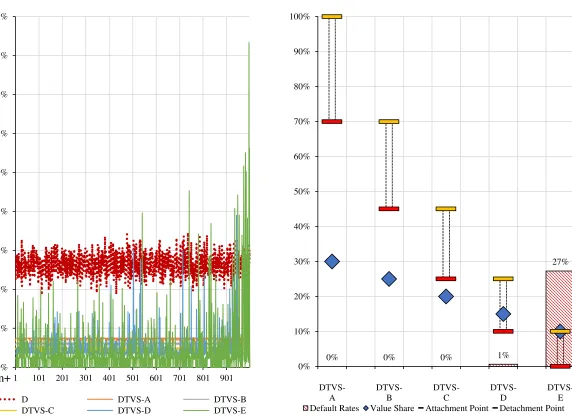
As evident, securities experience various price fluctuations (Figure 7.A), but DTVS-A, DTVS-B, and DTVS-C have a clear price floor (Figure 7.B) below which they never decline (only DTVS-C declined insignificantly several times) as the yields increase, while the underlying, and two junior value tranches continually experience value fluctuations bellow the initial PV at issuance. As a result, DTVS-D and DTVS-E experienced market price of zero multiple times amounting to 1% and 27% respectively (Figure 7.B). The default rates are compensated by the highest maximum yields with the values of 8% and 17% for DTVS-D and DTVS-E respectively (Figure 7.B, Figure 7.G).
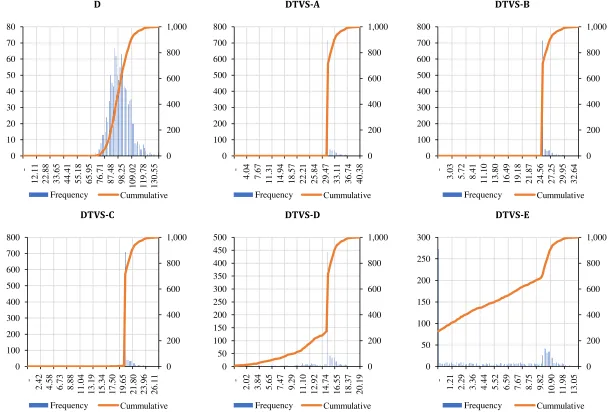
Correlations between the securities prices (Figure 7.E) reveals that three the most senior value tranches of debt underlying have perfect positive correlation of 0.99-1.00 with each other, while two the most junior value tranches have positive but less strong correlation with all other securities. YTM correlations (Figure 7.G) depict exactly the same picture for DTVS-A, DTVS-B, DTVS-C pairs, and DTVS-D, DTVS-E pairs, while all TVSs have imperfect positive correlation with the underlying debt security.
Based on the statistical assessment ETVS-E generated the highest maximum YTM, with the value of 17%, while the maximum return of the underlying debtsecurity was 7% (2.4x less than the YTM of ETVS-E). At the same time, all securities generated nearly the same mean YTM of 1%, except for the underlying with the value of 5%.
Assumed Issuance Information
Security Code Value Share (%)
Minimum Value* (US$) Fixed Income D 1.00 100.00
DTVS Senior DTVS-A 0.30 30.00
DTVS Subordinated DTVS-B 0.25 25.00
DTVS Junior DTVS-C 0.20 20.00
DTVS Mezzanine DTVS-D 0.15 15.00
DTVS Equity DTVS-E 0.10 10.00
Combined Price Data for Five TVSs and Underlying (US$)
TVS Price Share of Total Price of Underlying (%) Securities YTM (Limited to 0% to +8%)
Figure 7.A. Issuance, Price and Return Summary.
0 20 40 60 80 100 120 140
1 101 201 301 401 501 601 701 801 901
S
ec
u
rit
ie
s
V
al
u
es
DTVS-A DTVS-B DTVS-C DTVS-D DTVS-E D
n+
0% 20% 40% 60% 80% 100%
1 101 201 301 401 501 601 701 801 901
P
ric
e
S
h
ar
e
DTVS-A DTVS-B DTVS-C DTVS-D DTVS-E
n+
0% 1% 2% 3% 4% 5% 6% 7% 8%
1 101 201 301 401 501 601 701 801 901
S
ec
u
rit
is
es
R
et
u
rn
s
D DTVS-A DTVS-B DTVS-C DTVS-D DTVS-E
Securities YTM Full Snapshot TVS Default Rates (When Price Equals to Zero)
Figure 7.B. Return and Default Rates (%).
0% 2% 4% 6% 8% 10% 12% 14% 16% 18%
1 101 201 301 401 501 601 701 801 901
S
ec
u
ri
ti
es
Re
tu
rn
s
D DTVS-A DTVS-B DTVS-C DTVS-D DTVS-E
n+
0% 0% 0% 1%
27%
0% 10% 20% 30% 40% 50% 60% 70% 80% 90% 100%
DTVS-A
DTVS-B
DTVS-C
DTVS-D
27 D D T V S -A D T V S -B D T V S -C D T V S -D D T V S -E F igu re 7 .C . P ri ce C h a rt s ( U S $) w it h S M A (5 0 ).
0 20 40 60 80
100 120 140
1 68 135 202 269 336 403 470 537 604 671 738 805 872 939 n+
0 10 20 30 40 50
1 68 135 202 269 336 403 470 537 604 671 738 805 872 939 n+
0 10 20 30 40
1 68 135 202 269 336 403 470 537 604 671 738 805 872 939 n+
0 5 10 15 20 25 30
1 68 135 202 269 336 403 470 537 604 671 738 805 872 939 n+
0 5 10 15 20
1 68 135 202 269 336 403 470 537 604 671 738 805 872 939 n+
0 5 10 15
[image:28.842.97.525.126.726.2]D DTVS-A DTVS-B
[image:29.842.114.728.74.486.2]DTVS-C DTVS-D DTVS-E
Figure 7.D. Price Distribution Histograms (US$).
0 200 400 600 800 1,000 0 10 20 30 40 50 60 70 80
12.11 22.88 33.65 44.41 55.18 65.95 76.71 87.48 98.25 109.02 119.78 130.55
Frequency Сummulative
0 200 400 600 800 1,000 0 100 200 300 400 500 600 700 800
4.04 7.67
11.31 14.94 18.57 22.21 25.84 29.47 33.11 36.74 40.38
Frequency Сummulative
0 200 400 600 800 1,000 0 100 200 300 400 500 600 700 800
3.03 5.72 8.41
11.10 13.80 16.49 19.18 21.87 24.56 27.25 29.95 32.64
Frequency Сummulative
0 200 400 600 800 1,000 0 100 200 300 400 500 600 700 800
2.42 4.58 6.73 8.88
11.04 13.19 15.34 17.50 19.65 21.80 23.96 26.11
Frequency Сummulative
0 200 400 600 800 1,000 0 50 100 150 200 250 300 350 400 450 500
2.02 3.84 5.65 7.47 9.29
11.10 12.92 14.74 16.55 18.37 20.19
Frequency Сummulative
0 200 400 600 800 1,000 0 50 100 150 200 250 300
1.21 2.29 3.36 4.44 5.52 6.59 7.67 8.75 9.82 10.90 11.98 13.05
Table of Statistical Summary for Price
D DTVS-A DTVS-B DTVS-C DTVS-D DTVS-E Count 1,000.00 1,000.00 1,000.00 1,000.00 1,000.00 1,000.00
Mean 95.96 30.66 25.55 20.43 13.96 5.36
Median 95.49 30.00 25.00 20.00 15.00 5.49
Mode 100.00 30.00 25.00 20.00 15.00 -
Minimum 72.05 30.00 25.00 17.05 - -
Maximum 134.59 40.38 33.65 26.92 20.19 13.46
Range 62.54 10.38 8.65 9.87 20.19 13.46
Sample Variance 91.28 2.00 1.39 0.91 10.45 20.56
Standard
Deviation 9.55 1.41 1.18 0.96 3.23 4.53 Mean / Standard
Deviation 10.04 21.68 21.68 21.37 4.32 1.18 Standard Error 0.30 0.04 0.04 0.03 0.10 0.14
Kurtosis 0.49 10.49 10.49 10.13 4.84 (1.68)
Excess Kurtosis (2.51) 7.49 7.49 7.13 1.84 (4.68)
Skewness 0.45 2.97 2.97 2.79 (2.17) 0.03
Chart of Statistical Summary for Price
Price Correlations
D DTVS-A DTVS-B DTVS-C DTVS-D DTVS-E
D 1.00 0.80 0.80 0.81 0.80 0.91
DTVS-A 0.80 1.00 1.00 0.99 0.42 0.60
DTVS-B 0.80 1.00 1.00 0.99 0.42 0.60
DTVS-C 0.81 0.99 0.99 1.00 0.45 0.60
DTVS-D 0.80 0.42 0.42 0.45 1.00 0.63
DTVS-E 0.91 0.60 0.60 0.60 0.63 1.00
D DTVS-A DTVS-B
[image:31.842.182.725.77.489.2]DTVS-C DTVS-D DTVS-E
Figure 7.F. YTM Distribution Histograms (%).
0 200 400 600 800 1,000 0 5 10 15 20 25 30 35
0.04 0.04 0.04 0.05 0.05 0.05 0.05 0.06 0.06 0.06 0.06 0.07 0.07
Frequency Сummulative
0 200 400 600 800 1,000 0 100 200 300 400 500 600 700 800
0.01 0.01 0.01 0.01 0.01 0.01 0.01 0.01 0.01 0.01 0.01 0.02
Frequency Сummulative
0 200 400 600 800 1,000 0 100 200 300 400 500 600 700 800
0.01 0.01 0.01 0.01 0.01 0.01 0.01 0.01 0.01 0.01 0.01 0.01 0.01
Frequency Сummulative
0 200 400 600 800 1,000 0 100 200 300 400 500 600 700 800
0.01 0.01 0.01 0.01 0.01 0.01 0.01 0.01 0.01 0.01 0.01 0.01 0.01
Frequency Сummulative
0 200 400 600 800 1,000 0 100 200 300 400 500 600
0.00 0.01 0.02 0.02 0.03 0.04 0.04 0.05 0.06 0.06 0.07 0.08
Frequency Сummulative
0 100 200 300 400 500 600 700 0 50 100 150 200 250 300 350
0.00 0.02 0.03 0.04 0.06 0.07 0.08 0.10 0.11 0.12 0.14 0.15 0.16
Table of Statistical Summary for YTM
D DTVS-A DTVS-B DTVS-C DTVS-D DTVS-E Count 1,000.00 1,000.00 1,000.00 1,000.00 1,000.00 1,000.00
Mean 0.05 0.01 0.01 0.01 0.01 0.01
Median 0.05 0.02 0.01 0.01 0.01 0.01
Mode N/A 0.02 0.01 0.01 0.01 N/A
Minimum 0.04 0.01 0.01 0.01 0.00 0.00
Maximum 0.07 0.02 0.01 0.01 0.08 0.17
Range 0.03 0.00 0.00 0.01 0.07 0.16
Sample Variance 0.00 0.00 0.00 0.00 0.00 0.00
Standard
Deviation 0.01 0.00 0.00 0.00 0.01 0.02 Mean / Standard
Deviation 10.08 22.17 21.30 19.59 1.59 0.75 Standard Error 0.00 0.00 0.00 0.00 0.00 0.00
Kurtosis (0.01) 6.75 7.39 8.70 48.42 23.96
Excess Kurtosis (3.01) 3.75 4.39 5.70 45.42 20.96
Skewness 0.14 (2.54) (2.62) (2.57) 6.06 4.18
Chart of Statistical Summary for YTM
YTM Correlations
D DTVS-A DTVS-B DTVS-C DTVS-D DTVS-E
D
1.00 0.72 0.71 0.71 0.59 0.62
DTVS-A
0.72 1.00 1.00 0.98 0.22 0.30
DTVS-B
0.71 1.00 1.00 0.98 0.22 0.30
DTVS-C
0.71 0.98 0.98 1.00 0.21 0.30
DTVS-D
0.59 0.22 0.22 0.21 1.00 0.29
DTVS-E
0.62 0.30 0.30 0.30 0.29 1.00
B. Case Studies
B.1. Case Study: Equity Security
This section assesses the performance of TVS securities as if they were issued with General Electric Ordinary Common Stock (NYSE: GE) as underlying. For the purpose of analysis GE monthly performance for the period of 01/01/2007-01/12/2017 is used.
It is assumed that five Tranched Value Securities were issued with GE as underlying on 01/01/2007 when the opening price for GE was US$ 37.41, with characteristics presented on Figure 8.A.
kurtosis. Other price statistics, such as price range, standard deviation, and correlations also indicate a varying performance of all six securities.
Assumed Issuance Information
Security Code Value Share (%)
Minimum Value* (US$) NYSE: GE GE 1.00 37.41
GE TVS Senior GETVS-A 0.30 11.22
GE TVS Subordinated GETVS-B 0.25 9.35
GE TVS Junior GETVS-C 0.20 7.48
GE TVS Mezzanine GETVS-D 0.15 5.61
GE TVS Equity GETVS-E 0.10 3.74 * open price as of 01/01/2007
Combined Price Data for Five TVSs and Underlying (US$)
TVS Price Share of Total Price of Underlying (%) Securities Performance (Limited to -100% to +100%)
Figure 8.A. Issuance, Price and Return Summary.
0 10 20 30 40
2007 2008 2009 2010 2011 2012 2013 2014 2015 2016 2017
S
ec
u
rit
ie
s
V
al
u
es
GETVS-A GETVS-B GETVS-C GETVS-D GETVS-E GE
0% 20% 40% 60% 80% 100%
P
ric
e
S
h
ar
e
GETVS-A GETVS-B GETVS-C GETVS-D GETVS-E
-100% -80% -60% -40% -20% 0% 20% 40% 60% 80% 100%
S
ec
u
rit
ie
s
R
et
u
rn
s
Securities Return Full Snapshot TVS Default Rates (When Price Equals to Zero)
Figure 8.B. Return and Default Rates (%).
-100% 400% 900% 1400% 1900% 2400% 2900% 3400% 3900%
S
ec
u
rit
ie
s
R
et
u
rn
s
GE GETVS-A GETVS-B GETVS-C GETVS-D GETVS-E
0% 2%
35%
71%
89%
0% 10% 20% 30% 40% 50% 60% 70% 80% 90% 100%
36 G E G E T V S -A G E T V S -B G E T V S -C G E T V S -D G E T V S -E F igu re 8 .C . P ri ce C a nd le st ic k C h a rt s ( U S $) a nd S M A (5 0 ).
0 5 10 15 20 25 30 35 40 45
2007 2008 2009 2010 2011 2012 2013 2014 2015 2016 2017
0 2 4 6 8 10 12 14
2007 2008 2009 2010 2011 2012 2013 2014 2015 2016 2017
0 2 4 6 8 10 12
2007 2008 2009 2010 2011 2012 2013 2014 2015 2016 2017
0 1 2 3 4 5 6 7 8 9
2007 2008 2009 2010 2011 2012 2013 2014 2015 2016 2017
-1 0 1 2 3 4 5 6 7
2007 2008 2009 2010 2011 2012 2013 2014 2015 2016 2017
0 1 1 2 2 3 3 4 4 5
[image:37.842.101.525.115.726.2]GE GETVS-A GETVS-B
[image:38.842.134.732.78.490.2]GETVS-C GETVS-D GETVS-E
Figure 8.D. Price Distribution Histograms (US$).
0 20 40 60 80 100 120 140 0 2 4 6 8 10 12
3.38 6.76
10.14 13.52 16.90 20.28 23.66 27.04 30.42 33.80 37.18 40.56
Frequency Cumulative 0 20 40 60 80 100 120 140 0 20 40 60 80 100 120 140
1.01 2.03 3.04 4.06 5.07 6.08 7.10 8.11 9.12 10.14 11.15 12.17
Frequency Cumulative 0 20 40 60 80 100 120 140 0 10 20 30 40 50 60 70 80 90
0.84 1.69 2.53 3.38 4.22 5.07 5.91 6.76 7.60 8.45 9.29
10.14 Frequency Cumulative 0 20 40 60 80 100 120 140 0 5 10 15 20 25 30 35 40 45 50
0.68 1.35 2.03 2.70 3.38 4.06 4.73 5.41 6.08 6.76 7.44 8.11
Frequency Cumulative 0 20 40 60 80 100 120 140 0 10 20 30 40 50 60 70 80 90 100
0.51 1.01 1.52 2.03 2.53 3.04 3.55 4.06 4.56 5.07 5.58 6.08
Frequency Cumulative 0 20 40 60 80 100 120 140 0 20 40 60 80 100 120 140
0.34 0.68 1.01 1.35 1.69 2.03 2.37 2.70 3.04 3.38 3.72 4.06
Table of Statistical Summary for Price
GE GETVS-A GETVS-B GETVS-C GETVS-D GETVS-E Count 132.00 132.00 132.00 132.00 132.00 132.00
Mean 24.21 11.22 7.99 3.65 1.02 0.34
Median 24.68 11.22 9.35 4.10 0.00 0.00
Mode 35.36 11.22 9.35 0.00 0.00 0.00
Minimum 8.51 8.51 0.00 0.00 0.00 0.00
Maximum 41.40 12.42 10.35 8.28 6.21 4.14
Range 32.89 3.91 10.35 8.28 6.21 4.14
Sample Variance 51.91 0.09 5.99 10.72 3.72 1.06
Standard
Deviation 7.20 0.30 2.45 3.27 1.93 1.03 Mean / Standard
Deviation 3.36 37.40 3.26 1.11 0.53 0.33 Standard Error 0.63 0.03 0.21 0.28 0.17 0.09
Kurtosis (0.48) 55.49 1.91 (1.76) 1.46 7.12
Excess Kurtosis (3.48) 52.49 (1.09) (4.76) (1.54) 4.12
Skewness 0.26 (5.16) (1.70) 0.01 1.73 2.94
Chart of Statistical Summary for Price
Price Correlations
GE GETVS-A
GETVS-B
GETVS-C
GETVS-D
GETVS-E
GE 1.00 0.42 0.77 0.92 0.80 0.64
GETVS-A 0.42 1.00 0.40 0.24 0.30 0.37
GETVS-B 0.77 0.40 1.00 0.65 0.33 0.22
GETVS-C 0.92 0.24 0.65 1.00 0.64 0.41
GETVS-D 0.80 0.30 0.33 0.64 1.00 0.81
GETVS-E 0.64 0.37 0.22 0.41 0.81 1.00
GE GETVS-A GETVS-B
[image:40.842.102.729.75.489.2]GETVS-C GETVS-D GETVS-E
Figure 8.F. Return Distribution Histograms (%).
0 20 40 60 80 100 120 140 0 2 4 6 8 10 12 14
(0.29) (0.25) (0.20) (0.15) (0.11) (0.06) (0.01) 0.03 0.08 0.13 0.17 0.22 0.26
Frequency Cumulative 0 20 40 60 80 100 120 140 0 20 40 60 80 100 120 140
(0.24) (0.20) (0.17) (0.13) (0.09) (0.05) (0.02) 0.02 0.06 0.10 0.13 0.17 0.21
Frequency Cumulative 0 20 40 60 80 100 120 140 0 10 20 30 40 50 60 70 80 90 100
(1.00) (0.67) (0.34) (0.01) 0.32 0.65 0.99 1.32 1.65 1.98 2.31 2.64 2.97
Frequency Cumulative 0 20 40 60 80 100 120 140 0 10 20 30 40 50 60 70 80
(1.00) 2.20 5.39 8.59 11.79 14.99 18.18 21.38 24.58 27.77 30.97 34.17 37.37
Frequency Cumulative 0 20 40 60 80 100 120 140 0 2 4 6 8 10 12 14
(1.00) (0.77) (0.53) (0.30) (0.06) 0.17 0.40 0.64 0.87 1.11 1.34 1.57 1.81
Frequency Cumulative 0 20 40 60 80 100 120 140 0 1 1 2 2 3 3 4
(1.00) (0.85) (0.69) (0.54) (0.38) (0.23) (0.08) 0.08 0.23 0.39 0.54 0.69 0.85
Table of Statistical Summary for Return
GE GETVS-A GETVS-B GETVS-C GETVS-D GETVS-E Count 132.00 132.00 130.00 88.00 39.00 15.00
Mean (0.00) 0.00 0.02 0.41 (0.02) (0.11)
Median (0.01) 0.00 0.00 0.00 0.00 (0.00)
Mode N/A 0.00 0.00 0.00 0.00 (1.00)
Minimum (0.29) (0.24) (1.00) (1.00) (1.00) (1.00)
Maximum 0.28 0.22 3.05 38.17 1.87 0.89
Range 0.57 0.46 4.05 39.17 2.87 1.89
Sample Variance 0.01 0.00 0.12 16.68 0.37 0.28
Standard
Deviation 0.08 0.03 0.35 4.08 0.61 0.53 Mean / Standard
Deviation (0.02) 0.03 0.06 0.10 (0.03) (0.20) Standard Error 0.01 0.00 0.03 0.44 0.10 0.14
Kurtosis 1.92 43.91 45.32 86.81 3.07 0.33
Excess Kurtosis (1.08) 40.91 42.32 83.81 0.07 (2.67)
Skewness (0.11) (0.38) 5.05 9.29 1.28 0.09
Chart of Statistical Summary for Return
* One outlier for GETVS-C amounting to > 30.0x is excluded for display purposes Return Correlations
GE GETVS-A
GETVS-B
GETVS-C
GETVS-D
GETVS-E
GE 1.00 0.47 0.61 0.25 0.68 0.81
GETVS-A 0.47 1.00 0.25 0.00 0.03 0.07
GETVS-B 0.61 0.25 1.00 0.06 0.03 0.07
GETVS-C 0.25 0.00 0.06 1.00 0.41 0.07
GETVS-D 0.68 0.03 0.03 0.41 1.00 0.61
GETVS-E 0.81 0.07 0.07 0.07 0.61 1.00
GE Regression Summary Output GETVS-A Regression Summary Output
Regression Statistics
Multiple R 0.8690 R Square 0.7552
Adjusted R Square 0.7534 Standard Error 0.0594
Observations 132
ANOVA
df SS MS F Significance F
Regression 1 1.4146 1.4146 401.1269 0.0000
Residual 130 0.4585 0.0035
Total 131 1.8731
Coeffici ents
Standard
Error t Stat P-value Lower 95% Upper 95% Lower 95.0% Upper 95.0%
Intercept (0.0082) 0.0052 (1.5834) 0.1158 (0.0184) 0.0020 (0.0184) 0.0020 Market Risk
Premium 1.0995 0.0549 20.0282 0.0000 0.9909 1.2082 0.9909 1.2082
Regression Statistics
Multiple R 0.9087 R Square 0.8257
Adjusted R Square 0.8243 Standard Error 0.0433
Observations 132
ANOVA
df SS MS F Significance F
Regression 1 1.1533 1.1533 615.7806 0.0000 Residual 130 0.2435 0.0019
Total 131 1.3968
Coeffici ents
Standard
Error t Stat P-value Lower 95% Upper 95% Lower 95.0% Upper 95.0%
Intercept (0.0047) 0.0038 (1.2522) 0.2127 (0.0122) 0.0027 (0.0122) 0.0027 Market Risk
[image:42.842.120.717.88.506.2]Premium 0.9928 0.0400 24.8149 0.0000 0.9137 1.0720 0.9137 1.0720
Figure 8.H.1. Regression Analysis.
y = 1.0995x - 0.0082 R² = 0.7552
(0.60) (0.50) (0.40) (0.30) (0.20) (0.10) 0.10 0.20 0.30 0.40
(0.50) (0.40) (0.30) (0.20) (0.10) - 0.10 0.20 0.30
y = 0.9928x - 0.0047 R² = 0.8257
(0.50) (0.40) (0.30) (0.20) (0.10) 0.10 0.20 0.30 0.40
GETVS-B Regression Summary Output GETVS-C Regression Summary Output
Regression Statistics
Multiple R 0.4269 R Square 0.1822
Adjusted R Square 0.1758 Standard Error 0.3281
Observations 130
ANOVA
df SS MS F Significance F
Regression 1 3.0701 3.0701 28.5248 0.0000 Residual 128 13.7766 0.1076
Total 129 16.8468
Coeffici ents
Standard
Error t Stat P-value Lower 95% Upper 95% Lower 95.0% Upper 95.0%
Intercept 0.0133 0.0288 0.4618 0.6450 (0.0437) 0.0703 (0.0437) 0.0703 Market Risk
Premium 1.6520 0.3093 5.3409 0.0000 1.0400 2.2641 1.0400 2.2641
Regression Statistics
Multiple R 0.0165 R Square 0.0003
Adjusted R Square (0.0114) Standard Error 4.1017
Observations 88
ANOVA
df SS MS F Significance F
Regression 1 0.3928 0.3928 0.0233 0.8789 Residual 86 1,446.8336 16.8236
Total 87 1,447.2264
Coeffici ents
Standard
Error t Stat P-value Lower 95% Upper 95% Lower 95.0% Upper 95.0%
Intercept 0.4039 0.4373 0.9235 0.3583 (0.4655) 1.2733 (0.4655) 1.2733 Market Risk
[image:43.842.128.722.89.500.2]Premium (0.7804) 5.1074 (0.1528) 0.8789 (10.9335) 9.3727 (10.9335) 9.3727
Figure 8.H.2. Regression Analysis.
y = 1.652x + 0.0133 R² = 0.1822
(1.50) (1.00) (0.50) 0.50 1.00 1.50 2.00 2.50 3.00 3.50
(0.50) (0.40) (0.30) (0.20) (0.10) - 0.10 0.20 0.30
y = -0.7804x + 0.4039 R² = 0.0003
(5.00) 5.00 10.00 15.00 20.00 25.00 30.00 35.00 40.00 45.00
GETVS-D Regression Summary Output GETVS-E Regression Summary Output
Regression Statistics
Multiple R 0.0196 R Square 0.0004
Adjusted R Square (0.0266) Standard Error 0.5979
Observations 39
ANOVA
df SS MS F Significance F
Regression 1 0.0051 0.0051 0.0143 0.9055 Residual 37 13.2268 0.3575
Total 38 13.2319
Coeffici ents
Standard
Error t Stat P-value Lower
95%
Upper 95%
Lower 95.0%
Upper 95.0%
Intercept (0.0175) 0.0957 (0.1832) 0.8557 (0.2115) 0.1765 (0.2115) 0.1765 Market Risk
Premium (0.1481) 1.2399 (0.1195) 0.9055 (2.6604) 2.3641 (2.6604) 2.3641
Regression Statistics
Multiple R 0.3453 R Square 0.1193
Adjusted R Square 0.0515 Standard Error 0.5199
Observations 15
ANOVA
df SS MS F Significance F
Regression 1 0.4758 0.4758 1.7603 0.2074 Residual 13 3.5136 0.2703
Total 14 3.9894
Coeffici ents
Standard
Error t Stat P-value Lower
95%
Upper 95%
Lower 95.0%
Upper 95.0%
Intercept (0.1471) 0.1402 (1.0492) 0.3132 (0.4500) 0.1558 (0.4500) 0.1558 Market Risk
[image:44.842.120.723.87.506.2]Premium 4.8082 3.6240 1.3268 0.2074 (3.0210) 12.6374 (3.0210) 12.6374
Figure 8.H.3. Regression Analysis.
y = -0.1481x - 0.0175 R² = 0.0004
(1.50) (1.00) (0.50) 0.50 1.00 1.50 2.00
(0.30) (0.20) (0.10) - 0.10 0.20 0.30
y = 4.8082x - 0.1471 R² = 0.1193
(1.50) (1.00) (0.50) 0.50 1.00
B.2. Case Study: Fixed-Income Security
This section assesses the performance of TVS securities as if they were issued with APPLE INC. DL-NOTES 2013(13/23) WKN A1HKKX | ISIN US037833AK68 as underlying
(further referred as the “bond”), that were issued on 07/05/2013, have a maturity on 03/05/2023, and pay a coupon of 2.4% on semi-annual basis. For the purpose of analysis daily performance for the period of 07/05/2013-12/12/2018 was used. Furthermore, for the purpose of simplicity, accrued interest, and other minor details were omitted as they would not add significant value for the purpose of current assessment.
It is assumed that five Tranched Value Securities were issued with the bond as underlying on 07/05/2013 when the opening price was US$ 99.19 for each US$ 100.00
of security’s face value, with characteristics presented on Figure 9.A.
The results of the assessment are presented on Figure 9.A-9.G and were obtained for the minimum values of five value tranches and the bond. Based on the assessment, it is evident that AAPLTVS-E was the only value tranche that ever reached a value of zero, while other TVSs experienced insignificant price declines during the times of significant yield increases. That is evident from the TVSs attachment and detachment points, that results in the default rate of AAPLTVS-E amounting to 1%, while all other value tranches of the bond had a default rate of zero.
highly correlated security with the original bond, while other value tranches have nearly twice reduced correlations, but AAPLTVS-A, AAPLTVS-B and AAPLTVS-C have a perfect positive correlation between each other.
Yield-to-maturity (YTM) profiles of the bond display the highest variation, while in AAPLTVS-E this variation gets multiplied several times, displaying even higher instability, while for all other value tranches it is nearly fixed. Furthermore, YTM distributions of all value tranches indicate significantly changed shapes, while the original distribution of APPLE INC. DL-NOTES 2013(13/23) YTM was somewhat normal, all other securities obtained highly skewed distributions either to the positive, or to the negative sides. AAPLTVS-E is the only tranche that has extremely positive skewness, while all other tranches have slightly negative skewness, and the original underlying bond has a slightly positive skewness. Moreover, all securities, except for underlying experience positive excess kurtosis, while AAPLTVS-E exhibits extremely positive excess kurtosis.
Assumed Issuance Information
Security Code Value Share (%)
Minimum Value* (US$) APPLE INC.
DL-NOTES 2013(13/23) US037833AK68 1.00 99.19 AAPL TVS Senior AAPLTVS-A 0.30 29.76
AAPL TVS
Subordinated AAPLTVS -B 0.25 24.80 AAPL TVS Junior AAPLTVS -C 0.20 19.84
AAPL TVS
Mezzanine AAPLTVS -D 0.15 14.88 AAPL TVS Equity AAPLTVS -E 0.10 9.92 * open price as of 07/05/2013
Combined Price Data for Five TVSs and Underlying (US$)
TVS Price Share of Total Price of Underlying (%) Securities Yields-to-Maturity (Limited to 0% to +40%)
Figure 9.A. Issuance, Price and Return Summary.
0 20 40 60 80 100
2013 2014 2015 2016 2017 2018
S
ec
u
rit
ie
s
V
al
u
es
AAPLTVS-E AAPLTVS-D AAPLTVS-C AAPLTVS-B AAPLTVS-A US037833AK68
0% 20% 40% 60% 80% 100%
2013 2014 2015 2016 2017 2018
P
ric
e
S
h
ar
e
AAPLTVS-E AAPLTVS-D AAPLTVS-C AAPLTVS-B AAPLTVS-A
0% 5% 10% 15% 20% 25% 30% 35% 40%
2013 2014 2015 2016 2017 2018
S
ec
u
rit
ie
s
R
et
u
rn
s
Securities Yields-to-Maturity Full TVS Default Rates (When Price Equals to Zero)
Figure 9.B. Return and Default Rates (%).
0% 100% 200% 300% 400% 500% 600% 700%
2013 2014 2015 2016 2017 2018
S
ec
u
rit
ie
s
R
et
u
rn
s
US037833AK68 AAPLTVS-A AAPLTVS-B AAPLTVS-C AAPLTVS-D AAPLTVS-E
0% 0% 0% 0% 1% 0%
10% 20% 30% 40% 50% 60% 70% 80% 90% 100%
US037833AK68 AAPLTVS-A AAPLTVS-B
[image:49.842.123.718.73.484.2] [image:49.842.502.707.75.482.2]AAPLTVS-C AAPLTVS-D AAPLTVS-E
Figure 9.C. Price Candlestick Charts (US$) and SMA(50).
80 85 90 95 100 105
2013 2014 2015 2016 2017 2018
29 29 29 30 30 30 30 30 31 31 31
2013 2014 2015 2016 2017 2018
24 24 24 25 25 25 25 25 26 26 26
2013 2014 2015 2016 2017 2018
19 19 19 20 20 20 20 20 21 21
2013 2014 2015 2016 2017 2018
13 14 14 15 15 16 16
2013 2014 2015 2016 2017 2018
0 2 4 6 8 10 12
US037833AK68 AAPLTVS-A AAPLTVS-B
[image:50.842.119.728.72.487.2]AAPLTVS-C AAPLTVS-D AAPLTVS-E
Figure 9.D. Price Distribution Histograms (US$).
0 300 600 900 1,200 1,500 0 10 20 30 40 50 60 70 80 90
88.25 89.42 90.59 91.77 92.94 94.11 95.28 96.46 97.63 98.80 99.97 101.14 102.32
Frequency Cumulative 0 300 600 900 1,200 1,500 0 200 400 600 800 1,000 1,200
29.76 29.86 29.97 30.07 30.18 30.28 30.39 30.49 30.59 30.70
Frequency Cumulative 0 300 600 900 1,200 1,500 0 200 400 600 800 1,000 1,200
24.80 24.87 24.94 25.01 25.08 25.15 25.22 25.29 25.36 25.43 25.50 25.57 25.64
Frequency Cumulative 0 300 600 900 1,200 1,500 0 200 400 600 800 1,000 1,200
19.84 19.89 19.95 20.01 20.06 20.12 20.17 20.23 20.28 20.34 20.40 20.45 20.51
Frequency Cumulative 0 300 600 900 1,200 1,500 0 200 400 600 800 1,000 1,200
13.86 14.01 14.17 14.33 14.48 14.64 14.80 14.95 15.11 15.27
Frequency Cumulative 0 300 600 900 1,200 1,500 0 50 100 150 200 250
0.84 1.68 2.51 3.35 4.19 5.03 5.86 6.70 7.54 8.38 9.21
10.05
Table of Statistical Summary for Price
US037833 AK68
AAPLTV S-A
AAPLTV S-B
AAPLTV S-C
AAPLTV S-D
AAPLTV S-E
Count 1,421.00 1,421.00 1,421.00 1,421.00 1,421.00 1,421.00
Mean 96.69 29.84 24.86 19.89 14.91 7.19
Median 96.89 29.76 24.80 19.84 14.88 7.61
Mode 96.80 29.76 24.80 19.84 14.88 0.00
Minimum 88.25 29.76 24.80 19.84 13.86 0.00
Maximum 102.61 30.78 25.65 20.52 15.39 10.26
Range 14.36 1.03 0.86 0.68 1.53 10.26
Sample Variance 9.48 0.04 0.03 0.02 0.02 7.61
Standard
Deviation 3.08 0.20 0.17 0.14 0.12 2.76 Mean / Standard
Deviation 31.41 146.19 146.83 146.83 120.56 2.60 Standard Error 0.08 0.01 0.00 0.00 0.00 0.07
Kurtosis (0.01) 7.84 7.99 7.99 17.19 0.18
Excess Kurtosis (3.01) 4.84 4.99 4.99 14.19 (2.82)
Skewness (0.61) 2.91 2.94 2.94 (0.38) (1.00)
Chart of Statistical Summary for Price
Price Correlations
US03783 3AK68
AAPLTV S-A
AAPLTV S-B
AAPLTV S-C
AAPLTV S-D
AAPLTV S-E US03783
3AK68 1.00 0.57 0.57 0.57 0.61 0.98
AAPLTV
S-A 0.57 1.00 1.00 1.00 0.84 0.42
AAPLTV
S-B 0.57 1.00 1.00 1.00 0.84 0.42
AAPLTV
S-C 0.57 1.00 1.00 1.00 0.84 0.42
AAPLTV
S-D 0.61 0.84 0.84 0.84 1.00 0.48
AAPLTV
S-E 0.98 0.42 0.42 0.42 0.48 1.00