Penalized Flexible Bayesian Quantile Regression
Ali Alkenani1,2*, Rahim Alhamzawi1,2, Keming Yu1
1Mathematical Science Department, School of Information Systems, Computing and Mathematics, Brunel University, Uxbridge, UK
2Statistics Department, College of Administration and Economics, Al-Qadisiyah University, Al Diwaniyah, Iraq Email: *[email protected]
Received November 6, 2012; revised December 6, 2012; accepted December 13, 2012
ABSTRACT
The selection of predictors plays a crucial role in building a multiple regression model. Indeed, the choice of a suitable subset of predictors can help to improve prediction accuracy and interpretation. In this paper, we propose a flexible Bayesian Lasso and adaptive Lasso quantile regression by introducing a hierarchical model framework approach to en- able exact inference and shrinkage of an unimportant coefficient to zero. The error distribution is assumed to be an infi- nite mixture of Gaussian densities. We have theoretically investigated and numerically compared our proposed methods with Flexible Bayesian quantile regression (FBQR), Lasso quantile regression (LQR) and quantile regression (QR) methods. Simulations and real data studies are conducted under different settings to assess the performance of the pro- posed methods. The proposed methods perform well in comparison to the other methods in terms of median mean squared error, mean and variance of the absolute correlation criterions. We believe that the proposed methods are useful practically.
Keywords: Adaptive Lasso; Lasso; Mixture of Gaussian Densities; Prior Distribution; Quantile Regression
1. Introduction
Quantile regression has become a widely used technique to describe the distribution of a response variable given a set of explanatory variables. It provides a more complete statistical analysis of the stochastic relationships among random variables. It has been applied in many different areas such as finance, microarrays, medical and agricul-tural studies—see Koenker [1] and Yu et al. [2] for more details.
Let yi be a response variable and xi a k1 vec-
tor of covariates for the ith obsevation, xi is the ith row
in the X matrix, is the inverse cumulative dis- tribution function of
ii given iq x
y x . Then, the relation- ship between q x
i and xi can be modelled asi
q x i x , where is a vector of unknown parameters of interest and
k
determines the quantile level.
Koenker and Bassett [3] demonstrated that the regres-sion coefficients can be estimated by
1min n i i .
i
y x
(1) where
is the check function defined by
u uI0,
u 1
uI ,0
u
. (2) As a parametric possible link with minimizing the
check function (1), Koenker and Machado [4] showed that maximum likelihood solution of the asymmetric Laplace (ASL) distribution is equivalent to the minimi- zation of an objective function in (1). The idea of Koen- ker and Machado [4] was exploited by Yu and Moyeed [5] to propose Bayesian quantile regression. Yu and Moyeed [5] considered Markov Chain Monte Carlo (MCMC) methods for posterior inference. Recently, Bayesian approach for quantile regression has attracted much interest in literature. For example, Tsionas [6] de- veloped Gibbs sampling algorithm for the quantile re- gression model, while Yu and Standard [7] proposed Bayesian Tobit quantile regression. Additionally, Geraci and Bottai [8] considered Bayesian quantile regression for longitudinal data using asymmetric Laplace distribu- tion. Likewise, Kozumi and Kobayashi [9] and Reed and Yu [10] developed Gibbs sampling algorithms based on a location-scale mixture representation of the (ASL) dis- tribution while Benoit and Poel [11] proposed Bayesian binary quantile regression.
Some researchers suggested nonparametric approaches to avoid the restrictive assumptions of the parametric approaches. See for example Walker and Mallick [12], Kottas and Gelfand [13], Hanson and Johnson [14], Hjort [15], Hjort and Petrone [16], Taddy and Kottas [17] and Kottas and Krnjajic [18]. Recently, Reich et al. [19] pro-
posed a flexible Bayesian quantile regression model for independent and clustered data. The authors assumed that the error distribution is an infinite mixture of Gaussian densities. They called their method “flexible” because it does not impose a parametric assumptions (e.g., asym- metric Laplace) or shape restrictions on the residual dis- tribution (e.g., mode at the quantile of interest) as with other approaches (personal communication with Reich).
The selection of predictors plays a crucial role in building a multiple regression model. The choice of a suitable subset of predictors can help to improve predic- tion accuracy. Also, in practice, the interpretation of a smaller subset of predictors is easier than a large set of predictors (Li et al. [20]). Variable selection by penaliz- ing the classical least squares has attracted much research interest. See for example least absolute shrinkage and selection operator (Lasso) (Tibshirani [21]), smoothly clipped absolute deviation (SCAD) (Fan and Li [22]), Adaptive Lasso (Zou [23]) and the Bayesian approach of Park and Casella [24]. Although the classical least squares is popular for its mathematical beauty, it is not robust to outliers (Bradic et al. [25]; Koenker and Bassett [3]). For this reason, robust variable selection can be achieved using a rigorous method such as quantile re- gression.
The first use of regularization in quantile regression is made by Koenker [26]. The author put the Lasso penalty on the random effects in a mixed-effect quantile regres- sion model to shrink individual effects towards a com- mon value. Yuan and Yin [27] proposed Bayesian ap- proach to shrink the random effects towards a common value by introducing 2 penalty in the usual quantile
regression check function. In addition, Wang et al. [28] proposed the LAD Lasso method which combines the idea of least absolute deviance (LAD) and Lasso for ro- bust regression shrinkage and selection. Li and Zhu [29] developed the piecewise linear solution path of the 1
penalized quantile regression. Moreover, Wu and Liu [30] considered penalized quantile regression with the SCAD and Adaptive Lasso penalties. Li et al. [20] suggested Bayesian regularized quantile regression. The authors proposed different penalties including Lasso, group Lasso and elastic net penalties. Alhamzawi et al. [31] extended the Bayesian Lasso quantile regression reported in Li et al. [20] by allowing different penalization pa- rameters for different regression coefficients.
l
l
In this paper, we develop a flexible Bayesian frame- work for regularization in quantile regression model. Similar to Reich et al. [19], we assume the error distribu- tion to be an infinite mixture of Gaussian densities. This work is quite different from Bayesian Lasso quantile regression employing asymmetric Laplace error distribu- tion. In fact, the use of the asymmetric Laplace distribu- tion is unattractive due to the lack of coherence (Kottas
and Krnjajić [18]). For example, for different we have different distribution for the i’s and it is difficult
to reconcile these differences. Our motivating example is an analysis of body fat data which is previously analyzed by Johnson [32] and available in the package “mfp”. This study had a total body measurements of 252 men. The objective of this study is to investigate the relationship between the percentage body fat and 13 simple body measurements. In this paper we are interested in selecting the most significant simple body measurements for the quantile regression model, relating to the percentage body fat. Certain correlation is present between the pre- dictors in the body fat data. For example, the correlation coefficient is 0.943 between the weight and the hip cir- cumference, 0.916 between the chest circumference and the abdomen circumference, 0.894 between the hip cir- cumference and the thigh circumference, 0.894 between the weight and the chest circumference, 0.887 between the weight and the abdomen circumference, 0.874 be- tween the abdomen circumference and the hip circum- ference, and so on. The selection of variables is impor- tant in this application, in order to know which predictors have coefficients that vary among subjects. The high correlation between the predictors is an argument to use the Adaptive Lasso because the procedure deals with correlated predictors by using adaptive weights for the different predictors.
y
The remainder of this paper is organized as follows. A brief review of the flexible Bayesian quantile regression model for independent data is given in Section 2. Penal- ized flexible Bayesian quantile regression with Lasso and adaptive Lasso are proposed in Section 3 and Section 4, respectively. The experimental results are reported in Section 5. Finally, the conclusions are summarized in Section 6.
2. Flexible Bayesian Quantile Regression
(FBQR)
Following He [33], Reich et al. [19] considered the het-eroskedastic linear regression model
i i i
y xxγi (3)
where xi γ 0 for all xi and the residuals i are in-
dependent and identically distributed. The authors re- wrote the above model as quantile regression model:
i i i i
y x xγ (4) where i i q
has τth quantile equal to zero,
q is the inverse cumulative distribution function of
i
. To analyze yi’s τth quantile, xi , the authors considered only distributions for the residual term with τth quantile equal to zero. Also, they fixed the element of
tion, we will omit the subscript in the remainder of the paper. From a Bayesian approach view, Reich et al. [19] assumed that the error term i has a normal distri-
bution with mean H Gi i and variance i i
2
H G , where
1, 2,
i
G and are latent variables in- troduced to indicate the mixture component from which the ith observation is drawn. Under these assumptions, the conditional distribution of given
1, 2i
H
i
y H Gi i and
2
i i
H G
is given by:
1 , i i H G 2 , 2i i i i
i H G H G
i i y x x γ ~ 2
exp i i
i
H G
i H
f y
γ 2 x i i i G x
γ (5)
where 1m, 2m , ~AL
uniform
1
and1m 2m
0,c
0, ,
D m p 1 1 m m p
, 1, mp m
, where the parameters are the location, scale and the skewness. To specify a prior for
, where the pm are the mixture proportions with , Reich et al. [19] defined the proportions
2, through the latent variables m which are independently identically distributed from beta
V
1,Dwhere controls the strength of the prior for m. The first proportion is and the others are given by
D 1 m m d m p V
p j m p V 1 1where 1 1 .
p V
m
V d m
d m
The priors for the regression coefficients and scale pa- rameters are ~N 0,c2
1j
0.1,0.for large c2 and . The prior for j
~ Gamma
γ is vague normal
prior subject to xiγ0 for all xi and the first element
of γ corresponding to the intercept to be 1 to identify the scale of the residuals. As shown in Reich et al. [19], the performance of the above method is better than the frequentist method.
3. Flexible Bayesian Quantile Regression
with Lasso Penalty (FBLQR)
Tibshirani [21] proposed the Lasso for simultaneous variable selection and parameter estimation. The Lasso, formulated in the penalized likelihood framework, mini-mizes the residual sum of squares with a constraint on the l1 norm of . The author stated the Lasso
estima-tor can be interpreted as the posterior mode using normal likelihood and iid Laplace prior for . As extension to Lasso Tibshirani [21], Li and Zhu [29] suggested Lasso quantile regression for simultaneous estimation and variable selection in quantile regression models, and it is given by:
1 i i
y x
1
min
.
n k
i j j
(6)where 0 is the tuning parameter controlling the amount of penalty. The second term in (6) is the so-
called 1 penalty, which is essential for the success of
the Lasso. In this paper we consider a fully Bayesian approach to enable exact inference and shrinkage of an unimportant coefficient to zero. We propose flexible Bayesian Lasso quantile regression which solves the fol- lowing:
l
1
1
min i i k
j
u x W u x
j
(7)where u yi xiγH Gi i and W is a diagonal matrix with
the element
xiγH Gi i
2 on the diagonal i. The second term of (7) can be represented as a mixture of normals (Andrews and Mallows [34])
2 2 2 2 2
0
1
e e e d , 0
2 2π 2
z z s s s
s
We further
put gamma priors, f
2 2c11e
c22 , on the para-meter 2 (not ). Then, we have the following
hier-archical model:
2 2 2 2 1 2 2 2 2 2 2 0 2 1 2 1 21 2 1
1 2
2 2
1 1 2 2
, ~ ,
1
~ e e d
2 2π
e , ~ 0, ,
, ~ Uniform 0, , ~ Categorical , , ,
~ Categorical ,1
i i i i i i i i
i i
i H G H G i i H G i H G
s s c c m m m m i
i G G
m m
m
m m m m
y N x x x
s s
f A
c
G p p
H q q
Ф q Ф Ф
γ γ ,
,
LD
1 1, m m 1 m
d m
p V p V V
where
1 d 1
d m d m
p
Vm , the latent variables Vm which are independently identically distributed from beta
1,D . The details of the Gibbs sampler are given in the appendix.4. Flexible Bayesian Quantile Regression
with Adaptive Lasso Penalty (FBALQR)
Fan and Li [22] studied a class of penalization methods including the Lasso. The authors showed that the Lasso can perform automatic variable selection because the 1
penalty is singular at the origin. On the other hand, the Lasso shrinkage produces biased estimates for the large coefficients, and thus it could be suboptimal in terms of estimation risk. Fan and Li [22] conjectured that the ora- cle properties do not hold for the Lasso. The Adaptive Lasso can be viewed as a generalization of the Lasso penalty. Basically the idea is to penalize the coefficients
of different covariates at a different level by using adap- tive weights. In the case of least squares regression, Zou [23] proposed the Adaptive Lasso in which adaptive weights are used to penalize different coefficients in the
1 penalty. The author showed that the adaptive Lasso
has the oracle properties that Lasso does not have. We propose Flexible Bayesian adaptive Lasso quantile re- gression which solves the following
l
1
1
min i i k
j
u xβ W u xβ j βj
(8)The second term of (8) can be represented as a mixture of normals (Andrews and Mallows [34])
2 2 2 2
2
0
2
1
e e e d
2 2π 2 ,
j j
jzj z s j js
j j j j j s s
0 foreach j,j1,,k
, we assume gamma prior,
2 2 12 1
2 c e c j
j j
f
, on the parameter 2. Then we
have the following hierarchical model:
2 2 2 2 1 2 2 2 2 2 2 0 1 2 2 1 21 2 1
1 2
2 2
1 1
, ~ ,
1
~ e e d
2 2π
e , ~ 0, ,
, ~ Uniform 0, , ~ Categorical , , ,
~ Categorical ,1
i i i i i i i i
j j j
j
i i
i H G H G i i H G i H G
s j s
j j j
j
c c
j j m m
m m
i
i G G
m m
m
m m
y N x x x
s s
f
c
G p p
H q q
Ф q Ф
γ γ ,
,
ALD
2 2
1 1, 1
m m
m m m
d m
Ф
p V p V V
where 1 j
1d m d m m
p V
, the latent variables Vmwhich are independently identically distributed from beta
1,D .5. The Experimental Results
5.1. A Simulation Study
A numerical study was conducted to assess the perform- ance of the proposed methods. We generated R200 data-sets with size n300 observations from
i i i
y xxγi, where xi are generated as independ- ently and identically distributed standard normals. We simulated the error i from three possible error distri-
butions: standard normal, a t 3 distribution with three
degrees of freedom and Chi-squared distribution with three degrees of freedom
23
. We use the following designs for the vector :
Design 1:
1; 1; 1;0;0;0;0;0;0;0;0;0;0;0;0
Design 2:
3; 3; 3;0;0;0;0;0;0;0;0;0;0;0;0
1; 1; 1;0;0;0;0;0;0;0;0;0;1; 1; 1
Design 3:
Design 4:
3; 3; 3;0;0;0;0;0;0;0;0;0;3; 3; 3
. where the first element in corresponding to the in- tercept.Each simulated data set is analysis using five methods. We use our methods flexible Bayesian quantile regres-sion with Lasso penalty (FBLQR) and flexible Bayesian quantile regression with Adaptive Lasso penalty (FBA- LQR) which are proposed in Sections 3 and 4 respec-tively. We compare the proposed methods with Lasso quantile regression (LQR) and the standard frequentist quantile regression (QR) using the “quantreg” package in R. Also, the proposed methods are compared with flexi-ble Bayesian quantile regression (FBQR) (Reich et al.
[19]).
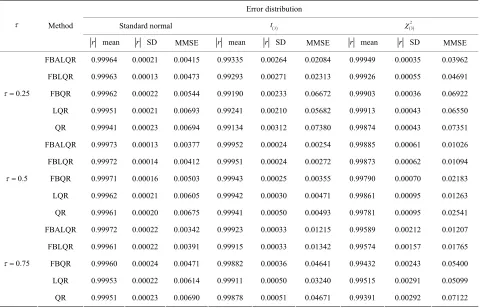
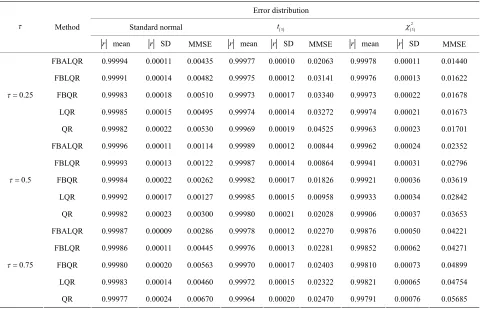
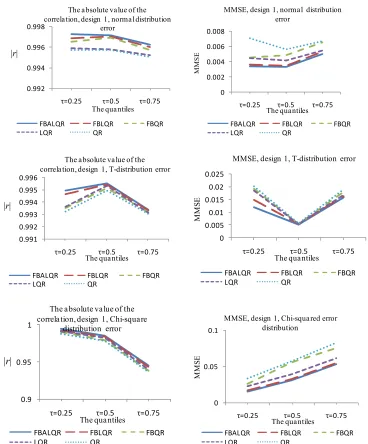
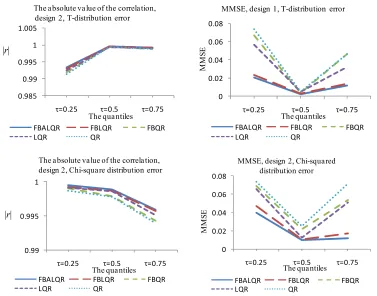
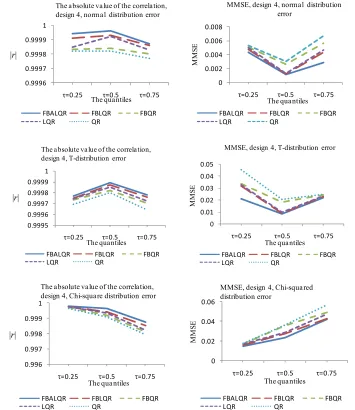
The results of the simulation are presented in Tables 1-4 and Figures 1-4. From Tables 1-4 and Figures 1-4,
according to the absolute correlation value of Xˆ and
X r and the median of the mean squared error (MMSE) for Xˆ, it can be seen that the proposed me- thods (FBALQR and FBLQR) are better than the other three methods for all the distributions under considera- tion and for all the values. This indicates that the pro- posed methods give precise estimates even when the er- ror distribution is an asymmetric. Most noticeably, when
0.25
and 0.75 the FBALQR and FBLQR are more significantly efficient than the other methods. In addition, we can observe that the worst estimators for all the values are QR.
5.2. Body Fat Data
Percentage of body fat is one important measure of health, which can be accurately estimated by underwater weighing techniques. These techniques often require spe- cial equipment and are sometimes not easily achieved, thus fitting percentage body fat to simple body mea- surements is a convenient way to predict body fat. John- son [32] introduced a data set in which percentage body fat and 13 simple body measurements (such as weight, height and abdomen circumference) are recorded for 252 men. The data set is available at the package (“mfp”). The response variable Y is the percent boday fat (%). The
13
k predictor variables x are, respectively, the age (years) x1, the weight (pounds) x2, the height (inches)
3
l
Table 1. Simulation results for FBALQR, FBLQR, FBQR, LQR and QR based on the linear mode yixiβxiγi, design
1.
r distribution
Erro
Standard normal t 3 23
Method
r mean r SD MMSE r mean r SD MMSE r mean r SD MMSE
FBALQR 0.99724 0.00131 0.00341 0.99494 0.00224 0.01182 0.99460 0.00172 0.01544
FBLQR 0.99684 0.00120 0.00363 0.99464 0.00241 0.01495 0.99210 0.00155 0.01673
FBQR 0.99655 0.00142 0.00452 0.99352 0.00251 0.01910 0.99053 0.00141 0.02620
LQR 0.99591 0.00141 0.00445 0.99361 0.00385 0.01852 0.99075 0.00143 0.02261
0.25
QR 0.99572 0.00143 0.00703 0.99322 0.00372 0.02010 0.98805 0.00196 0.03304
FBALQR 0.99714 0.00130 0.00331 0.99550 0.00113 0.00527 0.98537 0.00824 0.03151
FBLQR 0.99703 0.00131 0.00344 0.99543 0.00111 0.00554 0.98461 0.00726 0.03264
FBQR 0.99693 0.00144 0.00480 0.99514 0.00243 0.00535 0.97965 0.00733 0.05517
LQR 0.99580 0.00176 0.00412 0.99532 0.00213 0.00531 0.98221 0.00601 0.03926
0.5
QR 0.99571 0.00182 0.00562 0.99492 0.00127 0.00560 0.97846 0.00657 0.05702
FBALQR
QR 0.99504 0.00139 0.00665 0.99302 0.00311 0.01895 0.93623 0.02290 0.08290
0.99623 0.00103 0.00503 0.99337 0.00251 0.01572 0.94525 0.01794 0.05344
FBLQR 0.99602 0.00101 0.00530 0.99331 0.00244 0.01632 0.94325 0.01664 0.05443
FBQR 0.99575 0.00087 0.00653 0.99316 0.00315 0.01791 0.93853 0.01761 0.07512
LQR 0.99521 0.00143 0.00549 0.99314 0.00337 0.01689 0.93979 0.01783 0.06122
0.75
Table 2. Simulation results for FBALQR, FBLQR, FBQR, LQR and QR based on the linear model yixiβxiγi, design
2.
Error distribution
Standard normal t 3 23
Method
r mean r SD MMSE r mean r SD MMSE r mean r SD MMSE
FBALQR 0.99964 0.00021 0.00415 0.99335 0.00264 0.02084 0.99949 0.00035 0.03962
FBLQR 0.99963 0.00013 0.00473 0.99293 0.00271 0.02313 0.99926 0.00055 0.04691
FBQR 0.99962 0.00022 0.00544 0.99190 0.00233 0.06672 0.99903 0.00036 0.06922
LQR 0.99951 0.00021 0.00693 0.99241 0.00210 0.05682 0.99913 0.00043 0.06550
0.25
QR 0.99941 0.00023 0.00694 0.99134 0.00312 0.07380 0.99874 0.00043 0.07351
FBALQR 0.99973 0.00013 0.00377 0.99952 0.00024 0.00254 0.99885 0.00061 0.01026
FBLQR 0.99972 0.00014 0.00412 0.99951 0.00024 0.00272 0.99873 0.00062 0.01094
FBQR 0.99971 0.00016 0.00503 0.99943 0.00025 0.00355 0.99790 0.00070 0.02183
LQR 0.99962 0.00021 0.00605 0.99942 0.00030 0.00471 0.99861 0.00095 0.01263
0.5
QR 0.99961 0.00020 0.00675 0.99941 0.00050 0.00493 0.99781 0.00095 0.02541
FBALQR 0.99972 0.00022 0.00342 0.99923 0.00033 0.01215 0.99589 0.00212 0.01207
FBLQR 0.99961 0.00022 0.00391 0.99915 0.00033 0.01342 0.99574 0.00157 0.01765
FBQR 0.99960 0.00024 0.00471 0.99882 0.00036 0.04641 0.99432 0.00243 0.05400
LQR 0.99953 0.00022 0.00614 0.99911 0.00050 0.03240 0.99515 0.00291 0.05099
0.75
[image:5.595.60.540.426.734.2]Table 3. Simulation results for FBALQR, FBLQR, FBQR, LQR and QR based on the linear model yixiβxiγi, design
3.
ror dis n
Er tributio
Standard normal t 3 23
Method
r mean r SD MMSE r mean r SD MMSE r mean r SD MMSE
FBALQR 0.99868 0.00042 0.00602 0.99755 0.00128 0.01001 0.99699 0.00066 0.01391
F
FBQR
F F
FBQR
BLQR 0.99855 0.00044 0.00603 0.99744 0.00123 0.01043 0.99654 0.00091 0.01661
0.99754 0.00060 0.00624 0.99713 0.00132 0.01180 0.99603 0.00163 0.02303
LQR 0.99853 0.00051 0.00613 0.99731 0.00130 0.01122 0.99615 0.00100 0.02275
0.25
QR 0.99732 0.00063 0.00643 0.99701 0.00142 0.01263 0.99586 0.00157 0.02370
BALQR 0.99875 0.00052 0.00435 0.99852 0.00072 0.00593 0.99541 0.00173 0.01253
BLQR 0.99872 0.00054 0.00484 0.99824 0.00074 0.00664 0.99511 0.00180 0.01727
0.99823 0.00056 0.00543 0.99811 0.00077 0.00690 0.99270 0.00196 0.02465
LQR 0.99863 0.00055 0.00495 0.99815 0.00076 0.00685 0.99491 0.00190 0.01965
0.5
QR 0.99821 0.00059 0.00563 0.99802 0.00079 0.00688 0.99225 0.00201 0.03368
F
F
FBQR
LQR 0.99815 0.00058 0.00441 0.99755 0.00111 0.01652 0.98453 0.00521 0.04792
BALQR 0.99835 0.00052 0.00434 0.99765 0.00080 0.01025 0.98729 0.00471 0.04346
BLQR 0.99833 0.00055 0.00430 0.99757 0.00100 0.01044 0.98661 0.00505 0.04612
0.99812 0.00060 0.00476 0.99752 0.00112 0.01699 0.98354 0.00547 0.05250
0.75
[image:6.595.59.540.425.734.2]QR 0.99803 0.00061 0.00478 0.99754 0.00115 0.01910 0.98255 0.00574 0.05293
Table 4. Simulation results for FBALQR, FBLQR, FBQR, LQR and QR based on the linear model yixiβxiγi, design
4.
r di tion
Erro stribu
Standard normal t 3 3
2
Method
r mean r SD MMSE r mean r SD MMSE r mean r SD MMSE
FBALQR 0.99994 0.00011 0.00435 0.99977 0.00010 0.02063 0.99978 0.00011 0.01440
FBL
FBQR 0.
FBAL
FBL
FBQR 0.
FBAL
FBL
FBQR 0.
LQR 0.99983 0.00014 0.00460 0.99972 0.00015 0.02322 0.99821 0.00065 0.04754
QR 0.99991 0.00014 0.00482 0.99975 0.00012 0.03141 0.99976 0.00013 0.01622
99983 0.00018 0.00510 0.99973 0.00017 0.03340 0.99973 0.00022 0.01678
LQR 0.99985 0.00015 0.00495 0.99974 0.00014 0.03272 0.99974 0.00021 0.01673
0.25
QR 0.99982 0.00022 0.00530 0.99969 0.00019 0.04525 0.99963 0.00023 0.01701
QR 0.99996 0.00011 0.00114 0.99989 0.00012 0.00844 0.99962 0.00024 0.02352
QR 0.99993 0.00013 0.00122 0.99987 0.00014 0.00864 0.99941 0.00031 0.02796
99984 0.00022 0.00262 0.99982 0.00017 0.01826 0.99921 0.00036 0.03619
LQR 0.99992 0.00017 0.00127 0.99985 0.00015 0.00958 0.99933 0.00034 0.02842
0.5
QR 0.99982 0.00023 0.00300 0.99980 0.00021 0.02028 0.99906 0.00037 0.03653
QR 0.99987 0.00009 0.00286 0.99978 0.00012 0.02270 0.99876 0.00050 0.04221
QR 0.99986 0.00011 0.00445 0.99976 0.00013 0.02281 0.99852 0.00062 0.04271
99980 0.00020 0.00563 0.99970 0.00017 0.02403 0.99810 0.00073 0.04899
0.75
0.992 0.994 0.996 0.998
τ=0.25 τ=0.5 τ=0.75
The quantiles The absolute value of the correlation, design 1, normal distribution
error
FBALQR FBLQR FBQR
LQR QR
|r|
0 0.002 0.004 0.006 0.008
τ=0.25 τ=0.5 τ=0.75
MMS
E
The quantiles
MMSE, design 1, normal distribution error
FBALQR FBLQR FBQR
LQR QR
|r|
0.991 0.992 0.993 0.994 0.995 0.996
τ=0.25 τ=0.5 τ=0.75
The quantiles The absolute value of the correlation, design 1, T-distribution error
FBALQR FBLQR FBQR
LQR QR
0 0.005 0.01 0.015 0.02 0.025
τ=0.25 τ=0.5 τ=0.75
MM
SE
The quantiles
MMSE, design 1, T-distribution error
FBALQR FBLQR FBQR LQR QR
0.9 0.95 1
τ=0.25 τ=0.5 τ=0.75
The quantiles The absolute value of the correlation, design 1, Chi-square
distribution error
FBALQR FBLQR FBQR LQR QR
|r|
0 0.05 0.1
τ=0.25 τ=0.5 τ=0.75
MMS
E
The quantiles MMSE, design 1, Chi-squared error
distribution
FBALQR FBLQR FBQR
[image:7.595.114.482.82.526.2]LQR QR
Figure 1. The left column explains the plots for the absolute value of the correlation between Xβˆ and Xβ, design 1, and the error distributions are normal, T and Chi-square respectively. The right column explains the plots for the MMSE of Xβˆ, design 1, and the error distributions are normal, T and Chi-square respectively.
0.9992 0.9994 0.9996 0.9998
τ=0.25 τ=0.5 τ=0.75
The quantiles
The absolute value of the correlation, design 2, normal distribution error
FBALQR FBLQR FBQR LQR QR
|r|
0 0.002 0.004 0.006 0.008
τ=0.25 τ=0.5 τ=0.75
MMS
E
The quantiles
MMSE, design 2, normal distribution error
0.985 0.99 0.995 1 1.005
τ=0.25 τ=0.5 τ=0.75
The quantiles The absolute value of the correlation,
design 2, T-distribution error
FBALQR FBLQR FBQR LQR QR
|r|
0 0.02 0.04 0.06 0.08
τ=0.25 τ=0.5 τ=0.75
MM
SE
The quantiles MMSE, design 1, T-distribution error
FBALQR FBLQR FBQR LQR QR
0.99 0.995 1
τ=0.25 τ=0.5 τ=0.75
The quantiles The absolute value of the correlation, design 2, Chi-square distribution error
FBALQR FBLQR FBQR
LQR QR
|r|
0 0.02 0.04 0.06 0.08
τ=0.25 τ=0.5 τ=0.75
MMS
E
The quantiles MMSE, design 2, Chi-squared
distribution error
FBALQR FBLQR FBQR
[image:8.595.112.489.85.381.2]LQR QR
Figure 2. The left column explains the plots for the absolute value of the correlation between Xβˆ and β, model 2, and the error distributions are normal, T and Chi-square respectively. The right column explains the plots for the MMSE of Xβˆ, model 2, and the error distributions are normal, T and Chi-square respectively.
0.996 0.997 0.998 0.999
τ=0.25 τ=0.5 τ=0.75
The quantiles The absolute value of the correlation, design 3, normal distribution error
FBALQR FBLQR FBQR LQR QR
|r|
0 0.002 0.004 0.006 0.008
τ=0.25 τ=0.5 τ=0.75
MM
SE
The quantiles
MMSE, design 3, normal distribution error
FBALQR FBLQR FBQR LQR QR
0.996 0.997 0.998 0.999
τ=0.25 τ=0.5 τ=0.75
The quantiles The absolute value of the correlation, design 3, T-distribution error
FBALQR FBLQR FBQR LQR QR
|r|
0 0.005 0.01 0.015 0.02 0.025
τ=0.25 τ=0.5 τ=0.75
MM
SE
The quantile
MMSE, design 3, T-distribution error
0.97 0.98 0.99 1
τ=0.25 τ=0.5 τ=0.75
The quantiles The absolute value of the correlation, design3, Chi-square distribution error
FBALQR FBLQR FBQR
LQR QR
|r|
0 0.02 0.04 0.06
τ=0.25 τ=0.5 τ=0.75
MM
SE
The quantiles MMSE, design 3, Chi-squared error
distribution
FBALQR FBLQR FBQR
[image:9.595.132.466.85.214.2]LQR QR
Figure 3. The left column explains the plots for the absolute value of the correlation between Xβˆ and Xβ, model 3, and the error distributions are normal, T and Chi-square respectively. The right column explains the plots for the MMSE of Xβˆ, model 3, and the error distributions are normal, T and Chi-square respectively.
0.9996 0.9997 0.9998 0.9999 1
τ=0.25 τ=0.5 τ=0.75
The quantiles
The absolute value of the correlation, design 4, normal distribution error
FBALQR FBLQR FBQR
LQR QR
|r|
0 0.002 0.004 0.006 0.008
τ=0.25 τ=0.5 τ=0.75
MMS
E
The quantiles
MMSE, design 4, normal distribution error
FBALQR FBLQR FBQR
LQR QR
0.9995 0.9996 0.9997 0.9998 0.9999 1
τ=0.25 τ=0.5 τ=0.75
The quantiles The absolute value of the correlation, design 4, T-distribution error
FBALQR FBLQR FBQR
LQR QR
|r|
0 0.01 0.02 0.03 0.04 0.05
τ=0.25 τ=0.5 τ=0.75
MMS
E
The quantiles MMSE, design 4, T-distribution error
FBALQR FBLQR FBQR
LQR QR
0.996 0.997 0.998 0.999 1
τ=0.25 τ=0.5 τ=0.75
The quantiles The absolute value of the correlation, design 4, Chi-square distribution error
FBALQR FBLQR FBQR
LQR QR
|r|
0 0.02 0.04 0.06
τ=0.25 τ=0.5 τ=0.75
MM
SE
The quantiles MMSE, design 4, Chi-squared distribution error
FBALQR FBLQR FBQR
LQR QR
[image:9.595.120.475.277.687.2]The hip circumference (cm) x7, the thigh circumference
(cm) x8, the knee circumference (cm) x9, the ankle
circumference (cm) x10, the extended biceps circumfer-
ence x11, the forearm circumference (cm) x12 and the
wrist circumference (cm)
methods. It is clear that the proposed methods give pre-cise estimates. Again, we can see that when 0.25 and 0.75 the proposed methods are significantly more efficient than the other methods. The results of the simulation studies and real data example suggested that the proposed methods perform well.
13
x .
Hoeting et al. [35] and Leng et al. [36] analyzed this data set. Previous diagnostic checking (Hoeting et al. [35]; Leng et al. [36]) showed that it is reasonable to
assume a linear regression model.
6. Conclusion
In this study, we have proposed a flexible Bayesian Lasso and adaptive Lasso quantile regression by propos- ing a hierarchical model framework. We have theoreti- cally investigated and numerically compared our pro- posed methods with the FBQR, Lasso quantile regression (LQR) and quantile regression (QR) methods. In order to The results of the body fat data analysis are presented
in Tables 5 and 6 and Figures 5 and 6. From Table 5
and Figure 5, we have the following observations.
[image:10.595.66.539.310.418.2]Ac-cording to the mean squared error criterion, it can be seen that the performance of the proposed methods (FBALQR and FBLQR) is better than the performance of other
Table 5. MSE for βˆX which is estimated by FBALQR, FBLQR, FBQR, LQR and QR based on body fat data for 0 25. , .
0 5
and 0 75. .
MSE The methods
0.25
0.5 0.75
FBALQR 0.1084258 1.133324e–05 0.1370678
FBLQR 0.1241451 7.436673e–05 0.1423978
FBQR 0.1377442 9.326444e–05 0.1477935
LQR 0.1270168 0.001221321 0.1497241
[image:10.595.58.540.462.734.2]QR 0.1414865 0.0009612835 0.1639030
Table 6. The estimated βˆ which is estimated by FBALQR, FBLQR, FBQR, LQR and QR based on body fat data for .
0 25
, 0 5. and 0 75. .
0.25
0.5 0.75
FBALQR FBLQR FBQR LQR QR FBALQR FBLQR FBQR LQR QR FBALQR FBLQR FBQR LQR QR
0 ˆ
–0.329 –0.352 –0.371 –0.356 –0.376 –0.003 –0.009 –0.009 –0.035 –0.031 0.370 0.377 0.384 0.387 0.405
1
ˆ
0.145 0.088 0.067 0.089 0.071 0.111 0.105 0.108 0.095 0.106 0.123 0.124 0.145 0.099 0.127
2 ˆ
–0.001 –0.058 –0.047 –0.324 –0.018 –0.119 –0.099 –0.105 –0.001 0.127 –0.097 –0.163 –0.120 –0.307 –0.726
3 ˆ
–0.060 –0.028 –0.027 –0.007 –0.028 –0.030 –0.039 –0.037 –0.039 –0.042 –0.056 –0.039 –0.043 0.010 0.091
4 ˆ
–0.129 –0.202 –0.225 –0.199 –0.245 –0.160 –0.155 –0.171 –0.110 –0.147 –0.082 –0.095 –0.094 –0.018 –0.062
5 ˆ
0.022 0.040 0.024 0.128 0.017 –0.037 –0.020 –0.046 –0.089 –0.110 –0.076 –0.104 –0.122 –0.112 0.034
6 ˆ
1.010 1.085 1.149 1.169 1.162 1.163 1.122 1.167 1.190 1.181 1.089 1.175 1.168 1.180 1.353
7 ˆ
–0.176 –0.237 –0.324 –0.236 –0.370 –0.211 –0.172 –0.235 –0.296 –0.348 –0.072 –0.101 –0.123 –0.039 –0.003
8 ˆ
0.140 0.159 0.189 0.233 0.208 0.165 0.136 0.170 0.224 0.212 0.078 0.089 0.132 0.074 0.129
9 ˆ
0.001 0.054 0.059 –0.008 0.072 –0.009 –0.004 0.004 –0.043 –0.057 –0.028 –0.045 –0.065 –0.066 –0.129
10
ˆ
–0.001 –0.076 –0.08 –0.025 –0.090 –0.003 –0.011 –0.004 –0.011 –0.011 0.054 0.077 0.085 0.110 0.122
11 ˆ
0.018 0.018 0.024 –0.001 0.019 0.052 0.051 0.062 0.016 0.034 0.082 0.106 0.101 0.043 0.141
12
ˆ
0.132 0.084 0.079 0.207 0.091 0.081 0.064 0.075 0.105 0.105 0.047 0.049 0.054 0.074 0.078
13 ˆ
0 0.02 0.04 0.06 0.08 0.1 0.12 0.14 0.16
FBALQR FBLQR FBQR LQR
MS
E
The methods
MSE for different methods, ߬=0.25
߬=0.25
0.00E+00 2.00E-04 4.00E-04 6.00E-04 8.00E-04 1.00E-03 1.20E-03 1.40E-03
FBALQR FBLQR FBQR LQR QR
MS
E
The methods
MSE for different methods, ߬=0.5
߬=0.5
0.12 0.125 0.13 0.135 0.14 0.145 0.15 0.155 0.16 0.165 0.17
FBALQR FBLQR FBQR LQR QR
MS
E
The methods
MSE for different methods, ߬=0.75
[image:11.595.124.478.69.548.2]߬=0.75
Figure 5. plots explain MSE for βˆX which is estimated byFBALQR, FBLQR, FBQR, LQR and QR based on body fat data for 0 25. , 0 5. and 0 75. .
-0.6 -0.4 -0.2 0 0.2 0.4 0.6 0.8 1 1.2 1.4
ߚ0 ߚ1 ߚ2 ߚ3 ߚ4 ߚ5 ߚ6 ߚ7 ߚ8 ߚ9 ߚ10 ߚ11 ߚ12 ߚ13
-0.6 -0.4 -0.2 0 0.2 0.4 0.6 0.8 1 1.2 1.4
ߚ0 ߚ1 ߚ2 ߚ3 ߚ4 ߚ5 ߚ6 ߚ7 ߚ8 ߚ9 ߚ10 ߚ11 ߚ12 ߚ13
Estimated ߚ’s by using different methods, ߬=0.5
-1 -0.5 0 0.5 1 1.5
ߚ0 ߚ1 ߚ2 ߚ3 ߚ4 ߚ5 ߚ6 ߚ7 ߚ8 ߚ9 ߚ10 ߚ11 ߚ12 ߚ13
Estimated ߚ’ s by using different methods, ߬=0.75
[image:12.595.115.481.95.398.2]FBALQR FBLQR FBQR LQR QR
Figure 6. Plots explain the estimated βˆ which is estimated by FBALQR, FBLQR, FBQR, LQR and QR based on body fat data for 0 25. , 0 5. and 0 75. .
assess the numerical performance, we have conducted a simulation study based on the model yi xiβxiγi as
described in Section 5 with error i from three possible
error distributions: standard normal, a distribution with three degrees of freedom and Chi-squared distribu-
3
t
tion with three degrees of freedom
2 3 and five de- signs for the vector β. From the simulation study and real data, we can conclude that the proposed methods perform well in comparison to the other methods and thus we believe that the proposed methods are practically useful.
REFERENCES
[1] R. Koenker, “Quantile Regression,” Cambridge Univer- sity Press, Cambridge, 2005.
doi:10.1017/CBO9780511754098
[2] K. Yu, Z. Lu and J. Stander, “Quantile Regression: Ap- plications and Current Research Areas,” The Statistician, Vol. 52, No. 3, 2003, pp. 331-350.
doi:10.1111/1467-9884.00363
[3] R. Koenker and G. Bassett Jr., “Regression Quantiles,” Econometrica, Vol. 46, No. 1, 1978, pp. 33-50.
doi:10.2307/1913643
[4] R. Koenker and J. Machado, “Goodness of Fit and R
10473882
lated Inference Processes for Quantile Regression,” Jour- nal of the American Statistical Association, Vol. 94, No. 448, 1999, pp. 1296-1310.
doi:10.1080/01621459.1999.
le Regres- [5] K. Yu and R. A. Moyeed, “Bayesian Quanti
sion,” Statistics and Probability Letters, Vol. 54, No. 2, 2001, pp. 437-447. doi:10.1016/S0167-7152(01)00124-9 [6] E. Tsionas, “Bayesian Quantile Inference,” Journal of
Statistical Computation and Simulation, Vol. 73, No. 9, 2003, pp. 659-674. doi:10.1080/0094965031000064463 [7] K. Yu and J. Stander, “Bayesian Analysis of a Tobit
Quantile Regression Model,” Journal of Econometrics, Vol. 137, No. 1, 2007, pp. 260-276.
doi:10.1016/j.jeconom.2005.10.002
[8] M. Geraci and M. Bottai, “Quantile Regression for Lon- gitudinal Data Using the Asymmetric Laplace Distribu- tion,” Biostatistics, Vol. 8, No. 1, 2007, pp. 140-154. doi:10.1093/biostatistics/kxj039
[9] H. Kozumi and G. Kobayashi, “Gibbs Sampling Methods
icient Gibbs Sampler for
Poel, “Binary Quantile Re- for Bayesian Quantile Regression,” Technical Report, Kobe University, Kobe, 2009.
[10] C. Reed and K. Yu, “An Eff
Bayesian Quantile Regression,” Technical Report, Brunel University, Uxbridge, 2009.
[11] D. F. Benoit and D. Van den
Laplace Distribution,” Journal of Applied Econometrics, Vol. 27, No. 7, 2012, pp. 1174-1188.
doi:10.1002/jae.1216
[12] S. Walker and B. Mallick, “A Bayesian Semi-Param
99.00477.x
etric Accelerated Failure Time Model,” Biometrics, Vol. 55, No. 2, 1999, pp. 477-483.
doi:10.1111/j.0006-341X.19
emi-Parametric [13] A. Kottas and A. Gelfand, “Bayesian S
Median Regression Modelling,” Journal of the American Statistical Association, Vol. 96, No. 465, 2001, pp. 1458- 1468. doi:10.1198/016214501753382363
[14] T. Hanson and W. O. Johnson, “Modeling Regression Error with a Mixture of Polya Trees,” Journal of the Ame- rican Statistical Association, Vol. 97, No. 460, 2002, pp. 1020-1033. doi:10.1198/016214502388618843
[15] N. L. Hjort, “Topics in Nonparametric Bayesian
Statis-onparametric Quantile
8_0023
tics,” In: P. J. Green, S. Richardson and N. L. Hjort, Eds., Highly Structured Stochastic Systems, Oxford University Press, Oxford, 2003, pp. 455-475.
[16] N. L. Hjort and S. Petrone, “N
Inference Using Dirichlet Processes,” In: V. Nair, Ed., Advances in Statistical Modeling and Inference: Essays in Honor of Kjell A. Doksum, World Scientific, Singapore City, 2007, pp. 463-492.
doi:10.1142/978981270829
ametric Model-Based
C. M. Krnjajić, “Bayesian Nonparametric [17] M. Taddy and A. Kottas, “A Nonpar
Approach to Inference for Quantile Regression,” Techni- cal Report, UCSC Department of Applied Math and Sta- tistics, 2007.
[18] A. Kottas and
Modelling in Quantile Regression,” Scandinavian Jour- nal of Statistics, Vol. 36, No. 3, 2009, pp. 297-319. [19] B. Reich, H. Bondell and H. Wang, “Flexible Bayesian
Quantile Regression for Independent and Clustered Data,” Biostatistics, Vol. 11, No. 2, 2010, pp. 337-352. doi:10.1093/biostatistics/kxp049
[20] Q. Li, R. Xi and N. Lin, “Bayesian Regularized Quantile Regression,” Bayesian Analysis, Vol. 5, No. 3, 2010, pp. 1-24. doi:10.1214/10-BA521
[21] R. Tibshirani, “Regression Shrinkage and Selection
n via Nonconcav via the Lasso,” Journal of the Royal Statistical Society Series B, Vol. 58, No. 1, 1996, pp. 267-288.
[22] J. Fan and R. Li, “Variable Selectio e Penalized Likelihood and Its Oracle Properties,” Journal of the American Statistical Association, Vol. 96, No. 456, 2001, pp. 1348-1360. doi:10.1198/016214501753382273 [23] H. Zou, “The Adaptive Lasso and Its Oracle Properties,”
Journal of the American Statistical Association, Vol. 101,
No. 476, 2006, pp. 1418-1429. doi:10.1198/016214506000000735
an Lasso,” Journal of [24] T. Park and G. Casella, “The Bayesi
the American Statistical Association, Vol. 103, No. 482, 2008, pp. 681-686. doi:10.1198/016214508000000337 [25] J. Bradic, J. Fan and W. Wang, “Penalized Composite
.x
Quasi-Likelihood for Ultrahigh-Dimensional Variable Selection,” Journal of Royal Statistics Society Series B, Vol. 73, No. 3, 2010, pp. 325-349.
doi:10.1111/j.1467-9868.2010.00764
for Longitudinal [26] R. Koenker, “Quantile Regression
Data,” Journal of Multivariate Analysis, Vol. 91, No. 1, 2004, pp. 74-89. doi:10.1016/j.jmva.2004.05.006
[27] Y. Yuan and G. Yin, “Bayesian Quantile Regression for Longitudinal Studies with Non-Ignorable Missing Data,” Biometrics, Vol. 66, No. 1, 2010, pp. 105-114.
doi:10.1111/j.1541-0420.2009.01269.x
[28] H. Wang, G. Li and G. Jiang, “Robust Regression Shrink- age and Consistent Variable Selection through the LAD,” Journal of Business and Economic Statistics, Vol. 25, No. 3, 2007, pp. 347-355. doi:10.1198/073500106000000251 [29] Y. Li and J. Zhu, “L1-Norm Quantile Regressions,” Jour-
nal of Computational and Graphical Statistics, Vol. 17, No. 1, 2008, pp. 1-23.
[30] Y. Wu and Y. Liu, “Variable Selection in Quantile Re-
hamzawi, K. Yu and D. Benoit, “Bayesian Adaptive
304
gression,” Statistica Sinica, Vol. 19, No. 2, 2009, pp. 801- 817.
[31] R. Al
Lasso Quantile Regression,” Statistical Modelling, Vol. 12, No. 3, 2012, pp. 279-297.
doi:10.1177/1471082X1101200
f Body Fat to Simple
The Ameri- [32] R. W. Johnson, “Fitting Percentage o
Body Measurements,” Journal of Statistics Education, Vol. 4, No. 1, 1996, pp. 236-237.
[33] X. He, “Quantile Curves without Crossing,” can Statistician, Vol. 51, No. 2, 1997, pp. 186-192. doi:10.1080/00031305.1997.10473959
[34] D. F. Andrews and C. L. Mallows, “Scale Mixtures of
ry and C. T.
aptive
00v1.pdf Normal Distributions,” Journal of Royal Statistics Society Series B, Vol. 36, No. 1, 1974, pp. 99-102.
[35] J. A. Hoeting, D. Madigan, A. E. Rafte
Volinsky, “Bayesian Model Averaging: A Tutorial,” Sta- tistical Science, Vol. 14, No. 4, 1999, pp. 382-417. [36] C. Leng, M. N. Tran and D. Nott, “Bayesian Ad
Lasso,” Technical Report, 2010.
Appendix
The details of Gibbs sampler for the penalized flexible Bayesian Lasso quantile regression are given as follows:
1) The full conditional distribution of j is multi-
variate normal distribution
, ˆ2
j j
,
where
, and1 2
2 2 1
1
ˆj n ij i H Gl l j
i
x x s
γ
22
1
ˆ
l l i i
n
j j ij i H G i i H G
i
x x yi x x
γ γ
.2) The full conditional distribution of sj is inverse
Gaussian
,
,j1, , kwhere 2 2 j and
2 j .
3) The full conditional distribution of 2 is
1 2
1
Gamma , k j .
j
k c s c
Given N max
G1, , n
, , , ,
m mVk m
G and N , the parameters 1 2 1 2m
1, ,
m
G
and the standard de- viation parameters can be updated using Gaussian distri- bution. The group indicators i are also updated using
Metropolis-Hasting sampling (see Reich et al. [19] for more details). The full conditional distribution for all parameters in the penalized flexible Bayesian Adaptive Lasso quantile regression is similar to the above descrip- tion except for the full conditional distributions for sj
and 2,j1, , k which are given by
j
1) The full conditional distribution of sj is inverse
Gaussian
,
,j1, , k where2 2 j j
and 2 j .
2) The full conditional distribution of 2 j is
1 2