3356
Embedding Imputation with Grounded Language Information
Ziyi Yang1, Chenguang Zhu2, Vin Sachidananda3, and Eric Darve1, 4
1Department of Mechanical Engineering, Stanford University 2Microsoft Speech and Dialogue Research Group 3Department of Electrical Engineering, Stanford University
4Institute for Computational and Mathematical Engineering, Stanford University
{ziyi.yang, vsachi, darve}@stanford.edu,[email protected]
Abstract
Due to the ubiquitous use of embeddings as input representations for a wide range of natu-ral language tasks, imputation of embeddings for rare and unseen words is a critical problem in language processing. Embedding imputa-tion involves learning representaimputa-tions for rare or unseen words during the training of an em-bedding model, often in a post-hoc manner. In this paper, we propose an approach for embed-ding imputation which uses grounded infor-mation in the form of a knowledge graph. This is in contrast to existing approaches which typ-ically make use of vector space properties or subword information. We propose an online method to construct a graph from grounded information and design an algorithm to map from the resulting graphical structure to the space of the pre-trained embeddings. Finally, we evaluate our approach on a range of rare and unseen word tasks across various domains and show that our model can learn better repre-sentations. For example, on the Card-660 task our method improves Pearson’s and Spear-man’s correlation coefficients upon the state-of-the-art by 11% and 17.8% respectively us-ing GloVe embeddus-ings.
1 Introduction
Word embeddings (Mikolov et al.,2013; Penning-ton et al.,2014) are used pervasively in deep learn-ing for natural language processlearn-ing. However, due to fixed vocabulary constraints in existing ap-proaches to training word embeddings, it is diffi-cult to learn representations for words which are rare or unseen during training. This is commonly referred to as the out-of-vocabulary (OOV) word problem. In the original embedding implementa-tions, a special OOV token is typically reserved for such words. However, this rudimentary ap-proach often detriments the performance of down-stream tasks which contain numerous rare or
un-seen words. Recent works have proposed subword approaches (Zhao et al., 2018; Sennrich et al.,
2015), which construct embeddings through the composition of characters or sentence pieces for OOV words. Vector space properties are also uti-lized to learn embeddings with small amounts of data (Bahdanau et al., 2017; Herbelot and Ba-roni, 2017). In this paper, we propose a novel approach, knowledge-graph-to-vector (KG2Vec), for the OOV word problem. KG2Vec makes use of the grounded language information in the form of a knowledge graph. Grounded information has been extensively used in various NLP tasks to represent real-world knowledge (Niles and Pease,
2003; Gruber, 1993; Guarino, 1998; de Bruijn et al.,2006;Paulheim,2017) . In particular, early question answering systems used expert-crafted ontologies in order to endow these systems with common knowledge (Harabagiu et al., 2005;Xu et al., 2016). Additionally, lexical-semantic on-tologies, such as WordNet, have been used to provide semantic relations between words in a wide variety of language processing and inference tasks (Morris and Hirst,1991;Ovchinnikova et al.,
2010).
Grounded language information has been ob-served to augment model performance on a wide variety of natural language processing and under-standing tasks (He et al.,2017;Choi et al.,2018). In these settings, a model is able to provide bet-ter generalization by using relational information from a knowledge graph or knowledge base in ad-dition to the standard set of training examples. Ad-ditionally, outputs from models with grounded ap-proaches have been observed to be more factu-ally consistent and logicfactu-ally sound (Bordes et al.,
2014) compared with outputs from models with-out grounding information.
se-mantic meanings of words directly from the graph-ical structure in grounded knowledge using recent advances in network representation learning. Fur-thermore, KG2Vec leverages the most updated in-formation from comprehensive knowledge bases (Wikipedia & Wiktionary). Therefore, KG2Vec can be applied to training embeddings of newly emerging OOV words.
In summary, our contributions are three-fold: 1. An approach to constructing graphical
repre-sentations of entities in a knowledge base in an unsupervised manner.
2. Methods for mapping entities from a graphi-cal representation to the space in which a pre-trained embedding lies.
3. Experimentation on rare and unseen word datasets and a new state-of-art performance on Card-660 dataset.
2 Related Work
2.1 Graph Neural Networks
Graph neural networks (GNN) are an emerging deep learning approach for representation learn-ing of graphical data (Xu et al., 2018;Kipf and Welling,2016). GNNs can learn a representation vectorhv for each node in the network by
lever-aging the graphical structure and node featuresfv.
Node embeddings are generated by recursively ag-gregating each node’s neighborhood information and features. At thet-th iteration, the information aggregation is defined as:
htv =Mt(htv−1,{htu−1}u∈N(v)) (1)
wherehtv is the representation forvat thet-th it-eration,Mtis an iteration-specific message aggre-gation function parametrized by a neural network andN(v)is the set of neighbors of nodev. One simple form of Mt is mean neighborhood aggre-gation:
htv =ReLU( X
u∈N(v)
Wthtu−1
|N(v)| +B
tht−1
v ) (2)
where Wt and Bt are trainable matrices. Typi-cally,h0vis initialized asfv. The final node
repre-sentation is usually a function ofhTv from the last iterationT, such as an identity function or a trans-formation function (Ying et al.,2018).
2.2 The OOV word problem
The out-of-vocabulary (OOV) word problem has been present in word embedding models since
their inception (Mikolov et al.,2013;Pennington et al.,2014). Due to space and training data con-straints, words which are either infrequent or do not appear in the training corpus can lack repre-sentations at the time of inference.
Numerous methods have been proposed to tackle the OOV word problem with a small amount of training data. Deep learning based ap-proaches (Bahdanau et al.,2017) and vector-space based methods (Herbelot and Baroni, 2017) can improve the rare word representations on various semantic similarity tasks. One downside to these approaches is that they require small amounts of training data for words whose embeddings are be-ing imputed and, as a result, can have difficulties representing words for which training samples do not exist.
Sub-word level representations have been stud-ied in the context of the OOV word problem. Pin-ter et al. (2017) uses the RNN’s hidden state of the last sub-word in a word to produce representa-tions.Zhao et al.(2018) proposes using character-level decomposition to produce embeddings for OOV words.
3 Model
We propose the knowledge-graph-to-vector (KG2Vec) model for building OOV word rep-resentations from knowledge base information. KG2Vec starts with building a knowledge graph
Kwith nodes consisting of pre-trained words and OOV words. It then utilizes a graph convolutional network (GNN) to map graph nodes to low-dimensional embeddings. The GNN is trained to minimize the Euclidean distance between the node embeddings to pre-trained word embeddings in the dictionary such as GloVe (Pennington et al.,
2014) and ConceptNet Numberbatch (Speer et al.,
2017). Finally, the GNN is used to generate embeddings for OOV words.
3.1 Build the Knowledge Graph
In a knowledge graphK, each node v represents a word wv. The nodes (words) in the graph are
OOV words for which we would like to impute embeddings are also added to the graph as nodes.
For each node, we obtain its grounded informa-tion from two sources: (I) the words’ summary, defined as the first paragraph of the Wikipedia page when this word is searched; (II) the word’s definition in Wiktionary. We choose Wikipedia and Wiktionary over other knowledge bases be-cause they are comprehensive, well-maintained and up-to-date. Here is an example of the grounded information for the word Brexit.
• Wikipedia page summary:Brexit, a portman-teau of “British” and “exit”, is the impend-ing withdrawal of the United Kimpend-ingdom (UK) from the European Union (EU). It follows the referendum of 23 June 2016 when 51.9 per cent of voters chose to leave the EU...
• Wiktionary definition: Brexit (Britain, poli-tics)The withdrawal of the United Kingdom from the European Union.
All the words in the Wikipedia summary and the Wiktionary definition form the grounded lan-guage information of this word wv, defined as
Dv. Specifically,Dv is the concatenation ofwv’s
Wikipedia summary and the Wiktionary defini-tion. An undirected edgeevuexists between node
v andu if the Jaccard coefficient |Dv∩Du|
|Dv∪Du| > η,
whereη is a pre-defined threshold and chosen to be 0.5 empirically in the experiments. The edge evuis then assigned with a weightsvu=
|Dv∩Du|
|Dv∪Du|.
We also compute a feature vectorfuas the mean of
pre-trained embeddings of words inDv. Finally,
the obtained knowledge graphK = (V, E)has a feature vectorfv for each nodev∈V.
3.2 Graph Neural Network
The nodes in the graph are mapped to low-dimensional embeddings via graph convolutional neural network (GCN) (Kipf and Welling,2016). It follows that, at thet-th neighborhood aggrega-tion, the node embeddinght
v for nodev is
mod-elled as:
htv =ReLU(Wt X
u∈S(v)
svuhtu−1
C +b
t) (3)
whereS(v) =N(v)∪ {v}, and the normalization constantC = 1 +P
u∈N(v)svu. Wt andbt are trainable parameters. The node embeddings are initialized as the feature vectorfv, i.e. h0v = fv.
At the final iterationT, the generated node embed-dings{hTv}are computed without the ReLU
func-tion. The loss function of the GNN model is the mean square error between the pre-trained word vectors and generated embeddinghTv for all words in the graph which are part of the model’s vocab-ulary (e.g. GloVe). During inference, OOV words are assigned embeddings computed by the GNN.
4 Experiments
To evaluate our method’s ability to impute embed-dings, we conduct experiments on the following rare and unseen word similarity tasks.
4.1 Card-660: Cambridge Rare Word Dataset
Card-660 (Pilehvar et al., 2018) is a word-word similarity task with 660 example pairs involv-ing uncommon words and provides a benchmark for rare word representation models. Card-660 has a inter-annotator agreement (IAA) measure of 0.90, which is significantly higher than previous datasets for rare word representation. Addition-ally, Card-660 contains examples from a disparate set of domains such as technology, popular culture and medicine.
4.2 Stanford Rare Word (RW) Similarity
The Stanford Rare Word (RW) Similarity Bench-mark (Luong et al.,2013) is a word-word semantic similarity task including 2034 word pairs and tests the ability of representation learning methods to capture the semantics of infrequent words. Due to the probabilistic underpinnings of word embed-dings, where distances between two words’ repre-sentations are approximately proportional to their co-occurrence probability in a corpus, the authors found that rare words often have more noisy rep-resentations due to having fewer training samples. Although RW has a relatively low IAA measure of 0.41, the benchmark has been well-studied in previous literature.
4.3 Results
Bah-Model Missed words Missed pairs Pearsonr Spearmanρ
RW CARD RW CARD RW CARD RW CARD
ConceptNet Numberbatch 5% 37% 10% 53% 53.0 36.0 53.7 24.7
+ Mimick 0% 0% 0% 0% 56.0 34.2 57.6 35.6
+ Definition centroid 0% 29% 0% 43% 59.1 42.9 60.3 33.8
+ Definition LSTM 0% 25% 0% 39% 58.6 41.8 59.4 31.7
+ SemLand 0% 29% 0% 43% 60.5 43.4 61.7 34.3
+ BoS 0% 0% 0% 0% 60.0 49.2 61.7 47.6
+ Node features 0.02% 7% 0.04% 12% 58.4 54.0 59.7 51.4
+ KG2Vec 0.02% 7% 0.04% 12% 58.6 56.9 60.1 54.3
GloVe Common Crawl 1% 29% 2% 44% 44.0 33.0 45.1 27.3
+ Mimick 0% 0% 0% 0% 44.7 23.9 45.6 29.5
+ Definition centroid 0% 21% 0% 35% 43.5 35.2 45.1 31.7
+ Definition LSTM 0% 20% 0% 33% 24.0 23.0 22.9 19.6
+ SemLand 0% 21% 0% 35% 44.3 39.5 45.8 33.8
+ BoS 0% 0% 0% 0% 44.9 31.5 46.0 35.3
+ Node features 0.05% 0.4% 0.01% 0.7% 43.8 36.0 45.0 37.4
[image:4.595.121.481.61.315.2]+ KG2Vec 0.05% 0.4% 0.01% 0.7% 44.6 50.5 45.8 51.6
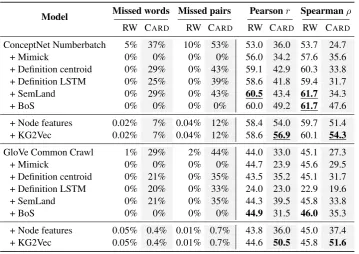
Table 1: Performance of OOV models on Stanford Rare Word Similarity and Card-660 datasets. Two word dic-tionaries are used: ConceptNet and GloVe. The overall best are underlined for each column, and the best results for each type of word dictionary are in bold. We run the BoS experiments with the default hyper-parameters from
Zhao et al.(2018). Performances of other baseline models are collected fromPilehvar et al.(2018).
danau et al., 2017), SemLand (Pilehvar and Col-lier, 2017) and BoS (Zhao et al., 2018). Dur-ing evaluation, zero vectors are assigned to miss-ing words and word-word similarity is computed as the inner product of the corresponding embed-dings. In KG2Vec, the number of iterationsT = 3 for GCN, and the number of nodes with pre-trained word vectors|V0|= 9000. We test on two types of pre-trained word vectors GloVe (Com-mon crawl, cased 300d) and ConceptNet Num-berbatch (300d). KG2Vec shows competitive per-formance in all test cases. On Card-660 dataset KG2Vec achieves state-of-the-art results by a sig-nificant margin. When using ConceptNet embed-dings, KG2Vec results in improvements of 7.7% and 6.7% on Pearson’s and Spearman’s correlation coefficients, respectively, when compared to prior state-of-the-art performance (BoS). When using GloVe embeddings, KG2Vec improves upon Sem-Land by 11% and 17.8% on Pearson’s and Spear-man’s correlation coefficients. Considering the fact that Card-660 contains a significant amount of recent OOV words (e.g. “Brexit”), this improve-ment indicates that KG2Vec’s can leverage up-to-date information from knowledge bases. Ad-ditionally, this shows that GNNs can effectively cover OOV words and precisely model their
se-mantic meanings. On Stanford Rare Word dataset, KG2Vec is comparable with other state-of-the-art models, suggesting its robustness across various test schemes. Note that the graph used in KG2Vec has a much smaller size compared with knowledge graphs used in SemLand, the WordNet, which has 155,327 words.
To fairly evaluate KG2Vec, we include a base-line model that assigns the node feature fv as
the final word representations for word wv ifwv
is not in the pre-trained dictionary. The results are denoted as “Node features” in table1. In all test cases, KG2Vec improves by a large margin upon this baseline. For example, using GloVe on the Card-660 dataset, KG2Vec’s achieves a per-formance increase of 14.5% and 14.2% respec-tively for Pearson’s and Spearman’s coefficients over Node features. This observation suggests that the information aggregation by GNN is critical for embedding imputation and semantic inference. It also indicates that learning from the knowledge graph and its language information is an effective way to parse the semantic meaning of a rare word.
5 Discussion
relational data in a tuple format: (entity1, en-tity2, relation), where entities can be considered as the “nodes” in the graph and relations define the edges. Note that there are different kinds of relations and therefore edges in the graph have different types or labels. To impute the embed-dings for entities in such scenario, one can con-veniently adapt KG2Vec following Schlichtkrull et al.(2018) by learning different transformations for different types of edges.
Adaption to New Vocabularies and Informa-tion. Considering the fast growth of vocabular-ies in the current era, the ability to perform on-line learning and quick adaptation for embedding imputations is a desired property. One can com-bine KG2Vec with meta-learning, e.g., MAML in
Finn et al. (2017), such that the resulting model can quickly learn the embeddings of newly added nodes (words), or updated node features.
6 Conclusion and Future Work
In this paper, we introduce KG2Vec, a graph neural network based approach for embedding imputation of OOV words which makes use of grounded language information. Using publicly available information sources like Wikipedia and Wiktionary, KG2Vec can effectively impute em-beddings for rare or unseen words. Experimen-tal results show that KG2Vec achieves state-of-the-art results on the Card-660 dataset. Future re-search directions include a theoretical explanation of KG2Vec and applications to downstream NLP tasks.
Acknowledgments
We would like to thank the anonymous reviewers for their valuable feedback.
References
Dzmitry Bahdanau, Tom Bosc, Stanislaw Jastrzebski, Edward Grefenstette, Pascal Vincent, and Yoshua Bengio. 2017. Learning to compute word embed-dings on the fly.CoRR, abs/1706.00286.
Antoine Bordes, Sumit Chopra, and Jason Weston. 2014. Question answering with subgraph embed-dings.CoRR, abs/1406.3676.
Jos de Bruijn, Marc Ehrig, Cristina Feier, Francisco MartnsRecuerda, francois Scharffe, and Moritz Weiten. 2006. Ontology Mediation, Merging, and Aligning, pages 95 – 113.
Eunsol Choi, He He, Mohit Iyyer, Mark Yatskar, Wen-tau Yih, Yejin Choi, Percy Liang, and Luke Zettle-moyer. 2018. Quac : Question answering in context. CoRR, abs/1808.07036.
Chelsea Finn, Pieter Abbeel, and Sergey Levine. 2017. Model-agnostic meta-learning for fast adaptation of deep networks. InProceedings of the 34th Interna-tional Conference on Machine Learning-Volume 70, pages 1126–1135. JMLR. org.
Thomas R. Gruber. 1993. A translation approach to portable ontology specifications. Knowl. Acquis., 5(2):199–220.
N. Guarino. 1998. Formal Ontology in Informa-tion Systems: Proceedings of the 1st InternaInforma-tional Conference June 6-8, 1998, Trento, Italy, 1st edi-tion. IOS Press, Amsterdam, The Netherlands, The Netherlands.
Sanda M. Harabagiu, Dan I. Moldovan, Christine Clark, Mitchell Bowden, Andrew Hickl, and Patrick Wang. 2005. Employing two question answering systems in trec 2005. InTREC.
He He, Anusha Balakrishnan, Mihail Eric, and Percy Liang. 2017. Learning symmetric collaborative di-alogue agents with dynamic knowledge graph em-beddings.CoRR, abs/1704.07130.
Aur´elie Herbelot and Marco Baroni. 2017. High-risk learning: acquiring new word vectors from tiny data. CoRR, abs/1707.06556.
Thomas N Kipf and Max Welling. 2016. Semi-supervised classification with graph convolutional networks. arXiv preprint arXiv:1609.02907.
Thang Luong, Richard Socher, and Christopher Man-ning. 2013. Better word representations with recur-sive neural networks for morphology. In Proceed-ings of the Seventeenth Conference on Computa-tional Natural Language Learning, pages 104–113. Association for Computational Linguistics.
Tomas Mikolov, Ilya Sutskever, Kai Chen, Greg Cor-rado, and Jeffrey Dean. 2013. Distributed represen-tations of words and phrases and their composition-ality. InProceedings of the 26th International Conference on Neural Information Processing Systems -Volume 2, NIPS’13, pages 3111–3119, USA. Curran Associates Inc.
Jane Morris and Graeme Hirst. 1991.Lexical cohesion computed by thesaural relations as an indicator of the structure of text. Comput. Linguist., 17(1):21– 48.
Ekaterina Ovchinnikova, Laure Vieu, Alessandro Oltramari, Stefano Borgo, and Theodore Alexan-drov. 2010. Data-driven and ontological analysis of framenet for natural language reasoning. In Pro-ceedings of the Seventh International Conference on Language Resources and Evaluation (LREC’10), Valletta, Malta. European Language Resources As-sociation (ELRA).
Heiko Paulheim. 2017. Knowledge graph refinement: A survey of approaches and evaluation methods. Se-mantic Web, 8(3):489–508.
Jeffrey Pennington, Richard Socher, and Christo-pher D. Manning. 2014. Glove: Global vectors for word representation. InIn EMNLP.
Mohammad Taher Pilehvar and Nigel Collier. 2017.
Inducing embeddings for rare and unseen words by leveraging lexical resources. InProceedings of the 15th Conference of the European Chapter of the As-sociation for Computational Linguistics: Volume 2, Short Papers, pages 388–393. Association for Com-putational Linguistics.
Mohammad Taher Pilehvar, Dimitri Kartsaklis, Vic-tor Prokhorov, and Nigel Collier. 2018. Card-660: Cambridge Rare Word Dataset – a reliable bench-mark for infrequent word representation models. In Proceedings of the 2018 Conference on Empirical Methods in Natural Language Processing, Brussels, Belgium.
Yuval Pinter, Robert Guthrie, and Jacob Eisenstein. 2017. Mimicking word embeddings using subword rnns.CoRR, abs/1707.06961.
Michael Schlichtkrull, Thomas N Kipf, Peter Bloem, Rianne Van Den Berg, Ivan Titov, and Max Welling. 2018. Modeling relational data with graph convolu-tional networks. InEuropean Semantic Web Confer-ence, pages 593–607. Springer.
Rico Sennrich, Barry Haddow, and Alexandra Birch. 2015.Neural machine translation of rare words with subword units. CoRR, abs/1508.07909.
Robert Speer, Joshua Chin, and Catherine Havasi. 2017. Conceptnet 5.5: An open multilingual graph of general knowledge. InThirty-First AAAI Confer-ence on Artificial IntelligConfer-ence.
Keyulu Xu, Weihua Hu, Jure Leskovec, and Stefanie Jegelka. 2018. How powerful are graph neural net-works? arXiv preprint arXiv:1810.00826.
Kun Xu, Yansong Feng, Songfang Huang, and Dongyan Zhao. 2016. Hybrid question answering over knowledge base and free text. InCOLING.
Zhitao Ying, Jiaxuan You, Christopher Morris, Xiang Ren, Will Hamilton, and Jure Leskovec. 2018. Hi-erarchical graph representation learning with differ-entiable pooling. InAdvances in Neural Information Processing Systems, pages 4805–4815.