41
Text Completion using a Context-Integrating Dependency Parser
Amr Rekaby Salama∗ Department of Informatics
Universit¨at Hamburg Germany
¨
Ozge Alac¸am∗ Department of Informatics
Universit¨at Hamburg Germany
{salama,alacam,menzel}@informatik.uni-hamburg.de Wolfgang Menzel Department of Informatics
Universit¨at Hamburg Germany
Abstract
Incomplete linguistic input, i.e. due to
a noisy environment, is one of the chal-lenges that a successful communication
system has to deal with. In this paper,
we study text completion with a data set composed of sentences with gaps where a successful completion cannot be achieved through a uni-modal (language-based) ap-proach. We present a solution based on a context-integrating dependency parser incorporating an additional non-linguistic modality. An incompleteness in one chan-nel is compensated by information from another one and the parser learns the as-sociation between the two modalities from a multiple level knowledge representation. We examined several model variations by adjusting the degree of influence of dif-ferent modalities in the decision making on possible filler words and their exact reference to a non-linguistic context ele-ment. Our model is able to fill the gap with 95.4% word and 95.2% exact refer-ence accuracy hrefer-ence the successful predic-tion can be achieved not only on the word level (such asmug) but also with respect to the correct identification of its context
ref-erence (such asmug 2among several mug
instances).
1 Introduction
Text completion/prediction is a crucial element of communication systems, due to its role in increas-ing the fluency and the effectiveness of the com-munication in scenarios where the environment is noisy, or the communication partner suffers
∗
*These authors contributed equally to this work
from a motor, or cognitive impairment
(Garay-Vitoria and Abascal, 2004). In this study, we
tackle the problem of compensating the incom-pleteness of the verbal channel by additional in-formation from visual modality. This capability for multi-modal integration can be a very specific yet crucial feature in resolving references and/or performing commands for i.e. a helper robot that aids people in their daily activities. To the au-thors’ knowledge, there is no multi-modal data set for a text completion task that systematically ad-dresses challenging linguistic structures (i.e. syn-tactic or referential ambiguities) for environments where helper robots, who have access to visual in-formation, would be employed.
The completion is performed by predicting tenable fillers for the missing, unknown, or vague parts in the input sentences through vary-ing techniques, usvary-ing svary-ingle or hybrid methods. The prediction process utilizes the available re-sources, usually linguistic information
(morpho-logical, syntactic, and semantic properties). It
closer. Using the Microsoft Research Sentence Completion Challenge (Zweig and Burges, 2012), Gubbins and Vlachos (2013) have showed that in-corporating syntactic information leads to gram-matically better options for a semantic text com-pletion task.
On the other hand, semantic clustering or clas-sification (like in ontologies) can be used to derive predictions on the semantic level. However, when it comes to the description of daily activities, con-textual information coming from another modality would be more beneficial, since linguistic distribu-tions alone could hardly contribute enough clues
to distinguish the action of washing a pan from
washing a mug, which is a crucial difference for helper robots.
A popular trick in natural language processing consists in training a model on one task, and then apply it to an entirely different one. We adopt this method by training a multi-modal dependency parser using noise-free sentences combined with a description of their visual context. In the second step, we make use of the trained parser to predict the best fillers of the gaps (guided by the context modality).
The paper starts by introducing our multi-modal approach for the text completion task. In section 3, we present the experimental setup including the compiled dataset. The implementation is de-scribed in section 4. Experimental results are pre-sented and discussed in section 5. Conclusions are drawn and future directions of research are pointed out at the end of the paper.
2 A Multi-Modal Approach for a Text Completion Task
Although closing the gaps in a sentence based only on a language model is a simple way to tackle the issue, in extremely ambiguous situations, gap reconstruction is almost impossible on a purely unimodal base. In this paper, we work on multi-modal data that consists of linguistic and context information. The linguistic part is provided by natural language sentences that refer to a partic-ular visual scene. The context information is a meta-data description of that scene. Per input sen-tence, the context channel contains a set of context
relations:(argument, relation type, predicate)
whererelation typeis one of a predefined set of
accepted relations, such as agent or theme while
P redicateandArgumentare tokens of the input
sentence. The complexity of the text completion task is controlled by creating challenging scenes along the following dimensions:
• Each scene is composed of different
compo-nents (i.e., persons and objects).
• A scene might contain multiple instances of
the same class (i.e., a blue mug (id: mug 1)
and a green mug (id:mug 2).
• The different instances are taking part in
var-ious relations (more details are given in Sec-tion 2.2).
In a series of experiments, we assess the po-tential of a context-integrating dependency parser for correctly solving the text completion task. We not only try to determine whether we can fill the gap in the sentence with the correct word but also whether it is possible to correctly determine the exact reference to an entity in the context descrip-tion given the contextual informadescrip-tion, in particular if the linguistic input is noisy and a token of the in-put sentence is missing. At this stage of research, we work only on one gap per sentence.
2.1 Context-integrating Dependency Parser
Dependency parsing is an essential NLP task that determines the syntactic structure of the input sen-tence in form of a dependency tree. Each token of the input is represented as a tree node. The tree consists of the dependency relations between each
word of the sentence and its head word (Nivre,
2004).
The standard input of a parser is a natural lan-guage sentence. To supply such a parser with ad-ditional information required for text completion in a multi-modal environment we have to make it sensitive to cues from the context.
2.2 The Data Set
In order to test how the model behaves for differ-ent linguistic structures, we used the nine differdiffer-ent
grammatical templates1 given in Table 1
featur-ing active/passive voice, PP-attachments, relative clause (RC) attachments, and conjunctions. They are combined with several actions performed by different agents. The dependency structures are represented in the CONLL-X format. The data set consists of 429 individual sentences for 20 differ-ent visual scenes. We performed a 10-fold cross validation and introduced exactly one gap for ei-ther a noun, verb or adjective into each test sen-tence obtaining 1457 test sensen-tences in total.
2.2.1 Linguistic Structures
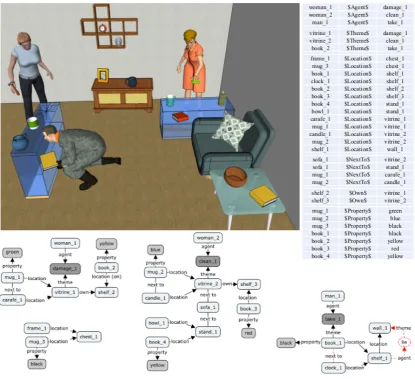
In this section, we examplify the nine grammtical templates used in our data-set. The following ex-amples belong to the scene in Figure 1:
• T1. RC2Attachment Ambiguity-1
T1A.Active voice in RC. “It is a mug on a vit-rine that the woman damages.”
Either the relative clause is low-attached (the
woman damages the vitrine) or high-attached (the woman damages the mug).
T1B.Passive voice in RC.“It is a mug on a vit-rine that is damaged by the woman.”
• T2. RC Attachment Ambiguity-2
T2A. Active voice. “The woman damages the vitrine with a mug on it.”
T2B.Passive voice. “The vitrine with a mug on it is damaged by the woman.”
• T3. RC Attachment Ambiguity with a
Geni-tive Object-3
T3A.Active voice in RC.“The woman removes the label of the medicine that lies on the shelf ”
T3B. Passive voice in RC. “The label of the medicine that lies on the shelf is removed by the woman.”
• T4. Scope Ambiguity
“There are a mug, a candle and books [that lie/lying] on the vitrine.”
• T5. Simple Imperative sentence
“bring me the mug [that lies/lying] on the vit-rine [that the woman cleans].”
1
inspired by the experimental setup of pyscholinguistic research
2Relative Clause
• T6. Imperative sentence with modifiers
“bring me the blue mug [that lies/lying] on the vitrine [that the woman cleans].”
2.2.2 Context Representations
The visual information of a picture is represented in a knowledge base that contains the relation-ships between objects, characters and actions in the scene. This information has been manually annotated as triplets composed of argument, rela-tion type and predicate. Currently, we consider six
different context relations, namely agent, theme,
location,next-to,part-of/own, as well asproperty
assignments for color, material, shape etc. (e.g.,a
blue mugora ceramic vase). Figure 1 exemplifies the context annotations of a visual scene with an additional concept map representation (bottom).
In this scene, the woman is the agent, who
per-forms the cleaning action, thevitrineis thetheme, i.e. the entity undergoing a change of state, caused by the action. The entire data set and source code
can be accessed fromhttps://github.com/
rekaby/MD-TC.V1.0
For the current study, the pictures, as the one given in Figure 1, serve illustrative purposes, be-cause the computational model does only have access to the manually annotated representations. An automatic relation extraction is not within the scope of this study.
The different semantic roles are distributed in the data set as follows; Agent (%13.6), Theme (%13.6), Location (%33.1), Next to (%9.8), Prop-erty (%19.5), Own (%10.3). Table 2 presents a statistics for the amount of contextual information per scene.
3 Implementation
RBG-2 parser starts by creating a fully connected graph representing the input tokens as nodes. The parser decodes a minimum spanning tree out of the graph maximizing the aggregated scores of the arcs. The scores are calculated by combining the weights of linguistic features and context features between the pair of tokens as follows:
y= max
y∈T(x,c) n
X
i=1
ωl.f(xi, xj, y)+ωc.fb(ci, cj, y)
(1)
Wherey is the best dependency tree,T(x, c)is a
set of all possible dependency trees for input
sen-tenceXand contextc. The linguistic feature
Types Templates Sentences Gaps Gap Types T1A PRO1nomVP1 NP1accNP2gen, WDT*accPRO2nomVP2 41 130 NP(114), VP(16)
T1B PRO1nomVP1 NP1accNP2gen, WDT*accPRO2nomVP2 40 130 NP(115), VP(15)
T2A PROnomVP1 NP1nom,pl.NP1nom,pl., WDTacc,pl.VP2 PP1 50 177 NP(153), VP(24)
T2B PROnomVP1 NP1nom,pl.NP1nom,pl., WDTacc,pl.VP2 PP1 50 177 NP(153), VP(24)
T3A NPit−cleftVP1 NP1nomNP2dat, WDTdatPRO3rd-sing.ADV VP2 36 177 NP(139), VP(36), ADJ(2)
T3B NPit−cleftVP1 NP1nomNP2dat, WDTdatPRO3rd-sing.ADV VP2 29 145 NP(113), VP(30), ADJ(2)
T4 EX VauxNP1nom(CONJ NP2) WDT*nomVP1 Prep. NP3 58 156 NP(154), VP(0), ADJ(2)
T5 VP1 (ProdatNP1 (WDT) VP2 Prep. NP2 63 141 NP(137), VP(1), ADJ(3)
T6 VP1 (Prodat(Adj1) NP1 (WDT) VP2 Prep. (ADJ2) NP2 62 224 NP(135), VP(9), ADJ(80)
[image:4.595.72.528.63.188.2]Total 429 1457 NP(1213), VP(155), ADJ(89)
Table 1: POS templates, the number of sentences and gaps for each sentence types, and the number of gaps for each POS category
Items Mean
Relations (Min.=28,Max.=41) 34.8
Context entities (Min.=30,Max.=41) 35.6
Unique entities5(Min.=21,Max.=28) 25
Table 2: Complexity of the contextual information for the visual scenes in the data set
f(xi, xj, y)with weightsωl. The context feature
vector isfb(ci, cj, y)with weightsωc.
We build the context features using combi-nations of the predicates’ and arguments’ POS, lemma, and word. So far, we only use first-order features for both channels. That means, only in-formation about immediately connected nodes in the graph (head-child relationships) is accounted for, but more complex, indirect connections (sib-lings, grantchilds, etc.) are ignored. We add the context features to the graph arc only if the pair of nodes (words) has a context relation in between. Using no higher-order features makes the learn-ing process faster and simpler but introduces some limitations as discussed in the result section. Each record in the training data set consists of a com-plete input sentence, a set of context relations such as in Figure 1, and an exact context reference for each sentence token (if it exists in the context de-scription).
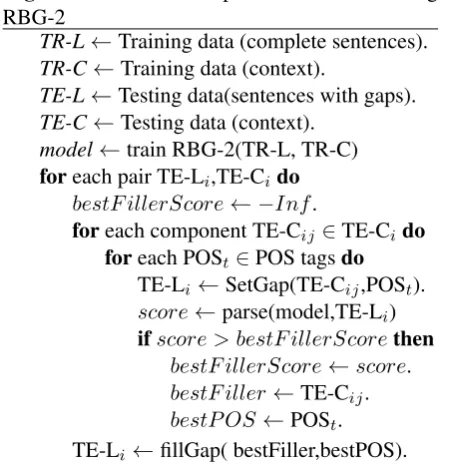
In the testing (text completion) phase, the in-put sentence is incomplete (containing exactly one gap) while the context information is the same as in the training phase except the mapping between the input sentence and context references is
miss-ing as well. E.g. in the sentence“The vitrine next
to sofa is cleaned by the GAP”accompanying the scene in Figure 1, we have multiple goals to deter-mine
Algorithm 1 Text Completion Workflow using RBG-2
TR-L←Training data (complete sentences).
TR-C←Training data (context).
TE-L←Testing data(sentences with gaps).
TE-C←Testing data (context).
model←train RBG-2(TR-L, TR-C)
foreach pair TE-Li,TE-Cido
bestF illerScore← −Inf.
foreach component TE-Cij ∈TE-Cido
foreach POSt∈POS tagsdo
TE-Li←SetGap(TE-Cij,POSt).
score←parse(model,TE-Li)
ifscore > bestF illerScorethen
bestF illerScore←score.
bestF iller←TE-Cij. bestP OS←POSt.
TE-Li←fillGap( bestFiller,bestPOS).
• the filler word(woman),
• the context filler reference(woman 2),
• the context filler reference for all the other
non-gap tokens in the input (if they exist). They are
{vitrine 2, sofa 1, clean 1},
• the POS tag of the filler(NN).
[image:4.595.306.532.260.495.2]Figure 1: The corresponding image4 for the sentences above and the semantic representations of the actions and relations in the image
is the best matching one that combines two per-spectives: grammatical correctness and compati-bility with the context information.
Although the ratio of contextual features to syn-tactic ones (first-order features) is 1:2.3, which is not high, trying all the possible context elements is rather expensive. For each sentence, we need to
buildG∗C∗P∗Mdependency trees that have to
be ranked to find the best one. Here,Gis the
num-ber of gaps (1 in our experiments),C the number
of context entities (35.6 in average),P the number
of PoS tags (3) andM = QN
i=1Mi, whereMiis
the count of possible candidates references andN
the number of sentence tokens with probable con-text references.
The search space could be reduced by avoiding irregular combinations of POS and filler words. In this stage of research, however, we do not prune it at all.
3.1 Context Data Preprocessing
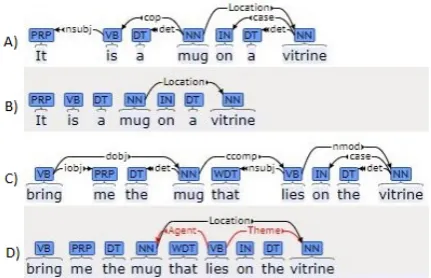
In a preprocessing phase, we enrich the context in-formation by inferring new relations from the orig-inal ones (colored red in Figure 1 and Figure 2). We have used two kinds of inferred relations:
Location to Agent/Theme: If we have a con-text relation such as(X, Location, Y), this might appear in the linguistic modality in two different forms having either direct or indirect syntactic
de-pendency. For example, mug and vitrine as in
Figure 2A and 2B have a direct syntactic depen-dency and context relation respectively. In other sentence forms as in Figure 2C and 2D, there is no direct correspondence between the linguistic de-pendency and the context relation. Contextually,
the two tokens are related through the Location
relation, but syntactically they are daughters of the
same action lie (no direct dependency). In this
lin-Figure 2: Location Inferred Agent/Theme Rela-tions: A and C) dependency trees, B) original con-text information, D) original and inferred concon-text relations
guistic modality using the verb tolie, which does
not appear as a predicate in the context descrip-tion.
To enrich the context repreresentation with in-formation corresponding directly to the linguis-tic one, we define a set of verbs (LV) that have a location meaning (i.e., lie, stand, hang). From
any location relation (X, Location, Y), we
in-fer another two relations (X, Agent, LVi) and
(X, T heme, LVi), where LVi ∈ LV andLVi is a token in the input sentence.
Location to Next To relations: Given each
pair of location relations (X, Location, Z)
and (Y, Location, Z) we infer new relation
(X, N ext−T o, Y), whereX, Y, Z ∈ W, W is the set of the input tokens. The inferred relations are added to the original list of the context input. In the rest of this paper, we use (IC) to refer to the Inferred Context relations and (OC) for the Original Context relations.
3.2 Model Variations
Varying syntactic/context’s weight ratios (S2C):
In the testing phase, we experiment with different ratios giving more influence (weight) to the con-text relations than to the linguistic ones. We assess different ratios (1to1,1to5, 1to10, and 1to25).
Original/Inferred relations’ weight ratio (OC2IC):Similar toS2C, in the testing phase, we give more weight to the original relations than to
the inferred ones by assigning theOC2ICratio to
5to1.
4 Results
In order to show the effect of contextual informa-tion and to optimize the performance of the current model, we carried out several experiments with different parameters of the model by keeping the data set constant. We used 18 scenes (386 sen-tences in average) for training and kept the remain-ing 2 scenes (146 sentences on average) for test using a 10-fold cross-validation. In case the gap
can be filled with more than one reference (<5%
of our dataset), we consider any possible one of them as correct. We used five evaluation metrics as listed below.
• POS-tag Accuracy
• Filler Word Accuracy
• Exact Filler Identification (EFI) Accuracy (i.e
mug 1in contrast tomug 2)
• Non-gap Identification Accuracy, for all the
other tokens in the input sentence.
• Complete Sentence Identification Accuracy
• Dependency Tree Accuracy (unlabeled
attach-ment score, UAS)
Table 3 presents the results obtained from dif-ferent variations of the model described in the
previous section. We test a uni-modal parser
(linguistic-only) only to show that the data set in-deed is consisting of sentences, where reference resolution/text completion cannot be achieved on a purely uni-modal sense. For that purpose, the contribution of contextual information is turned off. Because of the uniform structure of the train-ing dataset, the POS and dependency tree accura-cies are very high 97.6% and 95.6% respectively. However, the model’s prediction performance is drastically low for the gap words; 13.5% for the filler word and 7.8% for the exact filler identifica-tion.
As described in Section 3.2, the first model is based on having equal weights (S2C-1to1) for both syntactic (S) and contextual features (C) and the weights of original contextual (OC) features to the inferred features (IC) are kept equal as well (OC2IC-1to1). Giving equal weights leads to ap-prox. 83% accuracy in both filler word and ex-act filler ID predictions, while increasing the
in-fluence of the context resulted in 95% accuracy6.
6The other models with weights > 5 produced almost
[image:6.595.74.290.64.203.2]Furthermore, giving more weight to the original relations over the inferred ones resulted in lower accuracy, therefore OCtoIC-1to1 variation is cho-sen as the standard for the analysis in this sec-tion. It is apparent from Table 3, a higher influence of the context is beneficial for a correct reference prediction. However, it should be noted that giv-ing more weight to contextual features causes the model to be less sensitive about choosing a cor-rect dependency tree. A closer look at the differ-ences between the predictions of the S2C-1to5 and S2C-1to10 variations showed that 60 instances ei-ther in the dependency tree or in the filler ID were observed in the results. While S2C-1to5 builds 51 correct dependency trees and 43 correct refer-ences, S2C-1to10 chooses the correct dependency tree in only 12 instances, but even if the depen-dency tree is wrong, it fills the gap correctly in 48 out of 60 instances.
95 inaccurate EFI in 73 test sentences were ob-served. False predictions of the model variations can be categorized into several groups:
Inferred Relations. 60% of the inaccurate
pre-dictions occurred within this category. As
ex-plained in the Section 3.1, a phrase like “an
entity-1 that lies on an entity-2”can be resolved
due to an inferred relation. However, for
sen-tences containing structures like“an entity-1 that
lie/stand/hang(s) next to an entity-2”with a gap in
a position ofentity-2, the model prefers the most
plausible filler that has alocationrelation (either
original or inferred) with the entity-1 instead of
having anext torelation with it.
A Chain of Relations. This problem arises when for example there is a chain of location
re-lations among the entities (7.4%), i.e. (bird 1,
Location, cage 1), and (cage 1, Location,
chest 1) with a description“It is a cage on a chest that the man cleans”with a gap in achest posi-tion. While the S2C-1to5 model correctly fills the
gap, S2C-1to10 choosesbirdfor the gap position.
Assigning more weight to the context information leads to similar scores for the various entities of the chain, which may cause some wrong filler pre-dictions.
Less represented PP associations.
Syntacti-cally, all prepositions (with, of, on and next to)
have the same PoS tag but semantically they differ.
While prepositionofis associated with theown
re-lation, and prepositionnext towith next-to, there
are two prepositions which are related to the
lo-cationrelation;on/inandwith. The distribution of them is as follows;with: 21.3%, andon/in/under7: 78.7%. As shown in Figure 3, the most likely association between syntactic and contextual
fea-tures (w.r.t. location relations) is head to
argu-mentanddependent to predicate. This association is flipped for the prepositional phrase like “entity-2 with entity-1 on it”. Regardless of giving more influence to the context in that case, the model makes the prediction more strongly biased to the canonical direction of prepositional phrases result-ing a wrong text prediction.
A Verb in a Noun Position. This error oc-curs irrespective of the linguistic structure if more weight (1to10 or 1to25) is given to the context
(6.3%). As an example, a gap in the shelf
posi-tion in the sentence“There are a cat, a flower and
books on the shelf”is filled withchase, caused by the(cat 1, Theme, chase 1)relation. In that case, a stronger contextual influence overrides the syn-tactic form of the PP-attachment, and favors a
ref-erence with thethemerelation, which has a
consis-tent syntactic representation; its argument always points to the predicate. The goal to find syntac-tically correct PP-attachment is overruled by the more powerful features of the context relations,
and sochaseis selected considering thata catis
the only entity with a themerelation among
oth-ers.
Far-Attachments. Far-attachments of the rela-tive clauses or prepositional phrases are not that frequent as short-attachments, yet they are gram-matically correct and occur in a data set. The re-sults indicate that giving more influence to con-textual information (S2C-1to10 and 1to25) helps to correctly fill the gap, while a model with lower weight for the contextual information (S2C-1to1 and -1to5) tends to choose the wrong reference for the gap position. To illustrate, the sentence
“It is a blanket on a couch that is grasped by the woman”refers to one instance of a blanket class,
and the context contains two instances: blanket 1
andblanket 2, whereblanket 2is the theme of the
grasp action. When the gap is in the couch po-sition, S2C-1to5 chooses a dependency tree with a short attachment of the RC. It attaches the gap to the actiongraspand thus fills it withblanket 2.
This is consistent with the theme relation in the
context, resulting a sentence“It is a blanket 1 on
7excluding the occurrences of “
Model Variations PoS Filler Word EFI Non-Gap Complete DP-UAS Sentence
[image:8.595.87.511.66.156.2]Uni-model (linguistic only) 97.58 13.50 7.75 62.05 2.21 95.60 S2C Weight (1to1) + OC2IC Weight (1to1) 98.34 83.53 83.11 97.35 83.60 95.60 S2C Weight (1to5) + OC2IC Weight (1to1) 98.89 95.36 95.22 99.24 94.67 95.11 S2C Weight (1to10) + OC2IC Weight (1to1) 98.48 95.57 95.50 99.07 94.81 94.80 S2C Weight (1to25) + OC2IC Weight (1to1) 98.13 95.57 95.50 99.36 94.81 94.51 S2C Weight (1to5) + OC2IC Weight (5to1) 98.82 92.39 92.32 98.85 91.76 95.05
Table 3: The results of the different model variations
Figure 3: Syntactic/Context feature association for the prepositionsonandwith
a blanket 2 that is grasped by the woman”8. If the context had only one blanket, that instance of the blanket had to be assigned to a non-gap blan-ket position in the sentence, and then the model is forced to switch to another dependency tree with a lower score but a better alignment. On the other hand, a 1to10 model gives more influence to the context, resulting in a correct completion even if the dependency structure is wrong. This may indi-cate that in order to deal with more challenging contexts or less represented linguistic structures (like far-attachments) increasing the influence of the contextual information would be beneficial.
Contextually Challenging Cases. This
cate-gory covers 10.5% of the errors. To illustrate,
lets consider a context, which contains two
differ-ent roles for the same agdiffer-ent man 1together with
a sentence like “The handle of the mug on the
counter is hold by the man”; namely an action
washwith athemerelation to amugand another
actionholdwith athemerelation to ahandle.
An-other relevant relation for this sentence is(mug 1,
Own, handle 1). If in such a case the gap is in the verb position, the model can choose the alternative
actions associated with amuginstead of forcing a
far-attachment which is also favored contextually.
5 Conclusion and Future Directions
In this paper, we present a data set for sentence completion consisting of problematic instances, which can not be effectively handled using linguis-tic features alone. We apply a context-integrating
8Our assumption is not using same context reference
twice
dependency parser to solve this problem. There are number of assumptions and constraints of the current model. First, allowed gaps are only nouns, verbs and adjectives. Pronouns are not used as a possible gap filler. Furthermore, each individual instance is allowed to occur in the sentence once9,
thus a context reference (i.e. mug 1) can not be
assigned to more than one token of the input sen-tence. Morever, the set of context relations is re-stricted to the the six relations. Further studies will need to cover more variety to relax these limita-tions.
The results indicate that incorporating contex-tual information and giving a strong enough influ-ence to them helps to solve a majority of the prob-lems concerning different sentence structures with conjunctions, relative clauses or PP-attachments. There are still some challenging situations origi-nating from high degrees of linguistic or contex-tual complexity, which need to be addressed in fu-ture work. Furthermore, we plan to address noisier linguistic input with multiple gaps in a sentence as well as mismatches between the sentence and its contextual information. We also target reference resolution at the earliest time possible by employ-ing incremental processemploy-ing.
Acknowledgments
This research was partially funded by the Ger-man Research Foundation - DFG Transregio SFB 169: Cross-Modal Learning, and German Aca-demic Exchange Service (DAAD).
9This constraint is not based on linguistic phenomena, it
[image:8.595.127.468.189.245.2]References
Kavita Asnani, Douglas Vaz, Tanay PrabhuDesai, Surabhi Borgikar, Megha Bisht, Sharvari Bhosale, and Nikhil Balaji. 2015. Sentence completion us-ing text prediction systems. In Proceedings of the 3rd International Conference on Frontiers of Intelli-gent Computing: Theory and Applications (FICTA) 2014. Springer, pages 397–404.
Steffen Bickel, Peter Haider, and Tobias Scheffer. 2005. Learning to complete sentences. InEuropean Conference on Machine Learning. Springer, pages 497–504.
Jason M. Eisner. 1996. Three new probabilis-tic models for dependency parsing: An explo-ration. In Proceedings of the 16th Conference on Computational Linguistics - Volume 1. As-sociation for Computational Linguistics, Strouds-burg, PA, USA, COLING ’96, pages 340–345. https://doi.org/10.3115/992628.992688.
Nestor Garay-Vitoria and Julio Abascal. 2004. A parison of prediction techniques to enhance the com-munication rate. InERCIM Workshop on User In-terfaces for All. Springer, pages 400–417.
Nestor Garay-Vitoria and Julio Abascal. 2006. Text prediction systems: a survey. Universal Access in the Information Society4(3):188–203.
Joseph Gubbins and Andreas Vlachos. 2013. De-pendency language models for sentence completion. In Proceedings of the 2013 Conference on Empiri-cal Methods in Natural Language Processing. pages 1405–1410.
Ryan Mcdonald and Fernando Pereira. 2006. Online learning of approximate dependency parsing algo-rithms. InIn Proc. of EACL. pages 81–88.
Piotr Mirowski and Andreas Vlachos. 2015. Depen-dency recurrent neural language models for sentence completion. arXiv preprint arXiv:1507.01193.
Joakim Nivre. 2004. Incrementality in determin-istic dependency parsing. In Proceedings of the Workshop on Incremental Parsing: Bringing Engineering and Cognition Together. Associa-tion for ComputaAssocia-tional Linguistics, Stroudsburg, PA, USA, IncrementParsing ’04, pages 50–57. http://dl.acm.org/citation.cfm?id=1613148.1613156.
Amr Rekaby Salama and Wolfgang Menzel. 2017. Multimodal graph-based dependency parsing of nat-ural language. InProceedings of the International Conference on Advanced Intelligent Systems and In-formatics 2016. Springer International Publishing, pages 22–31.
Amr Rekaby Salama and Wolfgang Menzel. 2018. Learning Context-Integration in a Dependency Parser for Natural Language, Springer International Publishing, pages 545–569.
Yuan Zhang, Tao Lei, Regina Barzilay, Tommi Jaakkola, and Amir Globerson. 2014. Steps to excellence: Simple inference with refined scoring of dependency trees. In Proceedings of the 52nd Annual Meeting of the Associa-tion for ComputaAssocia-tional Linguistics (Volume 1: Long Papers). Association for Computational Lin-guistics, Baltimore, Maryland, pages 197–207. http://www.aclweb.org/anthology/P14-1019.