Proceedings of the 56th Annual Meeting of the Association for Computational Linguistics (Short Papers), pages 477–483 477
Linear-Time Constituency Parsing with RNNs
and Dynamic Programming
Juneki Hong1
1School of EECS
Oregon State University, Corvallis, OR
{juneki.hong, liang.huang.sh}@gmail.com
Liang Huang1,2
2Silicon Valley AI Lab
Baidu Research, Sunnyvale, CA
Abstract
Recently, span-based constituency parsing has achieved competitive accuracies with extremely simple models by using bidirec-tional RNNs to model “spans”. However, the minimal span parser of Stern et al.
(2017a) which holds the current state of the art accuracy is a chart parser running in cubic time, O(n3), which is too slow for longer sentences and for applications be-yond sentence boundaries such as end-to-end discourse parsing and joint sentence boundary detection and parsing. We pro-pose a linear-time constituency parser with RNNs and dynamic programming using graph-structured stack and beam search, which runs in time O(nb2) where b is the beam size. We further speed this up to O(nblogb) by integrating cube prun-ing. Compared with chart parsing base-lines, this linear-time parser is substan-tially faster for long sentences on the Penn Treebank and orders of magnitude faster for discourse parsing, and achieves the highest F1 accuracy on the Penn Treebank among single model end-to-end systems.
1 Introduction
Span-based neural constituency parsing (Cross and Huang,2016;Stern et al.,2017a) has attracted attention due to its high accuracy and extreme simplicity. Compared with other recent neural constituency parsers (Dyer et al., 2016; Liu and Zhang,2016;Durrett and Klein,2015) which use neural networks to model tree structures, the span-based framework is considerably simpler, only us-ing bidirectional RNNs to model the input se-quence and not the output tree. Because of this factorization, the output space is decomposable
which enables efficient dynamic programming al-gorithm such as CKY. But existing span-based parsers suffer from a crucial limitation in terms of search: on the one hand, a greedy span parser (Cross and Huang,2016) is fast (linear-time) but only explores one single path in the exponentially large search space, and on the other hand, a chart-based span parser (Stern et al., 2017a) performs exact search and achieves state-of-the-art accu-racy, but in cubic time, which is too slow for longer sentences and for applications that go be-yond sentence boundaries such as end-to-end dis-course parsing (Hernault et al., 2010; Zhao and Huang, 2017) and integrated sentence boundary detection and parsing (Bj¨orkelund et al.,2016).
We propose to combine the merits of both greedy and chart-based approaches and design a linear-time span-based neural parser that searches over exponentially large space. FollowingHuang and Sagae (2010), we perform left-to-right dy-namic programming in an action-synchronous style, with(2n−1)actions (i.e., steps) for a sen-tence ofnwords. While previous non-neural work in this area requires sophisticated features (Huang and Sagae, 2010;Mi and Huang,2015) and thus high time complexity such as O(n11), our states are as simple as ` : (i, j)where `is the step in-dex and(i, j)is the span, modeled using bidirec-tional RNNs without any syntactic features. This gives a running time ofO(n4), with the extraO(n) for step index. We further employ beam search to have a practical runtime ofO(nb2)at the cost of exact search where b is the beam size. How-ever, on the Penn Treebank, most sentences are less than 40 words (n <40), and even with a small beam size ofb = 10, theobservedcomplexity of an O(nb2) parser is not exactly linear in n (see Experiments). To solve this problem, we apply cube pruning (Chiang, 2007;Huang and Chiang,
renders an observed complexity that is linear inn (with minor extra inexactness).
We make the following contributions:
• We design the first neural parser that is both linear time and capable of searching over ex-ponentially large space.1
• We are the first to apply cube pruning to in-cremental parsing, and achieves, for the first time, the complexity ofO(nblogb), i.e., lin-ear in sentence length and (almost) linlin-ear in beam size. This leads to an observed com-plexity strictly linear in sentence lengthn.
• We devise a novel loss function which penal-izes wrong spans that cross gold-tree spans, and employ max-violation update (Huang et al., 2012) to train this parser with struc-tured SVM and beam search.
• Compared with chart parsing baselines, our parser is substantially faster for long sen-tences on the Penn Treebank, and orders of magnitude faster for end-to-end discourse parsing. It also achieves the highest F1 score on the Penn Treebank among single model end-to-end systems.
• We devise a new formulation of graph-structured stack (Tomita, 1991) which re-quires no extra bookkeeping, proving a new theorem that gives deep insight into GSS.
2 Preliminaries
2.1 Span-Based Shift-Reduce Parsing
A span-based shift-reduce constituency parser (Cross and Huang, 2016) maintains a stack of spans (i, j), and progressively adds a new span each time it takes a shift or reduce action. With (i, j)on top of the stack, the parser can eithershift to push the next singleton span (j, j + 1)on the stack, or it can reduce to combine the top two spans, (k, i) and (i, j), forming the larger span (k, j). After each shift/reduce action, the top-most span is labeled as either a constituent or with anull label∅, which means that the subsequence is not a subtree in the final decoded parse. Parsing initial-izes with an empty stack and continues until(0, n) is formed, representing the entire sentence.
1
https://github.com/junekihong/beam-span-parser
input w0. . . wn−1
state `:hi, ji:(c, v)
init 0:h0,0i: (0, 0)
goal 2n−1:h0, ni: (c,c)
shift `:h, ji: (c, )
`+ 1 :hj, j+ 1i: (c+ξ, ξ) j < n
reduce `
0:hk, ii: (c0, v0) `:hi, ji: (, v)
[image:2.595.314.517.66.209.2]`+ 1 :hk, ji: (c0+v+σ, v0+v+σ)
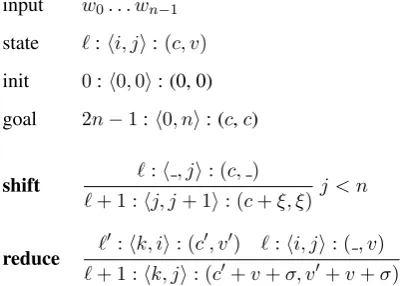
Figure 1: Our shift-reduce deductive system. Here `is the step index, c andv are prefix and inside scores. UnlikeHuang and Sagae(2010) andCross and Huang (2016), ξ and σ are not shift/reduce scores; instead, they are the (best) label scores of the resulting span: ξ = maxXs(j, j+ 1, X) and
σ = maxXs(k, j, X) where X is a nonterminal
symbol (could be∅). Here`0=`−2(j−i) + 1.
2.2 Bi-LSTM features
To get the feature representation of a span (i, j), we use the output sequence of a bi-directional LSTM (Cross and Huang, 2016; Stern et al.,
2017a). The LSTM produces f0, ...,fn forwards
andbn, ...,b0 backwards outputs, which we con-catenate the differences of(fj−fi)and(bi−bj)as
the representation for span(i, j). This eliminates the need for complex feature engineering, and can be stored for efficient querying during decoding.
3 Dynamic Programming
3.1 Score Decomposition
LikeStern et al.(2017a), we also decompose the score of a treetto be the sum of the span scores:
s(t) = X (i,j,X)∈t
s(i, j, X) (1)
= X
(i,j)∈t
max
X s((fj −fi;bi−bj), X) (2)
Note thatXis a nonterminal label, a unary chain (e.g., S-VP), or null label ∅.2 In a shift-reduce setting, there are2n−1steps (nshifts andn−1 reduces) and after each step we take the best label for the resulting span; therefore there are exactly
2
The actual code base of Stern et al. (2017b) forces s(i, j,∅) to be 0, which simplifies their CKY parser and
2n−1such (labeled) spans(i, j, X)in treet. Also note that the choice of the label for any span(i, j) is only dependent on(i, j)itself (and not depend-ing on any subtree information), thus the max over label X is independent of other spans, which is a nice property of span-based parsing (Cross and Huang,2016;Stern et al.,2017a).
3.2 Graph-Struct. Stack w/o Bookkeeping
We now reformulate this DP parser in the above section as a shift-reduce parser. We maintain a step index ` in order to perform action-synchronous beam search (see below). Figure 1 shows how to represent a parsing stack using only the top span (i, j). If the top span (i, j) shifts, it pro-duces(j, j+ 1), but if it reduces, it needs to know the second last span on the stack,(k, i), which is notrepresented in the current state. This problem can be solved by graph-structure stack (Tomita,
1991;Huang and Sagae,2010), which maintains, for each statep, a set of predecessor states π(p) thatpcan combine with on the left.
This is the way our actual code works (π(p)is implemented as a list of pointers, or “left point-ers”), but here for simplicity of presentation we devise a novel but easier-to-understand formula-tion in Fig.1, where we explicitly represent the set of predecessor states that state` : (i, j)can com-bine with as`0 : (k, i)where`0=`−2(j−i) + 1, i.e.,(i, j)at step`can combine with any(k, i)for anykat step`0. The rationale behind this new for-mulation is the following theorem:
Theorem 1 The predecessor states π(` : (i, j))
are all in the same step`0=`−2(j−i) + 1. Proof.By induction.
This Theorem bring new and deep insights and suggests an alternative implementation that does not require any extra bookkeeping. The time com-plexity of this algorithm is O(n4) with the extra O(n)due to step index.3
3.3 Action-Synchronous Beam Search
The incremental nature of our parser allows us to further lower the runtime complexity at the cost of inexact search. At each time step, we maintain the topbparsing states, pruning off the rest. Thus, a candidate parse that made it to the end of decod-ing had to survive within the top bat every step.
3The word-synchronous alternative does not need the step
index`and enjoys a cubic time complexity, being almost identical to CKY. However, beam search becomes very tricky.
With O(n) parsing actions our time complexity becomes linear in the length of the sentence.
3.4 Cube Pruning
However, Theorem 1 suggests that a parsing state pcan have up tobpredecessor states (“left point-ers”), i.e.,|π(p)| ≤ bbecauseπ(p)are all in the same step, a reduce action can produce up to b subsequent new reduced states. With b items on a beam andO(n)actions to take, this gives us an overall complexity ofO(nb2). Even thoughb2 is a constant, even modest values of bcan make b2 dominate the length of the sentence.4
To improve this at the cost of additional inex-actness, we introduce cube pruning to our beam search, where we put candidate actions into a heap and retrieve the top b states to be considered in the next time-step. We heapify the top b shift-merged states and the top b reduced states. To avoid inserting allb2 reduced states from the pre-vious beam, we only consider each state’s high-est scoring left pointer,5 and whenever we pop a reduced state from the heap, we iterate down its left pointers to insert the next non-duplicate re-duced state back into the heap. This process fin-ishes when we pop b items from the heap. The initialization of the heap takesO(b) and popping bitems takesO(blogb), giving us an overall im-proved runtime ofO(nblogb).
4 Training
We use a Structured SVM approach for training (Stern et al., 2017a;Shi et al., 2017). We want the model to score the gold treet∗higher than any other treetby at least a margin∆(t, t∗):
∀t, s(t∗)−s(t)≥∆(t, t∗).
Note that ∆(t, t) = 0for any t and∆(t, t∗) >0 for anyt6=t∗. At training time we perform loss-augmented decoding:
ˆ
t= arg max
t s∆(t) = arg maxt s(t) + ∆(t, t
∗).
4
The average length of a sentence in the Penn Treebank training set is about 24. Even with a beam size of 10, we al-ready haveb2 = 100, which would be a significant factor in
our runtime. In practice, each parsing state will rarely have the maximumbleft pointers so this ends up being a loose upbound. Nevertheless, the beam search should be per-formed with the input length in mind, or else asbincreases we risk losing a linear runtime.
5If each previous beam is sorted, and if the beam search
20 40 60 80 100 120 140
Sentence Length
0.0 0.5 1.0 1.5 2.0
Time (sec)
Chart Parsing: O(n2.26)
Beam 20 No Cube-Pruning: O(n1.26)
Beam 20 Cube Pruned: O(n1.08)
[image:4.595.86.281.59.259.2]Beam 5 Cube Pruned: O(n0.97)
Figure 2: Runtime plots of decoding on the train-ing set of the Penn Treebank. The differences be-tween the different algorithms become evident af-ter sentences of length 40. The regression curves have been empirically fitted.
wheres∆(·) is the loss-augmented score. If ˆt = t∗, then all constraints are satisfied (which implies arg maxts(t) =t∗), otherwise we perform an
up-date by backpropagating froms∆(ˆt)−s(t∗).
4.1 Cross-Span Loss
The baseline loss function from Stern et al.
(2017a) counts the incorrect labels(i, j, X)in the predicted tree:
∆base(t, t∗) =
X
(i,j,X)∈t 1
X 6=t∗(i,j)
.
Note that X can be null ∅, and t∗(i,j) denotes the gold label for span (i, j), which could also be ∅.6 However, there are two cases where t∗(i,j) = ∅: a subspan (i, j) due to binarization (e.g., a span combining the first two subtrees in a ternary branching node), or an invalid span in t that crosses a gold span in t∗. In the baseline function above, these two cases are treated equiv-alently; for example, a span(3,5,∅)∈tis not pe-nalized even if there is a gold span(4,6,VP)∈t∗. So we revise our loss function as:
∆new(t, t∗) =
X
(i,j,X)∈t 1
X6=t∗(i,j)
∨cross(i, j, t∗)
6Note that the predicted treethas exactly2n−1spans
butt∗has much fewer spans (only labeled spans without∅).
500 1000 1500 2000
Discourse Length (words)
0 500 1000 1500 2000 2500 3000 3500
Time (sec)
Chart Parsing
This Work Beam 10
102 103
Discourse Length (words)
10-1
100
101
102
103
Time (sec)
[image:4.595.308.525.61.202.2]This Work Beam 10 Chart Parsing
Figure 3: Runtime plot of decoding the discourse treebank training set. The log-log plot on the right shows the cubic complexity of baseline chart pars-ing. Whereas beam search decoding maintains lin-ear time even for sequences of thousands of words.
wherecross(i, j, t∗) =∃(k, l)∈t∗, andi < k < j < lork < i < l < j.
4.2 Max Violation Updates
Given that we maintain loss-augmented scores even for partial trees, we can perform a training update on a given example sentence by choos-ing to take the loss where it is the greatest along the parse trajectory. At each parsing time-step`, the violation is the difference between the high-est augmented-scoring parse trajectory up to that point and the gold trajectory (Huang et al.,2012;
Yu et al., 2013). Note that computing the viola-tion gives us the max-margin loss described above. Taking the largest violation from all time-steps gives us the max-violation loss.
5 Experiments
We present experiments on the Penn Treebank (Marcus et al.,1993) and the PTB-RST discourse treebank (Zhao and Huang,2017). In both cases, the training set is shuffled before each epoch, and dropout (Hinton et al., 2012) is employed with probability 0.4 to the recurrent outputs for regu-larization. Updates with minibatches of size 10 and 1 are used for PTB and the PTB-RST respec-tively. We use Adam (Kingma and Ba,2014) with default settings to schedule learning rates for all the weights. To address unknown words during training, we adopt the strategy described by Kiper-wasser and Goldberg (Kiperwasser and Goldberg,
Development Set 22 (F1) Baseline +cross-span Time This Work Beam 1 89.41 89.93 0.042 This Work Beam 5 91.27 91.91 0.050 This Work Beam 10 91.56 92.09 0.058 This Work Beam 15 91.74 92.16 0.062 This Work Beam 20 91.65 92.20 0.066 Chart 92.02 92.21 0.076
Table 1: Comparison of PTB development set results, with the time measured in seconds-per-sentence. The baseline chart parser is fromStern et al.(2017b), with null-label scores unconstrained to be nonzero, replicating their paper.
Test Set 23 End-to-End & Single Model LR LP F1 Socher et al.(2013) 90.4 Durrett and Klein(2015) 91.1 Cross and Huang(2016) 90.5 92.1 91.3 Liu and Zhang(2016) 91.3 92.1 91.7 Dyer et al.(2016) (discrim.) 91.7 Stern et al.(2017a) 90.63 92.98 91.79 Stern et al.(2017a) +cross-span 91.67 91.94 91.81 Stern et al.(2017b) 91.35 92.38 91.86 This Work Beam 10 91.44 91.91 91.67 This Work Beam 15 91.64 92.04 91.84 This Work Beam 20 91.49 92.45 91.97
Reranking/Ensemble/Separate Decoding
Vinyals et al.(2015) (ensem) 90.5 Dyer et al.(2016) (gen., rerank) 93.3 Choe and Charniak(2016) (rerank) 93.8 Stern et al.(2017c) (sep. decoding) 92.57 92.56 92.56 Fried et al.(2017) (ensem/rerank) 94.25
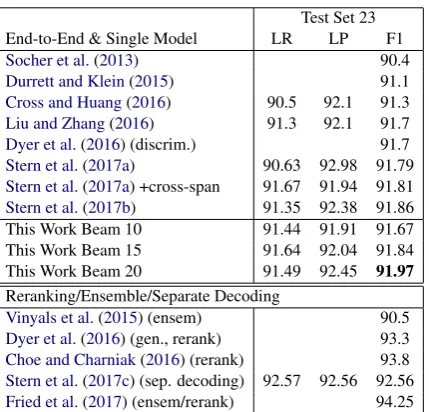
Table 2: Final PTB Test Results. We compare our models with other (neural) single-model end-to-end trained systems.
occurrences of wordwin the training corpus. Our system is implemented in Python using the DyNet neural network library (Neubig et al.,2017).
5.1 Penn Treebank
We use the Wall Street Journal portion of the Penn Treebank, with the standard split of sections 2-21 for training, 22 for development, and 23 for test-ing. Tags are provided using the Stanford tagger with 10-way jackknifing.
Table 1 shows our development results and overall speeds, while Table2compares our test re-sults. We show that a beam size of 20 can be fast while still achieving state-of-the-art performances.
5.2 Discourse Parsing
To measure the tractability of parsing on longer sequences, we also consider experiments on the
LR LP F1
Zhao and Huang(2017) 81.6 83.5 82.5
This Work Beam 10 80.47 80.61 80.54
This Work Beam 20 80.86 80.73 80.79
This Work Beam 200 81.51 80.84 81.18 This Work Beam 500? 81.50 80.81 81.16 This Work Beam 1000? 81.55 80.85 81.20
Table 3: Overall test accuracies for PTB-RST dis-course treebank. Starred? rows indicate a run that was decoded from the beam 200 model.
segment structure +nuclearity +relation
Bach et al.(2012) 95.1 - -
-Hernault et al.(2010) 94.0 72.3 59.1 47.3
Zhao and Huang(2017) 95.4 78.8 65.0 52.2
This Work Beam 200 91.20 73.36 58.87 46.38 This Work Beam 500? 93.52 74.93 60.16 47.03
This Work Beam 1000? 94.06 75.60 60.61 47.37
Table 4: F1 scores comparing discourse systems. Results correspond to the accuracies in Table 3, broken down to focus on the discourse labels.
PTB-RST discourse Treebank, a joint discourse and constituency dataset with a combined rep-resentation, allowing for parsing at either level (Zhao and Huang, 2017). We compare our run-times out-of-the-box in Figure 3. Without any pre-processing, and by treating discourse exam-ples as constituency trees with thousands of words, our trained models represent end-to-end discourse parsing systems.
For our overall constituency results in Table3, and for discourse results in Table4, we adapt the split-point feature described in (Zhao and Huang,
2017) in addition to the base parser. We find that larger beamsizes are required to achieve good dis-course scores.
6 Conclusions
We have developed a new neural parser that main-tains linear time, while still searching over an ex-ponentially large space. We also use cube prun-ing to further improve the runtime toO(nblogb). For training, we introduce a new loss function, and achieve state-of-the-art results among single-model end-to-end systems.
Acknowledgments
[image:5.595.73.290.62.151.2] [image:5.595.76.291.237.443.2]References
Ngo Xuan Bach, Nguyen Le Minh, and Akira Shimazu. 2012. A reranking model for discourse segmenta-tion using subtree features. In Proceedings of the 13th Annual Meeting of the Special Interest Group on Discourse and Dialogue. Association for Com-putational Linguistics, pages 160–168.
Anders Bj¨orkelund, Agnieszka Fale´nska, Wolfgang Seeker, and Jonas Kuhn. 2016. How to train depen-dency parsers with inexact search for joint sentence boundary detection and parsing of entire documents. InProceedings of the 54th Annual Meeting of the As-sociation for Computational Linguistics (Volume 1: Long Papers). volume 1, pages 1924–1934.
David Chiang. 2007. Hierarchical phrase-based trans-lation. Computational Linguistics33(2):201–208.
Do Kook Choe and Eugene Charniak. 2016. Parsing as language modeling. InProceedings of the Con-ference on Empirical Methods in Natural Language Processing. pages 2331–2336.
James Cross and Liang Huang. 2016. Span-based constituency parsing with a structure-label system and provably optimal dynamic oracles. In Proceed-ings of the 2016 Conference on Empirical Meth-ods in Natural Language Processing. Association for Computational Linguistics, Austin, Texas, pages 1–11.https://aclweb.org/anthology/D16-1001.
Greg Durrett and Dan Klein. 2015. Neural CRF pars-ing. arXiv preprint arXiv:1507.03641.
Chris Dyer, Adhiguna Kuncoro, Miguel Ballesteros, and Noah A Smith. 2016. Recurrent neural network grammars. arXiv preprint arXiv:1602.07776.
Daniel Fried, Mitchell Stern, and Dan Klein. 2017. Im-proving neural parsing by disentangling model com-bination and reranking effects. InProceedings of the Association for Computational Linguistics.
Hugo Hernault, Helmut Prendinger, David A DuVerle, Mitsuru Ishizuka, and Tim Paek. 2010. Hilda: a dis-course parser using support vector machine classifi-cation. Dialogue and Discourse1(3):1–33.
Geoffrey E Hinton, Nitish Srivastava, Alex Krizhevsky, Ilya Sutskever, and Ruslan R Salakhutdinov. 2012. Improving neural networks by preventing co-adaptation of feature detectors. arXiv preprint arXiv:1207.0580.
Liang Huang and David Chiang. 2007. Forest rescor-ing: Fast decoding with integrated language models. InProceedings of ACL 2007. Prague, Czech Rep.
Liang Huang, Suphan Fayong, and Yang Guo. 2012. Structured perceptron with inex-act search. In Proceedings of NAACL. http://www.isi.edu/ lhuang/perc-inexact.pdf.
Liang Huang and Kenji Sagae. 2010. Dynamic pro-gramming for linear-time incremental parsing. In Proceedings of ACL 2010. Uppsala, Sweden.
Diederik P Kingma and Jimmy Ba. 2014. Adam: A method for stochastic optimization. arXiv preprint arXiv:1412.6980.
Eliyahu Kiperwasser and Yoav Goldberg. 2016. Sim-ple and accurate dependency parsing using bidi-rectional LSTM feature representations. CoRR abs/1603.04351.http://arxiv.org/abs/1603.04351.
Jiangming Liu and Yue Zhang. 2016. Shift-reduce constituent parsing with neural lookahead features. arXiv preprint arXiv:1612.00567.
Mitchell P Marcus, Mary Ann Marcinkiewicz, and Beatrice Santorini. 1993. Building a large annotated corpus of english: The penn treebank. Computa-tional linguistics19(2):313–330.
Haitao Mi and Liang Huang. 2015. Shift-reduce con-stituency parsing with dynamic programming and pos tag lattice. InProceedings of NAACL 2015.
Graham Neubig, Chris Dyer, Yoav Goldberg, Austin Matthews, Waleed Ammar, Antonios Anastasopou-los, Miguel Ballesteros, David Chiang, Daniel Clothiaux, Trevor Cohn, Kevin Duh, Manaal Faruqui, Cynthia Gan, Dan Garrette, Yangfeng Ji, Lingpeng Kong, Adhiguna Kuncoro, Gaurav Ku-mar, Chaitanya Malaviya, Paul Michel, Yusuke Oda, Matthew Richardson, Naomi Saphra, Swabha Swayamdipta, and Pengcheng Yin. 2017. Dynet: The dynamic neural network toolkit. arXiv preprint arXiv:1701.03980.
Tianze Shi, Liang Huang, and Lillian Lee. 2017. Fast(er) exact decoding and global training for transition-based dependency parsing via a minimal feature set. InProceedings of EMNLP 2017 (to ap-pear).
Richard Socher, John Bauer, Christopher D Manning, and Andrew Y Ng. 2013. Parsing with composi-tional vector grammars. InProceedings of the As-sociation for Computational Linguistics. Associa-tion for ComputaAssocia-tional Linguistics, volume 1, pages 455–465.
Mitchell Stern, Jacob Andreas, and Dan Klein. 2017a. A minimal span-based neural constituency parser. InProceedings of the Association for Computational Linguistics.
Mitchell Stern, Jacob Andreas, and Dan Klein. 2017b. A minimal span-based neural constituency parser (code base). https://github.com/
mitchellstern/minimal-span-parser.
Masaru Tomita, editor. 1991. Generalized LR Parsing. Kluwer Academic Publishers.
Oriol Vinyals, Łukasz Kaiser, Terry Koo, Slav Petrov, Ilya Sutskever, and Geoffrey Hinton. 2015. Gram-mar as a foreign language. InAdvances in Neural Information Processing Systems. pages 2773–2781.
Heng Yu, Liang Huang, Haitao Mi, and Kai Zhao. 2013. Max-violation perceptron and forced decod-ing for scalable mt traindecod-ing. In Proceedings of EMNLP 2013.