This work is licensed under a Creative Commons Attribution-NonCommercial 3.0 Unported License
Newcastle University ePrints - eprint.ncl.ac.uk
Schleef E, Turton D.
Sociophonetic variation of like in British dialects: effects
of function, context and predictability
. English Language and Linguistics 2016
Copyright:
This article has been published in a revised form in English Language and Linguistics
http://dx.doi.org/10.1017/S136067431600023X This version is free to view and download for private research and study only. Not for re-distribution, re-sale or use in derivative works. © © Cambridge
University Press 2016
Date deposited:
28/10/2016
Sociophonetic variation of
like
in British dialects: effects of
1function, context and predictability
1 2E R I K S C H L E E F
Q1 3
University of Salzburg 4
and 5
DA N I E L L E T U RTO N 6
Newcastle University 7
(Received 22 December 2014; revised 27 October 2015) 8
This study examines sociophonetic variation in different functions of like among 9 adolescents in London and Edinburgh. It attempts to determine the factors that may 10 explain this variation. Our results suggest that the function oflikecorrelates primarily 11 with contextual factors, rather than the phonetic factors of vowel quality, /l/ to vowel 12 duration and /k/ realisation. In particular, the preceding and following segments and their 13 bigram predictability emerge as highly significant, in addition to the boundary strength 14 followinglike. In both London and Edinburgh, the vowel appears to be the only non- 15 contextual feature that is sensitive to the function oflike: quotativebe likeis more likely to 16 be monophthongised than other functions oflike. We argue that the more monophthongal 17 nature of quotativelikeis due to the syntactic and prosodic context in which it occurs. 18
1 Introduction 19
The last three decades have witnessed the appearance of a large number of studies on 20 the various discourse functions oflike(e.g. Underhill1988; Buchstaller2004; D’Arcy 21 2006; Tagliamonte & D’Arcy 2007; Cheshire, Kerswill, Fox & Torgersen 2011; 22 Durham et al. 2012). We have learned much about how like, particularly quotative 23
be like, is constrained in several varieties of English and what happens to these 24 constraints and social meanings oflikeonce it enters a new variety (e.g. Buchstaller 25 2006; Buchstaller & D’Arcy2009). While we assume generally that the lexical form 26 of discourselikewill be adapted into the linguistic system of any new variety it enters, 27 so that in Southern English varieties in the UK it will appear most commonly as [laɪk], 28 or for Scottish varieties [lʌik], we still know relatively little about the conversational 29 phonetics oflikein its various discourse functions in different varieties of English. 30
1 This research was funded by the UK Arts and Humanities Research Council (AHRC, grant AH/K003674/1,
Drager’s (2009, 2011) work on like in a New Zealand high school is a notable 31
exception. While investigating three different functions oflike(grammatical, quotative 32
and discourse particle), she found that like does indeed have different phonetic 33
realisations across functions. For example, quotativeliketends to be less diphthongal 34
thanlikeused in other functions. Drager (2011) takes her finding of the systematically 35
different realisation oflikefunctions as evidence that these items are stored in the mind 36
in such a way that functional distinctions are maintained, and that there must be a direct 37
link between lemma-based and acoustically rich information. 38
In the UK too, there is anecdotal evidence of likereduction: in London English, 39
likemay be pronounced as monophthongal [la:k] or with final consonant reduction 40
[laɪ], whereas in Edinburgh we find reduced forms such as [lɪk]. Thus, like is 41
subject to different system-internal pressures in New Zealand, London and Edinburgh, 42
which allows us to test Drager’s argument further, whilst providing a regional 43
comparison. The current study has two goals. It aims to (a) determine the nature of the 44
sociophonetic variation of different functions oflikeamong adolescents in London and 45
Edinburgh, and (b) explore which factors may explain this variation. We will extend 46
our investigative frame beyond the phonetic and contextual predictors investigated by 47
Drager and also include factors, such as prosody and word probability, to uncover 48
whether any reductive processes may be conditioned by the linguistic context in which 49
likeoccurs rather than discourse function. Thus, the findings will enable us to reflect on 50
the theoretical arguments proposed by Drager (2011). This is because further evidence 51
of contextual conditioning of function-based reduction would undermine arguments in 52
favour of function-based storage of phonetic detail in the mind. Based on the speech 53
of teenagers in London and Edinburgh, we demonstrate that the phonetic makeup of 54
likedepends first and foremost on contextual factors. 55
2 Like: functions, forms, development and reduction 56
This section outlines the different functions oflikeand justifies the current study. More 57
detail is provided on research that has investigated the phonetics of different functions 58
oflikeas well as descriptions of /l/, /aɪ/ and /k/ realisations in London and Edinburgh. 59
The section concludes with our hypotheses regarding the two questions raised above. 60
2.1 Likeand its functions
61
Various forms oflikecan be differentiated. In order to make our data comparable with 62
the majority of other studies conducted in the tradition of variationist sociolinguistics, 63
we follow D’Arcy (2007: 392–5) in differentiating between these. The lexical item 64
under investigation can, of course, be used in a variety of standard forms: as a verb 65
(I just love Ireland, Ilikethe music and everything there; Edinburgh 004, Jenna, 15), 66
adverb (our teacher lookslikepostman Pat; Edinburgh 002, Debbie, 14), conjunction 67
(they pure talk to uslikewe’re something scraped off their shoe; Edinburgh 009, Skye, 68
the exception of like used as a noun, all of these occur in our corpus, from which 70 examples have been taken. We provide subcorpus (Edinburgh, London) and speaker 71 information (speaker number, participant-selected pseudonym and age) following the 72
example. 73
We are particularly interested in the vernacular forms and differentiate between 74 approximative adverbs, discourse markers, discourse particles and quotative be like, 75
as defined in D’Arcy (2007). 76
Approximative adverbs signal approximation and are substituted frequently with 77
about or around(Schourup1983: 30): Um, I haven’t been forlike three years now 78
(London 013, April, 14). 79
Discourse markers mark discourse and information structure outside the clause:I 80
don’t know, when you go through to like Glasgow and stuff.LikeGlasgow’s really nice 81
and stuff but I’m kind of always glad I did like grow up in Edinburgh(Edinburgh 015, 82
Lucy, 14). 83
Discourse particles mark discourse and information structure within clauses. They 84 are used for focus. They also tend to occur before new information that has just been 85 introduced in the interaction (Dailey-O’Cain2000):Like we wouldn’t reallylikego on 86
a train tolikeBirmingham or something like that, it would just beliketoo far(London 87
023, Thomas, 13). 88
Quotativebe likeconveys a sense of approximation and introduces reported speech 89 (So she was like, aye, it looks like cellulitis; Edinburgh 011, Terrance Charles 90 Desmond, 16), thought (But they try and speak Scottish it’s stupid, it’s like go and 91
talk your ain language; Edinburgh 009, Skye, 14) or action; for example, gestures, 92 noises, etc. Be likealternates withsay, think, goand other verbs that express speech or 93
introduce quotation. 94
Several scholars have assumed that discourse marker, particle and quotative like 95 have all evolved out of the use oflikeas a preposition and then conjunction (Romaine 96 & Lange 1991; Andersen2001; Buchstaller2001). Romaine and Lange (1991: 261) 97 outline a path for the grammaticalisation of like, which very much hinges on it 98 developing functions of the conjunction. Oncelikehad reached this point, it was able 99 to take clausal complements. Likeintroduces full sentential clauses in this function; 100 thereby paving the way for developing discourse marker and quotative functions. 101 D’Arcy (2005) argues that the development of discourse marker functions is more 102 complex than Romaine and Lange had assumed, and that the discourse marker 103 developed from the use of like as a sentence adverb2. She further explains that 104 the discourse particle represents the beginning of a new developmental cline in the 105 evolution of like, rather than developing alongside the discourse marker. Once like 106 has developed discourse marker functions, it enters syntactic structure and, with 107 time, generalises ‘from one maximal projection to another’ (2005: 204). She provides 108
2 Sentence adverblikehas backward scope and occurs at the end of a proposition, for example:We’ll have to get
evidence for her argument with apparent time data from Toronto, which suggests that 109
clause internallikewas a later development. Thus, the discourse particle differs from 110
previouslikefunctions in that it represents a move back into the syntax (rather than 111
further to the edge) as well as a reduction in scope. Conversely, the discourse marker 112
moved further towards the syntactic edge and involved scope broadening. 113
It is widely assumed that discourse marker like also predates the development 114
of quotative like. The latter is believed to have emerged during the last three 115
decades of the twentieth century (Butters1982; Blythet al.1990; Romaine & Lange 116
1991; Tagliamonte & D’Arcy2004). There is disagreement as to how precisely this 117
happened. Several scholars have argued thatlike, in its vernacular functions, has gone 118
through a process of grammaticalisation (Romaine & Lange 1991; D’Arcy 2005; 119
Tagliamonte & D’Arcy 2007), that is, lexical forms have developed grammatical 120
functions. This happens gradually and in certain contexts (Hopper & Traugott1993: 121
xv). According to Romaine & Lange (1991: 261), once the conjunction function 122
was introduced and like was able to take clausal complements, the quotative was 123
able to evolve in contexts where alike-introduced clause is a quotation. Here,likeis 124
reanalysed as a quotative complementiser and a dummybeis inserted into the quotative 125
frame as English clauses need to contain a verb (Romaine & Lange1991: 261). 126
D’Arcy (2015: 53) provides evidence that questions the grammaticalisation 127
development outlined by Romaine & Lange, in addition to the status of likein be
128
likeas a complementiser. She cites Buchstaller’s (2014) proposition as an alternative 129
scenario by which the quotative was formed by the discourse marker filling the 130
syntactic slot adjacent to be. D’Arcy (2015) also entertains the possibility that be
131
likemay actually be on a trajectory of lexicalisation rather than grammaticalisation, 132
i.e. it has become a lexical rather than a grammatical structure. This relies on the 133
assumption that the discourse marker and the verbal elementbefunction as a unit: they 134
have developed a new meaning, new constraints and new ways of use. She provides 135
several pieces of evidence for her argument relating to a presumed lack of constraint 136
reorganisation and context expansion (Tagliamonte & D’Arcy2007; Durhamet al.
137
2012; Haddican, Zweig & Johnson2015; but see Butters1982: 149; Ferrara & Bell 138
1995: 279; Tagliamonte & D’Arcy2004), decategorialisation and semantic bleaching.3 139
It has been pointed out frequently that the definition of grammaticalisation and 140
lexicalisation hinges on one’s view of grammar and the lexicon. For those who do 141
not draw a line between the two, the need to differentiate these two processes holds 142
less importance. Vandelanotte (2012) argues that we may best view the development 143
of be like as a case of constructionalisation, putting the locus of language change 144
on the clause rather than the verb be like. He questions the analysis of like as a 145
complementiser on several grounds (see Vandelanotte2012: 176–9); instead analysing 146
the construction of whichbe likeforms a part as a reporting clause which functions as 147
a conceptually dependent head and the reported clause as a conceptually autonomous 148
3 In principle, of course, both grammaticalisation and lexicalisation can be involved in the development of
complement (2012: 181). In a construction grammar framework, he argues that 149 constructionalisation was involved in the initial formation of a be likeconstruction. 150 Through analogical extension, there was then a meaning shift from imitation clauses 151 involvingbe like, which were brought into correspondence with reporting clauses, and 152 were added to the inventory of reporting clauses slotting into a broader taxonomy. 153 He views this development as the continued analogical integration of be like into 154 ‘the “canonical” direct speech and thought construction’ (2012: 189), rejecting a 155 grammaticalisation scenario in the strict sense that involves mechanisms such as 156 decategorialisation as well as a scenario by which the be like construction may be 157 developing into a formulaic phrase. The advantage of this analysis is that variants of 158 thebe likeconstruction can be viewed as analogical extensions fromliketo particles 159 with similar functions slotting into the same direct speech and thought construction. 160 This correlates with Buchstaller (2014), who treats be likeas the combination of 161
beand a discourse marker. Similarly to Vandelanotte (2012), Buchstaller (2014: 15– 162 17) views quotation as a set of constructions that expresses reportativity and the 163
be like quotative as a subconstruction of the type Noun Phrase + be + like + 164 Quote.4 Lexical slots in a productive construction normally can be filled with other 165 material via analogical extension. Therefore, other words, usually discourse markers, 166 such as all, kinda,totally can all fill the same lexical slot in the same way as like. 167 Similarly,becan be replaced by other copula verbs. Thus, Buchstaller proposes a more 168 general copula-based construction type for these innovative quotative constructions 169 with additional schematic slots: Noun Phrase + Copula + (Discourse Marker) 170
+ Quote. Buchstaller’s focus on the productivity of this construction opens up a 171 new view to its future development. Moreover, it focuses on the emergence of a new 172 construction, rather than solely onbe like. We believe the focus on the reporting clause 173 is key, and we will return to its relevance to our study in the discussion section. 174 While there is disagreement regarding the evolution of be like, it is clear that it 175 spread into British English in the early 1990s. It was unattested until then (Tagliamonte 176 & Hudson1999) but has been found in several locations across England and Scotland 177 in data gathered from the mid 1990s. It is particularly frequent among adolescent 178 speakers but not used at all, or to very low degrees, by older speakers. Cheshire 179
et al. (2011) compare different quotative functions in London. Be likeoccurs 20 to 180 24 per cent of the time among the younger age group in Hackney and Havering. 181 However, when the youngest age groups are subdivided into ages 4–5, ages 8–9, ages 182 12–13 and ages 16–19, the use ofbe likerises to 46 per cent among the 16–19-year 183 olds. Meyerhoff & Schleef (2013) report a similar number for native adolescents of 184 approximately the same age in Edinburgh: 47 per cent of quotatives were occurrences 185
ofbe like. 186
While previous research has focused on how the linguistic and social constraints 187 play out in different varieties of English, system-specific pressures must surely act as 188 an important factor influencing the phonetic form oflikein its various functions as it 189
spreads from one variety to another. We now turn to precisely these kinds of questions; 190
starting with varieties outside the UK before moving on to London and Edinburgh. 191
2.2 Likereduction
192
In Drager’s (2011) investigation oflike-reduction among New Zealand adolescents, a 193
core argument is the relationship between phonetic realisation and token frequency. 194
It is assumed that greater reduction occurs among more frequent words and various 195
references are cited that seem to support this assumption; for example, Bybee (2001), 196
Zipf (1929). Furthermore, the notion is discussed that more predictable items are 197
more likely to be phonetically reduced (e.g. Jurafsky, Bell, Gregory & Raymond 198
2001; Jurafsky, Bell & Girand 2002; Bell, Jurafsky, Fosler-Lussier, Girand, Gregory 199
& Gildea2003). For example, Jurafskyet al. (2001) predict that items with a higher 200
probability will be subject to a larger degree of reduction. Drager applies this notion to 201
individual speakers, rather than words, as the probability that a speaker useslikevaries 202
between individuals. While this is an interesting notion, it should not preclude us from 203
also giving due consideration to word predictability in our statistical models. This is 204
particularly the case when investigating an item such aslike, as the quotative function 205
of it is highly limited in what lexical items can precede it: it has to be preceded by a 206
form ofbe. 207
Furthermore, Drager assumes that each function oflikeis a different lemma5as they 208
all have different meanings and grammatical roles. The main goal of her paper is to 209
test whether these different lemma, which she assumes share the same word form, are 210
realised differently phonetically. Her analysis is limited to two grammatical functions 211
(the lexical verb and the adverb) and two discourse functions (the discourse particle 212
and the quotative). These functions were selected as they all occur sentence-medially. 213
Her results reveal that the three different functions oflike(grammatical, quotative 214
and discourse particle) do indeed have different phonetic realisations in her data. 215
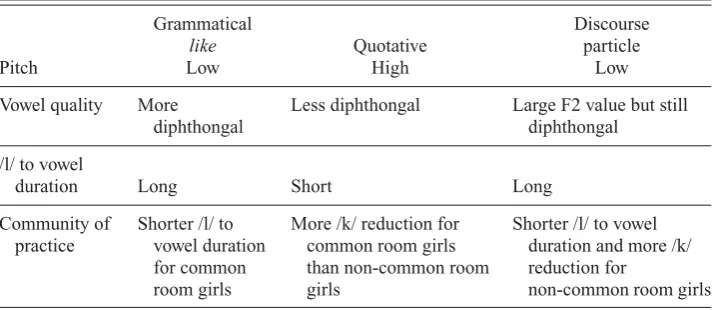
Table 1summarises her results. It also includes information on community-specific 216
realisations oflikein two communities of practice: the common-room girls and the 217
non-common-room girls. 218
The largest degree of reduction is observed for the quotative, which may be 219
surprising given frequency-based predictions and the fact that the discourse particle 220
is reported to be more frequent than the quotative (e.g. D’Arcy 2007: 396; Drager 221
2011: 698). This is certainly the case for our corpora based on adolescent speech from 222
London and Edinburgh (seetable 3). Considering the much higher frequency of the 223
discourse particle, a larger degree of reduction would be expected for this function 224
oflike. Many have argued for the link between word frequency and reductive sound 225
Table 1. Summary of phonetic realisations oflikefunctions (adapted from Drager
2011: 703)
Grammatical Discourse
like Quotative particle
Pitch Low High Low
Vowel quality More diphthongal
Less diphthongal Large F2 value but still diphthongal
/l/ to vowel
duration Long Short Long
Community of practice
Shorter /l/ to vowel duration for common room girls
More /k/ reduction for common room girls than non-common room girls
Shorter /l/ to vowel duration and more /k/ reduction for
non-common room girls
change (e.g. Bybee 2001; Phillips 2006; cf. Dinkin 2008), and although this does 226 not refer explicitly to function frequency, a similar effect for differentlikefunctions 227 is not an unrealistic expectation. However, no such link between frequency of like 228 function and reduction has been documented. This finding in itself may be a clue for a 229 contextual dependency of reduction. Indeed, Drager points towards two such potential 230 effects: the prosodic context in whichlikeoccurs, particularly accentedness, and word 231 contextual probability effects. We will test for both these factor groups in our study but 232 will, at this point, mostly elaborate on the latter in order to clearly separate different 233
contextual probability effects. 234
Drager (2011) found evidence of frequency-linked monophthongisation in New 235 Zealand, in that speaker-predictability matters: high users reduce more. Tamminga 236 (2013), in her study of /aɪ/-raising inlike, did not find current evidence of the effects 237 ofwordfrequency. She comparedlikein its adjective, conjunction, discourse marker 238 and preposition functions. With regard to /aɪ/-raising, she identifies a major divide 239 between function and content words, rather than word frequency, in the evolution of 240
the phenomenon. 241
Thus, rather than focusing on one frequency measure, a combined approach appears 254
the most logical. In this article, among other factors, we focus on one aspect 255
of probabilistic linguistic knowledge; namely, local probabilistic relations between 256
words. Previous research suggests that strongly related words or words that are 257
predictable from neighbouring words are more likely to be phonologically reduced 258
than less strongly related words (Krug1998; Bush1999; Bybee & Scheibman1999). 259
Jurafskyet al.(2002) argue that differences in the phonetic realisation of lemmas that 260
have the same word form are reduced or disappear once contextual predictability is 261
considered. If this is indeed the case and our statistical analyses reveal that it is not 262
like-function but contextual factors that predict reduction, claims that items are stored 263
in the mind in such a way that functional distinctions are maintained are much less 264
convincing. This is precisely what Drager concludes based on her results. She argues 265
that the different phonetic realisations for different functions oflikegive support to 266
production models with an acoustically rich lemma level or one that is directly indexed 267
to acoustic information. 268
Drager (2011: 704) argues that it is unlikely that all function-based peculiarities are 269
due to contextual predictability, for two reasons. First, there is substantial variability 270
in the distribution of phonetic features, and second, follow-up perception experiments 271
showed that individuals were able to match certainlikerealisations to certain functions. 272
The ultimate test to determine what factors influence the form of likeis to study 273
the form itself while exploring as many potential predictors as possible, includinglike
274
function. We will derive specific hypotheses based on this discussion at the end of 275
this section. However, before we do this, we will explore what precisely the details of 276
/l/, /aɪ/ and /k/ are in London and Edinburgh and whether there are any local system-277
internal factors that we should consider. 278
2.3 Likein Edinburgh and London
279
2.3.1 /l/
280
Analysis of /l/ reduction usually focuses on lenition of the liquid consonant; in other 281
words, whether /l/ is darkened or vocalised (Ash1982; Carter & Local2007; Turton 282
2014). Although /l/ lenition is found typically in coda position in words such asdullor 283
bulb, rather than in onset position, as inloveorlike, it is not uncommon to find such 284
lenition processes occurring in onset position in rapid or reduced speech. 285
In her analysis of like, Drager (2011) takes the duration of /l/ in relation to the 286
following vowel in order to gauge reduction: more reduced tokens should have shorter 287
/l/s. We will follow her in this procedure in order to render our data comparable. This 288
procedure helps to normalise the duration of /l/. Measuring the duration of /l/ alone 289
across different rates of speech would bias our reduction results towards fast speech. 290
Measuring instead the duration of /l/ relative to the following vowel controls for speech 291
rate effects. 292
Although most studies of London /l/ focus on vocalisation, this normally affects 293
Table 2. Summary ofpricerealisations in London
RP MC London WC suburban London Cockney MLE
[aɪ] [aɪ]∼[äɪ] [ɑɪ] [ɒɪ] [a:]
London, but may be slightly palatalised (Beaken 1971: 339; Tollfree 1999: 174). 295 Scottish English /l/, in contrast, is often described as showing dark or velarised variants 296 in all positions (Aitken1984: 102); however, studies conducted in Edinburgh (Speitel 297 1983) and Glasgow (Stuart-Smith1999: 210) reveal that /l/ is subject to sociolinguistic 298 variation, with middle-class and female speakers having lighter variants. 299
2.3.2 /aɪ/ 300
Although middle-class Londoners exhibit near-RPpricerealisations, such as [äɪ] and 301 [aɪ], working-class suburban London English is described as having a backer nucleus, 302 transcribed as [ɑɪ] (Wells 1982: 308; Tollfree 1999: 168; Hughes, Trudgill & Watt 303 2012: 77), or even rounded [ɒɪ] in more ‘vigorous “dialectal” Cockney’ (Wells1982: 304
308). 305
However, this is unlikely to be relevant to the West London adolescents investigated 306 in our study; particularly as more recent research suggests a shift from traditional 307 Cockney forms (often associated with East London) and towards a new variety, that 308 of Multicultural London English (MLE) (Kerswill, Torgersen & Fox 2008; Cheshire 309
et al.2011). Speakers of MLE tend to produce a more fronted and/or monophthongal 310 [a:]-like variant (Fox 2007; Kerswill et al. 2008; Cheshire et al. 2011). Data for 311 our corpus were collected in Ealing, a suburban district of West London,. MLE 312 occurs less frequently in these peripheral areas of London, particularly among the 313 white population. Nonetheless, a handful of our speakers may, impressionistically, 314 be categorised as speakers of a near-MLE variety. However, most of our speakers 315 produced [ɑɪ] or [aɪ] tokens. Although [ɑɪ] is still very much present in suburban 316 London, standard [aɪ] tokens seem to be more common amongst younger white 317
speakers (Fox2007).pricerealisations are summarised intable 2. 318
Scottish Englishpricehas gained attention from being subject to the Scottish Vowel 319 Length Rule (SVLR) in some contexts: certain vowels (particularly /i/, /u/, /aɪ/) are 320 normally short, but lengthened before /r/, voiced fricatives, a morpheme boundary and 321 when occurring in word-final open syllables. This means speakers have two perceptibly 322 different diphthongs in priceand prize, withlike taking the shorter realisation, as 323 it precedes a stop, giving something like [lʌik] for Standard Scottish English (SSE) 324 speakers (Scobbieet al.1999: 236). Middle-class Edinburgh speakers from areas such 325 as Morningside may have [əɪ]∼[ae] for price∼prize, which may be neutralised to 326 just [ae] (Chirrey1999: 226; Stuart-Smith2008: 58) and is often perceived as ‘over- 327
2.3.3 /k/
329
Variation in /k/ typically involves some kind of glottal reinforcement (preglottalisation) 330
preceding the stop, or/and a more advanced form of lenition in full glottal 331
replacement (glottalling). It is reported that all speakers of Edinburgh English 332
demonstrate regular glottalisation of word-final /k/ to some extent (Chirrey 1999: 333
229); however, this is subject to sociolinguistic conditioning (Speitel1983: 36). For 334
MC speakers, the majority variant is [kh∼k], but WC speakers may show glottalised
335
and fully glottalled forms [ʔk∼ʔ]. This may be a change in progress, led by young 336
females, paralleling word-final /t/ glottalling in Edinburgh (although /k/ is some way 337
behind). 338
Many Cockney speakers display frequent glottalling of the voiceless stops /p,k/ as 339
well as /t/. This can occur intervocalically (e.g. lucky) and finally (e.g. like; Wells 340
1982: 323; Cruttenden2001: 170). In Beaken’s (1971: 274) study of WC children in 341
London’s East End, word-final /k/s had some form of glottalisation almost 100 per cent 342
of the time, about half of which were fully glottalled (e.g. [ʔk∼ʔ]). 343
2.4 Conclusion
344
Thus, with the exception of /k/, the phonetic detail oflikeis rather different in London 345
and Edinburgh:liketokens occur in varieties with somewhat different system-internal 346
pressures. This makes separate statistical models highly advisable. Most importantly, 347
however, our review of /l/, /aɪ/ and /k/ indicates that all three features are variable 348
in both cities. Some of these are already subject to reduction. This is particularly 349
the case for /k/ in London and Edinburgh and /aɪ/ in London. Thus, if there is any 350
evidence for function-specific reduction, we would expect it to occur in /k/ or the 351
vowel. 352
Our review of the evolution of like would suggest that more reduction should 353
occur in the more established vernacular functions of like: the discourse marker 354
or the discourse particle. The case should be particularly strong for the discourse 355
particle, as it is the most frequent function oflike. However, we have also indicated 356
in our review that contextual factors may override any of the local or function 357
predictions. We have identified two such contextual factors to which we will pay 358
particular attention: the prosodic context in whichlike occurs and word-contextual 359
probability effects. We can formulate two specific hypotheses based on these 360
deliberations: 361
(H0) Contextual dependency oflikerealisation:likefunction will not be a significant factor 362
in the statistical analysis as variation is completely explained by contextual factors, 363
e.g. prosody and word probability. 364
(H1) Functional dependency: like function will be a significant factor in the statistical 365
analyses – alongside contextual factors, which may help us explain why function 366
matters. 367
We will now turn to our methodology and explain how we will address our hypotheses 368
3 Methods 370
3.1 Data 371
The data for this study come from 21 Edinburgh-born teenagers (8 males, 13 females) 372 and 24 London-born teenagers (12 males, 12 females). The data were originally 373 collected in the course of a study conducted on the acquisition of variation among 374 adolescents in these locales. More detail of this can be found in Schleef, Meyerhoff 375 & Clark (2011). Data were collected in two high schools in comparable social 376 settings and of similar social makeup; one in West Edinburgh and one in West 377 London. Students ranging from upper-working to lower-middle-class backgrounds 378 were interviewed in friendship pairs in order to facilitate a casual atmosphere. The 379 teenagers were all aged between 12 and 18, with a mean age of 14; a locally born 380 female research assistant carried out sociolinguistic interviews in Edinburgh, and 381 another locally born female assistant did likewise in London. The interviews were 382 transcribed orthographically using ELAN (Brugman & Russel 2004), resulting in a 383
time-aligned, searchable corpus. 384
3.2 Coding and acoustic analysis 385
In a first step, no more than the first 55 likerealisations per person were coded as 386 one of the functions outlined insection 2.1(i.e. quotative, discourse marker, discourse 387 particle, approximative adverb, etc.). We used these for acoustic analysis. We limited 388 these to the first 55 tokens oflikeper person in order to avoid the data from some high 389 users oflikebiasing the analysis. We established a limit of 55, as there seemed to be 390 a natural gap in speaker-specific token frequencies: while many speakers used up to 391 40 tokens oflikein their interview, no speaker had token frequencies between 46 and 392 55. Conversely, if speakers did use more than 55 tokens, they would often use many 393 more; sometimes more than 100 tokens in a single interview. This was the case for 16 394 speakers. For the remaining 29 speakers, all occurrences oflikewere included in the 395 analysis as they used fewer than 55 tokens oflikein the interview. 396 In addition, all quotatives in the transcripts were coded as one of the following: 397 quotatives be like, say, think, go, this is, zero quotative and other less frequently 398 occurring quotative verbs, such astell,shout, etc. We used these to calculate speaker- 399 specific probabilities to use quotative like. Each realisation of likewas coded twice 400 in ELAN by two paid, independent research assistants. Cases of coding disagreement 401
were resolved by a third researcher. 402
Table 3. Functions oflikefor adolescents in London and Edinburgh
London Edinburgh Total
Function N % N % N %
Discourse marker 257 32.0 189 23.5 446 27.8
Discourse particle 276 34.4 323 40.2 599 37.3
Grammatical 154 19.2 121 15.1 275 17.1
Quotative 55 6.8 106 13.2 161 10.0
Approximative adjective 32 4.0 39 4.8 71 4.4
Unclear/other 29 3.6 26 3.2 55 3.4
Total 803 100 804 100 1607 100
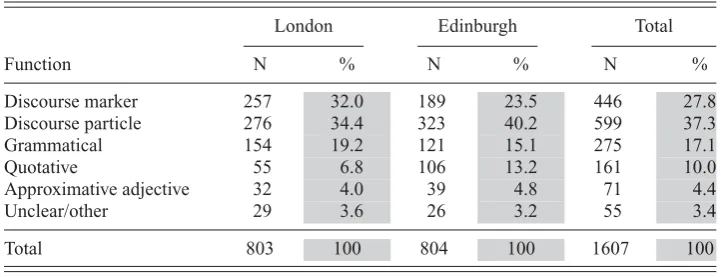
speakers and 803 tokens oflikefrom the London speakers. The data inTable 3present 409
the distribution of all functions oflikeamong the teenagers recorded in Edinburgh 410
and London. A regional comparison indicates that most functions oflike are used 411
in roughly the same frequency by adolescents in Edinburgh and London. The use of 412
discourse markers is somewhat higher in London, while quotatives are used somewhat 413
more frequently in Edinburgh. In both locations, the discourse particle is the most 414
frequent function of vernacularlike. 415
The first 55 liketokens per speaker were then subjected to an acoustic analysis. 416
Firstly, the vowel and the preceding and following element, /l/ and /k/, were determined 417
and then labelled in Praat (Boersma 2001). To determine the boundaries between 418
sounds, we followed Drager (2011: 698) as closely as possible. Vowel formants in 419
10 ms intervals, duration of /l/, vowel and /k/were then measured using a Praat script. 420
Speech rate was also determined by means of a Praat script, which calculates vowels 421
per second based on a three-word window in Praat; that is, three words either side of 422
eachliketoken. 423
The preceding and following phonological environment of eachlikeand the quality 424
of the /k/ were also determined, following Drager (2011: 698) as closely as possible. 425
For the latter, the categories were as follows: /k/ is (a) present; (b) deleted; (c) reduced 426
but with release; (d) reduced but there is no evidence of release in the spectrogram; (e) 427
realised as a fricative; and (f) glottalled.6 428
In the next step, prosodic characteristics were determined. The two words before 429
like, and the two words following like (if any) were noted and the pitch pattern 430
inspected while listening to the utterance. It was noted (1) whetherlikeis accented or 431
unaccented, and (2) whetherlikeis (intonation) phrase-final or not phrase-final. Finally, 432
(3) the boundary strength following like, using the Break Index Tier (Beckman & 433
6 We coded for three subcategories here: (a) full-glottal: /k/ is not present and there is clear evidence of closure
Hirschberg1993) was determined. A break index is a numerical value that is meant to 434 represent perceived degrees of juncture in an utterance. Break indices can be assigned 435 to perceived junctures between words and between the final word and the silence at the 436 end of the utterance. Ratings range from 0 to 4. Beckman & Hirschberg (1993: 1–2) 437
outline the break index values as follows: 438
0 for cases of clear phonetic marks of clitic groups; e.g. the medial affricate in contractions 439
of ‘did you’ or a flap as in ‘got it’. 440
1 Most phrase-medial word boundaries. 441
2 A strong disjuncture marked by a pause or virtual pause, but with no tonal marks; i.e. 442 a well-formed tune continues across the juncture. OR a disjuncture that is weaker than 443 expected at what is tonally a clear intermediate or full intonation phrase boundary. 444 3 Intermediate intonation phrase boundary; i.e. marked by a single phrase tone affecting the 445 region from the last pitch accent to the boundary. 446 4 Full intonation phrase boundary; i.e. marked by a final boundary tone after the last phrase 447
tone. 448
Strictly speaking, this is not an ordered factor as perceived juncture and intonation 449 combine to result in a score; however, the intonation phrase does not enter as a 450 criterion until break index 2. The break index can provide an indication of the prosodic 451 position in which like occurs. Specifically, it will be an indication of the perceived 452 break followinglikeand where in the intonation phrase different functions oflikemay 453 occur. Position within the intonation phrase and the type of break followinglikemay 454 influence the phonetic detail oflike. We would expectliketokens occurring in a 0 or 1 455 environment to be more reduced than those occurring in a break index 3 environment. 456 Before processing the formant values, the database was inspected for errors and 457 formant traces were corrected by hand. The F2–F1 distance was calculated, and a line 458 was then fitted to the values for the F2–F1 distance. The value of this slope is used 459 as the measure of monophthongisation, referred to as the DIPH value. If the result of 460 the slope is positive, the space between F1 and F2 is increasing; thereby indicating a 461 particular token is more diphthongal. A value closer to zero indicates that the vowel 462 quality is the same throughout, and therefore more monophthongal. Due to the focus 463
on the F2–F1 distance, there was no need to normalise the data. 464
corpora based on written texts (e.g. Brown, CELEX) and much smaller speech corpora 477
(e.g. the spoken component of the BNC), we approach the results with some caution, 478
given that scripted speech has been shown not to reflect the proper linguistic and social 479
conditioning of variables such asbe like(Dion & Poplack2007). 480
Nevertheless, until there is a corpus of natural speech large enough to cope with 481
the statistical measures used in the present article, SUBTLEX is by far the most 482
appropriate tool for bigram and frequency analyses. Figure 3 illustrates the good 483
degree of overlap in bigrams between our corpus and SUBTLEX. The presence of 484
bigrams, such aswas like in SUBTLEX, also demonstrates its reflection of casual 485
speech. In addition, we are assured in our choice by work in psychology which has 486
demonstrated that word processing times are highly improved in SUBTLEX, compared 487
with previously used frequency estimates (see Brysbaert & New2009).7 488
SUBTLEX bigram frequencies are further used as a measure of conditional 489
probability (Jurafskyet al.2001), by calculating how likely a word is to occur given the 490
previous word waslike, and how likelylikeis to occur given the previous word. The 491
conditional probability is derived by counting how often the two words in question 492
occur together and then dividing this number by the number of times the first word 493
occurs. Independent of the measure we take, we would expect more reduction with 494
higher probabilities. 495
In an attempt to make our results comparable with those of Drager (2011), we 496
focused on specific functions of like in our analysis. We conflated grammatical 497
functions oflikeinto one category; specifically, lexical verb and adverb were conflated. 498
These were contrasted with other functions oflike: the quotative, the discourse particle 499
and the discourse marker. Approximative adjectives do not form part of the analysis 500
as token counts were deemed too low to yield any reliable results. Unclear and ‘other’ 501
tokens (such as utterance-final sentence adverbs) were also removed from analysis. 502
The independent variables used in the current analysis, and the levels coded for under 503
each variable, are outlined below: 504
r Variant of like: grammatical, discourse marker, discourse particle, quotativebe like 505
r /l/ to V ratio between duration of /l/ and vowel: continuous (higher values indicate a longer 506
/l/ to vowel duration) 507
r Speech rate based on vowels per second: continuous 508
r Duration of /l/, vowel and /k/ in milliseconds (ms): continuous 509
r Bigram predictability – bigram count 1: (like + word), bigram count 2: (word + like): 510
continuous 511
r Conditional probability as above, but with conditional probabilities instead of counts: 512
continuous 513
r Speaker-specific probability of using quotativelike: continuous 514
r Diphthongisation (DIPH) value – high values indicate more diphthongal realisation of vowel: 515
continuous 516
r /k/ realisation: present, deleted, reduced, fricated, glottalled 517
r Accentedness oflike: accented, unaccented 518
r Position in intonation phrase:likeis phrase-final,likeis not phrase-final 519 r Boundary strength (BS) followinglike: 0, 1, 2, 3, 48 520 r Preceding phonological context: vowel, pause, nasal, liquid, plosive, fricative and affricate, 521
glide 522
r Following phonological context: vowel, pause, plosive, consonant other than plosive9 523
r Speaker sex: male, female 524
4 Results 525
Results are given in four distinct steps. In the initial step, we provide a summary 526 characterisation of the different functions oflike. We then explore the vowel quality of 527
likeand finally proceed to investigate /l/ and /k/. 528
4.1 Likefunction as dependent variable 529
Drager (2011) focuses on predicting the particular variant of like by using the 530 probability of the variant as the response variable and the phonetic and contextual 531 values as the predictors. This is somewhat unusual, given that the dependent variable 532 (i.e. the variable being tested) typically would be the phonetic realisation, and the 533 discourse function would be the predictor. We run analyses of this kind in section 534 4.2; however, in order to provide a comparison with Drager (2011),section 4.1uses 535 the probability oflikevariant as the dependent variable, to assess whether a particular 536
variant can be predicted from its phonetic realisation. 537
Our data differ from Drager’s in some ways, and we believe we can improve on 538 exploring the complexity of our data by using different statistical techniques. Drager 539 considers three functions of like in her paper, resulting in three models. However, 540 as we have four possible variants – discourse marker (DM), discourse particle (DP), 541 grammatical (Gram) and quotative (Quot) – we will need six models to be able to 542 consider each pairing. Thus, we are asking whether a particular variant oflike(e.g. 543 whether it is a discourse marker or a quotative) can be predicted by the phonetic 544 realisation of each of its segments, as well as other contextual factors listed in 545 section 3.2. If indeed the phonetic factors emerge as the most important, this would 546 lend weight to the idea that items are stored in the mind in such a way that functional 547
distinctions are maintained. 548
Because of the large number of predictors for this model, we took advantage of 549 the binary choice in dependent variables by running a series of random forests. This 550 has the added benefit of including highly collinear predictors (such as bigram counts 551 and their conditional probability, or accentedness and boundary strength) in the same 552 model, as random forests are well equipped to deal with such predictors, as well as 553
small sample sizes. 554
8 We excluded boundary strength 4 tokens, due to their low token numbers.
9 Originally coded for plosive; fricative and affricate; glide; nasal and liquid, but conflated on the basis of similar
Figure 1. Variable importance of factors from random forest in Edinburgh
Figure 2. Variable importance of factors from random forest of London
The importance of the predictors for Edinburgh and London can be viewed from the 555
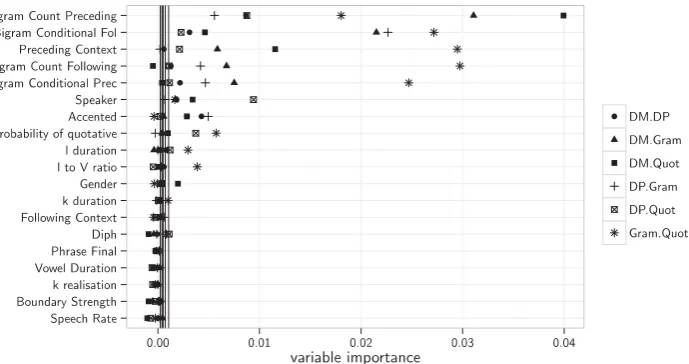
dotplots infigures 1and2, alongside the ctrees in the Appendix. Each shape represents 556
a different pairwise combination of variants of the dependent variable. The lines 557
represent the cut-off for significance: everything to the left of the line is considered 558
non-significant in each comparison (Strobl, Malley & Tutz2009: 342). Although there 559
are six separate lines on each of these plots, they are very tightly clustered, and any 560
points approaching the lines should be taken as not significant. 561
Overall, we can see that bigram frequency of the preceding and following words, and 562
[image:17.493.82.427.297.479.2]Figure 3. Top ten bigram frequencies for like and the preceding word in our corpus and in the SUBTLEX corpus
what kind of variant oflikewe have.10 For example, frequent combinations withlike 564 and a specific preceding word (BigramCount2) relate to a variety of functions of 565
like, not one specific function. Depending on the comparison, discourse markers and 566 discourse particles are often associated with low bigram frequencies of that particular 567 type, while the grammatical and quotative functions are often associated with high 568 bigram frequencies. Some frequent combinations are listed infigure 3. 569 Boundary strength, accentedness, /l/ and /l/ to vowel duration, and following context 570 also play a role for most or some combinations in both cities. In combinations that 571 include the quotative, we also find the probability of a speaker using the quotative 572 to be a significant predictor. This finding is unsurprising and somewhat circular: if a 573 token oflikeis uttered by a speaker who has a high probability of using quotativelike, 574 then that token is more likely to be quotativelikein comparison to other speakers. 575 The ctrees, built using R’s party package (Hothorn, Hornik & Zeileis2006), give us 576 more of an insight into how each factor contributes. As an example,figure 4illustrates 577 a conditional inference tree for discourse marker vs grammatical likein Edinburgh. 578 If the bigram with the following word is not particularly frequent (less than 3,350 579 occurrences in SUBTLEX), it is more likely to be a discourse marker. If it is very 580 frequent, the likelihood of the variant is decided by the boundary strength: a weaker 581 boundary indicates a grammatical element, whereas a stronger boundary is more likely 582 to be preceded by a discourse marker. The other trees (which can be viewed in the 583 Appendix) vary in their complexity; however, they demonstrate that the variant can be 584
accounted for with similar patterns of contextual factors. 585
Figure 4. Conditional inference tree for discourse marker (DM) vs grammatical (gram)likein Edinburgh
The forests and trees for this dataset inform us that the main distributional facts 586
reflect the fact that the context of the sentence (i.e. bigrams or boundary strength) 587
is the overwhelming predictor of the type of like.11 However, there are some small 588
indications, in some combinations that contain the quotative, that phonetic factors may 589
play a role in determining the type oflike. Diphthongisation/monopthongisation, /k/ 590
and /l/ to vowel duration demonstrate some small effects. 591
We will now explore more closely these phonetic factors and create three models 592
that take the phonetic realisation as the dependent variable; that is, the l-to-vowel 593
duration, the degree of monophthongisation/diphthongisation and the quality of /k/ 594
respectively. This tests whether different functions of like do nonetheless differ 595
significantly in the quality of /l/, /aɪ/ and /k/, despite the contextual constraints. 596
Therefore, the research question in this section is somewhat different. Rather than 597
asking whether a particular variant oflike(e.g. whether it is a discourse marker or a 598
quotative) can be predicted by the phonetic realisation of each of its segments, as well 599
as other contextual factors, we are now asking whether monophthongisation, /k/ quality 600
and l-to-vowel duration can be predicted from the factors listed in section 3.3. The 601
11To test whether the overwhelming strength of the bigram counts and conditional probabilities might be
Table 4. Coefficients of a general mixed-effects linear regression of monophthongisation and diphthongisation with speaker as random effect – London
Fixed effects
Estimate Std error t-value p-value
(Intercept) 0.643 0.067 9.547 <0.001
Boundary strength (ref. level: 0)
Boundary strength 1 −0.190 0.055 −3.451 <0.001 Boundary strength 2 −0.147 0.061 −2.429 0.015 Boundary strength 3 −0.168 0.057 −2.930 0.004 Variant (ref. level: discourse marker)
Discourse particle −0.001 0.021 −0.053 0.958
Grammatical −0.044 0.025 −1.777 0.076
Quotative −0.082 0.034 −2.425 0.016
Standard deviation: 0.221
most important question here is: will the function oflikebe selected as a significant 602
predictor or not? 603
4.3 Vowel quality 604
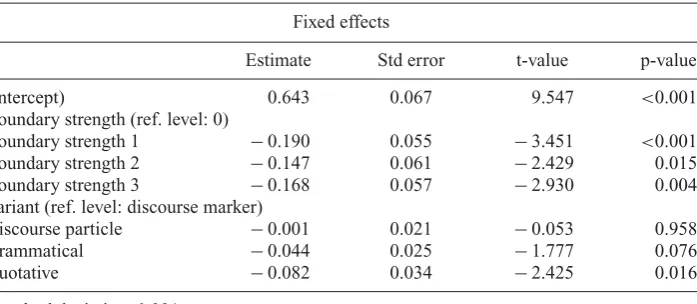
Tables 4and6provide the results of the linear regression models for the vowel quality 605 in London and Edinburgh. They list significant factors in column 1, and in columns 606 2, 3, 4 and 5, the estimate, the standard error, the t-value and the p-value are listed 607 respectively. We further provide the estimate of the intercept. The estimates given in the 608 regression models help us interpret the effect of a relevant factor level on vowel quality. 609 A negative quantity implies a larger degree of monophthongisation, while a positive 610 quantity implies a larger degree of diphthongisation than the respective reference level. 611 We can see fromtable 4that among our London adolescents, two factors achieve 612 statistical significance.Liketokens followed by a boundary strength of 1 are the most 613 monophthongalliketokens, followed by boundary strength 3.12Thus, prosodic factors 614 do indeed influence the realisation oflike, as we had expected. In addition, the function 615 oflikedoes influence the degree of monophthongisation as well: quotatives are more 616 monophthongal among London adolescents, which mirrors Drager’s results in New 617
Zealand. 618
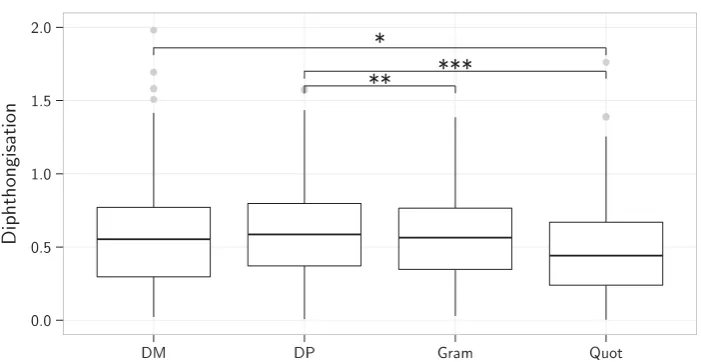
The box plot in figure 5 summarises the results for variants in London. The 619 additional bars demonstrate that quotatives are significantly more monophthongal 620 than discourse markers and discourse particles. Discourse particles differ significantly 621 from quotative and grammatical like, and grammatical functions of like are only 622
Table 5. Occurrence oflikein five boundary strength contexts in both London and Edinburgh
0 1 2 3 4
Discourse marker 3 209 54 173 4
Discourse particle 29 379 58 128 1
Grammatical 18 210 13 29 2
Quotative 1 113 13 31 0
Figure 5. Degrees of diphthongisation oflikein its different functions – London
significantly different from discourse particles. Although significant, the boxplot 623
shows that the differences are very fine-grained. Moreover, the results point towards 624
the conclusion that, in London, break type 1 is a favourable environment in which 625
monophthongisation is more frequent.Table 5outlines the breakdown of break type 626
bylikefunction. 627
Table 6shows that the results for Edinburgh are very similar to our London findings. 628
Boundary strength (BS) is a significant factor. However, in Edinburgh, like tokens 629
followed by a juncture strength of 3 are the most monphthongalliketokens, followed 630
by BS 1. In contrast to BS2, BS1 and BS3 are less diphthongal than BS0, although 631
this is only marginally the case for BS1. The difference between 1, 2 and 3 is not 632
significant. We will return to this point in our discussion. 633
As in London, the function of likeinfluences the degree of monophthongisation. 634
Figure 6shows that discourse particles are most diphthongal – more so than discourse 635
markers, and significantly more so than grammaticallikeand quotatives. Discourse 636
markers are the next most diphthongal, but not significantly more so than grammatical 637
like. Quotatives are the most monophthongal, with significantly lower DIPH values 638
Table 6. Coefficients of a general mixed-effects linear regression of monophthongisation and diphthongisation with speaker as random effect –
Edinburgh
Fixed effects
Estimate Std error t-value p-value
(Intercept) 0.848 0.077 11.007 <0.001
Gender (ref. level: female) −0.197 0.056 −3.484 0.002 Boundary strength (ref. level: 0)
Boundary strength 1 −0.099 0.058 −1.691 0.091 Boundary strength 2 −0.059 0.069 −0.847 0.397 Boundary strength 3 −0.136 0.064 −2.141 0.033 Variant (ref. level: discourse marker)
Discourse particle 0.049 0.031 1.592 0.112
Grammatical −0.065 0.040 −1.620 0.106
Quotative −0.108 0.042 −2.568 0.010
Vowel duration −2.035 0.505 −4.031 <0.001
[image:22.493.64.415.323.504.2]Standard deviation: 0.314
Figure 6. Degrees of diphthongisation oflikein its different functions – Edinburgh
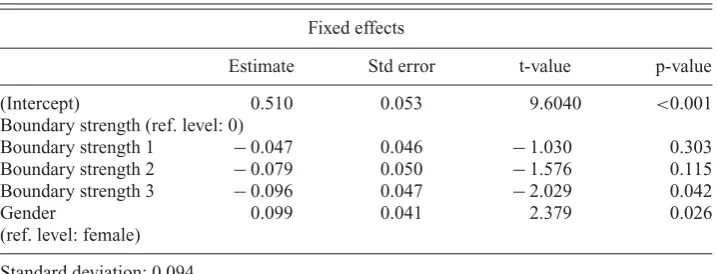
Table 7. Coefficients of a general mixed-effects linear regression of /l/ to vowel duration with speaker as random effect – London
Fixed effects
Estimate Std error t-value p-value
(Intercept) 0.510 0.053 9.6040 <0.001
Boundary strength (ref. level: 0)
Boundary strength 1 −0.047 0.046 −1.030 0.303 Boundary strength 2 −0.079 0.050 −1.576 0.115 Boundary strength 3 −0.096 0.047 −2.029 0.042
Gender 0.099 0.041 2.379 0.026
(ref. level: female)
Standard deviation: 0.094
the relatively recent introduction oflike and its use by younger age groups, we are 647
not in a position to make an assessment about the nature of the variation; that is, 648
whether or not it, or even the vowel quality of /ai/, is stable. It is similarly unlikely that 649
monophthongisedlikeoccurs above the level of awareness (yet), given the recentness 650
of the phenomenon. Future research is needed to uncover what precisely the status 651
of the observed variation is: by collecting data from different age groups and by 652
conducting perception and ethnographic work to investigate the extent to which 653
monophthongisation is perceived by speakers and the stylistic work it may do. 654
The significant factor of vowel duration indicates that long vowels are more 655
monophthongal. The situation is somewhat more complex but space constraints do 656
not permit a full treatment of this issue. In brief, more fine-grained analyses suggest 657
by selecting a binary cut-off between monophthongal (i.e. a DIPH value of around 0) 658
and diphthongal tokens, duration correlates with the diphthongal tokens only. 659
4.3 /l/ to vowel duration 660
The /l/ to vowel duration provides an indication of the length of /l/ relative to the 661
vowel: a low /l/ to vowel ratio indicates a short /l/ relative to the vowel duration. More 662
reduced tokens should have shorter /l/s.13In Drager’s (2011) study, tokens with a short 663
/l/ to vowel ratio were more likely to be quotative likethan grammatical like. The 664
results for /l/ to vowel duration in London (table 7) and Edinburgh (table 8) indicate 665
thatlike-function does not correlate significantly with the duration of /l/. Considering 666
this finding, we provide only a brief report of the results. 667
13We note that existing analyses of /l/ reduction have shown that darker /l/s have a longer duration (e.g. Sproat
Table 8. Coefficients of a general mixed-effects linear regression of /l/ to vowel duration with speaker as random effect - Edinburgh
Fixed effects
Estimate Std error t-value p-value
(Intercept) 0.579 0.020 28.743 <0.001 Preceding context (ref. level: fricative)
Preceding stop 0.058 0.022 2.656 0.008
Preceding pause 0.014 0.022 0.650 0.515 Preceding vowel 0.080 0.020 3.953 <0.001
Standard deviation: 0.071
In London, the boundary strength followinglikehas a significant effect. A BS of 0 668 is associated with a longer /l/ to vowel duration, while BS1 and 3 reflect the results we 669 found for vowel quality in that they are associated with a larger degree of reduction – 670 and in relation to /l/ – a shorter /l/ to vowel duration.Table 7also indicates that males 671
have a higher /l/ to vowel duration. 672
In Edinburgh, conversely, the preceding phonological context constrains /l/ to vowel 673 duration in like.The /l/ to vowel duration is highest when the preceding context is a 674 vowel, followed by stops, pauses and fricatives. The fricative context, which results in 675 the shortest /l/ to vowel duration, differs significantly from vowels and stops, but not 676
pauses. 677
4.4 /k/ realisation 678
The results for /k/ in London (table 9) and Edinburgh (table 10) also indicate thatlike 679 function is not a significant factor in determining the realisation of /k/. Intables 9and 680 10, a higher value indicates an increased likelihood of /k/ reduction. 681 In London, again the boundary strength followinglikehas a significant effect. A 682 BS of 0 is associated with the fullest /k/ realisation, while BS1 is significantly more 683 reduced. Table 9 also indicates that fuller /k/ realisations are associated with more 684 diphthongal realisations of the vowel, suggesting that /k/ and vowels inlikeare reduced 685 in tandem. Finally, the realisation of /k/ is influenced significantly by the following 686 context. This is the case in London as well as Edinburgh (seetable 10). In both locales, 687 we observe the highest degree of /k/ reduction before stops and the least degree 688 of reduction before vowels. Other consonants and pauses fall in between these two 689 extremes. This is in line with findings for /t/ reduction, particularly T-glottalling, for 690 which a consonant>pause>vowel hierarchy is often documented (see Schleef2013 691
for an overview). 692
Table 9. Coefficients of a general mixed-effects linear regression of /k/ with speaker as random effect – London
Fixed effects
Estimate Std error z-value p-value
(Intercept) 2.073 1.078 1.922 0.055
Following context (ref level: stop)
Following consonant −3.256 0.570 −5.713 <0.001 (other than stop)
Following vowel −3.712 0.588 −6.309 <0.001 Following pause −3.160 0.690 −4.579 <0.001 Boundary strength
(ref. level: 0)
Boundary strength 1 2.580 0.966 2.669 0.008
Boundary strength 2 1.835 1.038 1.768 0.077
Boundary strength 3 1.737 1.059 1.640 0.101
Diph −1.924 0.414 −4.646 <0.001
Standard deviation: 0.969
Table 10. Coefficients of a general mixed-effects linear regression of /k/ with speaker as random effect – Edinburgh
Fixed effects
Estimate Std error z-value p-value
(Intercept) 1.522 0.488 3.114 0.001
Following context (ref level: stop)
Following consonant (other than stop) −2.508 0.414 −6.058 <0.001 Following vowel −3.172 0.428 −7.408 <0.001 Following pause −2.612 0.404 −6.460 <0.001 Bigram Count 2 (log scaled) 0.105 0.040 2.592 0.009
Standard deviation: 0.686
the most common variant found, but if the bigram is very frequent it is more likely 695
to be reduced in some way (log-scale between 9 and 10; that is, between about 8,000 696
and 22,000 occurrences in the SUBTLEX corpus). This is in accordance with the 697
predictions made by Jurafskyet al.(2001,2002). 698
In conclusion, both results for /l/ and /k/ confirm our findings made in the 699
random forests analysis: the function oflikecorrelates mostly with contextual factors 700
rather than phonetic factors. Predictability of the preceding and following words, the 701
[image:25.493.80.433.362.490.2]Figure 7. /k/ realisation for Edinburgh speakers against the log of bigram count 2 (i.e. number of times like and its preceding word occur together)
functions of likeoccur in specific contexts, which have not resulted in significantly 703
different phonetic details for them. 704
However, this does not explain all the findings pertaining to vowel realisation. 705 In London and Edinburgh, the vowel is the only non-contextual feature that seems 706 to be sensitive to the function of like: quotative be like is more likely to be 707 monophthongised than other functions oflike. This means there are three independent 708 speech communities (New Zealand, London and Edinburgh) across which the price 709 vowel is subject to different phonetic and phonological pressures, and in all three the 710 data show that the quotative is most monophthongal. This is highly suggestive of a 711 contextual explanation for the monopthongisation oflikein this function. 712
5 Discussion 713
5.1 Summary 714
The discussion focuses on the monopthongisation of quotative like. It attempts to 715 provide an explanation for this phenomenon and illuminate its relevance. We argue that 716 it is rather premature to make claims about the cognitive representation of functions 717 of likebased on our evidence and that the more monophthongal nature of quotative 718
[image:26.493.68.405.79.277.2]frequency factors insection 5.1, and we discuss the potential relevance of our findings 722
to theoretical arguments regarding the evolution ofbe likeinsection 5.2. 723
Our results reveal thatlikefunction is an impressive predictor of monophthongisa-724
tion, yet never on its own: contextual factors appear to matter as well. Our data suggest 725
that quotative be like is most frequently followed by a BS1 break (see table 5); in 726
other words, it is not followed by a strong disjuncture and occurs within, rather than 727
at the edge of, an intonation phrase boundary: quotative and quote tend to be part of 728
the same intonation phrase. The other threeliketypes also occur frequently in this 729
prosodic context; however, in contrast tobe like, they also occur quite frequently in 730
other prosodic contexts (seetable 5). Those in whichbe likeoccurs are less variable 731
than those of the other threelikefunctions. While the grammatical function oflikeis 732
similarly restricted tobe likewith regard to its prosodic context, in contrast tobe like, 733
it also occurs in a BS0 context. Thus, prosody does seem to play an important role in 734
the contextual embedding of different functions oflike. 735
What makes these findings relevant is that the monopthongisation of /aɪ/ is 736
constrained in a similar manner to the prosodic embedding of be like: quotative 737
like, more often than other like functions, occurs in a favourable environment for 738
monophthongisation. The most diphthongal tokens oflikeoccur in a BS0 environment, 739
which is a context in which be like hardly ever occurs. In London, like tokens in 740
BS1, 2 and 3 contexts are more likely to be more monophthongal. They represent 741
favourable environments for monophthongisation. Thus,like, here, appears in a slot 742
where reduction is likely to occur. This makes quotativeliketokens least likely to be 743
diphthongal, as they seldom occur in a BS0 context. 744
In Edinburgh, the situation is similar, yet more complex: the most diphthongal 745
tokens of like also occur in a BS0 environment, which is a context in which be
746
like hardly ever surfaces. Here, like tokens in BS3 contexts are more likely to 747
be monophthongal, the second most frequent context for be like to occur. This 748
situation is rendered more complex by the fact that BS1 and BS2 contexts do not 749
differ significantly from BS0 contexts, BS3 contexts and each other: they lie in 750
between these two extremes. Nonetheless, quotativeliketokens are least likely to be 751
diphthongal, as they seldom occur in a BS0 context; moreover, mostliketokens occur 752
in an environment in which monophthongisation can certainly happen. Thus, in both 753
locationslike appears in a slot where reduction is likely to occur. The fact that in 754
Edinburgh the situation is more complicated and that in both locations BS1, BS2 and 755
BS3 do not differ from each other at a significant level, suggests that BS is merely a 756
reflection of a more important underlying process, and that our study may not have 757
caught fully the factors that constrain monophthongisation. Something else seems to 758
be going on. We will return to this below. 759
While prosody does play a role, bigram frequency does not seem to be a contextual 760
factor that influences the monophthongisation of like, as we had anticipated. Our 761
models of variable importance tell us that the preceding word does matter (in 762
the prediction of like, not a specific function of it); however, our analysis of 763
bigram frequency by itself does not interact with likefunction. For example, while 765
was likeis a frequent bigram that predicts the quotative, other highly frequent bigrams 766 predict other functions; for example, I like is grammatical, and like tends to be a 767
discourse marker or discourse particle. 768
5.2 Development of belike 769
When we consider the proposals regarding the process through which quotative be 770
likehas developed – grammaticalisation, lexicalisation and constructionalisation – our 771 conclusions have to remain rather modest. Our findings are only tangentially relevant 772 to this debate: they confirm that one of thelikefunctions, quotativebe like, has been 773 placed in a position to split off in form from the others. In section 5.3, we offer an 774 explanation of what exactly this position is. Since our data are not of a historical nature, 775 we have little to contribute to the discussion of howlikegot into this position because 776
we would expect reduction in all three processes implicated. 777
Grammaticalisation normally includes (a) pragmatic shift, (b) desemanticisation, (c) 778 decategorialisation and (d) phonetic reduction (e.g. Bybee 2003). This makes sense, 779 as grammaticalised items tend to be used more frequently and hence become more 780 predictable, thereby resulting in the loss of phonetic substance (Heine 2003: 583). 781 Highly grammatical elements, such as auxiliaries and prepositions, are often subject 782 to reduction. Grammatical elements tend to be more reduced than lexical ones (e.g. 783
nouns). 784
It is clear from our data that reduction is associated more strongly with the quotative 785 than it is with the other like functions. However, the findings of our study do not 786 mean that be like has been grammaticalised because both grammaticalisation and 787 lexicalisation may involve reduction (Lehman2002: 1). Lexicalisation is in fact very 788 strongly associated with reduction (Brinton & Traugott2005). An analysis ofbe like 789 as part of a construction too would lead us to expect reduction because reporting 790 clause constructions generally tend not to be particularly prominent prosodically 791 (e.g. Halliday & Matthiessen 2004: 446). We believe prosodic constraints are key 792 to understanding why it is that like in the quotative is reduced more than the other 793 functions oflike. The remainder of our discussion focuses on this issue of reduction 794 rather than the evolution ofbe like, and we develop a clearer notion of what precisely 795 it is that reduceslikein thebe likequotative more that thelikeserving other functions. 796
5.3 Likereduction 797
We would like to propose that our findings for monopthongisation and break type 798 are due to one unifying development. The evolution ofbe like, by whatever process, 799 has brought quotativelikeunder the influence of rhythmic and reduction patterns of 800 reporting clauses which are fundamentally an outcome of their relation to the reported 801