Elizabeth F. Severino, Director-Editorial William J. Muldowney, Group Managing Editor John R. Hillegass, Consulting Editor
J.B. Totaro, Consulting Editor
EDITORIAL SUPPORT
Joseph F. Kelly, Editorial Assistant Martha Vandevelde, Secretary Patricia DeVault, Staff Assistant Ethel Jackson, Staff Assistant
CUSTOMER SERVICE CONSULTANTS
John Allen, Manager, Customer Services Sara M. Buchanan, Service Consultant Kathleen Carey, Service Consultant Alan Hirsch, Service Consultant Patricia Jordan, Service Consultant Stanley Greene, Service Consultant Dale Kredatus, Service Consultant
SALES & SUBSCRIPTIONS
Jack McEriain, National Sales Manager
William Lauderbach, Northeastern Regional Sales Manager Elizabeth McKeown, Central Regional Sales Manager Charles R. Olson, Western Regional Sales Manager Russell Strunk, Manager-Renewal Sales
PUBLISHER
Donald F. Welsher
COMMUNICATIONS
SOLUTIONS
Datapro Research Corporation. 1805 Underwood Blvd., Delran, NJ 08075; 609-764-01001 A McGraw-Hili Company Chicago 312-236-8206/Dallas 214-980-1525/Palo Alto 415-967-6007/Phoenix 602-203-78311
Washington 301 -589-6040
a service devoted to the automation of banking operations and transactions; DAT APRO REPORTS ON RETAIL
AUTOMATION, An in-depth study of POS or point of transaction automation; DATAPRO DIRECTORY OF
SOFTWARE, a comprehensive series of summaries on computer programs and packages on the EOP market; DATAPRO
REPORTS ON DATA COMMUNICATIONS, a service devoted to data communications utilities, systems, terminals and
devices; DATAPRO EDP SOLUTIONS a management oriented service covering a range of EOP topics; DAIAPRO
AUTOMATED OFFICE SOLUTIONS, a management oriented service covering timely topics in the office area;
DATAPRO APPLICATIONS SOFTWARE SOLUTIONS, a management oriented service covering a wide range of
software applications; DATAPRO REPORTS ONOFFICE SYSTEMS, a comprehensive information service covering all aspects of office equipment, systems and services; DATAPRO REPORTS ON COPIERS & DUPLICATORS, a service devoted to copier and duplicator equipment found in the office or in-house reprographics center; and DATAPRO
COMMUNICATIONS
SOLUTIONS
Contents, Volume
1
I I
N.B. For a complete, detailed listing of the contents ohhis information service, see the Index, Section CS01.
Report Report No. of Pub'n. Report
Number Pages Date
INDEX CS01-l 00-1 01 7 5/80 Terminals
The Categories and Functions of
USER'S GUIDE CS03-1 00-1 01 3 6/79 Data Terminals
Typing and Printing at a Distance
INQUIRY SERVICE CS05-1 00-1 01 14 6/79 Display Terminals-The Soft Copy
Alternative to Teleprinters User Programmable Terminals
BASIC CONCEPTS Remote Batch Terminals
Integrated Point of Sale (POS)
Topic Index CS10-000-l0l 1 2/80 Systems
Technology Overviews
Voice Response Data Terminais
A Brief Historical Perspective of CS 10-120-101 10 6/79 Interface Equipment
Computer Communications Modems: Terminal-Line Linking
Teleprocessing-The Modern CS 1 0- 1 50- 1 01 8 6/79 Devices
Marriage of Computers and
Communications Transmission line Equipment
Line Use Optimization with
The Data Transmission Channel Multiplexing Equipment
The Special Requirements of Data CS1 0-21 0-1 01 10 6/79
Communications Traffic Concentration and line
The Basic Parameters of a Data CS 10-220-101 9 6/79 Management
Channel Com m u nications
Processors-General Solutions to Common CS 10-230-101 11 6/79 Special Kinds of Computer-Helping
Communications Interface Problems Computers
Multiplexing and Concentration Telephone Equipment
The Strengths and Applications of CS10-310-101 10 6/79 Private Telephone Systems-PBX
Digital Data Multiplexing and PABX
The Power of Concentration CS 10-320-101 4 6/79 The Equipment and Techniques of
Digital Transmission Techniques Digital Telephony
The Language and Techniques of CS1 0-41 0-1 01 16 6/79 Transmission Facilities
Pulse Code Modulation (PCM) Current Transmission Facility
The Nature and Organization of CS 10-411-101 10 6/79 Characteristics
Digital Transmission Channels Users' Views of Transmission
Facilities Protocols
Why Protocols? Why Standards? CS10-510-101 4 6/79 PLANNING
A Tutorial on Protocols CS 10-520-101 32 7/79
Network Technologies Topic Index
A Concise Summary of Public, CS1 0-610-101 8 6/79 Need Assessment Planning
Leased, and Private Transmission Overview
Facilities How to Determine Your Data
The Uses of Message Switching in CS10-620-101 20 6/79 Communications Needs
Communications Networks A Digest of the Latest
The Techniques and Applications CS1 0-650-1 01 9 6/79 Communications System Planning
of Packet Switching Techniques
Operating Systems for Computer CS1 0-660-1 01 11 2/80 Gaining a Better Perspective of
Networks Communications System
Applications
Wideband Transmission Facilities Planning Ahead for Your Data
Understanding Satellite-Based CS10-710-101 9 6/79 Comm unications Applications
Telecommunications Systems A Short Guide to the Arcana of
Nationai and internationai Data
Communications Control Techniques Communications Regulations and
A Summary Overview of CS1 0-81 0-1 01 23 6/79 Tariffs
Communications Network Control
Architectures and Protocols Terminals
A Short Checklist of Terminal
I Pianning Factors
SYSTEM COMPONENTS How to Calculate the Number of
Terminals You Will Need in Your
Topic Index CS 15-000-101 1 5/80 Communications Network
How to Measure a Terminal'S I.Q.
System Component Overview Providing User-Oriented System
A Brief Classification Guide to Data CS15-050-101 12 6/79 Interfaces
Communications Hardware Hardware Solutions to Problems in
The Integrated Uses of Hardware in CS15-060-101 13 6/79 the Terminal/Computer-to-Modem
Network Configurations Data Path
MAY 1980 © 1980 DATAPRO RESEARCH CORPORATION, DELRAN, NJ 08075 USA
REPRODUCTION PROHIBITED
Report Number
CS15-100-101
CS15-120-101 CS 1 5-150-101
CS 15-160-101 CS15-170-101 CS 1 5-180-201
CS i 5-i 90-i 0;
CS 1 5-220-101
CS 15-320-101
CS 15-420-101
CS15-610-101
CS15-612-101
CS 15-710-101
CS15-711-101
CS20-000-101
CS20-110-101
CS20-11 5-101
CS20-120-101
CS20-121-101
CS20-150-101
CS20-205-101
CS20-21 0-1 01
CS20-215-101 CS20-220-101
CS20-235-101
No. of Pub'n.
Pages Date
8 6/79
11 9/79
12 11/79
8 1/80
8 2/80
8 6/79
11 6/79
8 4/80
7 12/79
12 7/79
9 6/79
14 6/79
10 6/79
5 10/79
1 5/80
9 6/79
9 6/79
13 6/79
21 6/79
8 6/79
7 6/79
23 6/79
6 6/79
9 5/80
N.B. For a complete, detailed listing of the contents of this information service, see the Index, Section CS01.
Report Report No. of Pub'n. Report
Number Pages Date
Transmission Facilities System Architecture for
Planning Considerations for Dial-Up CS20-325-101 15 6/79 Distributed Data Management
Versus Leased-Line Facilities A Language for Distributed
Processing
Applications Maintaining Data Order and
Consistency in a
Multi-Office Automation Access Environment
An Office Automation Study CS20-400-101 16 12/79
EFT Electronic Mail Planning for Electronic Mail
High Velocity Money-Preparing CS20-41 0-1 01 10 6/79 Facsimile-How to Analyze Its
for EFT Role in Your Organization
Planning Guidelines for an EFT CS20-412-101 6 6/79
Audit and Control System
Teleconferencing The Economics and Other Issues of CS20-415-201 8 6/79
EFT Systems Planning for All-Electronic
Multimedia Corporate
Distributed Processing Communications
How to Conduct a Distributed CS20-51 0-1 01 18 6/79
Processing Feasibility Study MIS
Organizational Design for Distributed CS20-515-1 01 10 1/80 The Communications Framework of
Processing Management Information Systems
MAY 1980 :g '980 DATAPRO RESEARCH CORPORATION, DELRAN, NJ 08075 USA
REPRODUCT!ON PROHIBITED
Report Number
CS20-520-101
CS20-530-101
CS20-540-101
CS20-61 0-1 01 CS20-650-101
CS20-71 0-1 01
CS20-940-101
No. of Pub'n.
Pages Date
6 9/79
12 10/79
7 3/80
6 6/79
8 8/79
7 6/79
Filing
Instructions-May
1980
COMMUNICATIONS
SOLUTIONS
This supplement contains a new report on providing user-oriented system interfaces and
another interesting report about using an IBM Series / 1 minicomputer as a
communications system management tool. You will also find a drastically revised report on network diagnostic tools which includes the results of a recent Datapro user survey.
It takes only a few minutes to file the new reports in your looseleaf binders. Just follow the simple filing instructions on this page.
REMOVE INSERT
SECTION DESCRIPTION
Report No. of Report No. of Number Pages Number Pages
Volume 1 Contents 2 Contents 2 Contents of Volume 1 (revised)
Index CS01-050-101 2 - i
-Supplementary Index (merged with master index) CS01-1 00-1 01 6 CS01-1 00-1 01 7 Index (revised)
Planning CS20-000-101 1 CS20-000-101 1 Topic Index (revised)
- - CS20-220-101 9 Providing User-Oriented System Interfaces (new)
Volume 2 Contents 2 Contents 2 Contents Volume 2 (revised)
Installation CS35-610-201 11 CS35-610-201 36 Network Diagnostic Tools: An Equipment/
and Main- Vendor Survey (revised)
tenance
Systems CS50-000-101 1 CS50-000-101 1 Topic Index (revised) Management
- - CS50-330-101 10 Using a Minicomputer as a Communications
I System Management Too! (new)
I
Newsbriefs - - CS99-001-051 4 N ewsbriefs (new)MAY 1980 c 1980 DATAPRO RESEARCH CORPORATION, DELRAN, NJ 08075 USA ----
-_
_._--N.B. For a complete, detailed listing of the contents of this information service, see the Index, Section CS01.
Report Report No. of Pub'n Report Report
Number Pages Date Number
SYSTEM DESIGN Computer Services
Comparing Interactive Computer CS30-21 0-1 01
Topic Index CS25-000-101 4/80 Services
Design Motives and Goals Hardware Performance Analysis
Resource Sharing-The Motivating CS25-11 0-1 01 19 6/79 Selecting Data Communica- CS30-300-101
Goal of Communications System tions Facilities
Design Performance Analysis of Complex CS30-31 0-1 01
A Concise Overview of Communi- CS25-120-101 16 6/79 Communications Systems
cations System Design Factors
Nontechnical Issues in Network CS25- 121-101 7 6/79 Telephone Equipment
Design The Evaluation and Selection of a CS30-41 0-1 01
How to Design a Communications CS25-190-101 9 6/79 Telephone System
System with Elegance and Simplicity
Software
Terminals How to Evaluate and Select a Data CS30-61 0-1 01
The Impact of Human Biology on CS25-220-101 16 6/79 Communications Monitor
Man-Machine Interface Design
The Effects of Terminal Dialogue CS25-221-101 5 6/79 Contract Negotiations
Structure on Network Costs How to Negotiate Hardware CS30-710-101
Making a Special Purpose Terminal CS25-222-101 6 4/80 Contracts
Work in a General Purpose Sys- Contracts for Acquiring Software CS30-711-101
tems Environment Packages
Contracts for Outside Processing CS30-712-101
Line Control Services
The Elements of Line Control in CS25-31 0-101 12 6/79
Communications System Design INSTALLATION AND MAINTENANCE
A Guide to IBM's System CS25-320-101 11 7/79
Network Architecture (SNA) Topic Index CS35-000-101
Networks Maintenance Tools and Techniques
A 10-Year Summary of Solutions to CS25-411-101 14 6/79 The Equipment and Techniques of CS35-61 0-1 01
Packet-Switched Network Problems Communications Systems
ARPANET Versus SNA-A Side-by- CS25-415-101 10 6/79 Maintenance
Side Comparison of Two Packet- Network Diagnostic Tools: An CS35-61 0-201
Switched Network Design EquipmentNendor Survey
Approaches How to Design a Communications CS35-611-101
System Diagnostic Test Center Security
Some Insights into Cryptography CS25-51 0-1 01 15 6/79 Maintenance Services
and Its U:;es in Data Communications Understanding Independent Third CS35-71 0-1 01
Prevention of Computer CS25-520-101 15 10/79 Party Maintenance Services
Crime
Applications for Multilevel CS25-530-101 11 12/79 OPERATIONS MANAGEMENT
Secure Operating Systems
Topic Index CS40-000-101
Design Aids
Categories of Data Transmission CS25-605-101 6 8/79 Operational Checks
Systems A Protocol Validation Technique for CS40-320-101
How to Develop Computer Programs CS25-61 0-1 01 10 6/79 Operational Confidence
for Network Design Assistance Workflow-A Technique for CS40-330-101
How to Organize and Use a Data- CS25-611-101 8 6/79 Analyzing JES Systems
base for Network Design and
Management Operating Improvements
A Brief Introduction to the Language CS25-6i 5- i Oi i5 6/79 How to Improve Line Utilization CS40-41 0-1 01
and Techniques of Queueing Theory in an Existing System
Sophisticated Modem and CS40-420-101
Economic Analyses Multiplexer Utilization
How to Evaluate the Economics of CS25-81 0-1 01 26 6/79
System Design Alternatives Operating Cost Reductions
Putting the Squeeze on Your Te!e- CS40-51 0-1 01
SELECTION AND ACQUISITION communications Costs
Control of Variable Telephone CS40-520-101
Topic Index CS30-000-101 3/80 Costs
Data Communications Hardware Security
Basic Guidelines to the Selection CS30-110-101 13 6/79 Data Security and Protection CS40-750-101
and Acquisition of Communications Structures
System Hardware Communications and Data Base CS40-760-101
System Safeguards
MAY 1980 .~ 1980 DATAPRO RESEARCH CORPORATION, DELRAN, NJ 08075 USA
REPRODUCTION PROHIBITED
No. of Pub'n
Pages Date
8 2/80
29 3/80
10 11/79
22 6/79
6 6/79
9 6/79
10 6/79
9 8/79
10/79
7 6/79
36 5/80
5 6/79
12 6/79
4/80
13 6/79
6 10/79
9 6/79
5 11/79
10 6/79
7 9/79
9 6/79
" "
... un."M • •
vn~Lontents,
VOlume
L
SOLUTIONS
t~.B. For a complete, detailed listing of the conteiits of this infoimation SSiV;C6, see the Index, Section eS01.
Report No. of Pub'n Report Report
Report
Number Pages Date Number
Network Control Architectures
SYSTEMS MANAGEMENT
AT&T Answers 15 Questions About CS60-51 0-1 01
5/80 ACS
Topic Index CS50-000-101
A Fail-Safe Distributed Local CS60-520-101 System Performance Evaluation
13 6/79 Network for Data Communication
How to Measure and Evaluate CS50-120-101
Computer Response and Turnaround
Communications and Society Times in an Interactive Network
The Technological Path Toward a CS60-820-101
A Communications System CS50-130-101 6 6/79
Distributed Environment Performance Checklist
Two Possible Communications CS60-850-101
Futures: 1984 or the Goldfish Bowl Line Optimization
Toward the Information Society- CS60-860-101
The Differences in Line Optimization CS50-220-101 9 6/79
A Positive View Approaches to Short- and
Long-Potential I mpacts of Educa- CS60-865-101
Line Systems
tiona I Telecommunications
Special Systems Management Systems
CS50-31 0-1 01 10 6/79
Communications Network
Manage-VENDORS AND SUPPLIERS
ment in a Research and Develop-ment EnvironDevelop-ment
Vendors and Suppliers Index CS90-000-101
Institutional Control of Com- CS50-320-101 8 1/80
Teleprinter Terminals CS90-120-101
puting Funds and Resources in a
Display Terminals CS90-1 50-101
Networking Environment
User Programmable Terminals CS90-160-101
Using a Minicomputer as a CS50-330-101 10 5/80
Remote Batch Terminals CS90-170-101
Communications System
Integrated Point of Sale (POS) CS90-180-101 Management Tool
Systems
Voice Response Equipment CS90-190-101
Applications Management
Modems CS90-220-101
D istri buted Processi ng-Before CS50-510-101 14 6/79
Multiplexers CS90-320-101
Distributed Processing-After CS50-51 0-201 12 6/79
Communications Processors CS90-420-101
PBX, PABX, and Other Telephone CS90-61 0-1 01 International Operations
8179 Equipment
How to Cut Costs and Improve CS50-81 0-101 17 Service of Your International
STANDARDS AND PROTOCOLS
Telecommunications
Nationalism and Data CS50-815-101 8 6/79
American Standard Code for Communications
Information Interchange (ASCII) Advanced Data Communications
FUTURE SYSTEMS
Control Procedures (ADCCP) EIA Standard RS-232C
Topic Index CS60-000-101 3/80
IBM Binary Synchronous Communi-cations (BSC)
Applications and Software
IBM Synchronous Data Link Control A Realistic Look at the Future of CS60-160-101 8 6/79
(SDLC) EFT, POS, and Electronic Mail
Sperry Univac Universal Data Link
Some Yet-to-be-Solved Problems CS60-170-101 6 6/79
Control (UDLC) of Distributed Processing Systems
Burroughs Data Link Control (BDLC) The Future for Communications
Software
Terminals
Terminals in the 1980's A Prototype Advanced Terminal
System
New Transmission Technologies Fiber Optic Technology-Now and
Tomorrow
MAY 1980
CS60-180-101 7 6/79
CCITI X.25 Packet Switching Interface
CS60-220-101 9 6/79 GLOSSARY
CS60-230-101 10 2/80
Glossary
NEWSBRIEFS
CS60-310-101 23 6/79
Newsbriefs
:C;' 1980 DATAPRO RESEARCH CORPORATION, DELRAN. NJ 08075 USA
REPRODUCTION PROHIBITED
CS93-11 0-1 01
CS93-112-101
CS93-115-101 CS93-301-101
CS93-302-101
CS93-31 0-1 01
CS93-311-101 CS93-501-101
CS98-1 00-1 01
CS99-001-051
No. of Pub'n
Pages Date
14 6/79
9 1180
7 6/79
10 6/79
9 8/79
12 3/80
1 3/80
2 10/79
4 10/79
2 3/80
2 3/80
1 12/79
1 6/79
2 6/79
1 6/79
2 6/79
5 10/79
7 6/79
9 12/79
7 6/79
8 6/79
7 6/79
4 6/79
3 6/79
9 6/79
18 6/79
Supplementary Index
This supplementary Index includes only those items which have been added in the January, February, March and April updates to Communications Solutions. For index references to previously published reports, please turn to the Master Index which begins on the next leaf
A
ARPANET: CSIO-660-101
c
centralized data processing-cost-effectiveness of: CS20-515-1O I
Comparing Interactive Computer Services: CS30-21O-101
communications-facilities: CS30-300-10 I
Communications and Data Base System Safeguards: CS40-760- 10 I computing
resources-availability to institutional users: CS50-320- 10 I
costs:-of computer services: CS50-320-10 I
o
data communications-data protection: CS40-760-1O I fail-safe network concept: CS60-520-10 I security: CS40-760-10 I
selection of facilities: CS30-300-1O I data
processing-centralizing vs deprocessing-centralizing: CS20-515-1O I data control function: CS20-515- 10 I systems function: CS20-S15-101 distributed
processing-fail-safe network concept: CS60-520-101 organizing for: CS20-515- 10 I
terminals: CS 15-160-10 I
E
encryption: CS40-760- IO I
F
A Fail-Safe Distributed Local -:\etwork for Data Communication: CS60-520-101
facilities, selection of: CS30-300-101 future
systems-fail-safe distributed network concept: CS60-520-1O I
Institutional Control of Computing Funds and Resources in a Networking Environment: CS50-320-101
M
Maintaining Data order and Consistency in a Multi-Access Environment: CS20-540-10 I
Making a Special Purpose Terminal Work in a General Purpose Systems Environment: CS25-222-10 I
N
networks-for research facilities and educational institutions: CS50-320- 10 I operating system: CS 10-660-10 I
o
Operating Systems for Computer Networks: CSIO-660-IOI Organizational Design for Distributed Processing: CS20-515-IOI
p
Potential Impacts of Educational Telecommunications Systems: CS60-865-10 I
A Prototype Advanced Terminal System: CS60-230-IOI
R
resource sharing: CS50-320- 10 I
~ 1980 DATAPRO RESEARCH CORPORATION, DELRAN, NJ 08075 USA
CS01-060-102
Index
security-S
in a data communications environment: CS40-760-101 maintaining data order and consistency: CS20-540-101 Selecting Data Communications Facilities: CS30-300-1O I
selection-interactive computer services: CS30-21O-101
services-comparing interactive computer services: CS30-21O-101
software-network operating system: CS 10-660-10 1
system-network operating: CSIO-660-lOi
Supplementary Index
T
telecommunications-impact on education: CS60-865-1O 1
terminal-intelligent: CS 15-160-1 0 I programmable: CS 15-160-10 I special purpose: CS25-222-101 Terminals in the
1980's-a prototype 1980's-adv1980's-anced termin1980's-al system: CS60-230-1O I
u
User Programmable Terminals: CS 15-160-10 ID
if: 1980 DATAPRO RESEARCH CORPORATION, DELRAN, N~J 08075 USA
Index
A
access control: CS25-31O-101, CS25-520-101 accounting, network: CS25-11O-1O I ACS: see advanced communication service
ADCCP: (see advanced data communications control protocol) Advanced Communication Service: CSI5-71O-101, CS60-51O-101 Advanced Data Communications Control Protocol: CS25-81O-101 American Standard Code for Information Interchange (ASCII):
CS93-112-101
An Office Automation Study: CS20-400-101
applications-communications network: CS I 0-150-1 0 I, CS 15-420-10 I , CS20-120-IOI
distributed processing: CS20-51O-1O I, CS20-530-1O I, CS50-51O-1O I, CS50-51O-20 I
effect on system design: CS25-120-10 I for fiber optics: CS60-31O-1O I
gaining a better perspective of: CS20-120-1O I management: CS25-190-101
of PCM: CSIO-4IO-101
-oriented software: CS60-180-1O I planning: CS20-121-101, CS25-11O-101
unilevel and multilevel, for secure systems: CS25-530-1O I
Applications for Multilevel Secure Operating Systems: CS25-530-1 0 I
architecture-fiber optics: CS60-310-10 I network control: CS25-81O-1O I
systems for distributed data management: CS20-520-101 systems network: CS25-320-10 I
ARPANET: CSIO-660-IOI; CS25-411-101; CS25-415-101 ARPANET Versus SNA-A Side-by-Side Comparison of Two
Packet-Switched Network Control Design Approaches: CS25-415-101
AT&T Answers 15 Questions About ACS: CS60-51O-101 automated clearing houses: CS20-4 10-10 I
automated office: CS20-400-101
B
bandwidth, definitions of: CS 10-220-10 I, CS 10-230-10 I bank cards: CS20-41O-1O I
Basic Guidelines to the Selection and Acquisition of Communications System Hardware: CS30-110-101
The Basic Parameters of a Data Channel: CSIO-220-101 batch concept: CS 15-170-10 I
BDLC: see Burroughs Data Link Control benefit -cost analysis: CS25-81O-1O I
Brief Classification Guide to Data Communications Hardware: CS 15-050-101
Brief Historical Perspective of Computer Communications: CS 10-120-10 1
Brief Introduction to the Language and Techniques of Queuing Theory: CS25-615-10 1
BSC: see IBM Binary Synchronous Communications Burroughs Data Link Control: CS20-940-IOI, CS93-311-101
carrier-communications: CS20-150-10 1 network links: CS25-120-1O I
c
The Categories and Functions of Da ta Terminals: CS 15-100-10 I Categories of Data Transmission Systems: CS25-605-101 CCITT X.25 Packet Switching Interface: CS 10-650-10 I,
CS20-940-1O I, CS9 3-501-10 I centralized data
processing-cost-effectiveness of: CS20-515-1O I
centralized / distri buted net wor ks: CS25-120-10 I
channel-analog wide band: CS 15-710-10 I capacity: CS25-220-1O I
data communications characteristics of: CS 10-220-10 I digital transmission: CSI0-4II-101
ciphers: CS25-510-101
coding techniques: CSIO-410-101
communications-and the automated office: CS20-400-1O I departments, need for: CS40-51 0-10 I facilities: CS30-300-10 I; CS40-41 0-1 0 I
from the environmentalist's viewpoint: CS60-820-10 I future of: CS60-850-10 I; CS60-860-10 I
hardware: CS 15-050-10 I links: CS 15-060-10 I
man/ computer interface: CS25-220-1O I monitor: CS30-61O-1O I
networks-design: CS 10-620-10 I, CS25-611-1 0 I in R&D environment: CS50-310-101 management: CS25-611-1 0 I packet: CS25-411-1 0 I
processors: CS 15-060-10 I, CS 15-420-10 I
Communications and Data Base System Safeguards: CS40-760-1O I Communications Applications, Planning Ahead for Your Data:
CS20-121-101
communications
system-design: CS 10-310-10 I, CS25-11 0-10 l, CS50-130-1O I digital: CSIO-411-101
maintenance: CS35-61 0-1 01 test center design: CS35-611-101
using a minicomputer as a management tool: CS50-330-101 The Communications Framework of Management Information
Systems: CS20-940-10 I
Communications Interface Problems, General Solutions to Common: CS 10-230-10 I
Communications Monitor, How to Evaluate and Select a Data: CS30-610-101
Communications, Nationalism and Data: CS50-8l5-101
Communications Needs, How to Determine Your Data: CS20-11O-101 Communications Network Control Architectures, A Summary
Over-view of: CS25-81 0-1 0 I
Communications Network Management in a Research and Develop-ment EnvironDevelop-ment: CS50-31O-10 I
Communications Processors: CS90-420-10 I
MAY 1980
Index
Index
Communications Processors-Special Kinds of Computer-Helping Computers: CS 15-420-10 I
Communications Regulations and Tariffs, A Short Guide to the Arcana of National and International Data: CS20-150-101 Communications System Applications, Gaining a Better Perspective
of: CS20-120-10 I
Communications System Design Factors, A Concise Overview of: CS25-120-101
Communications System Design, Resource Sharing-The Motivating Goal of: CS25-11O-101
Communications System Diagnostic Test Center, How to Design a: CS35-611-101
Communications System, How to Design with Elegance and Simplic-ity: CS25-190-10 I
Communications System Performance Checklist: CS50-130-101 Communications Traffic, The Special Requirements of Data:
CS 10-2 10-10 I
Comparing Interactive Computer Services: CS30-21O-101 compiling new telephone system specifications: CS30-41O-1O I
components of optical systems: CS60-310-10 I
computer aided educational network: CS50-110-101 computer crime, prevention of: CS25-520-101
computer net work system security: CS25-530-1O I, CS40-750-1O I Computer Response and Turnaround Times in an Interactive
Network, How to Evaluate: CS50-120-IOI computers, types of: CS30-11O-101 computing
resources-availability to institutional users: CS50-320-1O I concentration: CSIO-320-101, CS40-41O-101 concentrators: CSI0-320-101, CSI5-060-101
A Concise Overview of Communications System Design Factors: CS25-120-101
A Concise Summary of Public, Leased, and Private Transmission Facilities: CS 10-610-10 I
conditions of measurement: CS50-120-1O I contract negotiations: CS30-710-10 I
Cunlrads fur Al:4uiring Suftware Pal:kages: CS30-7i i-Wi
Contracts for Outside Processing Services: CS30-712-101 Control of Variable Telephone Costs: CS40-520-10 I
controllers. communications: CS 15-050-10 L CS20-51O-10 I
cost considerations, telecommunications: CS25-81O- 10 I
cost saving considerations, communications networks: CS 15-320-10 I
costs-basic evaluation of: CS25-81O-1O I
control of, telecommunications systems: CS40-520-1O I electronic fund transfer: CS20-41O-20 I
international telecommunications: CS50-81O-1O I
minimizing network: CS20-71O-101 network: CS25-221-101
of computer services: CS50-320-1O I telecommunications: CS40-51O-1O I
telephone communications network: CS20-325-1O I criteria, distributed processing systems: CS20-51 0-10 I cryptography: CS25-510-101. CS25-520-101, CS40-750-101
Cryptography and Its Uses in Data Communications, Some Insights Into: CS25-51O-1O I
o
Database for Network Design and Management. How to Organize and Use a: CS25-611-101
data base
management-involved with system architecture: CS20-520-1O I systems security: CS25-530-101
database use: CS25-611-101
Data Channel, The Basic Parameters of a: CS 1O-220-!O I data
communications-data protection: CS40-760-!O I
dial-up versus leased line facilities: CS20-325-!O I fail-safe network concept: CS60-520-101 hardware: CS 15-050-101
hierarchies and interfaces: CS20-940-101
'leeds. determination of: CS20-110-1O I
network: CSI5-060-101, CS20-115-101 processors: CS 15-420-10 I
protocols: CS93-112-101, CS93-115-101, CS93-301-101, CS93-302-101, CS93-31O-101, CS93-311-101
regulations and tariffs: CS20-150-101 security: CS40-760-10 I
security and privacy: CS25-51O-1O I selection of facilities: CS30-300-101 transmission: CS25-81 0-10 I
Data Encryption Standard (DES): CS25-51O-1O I, CS25-520-1O I data entry: CSI5-100-101
data networks: CS20-71O-101 data
processing-centralizing vs deprocessing-centralizing: CS20-515-IOI data control function: CS20-515-101 systems function: CS20-515-101
data processing systems: CS50-51O-101, CS50-51O-201
data security: CS25-520-1O L CS40-750-1O I
Data Security and Protection Structures: CS40- 750-10 I data transmission systems, categories of: CS25-605-1O I dataphone digital service: CS 15-710-10 I
DDD: see direct distance dialing DDS: see dataphone digital service
decentralization vs. centralization: CS20-51 0-10 I DES: see data encryption standard
design-communications system: CS25-11O-1O I, CS25-31O-1O I communications system diagnostic test center: CS35-611-101 data transmission facilities: CS25-190-10 I
distributed processing systems: CS20-51O-1O I, CS20-530-1O I network: CS 10-620-10 I
network control: CS25-415-10 I packet switching network: CS25-411-101 telephone network: CS20-71O-101
diagnostic equipment: CS35-61O-1O I, CS35-61O-20 I
diagnostic test center: CS35-611-101 diagnostics. need for: CS 15-220-;0 I
dialogue-manl computer: CS25-220-10 I structure of terminal: CS25-221-1O I dial-up lines: CS20-325-1O I
Differences in Line Optimization Approaches to Short- and Long-Line Systems: CS50-220-1O I
A Digest ofthe Latest Communications System Planning Techniques: CS20-115-101
Digital Data Multiplexing, The Strengths and Applications of: CSIO-31O-IOI
digital transmission: CS I 0-71 0-10 I, CS 15-612-10 I, CS40-41 0-1 0 I digital transmission and switching systems: CSI5-612-IOI direct distance dialing: CS 15-710-10 I
display terminals: CS20-21O-10 I
Display Terminals: CSI5-150-101, CS90-150-101
Display Terminals-The Soft Copy Alternative to Teleprinters: CS 15-150-10 I
Distributed Environment, The Technological Path Toward a: CS60-820-10 I
distributed
processing-advantages: CS50-5 10-101 , CS50-51O-201 approaches to: CS50-51O-1O I
continuing problems of: CS60-170-1O I
data management, system architecture: CS20-520-1O I fail-safe network concept: CS60-520-IOJ
feasibility study: CS20-51O-101 in remote job entry: CS 15-170-10 I organizing for: CS20-515-101
programming language for: CS20-530-1O I systems: CS50-51O-20 I, CS60-170-1O I terminals: CS 15-160-10 I
Distributed Processing, A Language For: CS20-530-101 distributed processing systems: CS 10-520-20 l; CS20-530-10 I
Distributed Processing Systems, Some-Yet-T 0-Be-Solved Problems
of: CS60-170-10 I
distributed services, SN A: CS2S-320-10 I Distributed Processing- After: CSSO-SI 0-20 I Distributed Processing- Before: CSSO-5 iO-lO 1
¢ 1980 DATAPRO RESEARCH CORPORATION. DELRAN, NJ 08075 USA
Index
E
The Economics and Other Issues of EFT Systems: CS20-41O-201 The Effects of Terminal Dialogue Structures on Network Costs:
CS25-22 1-10 I
EFT: see electronic fund transfer
EFT Audit and Control System, Planning Guidelines for: CS20412-1O I
electronic fund transfer: CS20-120-1O I, CS20-61O-1O I, CS20409-1O I, CS20410-201, CS20412-101, CS60-160-101
EIA Standard RS-232C: CS 10-230-10 I, CSIO-81O-101, CS93-115-101 electronic mail: CS20-61O-1O I, CS20-71O-1O I, CS60-160-1O I
electronic office system: CSI5-100-101 ,
The Elements of Line Control in Communications System Design: CS25-310-10 I
encryption: CS20-235-1O I, CS25-520-1O I, CS40-760-1O I The Equipment and Techniques of Communications Systems
Maintenance: CS35-610-101
The Equipment and Techniques of Digital Telephony: CSI5-612-101
equipment-distributed processing: CS20-51O-1O I network testing: CS35-61O-101
selection-communications processors: CS 15420-10 I multiplexers: CS 15-320-10 I
The Evaluation and Selection of a Telephone System: CS3041O-101 evaluation of manufacturer's proposals: CS20-51O-1O I
F
facilities, selection of: CS30-300-1O I
Facsimile-How to Analayze Its Role in Your Organization: CS20-650-10 I
A Fail-Safe Distributed Local Network for Data Communication: CS60-520-1O I
feasibility study, distributed processing: CS20-51O-1O I features of various computers: CS30-11O-1O I
Fiber Optic Technology-Now and Tomorrow: CS60-31O-101 flexibility of various computers: CS30-11O-1O I
front-end processors: CS 15-060-10 I, CS 15420-10 I funds
transfer-authorization: CS20409-101 international: CS20-409-1O I
The Future for Communications Software: CS60-180-101 future
systems-fail-safe distributed network concept: CS60-520-1O 1
G
Gaining a Better Perspective of Communications System Applica-tions: CS20-120-10 I
General Solutions to Common Communications Interface Problems: CSIO-230-101
Glossary: CS98-100-1O I
H
hardware, communications: CS 15-050-10 1
Hardware in Network Configurations, The Integrated Uses of: CS 15-060-101
Hardware Solutions to Problems in the Terminal;' Computer-to-Modem Data Path: CS20-235-lOi
high level data link control: CS25-81O-1O I
High-Velocity Money-Preparing for EFT: CS20409-101 HDLC: see high level data link control
How to Calculate the Number of Terminals You Will Need in Your Communications Network: CS20-21O-101
How to Conduct a Distributed Processing Feasibility Study: CS20-51O-1O I
How to Cut Costs and Improve Service of Your International Tele-communications: CS50-81 0-1 0 I
How to Design a Communications System Diagnostic Test Center: CS35-6II-101
How to Design a Communications System with Elegance and Simplicity: CS25-190-10 I
How to Determine Your Data Communications Needs: CS20-11O-IOI How to Develop Computer Programs for Network Design Assistance:
CS25-610-IOI
How to Evaluate and Select a Data Communications Monitor: CS30-610-101
How to Evaluate the Economics of System Design Alternatives: CS25-810-10 I
How to Improve Line Utilization in an Existing System: CS4041O-1O I How to Measure and Evaluate Computer Response and Turnaround
Times in an Interactive Network: CS50-120-101 How to Measure a Terminal's IQ: CS20-215-101 How to Negotiate Hardware Contracts: CS30-71O-1O I How to Organize and Use a Database for Network Design and
Management: CS25-611-101
IBM Binary Synchronous Communications (BSC): CS93-301-101 IBM Synchronous Data Link Control (SDLC): CS93-302-101 IBM's Systems Network Architecture (SNA): CS25-320-101 The Impact of Human Biology on Man-Machine Interface Design:
CS25-220-1O I
implementation-of a distributed processing system: CS50-51O-201
planning: CS50-51O-201 .
An In-Depth Guide to IBM's Systems Network Architecture (SNA): CS25-320-1O I
information-handling: CS 15-190-10 I networks: CS20-121-101
storage and retrieval systems: CS20-940-1O I systems: CS50-51O-101
Information Society, Toward A Positive View: CS60-860-101 Institutional Control of Computing Funds and Resources in a
Networking Environment: CS50-320-101
integrated office communications system: CS20-400-10 I
Integrated Point of Sale (POS) Systems: CS 15-180-20 I, CS90-180-1 0 I The Integrated Uses of Hardware in Network Configurations:
CS15-060-10 I
integration of communications in society: CS60-860-1O I interactive networks: CS50-120-10 I
i ,1terconnect: CS 15-610-10 I
interface-communications: CS 10-230-10 I devices: CSI5-IOO-101 man-machine: CS25-220-10 I
international-communications: CS20-150-10 I data communications: CS50-815-10 I
J
JES: see iob entry systems: CS40-330-1O I
job entry: remote~ CS40-330-101
job entry systems: CS40-330-101
L
The Language and Techniques of Puise Code Modulation (PCM): CS 10410-10 I
Language for Distributed Processing, A: CS20-530-IO I
languages-Concurrent PAS CAL: CS20-530-10 I high-level: CS60-180-10 I
network command: CS25-110-101 large scale integrated circuits: CSI5-612-101 layered architecture: CS25-320-101 leased lines: CS20-325-101
MAY 1980 © 1980 DATAPRO RESEARCH CORPOR.ATION, DELRAN, NJ 08075 USA
Index
Index
leasing, teleprinter companies: CS 15-120-10 I
line-categories: CS 10-610- 10 I
communications system control: CS25-3 10- 10 I utilization: CS40-41O-101, CS50-220-101
Line Use Optimization with MUltiplexing Equipment: CSI5-320-101 Line Utilization, How to Improve in an Existing System: CS40-41 0-1 0 I links, communications: CS25-310-101
LSI: see large scale integrated circuits
M
machine time scale: CS30-7 J 2- J 0 J
Maintaining Data Order and Consistency in a Multi"Access Environ-ment: CS20-540- 10 I
maintenance-communications systems: CS35-61O-101 third-party: CS35-7 10- 10 I
Maintenance Services, Understanding Independent Third-Party: CS35-7 10- 10 I
Making a Special Purpose Terminal Work in a General Purpose Systems Environment: CS25-222- 10 I
management-by exception: CS50-51O-201 line: CS40-51O-101
of computer security: CS25-520- 10 I of information needs: CS50-51O-101
of information systems: CS20-940-10 I, CS50-5 10-20 I
Management Information Systems, The Communications Frame-work of: CS20-940-101
man/ machine interface: CS20-205-10 I, CS25-220-10 I, CS25-221-10 I measurement criteria for communications systems: CS50- J 30-10 J
message-handling: CS20-71 0-1 0 I packet-switching: CS40-4IO-IOI switching: CSIO-620-IOJ
telecommunications service (MTS): CS50-81O-1O I methods of measurement and analysis: CS50-120-10 I
microcomputers-in distributed processmicrocomputers-ing systems: CS20-5 10-10 I in telephone switching systems: CSI5-612-101 microprocessors: CS20-5 10- 10 I
minicomputer-used as a communications system management tool: CS50-330- 10 1 MIS: see management information systems
modems: CS 10-230- 10 I, CS 15-050- 10 I, CS 15-060- 10 I, CS J 5-220- 10 I, CS20-235- 10 J, CS90-220- 10 I
Modems: CS90-220-101
Modems: Terminal-Line Linking Devices: CSI5-220-101 modes, interactive and batch: CS50-5 10-20 I
monitors-evaluation: CS30-61O-1O I types of: CS3 5-610-20 I
multiple processor systems: CS20-530-1O I mUltiplex systems, PCM: CSIO-4IO-101
multiplexers-and concentrators: CS 10-320- 10 I and configuration planning: CS 15-060-10 I and system design factors: CS25- J 20- 10 J categories: CS 15-320- 10 I
network: CS J 5-050- 10 I vendors: CS90-320- 10 I Multiplexers: CS90-320-1O I
mUltiplexing: CSIO-31O-101, CS40-41O-101
N
~ational Bureau of Standards: CS25-520-101 National Security Agency: CS25-520-1O 1
Nationalism and Data Communications: CS50-815-101 The Nature and Organization of Digital Transmission Channels:
CS J 0-41 1-! 0 !
networks-addressable units: CS25-320-1O I, CS25-81O-1O I in remote batch operations: CS 15-170-10 I architectures: CS20-115-1O 1
characteristics of: CS 10-620-10 I communications: CS20-325-10 I
communications problems: CS20-235-10 I configurations: CS 15-060-10 I, CS25-81O- 10 I
and hardware alternatives: CS25-6 10-10 I considerations for: CS 15-320-10 I control architectures: CS25-31 0-1 0 I
current transmission characteristics of: CS 15-710- 10 I design: CS 10-620- 10 I, CS25- J 2 J - 10 J, CS25-120-1O I tools: CS25-61O-1O I
diagnostic equipment: CS35-6JO-20J distributed systems: CS50-5 J 0-20 J
for research facilities and educational institutions: CS50-320-10 I interactive: CS50-120-10 I
management-in communications: CS25-611-101 in an R&D environment: CS50-31O-IOI number of terminals needed in: CS20-21O-101 operating system: CS 10-660-10 I
organization approaches: CS50-220-10 I packet: CS25-411-1 0 I
queueing problems in: CS25-615-101 satellite based: CSIO-71O-101 security: CS25-11 0-1 0 I special purpose: CS 10-120-10 I systems planning: CS 15-060- 10 I terminal-oriented: CSIO-120-101
testing techniques, digital and analog: CS35-6 10-10 1 transparency: CS 10-650-101
Network Diagnostic Tools: An Equipment; Vendor Survey:
CS35-6 10-20 1 .
Nontechnical Issues in Network Design: CS25-121-101
o
Operating Systems for Computer Networks: CS 10-660-10 1
organization-system security: CS25-530-1O I
Organizational Design for Distributed Processing: CS20-515-1O I Outside Processing Services, Contracts for: CS30-712-1O 1
p
PABX: CS 15-610-10 I, CSI5-612-101
packet switching: CS 10-650- 10 I, CS25-415-10 I
Packet-Switching Network Problems, A 10-Year Summary of Solutions to: CS25-411-101
Packet-Switching, The Techniques and Applications: CS 10-650- 10 I PBX: CSI5-61O-101
PBX, PABX, and Other Telephone Equipment: CS90-610-IOI PCM: see pulse code modulation
performance-criteria for network: CS20-115- 10 I of computers: CS30-1 10-101
measurements for communications networks: CS25-120-101 rating: CS50-130-101
planning-an integrated office communications system: CS20-400-10 I for communications systems: CS20-115- 10 1
for data communications: CS20-1 10-101
Planning Ahead for Your Data Communications Applications: CS20-121-1O I
Planning Considerations for Dial-Up Versus Leased-Line Facilities'
CS20-325- 10 1 .
Planning for All-Electronic Multimedia Corporate Communications'
CS20-71O-101 c .
Planning for Electronic Mail: CS20-6! 0-1 0 I
Planning Guidelines for an EFT Audit and Control Svstem:
CS20-412-10 1 .
"r;; 1980 DATAPRO RESEARCH CORPORATION, DELRAN. NJ 08075 USA
point of sale: CSI5-180-201, CS60-160-101
Point of Sale (POS) Systems, Integrated: CS 15-180-20 I POS: see point of sale
Potential Impacts of Educational Telecommunications Systems: CS60-865-10 I
The Power of Concentration: CS 10-320-10 I Prevention of Computer Crime: CS25-520-IOI price, terms of software and delivery: CS30-711-1O I
printers-terminals: CS 15-060-10 I types of: CSI5-120-101
printing, impact / non-impact: CS 15-120-10 I
privacy-data: CS25-520-1O I data base: CS30-7 i 2- iO i
privacy, international data; CS50-815- 10 I private line service: CS 15-710-10 I
Private Telephone Systems-PBX and PABX: CSI5-61O-101 processors, communications: CS 15-060-101, CS 15-420-10 I,
CS90-420-10 I
program architecture: CS25-6 10- 10 1
programma ble communications processors: CS 15-420-10 I
protection-data: CS25-520- 10 I
A Protocol Validation Technique for Operational Confidence: CS40-320- 10 I
protocols-and engineering economy: CS25-8 10- 10 I and remote batch networks: CS 15-170-10 I
and special requirements of data communications traffic: CSIO-21O-10 I
and system network architecture: CS25-320-1O I ASCII: CS93-112-101
EIA RS232C: CS93-115-101 functions: CS 10-520-20 I
in message switching networks: CSIO-620-101 needs for: CS 10-510- 10 I
standards: CS 10-520-20 I tutorial on: CS 10-520-20 I validation: CS40-320-101
A Prototype Advanced Terminal System: CS60-230-101 Providing User-Oriented System Interfaces: CS20-220- 10 I pulse code modulation: CS 10-4 iO-1O L CS 10-411- iO i Putting the Squeeze on Your Telecommunications Costs:
CS40-510-101
Q
queuing theory: CS20-21O-101, CS25-120-101, CS25-615-101
R
rate of return cost analysis method: CS25-8 10- 10 I RBT: see Remote Batch Terminals
A Realistic Look at the Future of EFT, POS, and Electronic Mail: CS60-160-101
real-time MIS: CS50-SI0-101
reguiation-of communications: CS20-150-10 I
of international data communications: CS50-815-10 I reliability analysis: CS25-61 0-1 0 I
RJ E: see Remote Job Entry
Remote Batch Terminals: CSI5-170-101
remote batch terminais: CS i 5-060-iO i, CS i 5- i 70- i 0 i, CS20-5 iO-iO i, CS40-330- 10 I
Remote Batch Terminals: CS90-170-101
Remote Batch Terminals or How to Tap Into Idle Computer Time from Anywhere in the World: CSI5-170-101
remote job entry: CS 15-170-10 I, CS40-330-10 I
resource sharing: CS20-121- 10 I, CS25-1 10- 10 I, CS25-120- 10 I, CS25-411-1O I, CS40-4 10- 10 I, CS50-320-10 I
Resource Sharing-The Motivating Goal of Communications System Design: CS25-11 0-1 0 I
response time-analysis: CS25-61 0-10 I
and consideration of communication needs: CS20-11O- 10 I and planning for leased-line facilities: CS20-325-101 and terminal planning factors: CS20-210-101 communications network: CS25-120-10 I man/ computer interface: CS25-220-10 I measurement of: CS50-120-10 I
s
satellite-channels, unique properties of: CSIO-71O-101 costs: CS 10-710- 10 I
communications: CS i 0-7 i 0-i 0 i services: CS 15-710-10 I
SDLC: see IBM Synchronous Data Link Control
security-data: CS40-750- 10 I
in a data communications environment: CS40-760-101 maintaining data order and consistency: CS20-540-1O I operating systems: CS25-530-101
I privacy, EFTS: CS20-409- 10 I remote terminal: CS40-750-101 system: CS25-51O- 10 I
Selecting Data Communications Facilities: CS30-300-101
selection-distributed processing system: CS20-51O- 10 I equipment: CS20-51 0- 10 I
interactive computer services: CS30-2 10- 10 I telephone system: CS30-4 10- 10 I
service bureaus: CS30-712- 10 I
service support systems, resource-sharing: CS25-1 10-101
services-comparing interactive computer services: CS30-21O- 10 I Services, Contracts for Outside Processing: CS30-712- 10 I session structure: CS25-320- 10 I
A Short Checklist of Terminal Planning Factors: CS20-205-101 A Short Guide to the Arcana of National and International Data
Communications Regulations and Tariffs: CS20-150-101 SNA: see systems network architecture
SNA supported IBM terminals: CS25-320-101 society, information-discussion of: CS60-860-101
software-communications: CS60-180-1O I network operating system: CS 10-660- 10 I source availability and access of: CS30-711-101 specifications of: CS30-711-101
Software, The Future for Communications: CS60-180-101 Some Insights Into Cryptography and Its Uses in Data
Communica-tions: CS25-51O- 10 I
Some Yet -T 0-Be-Solved Problems of Distributed Processing Systems:
CS60-170-10 I
The Special Requirements of Data Communications Traffic: CS I 0-21 0-1 0 I
Sperry Univac Universal Data Link Control (UDLC): CS93-31O-101 standard data encyrption algorithm: CS25-5 10- 10 I
standards: CS 10-210-10 I, CS 10-510-10 I
The Strengths and Applications of Digital Data Multiplexing: CSI0-31O-I01
subsystems, job entry: CS40-330-1O I
A Summary Overview of Communications Network Control Archi-tectures: CS25-81 0-1 0 I
switched networks: CS 15-710-10 I switching equipment: CSI5-61O-101 synchronous data Imk control: CS25-~ 10- 10 I
system-data transmission: CS25-605-1O I design of facsimile: CS20-650-101
foreign exchange and tie-line: CS40-520-101 job entry: CS40-330-101
network architecture: CS25-230-101, CS25-415-IOI, CS25-8IO-101 network operating: CSIO-660-101
planning: CS20-115-10 I transmission time: CS25-605-10 I
MAY 1980 ~. 1980 DATAPRO RESEARCH CORPORATION, DELRAN, NJ 08075 USA
Inaex
Index
System Architecture for Distributed Data Management: CS20-520- 10 I system design: CS20-940-10 I, CS25-11 0-1 0 I, CS25-120-10 I,
CS25-220-10 I, CS25-31 0-1 0 I system
management-using a minicomputer as a management tool: CS50-330-101 Systems Network Architecture (SNA), A Long Leisurely Look at
IBM's: CS25-320-101
T
tariffs: CS 10-610- 10 I, CS20-150- 10 I, CS40-5 10- 10 I tech control center: CS35-611-101
The Techniques and Applications of Packet-Switching: CSIO-650-101 The Technological Path Toward a Distributed Environment:
CS60-820-10 I
technology-communications: CS 10-150- 10 I, CS60-820-1O I EFT: CS20-41O-201
teleprinter: CS 15-120-10 I
telecommunications-access methods: CS30-61O-101 and electronic mail: CS20-61O-101 equipment and techniques: CSI5-612-101 impact on education: CS60-865-101 international: CS40-5 10-10 I
management and design system: CS25-611-1O I
nature and organization of transmission channels: CSIO-4II-101 planning considerations for: CS20-71O-101
private telephone system: CSI5-61O-101 system performance: CS50-130-1O 1 understanding of: CS 10-710-10 I
Telecommunications Costs, Putting the Squeeze on: CS40-51O-101 Telecommunications, How to Cut Costs and Improve Service of Your
International: CS50-8 10-10 1 teleconferencing: CS20-71O-1O 1
telephone-communications: CS20-325-10 1 cost controls: CS40-520-10 1 digital: CSI5-612-101
equipment vendors: CS90-610-101 interconnect: CS20- 150-10 I
network-corporate: CS20- 710-10 I organization: CSI5-71O-101 traffic: CS60-I60-IO I private systems: CS 15-610-10 I use analysis form: CS30-41O-101
Telephone System, The Evaluation & Selection of a: CS30-41O-101 teleprinter leased channels: CS50-81 0-10 I
T elepri nter Terminals: CS90-120-10 1
teleprinters: CS 15-120-10 I, CS 15-150-10 I, CS20-21O-1O I
Teleprocessing-The Modern Marriage of Computers and Commun-ications: CS 10-150-10 I
teleprocessing systems: CS 10-150-10 I, CS 10-230-10 1 teletypewriter terminals: CS 15-060-10 I
telex, international: CS50-81O-101 TELPAK network: CS25-611-101
A 10-Year Summary of Solutions to Packet-Switching Network Problems: CS25-411-1O I
terminal-bank: CS20-409-1O I
communications requirements: CS20-235-1O 1 control units: CS50-220- 10 I
data communications: CSI5-100-101, CSI5-190-101, CS 15-220-10 I, CS20-325-101
dialogue structure: CS25-22 1-10 I display: CSI5-150-101
intelligent: CSI5-160-101
microprocessor controlled: CS! 5-! 50-!O!
number of in networks: CS20-21O-101, CS25-120-101 operations: CS20-215- 10 I
operators: CS20-205-10 I, CS20-21O-1O I, CS25-220-1O 1 -oriented networks: CSIO-120-101
performance analysis: CS40-330-101
point of sale: CSI5-180-201 programmable: CS 15-160-10 I real-time system: CS25-220- 10 I remote batch: CS40-330-101 special purpose: CS25-222-1O I
subsystem developments in 1980: CS60-220-1O 1 system: CS 15-050-10 1
teleprinter: CS 15-120-10 1
traditional characteristics of: CS60-220-1O I
types of: CS 15-060-101 , CS20-215-101, CS20-51O-101, CS25-320-101 types of usage: CS60-220-IO I
utilization of: CS50-51O-20 I
vendors listing: CS90-120-1O I, CS90-150-1O I, CS90-170-1O I, CS90-180-101
Terminal Planning Factors, A Short Checklist of: CS20-205-101 Terminals, How to Calculate the Number of You Will Need in Your
Communications Network: CS20-21O-101 Terminals in the 1980's: CS60-220-1O I Terminals in the
1980's-a prototype 1980's-adv1980's-anced termin1980's-al system: CS60-230-1O I
terminals-user oriented: CS20-220-10 I
third-party computer maintenance: CS35-71O-1O I
Third-Party Maintenance Services, Understanding Independent: CS35-71O-101
time division mUltiplexing: CS 10-310-10 I timesharing: CS25-605-10 I
Toward the Information Society-A Positive View: CS60-860-101 traffic, data communications: CSIO-21O-101, CS20-11O-101,
CS20-115-101, CS20-325-101 transaction systems: CS 15-100-10 I trans border data flow: CS50-815-1O I
transmission-analog: CSIO-4IO-IOI, CSI5-710-101 channels: CS 15-050-10 I, CS 15-320-10 I communications: CS20-121-101 data: CSIO-320-101
data networks: CSIO-650-101 digital: CSI5-71O-101
facilities: CSIO-61O-101, CSI5-71O-101, CS20-115-101 logical and physical: CS60-180-1O I
problems: CS 10-230-10 I rates: CS 10-610- 10 I services: CS 10-210-10 I
Transmission Channels, The Nature and Organization of Digital: CSIO-4II-101
Transmission Facilities, A Concise Summary of Public, Leased, and Private: CS 10-610- 10 I
Transmission Facility Characteristics: CS 15-710-10 I transmission facsimile: CS20-650-10 I
transmission systems, off line: CS25-605-1O I transmission systems, on line: CS25-605- 10 I A Tutorial on Protocols: CSIO-520-201 trans parency, netwOf k/ terminal: CS60-180-1O I
Two Possible Communications Futures: 1984 or the Goldfish Bowl: CS60-850-10 I
Typing and Printing at a Distance: CSI5-120-101
u
UDLe: see Sperry Univac Universal Data Link Control Understanding Independent Third-Party Maintenance Services:
CS35-710-101
Understanding Satellite-Based Telecommunications Systems: CS 10-7 10-10 I
user-considerations of terminals: CS20-205-1O I man-machine dialogue: CS20-220-101 service measures: CS 50-120- 10 I terminal orientation: CS20-220- 10 I
User Programmable Terminals: CSI5-160-IOI, CS90-160-101 Users' Views of Transmission Facilities: CSI5-711-101
The Uses of Message Switching in Network Design: CS 10-620-10 I
.~. 1980 DATAPRO RESEARCH CORPORATION, DELRAN, NJ 08075 USA
Using a Minicomputer as a Communications System Management Tool: CS50-330-101
utilities, network: CS25-1 10-101
v
validation of protocols: CS40-320-101 value-added networks: CSI5-71O-101 viewdata, description: CS60-860- 10 1 voice/ record leased channels: CS50-8 10- 10 1 voice recognition: CS 15-190- 10 1
voice-response: CS 15-100-101, CS 15-190-10 I
Voice Response Data Terminals: CSI5-190-101, CS90-190-101 Voice Response Equipment: CS90-190- 10 1
w
Why Protocols? Why Standards?: CS 10-5 10- 10 1
Workflow-A Technique for Analyzing JES Systems: CS40-330-101 workflow analysis: CS40-330- 10 I
x
X.25: CS25-81O-101O
! ... I1AY 1980 :g 1980 DATAPRO RESEARCH CORPORATION, DELRAN, NJ 08075 USA
User's Guide
DA TAPRO COMMUNICATIONS SOLUTIONS is an information service devoted
entire~v to the problems of communications equipment, systems, and networks.
Communications, in its modern sense, is frequent~v restricted to mean data
communications, which defines the pure~v digital world of terminals and computers but
which excludes the rich~l' expressive worlds of electronically augmented voice and video
communications. The latest developments in communications indicate a distinct trend toward all-electronic multimedia systems in which every possible form of
communications is exploited. The user is emerging as the star of this developing scenario because the electronic machinery of the media is becoming increasingly transparent to the user and thus far more accommodating to the user in terms of how
easi~l' information can be transferred from point to point. Much of the "easiness" of modern communications is the direct product of wider and faster channels among communications users coupled with computer-assisted channel control and routing techniques.
DATAPRO COMMUNICATIONS SOLUTIONS addresses many of the difficult adjustment problems that are surfacing in the wake of this growing merger between the separate disciplines of communications and computers and the interaction of these
merging disciplines with the equal~v growing needs of an ever-larger body of
users-users who are anxious to realize the benefits of teleprocessing, distributed processing, and many other new techniques but with as little technological pain as possible.
DATAPRO COMMUNICATIONS SOLUTIONS answers these needs with concise, easy-to-read syntheses of the best currently available solutions to major communications problems.
PURPOSE OF THIS PUBLICATION
If your company does over one million dollars per year, you must consider using at least one inescapable product of modern technology-the computer. One million dollars is a convenient breakpoint because it is a general indicator of where certain clerical and other' operations of a business can be profitably automated relative to the current costs of data proc-essing hardware and software. The breakpoint can be slightly higher or lower and will be influenced somewhat by the nature of your company's business, but once beyond the breakpoint, the nature of your
company's business is irrelevant to· the need for a computer. Why? Because it has been amply and unarguably demonstrated that a company can operate more profitably (and thus more competively) with automated data processing facilities, and it is becoming practically impossible for a company to survive competitively without them. This dawning fact of economic and business survival is the dominant pressure in the rapidly swelling small-business computer market; but there are other ways one can have access to data processing power without necessarily buying a computer for each user.
JUNE 1979 f: 1979 DATAPRO RESEARCH CORPORATION, DELRAN. NJ 08075 US.A.
User's Guide
User's Guide
The classic approach, one that started early in the 60's, is time sharing. Now called by many different names, the basic concept is simply one of distributing the unused portion of a central computer's power to remote users who can then "talk" to the computer through a terminal, which costs very little compared to the computer but which makes much of the computer's power available and usable even though the computer may be physically located several thousand miles away from the user. However, although terminals are quite adequate for casual processing tasks and are moderately adequate for certain small- to medium-sized tasks, they are not adequate for large, complex tasks. So, a modern trend, stimulated primarily by rapidly falling
I hardware prices, is to concentrate increasingly larger
amounts of unfettered processing power at the remote sites and to link the sites together into a network of
intellig~nt nodes. This approach is called distributed processmg.
To restate the options: you can either buy a computer and use it as a dedicated central resource that only a few people can use; or you can buy / rent/lease computing power and distribute it among many users, each according to his special needs. Obviously, the second option is more desirable because it permits you to leverage, or get the most out of, a given investment in data processing power. But one significant ingre-dient is needed to make the techniques of timesharing and distributed processing work-communications.
The most desirable conceivable form of communi-cations would be an invisible path between two or more separated points-invisible in the sense that the path does not contain any impediments to the easy, natural flow of information among the points-and this is the goal toward which all of modem communi-cations technology is driving relentlessly. Unfor-tunately, the ideal "invisible path" is still several years in the offing because the "path" consists of evolving electronic techniques, microwave techniques, laser and optic techniques, hardware components, computers and computer software, and many other essentially disconnected disciplines that are being forcibly combined to satisfy the demanding pressures for universally available computational power.
ORGANIZATION
The service concept of DATA PRO COMMUNICA-TIONS SOLUCOMMUNICA-TIONS is based on a set of problems distilled from the experience of Datapro's editorial staff with the needs of a broad spectrum of typical communications users. Each problem is addressed directly through a report that offers the best currently available solution to the problem. Each solution is
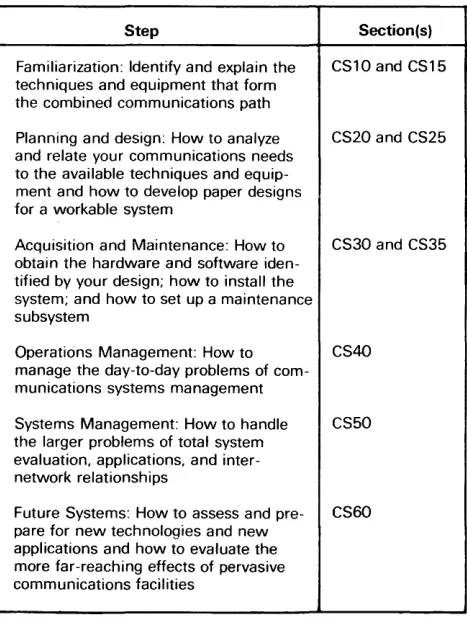
carefully selected from among perhaps dozens of candidate solutions according to stringent criteria of clarity, applicability, and strength. The reader thus benefits both from the broad experience of Datapro's staff and from the well developed ability of the staff to recognize an optimum solution to a given problem. Each report is a problem/solution couplet. The problem is clearly defined in a prefatory statement to each report, and the body of the report is the selected solution. The reports are organized in nine major sections that reflect Datapro's perceptions of the problems a reader would typically encounter beginning with no communications system and gradually progressing through all the steps of basic familiarization, initial planning, design, acquisition, maintenance, management, and concluding with guidelines for future technology assessments. The reports are grouped as shown in Table 1 to address each of the preceding steps.
Step Section(s)
Familiarization: Identify and explain the CS10 and CS15 techniques and equipment that form
the combined communications path
Planning and design: How to analyze CS20 and CS25 and relate your communications needs
to the available techniques and equip-ment and how to develop paper designs for a workable system
Acquisition and Maintenance: How to CS30 and CS35 obtain the hardware and software
iden-tified by your design; how to install the system; and how to set up a maintenance subsystem
Operations Management: How to CS40
manage the day-to-day problems of com-munications systems management
Systems Management: How to handle CS50
the larger problems of total system evaluation, applications, and inter-network relationships
Future Systems: How to assess and pre- CS60 pare for new technologies and new
applications and how to evaluate the more far-reaching effects of pervasive communications facilities
Table 1. General organizational structure of DA T A PRO COMMUNICATIONS SOLUTIONS
Auxiliary, nonsolution-type infonnation is concen-trated in Sections CS90 through CS98. Major com-munications equipment supplier~ are listed in CS90; the significant communications standards and proto-cols are described in section CS93; and an extensive glossary of c~mmunications-related terms is offered in Section CS98. Section CS99 is . reserved for the monthly news briefs supplied as part of the total
sub-© 1979 DATAPRO RESEARCH CORPORATION, DELRAN, NJ 08075 USA
REPRODUCTiON PROHIBITED
[image:19.613.306.540.290.600.2]scription service, and Section CSOS explains the inquiry service, which is also part of the total subscrip-tion service.
Finally, a comprehensive index is given in Section CSO 1. The index is augmented by supplementary behind-the-tab indexes that are the first pages of each section CS 10 through CS60. Each behind-tlie-tab index lists the Section reports by major problem topic category and provides a "See Also Report ... " column offered to help the reader make connections to related reports throughout the service without having to resort to an index search.
HOW TO USE THIS SERVICE
The overall organizational structure of DATAPRO COMMUNICATIONS SOLUTIONS parallels the learning process for someone who enters communi-cations as a novice (Sections CS 10 and CS IS) and who evolves into a sophisticated designer/user/manager of communications systems and networks (Sections CSSO and CS60). But the sectional breakdown of the service accommodates any level of reader sophisti-cation because, although the reports are woven together loosely into a tutorial structure, each report essentially stands by itself. For example, a reader who is already familiar with communications techniques and equipment and who has already planned and paper designed a system may need some concrete
advice on how to evaluate the relative economics of various design approaches. A quick scan of the behind-the-tab index to Section CS2S (Systems Design) yields the title "How to Evaluate the Economics of System Design Alternatives" (Report CS2S-81 0-1 0 1) in the general problem category of Economic Analyses. The index entry is linked to other reports that explain how to negotiate contracts to provide the next link in the sequence of acquiring and assembling a system. This example provides a specific soiution to a specific probiem. The reader can aiso "browse" to establish points of reference for further planning. For example, a manager with an existing communications network may want to explore other possible applications of the network and to make some broad assessments of their utility and cost. A quick scan of Sections CS20 and CSSO will yield several titles, general and specific, for applications such as distributed processing, electronic mail, and Electronic Funds Transfer systems. These reports provide a convenient entry point for further investigation, and each report generally concludes with a comprehensive list of references that points the reader to a larger body of useful literature.
Finally, the reader is encouraged to use the Inquiry Service, which is a direct line to the Datapro editorial staff, for solutions not addressed directly by DATAPRO COMMUNICATIONS SOLUTIONS or for further, more specific solutions assistance to any problem covered by the service.D
JUNE 1979 © 1979 DATAPRO RESEARCH CORPORATION, DELRAN, NJ 08075 USA