For Peer Review
End-to-End Feature-aware Label Space Encoding for
Multi-label Classification with Many Classes
Journal: IEEE Transactions on Neural Networks and Learning Systems
Manuscript ID TNNLS-2016-P-6192.R2
Manuscript Type: Paper
Date Submitted by the Author: n/a
Complete List of Authors: Lin, Zijia; Tsinghua University, Department of Computer Science and Technology
Ding, Guiguang; Tsinghua University, School of Software
Han, Jungong; Northumbria University, Department of Computer Science and Digital Technologies
Shao, Ling; Northumbria University,
Keywords: Multi-label classification, Label space dimension reduction, End-to-end feature-aware label space encoding, E2FE
For Peer Review
Summary of Changes and Responses to Reviews
We appreciate very much the handling editor and all re-viewers for their time and efforts devoted to the peer-review of this paper. Their constructive comments have guided us to further improve it.
We have conducted a “minor revision” for the manuscript to address the editor’s and reviewers’ comments. And we believe that all the comments raised in the review report have been carefully accommodated. Below we will firstly list the changes we have made in this revision, and then respond to each comment in turn.
I. SUMMARY OFCHANGES
The main changes made in this revision include:
1) In the “Introduction” of the revision, we have stated more clearly about the connection between our work and the community of neural networks and related learning systems, as well as our contributions to the community. Moreover, we have improved the language presentation of our manuscript with the help of a native speaker to make it more clear and easier to follow.
2) To make our manuscript more focused on the key points, we have moved the following content to a supplementary material: 1) proofs of Lemma 1 and Lemma 3, 2) overmuch details of the experiment for significance tests, and 3) overmuch details of the experiment for vali-dating the orthonormality assumption in our proposed method. Particularly, for 2) and 3), we mainly present the corresponding experimental results and analysis in the manuscript. And for more details, one can refer to the supplementary material.
II. RESPONSES TOREVIEWS
1) Comment: The language presentation in this paper needs to be improved. The authors are encouraged to have a native speaker or use a professional editing service (see TNNLS website for more information, section ”Professional Editing Services” under ”Information for Authors”) to help to improve the language presentation.
Response: Thanks for the suggestion. In the revision, we have invited our colleague, who is a native speaker and familiar with the topic, to help polish our manuscript and improve the language presentation.
2) Comment: The authors should clearly state the key contributions to the core of neural networks and related learning systems to show a strong connection to the NNLS community. The authors might want to take a look of the recently published papers in TNNLS on this
topic as well.
Response: Thanks for the suggestion. In the “Introduc-tion” of the revision, we have stated more clearly about the connection between our work and the NNLS com-munity, as well as our contributions to the community. Please refer to the first two paragraphs of “Introduction” (Page 1) and the 5th paragraph of Page 2.
Specifically, multi-label classification, especially large-scale multi-label classification, is an important topic for the machine learning community, with many research works like [1]–[7] dedicated to it for tackling challenges. Similar to the previous publications like [3], our work also focuses on tackling the challenge of large label sets in large-scale multi-label classification problems. To do so, we propose an effective method termed E2FE to perform label space dimension reduction (LSDR), which aims to yield acceptable classification performance with substantially lower costs. Extensive experiments show that E2FE gains performance improvements over other state-of-the-art LSDR methods. Moreover, since the pre-dictive model used in E2FE is open for any effective one, including neural networks, E2FE can also be applied with existing predictive models or feature dimension reduction approaches in the community to better handle large-scale multi-label classification problems.
REFERENCES
[1] C. Ferng and H. Lin, “Multilabel classification using error-correcting codes of hard or soft bits,” IEEE Transactions on Neural Networks and
Learning Systems, vol. 24, no. 11, pp. 1888–1900, 2013.
[2] Y. Luo, D. Tao, C. Xu, C. Xu, H. Liu, and Y. Wen, “Multiview vector-valued manifold regularization for multilabel image classification,” IEEE
Transactions on Neural Networks and Learning Systems, vol. 24, no. 5,
pp. 709–722, 2013.
[3] F. Charte, A. Rivera, M. del Jesus, and F. Herrera, “Li-mlc: A label infer-ence methodology for addressing high dimensionality in the label space for multilabel classification,” IEEE Transactions on Neural Networks and
Learning Systems, vol. 25, no. 10, pp. 1842–1854, 2014.
[4] W. Bi and J. Kwok, “Mandatory leaf node prediction in hierarchical multilabel classification,” IEEE Transactions on Neural Networks and
Learning Systems, vol. 25, no. 12, pp. 2275–2287, 2014.
[5] Q. Wu, Y. Ye, H. Zhang, T. Chow, and S. Ho, “Ml-tree: A tree-structure-based approach to multilabel learning,” IEEE Transactions on Neural
Networks and Learning Systems, vol. 26, no. 3, pp. 430–443, 2015.
[6] S. Chen, X. Yang, and Y. Tian, “Discriminative hierarchical k-means tree for large-scale image classification,” IEEE Transactions on Neural
Networks and Learning Systems, vol. 26, no. 9, pp. 2200–2205, 2015.
[7] X. Cao, C. Zhang, H. Fu, X. Guo, and Q. Tian, “Saliency-aware nonparametric foreground annotation based on weakly labeled data,”
IEEE Transactions on Neural Networks and Learning Systems, vol. 27,
no. 6, pp. 1253–1265, 2016.
For Peer Review
End-to-End Feature-aware Label Space Encoding
for Multi-label Classification with Many Classes
Zijia Lin, Student Member, IEEE, Guiguang Ding, Member, IEEE,
Jungong Han, Ling Shao, Senior Member, IEEE,
Abstract—To make the problem of multi-label classification with many classes more tractable, in recent years academia has seen efforts devoted to performing label space dimension reduction (LSDR). Specifically, LSDR encodes high-dimensional label vectors into low-dimensional code vectors lying in a latent space, so as to train predictive models at much lower costs. With respect to the prediction, it performs classification for any unseen instance by recovering a label vector from its predicted code vector via a decoding process. In this paper, we propose a novel method, namely End-to-End Feature-aware label space Encoding (E2FE), to perform LSDR. Instead of requiring an encoding function like most previous works, E2FE directly learns a code matrix formed by code vectors of the training instances in an end-to-end manner. Another distinct property of E2FE is its feature awareness attributable to the fact that the code matrix is learnt by jointly maximizing the recoverability of the label space and the predictability of the latent space. Based on the learnt code matrix, E2FE further trains predictive models to map instance features into code vectors, and also learns a linear decoding matrix for efficiently recovering the label vector of any unseen instance from its predicted code vector. Theoretical analyses show that both the code matrix and the linear decoding matrix in E2FE can be efficiently learnt. Moreover, similar to previous works, E2FE can be specified to learn an encoding function. And it can also be extended with kernel tricks to handle non-linear correlations between the feature space and the latent space. Comprehensive experiments conducted on diverse benchmark datasets with many classes show consistent performance gains of E2FE over the state-of-the-art methods.
Index Terms—End-to-end feature-aware label space encoding, Label space dimension reduction, Multi-label classification.
I. INTRODUCTION
A
S a generalized version of multi-class classification [1], [2], where each instance is restricted to having only one class label, multi-label classification [3]–[20] allows an instance to be associated with several class labels to describe its semantic content or attributes more clearly. Multi-label classification methods are increasingly demanded by modern applications, like multi-label text classification [3], music emo-tion categorizaemo-tion [4], and semantic image annotaemo-tion [18]– [20]. In addition, many researches on neural networks andZijia Lin is with the Department of Computer Science and Technology, Tsinghua University, Beijing 100084, China (e-mail:
Guiguang Ding is with School of Software, Tsinghua University, Beijing 100084, China (e-mail:[email protected]). Guiguang Ding is the corresponding author.
Jungong Han is with the Department of Computer Science and Digital Technologies, Northumbria University, Newcastle, U.K. (e-mail:
Ling Shao is with the School of Computing Sciences, University of East Anglia, Norwich NR4 7TJ, U.K. (e-mail:[email protected]).
F
G
Q:decoding
P:encoding
X Z Y
Label Space Low-dimensional
Latent Space Feature Space
function-based end-to-end
Fig. 1. Illustration of the principles behind traditional multi-label classification methods (red) and those with label space dimension reduction (blue).
other learning approaches are also dedicated to the field, like the tree-structure based method ML-TREE [17], the multiview vector-valued manifold regularization method MV3MR [18], and the label inference method LI-MLC [21], etc.
Recently, due to the emergence of web-based applications, multi-label classification problems tend to be large-scale, with new challenges of numerous instances and large label sets (i.e. high-dimensional label spaces) coming up. For instance, in the picture sharing community Flickr, there are billions of images and each can be annotated with textual labels selected from millions of candidates. In the community of neural networks and related learning systems, to handle the challenges, some works like [22]–[26] focus on feature dimension reduction or model simplification, while others like LI-MLC [21] focus on shrinking the label space. Here we follow the latter one.
As advocated by Kapoor et al. in [5], large label sets cause many existing effective multi-label classification methods [6]– [15] to be infeasible, since generally they need to learn a predictive model for each label independently or with inter-label correlations, and then combine them in a certain manner for prediction. Specifically, for a multi-label classification problem with many classes (i.e. a large label set, or a high-dimensional label space), the number of needed predictive models would generally be large, thus making the training costs, if not unaffordable, extremely high. To tackle this issue, researchers have recently proposed to perform label space dimension reduction (LSDR) [5], [27]–[32], which aims to reduce the training costs while maintaining acceptable clas-sification performance. Specifically, for LSDR, as illustrated in Fig. 1, the high-dimensional label vector of any training instance is encoded into a low-dimensional code vector in a latent space. Afterwards, predictive models are trained to map instance features into low-dimensional code vectors, whose quantity is much smaller and thus can significantly reduce the
For Peer Review
training costs. As for performing prediction for any unseeninstance, a low-dimensional code vector is firstly obtained with the learnt predictive models from its features, and then decoded for recovering its label vector. Generally speaking, if the learnt predictive models and the decoding process are effective and efficient enough, LSDR usually yields acceptable classification performance with much lower costs, making the multi-label classification problem with many classes more tractable.
Prior methods dedicated to LSDR mostly require an encod-ing function (function-based), e.g. a linear one, to map label vectors of training instances into code vectors lying in the latent space. However, due to the following observations, we argue that learning the code vectors of training instances in an end-to-end manner, i.e. directly learning them without any encoding functions, can be feasible and even preferable.
• From Fig. 1 it can be seen that, to perform prediction, the encoding process is totally redundant, and thus any encoding function is useless during prediction. Moreover, even for training, it is the encoding result (i.e. code vectors of training instances) that will affect the learning of predictive models, no matter whether an encoding function is required or not.
• Defining an encoding function may limit the searching space of the to-be-learnt code vectors of training in-stances. For example, given the tagging matrix Y of training instances, using a linear encoding function P
can limit the to-be-learnt code vectors in the spaceYP, thereby preventing them from being searched in the whole real space that could potentially minimize the loss of classification performance.
• In some cases, code vectors of training instances are re-quired to have specific properties, like the orthonormality between code dimensions in this paper. Although those property requirements can somehow be transferred to the encoding function, it will inevitably make the objective function much more complex for optimization.
In fact, compared to a function-based encoding, an end-to-end encoding requires no encoding function, and thus can search the whole real space for the optimal to-be-learnt code vectors. Moreover, for an end-to-end encoding, it would be direct to add property requirements for the to-be-learnt code vectors, making the objective function less complex for optimization. To the best of our knowledge, MLC-BMaD [31] is the only previous research that pioneered end-to-end label space encoding via boolean matrix decomposition. However, as will be shown later, its training is not efficient enough and as a result it may not fully accomplish the goal of LSDR. Moreover, MLC-BMaD learns the code vectors of training instances in a feature-unaware manner, meaning that the correlations between the latent space and the feature space are not considered. That, as advocated by Chen and Lin [30], can probably make the learnt latent space less predictable and thus degrade the final classification performance. Therefore, further researches on end-to-end label space encoding are highly expected.
In this paper, we propose a novel method termed E2FE
to perform LSDR via End-to-End Feature-aware label space Encoding. Specifically, E2FE directly learns a code matrix formed by code vectors of training instances via jointly maximizing the recoverability of the label space and the predictability of the latent space, with the latter considering the correlations between the latent space and the feature space. And thus E2FE is feature-aware. Based on the learnt code matrix, predictive models are trained as other LSDR methods, to predict code vectors from instance features. Meanwhile, E2FE further learns a linear decoding matrix that can recover the predicted label vector of any unseen instance from its code vector generated by the trained predictive models.
Since the predictive models in the proposed E2FE are open for any effective ones, including neural networks, E2FE can actually be applied with existing predictive models or feature dimension reduction approaches in the community to better tackle the large-scale multi-label classification problem. Particularly for LSDR, below are three highlighted properties of E2FE, which are in line with our contributions.
• We propose an effective LSDR method termed E2FE for tackling (large-scale) multi-label classification problems with many classes. To the best of our knowledge, it is the first to make LSDR both end-to-end and feature-aware. • We jointly maximize the recoverability of the label space
and the predictability of the latent space for performing LSDR in E2FE. The objective function w.r.t the to-be-learnt code matrix can be transformed to an eigenvalue problem, and is sufficiently flexible in the sense that different optimization strategies can be used depending on the applications for efficient optimization.
• We show that E2FE is a generic approach that covers previous LSDR researches, and it can also be specified to learn an encoding function. Moreover, it can be ex-tended with kernel tricks to handle non-linear correlations between the feature space and the latent space.
This paper is based on our previous work presented in [33], which was termed FaIE, but it substantially extends that work by enhancing the proposed method to be more efficient and effective. Below are the summarized extensions.
• We propose a more efficient optimization method for the proposed method to learn the code matrix in cases wheren≫dx+dy, withn,dy,dxrespectively denoting
the number of training instances, the dimensionality of the label space and that of the feature space. This is helpful for practical applications, as such cases are quite common. Specifically, the newly proposed optimization method transforms the size of the eigenvalue problem w.r.t the objective function of E2FE from Rn×n to
R(dx+dy)×(dx+dy), which can be solved more efficiently
and can substantially reduce space costs.
• We further propose πE2FE, πLinearE2FE and kernel-πE2FE, to consider the priori knowledge provided by the eigenvalue problem w.r.t the to-be-learnt code matrix for learning an enhanced decoding matrix. Experiments com-paring πE2FE, πLinearE2FE, kernel-πE2FE with their corresponding counterparts, i.e. E2FE, LinearE2FE and kernel-E2FE, show that enhancing the decoding matrix
For Peer Review
with such priori knowledge can help to gain significantperformance improvements (on average48.1%for label-based macroF1 and33.9%for example-based Accuracy). • In this paper, we provide a thorough discussion and exper-imental validation for that the orthonormality assumption for columns of the to-be-learnt code matrix in E2FE is reasonable. We also make error analyses for the proposed E2FE, and derive its error bound. Additionally, more theoretical analyses, like those regarding time complexity and parameter settings, are also presented here.
• To better validate the effectiveness of E2FE, we utilize more widely-used benchmark datasets for experiments. We also conduct the experiments on the full datasets instead of the sampled ones in [33], so as to demonstrate the applicability of E2FE for handling larger datasets. More experimental results are also reported, like the sig-nificance tests for the improvements gained by E2FE over compared baselines, and the comparison of computational costs between the newly proposed optimization method here and that presented in [33].
The remainder of this paper is organized as follows. Section II gives an overview of related works. Section III elaborates on the proposed E2FE. Section IV shows the proposed opti-mization methods and its corresponding theoretical analyses. Section V describes details about enhancing the linear decod-ing matrix with priori knowledge. Then Section VI presents the extensions of E2FE, and analyses its relations to previous works. Experimental settings, results and analyses are given in Section VII. Finally we present discussions regarding E2FE in Section VIII and conclude the paper in Section IX.
II. RELATEDWORK
With the explosion of label spaces in real-world appli-cations, many remarkable effective multi-label classification methods tend to be infeasible due to the high training costs. To tackle such multi-label classification problems with many classes, a lot of effective methods were proposed, like con-structing a hierarchy of multi-label classifiers [34], refining the output of heuristic efficient classifiers [35], performing label selection to recover the vocabulary with only a subset [36], or using label inference method based on the use of association rules to discover label dependencies [21], etc. Recently, LSDR was also proposed and is attracting more and more attention. To the best of our knowledge, Hsu et al. [27] are the first to propose LSDR. Specifically, Hsu et al. exploited the sparsity of the label space, and proposed to linearly encode it to a low-dimensional latent space as compressed sensing (CS) and then train linear regression models w.r.t the derived codes. As for performing classification for an unseen instance, a code vector is firstly obtained with the learnt regression models from its features and then decoded with standard recovery algorithms like CoSaMP [37] to derive the predicted label vector. Kapoor et al. [5] further considered both label space compression and predictive model learning in a single probabilistic model, and derived a Bayesian framework termed BML-CS for multi-label classification via jointly optimizing over both.
Apart from compressed sensing based methods, Tai and Lin [28] proposed to perform principle label space transformation
TABLE I
CATEGORIZATION OF EXISTINGLSDRMETHODS ANDE2FE feature-unaware feature-aware
function-based CS [27], PLST [28], BML-CS [5], CL [29], ML-CSSP [32] CPLST [30] end-to-end MLC-BMaD [31] E2FE
(PLST) for seeking important correlations between labels, which is essentially PCA [38] for the label space. Chen and Lin [30] further enhanced it by proposing feature-aware con-ditional principal label space transformation (CPLST), which actually integrates orthogonally constrained canonical corre-lation analysis into the framework of PLST for considering the predictability of the latent space. Both PLST and CPLST performed LSDR via linear encoding and linear decoding. Zhou et al. [29] proposed another method termed “Compressed Labelling (CL)”, which takes the signs of the linear Gaussian random projection results on the original label vectors as the derived code vectors and utilizes a series of Kullback-Leibler divergence based hypothesis tests for decoding. Alternatively, Wicker et al. [31] proposed MLC-BMaD for LSDR via boolean matrix decomposition on the binary tagging matrix, factorizing it as the product of a binary code matrix and a binary linear decoding matrix. Bi and Kwok [32] presented an efficient randomized sampling procedure termed ML-CSSP for selecting a column subset of the tagging matrix that can well span it, which is a special case of linear encoding.
Actually, the majority of existing methods perform LSDR in a function-based manner and require an encoding function. Such approaches, as analysed in section I, carry several drawbacks. To avoid those, performing LSDR in an end-to-end manner with no need for any encoding function is highly desired. MLC-BMaD seems to be the only existing LSDR method that supports end-to-end label space encoding via boolean matrix factorization. However, MLC-BMaD is feature-unaware, and thus the learnt latent space could be less predictable, which can result in performance deterioration. Therefore, in this paper we propose E2FE, which performs LSDR in an end-to-end manner and is also feature-aware.
To sum up, Table I categorizes the remarkable existing LSDR methods and the proposed E2FE into different combi-nations of{function-based, end-to-end}and{feature-unaware, feature-aware}, which well highlights the distinctness of E2FE.
III. PROPOSEDAPPROACH
A. Preliminaries
Generally in the case of multi-label classification, the fea-tures of an instance are represented as adx-dimensional feature
vector x in the feature space X, i.e. x ∈ X ⊂ Rdx, and
its labels are represented as a dy-dimensional binary label
vector y in the label space Y, i.e. y ∈ Y ⊂ {0,1}dy.
Here the ith entry of the label vector y is set as 1 if the instance is associated with the ith label and 0 otherwise. Suppose that we are given n labelled instances for training, denoted as {(x(i),y(i))}n
i=1, with x(i) and y(i) being the
feature vector and the label vector of theith training instance.
For Peer Review
Multi-label classification will utilize them to learn the mappingF :X → Y from the feature spaceX to the label spaceY, as illustrated in Fig. 1, and then utilizeF for predicting the label vector of any unseen instance based on its feature vector.
As mentioned before, to derive the mapping F, many existing effective multi-label classification methods will learn a predictive model for each label independently or with inter-label correlations, and then combine them in a certain manner for prediction. In that case, the number of the to-be-learnt predictive models will be at least dy, and even much larger
for methods using label powerset [39]. Then for a multi-label classification problem with many classes,dywill become
quite large and the training costs of the to-be-learnt predictive models will be extremely high and even unaffordable. To tackle such a challenge, LSDR was recently proposed and is attracting more and more attention. With LSDR, the training process to learn F is transformed into a two-step learning process. That is, firstly the label vectors of training instances are encoded into low-dimensional code vectors in a latent space Z ⊂ Rdz with an encoding process P : Y 7→ Z,
and then a mapping G : X 7→ Z w.r.t the code vectors is learnt. Here dz is the dimensionality of the latent space
Z, and generally dz ≪ dy. Moreover, as illustrated in Fig.
1, P can be performed in a function-based manner (e.g. linear encoding function) or an end-to-end manner (e.g. matrix decomposition). Similar to learningF, learningGcan be based on training dz predictive models, one for a dimension of Z.
As for predicting the labels of any unseen instance, a dz
-dimensional code vector inZ will firstly be derived using the learnt G with its feature vector, and then a dy-dimensional
predicted label vector will be recovered through a decoding process Q : Z 7→ Y. For LSDR methods, with dz ≪ dy,
the number of the to-be-learnt predictive models is generally much smaller and thus the training costs are substantially lowered, making the multi-label classification problem with many classes more tractable. Meanwhile, if the mappingGand the decoding processQare effective enough, the classification performance using LSDR is expected to be acceptable.
It should be noticed that for LSDR, the latent space Z is supposed to be derived from the label space Y rather than the feature space X, even though X can sometimes be considered for increasing the predictability of Z. And thus the dimensionality of the latent space (i.e. dz) can either be
higher or lower than that of the feature space (i.e. dx), but
will always be lower than that of the label space (i.e. dy).
Moreover, for LSDR methods, the mappingG fromX toZis open for any effective mapping algorithm after Z is derived. Meanwhile, the decoding process Q generally needs to be specified before deriving Z, which, from the perspective of efficiency in prediction, is preferred to be linear, like those in PLST, CPLST, MLC-BMad and ML-CSSP.
B. End-to-End Feature-aware Label Space Encoding
Before elaborating on the proposed E2FE, to make it more clear, Table II summarizes the important symbols in this paper. As mentioned previously, E2FE performs LSDR in an end-to-end manner and directly learns a code matrix Z∈Rn×dz
TABLE II
IMPORTANTSYMBOLS IN THEPROPOSEDE2FE.
n the number of training instances
dx the dimensionality of the feature spaceX
dy the dimensionality of the label spaceY
dz the dimensionality of the latent spaceZ,dz≪dy
X the feature matrix of training instances,X∈Rn×dx Y the tagging matrix of training instances,Y∈ {0,1}n×dy Z the code matrix of training instances,Z∈Rn×dz Q the linear decoding matrix,Q∈Rdz×dy H notation forX(XTX)−1XT,H∈Rn×n
M·,i theith column of a matrixM
formed by code vectors of training instances. Generally, the classification performance of LSDR methods depends on both the predictive mappingGand the decoding processQ. There-fore, it is crucial for code vectors to be predictable, having a strong correlation with instance features, as revealed in [40]. Meanwhile, the label vectors should also be highly recoverable via decoding the corresponding code vectors. Therefore, to learnZ, E2FE jointly maximizes the recoverability of the label space and the predictability of the latent space. The former is denoted as Ψ1(Y,Z) and the latter as Ψ2(X,Z), where
Y ∈ {0,1}n×dy is the tagging matrix of training instances
formed by their label vectors row by row andX∈Rn×dx is
the feature matrix formed by their feature vectors in the same way. Then the objective function w.r.t Z is as follows.
Ψ = max
Z Ψ1(Y,Z) +αΨ2(X,Z) (1)
whereα≥0 is a parameter for balancing recoverability and predictability. When α = 0, Z will be derived via merely maximizing recoverability, implying thatZ is just dependent on Y. On the contrary, when α > 0, correlations between instance features and code vectors will be further considered for makingZfeature-aware and more predictable.
1) Recoverability of Label Space: To improve the recover-ability of the label space, the difference between the tagging matrix Y and the recovered one, which is based on the to-be-learnt code matrix Z, is expected to be minimized. Here we denote the difference as L. As mentioned previously, for efficient decoding, the proposed E2FE learns a linear decoding matrixQ∈Rdz×dy to recover label vectors from code vectors,
following PLST, CPLST, MLC-BMad and ML-CSSP. ThenL is formulated as follows.
L= minkY−ZQk2f ro (2)
where k · kf ro is the Frobenius norm of a matrix. Given Z,
the optimalQto minimizeLcan be derived as the following closed-form expression by solving ∂∂QL =0.
Q= (ZTZ)−1ZTY (3)
To mitigate redundant information in the latent space and then encode the label space more compactly, we assume that the dimensions of the latent space are uncorrelated and thus the columns ofZ are orthonormal, as shown in formula (4).
ZTZ=I (4)
For Peer Review
whereI∈Rdz×dz is an identity matrix. Actually, as analysedlater, although such an orthonormality assumption may seem to be strong, it is still reasonable and important for E2FE. With formula (4), the optimal Q can be simplified asQ=ZTY,
and then formula (2) can be reformulated as follows.
L=Tr[YTY−YTZZTY] (5)
where Tr[·] refers to the trace of a matrix. With Tr[YTY] being a constant, minimizing L is identical to maximizing
Tr[YTZZTY], which can be seen as an expression of the recoverability of the label space, i.e. Ψ1(Y,Z). We can thus
derive the following formula.
Ψ1(Y,Z) =Tr[YTZZTY] =Tr[ZTYYTZ]
s.t. ZTZ=I (6)
2) Predictability of Latent Space: As advocated in [40], to improve the predictability of the latent space, the code matrix
Z is supposed to be strongly correlated with the instance features. Here we firstly consider linear correlations, and will later handle non-linear ones with kernel tricks. Considering a linear projectionwfor the feature space and a dimensionzof the latent space, i.e. a column of Z, the correlation between features andz, denoted asr(X,z), can be defined as follows.
r(X,z) = (Xw)
Tz
p
(Xw)T(Xw)√zTz (7)
Due to the orthonormality assumption forZ, i.e. formula (4),
zTz= 1will hold for any column of Z. Moreover, linearly rescalingwby a non-zero multiplier will not changer(X,z). Then maximizingr(X,z)equals the following formula.
max (Xw)Tz s.t. (Xw)TXw= 1 (8)
Given a dimensionzof the latent space, the maximalr(X,z) reflects its potential maximal correlation with the feature space, and thus the maximal r(X,z) can be seen as an expression of the predictability ofz. Specifically, withzfixed, the optimalwfor formula (8), denoted asw∗, can be derived as follows with the method of Lagrange multipliers.
w∗= (X
TX)−1XTz
p
zTX(XTX)−1XTz (9)
Note that following CPLST, here we assume A = XTX to
be invertible. Actually, this assumption usually holds when n > dx, but it will fail in cases with n < dx, as A will
not be full-rank then. To handle the latter cases, we propose to ensureAto be invertible via: 1) performing dimensionality reduction for the feature space via PCA or alternative methods to make dx small enough for obtaining a full-rankXTX, or
2) adding a tiny value to the entries on the diagonal ofXTX, i.e. A = XTX+εI1 with I1 ∈ Rdx×dx being an identity
matrix and εbeing a tiny value, e.g.10−6.
By substitutingw∗ into formula (7), the predictability ofz, denoted as ψ2(X,z), can be derived as follows.
ψ2(X,z) = (Xw
∗)Tz
√
(Xw∗)T(Xw∗)√zTz = (Xw
∗)Tz=√zTHz
(10)
Algorithm 1 Overview of E2FE
Input: Feature matrix Xtr and tagging matrixYtr of the training
instances, feature matrix Xts of the test instances, predefined
model parameterα, and latent space dimensionalitydz
Output: Predicted binary tagging matrixYtsof the test instances
Training Process:
1: derive code matrixZtr via optimizing formula (12) 2: learn predictive models:G(Xtr)→Ztr
3: derive linear decoding matrix:Q=ZT trYtr
Predicting Process:
4: predict code vectors of test instances:Zts=G(Xts) 5: recover the predicted tagging matrix:Yts=round(ZtsQ)
where H = X(XTX)−1XT ∈ Rn×n. To improve the
predictability of the latent space, each column zof the code matrixZ is supposed to maximize ψ2(X,z). As maximizing
ψ2(X,z)can be guaranteed by maximizingzTHz, the overall
predictability ofZ can be formulated as follows.
Ψ2(X,Z) = dz X
i=1
ZT·,iHZ·,i=Tr[ZTHZ]
s.t. ZTZ=I
(11)
whereZ·,i(i∈ {1,2, . . . , dz})denotes theith column ofZ.
3) Detailed Objective Function: With Ψ1(Z,Y) and
Ψ2(X,Z)derived, the objective function w.r.t the to-be-learnt
code matrixZ, i.e. formula (1), can be detailed as follows.
Ψ = max
Z Tr[Z
TYYTZ] +αTr[ZTHZ]
= max
Z Tr[Z
T(YYT +αH)Z]
s.t. ZTZ=I
(12)
whereH=X(XTX)−1XT. As analysed in section IV,Ψcan
be transformed to an eigenvalue problem w.r.t YYT +αH,
andZis derived by concatenating the normalized eigenvectors corresponding to the top dz largest eigenvalues column by
column. With the code matrix Z derived, predictive models can be trained for mapping instance features into code vectors. 4) Deriving Linear Decoding Matrix: According to for-mula (2) and (3), givenZ withZTZ =I, the optimal linear decoding matrixQcan be derived as follows.
Q= (ZTZ)−1ZTY=ZTY (13)
And its computational complexity isO(ndydz).
An overview of E2FE is given in Algorithm 1.
C. Error Analysis
As shown in Algorithm 1, following PLST, CPLST and ML-CSSP, the proposed E2FE rounds each entry of the decoding results into its nearest 0 and 1, so as to derive binary label vectors. Considering that, we proceed to analyse the root mean square error (RMSE) of E2FE on the training instances.
Specifically, RMSE is defined as follows.
RM SE= √1
nkround(G(X)Q)−Ykf ro (14)
whereG denotes the learnt predictive models for mapping in-stance features into code vectors, andround(G(X)Q)denotes
For Peer Review
the recovered binary tagging matrix. Then we can derive thefollowing lemma regarding the error bound of E2FE.
Lemma 1. For E2FE, its RMSE is bounded by
RM SE≤√2 n
√
dzkYkf rokZ− G(X)kf ro+kY−ZQkf ro
For a detailed proof, one can refer to the supplementary material. Actually, the error bound for E2FE is similar to those of PLST and ML-CSSP. Namely, it also consists of two parts. The first part, i.e. √dzkYkf rokZ− G(X)kf ro denotes the
weighted training error of predictive models, and the second part, i.e. kY−ZQkf ro, denotes the loss of encoding label
vectors into low-dimensional code vectors.
IV. OPTIMIZATIONMETHODS
For optimizing the objective functionΨw.r.t the to-be-learnt code matrix Z, any column Z·,i(i ∈ {1,2, . . . , dz}) can be
derived with the following optimization sub-problem.
Ψ(i)= max
Z·,i
ZT·,i(YYT +αH)Z·,i
s.t. ZT·,iZ·,i= 1, ZT·,jZ·,i= 0 (∀j < i)
(15)
With the method of Lagrange multipliers, the optimal Z·,i
should satisfy the following optimality condition.
(YYT +αH)Z·,i=λiZ·,i (16)
where λi is the introduced Lagrange multiplier and will also
be the optimal value of the sub-problem. It can be seen that the optimization for Z can be transformed to an eigenvalue problem. Then by normalizing the eigenvectors of U = YYT+αHthat correspond to the topdz largest eigenvalues,
we can derive the optimal code matrix Z formed of these eigenvectors column by column, which satisfies ZTZ=I.
As described in our previous work [33], we can directly calculate U and then utilize effective methods to derive its eigenvectors. However, considering thatU∈Rn×n, for cases withn≫dx+dy, which are common in practical applications,
calculating U will result in high space costs. To avoid that, we derive the following lemma and further propose a more efficient optimization method for such cases.
Lemma 2. Given H = X(XTX)−1XT, the matrix U =
YYT +αH can be decomposed as U = VVT with V ∈
Rn×(dy+dx). Also, the eigenvectors ofUcan be derived from
those ofVTV, meaning that the size of the eigenvalue problem w.r.tU can be transformed fromRn×n toR(dx+dy)×(dx+dy).
Proof. SupposeA=XTX is invertible. SinceA∈Rdx×dx
is a real symmetric and positive-semidefinite matrix,A−1will be real symmetric and positive semi-definite, and thusA−1is diagonalizable by orthogonal matrices [41]. Namely, A−1= BΛBT, with Λbeing a diagonal matrix having non-negative diagonal entries and B being an orthonormal matrix. Then
A−1 = BΛ12Λ12BT =
BΛ12 BΛ12 T
, where Λ12 is a
diagonal matrix with each diagonal entry being the square root of the corresponding diagonal entry in Λ. Furthermore, with
G =XBΛ12 ∈ Rn×dx, H =GGT. Finally, U= YYT +
Algorithm 2 Optimization for E2FE
Input: Feature matrix Xtr ∈ Rn
×dx and tagging matrix Y
tr ∈ Rn×dy of training instances, predefined model parameter α, latent space dimensionalitydz
Output: Learnt code matrixZtr of training instances 1: ifXTtrXtr is NOT invertible then
2: Option 1:{dimension reduction for feature space}
3: Xtr=DimReduce(Xtr)
4: Option 2:{adding a tiny value to diagonal entries}
5: XTtrXtr=XTtrXtr+εI1
6: end if
7: ifn≫dy+dxthen 8: A=XTtrXtr
9: [B,Λ] =diagonalize(A−1){A−1 =BΛBT
}
10: G=XtrBΛ
1 2
11: V= [Ytr,√αG]
12: E=eigenvector(VTV, dz) {eigenvectors of VTV
corre-sponding to the topdz largest eigenvalues}
13: Ztr =normalize(VE) {normalizing each column of VE
into a unit vector}
14: else
15: H=Xtr(XTtrXtr) −1XT
tr 16: U=YtrYTtr+αH
17: E˜ =eigenvector(U, dz) {eigenvectors ofU corresponding
to the topdz largest eigenvalues}
18: Ztr=normalize(E˜){normalizing each column ofE˜into a
unit vector}
19: end if
αH=YYT + (√αG) (√αG)T = [Y,√αG][Y,√αG]T =
VVT, withV= [Y,√αG]∈Rn×(dy+dx).
Suppose {λ,p} and {σ,q} are respectively the paired eigenvalue/eigenvector of VVT and VTV. According to 1)
VVTp=λp→(VTV)VTp=VT(VVTp) =λVTpand 2) VTVq = σq → (VVT)Vq = V(VTVq) = σVq, we can see thatVVT andVTVshare identical eigenvalues, and the eigenvectors of U = VVT can be derived from those ofVTV based on the second derivation above. Considering
VTV∈R(dx+dy)×(dx+dy), the size of the eigenvalue problem
w.r.tU can be transformed fromRn×n toR(dx+dy)×(dx+dy).
With Lemma 2, in different cases we can utilize different optimization methods to obtain the eigenvectors of U = YYT+αHand then derive the code matrixZ, as summarized
below and illustrated in Algorithm 2.
1) Ifn≫dy+dx, it is preferable to firstly derive the matrix
VsatisfyingU=VVT, then calculate the eigenvectors
ofVTVcorresponding to the topd
zlargest eigenvalues,
and finally utilize them to derive the eigenvectors ofU. Sincedz≪dyandVTVis a real symmetric matrix, the
eigenvalue problem w.r.tVTVcan be solved efficiently using iterative methods like Arnoldi iteration [42], which can achieve an optimal computational complexity of O(dxdz2+dydz2). Here the computational complexity
of deriving V is O nd2 x
, while that of calculating
VTV and deriving the eigenvectors of U from those ofVTVisO n(dx+dy)2
.
2) Otherwise, it is preferable to directly calculate U and then perform an eigenvalue decomposition on it. The computational complexity for calculating U is at most
For Peer Review
O(min{n2d
x, nd2x}) +O(n2dx +n2dy). Considering
that generally dz ≪ n and U is a real symmetric
matrix, the eigenvalue problem w.r.t U can also be solved efficiently using Arnoldi iteration with an optimal computational complexity ofO(ndz2).
V. πE2FE: ENHANCINGLINEARDECODINGMATRIX WITH PRIORIKNOWLEDGE
As analysed in formula (16), each column of the code matrix
Z corresponds to an eigenvalue ofU=YYT +αH, which is also the optimal value for its corresponding optimization sub-problem (i.e. formula (15)). Knowing that each column denotes one dimension of the latent space, for each column, the eigenvalue w.r.t it actually reflects 1) how predictable its corresponding dimension of the latent space is and 2) from the dimension how recoverable the label space is. Specifically, a higher eigenvalue w.r.t a column of Z means that its corre-sponding dimension of the latent space is more predictable and the label space is more recoverable from the dimension.
Here we propose to consider such priori knowledge to derive an enhanced linear decoding matrix for E2FE. We denote it as πE2FE. Essentially, for a linear decoding matrixQ, itsith columnQ·,i(i∈ {1,2, . . . , dy})acts as a weighting vector to
linearly combine dimensions of the latent space for recovering the ith dimension of the label space. Then for dimensions of the latent space that are more predictable and make the label space more recoverable, i.e. with higher corresponding eigenvalues, they are expected to be assigned with higher weights in the decoding process. Therefore, we derive the objective function for Q·,i as follows.
˜
L(i)= min Q·,i k
Y·,i−ZQ·,ik2f ro−η dz X
j=1
λjQ2j,i (17)
where Y·,i is the ith column of the tagging matrix Y, λj
is the eigenvalue corresponding to the jth column of Z and η is a non-negative weighting factor. It can be seen that, by considering the priori knowledge as a regularizer in L˜(i), a larger λj can help to lead Q2j,i to be larger, meaning that
as expected the jth dimension of the latent space is assigned with a higher weight for decoding. For model simplicity, here η is shared by allQ·,i(i∈ {1,2, . . . , dy}). Then the objective
function for deriving the linear decoding matrixQofπE2FE can be formulated as follows with matrix notations.
˜
L= min
Q kY−ZQk
2
f ro−ηTr[QTΛQ˜ ] (18)
whereΛ˜ is a diagonal matrix withΛ˜j,j =λj. Ifη is properly
set to make L˜ non-trivial, as discussed later, the optimal decoding matrix forπE2FE can be derived as follows.
Q= (I−ηΛ˜)−1ZTY (19)
where(I−ηΛ˜)is a diagonal matrix and thus its inverse can be efficiently calculated. Actually, asdz≪dy, the computational
complexity of derivingQinπE2FE is alsoO(ndydz).
Note that in formula (18), a largeη can lead L˜ to become trivial and achieve an optimum of negative infinity. To cope
with that, we derive the following lemma for properly setting η, where~λ= [λ1, λ2, . . . , λdz].
Lemma 3. For any η ∈ [0, 1
max(~λ)] with max(~λ) being the
maximal value of~λ,L˜will be non-trivial for optimization. For a detailed proof, one can refer to the supplementary material.
VI. EXTENSIONS ANDANALYSES
A. Function-based Encoding: a Linear Encoding Case Though the proposed E2FE requires no encoding function, it can still be specified to learn an encoding function as most previous works, given that the encoding function can be optimized, e.g. a linear one, as described below.
Following PLST and CPLST, we use an encoding matrix
P∈Rdy×dz to denote the linear encoding function. Then the
code matrixZ can be expressed as Z=YP. SubstitutingZ
withYPin the objective function of E2FE, i.e. formula (12), we can derive the following objective function forP.
Ψ = max
P Tr
PT YTYYTY+αYTHY
P
s.t. PTYTYP=I
(20)
Similarly, we use the method of Lagrange multipliers and decompose Ψ into dz optimization sub-problems w.r.t each
column P·,i of the to-be-learntP. Then we derive that P·,i
should satisfy the following optimality condition.
YTYYTY+αYTHY
P·,i=λi(YTY)P·,i (21)
where λi is a Lagrange multiplier and will be the optimal
value of the optimization sub-problem w.r.tP·,i. It can be seen
that the optimization ofPis essentially a general eigenvalue problem. And the normalized eigenvectors corresponding to the topdz largest eigenvalues will form the optimalP.
Denoting this case of linear function-based encoding as LinearE2FE, the linear decoding matrixQwithout considering priori knowledge is Q = (YP)TY. Meanwhile, for the
case of utilizing the eigenvalues w.r.t Pas priori knowledge,
Q=I−ηΛ˜−
1
(YP)TY withΛ˜ being a diagonal matrix
consisting of the eigenvalues, which is termedπLinearE2FE.
B. Kernel Version
The proposed E2FE, thanks to kernel tricks, can be extended to deal with non-linear correlations between the feature space and the latent space, which is termed kernel-E2FE.
In kernel-E2FE, each feature vector x(i) is mapped to the Reproducing Kernel Hilbert Space (RKHS) as φ(x(i)). In RKHS, the inner product between φ(x(i)) and φ(x(j)) is equal to κ(x(i),x(j)), where κ(·,·) is the introduced kernel function. Using a non-linear κ(·,·), the linear correlations between the RKHS and the latent space actually reflect the non-linear correlations between the original feature space and the latent space. Similar to formula (7), we measure the correlationr(Φ,z)by considering a linear projectionw1 for
kernel features in RKHS and a columnzof the code matrix. Following [43], here w1 is assumed to be in the span of 1
For Peer Review
sampled kernel feature vectors, i.e. w1 = ΦT∗w˜ where Φ∗is a matrix built by the sampled kernel feature vectors row by row andw˜ is ans-dimensional weighting vector withsbeing the sampling size. Thenr(Φ,z)can be measured as follows.
r(Φ,z) = (ΦΦT∗w˜)
Tz
√ (ΦΦT
∗w˜)T(ΦΦT∗w˜) √
zTz
=√ (K ˜w)Tz (K ˜w)T(K ˜w)√zTz
(22)
where K = ΦΦT
∗ ∈ Rn×s is a kernel matrix and can be efficiently derived using the kernel function with the original feature vectors. Similar to subsection III-B2, the predictability of z based on non-linear correlations can be derived from the maximal r(Φ,z) and measured as ψ2(Φ,z) =
p
zTHz˜
with H˜ = K(KTK)−1KT. Then the objective function of
kernel-E2FE is as follows, which can also be transformed to an eigenvalue problem.
Ψ = max
Z Tr[Z
T(YYT +αH˜)Z] s.t. ZTZ=I
(23)
Like E2FE, the linear decoding matrix Q for kernel-E2FE is Q = ZTY. Meanwhile, when eigenvalues w.r.t Z are
considered as priori knowledge, Q = I−ηΛ˜−1ZTY,
whereΛ˜ is a diagonal matrix consisting of eigenvalues. Here we denote this case as kernel-πE2FE.
C. Relations to Previous Works
If the mean values of the label vectors are shifted as zeros, the proposed E2FE will degenerate to PLST [28] when only the recoverability of the label space is considered (i.e. α= 0 in formula (12)). Here, we denote this case as R-E2FE and its corresponding objective function is given as follows.
Ψ = max
Z Tr[Z
TYYTZ], s.t. ZTZ=I
(24)
The code matrixZ consists of the normalized eigenvectors of
YYT corresponding to the topdzlargest eigenvalues, and the
linear decoding matrix without considering priori knowledge isZTY. Meanwhile, the linear encoding matrixPof PLST is formed with normalized eigenvectors ofYTYcorresponding to the topdz largest eigenvalues, with the derived code matrix
beingYPand the linear decoding matrix beingPT. As in the
proof of Lemma 2, we can derive that YYT and YTY are
positive semi-definite and share the same positive eigenvalues. Specifically, provided that λi is the ith largest eigenvalue,
we can derive that: 1) YTYP
·,i = λiP·,i; 2) YYTZ·,i =
λiZ·,i; 3) (YYT)[YP]·,i = Y(YTYP·,i) = λi[YP]·,i; 4)
(YTY)[YTZ]
·,i = YT(YYTZ·,i) = λi[YTZ]·,i. Then for
R-E2FE and PLST, we can find one-to-one correspondences between the ith columns of their encoding results (i.e.Z·,i=
[YP]·,i
√
λi ), and between the ith rows of their linear decoding
matrices (i.e. [ZTY]i,· =√λi[PT]i,·). Therefore, R-E2FE is equivalent to PLST, with Z(ZTY) = (YP)PT. However, when α >0, the code matrixZin E2FE will be associated to instance features and will then differ from PLST.
When coping with linear function-based encoding, i.e. for-mula (20), given the mean values of label vectors and those of feature vectors shifted as zeros, E2FE is closely connected
to CPLST [30] if only the predictability of the latent space is considered. We denote this case as P-LinearE2FE, with its corresponding objective function defined as follows.
Ψ = max
P Tr[P
TYTHYP], s.t. PTYTYP=I (25)
Meanwhile, the objective function of CPLST is as follows.
˜
Ψ = max
P Tr[P
TYTHYP], s.t. PTP=I (26)
It can be seen that P-LinearE2FE and CPLST share an identical objective function but with different constraints. Namely, the former requires dimensions of the code matrix (i.e.YP) to be orthonormal while the latter requires dimensions of the linear encoding matrix (i.e.P) to be orthonormal.
Another useful observation w.r.t E2FE is that E2FE actually performs dimensionality reduction for both the label space and the feature space when the predictability of the latent space is over-emphasized with an assumption that the code matrix can be directly expressed by the feature matrix, i.e.Z=XW
whereW∈Rdx×dzis a regression matrix. This case is termed
OP-E2FE. As the predictability of the latent space is constant in OP-E2FE, its objective function is formulated as follows.
Ψ = max
W Tr[W
TXTYYTXW]
s.t. WTXTXW=I
(27)
The optimization forWcan again be interpreted as a general eigenvalue problem, i.e.(XTYYTX)W
·,i=λi(XTX)W·,i,
but it requiresdz≤dx. HereZcan be seen as the
dimensional-ity reduction result learnt from the label space in an end-to-end manner, or the linear dimensionality reduction result from the feature space withW. However, for OP-E2FE, we can observe the following weak points. 1) The dimensionality of the to-be-learnt latent space cannot be larger than the dimensionality of the feature space, which can sometimes be too small to keep enough information of the label space, especially when dx≪dy. 2) The predictive models from the feature space to
the latent space are limited to be linear regression whereas for LSDR they are expected to be open for any effective model.
VII. EXPERIMENTS
A. Experimental Settings
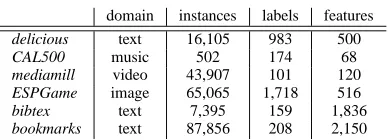
To validate the proposed E2FE, we use in our experiments five widely-used benchmark datasets with relatively large vo-cabularies from Mulan [44], i.e. delicious, CAL500, mediamill, bibtex and bookmarks. They belong to one of the following domains: text, music and video. Moreover, following CS [27], we also conduct experiments on the image dataset ESPGame [45], and take those tags appearing at least 20 times in the dataset to form a large vocabulary, which almost doubles the size of that used in the experiments of CS. Each instance in ESPGame is represented by a 516-D feature vector1extracted with Lire [46], and it is removed if no tags are associated. The original statistics of the datasets are given in Table III.
For performance comparison, we select Binary Relevance (BR) [47], CS [27], PLST [28], CPLST and kernel-CPLST
1516-D feature vector: 60-D Gabor, 192-D FCTH, 80-D Edge Histogram,
120-D Color Layout and 64-D RGB Color Histogram
For Peer Review
TABLE IIISTATISTICS OF DATASETS
domain instances labels features
delicious text 16,105 983 500
CAL500 music 502 174 68
mediamill video 43,907 101 120
ESPGame image 65,065 1,718 516
bibtex text 7,395 159 1,836
bookmarks text 87,856 208 2,150
[30], MLC-BMaD [31] and ML-CSSP [32] as baselines, where BR is a widely-used multi-label classification method that trains a separate binary relevance model for each label. In our experiments, we use both linear SVM (L-SVM) [48] and linear ridge regression (L-RR) for BR. And for the latter, we use 0.5 as a threshold to decide the binary (0 or 1) classification results. To reduce the computational costs of L-SVM on bibtex and bookmarks, we perform feature dimensionality reduction for both datasets via PCA. We also follow the reported preprocessing steps of baselines, like shifting the mean values of feature vectors to be zeros, etc. Note that BR in fact does not perform LSDR and thus its performance is a reference for other algorithms. BML-CS [5] is not included since it is sophisticated with numerous parameters to tune.
For E2FE, we evaluate the following variants. 1) R-E2FE: considering only the recoverability of the label space (i.e. for-mula (24)), theoretically equivalent to PLST; 2) P-LinearE2FE: considering only the predictability of the latent space for linear function-based encoding (i.e. formula (25)), similar to CPLST; 3) OP-E2FE: over-emphasizing the predictability of the latent space (i.e. formula (27)); 4) LinearE2FE: linear function-based encoding (i.e. formula (20)); 5) πLinearE2FE: identical to LinearE2FE except that the linear decoding matrix is learnt with priori knowledge; 6) E2FE: end-to-end feature-aware label space encoding (i.e. formula (12)); 7)πE2FE: identical to E2FE except that the linear decoding matrix is learnt with priori knowledge; 8) kernel-E2FE: kernel version of E2FE (i.e. formula (23)); 9) kernel-πE2FE: identical to kernel-E2FE except that the linear decoding matrix is learnt with priori knowledge.
In our experiments, each dataset is evenly and randomly divided into 5 parts. Five runs of each algorithm are then per-formed on the dataset, taking each time one part for testing and the rest for training without duplication. Experimental results are measured with widely-used metrics in the field of multi-label classification, i.e. multi-label-based macroF1 and example-based Accuracy [49], and then averaged over the 5 runs. Higher label-based macroF1 and example-based Accuracy means better performance. Specifically, for each run, label-based macroF1 is calculated as follows.
macroF1 = 1 dy
Pdy i=1
2piri pi+ri
s.t. pi= |G|iP∩iP|i|, ri =|G|iG∩iP|i|
(28)
wheredyis the number of all labels,GiandPiare respectively
the sets of the ground-truth and the predicted positive instances for the ith label, and∩, ∪are operations of intersection and
union between two sets. Meanwhile, example-based Accuracy is given by the following formula.
Accuracy= n1tPnt j=1
|G′
j∩Pj′|
|G′
j∪Pj′| (29)
wherent is the test set size, G′j andPj′ are respectively the
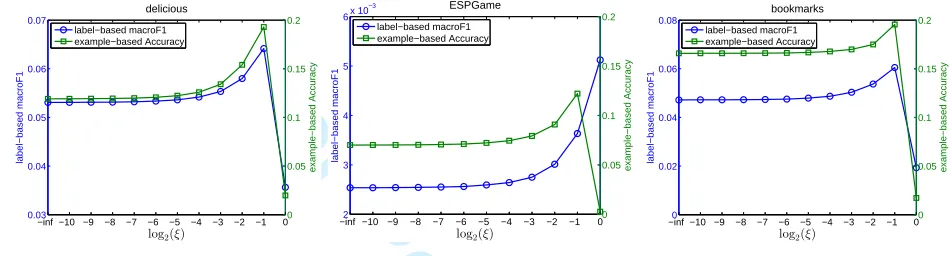
ground-truth and the predicted label set of thejth test instance. Moreover, for each run of any algorithm, we conduct 5-fold cross-validation on the training set for selecting model parameters via grid search in predefined value ranges. Specif-ically, α in the proposed E2FE and its variants is selected from{10−1,100, . . . ,104},τfor MLC-BMaD is chosen from {0.1,0.2, . . . ,1.0}, and the predefined sparsity level in CS is selected from {1,2, . . . , M} with M being the maximal number of labels in an instance, etc. Additionally, for η in πE2FE/πLinearE2FE/kernel-πE2FE, we set η = ξ 1
max(~λ) for
each dataset and selectξ from{0,2−10,2−9, . . . ,2−1,1} via cross-validation. Following most previous works, like [5], [28], [30], [32], we utilize linear ridge regression as predictive mod-els to learn the mappings from instance features to code vec-tors. As for kernel-CPLST, kernel-E2FE and kernel-πE2FE, we empirically utilize the Gaussian kernel function and set the smoothing parameterσas twice the mean Euclidean distance between feature vectors for each dataset. Accordingly, we utilize kernel ridge regression as predictive models for them to learn the non-linear mappings from instance features to code vectors. Moreover, following PLST, CPLST and ML-CSSP, we round each continuous entry of the decoding results into its nearest0or1to get the binary label vectors for test instances.
B. Experimental Results of LSDR
We run all algorithms on the six datasets with different values of dz/dy (mostly from 10% to 50%) where dz and
dy are respectively the dimensionality of the latent space and
that of the label space. Particularly, for ESPGame, dz/dy is
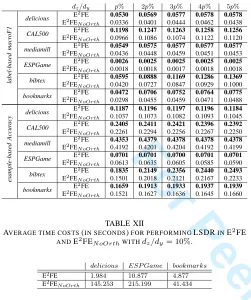
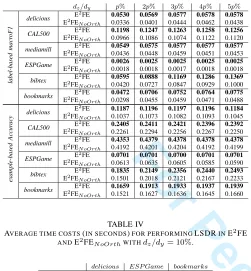
varied from5% to25%, as it has a much larger vocabulary. 1) Performance Comparison with Baselines: The exper-imental results of compared baselines and variants of the proposed E2FE are reported in Table IV and V.
A close look at the achieved results reveals: 1) The proposed E2FE as well as its linear function-based variant LinearE2FE generally outperform the compared baselines on each dataset, which clearly demonstrates their effectiveness. 2) E2FE out-performs LinearE2FE on all datasets, reflecting the superiority of learning code vectors in an end-to-end manner rather than a function-based manner. 3) E2FE outperforms R-E2FE and LinearE2FE outperforms P-LinearE2FE, which implies that jointly considering predictability and recoverability will obtain better performance. 4) OP-E2FE yields inferior performance to E2FE and cannot even perform LSDR on CAL500 when dz/dy ≥ 40%, as the dimensionality of the feature space
will be smaller thandz. That points out the weakness of
OP-E2FE and further validates the superiority of keeping a good trade-off between predictability and recoverability. 5) R-E2FE yields nearly the same performance as PLST, as predicted by our theoretical analyses about their equivalence. 6) With an identical objective function but different orthogonality constraints, P-LinearE2FE seems to be slightly superior to