© 2019, IRJET | Impact Factor value: 7.211 | ISO 9001:2008 Certified Journal
| Page 3383
Study on Comparative Design of Retaining Wall Structures and Analysis
it in ANSYS APDL Software
Sanket Pramod Dongare
1, Prachi Rajeev Gandhi
2, Shubham Sandip Gosavi
3,
Pravin Ajit Redkar
4, Prof. Reshma shaikh
51,2,3,4,5
Department of civil engineering, Dilkap research institute of engineering and management studies, Neral,
Maharashtra, India
---***---Abstract -
This research concerned typical representation of retaining wall with the development of an approach which can be used in reduction of c/s area and material cost. It’s however applied a retaining wall are going to replace it with a cantilever retaining wall structure because as we all know cantilever retaining wall requires a smaller c/s than the gravity retaining wall and hence make it safe and We have also done all important required stability checks under the static loading condition for the same location. So, the aim of this project is to developed a structurally efficient profile of retaining wall by compared it with a cantilever retaining wall structure of the same height and properties, where is further analyzed by finite element method by using ANSYS software under static loading condition. The finite element method (FEM) is a numerical method for solving problems and mathematical physics. This gravity retaining wall is located on Bendse-wave- Bridges, Karjat city of Maharashtra state of India. Then a modeled in the finite element software (ANSYS) is the developed and the deformation and displacement behavior of retaining wall is estimated for static load. Finally the results obtained from the numerical and the finite based analysis is compared.Key Words: Cantilever retaining wall, Gravity retaining wall, ANSYS software.
1. INTRODUCTION -
Retaining walls are used to retain earth or other loose material. The outline design of earth retaining wall involves the choice of wall, while detailed design concerns with the numerical calculation necessary to allow for safe chosen wall. However, wall sections forms a crucial part of the overall design process and hence should be given much greater attention. This Project focuses on comparative design of rigid retaining wall which is located on bendse Wave Bridge, Karjat by detailed numerical calculation and analysis in ANSYS software and comparing it with cantilever retaining wall and calculating and comparing results of both manually and in ANSYS software. This comparative design procedure should lead to economics of selection as a more informed comparison of alternative retaining wall types can be made.
ANSYS software helps in solving complex structural engineering problems with Finite Element Analysis (FEA)
simulation software for implicit structural engineering problems and makes better, faster design decisions With finite element analysis (FEA) tools available in the suite, we can customize and Automate solutions for structural mechanics problems. ANSYS Structural analysis software is used throughout the industry to enable engineers to optimize their product designs means specialized service that requires engineering knowledge so as to reduce weight of the product and still enhances its strength and reduce the costs of physical testing.
[image:1.595.313.556.387.535.2]1.1
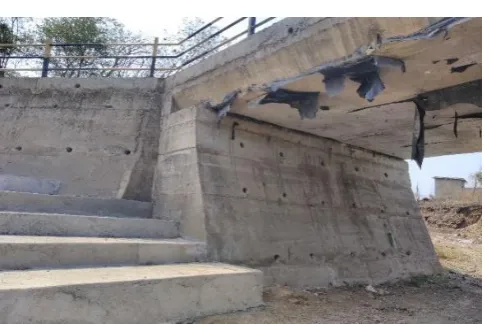
Original site pictures and location on map –
[image:1.595.313.556.565.728.2]Figure 1.1 Bridge site
© 2019, IRJET | Impact Factor value: 7.211 | ISO 9001:2008 Certified Journal
| Page 3384
Figure 1.3 Location of site on Google map
1.2 Standard section size of retaining wall from
PWD department -
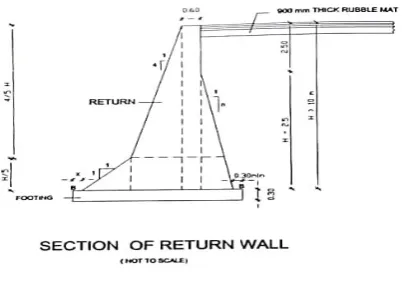
Figure 1.4 section of retaining wall
From the above section we have designed gravity retaining wall and some of the properties are also used in the design of cantilever retaining wall by using limit state method (LSM). As we all know masonry can be saved in the retaining wall by using steel but this cross section is generally used by PWD department.
1.3
Relevance –
Conventionally, retaining walls are broadly classified as –
1. Gravity retaining wall,
2. Semi gravity retaining wall,
3. Cantilever retaining wall and
4. Counter fort retaining wall.
A gravity retaining wall utilizes entirely its own weight to produce the necessary stability. Cantilever and counter fort retaining walls utilize the weight of the soil itself to produce stability. Semi-gravity retaining walls are intermediate between the cantilever and gravity types walls. Among the concrete retaining walls, the cantilever retaining walls are most widely used as it is economical. This wall increases the weight of the soil itself to produce stability. Cantilever retaining walls are used in basement of buildings, as
abutments of bridges, as a flood walls in irrigation works as well as for retaining ores, minerals and other granular materials. Therefore, considering the importance of cantilever retaining structures, the estimation of earth pressure is found to be essential for the safe design of retaining wall under the static conditions.
2. LITERATURE REVIEW –
Bharat Shah and P.P.Tapkire (Optimization of gravity retaining wall profile by introducing cavity) (2015) etc. in which the main aim of this paper is to develop a cost effective and structurally efficient profile of gravity retaining wall by introducing cavity in the section. For this, various section sizes of gravity retaining wall are analyzed and accordingly profile is selected and then after selection of an appropriate profile of gravity retaining wall stability calculations are carried out for various heights using ‘C’ programming by strength of material approach then section is further analyzed by finite element method by using software ANSYS.
A.sadrekarimi (Gravity retaining walls: Reinvented) (2015) etc. Stated that Gravity Retaining wall are indispensable element of most important infrastructure, however many of these structures have experienced large displacements during past earthquakes, resulting in damage to the structures built on their backfill. In this published paper the study carried out using limit equilibrium analysis to investigation the effect of wall back faces geometry on seismic lateral earth thrust and overturning moment. This can be simply accomplished by modifying the back face shape of the wall. One particular approach for reducing lateral earth pressure is to minimize the size of the failure wedge developed behind the wall.
Karan yadav and Dr. Raghvendra Singh (stability assessment of earth retaining structure) (2018) etc. stated a failure of a recently constructed R.C.C. counter fort retaining wall of 5.0 high and 230 m length constructed in 2003 which is located near sangli city of Maharashtra state of India is analyses with analytical and finite element based software distressed under static loading condition. The wall could not sustain the flood impact and there was a sliding, collapse and even rotational failure at some portion of wall was observed and this wall was constructed to protect a village road about 1800 m along a stream from flood water and it seems that the wall failed due to heavy flood and backwater in the stream from river Krishna and the improper design criteria.
3. METHODOLOGY –
[image:2.595.68.271.287.428.2]© 2019, IRJET | Impact Factor value: 7.211 | ISO 9001:2008 Certified Journal
| Page 3385
cantilever retaining wall in ANSYS APDL software. The method we are using in manual calculations is limit state method (LSM).
3.1 Manual calculations of gravity retaining wall –
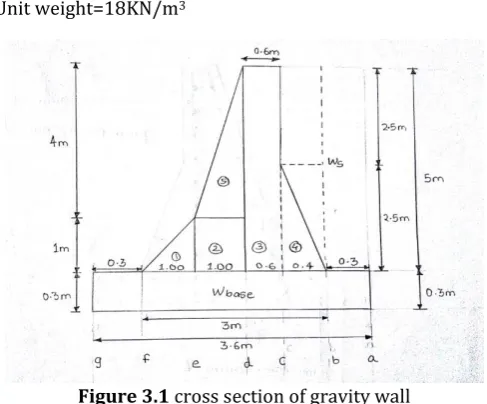
Given –
Height=5m, Safe bearing=200KN/m2
Angle of Internal friction=30o, Cohesion=0
M20 grade Fe415, Soil coefficient=0.5
[image:3.595.53.550.61.805.2]Unit weight=18KN/m3
Figure 3.1 cross section of gravity wall
Table 3.1 Load calculation table for gravity retaining wall
Load due to
Vert
ical Horizontal fro m toe Mom ent resto ring Moment overtur ning 1)Stem 1)25×0.5 ×1×1
12.5 0.96
67
12.08 3
2)25×1× 1×1
25 1.8 45
3)25×0.6 ×5×1
75 2.6 195
4)25×0.5 ×0.4×2.5
×1
12.5 3.03
33 37.91 6 5) 25×0.5×1 ×4×1
50 1.96
67 98.33 3 2)Base =3.6×0.3 ×25×1
27 1.8 48.6
3)Backfi ll
1)18×0.5 ×0.4×2.5
×1
9 3.16
67
28.5
2)18×0.3 ×5×1
27 3.45 93.15
3) 18×0.4×2
.5×1
18 3.1 55.8
4)Earth pressure = 83.42 7 1.76 67 147.387 5)Surch arge
kaQH=0.3
3×3.83×5 .3
6.69 8
2.65 17.74 97
6)Water pressure
Yw× h=
9.81×3.3
32.37 3
1.1 35.6103
Σv= 262. 698 KN ΣH= 115.8 KN ΣMR= 632.1 31KN. m ΣM0= 182.997 KN.m Check :-
[image:3.595.39.283.264.466.2]© 2019, IRJET | Impact Factor value: 7.211 | ISO 9001:2008 Certified Journal
| Page 3386
Sliding = = 1.47 ˂ 1.55 ⸫so fail in sliding
So shear key provide
This less than 1.55 hence we will provide a factor of safety 1.55 the wall should be same for the horizontal pressure force 1.55
1.55×pH = 1.55×115.8 = 179.49KN
Maximum available friction = 170.7537KN
Unbalanced horizontal friction = 179.49-170.7537
= 8.74KN
Safe horizontal soil reaction = 0.7×200 = 140KN\m2
Let the height of shear key be ‘y’
Safe horizontal reaction × y = unbalanced horizontal force
140×a×y = 8.74
y = 0.0624m 0.1m 100mm
Moment = 8.74×0.1 = 0.874KN.m Ultimate moment
= 1.311KN.m
Calculation of steel:-
mu = 0.138×fck×bd2
d = = 25.16mm
Add cover = 20mm D = 25.16+20= 45.16 50mm
Ast= [1- ] = 138.80mm2
Ast min = 0.12%×bD= 60mm2
Ast>Astmin
Main steel:-
Distribution steel:-
Use 10mm ϕ bars Use 6mm ϕ bars
Spacing = 550mm
Provide 10mm ϕ at 550mm c/c
Spacing = 450mm c/c
Provide 6mm ϕ at 450mm c/c
Check for pressure:-
= = 1.709m e = - = 0.091 ˂ or 0.6
P= [1+ ]
Pmax= 84.039KN/m2 Pmin= 61.904KN/m2
m = = 6.148
Pa = 61.904KN/m2 Pb = 63.7484KN/m2
Pc =66.207KN/m2 Pd = 69.896KN/m2
Pe = 76.044KN/m2 Pf = 82.192KN/m2
Pg = 84.039KN/m2
Design of
stem:-D = 3000mm d=2400mm
mu max = 0.138×fckbd2 = 17892252×103KN.m
mu = 17892252×103×1.5 = 282.310KN.m
Calculation of steel:-
Ast= [1- ] = 266.7597mm2
Astmin = 0.12%bD = 3600mm2
Ast>Astmin
Main steel:
Provide 20mm ϕ bar
Spacing = 80mm c/c
Astprovided = = 3926.99mm2
Provide 20mm ϕ 80mm c/c---main steel
Distribution steel:
© 2019, IRJET | Impact Factor value: 7.211 | ISO 9001:2008 Certified Journal
| Page 3387
Spacing = 275mm c/c
Provide 10mm ϕ 275mm c/c
Check for Shear:
Pa = 98.195 VuD = 1.5×98.195 = 147.29KN
pt% = ×100 = 1.33%
(By interpolation) ΓuC= 0.686N/mm2
VuC =ΓuC×bd = 2016.8×103KN >VuD ⸫Safe
Design of Toe:-
w1 = 2.25KN v1 = 24.6576KNv2= 0.277KN
m @ d w1×x1+v1×x2+v2×x3=4.09154KN.m
mu @ d = 1.5×4.09154 =6.02931KN.m
Calculation of steel:-
Main steel:
Ast= [1- ] = 70.18mm2
Ast min = 0.12%×Bd = 360mm2
Ast˂ Ast min ---So take Ast min
Use 16mm ϕ bars
Spacing = 550mm
Provide 16mm ϕ at 550mm c/c
Distribution steel:-
Ast D = 70.18mm2
Use 10mm ϕ bars
Spacing = 1100mm c/c
Ast provided = = 365.56mm2
Provide 10mm ϕ at 1100mm c/c
Design of heel:-
w1 = 2.25KN w2= 27KN
w3 = 9KN w4= 18KN
v1= 18.57KN v2 = 0.2766KN
m=14.443KN.m mu= 21.665KN.m
vD= -37.4024KN (↓) vuD= 56.1036KN
Calculation of steel:-
Ast= [1- ] = 705.0936mm2
Ast min = 0.12%×bD= 360mm2
Ast>Astmin
Main steel:-
Use 16mm ϕ bars
Spacing = ×1000 275mm
Astprovided = = 731.134mm2
Provide 16mm ϕ at 275mm c/c
Distribution steel:-
Ast D = 360mm2
Spacing = 215mm c/c
Provide 10mm ϕ at 215mm c/c
Check for shear:-
Pt% = = 0.30 (By interpolation) Γuc= 0.384
© 2019, IRJET | Impact Factor value: 7.211 | ISO 9001:2008 Certified Journal
| Page 3388
Figure 3.2 Detailed drawing of gravity wall section
3.2 Manual calculations of cantilever retaining
wall:
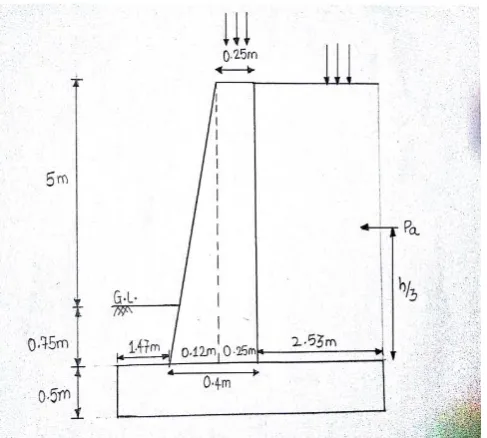
Given –
Height=5.75m, Safe bearing=200KN/m2
Angle of Internal friction=30o, Cohesion=0
M20 grade Fe415, Soil coefficient=0.5
Unit weight=18KN/m3
Figure 3.3 section of cantilever wall
Dfmin= 1.25m Ka = = 0.33
H = 5+1.25 = 6.25m
Base slab:
Width of base slab = 0.6H or 0.7H = 4.37 4.4m
Depth of base slab = 0.06H or 0.07H = 0.4375 0.5m
Toe projection = ×B= 1.47m
Stem:-
Top projection = 250mm (Assume 200mm to 400mm)
Bottom projection:
Pa = ×Ka× hs×hs= 98.2KN
Moment at base of stem = Pa×
= 188.20KN.m
Ultimate moment at stem = 1.5×188.20
= 282.310KN.m
= mu at stem = 0.138×bd2
[image:6.595.298.577.422.670.2]d = 319.82mm
Table 3.2 Load calculation table for cantilever wall
Sr.
No. Height Vertical Horizontal from toe
Moment of Resistanc
e
Momen t of overtur
ning
1. Stem
w1
w2
35.9 37
10.7 81
1.74 5
1.57
62.71
16.926 2. Base 55 2.2 121 3. Backfi
ll 261.85 3.135 820.91
4. Earth press ure
116.0
[image:6.595.41.285.426.645.2]© 2019, IRJET | Impact Factor value: 7.211 | ISO 9001:2008 Certified Journal
| Page 3389
5. Surch arge
=KaqH
=0.33 ×3.83 ×6.25
7.89
9 13/4 25.671
6. water press ure
= ×h
= 9.81× 4.25
41.69
25 17/12 59.064
ΣV = 371. 45
ΣH = 157.7 08
ΣMR =
1047.2 ΣMo = 300.76 3
Check:-Overturning = = 3.48 > 1.55 ⸫Safe
Sliding = =1.529 1.53 ⸫Ok
Check for pressure:-
= = 2.009mm
e = - = 0.919 ˂ or 0.735 P= [1+ ]
Pmax = 106.408KN/m2 Pmin = 62.433 KN/m2
m = = 9.994
Pa = 62.433KN/m2 Pb = 87.707KN/m2
Pc = 90.2052KN/m2 Pd = 93.703KN/m2
Pe = 106.408KN/m2
Design of stem:-
D=400mm d=400-60 = 340mm
mu = 282.310KN.m
Calculation of main steel: -
Ast= [1- ] = 2768.744mm2
Astmin = = 480mm2
Ast>Astmin
Provide 20mm ϕ bar
Spacing = 100mm c/c
Astprovided = = 3141.592mm2
Provide 20mm ϕ 100mm c/c
Calculation of distribution steel:-
Ast min = 480mm2
Use 10mm ϕ bar
Spacing = 150mm c/c
Provide 10mm ϕ 150mm c/c
Check for Shear:-
Pa = 98.195KN VuD = 1.5×98.195 = 147.29KN
pt% = ×100 = 0.923% ΓuC= 0.601N/m2
(By Interpolation)
VuC =ΓuC×bd = 204.34KN >VuD ⸫Safe
Design of Toe:-
D = 500mm d = 440mm
cover = 60mm
w1 = 18.975KN v1 = 137.434KN v2 = 9.084KN
m @ d w1×x1+v1×x2+v2×x3= 96.637KN.m
mu @ d = 1.5×96.637 = 144.956KN.m
Calculation of steel:-
Main steel:-
© 2019, IRJET | Impact Factor value: 7.211 | ISO 9001:2008 Certified Journal
| Page 3390
Ast min = 0.12%×bD= 600mm2
Use 16mm ϕ bars
Spacing = 200mm
Astprovided = = 1005.309mm2
Provide 16mm ϕ at 200mm c/c
Distribution steel:-
Ast D = 600mm2
Spacing = 125mm c/c
Provide 10mm ϕ at 125mm c/c
Check for
shear:-Pf = 62.433+9.99×(2.53+0.4+1.06) = 102.293KN/m2
w = 13.25KN V1 = 99.325KN V2 = 4.552KN
VD = V1+V2-w = 90.627KN
VuD = 1.5×90.627 = 135.940KN
Pt% = = 0.22 Γuc= 0.336N/mm2
VuC = Γuc×bd= 147.84KN > 135.940KN ⸫Safe in shear
Design of heel:-
w1= 31.625KN w2 = 261.855KN v1 = 157.955KN
v2 = 31.97KN
m@b = 144.583KN.m mu@b = 216.875KN.m
vD = -103.254KN (103.254 ↓) vuD=154.881KN
Calculation of steel :-
Ast= [1- ] = 1024.97mm2
Ast min = 0.12%×bD= 600mm2 Ast>Astmin
Main steel:-
Use 16mm ϕ bars Spacing = 175mm
Astprovided = = 1148.925mm2
Provide 16mm ϕ at 175mm c/c
Distribution steel:-
Ast D = 600mm2
Spacing = 125mm c/c
Provide 10mm ϕ at 125mm c/c
Check for shear:-
Pt% = = 0.26 Γuc= 0.384 (By interpolation)
[image:8.595.313.553.291.501.2]VuC = Γuc×bd= 168.46KN > 154.881KN ⸫ Safe in shear
Figure 3.4 Detailed drawing of cantilever retaining wall
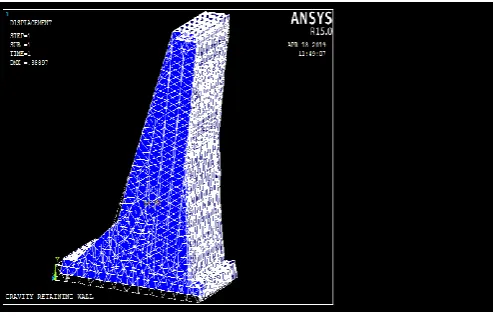
[image:8.595.311.558.574.733.2]3.3 ANSYS APDL analysis results of gravity
retaining wall:
© 2019, IRJET | Impact Factor value: 7.211 | ISO 9001:2008 Certified Journal
| Page 3391
[image:9.595.37.288.99.276.2]Figure 3.6 DOF solution displacement vector sum
Figure 3.7 Shear stress in XY plane
Figure 3.8 Shear stress in YZ plane
Figure 3.9 Shear stress in XZ plane
3.4 ANSYS APDL analysis results of cantilever
retaining wall:
Figure 3.10 Displacement of cantilever wall deformed and undeformed shape
[image:9.595.38.284.310.506.2] [image:9.595.310.559.342.511.2] [image:9.595.137.545.551.731.2]© 2019, IRJET | Impact Factor value: 7.211 | ISO 9001:2008 Certified Journal
| Page 3392
Figure 3.12 Shear stress in XY plane
Figure 3.13 Shear stress in YZ plane
Figure 3.14 Shear stress in XZ plane
4. RESULTS
4.1 Manual calculation results –
SR.
No. Checks Gravity retaini ng wall
Remark Cantilev er retainin
g wall
Rem ark
1. Overtu
rning 3.45 > 1.55 Safe 3.48 > 1.55 safe 2. Sliding 1.47 <
1.5 (added Unsafe shear
key)
1.53 >
1.5 Safe
3. Pressu
re 0.091 < 0.6 (B/6)
Safe 0.191 < 0.735 (B/6)
[image:10.595.34.290.101.295.2]Safe
Table 4.1 Checks for retaining wall
4.2 Total volume calculations –
SR. NO. Type of
wall Component Area (m2)
Volum e(m3)
1. Gravity
wall Stem 7.45 44.7
Base 1.08 6.48
TOTAL 8.53 51.18
2. Cantilever
wall stem 1.86875 11.212
Base 2.2 13.2
[image:10.595.309.561.144.308.2]TOTAL 4.06875 24.412
Table 4.2 Total volume calculation
Volume Reduction in cantilever retaining wall = 26.767m3
5. SCOPE
[image:10.595.34.290.331.528.2] [image:10.595.310.559.366.540.2] [image:10.595.35.290.565.748.2]© 2019, IRJET | Impact Factor value: 7.211 | ISO 9001:2008 Certified Journal
| Page 3393
6. CONCLUSION
The actual location is made with the help of gravity retaining wall but from all aspects we have finally concluded that for that location cantilever retaining wall is the best option.
REFERENCES
[1] A Sadrekarimi, “Gravity retaining wall: Reinvented,” 6th international conference on earthquake geotechnical engineering, 2015.
[2] Vipin singh and Pooja semwal, “Detailing aspect of the reinforcement in reinforced concrete structures retaining wall: A case study,” 2018.