warwick.ac.uk/lib-publications
Manuscript version: Author’s Accepted Manuscript
The version presented in WRAP is the author’s accepted manuscript and may differ from the
published version or Version of Record.
Persistent WRAP URL:
http://wrap.warwick.ac.uk/109574
How to cite:
Please refer to published version for the most recent bibliographic citation information.
If a published version is known of, the repository item page linked to above, will contain
details on accessing it.
Copyright and reuse:
The Warwick Research Archive Portal (WRAP) makes this work by researchers of the
University of Warwick available open access under the following conditions.
Copyright © and all moral rights to the version of the paper presented here belong to the
individual author(s) and/or other copyright owners. To the extent reasonable and
practicable the material made available in WRAP has been checked for eligibility before
being made available.
Copies of full items can be used for personal research or study, educational, or not-for-profit
purposes without prior permission or charge. Provided that the authors, title and full
bibliographic details are credited, a hyperlink and/or URL is given for the original metadata
page and the content is not changed in any way.
Publisher’s statement:
Please refer to the repository item page, publisher’s statement section, for further
information.
AN ONLINE ALGORITHM FOR CONSTRAINED FACE CLUSTERING IN VIDEOS
Prakhar Kulshreshtha, Tanaya Guha
Indian Institute of Technology, Kanpur
ABSTRACT
We address the problem of face clustering in long, real world videos. This is a challenging task because faces in such videos exhibit wide variability in scale, pose, illumination, expressions, and may also be partially occluded. The majority of the existing face clustering algorithms are offline, i.e., they assume the availability of the en-tire data at once. However, in many practical scenarios, complete data may not be available at the same time or may be too large to process or may exhibit significant variation in the data distribution over time. We propose anonlineclustering algorithm that processes data sequentially in short segments of variable length. The faces de-tected in each segment are either assigned to an existing cluster or are used to create a new one. Our algorithm uses several spatio-temporal constraints, and a convolutional neural network (CNN) to obtain a robust representation of the faces in order to achieve high clustering accuracy on two benchmark video databases (82.1%and 93.8%). Despite being an online method (usually known to have lower accuracy), our algorithm achieves comparable or better results than state-of-the-art offline and online methods.
Index Terms—Online clustering, face clustering, deep features, constrained clustering, movie analysis
1. INTRODUCTION
We are interested in automatically clustering faces into disjoint groups appearing in long, real-world videos such that each group consists of faces from a single person. An effective solution to this problem has direct application to many areas, such as video sum-marization and indexing, content-based video retrieval, character discovery and analytics [1], and organizing and managing a large collection of faces [2]. This is a highly challenging task because faces in real world videos exhibit wide variability in scale, pose, il-lumination, expressions, appearance (owing to changes in hair style, make-up), and also may be partially occluded [2, 3].
The problem of face clustering is relatively less studied as com-pared to face recognition - its supervised counterpart. The dominant approach to face clustering (both in images and videos) is completely unsupervised, where the primary objective is to learn a suitable dis-tance measure between the data samples [4, 5, 6, 7]. Several methods [8, 9] have proposed to use partial supervision to improve clustering performance. In the context of video-based clustering, significant improvement can be achieved by exploiting the temporal informa-tion about the occurrence of the faces [2]. For example, when two faces appear at the same time in a video, they can be safely assumed to belong to two different entities. Such constraints were used in a hidden Markov random field-based framework (HMRF) [2] to per-form face clustering in videos from movies and TV series. Another constrained clustering approach, called the unsupervised logistic dis-criminative metric learning (ULDML) [10], learned a metric opti-mizing over similar temporal constraints. A constrained multiview
video face clustering technique [11] used constrained sparse sub-space representation of faces with constrained spectral clustering. Constrained or not, all clustering techniques ultimately compute a distance between faces in a feature space. An effective representa-tion of faces hence can dramatically improve the performance of any clustering algorithm. Recent clustering approaches choose convolu-tional neural networks (CNN) to learn robust representation of faces [12, 5, 13]. Face clustering in videos has been shown to improve by using aggregated deep features [12], deep features with pairwise constraints [5], and by using deep features with triplet loss [13].
The approaches discussed above are allofflinemethods i.e., they assume the availability of the entire data at once. In this paper, we address a more challenging problem, that is of clustering faces in an
onlinemanner. In an online setting, a clustering algorithm does not have the luxury of ‘seeing’ the entire data simultaneously. Instead, data is available in small chunks, and prior information about the number of characters (cluster count) is also not available. Evidently, this is a more difficult scenario, and is known to trail offline meth-ods in terms of performance. Nevertheless, online clustering can be highly useful in cases where the entire data is not available at once, or has to be processed and monitored for a very long duration (e.g., in surveillance systems). To the best of our knowledge, there is only one work on online face clustering in videos in the existing literature [14]. This work created small tracklets of faces from the video, and clustered them in an online fashion based on temporal coherence and the Chinese restaurant process (TCCRP) [14] . However, this online method tends to create multiple clusters for the same person thereby degrading the completeness (whether or not a cluster contains all data from the same class) of the clusters.
In this work, we propose an online method to cluster faces in real world videos as they appear in the video stream. Our algorithm pro-cesses a video in small segments or ‘shots’, where the shot bound-aries are also detected automatically in an online manner. Faces are detected in each frame within a shot, and a spatial matching tech-nique is used to create face tracks pertaining to individual charac-ters. In order to obtain a robust representation of a face track, a CNN-based architecture, called the FaceNet [4], is employed. Us-ing the deep features and several temporal constraints, we develop an online algorithm to cluster faces. Unlike most offline clustering methods, the proposed method does not require any prior knowledge of the number of clusters to be formed. The proposed method, de-spite being an online approach, achieves comparable or better clus-tering accuracy than several state-of-the-art offline methods on two real-world video databases.
2. PROPOSED APPROACH
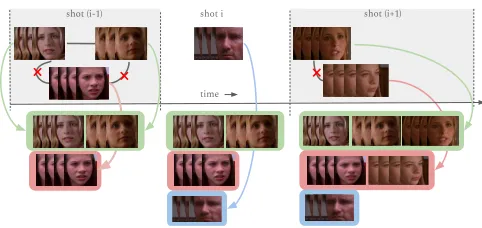
time
shot (i-1) shot i shot (i+1)
Fig. 1. Overview of the proposed online clustering algorithm.
2.1. Face track creation
In this step, we perform the following subtasks: shot boundary de-tection, face detection and face track creation.
Shot boundary detection:We process each movie at the shot level. A shot is defined as a contiguously recorded sequence of frames [15]. Given a movie, we first detect the shot boundaries in an online fashion. For our framework, the accuracy of shot bound-ary detection is not critical, hence we stick to the simple frame difference-based method [16] for detecting the shot boundaries. Let us consider a movieMthat comprisesT frames: M ={It}Tt=1. The ith shot Si is defined as a sequence of consecutive frames
{Iti, Iti+1. . . It(i+1)−1}, where ti is the i
th
shot boundary, and
t1 is initialized as the first frame. The ith shot boundary Ti is
detected when the distance between consecutive frames exceeds a predefined thresholdγ. This is given byTi←t:{β(It−1, It)≥γ,
|β(It−2, It−1)−β(It−1, It)| ≥ γ}, whereβ(·)is average pixel
difference between two frames.
Face detection and deep feature extraction:After detecting the shot boundaryti+1, we obtain theithshotSi. We run a standard face
detector [17, 18] on each frame inSi. Note that this frame level face
detection can be done in parallel to searching for shot boundaries. The face detector returns the corner coordinates of the rectangular bounding box of each face detected in every frame. To build a ro-bust representation of these faces, we employ a convolutional neural network (CNN) that can extract robust features from them. We use theFaceNet- a variant of CNN that is trained on a triplet loss involving matching and non-matching face patches [4]. The features learned using FaceNet have been shown to achieve state-of-the-art face verification and clustering results even using standard tech-niques, such as k-nearest neighbor (kNN) [4]. The learned features are also observed to be robust to pose variation, lighting conditions and image resolution [4]. Each facefpis forward-passed through the pretrained FaceNet to obtain itsd-dimensional unit norm feature vectorvp.
Face track creation:Instead of tracking individual faces, we use a simple yet effective strategy to combine the faces detected in consec-utive frames to form a face track. Let us define the cropped facesfp andfq
pertaining to two faces detected in two consecutive frames. The overlap percentagea(·)between two faces is defined as:
a(p, q) = area(f
p∩fq)
max(area(fp),area(fq))∗100 (1)
wherearea(f)is the area of the rectangular bounding boxf. The squared feature distance between feature vectorsvp
andvq
are
de-Fig. 2. Example of 85% spatial overlap between face pairs in two consecutive frames.
fined asδ(p, q) =kvp−vqk2
. Ifa(p, q)>0.85andδ(p, q)≤0.1 i.e., if the faces have more than85% overlap and less than0.1feature distance in consecutive frames, they are considered to be of the same person (see Fig. 2). Detected faces that overlap this way in consecu-tive frames are thus combined to form a sequence of cropped faces, called aface track, and the sequence of features corresponding to each of these faces is defined as afeature track.
2.2. Online face clustering
Our next task is to cluster the face tracks sequentially as they appear in each shot. We assume the availability of all face tracks in a single shot at a time. Our goal is to assign a face track belonging to a person who has appeared earlier to the correct existing cluster, and to form a new cluster for a face track belonging to a person appearing for the first time.
We cluster the face tracks across shots using their deep features. Let us consider theithshotSifor processing. Upto this point, we
have processed(i−1)number of shots, and have obtained a set of
Lclusters corresponding to theLcharacters. The clusters are rep-resented by their corresponding cluster centersC={cl}Ll=1, where cl ∈ Rd. A cluster center is simply defined as the mean feature vector obtained by averaging all features across all face tracks con-tained in that cluster. Let us also assume that there areKface tracks inSi, where each face trackFkis represented by its featuretrack set
Vk. Note that the number of clusters and the clusters themselves are
dynamic since they evolve as each shot is processed. To this end, we define three matrices as follows:
• Atemporal constraint matrixQ∈RK×Kis defined as
Q(p, q) =
(
0 ifFpandFqoverlap in time
1 otherwise (2)
where,p, q ∈ {1,2, . . . , K}. The matrixQenforces a tem-poral constraint on the face tracks such that if two face tracks have any overlap in time, they are considered to belong to two different characters, and hence, are assigned to different clusters.
• Asimilarity matrixD ∈ RL×K which measures the simi-larity between a face track (represented byVk), and a cluster
centerclfor a given shot.
D(l, k) =d(cl,Vk) = 4−
1
Nk
Nk
X
j=1
kvjk−clk22 (3)
where l = 1,2, . . . , L, and k = 1,2, . . . , K. The sec-ond component is an average squared distance, the maximum value of of which is4(since each feature is a unit vector). By subtracting the distance from4we obtain a similarity value between[0,4].
[image:3.612.317.558.72.131.2] [image:3.612.56.297.77.191.2]Algorithm 1:Facetrack clustering for a given shot.
Input:Face track features in the current shot:{Vk}Kk=1, Initial clusters:C
Output:UpdatedC
Initialize:ind= [1,2, . . . , K],W=all-ones matrix.
ComputeQ,Dusing (2) and (3)
whilelength(ind)>0do
ifCnot empty &&maxl,k(DW)≥τthen
(ˆl,ˆk)←argmaxl,k(DW)
k∗←ind[ˆk]
Update cluster centercˆjwithVk∗
else
Add new cluster(ˆl,ˆk)←(L+ 1,1)
k∗←ind[ˆk] cnew←mean(Vk∗)
C ← C ∪cnew
end
RecomputeDforcˆl
W(ˆl,:)←Q(ˆk,:)
DeleteD[:,ˆk],W[:,ˆk],Q[ˆk,:],Q[:,kˆ],ind[ˆk] end
GivenV1, . . . ,VK inSi shot, our task is to assign them (one at a
time) to their respective clusters or create a new cluster. This is done by computing the similarities between each face track and each clus-ter cenclus-ter, and obtaining the face track with the highest similarity to an existing cluster. For keeping track of the ids of face tracks we define a vectorind= [1,2,· · ·K]
(ˆl,ˆk) = argmax
l,k
(DW) (4)
wheredenotes element wise product between two matrices. Let
k∗=ind[ˆk]. Formaxl,k(DW)≥τ, whereτis a user-defined
threshold, the faces inVk∗ are considered similar to those in the
clustercˆl. If the face trackVk∗ is assigned to theˆlth cluster, we
update the cluster centercˆlby averaging over the existing and the newly added faces. On the other hand, ifmaxl,k(DW)< τ, then
none of the clusters is considered close enough toVk∗, and hence,
a new clustercnewis created. Thus it belongs to a completely new
person, we add a new cluster to the set of clustersC ← C ∪cnew
with its center being the mean of all the vectors inVk∗. Note that
sinceWis initialized as a matrix of all ones, it has no effect on the clustering of the first face track i.e., the face track with the highest similarity to any cluster. For the subsequent assignments of face tracks to clusters,Wis updated to add temporal constraints.
AfterVˆkis assigned to a cluster, we update the similarity matrix
Dand the weight matrixWas follows.
• Case I:Vˆkis assigned to an existing clusterˆl
W(ˆl,:)←Q(ˆk,:) (5)
This updatedWwill makeDWzero for all the face tracks having any temporal overlap withVk∗in theˆlthrow.
D(ˆl, k) =d(cˆl,Vk) fork∈[1,|ind|] (6)
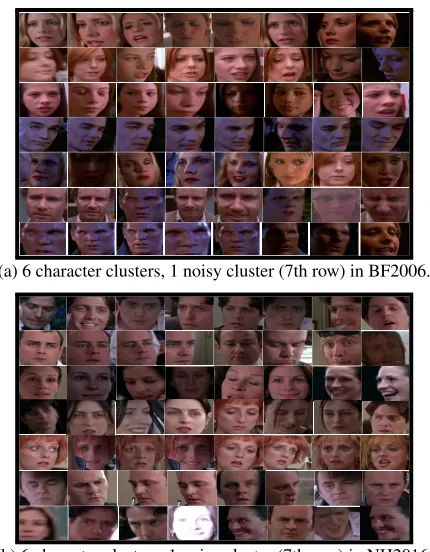
(a) 6 character clusters, 1 noisy cluster (7th row) in BF2006.
(b) 6 character clusters, 1 noisy cluster (7th row) in NH2016.
Fig. 3. Sample faces from all the clusters created by the proposed online algorithm on the two video databases.
• Case II:Vkˆis assigned to a new cluster
ˆ
l=|C|+ 1 (7)
C ← C ∪cnew (8)
W(ˆl,:)←Q(ˆk,:) (9)
D(ˆl, k) =d(cnew,Vk)fork∈[1,|ind|] (10)
As trackVk∗is processed and sent into a cluster, its id is removed
i.e.ˆkthelement ofind,kˆthcolumn ofDandW, andkˆthrow and
column ofQare removed. This process goes on till all the tracks in the shot are processed, and then we move to next shot. Algorithm 1 summarizes this online clustering process for a given shot1.
3. PERFORMANCE EVALUATION
In this section, we present detailed evaluation of the proposed online face clustering algorithm, and compare its performance with several existing algorithms on two video databases.
3.1. Databases
We have used two real-world video databases which are commonly used to benchmark face clustering algorithms: (i) TheBuffydatabase (BF2006) [3, 2] containing229face tracks of6characters (17,337 faces altogether) extracted from the episode 2, season 5 of the TV seriesBuffy - the Vampire Slayer. The database includes the frame number, bounding box coordinates, track ids, and the character names for each face. (ii) TheNotting Hilldatabase (NH2016) [19]
[image:4.612.330.545.68.344.2]Table 1. Comparison with the baselines (all with FaceNet features)
BF2006 NH2016
Vmeasure Fscore Vmeasure Fscore
GMM 0.80 0.82 0.79 0.72
Kmeans 0.78 0.81 0.78 0.72
Proposed 0.68 0.73 0.89 0.94
Table 2. Comparison with the online face clustering method
BF2006 NH2016
TCCRP [14] Proposed TCCRP [14] Proposed
Homogeneity 0.93 0.68 0.92 0.88
Completeness 0.44 0.69 0.44 0.89
Vmeasure 0.60 0.68 0.58 0.89
clusters 57 7 61 7
that contains 277 facetracks of 7 characters (19,278 faces alto-gether) from the movieNotting Hill. It contains the frame numbers, bounding boxes, track ids, features and character names for each face in the database.
3.2. Results and discussion
For the videos in each database, we obtain shot boundaries, create face tracks, extract deep features and cluster the faces using our proposed algorithm (see Algorithm 1). The value of the threshold parameterτis set to2.80and2.85for the BF2006 and the NH2016 database. Sample faces from all the clusters created by our algorithm are presented in Fig. 3. For BF2006, we get a cluster for each of the 6 characters, and for NH2016, we get a cluster for 6 / 7 characters.
Comparison with baselines: To evaluate the performance of the proposed method, we first create two baselines: Gaussian mixture model (GMM) with FaceNet features, and Kmeans with FaceNet features. We compare the proposed online method with these base-line methods in terms ofV measure[20] andF score[21] in Table 1. TheV measure(bounded between0to1) is an entropy-based measure of cluster homogeneity and completeness. TheF score
(bounded between0to1) is the geometric mean of precision and re-call. For both the metrics higher value indicates better performance. Results in Table 1 show that the performance of the baselines is slightly better than the proposed method on the BF2006 database, while the proposed algorithm outperforms the baselines on NH2016 database. Note that the baselines are offline methods, while our proposed method is online.
[image:5.612.349.526.102.213.2]Comparison with online face clustering: As mentioned earlier, to the best of our knowledge only one work on online face clustering [14] in the literature. We used the original TCCRP code provided by the authors [14]. Although not originally used with FaceNet features, we combine TCCRP with FaceNet features for better per-formance, and used a tracklet length of10. For both TCCRP and our method, no detected face is rejected, and no cluster created by the algorithms is discarded. We compare the proposed method with TCCRP in terms of three entropy based-measures [20]: homogene-ityscore, completenessscore and their harmonic-mean i.e., theV measure(see Table 2). F score has not been used as the number of clusters formed by TCCRP and our method are quite different, and hence a fair comparison is not possible. Table 2 shows that TCCRP has higher cluster homogeneity, but this is achieved at the cost of overclustering (note the large number of clusters created by TCCRP) and thereby degrading completeness. Our method achieves
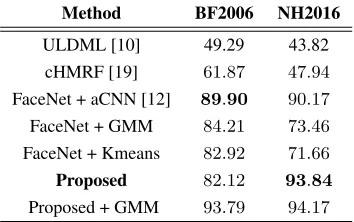
Table 3. Performance comparison with the state-of-the-art (offline) clustering methods in terms of clustering accuracy (%)
Method BF2006 NH2016
ULDML [10] 49.29 43.82
cHMRF [19] 61.87 47.94
FaceNet + aCNN [12] 89.90 90.17
FaceNet + GMM 84.21 73.46
FaceNet + Kmeans 82.92 71.66 Proposed 82.12 93.84 Proposed + GMM 93.79 94.17
significantly higher completeness and V measure while discovering a more accurate number of clusters.
Comparison with the state-of-the-art: We also compare the per-formance of our method with several state-of-the-art face clustering methods: (i) ULDML [10], (ii) a recently proposed constrained clus-tering method - the coupled HMRF (cHMRF) [19], and (iii) an ag-gregated CNN feature-based clustering (aCNN) [12] Performances of all the method are compared in Table 3.2 in terms of clustering accuracy (expressed in %) which compares the predicted cluster la-bels with the ground truth lala-bels. Note that all the methods in Table 3.2 are offline methods, where the entire data, information about the face tracks, and the cluster counts are provided as an input to the al-gorithms. For the proposed online method, however, no information about the face tracks or cluster counts are made available.
Note that the baseline clustering techniques, such as GMM and Kmeans when combined with deep (FaceNet) features out-perform sophisticated clustering methods such as cHMRF. The performance of our algorithm on the BF2006 database is superior to that of cHMRF and ULDML, and is comparable to Kmeans. On the NH2016 database, our algorithm outperforms all its offline counter-parts, achieving a clustering accuracy of93.8%. Furthermore, we show that if GMM (similar trend is noticed with Kmeans) is ini-tialized with the cluster centers discovered by the proposed method (see the last row of Table 3.2), even better clustering performance is achieved. This indicates the possibility of developing hybrid meth-ods where the advantages of both online and offline methmeth-ods can be exploited.
4. CONCLUSION
[image:5.612.66.287.186.246.2]5. REFERENCES
[1] T Guha, CW Huang, N Kumar, Y Zhu, and S S Narayanan, “Gender representation in cinematic content: A multimodal approach,” inProc. ACM International Conference on Mul-timodal Interaction (ICMI), 2015, pp. 31–34.
[2] B Wu, Y Zhang, BG Hu, and Q Ji, “Constrained clustering and its application to face clustering in videos,” inProc. CVPR 2013, 2013, pp. 3507–3514.
[3] M Everingham, J Sivic, and A Zisserman, “Hello! my name is... buffy–automatic naming of characters in tv video,” inProc. BMVC 2006, 2006.
[4] F Schroff, D Kalenichenko, and J Philbin, “Facenet: A unified embedding for face recognition and clustering,” in Proceed-ings of the IEEE conference on computer vision and pattern recognition, 2015, pp. 815–823.
[5] Z Zhang, P Luo, C C Loy, and X Tang, “Joint face representa-tion adaptarepresenta-tion and clustering in videos,” inECCV 2016, 2016, pp. 236–251.
[6] Y Sun, Y Chen, X Wang, and X Tang, “Deep learning face representation by joint identification-verification,” in Proc. Advances in Neural Information Processing systems (NIPS), 2014, pp. 1988–1996.
[7] Quoc V Le, “Building high-level features using large scale unsupervised learning,” in Proc. IEEE Int. Conf. Acous-tics, Speech and Signal Processing (ICASSP), 2013, 2013, pp. 8595–8598.
[8] M Du and R Chellappa, “Face association across uncon-strained video frames using conditional random fields,” in
Proc. ECCV 2012, 2012, pp. 167–180.
[9] L Wolf, T Hassner, and I Maoz, “Face recognition in uncon-strained videos with matched background similarity,” inProc. CVPR 2011, 2011, pp. 529–534.
[10] R G Cinbis, J Verbeek, and C Schmid, “Unsupervised metric learning for face identification in tv video,” inICCV 2011, 2011, pp. 1559–1566.
[11] X Cao, C Zhang, C Zhou, H Fu, and H Foroosh, “Constrained multi-view video face clustering,”IEEE Trans. Image Process-ing, vol. 24, no. 11, pp. 4381–4393, 2015.
[12] V Sharma, M Saquib Sarfraz, and R Stiefelhagen, “A simple and effective technique for face clustering in tv series,” .
[13] S Zhang, Y Gong, and J Wang, “Deep metric learning with improved triplet loss for face clustering in videos,” inPacific Rim Conference on Multimedia. Springer, 2016, pp. 497–508.
[14] A Mitra, S Biswas, and C Bhattacharyya, “Bayesian modeling of temporal coherence in videos for entity discovery and sum-marization,” IEEE Trans PAMI, vol. 39, no. 3, pp. 430–443, 2017.
[15] J Vendrig and M Worring, “Systematic evaluation of logical story unit segmentation,” IEEE Trans. Multimedia, vol. 4, no. 4, pp. 492–499, 2002.
[16] J Mathe, “Shotdetect: A free software which detects shots and scenes from a video,” 2012.
[17] D E King, “Dlib-ml: A machine learning toolkit,” Journal of Machine Learning Research, vol. 10, pp. 1755–1758, 2009. [18] N Dalal and B Triggs, “Histograms of oriented gradients for
human detection,” inCVPR 2005. IEEE, 2005, vol. 1, pp. 886– 893.
[19] B Wu, BG Hu, and Q Ji, “A coupled hidden markov random field model for simultaneous face clustering and tracking in videos,”Pattern Recognition, vol. 64, pp. 361–373, 2017.
[20] A Rosenberg and J Hirschberg, “V-measure: A conditional entropy-based external cluster evaluation measure,” inProc. Joint Conf Empirical Methods in Natural Language Process-ing and Computational Natural Language LearnProcess-ing (EMNLP-CoNLL), 2007.