warwick.ac.uk/lib-publications
Original citation:
Wang, Yiran, Noel, Adam and Yang, Nan (2018) A new simulation algorithm for absorbing
receiver in molecular communication. In: IEEE International Conference on Sensing,
Communication and Networking (SECON) Workshops 2018, Hong Kong, China, 11-13 Jun
2018
Permanent WRAP URL:
http://wrap.warwick.ac.uk/101174
Copyright and reuse:
The Warwick Research Archive Portal (WRAP) makes this work by researchers of the
University of Warwick available open access under the following conditions. Copyright ©
and all moral rights to the version of the paper presented here belong to the individual
author(s) and/or other copyright owners. To the extent reasonable and practicable the
material made available in WRAP has been checked for eligibility before being made
available.
Copies of full items can be used for personal research or study, educational, or not-for-profit
purposes without prior permission or charge. Provided that the authors, title and full
bibliographic details are credited, a hyperlink and/or URL is given for the original metadata
page and the content is not changed in any way.
Publisher’s statement:
“© 2018 IEEE. Personal use of this material is permitted. Permission from IEEE must be
obtained for all other uses, in any current or future media, including reprinting /republishing
this material for advertising or promotional purposes, creating new collective works, for
resale or redistribution to servers or lists, or reuse of any copyrighted component of this
work in other works.”
A note on versions:
The version presented here may differ from the published version or, version of record, if
you wish to cite this item you are advised to consult the publisher’s version. Please see the
‘permanent WRAP URL’ above for details on accessing the published version and note that
access may require a subscription.
A New Simulation Algorithm for Absorbing
Receiver in Molecular Communication
Yiran Wang
†, Adam Noel
‡, and Nan Yang
††Research School of Engineering, Australian National University, Canberra, ACT 2600, Australia ‡School of Engineering, University of Warwick, Coventry, CV4 7AL, United Kingdom
Email: [email protected], [email protected], [email protected]
Abstract—The simulation of diffusion-based molecular com-munication systems with absorbing receivers often requires a high computational complexity to produce accurate results. In this work, a new a priori Monte Carlo (APMC) algorithm is proposed to precisely simulate the molecules absorbed at a spherical receiver when the simulation time step length is relatively large. This algorithm addresses the limitations of the current refined Monte Carlo (RMC) algorithm, since the RMC algorithm provides accurate simulation only for a relatively small time step length. The APMC algorithm is demonstrated to achieve a higher simulation efficiency than the existing algorithms by finding that the APMC algorithm, for a relatively large time step length, absorbs the fraction of molecules expected by analysis, while other algorithms do not.
I. INTRODUCTION
Molecular communication (MC) has recently emerged as an underpinning paradigm of exchanging information in nano-scale environments such as organs, tissues, soil, and water [1]. This information exchange is conducted among small-scale devices. Within the research community, diffusion-based MC is a simple but commonly adopted MC system. In such a system, information molecules propagate using kinetic energy only, which preserves a high energy efficiency. One of the major challenges in designing and analyzing a diffusion-based MC system is receiver modeling. The majority of the existing MC studies have considered two types of receivers: passive receivers and active receivers. Passive receivers do not impose any impact on molecule propagation, while active receivers can absorb molecules when they hit the receiver’s surface. In nature, most receiver nanomachines react with or remove selected information molecules from the environment when they hit the receiver’s surface. Thus, active receivers are generally more realistic than passive ones in describing the chemical detection mechanism in MC. This motivates us to investigate the properties of absorbing receivers.
The notion of diffusion with absorption is a long existing phenomenon that has been described in the literature, e.g., [2]. Considering a diffusion-based MC system with a single fully absorbing receiver within an unbounded three-dimensional environment, [3] presented the hitting rate of molecules at different times and the fraction of molecules absorbed until a given time. Recently, [4] and [5] evaluated the impact of receiver with reversible absorption on the performance of MC systems, where a molecule can be released back to the environment at some time after being captured by the receiver.
Apart from theoretical analysis such as [3–5], the simulation of MC systems is also an effective means for performance evaluation. One of the most common MC simulation methods is particle-based microscopic simulation. For diffusion-based MC, molecules are moved by adding Gaussian random vari-ables (RVs) to their x-, y-, and z-coordinates at the end of every simulation time step. In practice, molecules may actually diffuse into an absorbing receiver between two sampling times. To determine this absorption, some existing simulation algo-rithms simply compared the observed coordinates of molecules with those of the receiver [4, 6, 7]. As a consequence, the molecules that hit a receiver between sampling times cannot be considered as “absorbed” by using these simulation algo-rithms. Recently, [8] and [9] investigated the possibility of molecule absorption between sampling times. Specifically, [8] declared a molecule as “absorbed” if its straight-line trajectory within a time step crossed an absorbing surface. Differently, [9] approximated the intra-step absorption probability for spherical receiver boundaries using the equation for planar receiver boundaries given by [10]. This approximation was referred to as the refined Monte Carlo (RMC) algorithm.
The key contribution in this paper is that we propose a new algorithm, i.e., thea priori Monte Carlo (APMC) algorithm, for simulating an MC system with an absorbing receiver, considering a relatively large time step length. We show that using our APMC algorithm, the fraction of molecules absorbed at the receiver precisely matches the corresponding analytical result when the time step length is relatively large, or equiv-alently, the receiver’s radius is small. This demonstrates that our APMC algorithm achieves a high simulation efficiency.
II. SYSTEMMODEL
We consider a diffusion-based MC system within a three-dimensional space, as depicted in Fig. 1. In this system, a point transmitter (TX) is located at the origin of the space and a single fully absorbing spherical receiver (RX) is centered at location (r0,0,0). We denote rr as the RX’s radius and
Ωras the RX’s boundary. At the beginning of a transmission
y-axis
z-ax
is
x-a xis
Receiver (r ,0,0)0 Molecules
Transmitter (0,0,0)
rr
[image:3.612.73.277.52.168.2]Ωr
Fig. 1: Illustration of our system model. The TX is a point transmitter located at (0,0,0), the RX is a spherical receiver located at (r0,0,0) with rr
being the radius andΩrbeing the RX’s fully absorbing boundary. Molecules
propagate in the environment according to Brownian motion.
Absorbing Receiver
Molecule’s initial position before propagation
Molecule’s final location after propagation
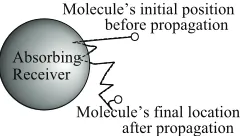
Fig. 2: Illustration of the intra-step molecule movement. There is a possibility that a molecule crossed an absorbing boundary within one time step, even if its initial and final positions during that time step are both outside the absorbing receiver.
from the origin at time t0 = 0 s and absorbed by the RX at
timet. As per [11, Eq. (3.116)], we express Nhit(Ωr, t|r0)as
Nhit(Ωr, t|r0) =
N rr
r0
erfc
(
r√0−rr
4Dt
)
, (1)
whereDis the diffusion coefficient and erfc(·)is the comple-mentary error function. Here,D describes the proportionality constant between the flux due to molecular diffusion and the gradient in the concentration of molecules.
As mentioned in Section I, most existing simulation algo-rithms for absorbing RXs do not consider the possibility of
[image:3.612.314.565.74.268.2]intra-step molecule absorption. This absorption is depicted in Fig. 2, which shows that the actual trajectory of a molecule may cross the absorbing boundary during one simulation time step, even if its initial position at the beginning of the time step and its final position at the end of the same time step are both outside the absorbing RX. If this crossing occurs, the molecule is absorbed by the RX in practice. Ignoring this absorption leads to underestimation of the number of molecules absorbed, thus deteriorating the accuracy of simulation. In this work, we refer to the probability that a molecule is absorbed during a simulation time step as the intra-step absorption probability. We note that the intra-step absorption probability was only considered in [8, 9]. In [9], the intra-step absorption probability of a fully absorbing RX with the spherical boundary was approximated as that of a fully absorbing RX with an infinite
planar boundary, given by [10, Eq. (10)]
PrRMC= exp
( − lilf
D∆t
)
, (2)
whereliis the initial distance of a molecule from the absorbing
boundary at the beginning of a time step,lfis the final distance
Algorithm 1 A common structure of simulation algorithms for a single absorbing RX
1: Determine the end time of simulation.
2: for all simulation time stepsdo
3: ift= 0then
4: AddN molecules to environment.
5: end if
6: Scan all not-yet-absorbed molecules, i.e., molecules which are not absorbed by the RX.
7: for allnot-yet-absorbed moleculesdo
8: Propagate each molecule for one step according to Brownian motion.
9: Determine if the molecule is absorbed. molecules absorbed
10: Update the location and status of the molecule.
11: end for
12: Record the number of molecules absorbed by the RX.
13: end for
of a molecule from the absorbing boundary at the end of the same time step, and ∆t is the simulation time step length.
III. SIMULATIONALGORITHMS
In this section, we first clearly present the common structure of the existing simulation algorithms for absorbing receivers. Then we present our proposed APMC algorithm.
A. Common Structure of Existing Simulation Algorithms
Built upon the observation of the existing simulation al-gorithms for microscopic molecule absorption (such as those in [6, 8, 9]), we find that they follow a common structure. This common structure is presented in Algorithm 1.
We clarify that each algorithm has its own criterion for determining whether or not a molecule is absorbed by the RX, as given in Line 9 of Algorithm 1. The determination criteria for the existing algorithms in [6, 8, 9] are summarized as follows:
• As per the determination criterion in [6], the molecules being observed inside the RX at the end of a time step are absorbed. This criterion is referred to as the simplistic Monte Carlo (SMC) algorithm.
• As per the determination criterion in [8], a molecule is absorbed if the line segment from its initial position to its final position crosses the RX’s boundary. However, we note that the line segment crossing the RX’s surface is neither sufficient nor necessary to correctly detect intra-step absorption.
• As per the determination criterion in [9], referred to as the RMC algorithm, (2) is used to calculate the intra-step absorption probability of a fully absorbing RX with the spherical boundary.
B. A New A Priori Monte Carlo Algorithm
[image:3.612.101.221.217.285.2]absorbing RX when √D∆t/rr is larger than that considered
for the RMC algorithm in [9]. We refer to the newly proposed algorithm as the APMC algorithm.
The procedure of the APMC algorithm is to first calculate,
before the jth molecule diffuses, the probability that this molecule will be absorbed in the current time step. This probability depends on the distance between this molecule and the center of the RX, dj, and the time step length, ∆t.
Specifically, this probability is calculated as
PrAPMC=
rr
dj
erfc
(
dj−rr
√
4D∆t
)
, (3)
which is obtained by scaling (1) by N, replacing the total simulation timetwith∆t, and replacingr0withdj. Then the
molecule absorption is determined by generating a uniform RV u, where 0 ≤ u ≤ 1, and comparing its value with the probability obtained by (3). A molecule is marked as “absorbed” if u ≤ PrAPMC. After determining the molecules absorbed, each not-yet-absorbed molecule is propagated ac-cording to Brownian motion. If any not-yet-absorbed molecule is inside the RX’s boundary at the end of the current time step, we revert the diffusion of this molecule and let it propagate again, until this molecule diffuses to a location outside the RX. This reversion is due to that if a molecule propagates to a location inside the RX, it contradicts the fact that this molecule has been determined as a “not-yet-absorbed” molecule. The APMC algorithm is detailed in Algorithm 2.
IV. NUMERICALRESULTS
In this section, we use Monte Carlo simulations to compare the time-varying results produced by the SMC algorithm, the RMC algorithm, and the APMC algorithm for a single receiver. The algorithms are implemented in MATLAB. Throughout this section, we set the diffusion coefficient asD= 10−9m2/sand assume that other parameters vary. In the figures, M denotes the number of time steps. If not otherwise noted, the TX-RX distance isr0= 50µmand the number of molecules released
is N = 106. The fraction of molecules absorbed is defined
as the ratio between the number of molecules absorbed at the RX and the total number of molecules.
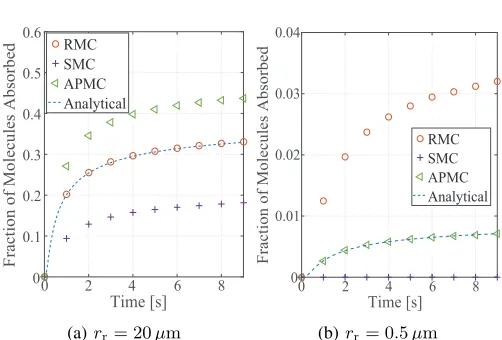
Fig. 3 plots the simulated fraction of molecules absorbed versus time t for M = 100, ∆t = 0.1 s, and rr = 20µm
or 0.5µm. In this figure, the analytical result obtained from (1) is also plotted for evaluating the accuracy of the algo-rithms. From this figure, we observe that our APMC algorithm achieves a higher accuracy when rr decreases while ∆t, D, and r0 remain unchanged. Specifically, Fig. 3(a) shows
that the RMC algorithm matches the fraction of molecules absorbed expected by the analytical result when√D∆t/rris
small, which meets our expectation. Indeed, the performance of the RMC algorithm depends on the value of √D∆t/rr.
When √D∆t/rr approaches 0 and r0 is larger than rr, the
surface area of the RX can be approximated by an infinite plane. Therefore, the probability of a molecule entering the RX between sampling times is comparable to the probability of a molecule crossing a planar boundary between sampling
Algorithm 2 The APMC algorithm for molecule absorption
1: Determine the end time of simulation.
2: for all simulation time stepsdo
3: ift= 0then
4: Release N molecules into environment.
5: end if
6: Scan allnot-yet-absorbed molecules.
7: for allnot-yet-absorbed moleculesdo
8: Calculate the distance between thejth molecule to (r0,0,0), denote bydj.
9: Calculate the absorbed probability PrAPMC for each
not-yet-absorbed molecule using (3) with rr,dj, D, and
∆t.
10: if PrAPMC≥uthen
11: The molecule is absorbed.
12: end if
13: end for
14: for allnot-yet-absorbed moleculesdo
15: Propagate the molecule for one step.
16: end for
17: for allfree molecules in environmentdo
18: whilethe molecule’s distance to(r0,0,0)≤rrdo
19: Revert the movement of this molecule.
20: Propagate this molecule again.
21: end while
22: end for
23: Record the number of molecules absorbed at the RX after this time step.
24: end for
Time [s]
0 0.1 0.2 0.3 0.4 0.5 0.6
F
ra
c
ti
on of M
ol
e
c
ul
e
s A
bs
orbe
d RMC
SMC APMC Analytical
0 2 4 6 8
(a)rr= 20µm
0 0.01 0.02 0.03 0.04
Time [s]
0 2 4 6 8
F
ra
c
ti
on of M
ol
e
c
ul
e
s A
bs
orbe
d
RMC SMC APMC Analytical
[image:4.612.312.563.401.571.2](b)rr= 0.5µm
Fig. 3: Comparison of the time-varying results produced by the SMC algorithm, the RMC algorithm, and the APMC algorithm forM= 100and
∆t= 0.1 s.
times. We also observe from Fig. 3(a) that when√D∆t/rris
0 0.05 0.1 0.15 0.2 RMC SMC APMC Analytical Time [s]
0 1 2 3 4
F
ra
ct
ion of M
ol ec ul es A bs orbe d
(a)∆t= 0.5 s
0 0.1 0.2 0.3 0.4 RMC SMC APMC Analytical Time [s]
0 10 20 30 40
F
ra
ct
ion of M
ol ec ul es A bs orbe d
[image:5.612.51.300.51.208.2](b)∆t= 5 s
Fig. 4: Comparison of the time-varying results produced by the SMC algorithm, the RMC algorithm, and the APMC algorithm forM= 100and
rr= 10µm.
Time [s]
# of N
e w ly-A b sor be d M ol e c ul e
s Distribution of
absorbed molecules Analytical 0 0.1 0.2 0.3
(a) RMC Algorithm
Time [s]
# of N
e w ly-A b sor be d M ol e c ul e
s Distribution of
absorbed molecules Analytical 0 0.1 0.2 0.3
[image:5.612.50.300.256.415.2](b) APMC Algorithm
Fig. 5: Distribution of the number of molecules newly absorbed during each time step for the RMC and APMC algorithms with∆t= 0.5 s,M= 10, and
rr = 10µm. Simulations are repeated103 times andN = 103 molecules are released each time. The spectrum bars represent observation probabilities.
analytical result when t > 0 s. Indeed, when √D∆t/rr is
large, the spherical RX’s boundary cannot be approximated by a plane. Therefore, the RMC algorithm overestimates the fraction of molecules absorbed.
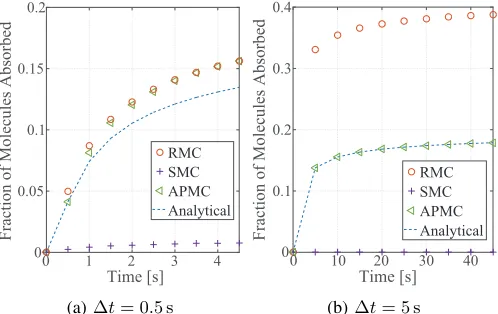
Fig. 4 plots the simulated fraction of molecules absorbed, together with the analytical result from (1), versus time t for
M = 100, rr = 10µm and ∆t = 0.5 s or 5 s. We observe
from this figure that when ∆t increases from 0.5 s to 5 s, our APMC algorithm achieves a higher accuracy. Specifically, Fig. 4(a) shows that the gap between the fraction of molecules absorbed produced by the APMC algorithm and that produced by the RMC algorithm is very small. Also, Fig. 4(a) shows that both the APMC and the RMC algorithms overestimate the fraction of molecules absorbed. Unlike Fig. 4(a), Fig. 4(b) shows that the APMC algorithm matches the fraction of molecules absorbed expected by the analytical result. Fig. 4(b) shows that the fraction of molecules absorbed produced by the RMC algorithm is approximately twice of that produced by the APMC algorithm when t ≥ 10 s. This demonstrates the accuracy of our APMC algorithm when √D∆t/rr is large.
Fig. 5 depicts the distribution of molecules newly absorbed during each time step (e.g., from t = 1 s to t = 1.5 s) for both the RMC and APMC algorithms for M = 10, rr =
10µm, and ∆t = 0.5 s. The analytical result in this figure is obtained based on (1). We observe from this figure that the RMC algorithm significantly overestimates the number of molecules newly absorbed when t = 1 s, while our APMC algorithm gives an improved estimation accuracy whent= 1 s by absorbing molecules according to (3). When t increases, the overestimation of the RMC algorithm is slightly less severe than that of the APMC algorithm. We further observe that the distribution of molecules newly absorbed in Fig. 5(b) is very similar to that in Fig. 5(a), which demonstrates that our APMC algorithm does not noticeably affect this distribution. Importantly, the average of the simulated distribution using our APMC algorithm is not far from the analytical result.
V. CONCLUSION
We proposed a new a priori Monte Carlo (APMC) algo-rithm to simulate the probability that a molecule is absorbed by a spherical receiver in MC systems. Based on numerical results, we confirmed that our APMC algorithm produces a more accurate result for the fraction of molecules absorbed than the existing RMC and SMC algorithms when√D∆t/rr
is large. This demonstrates that our algorithm is suitable to enable an efficient simulation with a relatively large diffusion time step length.
REFERENCES
[1] T. Nakano, A. W. Eckford, and T. Haraguchi,Molecular Communica-tion. Cambridge University Press, 2013.
[2] H. C. Berg,Random Walks in Biology. Princeton University Press, 1993. [3] H. B. Yilmaz, A. C. Heren, T. Tugcu, and C. B. Chae, “Three-dimensional channel characteristics for molecular communications with an absorbing receiver,”IEEE Commun. Lett., vol. 18, no. 6, pp. 929–932, June 2014.
[4] Y. Deng, A. Noel, M. Elkashlan, A. Nallanathan, and K. C. Cheung, “Modeling and simulation of molecular communication systems with a reversible adsorption receiver,” IEEE Trans. Mol. Biol. Multi-Scale
Commun., vol. 1, no. 4, pp. 347–362, Dec. 2015.
[5] A. Ahmadzadeh, H. Arjmandi, A. Burkovski, and R. Schober, “Com-prehensive reactive receiver modeling for diffusive molecular commu-nication systems: Reversible binding, molecule degradation, and finite number of receptors,”IEEE Trans. Nanobiosci., vol. 15, no. 7, pp. 713– 727, Dec. 2016.
[6] H. B. Yilmaz and C.-B. Chae, “Simulation study of molecular com-munication systems with an absorbing receiver: Modulation and ISI mitigation techniques,” Simulation Model. Practice. Th., vol. 49, pp. 136–150, Dec. 2014.
[7] I. Llatser, D. Demiray, A. Cabellos-Aparicio, D. T. Altilar, and E. Alarc´on, “N3sim: Simulation framework for diffusion-based molec-ular communication nanonetworks,” Simulation Model. Practice. Th., vol. 42, pp. 210–222, Mar. 2014.
[8] A. Noel, K. C. Cheung, R. Schober, D. Makrakis, and A. Hafid, “Simulating with AcCoRD: Actor-based communication via reaction– diffusion,”Nano Commun. Netw., vol. 11, pp. 44–75, Mar. 2017. [9] D. Arifler and D. Arifler, “Monte Carlo analysis of molecule absorption
probabilities in diffusion-based nanoscale communication systems with multiple receivers,”IEEE Trans. Nanobiosci., vol. 16, no. 3, pp. 157– 165, Apr. 2017.
[10] S. S. Andrews and D. Bray, “Stochastic simulation of chemical reactions with spatial resolution and single molecule detail,”Phys. Biol., vol. 1, no. 3, p. 137, Aug. 2004.