© 2019, IRJET | Impact Factor value: 7.211 | ISO 9001:2008 Certified Journal
| Page 1390
Face Recognition using Euclidean Distance Correlation Algorithm
Tanuj Nagaria
1, Dr. Dharmendra Chourishi
21
M.Tech (CSE) Research Scholar, NRI Institute of Science and Technology, RGPV, Bhopal, M.P, India
Abstract –
Biometric based techniques to recognize an individual identity seems to be one of the most reliable way for recognition. Being a promising approach, it is one of the most challenging techniques as it presents various hurdles to compete for. Face recognition is one of those biometric identity techniques which is reliable though challenging and presents problem in image analysis and computer vision and has received a great deal of attention over last few years due to its applications on various domain. Various approaches and algorithms have been developed and proposed earlier for better results on face recognition. In this paper, a Euclidean Distance Correlation (EDCB) based approach/algorithm is proposed to implement the 2D human face image recognition.Key Words: Face Recognition, Dimensionality Reduction, Feature extraction, PCA based approach, Euclidean Distance, Voila-Jones Algorithm, Correlation, AT&T, YALE, CALTECH and FACES94 Image Database, MATLAB.
1. INTRODUCTION
Biometric identification has attracted much attention in recent times for implementing it for security purpose and also for access, attendance etc. It also has great potential in numerous applications like in criminal justice system, surveillance and smartcard application, multimedia environments with adaptive human computer interface, civilian applications and video indexing. FACE recognition has been a very interesting and active field of research in Biometric identification, Image processing, recognition and computer vision. In recent years the emphasis of image processing has been shifted from recognition of various features of face for biometric identity verification. Face recognition with various Facial feature recognition techniques accompanied in it has developed and research has shifted to dealing with unconstrained conditions, including variability in ambient lighting, pose, expression, face size, occlusion and distance from camera. Face Detection is one among the most important advanced topics in computer vision and pattern recognition activities and critical step for facial analysis method which has issues in computer vision like face recognition, facial expression, face tracking and verification.
Biometrics based technologies include identification based on physiological characters (such as face, iris, retina fingerprints, finger or palm geometry, voice) and behavioral traits (like gait, signature, keystroke dynamics). Among all the features of human being, used as identification, Face
Recognition appears to have more advantages (benefits) over other biometrics based identification methods as analyzed and mentioned in [23]. Some of them are that Face recognition provides better security with convenient, friendly solution with easy integration, good for surveillance purposes. It can be done passively with less explicit intervention. Facial features like individual biological traits cannot be misplaced, forgotten, stolen, tampered or forged. But face recognition is totally non-intrusive with less risks [23]. Proceeding further in this paper, we would like to suggest that despite new advances in the face recognition area, techniques for this has not met the prospection that it will subvert human lifestyle in any aspects [1].
The objective of face detection is to determine any faces in the image and return its position of each face in spite of occlusions, orientation, expression, illuminations, facial pose etc. The activity of Face recognition involves face detection in an image and then identifying the identity of the individual with the one already available in the database so as to recognize it as an individual. Human Face recognition can be performed both on a still image and in a video. Still or Static image recognition better referenced as Passive Identification is more superior over other conventional biometric modalities [2].
Among the classical facial recognition algorithms are Eigenface [3], Local Binary Patterns (LBP) [5-7], Linear Discriminant Analysis (LDA) [8]. The Eigenface algorithm is easy to implement, but it could not handle the effect of facial expressions and illumination [4-7]. The LBP algorithm amends the effect of illumination, but the facial expressions still affect the result of identification [4]. The LDA resolves the illumination and the facial expressions in some reasons. It exists some deviations in the application of different races [7]. The traditional facial recognition algorithms and conventional sensors have inherent restrictions that the stereoscopic view of face could not be expressed very well, including the eye blinks, illumination, pose, occlusions, aging and facial expressions are still challenges in face recognition which will affect the speed of recognize and the accuracy of recognition, etc. [8].
2. ALGORITHMS AND PREVIOUS WORK ON FACE
RECOGNITION METHODS
There are various algorithms developed for face recognition whose classification and detailed study on them is provided in this section. Also brief about KPCA (Kernel 2
Head PG, MCA, NRI Institute of Science and Technology, RGPV, Bhopal, M.P, India
---***---© 2019, IRJET | Impact Factor value: 7.211 | ISO 9001:2008 Certified Journal
| Page 1391
PCA), KFD (KPCA plus LDA), Compete KFD and GeneralizedKFD are provided in coming section of this paper.
2.1 CLASSIFICATION OF FACE RECOGNITION
METHODS
Face Recognition Methods are classified into following four categories [3][10][11][12]. The Categorization of Methods for Face Detection and Recognition in a Single Image is mentioned in [23].
A. Knowledge Based Methods:
1. It uses pre-defined rules to determine a face based on human knowledge and uses information of what makes a typical human face.
2. It captures relationship between facial features. 3. It is used or designed mainly for face localization. 4. It is a rule based method which involves capturing the
knowledge of face and converting into set of rules. For example, a face usually has two symmetric eyes, and the eye area is darker than the cheeks etc.
5. If the rules are general then they are false positive. Also, if they were too detailed then there are false negatives. 6. To overcome the problems is to make hierarchical
knowledge-based methods which are efficient with simple inputs.
Limitations of this approach is Difficulty in building an appropriate set of rules as mentioned in [23].
B. Feature based methods: Also known as Feature invariant approaches and are mainly designed for face localization.
These methods aim to find structural features that exist even when the pose, viewpoint, or lighting conditions differ and uses these to locate faces. It tries to find face structure features that are robust to pose and lighting variations (mouth, cheek, eyes, ears, nose, chin, lips etc.). Distance between eyes, ears or location of eyes, nose,
and nose length is used as to determine the face. Also potential faces are normalized to a fixed size,
position and orientation. Then, the face area in an image is verified using a back propagation neural network.
C. Template Matching Methods:
It uses pre-stored face templates to judge if an image is a face and compares input image with stored template of faces or features. For this it defines a face as a function. Each features can be defined independently. It is used
both for face localization and detection.
Easy to implement but incomplete for face detection and do not give good results for variations in scale, shape and pose.
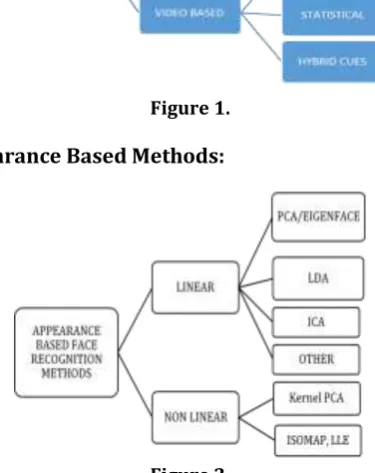
D. Appearance Based Methods:
It uses a set of training images for learning of the models or templates. It shows superior performance over others and also rely on techniques from statistical analysis and machine learning to find the relevant characteristics of face and non- face images.
In this method, the learned characteristics are in the form of distribution models or discriminant functions that are consequently used for face detection [2].
Algorithms used with this methods are PCA (Eigenface), Distribution based methods, Neural Networks, Support Vector Machines (SVM), Hidden Markov model (HMM) etc.
2.2 CLASSIFICATION BASED ON APPROACH TO
DETECT THE FACE
Recognition of face can be performed both in still image and in video based. In this study, we are performing face recognition in still images which can be classified in 3 main approaches as mentioned in [23] below:
1. Holistic based Approach:
In this approach, the whole face region is taken into consideration as input data into face detection system. It is an excellent technique for recognizing face in terms of recognition rate. Holistic face recognition utilizes global information from faces to perform face recognition. The global information from faces is basically represented by a small number of features, directly derived from the pixel information of face images. These small number of features distinctly capture the variance among different individual faces and therefore are used to uniquely identify individuals. Types of holistic method are:a. Principal Component Analysis (PCA) b. Single Value Decomposition (SVD) c. Artificial Neural Network (ANN)
2. Feature based Approach:
In this approach, Local features on face such as eyes, nose, ears, lips, nose length, cheek, chin position, location, length etc. are taken into consideration and are used as input data for structural classifier. Hidden Markov Model method belongs to this category.
3. Hybrid based Approach:
© 2019, IRJET | Impact Factor value: 7.211 | ISO 9001:2008 Certified Journal
| Page 1392
2.3 DETAILS OF METHODS AND ALGORITHMS USED
IN FACE RECOGNITION
[image:3.595.66.254.245.482.2]In this section, we have tried to provide detailed information on algorithms used for Face Recognition.
Figure 1.
Appearance Based Methods:
Figure 2.
2.4 CLASSICAL 2D FACE RECOGNITION ALGORITHM
A.
EIGENFACE
The algorithm based on the Principal Component Analysis (PCA) method, is the first method which is quite practical [3]. It needs to get the set S with M images of faces to be recognized. Each image can be converted into an N-dimension eigenvector Γ. The eigenvectors (Γ1, Γ2, Γ3, …., ΓM)
of M images in the set S are defined as the following equation:
S
=
{
Γ
1,
Γ
2,
Γ
3, ……..,
Γ
M}
(1)After getting the face eigenvector set S, it calculates the average image Ψ. The average can be calculated through iteration and accumulation. Ψ is actually an eigenvector of N dimensions.
Mn n
M
11
(2)
Then, the algorithm computes the difference value Φ between each image and the average. Φi is given by:
n
n
(3) Where n is the index of the face images.Find
M
unit eigenvectors,
n, which are orthogonal to each other. Those unit eigenvectors are used to describe the distribution of the difference valueΦ
.
n is calculated by using the Eq. (4).
Mn
n T k k
M
12
)
(
1
(4)
In Eq.4, when the takes the smallest value, the corresponding will be found. In addition, the needs to meet the following equation:
otherwise
k
l
k T l,
0
,
1
(5)
The vectors
μ
k and scalarsλ
k are the eigenvectorsand eigenvalues, respectively, of the covariance matrix
Mn
T T n n
AA
M
C
1
1
(6)
]
...
[
1 2 MA
The matrix
C
, however, isN
2 byN
2,
anddetermining the eigenvectors and eigenvalues is an intractable task for typical image sizes. A computationally feasible method is needed to find these eigenvectors. A new face image is transformed into its Eigenface components (projected onto “face space”) by a simple operation.
)
(
nn
(7) Here n=1,……,M. This describes a set of point-by-point image multiplications and summations. The Eq. (8) can compute the weights. M weights can build a vector.
[
1,
2,...,
M']
T
(8) The weights form a vector that describes the contribution of each eigenface in representing the input face image, treating the eigenfaces as a basis set for face images. The vector may then be used in a standard pattern recognition algorithm to find which of a number of predefined face classes, if any, best describes the face. That is the reflection of the new face by eigenface. Finally, to judge the new face, the algorithm sets the threshold value. But this method has the drawbacks that it could not handle the effect of facial expressions and illumination.B. Local Binary Patterns (LBP)
© 2019, IRJET | Impact Factor value: 7.211 | ISO 9001:2008 Certified Journal
| Page 1393
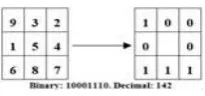
facial expressions still could not be solved. The LBP algorithm [image:4.595.110.213.206.254.2]selects and partitions the Eigen areas firstly. Next, the algorithm puts the Eigen area in the neighboring pixels with a 3×3 matrix by the grey level and chooses the center point value as the threshold. If the grey level value of surroundings is greater than the threshold, it will be set as 1. Otherwise, they are set as 0. Then, the LBP algorithm can get 8 bits binary number see Figure 3). It can reflect the texture information of this Eigen area.
Figure 3. Process of getting 8 bits binary number
.
The process of getting Eigen area can be described as:
(9)
where (xc, yc) represents the central element of the 3×3
matrix. ic is the pixel value of (xc, yc). ip is the pixel value of
surroundings.
s
(x)
is a signal function and defined as that:(10) The histograms of LBP are used for face recognition since LBP histograms contain information about the distribution of local micro patterns. Because the face image is too big for LBP calculation, dividing the image into small regions is proposed. Some parts of face (like eyes, mouth) contain more information for face recognition. Yang et al. [11] proposes to train and allocate different weights for face parts, by their information covering and then concatenating them end to end to build up global description of face. This helps to collect local pattern information with spatial details of the whole image. To decide if two face images are belong to same person, the images histograms are compared.
C. Distribution based Methods – LDA Algorithm
Linear Discriminant Analysis (LDA) is also called as Fisher’s Discriminant Analysis or Fisherface Analysis.
It is based on the analysis of variance (ANOVA). It tries to express one dependent variable as a linear
combination of other features or measurements. ANOVA uses categorical independent variables and a
continuous dependent variable and regression. It is an example of class specific and dimensionality
reduction technique.
Fisher’s Linear Discriminant Analysis finds a small number of features that differentiates individual faces but recognizes faces of the same individual. A small number of features is found by maximizing the Fisher Discriminant Criterion (Fisher 1936), which is achieved by maximizing the grouping
of individual faces whilst minimizing the grouping of different individual faces. Therefore by grouping faces of the same individual these features can be used to determine the identity of individuals.
In LDA, the goal is to find an efficient way to represent the face vector space in the vectors in underlying space that best discriminate among classes. LDA maximizes between class scattering matrix measure while minimizes the within class scatter matrix measure, which make it more steady for classification [7]. It is based on appearance method. LDA tries to differentiate between classes rather than trying to present the data and hence cares about getting feature vectors for class discrimination. We define 2 scatter matrices
The first is within-class scatter matrix and second is between-class scatter matrix. j denotes the class while i denotes the image number. μ j is the mean of class j while μ is
the mean of all classes. M j is the number of images in class j
and R is the number of classes. LDA-based methods outperform PCA for both face identification and verification. This method still could not handle the effect of illumination.
3. PROPOSED ALGORITHM
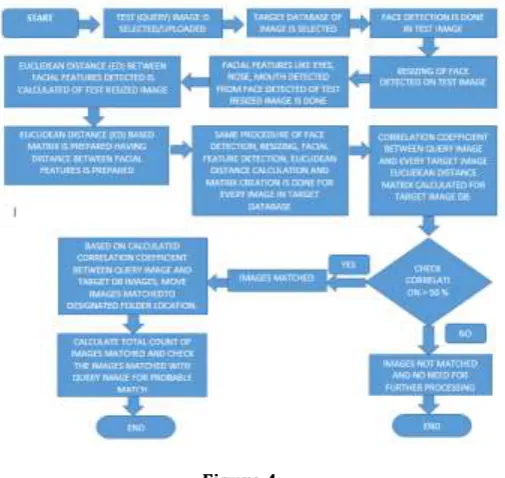
In this section, we have proposed a new algorithm which is referenced as Euclidean Distance Correlation Based (EDCB) Algorithm. In this algorithm, we have following steps. MATLAB Image processing tool is used for implementation of this algorithm. Our proposed algorithm involves the following steps:
1) Source Image or Query Image or Test Image is taken. 2) Using Voila Jones Algorithm, Face region is detected
from the query/test image, cropped and resized. Also using Voila Jones Algorithm (PCA/Eigen based algorithm), we detected facial features or face principal components like eyes, mouth, nose in the resized test image. Voila Jones Algorithm uses the following stages:
Haar Feature Selection
Creating an integral image
AdaBoost Training
Cascading Classifiers
3) Face image cropped is resized to 256 by 256 pixel size. 4) Calculate the mean/center point of face cropped and
facial features detected in the query/test image. 5) Calculate the Euclidean Distance between the points of
© 2019, IRJET | Impact Factor value: 7.211 | ISO 9001:2008 Certified Journal
| Page 1394
6) Select the Target Image Database containing set ofimages which are to be compared or matched.
7) Repeat the above steps from step no. 1 to 5 for every image in the target image of image database.
8) Calculate the correlation coefficient for between query image/test image and every image in target image database.
[image:5.595.40.293.223.462.2]9) If the correlation coefficient percentage is greater than 50% then move images to designated folder location else do not move. Calculate Accurate Recognition Rate.
Figure 4.
Proposed EDCB Algorithm Flow Chart
The correlation coefficient used here is adjustable and can be set to higher value as well. This algorithms is very efficient and is of very use in the surveillance, security systems. It is of great use in the criminal detection and probable match of criminals whose identity is known but not yet caught.
4. IMPLEMENTATION OF PROPOSED ALGORITHM
In this section, we first explain the experimental protocols that we use to test our method. Then we show all of the results obtained, in comparison with the state of the art algorithms in the different scenarios, one table per database. All the methods used for comparison were recently published.
4.1 FACE Database used in implementation
Among numerous face recognition databases which are available for researches to implement differ in size and purpose. As a good practice we have used a standard test face recognition database to be able to compare the final results. We have used 4 Face Databases for testing of our
proposed EDCB algorithm. ATT, Yale and CALTECH, FACES94 databases are used for this in our work.
IMAGE
DATABASE IMAGE FORMAT INDIVIDUALS SIZE ( in pixels) CALTECH RGB
JPEG 450 images of 27 diff. people 896 x 592 pixels ATT
(Formerly ORL DB)
GRAY 400 (10 diff. images of 40 people subject)
92x112 pixels
YALE GRAY 165 GIF imgs of
15 subjects (11 images/subject)
320x243 pixels
FACES94 RGB 153 180x200
a. CALTECH FACE DB
b. YALE Image
c. ATT
d. FACES94-Female Images
e. FACES94-Male Images Figure 5.
© 2019, IRJET | Impact Factor value: 7.211 | ISO 9001:2008 Certified Journal
| Page 1395
4.2 Testing Methodology
In this paper, we evaluate the performance of our EDCB approach by comparing it with number of recently published algorithms and on different mentioned Databases. Finally we will specify the computational implementation of the method, including the libraries and machines used.
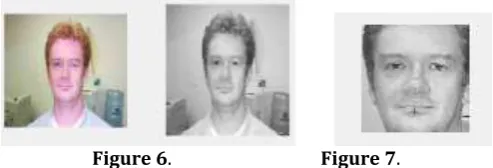
In this section we have considered the result analysis of our proposed algorithm Euclidean Distance Correlation Based (EDCB) Algorithm with the one provided in [24][25]. In below Figure 6 and 7, we have shown the implementation of proposed Face recognition Algorithm Euclidean Distance Correlation Based Algorithm (EDCA).
[image:6.595.38.285.275.359.2]Figure 6. Figure 7.
Figure 6 shows conversion of Color and Grayscale frontal face image, Figure 7 shows the Face and Facial Features detection of image of CALTECH image DB and then center point detection and marking of facial features.
5. EXPERIMENTAL RESULTS AND ANALYSIS
Principal component analysis (PCA) and Fisher linear discriminant (FLD) are two fundamental, classical and efficient methods for working with image recognition and data representation. With the developments in the recent past few years, such nonlinear feature extraction methods as kernel principal component analysis (KPCA) and kernel Fisher discriminant analysis (KFD) have become research hotspot in the domain of pattern and image recognition [13-25]. However, KFD is considered to be one of the most effective methods in many real-world applications, which can help extract the most discriminatory nonlinear features [17-19,20-22]., but has some ill-posed problems. KFD was carried out in the space spanned by all M mapped training samples, and need to estimate an M*M with-class covariance matrix (singular generally) with M samples. A number of methods that may settle this problem have been suggested [14-18]. The discriminant information which plays a very important par for face recognition [16][18], contained in the null space of the with-class scatter matrix could be discarded with these methods in the procession of the implementation. To tackle the above problem a new KFD framework based on a strict theoretical derivation in Hilbert space [13, 14] has been proposed. KPCA, together with LDA, is the essence of the proposed framework. Also the proposed Compete KFD method (CKFD) can utilize two kinds of discriminant information with class scatter matrix.
In this section of paper, KPCA (Kernel PCA), KFD which is (KPCA plus LDA), CKFD (Compete KFD) and GKFD (Generalized KFD) are analyzed, compared with our proposed Euclidean Distance Correlation Based (EDCB) Algorithm and the test analysis essence is demonstrated in the below tables. In this section, the CALTECH, FACES94, ORL, ATT and YALE database is used to test the proposed method and the results show that EDCB and correlation has a remarkable effect in face recognition.
Below table shows the comparison of various previously developed Algorithm or methods and our Euclidean Distance Correlation Based Algorithm (EDCB Algorithm) (in row 5) with their Accurate Recognition Rate (ARR).
S.NO METHODS ARR*
1. KPCA (Kernel PCA) 90.5%
2. KFD (Kernel Fisher Discriminant) 91.3%
3. CKFD (Compete KFD) 93%
4. GKFD (Generalized KFD) 93.5%
5. EDCB(Euclidean-Distance Correlation
Based Algorithm) >95% *ARR stands for ACCURATE RECOGNITION RATE
IMAGE DATABASE (Target Database) FACES94
Total Images of all persons in FACES94 1080 Total Count of Images identified with faces
using EDCB Algorithm with Facial Features 1057 Count of images used in target database which
belongs to same person in source/query image 20 Total Count of Images exactly recognized as
same or accurate with the one in source (query/test) image
20
Count of Images Identified with c>=0.50 580 Count of Images Identified with c>=0.80 382 Probable Match Identified similar to Test Image 580 Accurate Recognition Rate (ARR) (approx.) 100%
IMAGE DATABASE (Target Database) CALTECH
Total Images of all persons in CALTECH 450 Total Count of Images identified with faces
using EDCB Algorithm with Facial Features 446 Count of images used in target database which
belongs to same person in source/query image 19 Total Count of Images exactly recognized as
same or accurate with the one in source (query/test) image
19
© 2019, IRJET | Impact Factor value: 7.211 | ISO 9001:2008 Certified Journal
| Page 1396
TARGET IMAGE DATABASEYALE
Total Images of all persons in YALE 165 Total Count of Images identified with faces
using EDCB Algorithm with Facial Features 165 Count of images used in target database which
belongs to same person in source/query image 11 Total Count of Images exactly recognized as
same or accurate with the one in source (query/test) image
10
Count of Images Identified with c>=0.50 39 Count of Images Identified with c>=0.80 34 Probable Match Identified similar to Test Image 39 Accurate Recognition Rate (ARR) (approx.) 90%
We would like to acknowledge that in our proposed EDCB Algorithm for Face Recognition the Accurate Recognition Rate (ARR) is approximately 100% or always above 95%. We have also defined a new parameter called The Probable Recognition Rate (PRR) parameter which refers to Images recognized as probable match but are not the correct / exact or true match.
Also we would like to apprise that for some of the target databases like FACES94 or CALTECH that we have used in the implementation with our script in MATLAB for our proposed Euclidean Distance Correlation Based (EDCB) Algorithm, few faces or facial features in the images were not identified as due to shadow, occlusion, beard etc.
5. CONCLUSIONS
This paper attempts to provide a comprehensive study approach for Face Recognition Algorithm. We propose new methodology to improve performance and reliability. Also we have successfully designed and implemented a prototype Face Recognition System using Euclidean Distance Correlation Based algorithm on MATLAB software.
The list of references to provide more detailed understanding of the approaches described is enlisted. When appropriate, we have reported on the relative performance of methods. But in doing so, we are cognizant that there is a lack of uniformity in how methods are evaluated. We have tried to provide brief on all important algorithms in simple and understandable manner with categorization. We apologize to researchers whose important contributions may have been overlooked.
ACKNOWLEDGEMENT
The author would like to thank professors and management of NRI Institute of Science and Technology, Bhopal (Madhya Pradesh) for providing their valuable guidance and providing excellent facilities for carrying the research work.
REFERENCES
[1] Z. Zhang, "Microsoft Kinect Sensor and Its Effect", IEEE Multimedia, vol. 19, no. 2, pp. 4-10, 2012.
[2] Zijun Cheng, Tianwei Shi, Wenhua Cui, et al. 3D Face Recognition Based on Kinect Depth Data 2017, ICSAI 1-2 [3] M. A. Turk, A. P. Pentland. Face recognition using eigenface. International Journal of Computer Applications, 2015, 118(5): 12-16.
[4] A. Ali, S.Hussain et al, Face Recognition with Local Binary Patterns. Bahria University Journal of Information & Communication Technologies, 2014, 5(1): 46-50.
[5] C. Zhu et al, “Multi-scale Color Local Binary Patterns for Visual Object Classes Recognition”. 2016: 3065-3068. [6] T. Ojala, M. Pietikäinen, T. Mäenpää. Gray Scale and
Rotation Invariant Texture Classification with Local Binary Patterns// European Conference on Computer Vision. Springer-Verlag, 2000: 404-420.
[7] An Efficient LDA Algorithm for Face Recognition Jie Yang, Hua Yu, William Kunz School of Computer Science Interactive Systems Laboratories Carnegie Mellon University Pittsburgh, PA 15213.
[8] M. Zainudin, H. Radi, S. Abdullah, et al. Face Recognition using Principle Component Analysis (PCA) and Linear Discriminant Analysis (LDA). International Journal of Electrical & Computer Sciences, 2012, 12(05): 50-55. [9] P. Sanguansat, W. Asdornwised, S. Jitapunkul, et al.
Two-Dimensional Linear Discriminant Analysis of Principle Component Vectors for Face Recognition. IEICE - Transactions on Information and Systems, 2006, E89-D (7):2164-2170.
[10] B.S Khade et al, “Face Recognition Techniques: A Survey” International Journal of Computer Science and Mobile Computing, Vol.5 Issue.11, November- 2016, pg. 65-72. [11] M.-H. Yang, D. J. Kriegman, and N. Ahuja. Detecting faces
in images: A survey. IEEE Trans. on PAMI, 24(1):34–58, 2002. 1, 11, 12, 13
[12] A Survey of Recent Advances in Face Detection: Cha Zhang and Zheng you Zhang June 2010 Technical Report MSR-TR-2010-66.
[13] M. Turk and A. Pentland, “Eigenfaces for recognition,” Journal of Cognitive Neuroscience, vol. 3, no. 1, pp. 71~86, 1991.
[14] Jian Yang, Alejandro F. Frangi, Jing-yu Yang, David Zhang ,and Zhong Jin, “KPCA Plus LDA: A Complete Kernel Fisher Discriminant Framework for Feature Extraction and Recognition,” IEEE Trans. Pattern Analysis and Machine Intelligence, vol. 27, no. 2, Feb. 2005. [15] Jian Yang, Zhong Jin, Jing-yu Yang, David Zhang, and
Alejandro F.Frangi, “Essence of kernel Fisher discriminant: KPCA plus LDA,” Pattern Recognition, vol. 37, pp. 2097~2100, 2004.
© 2019, IRJET | Impact Factor value: 7.211 | ISO 9001:2008 Certified Journal
| Page 1397
[17] Yang Jian and Yang Jingyu, “Why Can LDA be performedin PCA Transformed Space?” Pattern Recognition. 2003, 36(2): 563-566.
[18] Yu Hua and Yang Jie, “A Direct LDA Algorithm for High-Dimensional Data with Application to Face Recognition,” Pattern Recognition, 2001, 34(10): 2067-2070. [19] B. Scholkopf, A. Smola, and K. R. Muller, “Nonlinear
Component Analysis as a Kernel Eigenvalue Problem,” Neural Computation, vol. 10, no. 5, pp. 1299-1319, 1988. [20] M.H. Yang, “Kernel Eigenfaces vs. kernel Fisherfaces: face recognition using kernel methods,” Proceedings of the Fifth IEEE International Conference on Automatic Face and Gesture Recognition (RGR’02), WA DC, May, 2002, pp. 215–220.
[21] Jian Yang, Alejandro F. Frangi, and Jing-yu Yang, “A new kernel Fisher discriminant algorithm with application to face recognition,” Neurocomputing, 56 (2004), 415-421. [22] Li Zhang, Wei Da Zhou, Pei-Chann Chang, “Generalized nonlinear discriminant analysis and its small sample size problems,” Neurocomputing, 74(4), 2011.
[23] Tanuj Nagaria, et al,”A Comprehensive Survey and Detailed Study on various Face Recognition Methods, IRJET Vol 5 Issue 12 Dec 2018: 655-656.
[24] Yuexiang Shi, Yang, Ping Gong, et al, “A Generalized Kernel Fisher Discriminant Framework Used for Feature Extraction and Face Recognition”. IEEE 2016 12th Intl
Conf on Natural Computation, Fuzzy Systems and Knowledge Discovery (ICNC-FSKD) pg. 1490-1491. [25] Yuexiang Shi, Saizhou Yang, Ping Gong, et al, “A