© 2019, IRJET | Impact Factor value: 7.211 | ISO 9001:2008 Certified Journal
| Page 1847
Implementation of IOT Based Smart Garbage and Waste
Collection System
Gaurav Makde
1, Ashutosh Bele
2, Vaibhav Khapekar
3, Nidhi Gajarlwar
4, Sakshi Gajbhiye
5,
Kunal Purohit
61,2,3,4,5
Department of Information Technology, S.B. Jain Institute of Technology, Management and Research, Nagpur
6
Project Guide, Department of Information Technology, S.B. Jain Institute of Technology, Management and
Research, Nagpur
---***---Abstract -
Many times, in our city we see that the garbage bins or dustbins placed at public places are overloaded. It creates unhygienic conditions for people as well as ugliness to that place leaving bad smell. It creates bad health condition for the people by spreading some deadly diseases, to avoid all such situations we are going to implement a project called IOT Based Smart Garbage and Waste Collection bins. These dustbins are interfaced with Node MCU based system using Ultrasonic Module, WIFI Module which is present in the Node MCU along with central system showing current status of garbage, on mobile web browser with html page or in android app by Wi-Fi. Hence the status will be updated on to the html page. Major part of our project depends upon the working of the Node MCU; essential for its implementation. The main aim of this project is to reduce human resources and efforts along with the enhancement of a smart city vision. Each bin is given a particular ID it will in display in the screen of the respected admin and they can take immediate action. We are designing a smart bins means it contains some sensors, Ultrasonic Module. Thus this scheme helps to maintain the city sparkling by informing about the trash levels of the bins via a web page.Key Words: Node MCU, Ultrasonic Sensor.
1. INTRODUCTION
Recent days, many people are living in cities only for their convenience in all the ways and many people are coming from the rural areas for the opportunities. Due to this there is huge growth of population in metro politician Cities the waste percent is increased to the enormous level, the waste is overflowing from the bins and finally it leads a situation of general bin into mini dump yard in each and every street. So, it’s became a major problem for the municipal authorities to clean that waste. They are unable to clean that waste in time. So, to reduce this, based on latest technology moving to smart bin. Up to now this method is not widely implemented in India, presently we are using only old bins and compressor bins in our premises. So with all the power at our finger tips this is what we have come up with the is : - Internet of Things (IOT).
This project IOT Garbage Monitoring system is a very innovative system which will help to keep the cities clean.
This design designates a technique in which the garbage level could be checked at regular intervals which would prevent the undesirable overflow of the bin. The system makes use of Node MCU and Ultrasonic Sensor which are the main part of the system. This system monitors the garbage bins and informs about the level of garbage collected in the garbage bins. For this, the system uses ultrasonic sensors placed over the bins to detect the garbage level and compare it with the garbage bins depth. The system makes use of Node MCU and a Wi-Fi is already placed in the Node MCU for sending data to webserver that monitors the garbage levels. Programming is done in Arduino IDE such a way that once a particular level of filling is sensed information message is sent requesting a clean-up.
This is our IOT Based Smart Garbage and Waste Collection System, an innovative way that will help to keep the cities clean and healthy by informing about the garbage levels of the bins.
1.1 PROBLEM STATEMENT
One of the main concerns with our environment has been solid waste management which impacts the health and environment of our society. The detection, monitoring and management of waste is one of the primary problems of the present era. The Traditional way of manually monitoring the waste in waste bin is a cumbersome process and utilizes more human efforts, time and cost which can easily be avoided with our present technologies.
1.2 PROPOSED SYSTEM
© 2019, IRJET | Impact Factor value: 7.211 | ISO 9001:2008 Certified Journal
| Page 1848
percent or it is not working then the admin can easily delete the dustbin from the table.
At the start the garbage bin is unfilled and the sensors placed over the bins senses the level of the garbage composed/fixed in the bins. If the sensor senses no garbage in the bin then it does not refer information to the person. Else if the sensor senses any garbage in the bin and the level of the garbage is in between 0%-80% there will not be any alert or text message. If level is in between 80-100% then it will send information (text message) to the admin and then the admin will text to the garbage collector (labor) then directly the person collect the garbage from that area.
2. LITERATURE SURVEY
The aim is to develop an IOT base garbage monitoring system. So in this we survey about the Garbage level that will tell the waste level which is detection inside the dustbin and a web page is built to show the status to the user monitoring it. The web page gives a Graphical view and highlights the garbage collected in color in order to show the level of garbage collected to the user. So we take a basic knowledge about the types of waste present in the dustbin i, e., Solid, Liquid, Sludge and Hazardous (Waste item, domestic bin, trash bags). [1]
We have taken the idea of code how to take sensor reading from the hardware and take input from Node MCU and Ultrasonic sensor and pushing the data into the database which will then display the value in the table which is present in the web page [2]
Ultrasonic sensor are very use full in today’s generation. So we have used this sensor to detect the level of the garbage. The sensors are place at the top of the dustbin in the common garbage bins placed at the public place when the garbage reaches the level of the sensors it will send SMS using WI-FI module to the web page and will show graphical view of the bin how much it is fill.[3]
For this there should be a flow of system. So we have taken an overview about the system architecture and we have referred the flow chart which tells the flow of the system and the architecture tells which parts are connected to whom. Smart Dustbins can prevent the accumulation of the garbage along the roadside to a great extent thereby controlling the widespread of many diseases. It can prevent pollution and also prevent the consumption of the spread out garbage by the street animals. [4]
The sensors attached to smart bins connected through the cellular network creates a large amount of sensor information, which is analyzed and monitored to get knowledge about the status of garbage bins. This paper also aims at encouraging further research in the topic of waste management. Wi-Fi Module is used to send message to the
garbage depot if the Garbage exceeds the set threshold level. With the help of Wi-Fi module interfaced, we can send short text messages to the required authorities. [5]
2.1 SYSTEM REQUIREMENET
Functional Requirements:
• Taking sensor reading from the Sensor Circuit • Pushing the data to a MySQL database.
• Retrieving information from database for Calculation garbage bin which fulfils the condition for garbage collection, example: Collect garbage from bins whose level is over 80% of bin.
• A client side script to get Garbage collection live Monitoring.
Non-functional Requirement:
• The project requires a user interface for monitoring and manually intervening (if required) in the efficient and timely collection of garbage from the selected Garbage bins.
2.2.1 SYSTEM REQUIREMENET
1. Arduino IDE
The open-source Arduino Software (IDE) makes it easy to write code and upload it to the board. It runs on Windows, Mac OS X, and Linux. The environment is written in Java and based on Processing and other open-source software. The Arduino IDE supports the languages C and C++ using special rules of code structuring. The Arduino IDE supplies a software library from the Wiring project, which provides many common input and output procedures. User-written code only requires two basic functions, for starting the sketch and the main program loop, that are compiled and linked with a program stub main() into an executable cyclic executive program with the GNU tool chain, also included with the IDE distribution. The Arduino IDE employs the program avrdude to convert the executable code into a text file in hexadecimal encoding that is loaded into the Arduino board by a loader program in the board's firmware.
2. XAMPP Local Server
XAMPP is an open source free software developed by Apache friends. XAMPP software package contains Apache distributions for Apache server, MariaDB, PHP, and Perl. And it is basically a local host or a local server. This local server works on your own desktop or laptop computer. You can just install this software on your laptop or desktop and test the clients or your website before uploading it to the remote web server or computer. This XAMPP server software gives you suitable environment for testing MYSQL, PHP, Apache and Perl projects on the local computer.
© 2019, IRJET | Impact Factor value: 7.211 | ISO 9001:2008 Certified Journal
| Page 1849
Cross-platform usually means that it can run on any computer with any operating system. Next MariaDB is the most famous database server and it is developed by MYSQL team. PHP usually provides a space for web development. PHP is a server-side scripting language. And the last Perl is a programming language and is used to develop a web application.
The XAMPP installation process is very simple and fast. Once XAMPP is installed on your local computer it acts as a local server or localhost. You can test the websites before uploading it to the remote web server. This XAMPP server software gives you suitable environment for testing MYSQL, PHP, Apache and Perl applications on a local computer.
3. MySQL Database
MySQL is an open source software. It is actually a relational database management system (RDBMS). This SQL stands for Structured Query Language. It is the most popular and best RDBMS used for developing a variety of web-based software applications. With the help of MYSQL, it is possible to organize the information, manage, retrieve and update the data whenever you wish to do.
MySQL is very popular for Web-hosting applications because of its plethora of Web-optimized features like HTML data types, and because it's available for free. It is part of the Linux, Apache, MySQL, PHP (LAMP) architecture, a combination of platforms that is frequently used to deliver and support advanced Web applications. MySQL runs the back-end databases of some famous websites, including Wikipedia, Google and Facebook. Although MySQL is technically considered a competitor of Oracle DB, Oracle DB is mainly used by large enterprises, while MySQL is used by smaller, more Web-oriented databases. In addition, MySQL differs from Oracle's product because it's in the public domain.
4. Cloud Server Hosting
Cloud server hosting is when hosting services are made available to customers on demand via the Internet. Rather than being provided by a single server or virtual server, cloud server hosting services are provided by multiple connected servers that comprise a cloud. Cloud server hosting is also sometimes referred to as cluster server hosting or server on-demand hosting.
Cloud server hosting offers the advantages of increased accessibility and reliability, seamless scalability and potential cost savings, as customers are freed from having to invest in on-premises servers and hardware, and they pay only for the resources they consume. On the other hand, security and lack of access and full control are potential concerns with cloud server hosting.
2.2.2 HARDWARE REQUIREMENT
1. Node MCU
Node MCU is an open source IOT platform. It includes firmware which runs on the ESP8266WiFi SoC from Espressif Systems, and hardware which is based on the ESP-12 module. Node MCU provides a way to connect different sensors to their controllers wirelessly via Wi-Fi. Since, it is an improved version of the ESP8266 it has better and easier programming, with better voltage stability and more reliability.
2. Ultrasonic Sensor
An optical sensor has a transmitter and receiver, whereas an ultrasonic sensor uses a single ultrasonic element for both emission and reception. In a reflective model ultrasonic sensor, a single oscillator emits and receives ultrasonic waves alternately. HC-SR04 is an ultrasonic sensor which is used for measuring the distance.
3. Jumper Wire
A jump wire is an electrical wire, or group of them in a cable, with a connector or pin at each end, which is normally used to interconnect the components of a breadboard or other prototype or test circuit, internally or with other equipment or components, without soldering. Jumper wires are simply wires that have connector pins at each end, allowing them to be used to connect two points to each other without soldering. Jumper wires are typically used with breadboards and other prototyping tools in order to make it easy to change a circuit as needed.
4. Breadboard
A thin plastic board used to hold electronic components such as transistors, resistors, chips, etc. that are wired together. Used to develop prototypes of electronic circuits, the boards can be reused for future jobs. Breadboards can also be used to create one-of-a-kind systems, although commercial products placed on printed circuit boards are typically much more robust and can handle greater frequencies.
5. USB Cable
© 2019, IRJET | Impact Factor value: 7.211 | ISO 9001:2008 Certified Journal
| Page 1850
3. SYSTEM DESIGN
3.1 Use Case
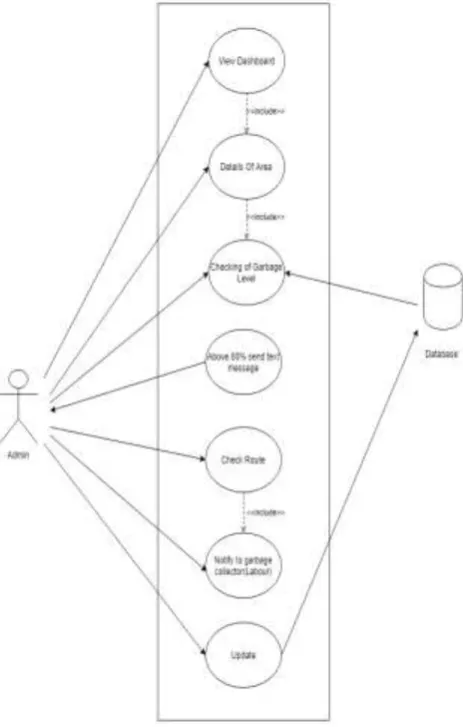
[image:4.595.322.543.66.377.2]There will be one actors for this system and the database which will store the value coming from ultrasonic sensor. The Admin is responsible making changes in the dashboard. This will show how the every module interact with the system and how modules are interconnected. This diagram shows user interaction with the system. So use case diagram is the only way to solve the problem and give better explanation.
Figure 3.1 Use Case Diagram 3.2 Flow Chart
[image:4.595.43.275.258.622.2]This diagram shows the actual flow of system. The IOT based garbage monitoring system is a very innovative system which will help to keep the environment and cities clean. This system monitors the garbage bins throughout the city and informs about the level of garbage collected in the garbage bins to the Admin.
Figure 3.2 Flow Chart Diagram
4. IMPLEMENTATION OF THE SYSTEM
4.1 DESIGN MODULES
1. Sensing: Ultrasonic sensors provide information on an absolute position of an object. This helps in early detection of events and enables to take the necessary steps.
2. Monitoring: Along with continuous monitoring of the sensors, the information should be reported in real time to the appropriate central server.
3. Control: The monitored data is analyzed in real time and the optimum control information is determined and transmitted over networks.
4. Storage & Backup: Rapid, flexible and accurate responses is desired since the analysis and control information is done on real time. In accordance with the requirements, the intelligence of our system is provided by the IOT devices. Ultrasonic sensors are used in smart bins. The IOT devices send these data over the wireless networks to the processing server and this data is used to generate optimum schedules for waste collection.
© 2019, IRJET | Impact Factor value: 7.211 | ISO 9001:2008 Certified Journal
| Page 1851
enables the processing system to generate an optimized schedule according to which the smart trucks will collect waste from these bins.
6. Notification module: This module will send notification to the contractor and NMC when the garbage level is 80% above. Then the contractor will send the text message to the garbage collector (labor) if he is in the same route to collect the garbage.
5. TESTING
5.1 TYPES OF TESTING Manual Testing
Manual testing includes testing a software manually, i.e., without using any automated tool or any script. In this type, the tester takes over the role of an end-user and tests the software to identify any unexpected behavior or bug. There are different stages for manual testing such as unit testing, integration testing, system testing, and user acceptance testing.
Testers use test plans, test cases, or test scenarios to test a software to ensure the completeness of testing. Manual testing also includes exploratory testing, as testers explore the software to identify errors in it.
Following are the testing techniques that are performed manually during the test life cycle:
• Acceptance Testing • White Box Testing • Black Box Testing • Unit Testing • System Testing • Integration Testing
5.2 LEVELS OF TESTING There are four levels of testing: 1. Unit
2. Integration 3. System 4. Acceptance
1) Unit Testing: In this software testing process where individual units/components of a software/system are tested. The purpose is to validate that each unit of the software performs as designed. And with the help of this testing we also tested the individual hardware of the system.
2) Integration Testing: A level of the software testing process where individual units and the hardware components are combined and tested as a group. The
purpose of this level of testing is to expose faults in the interaction between software and the hardware.
3) System Testing: A level of the software testing process where a complete, integrated system/software is tested. The purpose of this test is to evaluate the system’s compliance with the specified requirements and produce the required output.
4) Acceptance Testing: A level of the software testing process where a system is tested for acceptability. The purpose of this test is to evaluate the system’s compliance with the business requirements and assess whether it is acceptable for delivery.
6. RESULT AND DISCUSSION
6.1 RESULT
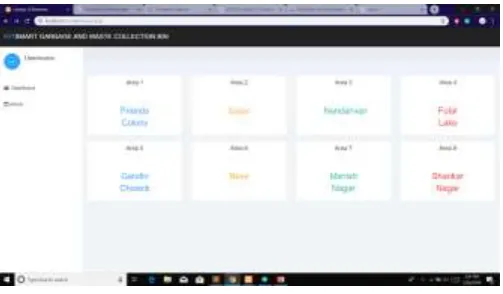
[image:5.595.309.561.398.545.2]In this dashboard which contain the different area of the city and each area contain the number of dustbin and in dashboard there will also be an admin option. To go to the admin option there will be a login page. The login page will only contain the admin ID to login to the page.
Figure 6.1 Dashboard
After that the admin can add the area and also can remove or delete the area from the dashboard. The admin can also add and delete the dustbin from the table. If the dustbin is not showing the percent or it is not working then the admin can easily delete the dustbin from the table.
© 2019, IRJET | Impact Factor value: 7.211 | ISO 9001:2008 Certified Journal
| Page 1852
Figure 6.2 Tables of Areas
In this database it contain id, filled and percent where ID is auto-incremented and the filled and percent values are stored in the column name.
Figure 6.3 Database 6.2 DISCUSSION
The discussion included of proposing a system that would be used to help to manage and keep the society and the environment clean. This has various advantages like less labor work, smart work etc. This application can be launched on larger scale.
And we have use tool and technologies which help use to develop this system. Hence we have discussed about all the components and learned that what the component is about and how it works.
7. APPLICATION AND ADVANTAGES
Advantages:-
•It is the good method to manage waste. •It is safe and easy to implement. •Support Digital India.
•Real time based cleaning our cities.
Applications:-
•This project can also be used in the” SMART CITY”. •This project is also helpful in the government project of “SWACHH BHARAT ABHIYAN”.
8. CONCLUSIONS AND FUTURE SCOPE
8.1 CONCLUSION
We Design and completed the investigation of complex problem for our problem statement “IOT Based Smart Garbage and Waste Collection Bin”. We have applied Engineering Knowledge for investigation and analyze societal problem so that it will be beneficial for engineer and society. We have studied previous work which is related to our project, we have analyze these work and try to overcome the problems and drawbacks of their work. We make use of modern tools and technologies for faster and advance development of the system. During the development of our project we learned so many things that give us lifelong learning. We came to importance of each individual and the whole team also. Team management and coordination is the key point for the successful development of the project.
8.2 FUTURE SCOPE
We have successfully completed the project “Smart Garbage Management”, but, there still room for change.
• Automatic Garbage Fill system helps us to reduce the pollution. Many times garbage dustbin is overflow and many animals like dog or cow enters inside or near the dustbin. Also some birds are also trying to take out garbage from dustbin. This project can avoid such situations.
• And the message can be sent directly to the cleaning vehicle instead of the contractor’s office. Apart from this, differentiation can be made between dry trash bin and wet trash bin collecting plastic dry waste and biodegradable waste respectively.
• To implement this methane and smell sensors can be used. This helps in distinguishing the waste at the source and hence reducing the requirement of manpower. To enhance it further, an automated system can be developed which is able to pick up waste in and around the bin, segregate them and put them in respective bins.
9. REFERENCES
[1] Dr. K. Alice Mary, Perreddy Monica, A. Apsurrunisa , Chathala Sreekanth, G. Pavan Kumar “International Journal of Scientific & Engineering Research”, Volume 8, Issue 4, April-2017, ISSN 2229-5518.
[image:6.595.34.290.317.469.2]© 2019, IRJET | Impact Factor value: 7.211 | ISO 9001:2008 Certified Journal
| Page 1853
[3] Ms. Rupa, Ms. Rajni Kumari, Ms. Nisha Bhagchandani, Mr. Ashish Mathur “IOSR Journal of Engineering” Volume 08, Issue 5, May 2018, ISSN (e): 2250-3021.
[4] Ashima Bajaj, Sumanth Reddy “International Journal of Pure and Applied Mathematics” Volume 114, 12 2017, ISSN: 1311-8080.