© 2019, IRJET | Impact Factor value: 7.211 | ISO 9001:2008 Certified Journal
| Page 2048
Quadrotor Modeling and Control using PID Technique
Amer Hamadi
1, Dr. Abdulla Ismail
21
Graduate Student, Dept. of Electrical Engineering, Rochester Institute of Technology, Dubai, UAE
2Professor, Dept. of Electrical Engineering, Rochester Institute of Technology, Dubai, UAE
---***---Abstract -
Quadrotors are considered nowadays one of thefastest growing technologies. It is entering all fields of life making them a powerful tool to serve humanity and help in developing a better life style. It is crucial to experiment all possible ways of controlling quadrotors. In this paper a conventional type of controllers is used which is the PID, to control the quadrotor attitude angles and altitude. The open loop system is modeled using MATLAB. Then PID controllers have been designed and added to the system. The main objective for this paper is to have stable response for the system. The results of controlled system simulation at the end of this paper show that the PID control is an adequate and a reliable technique for this objective. The system model, controllers and results are presented at the end of the paper.
Key Words: Quadrotor, PID control, Roll, Pitch, Yaw,
1. INTRODUCTION
[image:1.595.313.564.497.647.2]UAV (Unmanned Aerial Vehicle) is an aircraft without a pilot, depending mainly on autonomous or remote flight control, this system is used in recent years in many civil and military applications, providing many advantages over manned systems such as reduced cost, no risk on crew for hazardous missions, maneuverability and long endurance [1]. UAVs can be classified according to size , range, altitude or number of rotors , Table 1 shows the possible classification of UAV.
Table -1: UAV Classification UAV
Size Range Altitude ConfiguratiWing
on
No. of Rotors
Micro
(MAV) range Close
High Altitude Long Endurance
HALE
Fixed
Wing Single Rotor
Mini
(MUAV) range Short
Medium Altitude Long
Endurance MALE
Flapping
wing rotors Multi
Nano (NAV) Medium Range Enduran ce Blimps
QUAV (Quadrotor UAV) is a Multirotors UAV that is lifted and propelled by four rotors. It is considered a benchmark research platform because of its high maneuverability and
simple mechanical structure. However the control design for this type of vehicles is a complex task.
2. Quadrotor Modeling
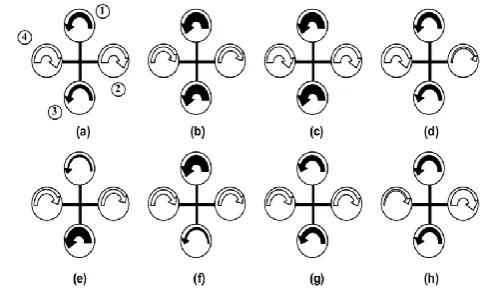
Quadrotors in general use two pairs of identical propellers (1,3) and (2,4) as described in Figure 1, two turn clockwise (CW) and two counterclockwise (CCW). To achieve control of quadrotor , independent variation of the speed of each rotor is used. [1] The basic Quadrotor motion is defined by using Euler angles yaw ψ, pitch θ, roll φ and vertical motion z. The motion in these directions can be achieved by having the following propeller speed variation: [2]
• Changing the speed of all propellers at the same time will generate vertical z motion as shown in Figure 1 (c,g).
• Changing 2 and 4 propellers conversely will create a roll φ rotation as shown in Figure 1 (d,h).
• Changing 1 and 3 propellers conversely will create a pitch θ rotation as shown in Figure 1 (e,f).
[image:1.595.33.292.534.723.2]• The difference in the counter-torque between each pair of propellers will create yaw ψ rotation as shown in Figure 1 (a,b).
Fig -1: Quadrotor motion description- the arrow width is proportional to rotor speed [3]
© 2019, IRJET | Impact Factor value: 7.211 | ISO 9001:2008 Certified Journal
| Page 2049
The system state-space form can be written as =
(X,U)with U inputs vector and X state vector as follows[4]:
State vector
Where x,y,z are position in body coordinate frame, θ is pitch angle, φ is roll angle, and ψ is yaw angle
Where U the inputs are:
From above we obtain after simplification:
Where b is the thrust, d is drag factor, g is acceleration due to gravity, Ixx,yy,zz are inertia moments, l is horizontal distance from propeller center to CoG, m is overall mass, and U are control inputs.
Ideally the system derived from the above equation consists of two subsystems, the Angular and Translation subsystems as shown in Figure 2.
Fig-2 : The angular and translations subsystems
3. Simulation
In order to validate the presented system equations, a simulation environment is created under Simulink. The simulation is based on the full nonlinear model of the quadrotor presented by the equations in section 2. Following the same analogy of the system in Figure 2 , the system simulation is implemented on Simulink as shown in Figure 3.
Fig-3:
System model using Simulink
(1)
(2)
(3)
© 2019, IRJET | Impact Factor value: 7.211 | ISO 9001:2008 Certified Journal
| Page 2050
[image:3.595.313.555.56.266.2]The Quadrotor parameters used in the simulation are summarized in Table 2 [4]
Table -2: Quadrotor Parameters
Parameter Value Parameter Value
Ixx 0.0075 a1 (Iyy-Izz)/Ixx
Iyy 0.0075 a2 Jr/Ixx
Izz 0.013 a3 (Izz-Ixx)/Iyy
l 0.23 a4 Jr/Iyy
d 7.50*10^(-7) a5 (Ixx-Iyy)/Izz
Jr 6.5*10^(-5) b1 l/Ixx
g 9.81 b2 l/Iyy
m 0.65 b3 1/Izz
b 3.13*10^(-5) la 0.23
4. PID Control and System Response
PID controller is considered by far the most predominant form of control loop feedback mechanism used in industrial automation because of its remarkable effectiveness and implementation simplicity.
[image:3.595.32.296.146.367.2]Four PID controllers were added to the system to control roll, pitch, yaw and altitude. The roll φ controller can be implemented as shown in Figure 4.
Fig-4: The roll φ controller
After tuning the values of proportional gain Kp=9 , integral gain Ki=0, and derivative gain Kd=1 the system step response is shown in Figure 5.
Fig-5: System step response for the Roll φ controller PID controllers are implemented for the pitch, yaw and altitude in the same way.
Tuning Pitch PID gain constants Kp=10, Ki=1, Kd=1, results in the system step response shown in Figure 6.
Fig-6: System step response for the pitch θ controller Tuning Yaw PID gain constants Kp=5, Ki=5, Kd=1, results in the system step response shown in Figure 7.
[image:3.595.310.561.360.509.2] [image:3.595.38.293.503.615.2] [image:3.595.311.555.573.743.2]© 2019, IRJET | Impact Factor value: 7.211 | ISO 9001:2008 Certified Journal
| Page 2051
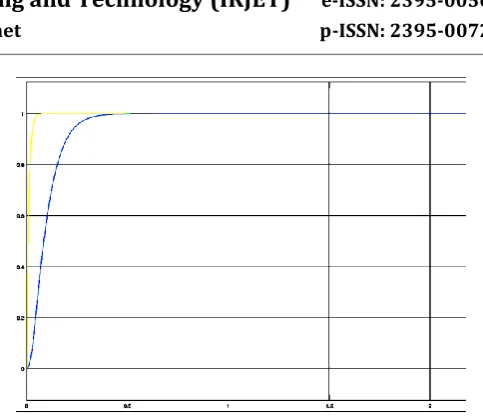
Tuning Altitude PID gain constants Kp=150 , Ki=20, Kd=100 ,results in the system step response shown in Figure 8.
[image:4.595.37.298.129.282.2] [image:4.595.310.564.199.385.2]Fig-8: System step response for the altitude z controller The results from above response Figures are summarized in Table 3.
Table -3: Comparison of unit step responses for the QUAV system with PID controllers
Roll
φ Pitch θ Yaw ψ Altitude z
Rise Time(sec) 0.4 0.3 0.4 1.7
Settling
Time(sec) 0.45 0.35 2.5 5
Peak
Overshoot (%) 0 0 4 8
Steady State
Error(sec) 0 0 0 4
Examining Table 3 shows us a good understanding of the PID control response. The rise time required for Altitude is much longer than for the attitude angles which is obvious in real flight for the Quadrotor, where changing the altitude and reaching settling time is taking more time than merely changing the yaw angle, for example, which would take less than a second. However unlike the attitude angles the Altitude control has a steady state error and noticeable 8% Overshoot.
The Rise and Settling times for unit step response for the Roll and Pitch angles were all under 0.5 second and have zero overshoot and Steady State Error, while the Yaw angle required more settling time and response suffer from Peak Overshoot of 4%.
The PID control is proposed to stabilize the QUAV and according to the above response results, the proposed strategy is successfully applied and the controllers are performing satisfactorily.
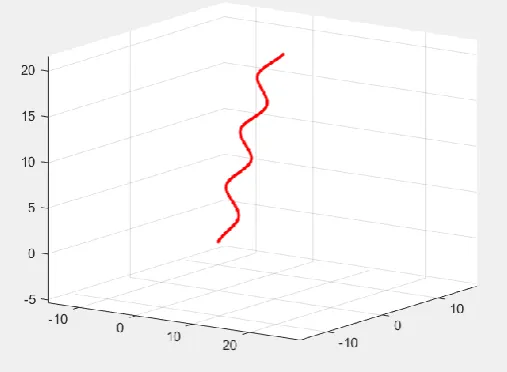
Since the system step response is not illustrating the quadrotor behavior in real flight and to have a better idea of the response to multiple inputs at the same time, a 3-Dimentional visualization of the quadrotor, while a simulation is running, is implemented as shown in Figure 9. In this system simulation the Quadrotor is following an arbitrary trajectory of a ramp z input and a sinusoidal signal in pitch angle.
Fig-9: Simulation for the Quadrotor in 3D space
5. CONCLUSION
In this paper a mathematical model of the quadrotor is developed and implemented using MATLAB and Simulink. To stabilize the quadrotor a controller is required to feedback the output to the input of the system. PID controller has been selected for this purpose. Four PID controllers were designed and added to the model to control the system, After tuning the controller parameters in MATLAB, the results are presented and analyzed, the system was successfully stabilized.
REFERENCES
[1] Luis Rodolfo García Carrillo et al., ”Quad Rotorcraft Control-Vision Based Hovering”,2011.
[2] Samir BOUABDALLAH et al.,” Design and Control of an Indoor Micro Quadrotor “2004.
[3] Oualid Araar and Nabil Aouf “Full linear control of a quadrotor UAV, LQ vs H∞”, 2012..
[image:4.595.40.284.377.529.2]© 2019, IRJET | Impact Factor value: 7.211 | ISO 9001:2008 Certified Journal
| Page 2052
BIOGRAPHIES
Amer Mahdy Hamadi is a graduate of Electronics and Communications Engineering from Al Nahrain University Baghdad, Iraq. Currently pursuing his Master’s degree in Electrical Engineering, specializing in Control System, at Rochester Institute of Technology (RIT), Dubai Campus.