IS
LEMETER
\GNETICS
IPPORTS
IE WEIGHT
ONE
)UNG
.EPHANT
s a jaster, more reliable memory, too!
LLY TEST
t we hope it attracts your ention to the thorough "ee-stage inspection and testing len every TELEMETER MAGNETICS ~mory product - from core to
ray to buffers and memory systems.
1PORTAlH JOB OPPORTUNITIES
IIII'll/un s(uclt JUT a '20-lIIir'f"()s(,(,()lId "ystem
20 Jf! UfJld., ui 2'2 liI',,\ I'll!'!!
liJ\11tW,ilffii j itJit:Il": l,~ill( ,1i(~i'tllijH !~'fu.;liT:USdjll\Ji~t !!lDH tfUfjjlF~l~ !!i~'(~:iij»; ~iU atLriG':t ;J{U; j.\fmlHil.ti1!14:i::v1hT~~: (tori.i!'t!Uiii('l:.1 \~iif~){iI;(iJjtl!~H#:t( , .• ",\,,~'th O!,<:, "",f!'t.t:\'l{,I! .~r:r,':ihr:ltlr.'f." i:flf,tha If-,·;rl.~n ,;.,. ~OYiHir:l""tt.Iilr.lillH
"
~/ ./
.C·l!r~.····~ ')1
r·,1 :!~:rIGS arufac'c;re: th" :-;)em;~r)' sy:;te;' complete from core
pro-du~;t i::: irin.c: t ~is':,j ... and because TElEf~ETER MAGr'lETIGS tests FlU cal ;~e tnat milch :;ur~i when you specify memory
",'!;ar 'lJ':\::~~ mernar! "y~tems to satisfy practically any :;)t)figuf?t:on. linns :-;f :1:'''-' Hl to 1,~:;;O,OOU bits are COlllmon.,. memories can be iiiuil ~,il' :i, a:j:jitic;n, n.~! offers you :\ selection of memory
up:t~, ":ili! r:vr.ie tirnl?s of ;,1 microsecond:;, 6 to 8 microseconds, ilnd 3 microseconds.
[i.':cti or:ic circui::', in TEU:W::n:R f,li'IGNH!GS menlOl y systems employ solid state elements ilrc on n!il;,-in (>W;'j tor com~~3ctness anti mainten'lf]ce ease,
,'f ,. r' t ,.' f ( ,r .... I I j • ~ ~. / i " '(" ( ,: r I' I .7 , .~ / ( ' : ' ! .' ,I .r ) / f ' / •
,\fulIu/ul'lurl ' / ' . ,,!, • I i j' I ' { i I [ • / (~ '. \
0/
1
TELEMETER MAGNETICS
Inc.
July/August 1959
'new!
from
benson-lehner ...
direct display
from
magnetic tape!
Now you can plot maps, charts and graphs directly from
digital magnetic tape by using Benson-Lehner's new
transis-torized con,yerter. Adaptable to any computer magnetic tape,
it eliminates the need for conversion to punched cards and
will more than double the speed of the Benson-Lehner
ELECTRO PLOTTER you already own! By converting
digi-tal tape data to an analog voltage, it provides a compatible
input for many automatic graph plotters and X-Y recorders.
Write now for information or to have an applications
engi-neer help establish your exact requirements.
~
bel"1lsol"1l-leh l"1Ier
Co'pomtiofl 1860 Franklin Street· Santa Monica, CaliforniaOFFICES: LOS ANGELES; WASHINGTON, D.C.; DAYTON, OHIO
Service Center in 28 cities throughout the world.
C '59 PB
2
The way to know -
An ominous shadow over ocean or wasteland ... an unidentified "blip" on a radar scopeI
A challenge from an airborne AN/ APX-7 interrogating unit spurts into the ether. In microseconds a reply identifies the potential marauder as friendly. The absence of such a reply alerts the pro-tective and retaliatory might of the nation.ENGINEERING BEYOND THE EXPECTED Packard Bell's reputation as a leading designer and foremost producer of IFF (identification, friend or foe) equipment is indicated by the fact that both the AN/APX-7 and the AN/APX.6, which returns the reply, are products of our Technical Products Division. Advanced devel-opment, company-sponsored, has recently pro-duced miniaturized IFF modules which operate up to 200oC.
Technical Products Division 12333 W. Olympic Blvd. Los Angeles 64, Calif •• BR. 2-2171
Circle 3 on Reader Service Card.
from the
.editor ...
A headline writer might title this piece, "Who's on Second, Is Bull on Third?" He would, of course, be heading a story concerning the developing controversy in the Computer League Standings.
IBM has been, and should continue to be in the forseeable future, THE first place club. But as to who is the second largest computer manufacturer in the world ...
For years, everyone just assumed it was Remington Rand. Then, about a year ago, Burroughs Corp. laid claim to the No.2 spot.
What was a neat two-way American argument turned into an international situation this year when not one but two British firms decided they liked the sound of "second." International Com-puters and Tabulators said they were just behind IBM as did Electrical and Musical Industries.
A slightly more modest Bull Machine Co. (France) decided to settle for the No. 3 position. They so stated in a world-wide news release in June. But if Bull is third, which of the four claim-ing second was also wrong about beclaim-ing No: 3. And who is in slots 4, 5 and 6. Even if this debate could be settled, all of the firms concerned, including IBM, are probably mistaken in their claims. Surely, the world's largest com-puter manufacturer is in Russia .
. 1
..
.,
.1If three of your 700-series computers and 7,000 reels of tape (the correct figure) burned up one day, would you be inconvenienced?
Certainly a lot of interest was gen-erated, along with the heat, from the blaze in Air Force Colonel Marshall Gray's statistical services data process-ing facility in the Pentagon on July 2. A 704, a 705 and a 709 melted down and all those reels of tape went up.
The cause? Col. Gray: "Faulty wir-ing in the tape vault (our first esti-mate)." The cure? "Fireproof the tape vault." Three machines in one room again? "A must. Space limited." How are you surviving? "IBM moved in a
705 and a 709 within two weeks. Lots of 704 time available from other
in-stallations. In fact, more time available now than we ever had but this is a tough way of getting it." What about the info on the tape? "We should be able to reconstruct over 95 % of the material." When will you be in opera-tion again? "In 30 days."
Moral for the industry: Checked your extinguishers lately?
DATAMATION is published bi-monthly on or about the first day of every even-numbered month by F. D. Thompson Publications, Inc., Frank D. Thompson, president. Executive Circulation and Advertising offices, 141 East 44th St., New York 17, N. Y. (MUrray Hill 7-5180). Editorial offices, 10373 West Pi co Blvd., Los Angeles 64, Calif. (BRadshaw 2-0817). Published and ac-cepted as controlled circulation publication at Chicago, Illinois. Copyright 1958, F. D. Thompson Publications, Inc.
July/August 1959
prints up to
48,000
digits per minute
adaptable to all digital data sources
these
OPERATI NG SPEEDS
~ 4 BIT DATA @ 20 lines/sec. 6 BIT DATA @ 10 lines/sec. PAPER FEED TIME ... 15 Ms SERIAL LOADING RATE 20 kcs
CUSTOM DESIGNS
Designs to meet MIL or Commercial Specs.
features
• • •
RELIAB I LITY
Solid state storage, transistor-ized hammer drive and paper feed ••• troublesome contacts and wiper arms eliminated by reluctance pickup. Digital logic throughout.
COMPATIBILITY
4 or 6 bit input data in par-allel or serial-parpar-allel form and in any coding system.
FLEXIBILITY
Self-synchronized or random (slaved) operating modes Tailored horizontal and/or vertical formats
Modular construction permits wide variation of characteristics Accessible input/output command functions for maximum utility
A&1tJ
.
rtJ"":'~)
POTTER INSTRUMENT
COMPANY~INC.
" . .'~ .... // Sunnyside Boulevard, Plainview, N. Y. OVerbrook 1-3200
Circle 4 on Reader Service Card.
. -1
::'
\-
- . ...'"
" \
_, - - -H~I
'"
L. ______ •
"
~---. ~---
..
I
ICODIlCI I
II ~";;L_P
:----=--~i
---)
:
I ./
"
I[]
'iJOI'
J-I'd
;1
I.-~
I
'u-
II
"
I--+
S)r=C
5 2 0 0
IJ
,
II
.... +-
______ JCLOSE TOLERANCE PRINTING
ON PRE-PRINTED FORMS
4
Newest of the S-C 50QO Series High-Speed
Elec-tronic Printers, S-C 5200 Registration Printers
are specially designed for commercial
applica-tions requiring close tolerance registration of
computer data on pre-printed forms. Printing
up to 5',000 lines per minute-five.to ten times
faster than electro-mechanical printers -
S-C
5200 Registration Printers provide unequalled
efficiency and economy in large-volume
proces-sing of invoices, statements, premium notices
and inventory records.
Send for complete information concerning S-C
5200 Registration Printers. Ask for Bulletin 7-D
Write today: Stromberg-Cadson -
San Diego,
1895 Hancock Street, San Diego 12, California.
GENERAL DYNAMICS
STROMBERG-CARLSON DIVISION
Circle 5 on Reader Service Card.
the automatic handling of
in formation
volume
5,
number
4
FRANK D. THOMPSON Publisher
GARDNER F. LANDON Vice President
SANTO A. LANZARonA Editor
ETIENNE J. GUERIN European Editor
BETTE L. H'OWE Production M imager
MARTHA KNOWLES Circulation M gr.
DANIEL D. McCRACKEN C. L. WAN LASS
Editorial Advisors
RICHARD W. NIELSON Sales Mgr.
WARREN A. TIBBETTS
New England District Manager
434 Webster St., Manchester 4, N. H. NAtional 5-9498
RICHARD W. NIELSON
Eastern District Manager
141 E. 44th St., New York 17, N. Y. MUrray Hill 7-5180
ALBERT PUDVAN
Cleveland District Manager
3537 Lee Road, Shaker Heights 20, Ohio WAshington 1-9370
GILBERT THAYER
Midwest District Manager
201 N. Wells St., Chicago 6, "'. Financial 6-1026
HAMILTON S. STYRON
Western District Manager
10373 W. Plco Blvd., Los Angeles 64, Cal. BRadshaw 2-2643
E. J. GUERIN
European Manager
Box 824
Stockholm 1, Sweden
July/August 1959
ARTICLES
6 Internati.onal Conference on Information Processing
Presented in a special five-page report is a review of events and
accomplishments at the Paris meeting and pictures of conference personalities.
} 4 Automatic Programming in the Soviet Union
A. P. Ershov outlines some of the earliest automatic programming work done in Russia and discusses various procedures in this work.
24 lsI t Overhaul or Trade-in Time?
Computer specialists meet at RAND. Among topics discussed-A re present professional societies adequate? Is a new society needed?
48 All About Paper Tape
In this second of two installments, eight manufacturers of paper tape equipment present representative products.
52 Competition, It's Wonderful!
There is quite a battle shaping up between RemRand's USS-80 and IBM's 650 IV. We present the facts and figures.
DEPARTMENTS
3 from the editor ...
21 Datamation in Business and Science 36 Datamation Abroad
39 New Products in Datamation
43 New Datamation Literature 53 Datamation News Briefs
56 Advertiser's Index
With the fuly/ August issue we introduce two advisers to the editorial staff . .. DANIEL D. McCRACKEN, author, writer and private consultant in computer programming, worked directly with computers (in many applications) for the GE Company from 1951-58. He is author of "Digital Computer Programming," (1957, fohn Wiley & Sons) and
"Programming Business Computers," published this June by Wiley, and co-authored by Harold Weiss and Tsai-Hwa Lee. His latest book covers programming-from analysis to flow charting to coding-with special emphasis on its application to business data processing.
CRAVENS L. W ANLASS, director of research at Computer Operations, Aeronutronic, a div. of Ford Motor Co.,
has been responsible for the design of a number of vacuum tube and solid state digital computers (mostly for military applications). He holds patents in digital computer techniques and basic computer elements and has authored a number of technical articles. Wanlass headed the computer dept. at Lockheed's Missile Systems Div., and directed computer component development programs at Ramo-Wooldridge and North American, prior to
-joining Aeronutronic.
EDITORIAL OFFICES - 10373 W. PICO BLVD., LOS ANGELES 64, CALIF.
OVER 24,000 CIRCULATION
DATAMATION is circulated without' charge by name and title to the manufacturers and users of automatic, information-handling equipment in all branches of business, industry, government and military installations. Qualified individuals in the United States and Canada are invited to request this publication on their company letter-head, stating position and firm's business. Available to others by subscription at the rate of $5.00 annually; single issue, $1.00 when available. No subscription agency is authorized by us to solicit or take orders for subscriptions
in the United States, Canada or overseas. DATAMATION will accept and consider articles dealing with small, medium and large electronic data processing systems; articles covering de-velopment and application of components, sub-systems and sub-systems; and other general arti-cles of interest to those In the data processing industry. Material submitted should be accom-panied by pictures and illustrations when pos-sible. Unsolicited manuscripts to be returned to writer should include return postage but editor assumes no responsibility for their safety or re-turn (although all reasonable care will be taken).
Top-This is a general view of the ICIP opening session which was held in Paris' Sorbonne University amphitheater.
C~mter~ICIP delegates- attended sessions in the new UNESCO buildings. Pictured is the plenary session auditorium.
Lower left-One of the symposia is in session in another of the modern rooms. Note individual desks for spectators.
Lower right-This translation booth in full operation offered, simultaneously, Russian, French, Spanish and English translations of conference papers and addresses,
·6
Editorial and pictorial coverage of the International Conference on Information Processing, as repre-sented on these pages, was pro-'vided by DATAMATION's Euro-pean Editor, Etienne I. Guerin (pictured in ICIP p'ressroom),
In looking back on the first International Conference on Information Processing (Paris, June 15-20), the most sig-nificant feature seems to be that it was held. "Finally held" might better express the feeling of many conference at-tendees who have long recognized the need for. formal international cooperation in this ever-broadening field.
The United Nations Education and Scientific Organiza-tion lent its name and brilliant organizaOrganiza-tional techniques to this first gathering of nearly 1,800 data processing dele-gates from 37 countries and 13 international organizations.
It is .an understatement to say that UNESCO assistance insured the conference's success fro'm the start. The con-ference site and facilities provided in the world organiza-: tion's new buildings were, in that order, beautiful and ex-cellent. One feature most appreciated was the simultaneous translation of papers and addresses to delegates made possible by the staffing of translation booths overlooking the main auditorium.
What seems to be a persistent computer conference complaint was heard at this gathering - technical papers offered nothing new or revealing. But this Haw was easily overshadowed by the many ICIP accomplishments.
Perhaps the most important result of the meeting was the creation, on June 18, of the International Federation of Information. Processing Societies.' (See page 8.)
Another striking feature of the conference was one that seems to be a' persistent computer conference advantage. Major contributors to the computer field from all over the 'world re-established old friendships and made new friends at. a rapid rate. The exchange of new ideas and new in-formation privately probably exceeded that which took place at formal presentations.
Official inauguration of the ICIP was held in the amphi-theatre of the Paris Sorbonne University, a short distance from the statue of Pascal, an originator of calculus.
Welcoming the participants, UNESCO acting director general, Rene Maheu, stressed the practical importance of the ICIP by declaring:
"It is impossible today to imagine a large plant, a large government office, or a large research laboratory without a computation service in which a few of these machines replace a large number of specialized (personnel). One cannot even say that these machines take the place of men because in fact they enable the performance of operations which ~ould be practically impossible (without computers) because of the number of man hours they would require. Thus, man's intellectual power has been increased in an extraordinary manner by placing at his disposal inex-haustible memories and automatic calculation organs, capa-ble of ultra-rapid consultation which can perform in a few seconds what once required weeks to accomplish."
The audience then heard an address by Professor Howard H. Aiken of Harvard University, who traced the history of the electronic computer back to its early days, twelve years ago, when scientists were trying to construct any kind of a computer which would work while being given problems to solve on this computer posed by other branches of science. "Progress has been great and it will continue," he stated, "as long as faster machines of smaller bulk are required."
Andre Danjon, director of the Paris Observatory and president of the French Computing Association commented that the ambitious program of the ICY would have been "pure madness if we had not been certain of being able to analyze very rapidly all the data gathered from the entire surface of the earth."
Such a gathering as the first ICIP was badly needed to take stock of world-wide knowledge in the field of auto-matic information handling. If there was ever any doubt, this conference demonstrated that the science of comput-ing has come of global age. ICIP participants can be proud of having been part of this epoch-making conference. Others will undoubtedly follow .
Top-During a taped broadcast recorded by UNESCO for distribu-tion to the UN in N ew York and SO networks around the world, issues regarding human values and computers were discussed by a panel composed of {left to right, clockwise} Sami de Picciolto, Italy; Bernard S. Benson, U. S.; Willem van der Poel, Holland; Gilbert W. King, U. S.; and Ritchie Calder.
Bottom-Howard H. Aiken, head of the Computation Laboratory at Harvard University receives the only Gold Medal awarded during the conference from Jacques Dursort of the Paris City Council. Medal honored Aiken's work in ICIP planning and his role as honorary chairman.
. DATAMATION's tabulation of the ICIP attendance breaks down as follows:
Argentina __ ~~ _____ ~ ________ .___ 3 Finland ______ .. _ ... __ .________ 6 Israel ___ . ____ ._ .. ___ .. _ .. _______ . 8 Sweden __________ .. __ . ____ .: ... __ ~ 87 Australia _________ . __ -______ .__ 4 France ... _________ . ___ . ____ . __ 504 Italy ___ .. _____ .... ______ . __ .. _____ 83 Switzerland ... ____ . ____ .__ 26
Austria" . _____ .. _;._~. ____ .. _~_ .. _.
10
West Germany ___________ .. _204J
apim ____ .... __ ... __ . ____ .____ 16 South Africa ____ .. ____ ... _ 3 Belgium .. _, ____ .;. __ , __ ... __ ... 35 East Germany _______ .. ___ ..11
Mexico __________ .. ___ .. ____ .. ___ 3 United Arab Republic __ ..1
. Brazil ___________ ._ .... _______ : __ . 2 Ghana ______ .. _______ .. __ ... ____
1
Netherlands __ ... __ .... ____ .. ___ 79 United Kingdom __ .. ______ .,165 .'. Bulgaria . __ ... ___ . __ .____ 3 Greece __ .... _______ ._ .. _________ 2 Norway _ .. ____ .. __ ... __ ...5
U.S.A. : __ .. __ ... __ .. ____ .. ______ .. 406Canada __ ... , ________ .". __ ._..
5
Hungary ._______________________ 3 Pakistan _______ . _______ ... ___ 1 U.S.S.R. _ .. __________________ ... 38 : . China ... ______ .... __ .. __ ... ;_.. 2 India ____ . ______ ... ________ .... 3 Poland ____________ .... __ .... ____ 18 Yugoslavia _ ... __ .. _ ... ____ .. 6 Czechoslovakia ... ; ... __ . 6 Indonesia .. _________ .. ____ .. ___1
Portugal __ .... __ .. ________ ... __ . 3 IntI. Organizations ._____ 20Denmark : __ .. _. __ ; _____ ... ~ __ .. 14 Ireland _________________ .. _._____
1
Spain .. __ ... ____ .. __ .________ 8 TOTAL 1,796In sponsoring the ICIP, UNESCO actcd to assist those pel:sons and groups interested in information processing in establishing closer cooperation. On June 18, at th~
Paris conference, this cooperative spirit resulted in forma-tion of the Internaforma-tional Federaforma-tion of Informaforma-tion Proc-essing Societies, IFIPS. This body was established to sponsor future international conferences· on information processing and to coordinate a world-wide exchange of information in the field. IFIPS will also establish interna-tional committees to undertake special tasks falling within the spheres of action of national member societies.
The Provisional Bureau, acting on behalf of IFIPS until the first quarter of 1960 was also formed until actual ratification will have been confirmed by the various coun- . tries. Representatives who decided upon the formation of IFIPS were highly placed individuals in their own coun-tries and in the societies with which they are affiliated. In this capacity they were acting as private individuals until they can report back to their respective countries with a proposal for ratification of IFIPS statutes.
Sorbonne University Professor, Pierre Auger, Secretary General of the ICIP, heartily endorsed formation of IFIPS with this statement: "It is an absolute necessity that there be an international body to serve the needs of the science of information processing. There are already similar inter-national organizations serving such sciences as geodesy, astronautics, radio, medicine, astronomy, mathematics, chemistry and physics. UNESCO has agreements for pro-viding consultative services and cooperation to the inter-national, non-governmental organizations representing these other sciences, helping them to widely express the views of their members and also receiving from them ex-pert information, advice and technical operation.
"In sponsoring this current ICIP, UNESCO accepted responsibility only for convening the first international meeting ... \Ve had expected, and correctly so, that snch a meeting would act as the catalyst for the formation of an international federation. \Ve look forward to the possibility of an agreement, similar to the cooperative agreements with other international bodies representing other sciences,
8
IFIPS
These men lcill head the proL'isiollal bureall of the International Federation of Informa-tion Processing Societies until I Fl PS charter has been ratified by member countries. Left-Yuri lakoricez:ich Bazilievsky. Russia. rice-chairman.
Center-Isaac L. Auerbach. U. S .. chairman.
Right~Adrian z:an Wijngaarden. l\'ether-lands. vice-chairman.
with this new IFIPS, which already appears to represent preeminent national organizations for this . . . science."
Chairman of the provisional bureau for IFIPS is Isaac
L. Auerbach, representing theU. S. National Joint Com-puter Committee. He was elected unanimously by the international group until some time in 1960 when the Federation will hold its first meeting. Vice Chairmen will be Professor Yuri Iakovicevich Bazilievsky, subject t(1 the agreement of the Academy of Sciences of the USSR, and Professor Adrian van Wijngaarden of the Mathematical Center, Amsterdam, representing the Dutch Computer So-ciety. Jean Mussard, secretary of the ICIP, will be acting secretary of the Federation.
The next ICIP and associated technical exhibit will most likely be held in 1963 and will be sponsored by IFIPS. Each country represented in the provisi,onal bureau - 18 countries in all - have been asked to propose a site for such a· meeting.
At the moment, all activities wilJ4
be c()()Iclinated by Auerbach (his address - Auerbach Electronics Corp., 109 N. Essex Ave., Philadelphia, Penna.) and through Jean Mussard (UNESCO, Palace Fontenoy, Paris, France) until the IFIPS seat is established in Brussels, next year.
Days of intensive effort ll'ere necessary hefore the IFIP.') he('arne Il
reality. One of the lForking sessions is pictllred in ful! Siring.
ORTRMRTION
IT
From June 13 to June 23, The International Exhibition of Digital Processing Units, which was known by the shorter name of AUTO MATH 59, attracted 10,000 spectators having a passing or lasting interest in information process-ing equipment.
About 1,500 ICIP participants toured the exhibit area - many of them several times. Displaying equipment in two halls (10,000 sq. ft) were 29 exhibitors from eight countries. It was the first time that data processing units from the Western Hemisphere, Europe and the Far East were exhibited together. Equipment from France, U.S.A., West Germany, Great Britain, Sweden, Italy, Belgium and Japan was shown.
One of the most talked about AUTO MATH features was the large display of Japanese equipment, much of which was seen for the first time in the West. Key Far Eastern personalities in the computer field claimed that Japan would soon be able to manufacture a considerable amount· of computer equipment at stiffiy competitive prices. They point out that their first market is a large one - the many countries in the Middle and Far East which have not yet been exposed to information processing.
In speaking of the trend toward the emergence of Japan as a major factor in computer production, the following points may be noted. A number of their technicians have been and are being educated in the West, and. are re-turning home full of ideas. They are limited only by the size of the budget available to them. Prices will certainly bea key feature in the attractiveness of Japanese equip-ment. Speed might be disregarded to a certain extent but, of course, will not be completely overlooked. Some Japa-nese equipment is attempting to penetrate the U.S. market (see New Products) and in fact a few components used in U.S. equipment have been bought in Japan. But it will probably be some time before a real effort is made by the Japanese to invade Western markets.
A discussion of equipment exhibited at AUTO MATH by many of the countries mentioned above will be featured in the next issue of DATAMATION.
July/August 1959
EXHIBITS
Top-Exhibited at AUTO MATH S9 was this HIPAC 101, manu-factured by Hitachi Ltd. of Tokyo. HIPAC stands for Hitachi Para-metron Automatic Computer. It is a binary,fixed point machine. Center-This Belgian-made endless loop magnetic tape storage was also on exhibit in Paris.
Lower right-A binary, serial computer, the Stantec Zebra, was shown at AUTO MATH. It is made by Standard Telephones and Cables Ltd., an IT&T affiliate in England.
Lower left-On display was this mock-up of a Facit EDB installa-tion using ECM-64 carrousel memories (right).
Left to right, Ahmed M andzic, Tihomir Aleksic, and lovan Petrie. All are of the Institute of Nuclear Sciences "Boris Ki-dric," Belgrade, Yugoslavia.
Left, M; Lehman (Israel) of the Scientific Dept., Ministry of Defense, Tel Aviv, Israel. Right, Sorbornne University Professor, Pi-erre Auger, from France, acting as special advisor for ICIP and Unesco.
lean Kuntzmann (left) of the Fourier Insti-tute, Grenoble, France, and Manuel Sadosky (Argentina) of the Faculty of Sciences, Buenos Aires.
Left, Alston S. Householder (U.S.A.) of Oak Ridge National Laboratory, and Philippe Dreyfuss (France), Bull Machine Company.
10
Left, Dr. Alwin Walther, 61, has been teach-ing for 31 years at the Darmstadt Technical University, West Germany, where he started the famous Institute for Practical Mathe-matics. Right, L. Bie~mann of the Max Planck Institute of Physics, Munich, West Germany.
Left to right, Dr. H eido Yamashita (I apan) , 70, who has been teaching electrical engi-neering at Tokyo University for 40 years; Prof. Howard H. Aiken (USA), Computa-tion Laboratory, Harvard University; Dr. Hiroshi Wada, (Japan) Chief of Electronics Div., Electrotechnical Laboratory, Ministry of International Trade and Industry. Drs. Yamashita, and Wada, are pioneers in I apa-nese computers.
Left to right, Philip Rabinowitz (Israel), Chief. Programmer, Weizmqnn Institute of Science in Rehovot,'who will visit the US at the invitation of the National Bureau of Standards; Zwi Riesel, (IsTliel) Chief Engi-neer, Weizmann Institute; and Gordon D. Goldstein, (USA) Office of Naval Research ,in Washington and editor of DIGITAL
COMPUTING NEWSLETTER.
PERSONALITIES
Christofer Strachey (left), National Re-search Development Corp., London, Eng-land, and Maurice V. Wilkes (right), Uni-versity Math Lab., Cambridge, England.
Left to right, Nikolai Birukov, Institute of Automatics and Telemechanics, Moscow; Anatoli Alexeeivitch Dorodnitsyn, Chief of the Computing Center, Academy of Sci-ences, Moscow; Paul Tikhonov, Academy of Sciences, Moscow, USSR.
Left, Motinori Goto of the Electrotechnical Laboratory, Tokyo, lapan-an ICIP scien-tific consultant, and right, Eiichi Goto of Tokyo, one of the parametron inventors.
:Left to right, US panellists, Edward Cannon, National Bureau of Standards, Washington; Mrs. Ida Rhodes also of NBS; an unidenti-fied participant; and Anthony G. Oettinger of Harvard University, Cambridge, Mass.
F-J06 model in Convair's supersonic wind tunnel at San Diego, California.
MicroSADIC ... Consolidated's new all solid-state data pro·, ssing system ...
is now in action sampling, digitizing, and rec
.
a.t:the~maximum
speed of
.,y,.,.p'
computer input. In one high-speed wind tunnel,
5
force mode channels and
associated block
'gaps
are recorded by this inte
system in less than 20
milliseconds. In the pressure mode sampling of
all 125
data
V~~''''''~:';'&;~V.I.Io~'-J'"",~,~.L
only
0.8
seconds. These are just some of the capabilities of this flexible au
matic system ... a system that can also be custom-tailored to rocket
thermostructure, or t.elemetry data reduction. Full information is in
CEC 3020-X2.
'S''':;'':''::'~''''
: /-")'.
\CONSOLIDATED SYSTEMS
l'
"YCORPOR
1500
S.
Shamrock, Monrovia, Calif, \
~)
i\
SUBSIDIARY'w;
Complete from transducers through digital magnetic tape, the system acquires and processes data directly compatible with entry into either the IBM 650 or 704 computer. Auto-matic plotting of the computed data is also provided:
"'--'
Circle 6 on Reader Service Card.
THE
!?O
ill&)[!
ALL TRANSISTORIZED ANALOG COMPUTER
-. basic mode/less than
$4000
PACE TR·10 Eliminates Drudgery- Gives New Insight Into Engineering Problems
This compact unit, 15" x 16" by 24" high, is powered by 115 volts AC and can provide day-in day-out instant solution of your most vexing engineering problems. Even if you have never seen a computer before, you can learn to operate the TR-IO as easily as you learned to use a slide rule.
Simply turn a dial to feed in design parameters, and the computer provides an instant by instant, dynamic picture of the effect of each change. You can study the inter-related effects of heat, pressure, flow, vibration, torque or any vari-able, and visually compare one with the other. Engineering data comes alive - insight into how new designs will work is obtained easier, faster.
Because of its minimum size and low price, the rrR-IO can become your own personal analog computer. You gain first-hand experience with the power of analog techniques, and convert more of your time to creative engineering. New ideas that were too costly to try before are now practical.
You can design virtually to perfection and have a permanent, visual record of performance before building pilot models or prototypes. As a result, "cut and try" expense is reduced.
The same quality workmanship and design that has made Electronic Associates the world's leading producer of pre-cision general purpose analog computers will be found in this new unit. Accuracy to ±.1 per cent. Modular construc-tion allows you to select varying quantities of the following computing functions: summation, integration, multiplication or division, function generation, parameter adjustment, logical comparison.
for complete engineering data, write for Bulletin TR-J O-G.
ERI
ELECTRONIC ASSOCIATES, INC.Long Bmnch, New Jersey
Circle 7 on Reader Service Card.
Do computers
really
pay?
47 users in the civil engineering field
alone, are proving that the Bendix G-15
more than pays its way.
The repeated computations encountered by civil engineers in "the design of highways, bridges, dams and other public works, are tedious at best. With electronic computation the engineers are relieved of such uncreative work because the computer performs repetitive arithmetic automatically at high speed.
In time savings alone, the Bendix G-15 is a profitable tool. But add to that the value of the extra productive hours available to each engineer and the fact that the computer eliminates compromise solutions by finding the best answer through many "trial and error" solutions at tremendous speed - you can begin to see the important hidden profits of elec-tronic computing.
Many problems are being selved today on the Bendix G-15 that have never been solved before, because of the many man-years of math that manual methods would require. Pronts here are so great that it is difficult to even measure them. Then there is the increased accuracy of electronic computing, with the resulting reduction of checking time.
The benefits are so many and varied that it is difficult to express them in dollars and cents. But qonsider the proof that 47 Bendix G-15s are being used in the civil engineering field alone. And in other fields - electronics, optics, tools, mis-siles, navigation, illumination, and even animal husbandry, the G-15 is making itself known as the computer that pays big profits in many ways. Full details are available on request.
July/August 1959
DIVISION OF BENDIX AVIATION CORPORATION
Circle 8 on Reader Service Card.
PARTIAL LIST OF
CIVIL ENGINEERING USERS
Alfred Benesch and Associates Barber-Colman Company Bonneville Power Administration Bucyrus-Erie Company
Butler Manufacturing Company Clark, Daily and Dietz
Consoer, Townsend and Associates Cook County Highway Department Crawford, Murphy & Tilly De Leuw Cather and Company
Edwards and Kelcey, Engineers &"Consultants Ellerbe and Company
Emmet J. McDonald Associates Harley, Ellington & Day, Inc.
Highway Research Board, AASHO, Road Test H. W. Lochner, Incorporated
Homer L. Chastain & Associates Hurst-Rosche, Incorporated Illinois Division of Highways J. E. Greiner Company
J. Stephen Watkins, Consulting Engineers Jenkins, Merchant & Nankivil
John F. Meissner Engineers, Incorporated Lockwood, Kessler & Bartlett, Inc. Michigan State Highway Department Palmer and Baker Engineers, Inc.
Parsons, Brinckerhoff, Hall and Macdonald Portland Cement Association
Reynolds, Smith & Hills
Richardson, Gordon and Associates Rochester and Goodell Engineers, Inc. Stanley Engineering Company Tudor Engineering Company U. S. Army Corps of Engineers Vogt, Ivers, Seaman Associates Warren & Van Praag, Incorporated
Wilson and Company, Engineers & Architects Wyoming Department of Highways
DEPT. E-9a, LOS ANGELES 45, CALIFORNIA
AUTOMATIC PROGRAMMING IN THE SOVIET UNION
by A. P. ERSHOV
Chief, Theoretical Programming Dept.
Computing Center, Academy of Sciences of the USSR
as related to ETIENNE J. GUERIN
DATAMATION'S European Editor
Automatic programming can be defined as the use of. a computer to perform automatically any part of the pro-gramming job. Early developments in this field in the USSR took place in 1954. And the greatest influence in programming methods can be attributed to Professor A. A. Ljapunov who in the years 1952-53 described the OPER-ATOR PROGRAMMING METHOD in his series of lec-tures "Logical Schemes of Programs" at Moscow University.
The main features of the operator method are· that the program is conSidered as a complex operator acting with initial data, and consisting of elementary operators of various types. The main types of elementary operators acting with initial data are ARITHMETICAL OPER-A TORS performing direct, data transformation, and logical operators determining the next sequencing of computa-tions. The conception that the operator should depend on some integer parameter-for instance the address of the indexed number depending on the values of these indexes -was also very important. Considered, too, were CON-TROL OPERATORS not acting with initial data but deal-ing with the program itself. To be mentioned were the READDRESSING OPERATORS, (1) changing the de-pendent parameter addresses while the parameter value is changing, and (2) the RESTORATION OPERA TOR restoring the dependent parameter addresses to their initial condition according to the initial value of the para-meter. The detailed computing plan's· record written as the sequence of the operators of various types is called the operator scheme of program (or logical scheme of program). Ljapunov's operator method was very important in the development of automatic programming because:
14
(1) For the first time the program components-here called elementary operators-were form-ally classified according to their functions regardless of the . problem programmed. In this way the language of the logical scheme program could easily be formalized, and it was made universal for writing problems to be solved.
(2) The language of logical schemes of programs was easy to algebraize, which fact was veIY, important for the direct input of the pro-gram's logical scheme into the computer. (3) The logical scheme of program as an
inter-mediate result of the programmer's work successfully separates the programming proc-ess. The composition of the logical scheme corresponds to the "intellectual" work of the programmer while the laborious mechanical work becomes a transition from the logical scheme to the object program. Accordingly the stage of the programming process which is the. easiest to automatize, was separated. (4) Separating the whole problem as a sequence of separate operators permits the programmer , . ,r:, to divide the programming· process into
pro-gramming of separate elementary operators, which makes the coding easier.
V. M. Kurochkin composed in the summer of 1954 in the Computing Center a program for BESM, permitting symbolic programming.
L. M. Korolev composed the first version of the program for BESM which carried out the programming of arith-metical formulas.
G. S. Bagrinovskaja from the Mathematical Institute described a project of the program for programming of readdressing operators.
E. Z. Lubimsky and S. S. Kaminin in summer 1954 constructed the programming program for the STRELA computer (designated as PP-1), performing the program-ming of readdressing, restoring and logical operators.
Such work was only experimental but was a necessary step toward the design of large programming programs.
the first programming program,s
During Professor A. A. Ljapunov~s seminar in October 1954, E. Z. Lubimsky and S. S. Kaminin described the first project of the programming program (designated as PP-2) which fully automatizes the transition from the logi-cal scheme to the object program.
Source information for this programming program con-sists of (1) the logical scheme of the program and (2) the table of storage assignment. The logical scheme may in-clude arithmetical and logical operators, readdressing ,and restoring operators and so-called non-standard operators presenting parts of the object program written in com-mands with symbolic addresses.
strela-3 programming program
,The main result of the Computing Center's work in the field of automatic programming is the present-day pro-gramming program for the STRELA-3 computer which is
installed in the Center. Work on the programming pro-gram for the STRELA-3 (designated as PPS) started in the fall of 1956. It was completed in the fall of 1957 and was p'erformed by 6 staff workers of the theoretical pro-gramming department.
When requirements for the source information were developed, the following aims were sought: (1) The repre-sentation of the source information has to be close to the mathematical formulation of the problem. (2) The size of auxiliary and technical work not connected with the math-ematical formulation has to be reduced to a minimum. (3) The source information must give full information about the structure of the object program. (4) Source in-formation must be maximally compactable and presentable.
Source information prepared by the programmer con-sists of 5 parts. These are the program's scheme (the main part of information), the carried away operators, informa-tion about variables, informainforma-tion about storage blocks, and blocks. Some source information parts may be absent.
A few comments are in order· concerning terminology used here. A variable is a letter symbol contained in the source information, which may denote some mathematical variable or constant, . or in general, any machine word. A storage block means any group. of locations which has to be placed in the storage one after another.
Regarding information about variables, all the variables . requiring some additional information are written down. Such additional information may be a constant, if the variable represents a constant. Four types of constants may exist, such as decimal floating-point constants, binary floating point constants, commands with symbolic ad-dresses and commands with real adad-dresses. This additional information may also be an address, in case the location of the variable in storage is to be prescribed.
Blocks include any data placed into blocks and intro-duced into the storage by the object itself.
strela-3 program's scheme
In the program's scheme all operators of the object program are written down one after another and the order of placing the operators in the scheme corresponds to their place in the object program. The scheme may include op-erators of the following types:
Name of the operator Symbol denoting the operator's type
l. Arithmetical A
2. Logical L
3. Restoring V
4. Non-standard H
5. Readdressing P
6. Double-counting DC
As a rule every operator is represented by a letter de-noting the operator's type after which in parenthesis, in-formation about the operator follows. The letter symbol and parenthesis may be omitted only for the arithmetical operators.
Name Symbol
Operations with two arguments
Addition Subtraction
Addition by modulo 2 (digit by digit)
Logical addition (digit by digit) Multiplication
Logical multiplication (digit by digit)
+
+
v
x or • (see below) /\
Operations with one argument
Integer part Fractional part Absolute value Sign Sinus Cosinus Arcsinus Arccosinus Arctangent Exponent. Natural logarithm
Binary to decimal conversion Decimal to binary conversion Logical negation (digit by digit)
powers: E D Mod sign sin cos arcsin arccos arctg exp In Dec Bin
--,
1 2 3 !<. -~ +p
x-, x. X. xt
, X ,x~ (1<P<51l,O<Q<7)
The usual hierarchy of operations u.sed in mathematics is used for the determination of the order of operation ful-fillment. There is only one difference between the marked and non-marked multiplication (x and .), which is obvious from the following example in which arguments of the corresponding operations are underlined:
cos '2 x2 + sin(a+ b)(a-b)+ sin(a-+b) x
(a-b)--Mod
lC.
sign(x +y) a2Besides this, the following notation is allowed: sinm x, which denotes (sin x)m.
The Computing Center's experience shows that the only transformations of formulas which are necessary in the preparation of source information are: (1) the omitting of radixes and (2) the replacement of division by appropriate powers.
As part of the program's scheme it may be necessary to perform the cycle repetition of certain sequence of'
oper-ators. For this purpose such a sequence is inserted into a loop. Besides this, special symbols may appear in the source information, denoting the command transmitting information between computer's parts, and transfers. Every operator may possess a number which is rendered by a letter denoting the operator's type as a subscript. Every operator can be carried away from the program's scheme into the second part of the source information. All the non-standard operators and some complicated arithmetical ones are carried away into the second part. In this case, in place of the operator carried away, a letter denoting its
type with the number, is left in the scheme. The main rea- logical operators
son that the source information is presentable and oQVi()u~ A logical operator performs the verification of 1 of 5 is the successful solution of the problem of/f€C"th:ding~<~,:, standard logical relations which are:
arithmetical formulas and the use of obvioussyinholism. 1
I~:
':,. a < b a < b I al < Ibl lal < Ibl a = barithmetical operators .... ; ; > . ' ; . : " where a and b are variable or constants
The arithmetical operator fulfills the
evaluatidii·~~ia~~EbiJ.:it:i{;:~
/li
In the program's. scheme, logical ;perators are the sequence of formulas as i n ' j · y ; · , s e n t e d as:
repre-:;.~t
LCa~b[l)
F (Xl"'" Xn) ~ y ' '~"::' .• ,~._~~:.:.:;;: N
z where F is a superposition of operations from some fixed
list of operations and Xl , ••• ,Xn are variables and con-stants. In particular, this list contains all the operations of STRELA-3. y denotes the result of evaluating the formula. The constants in formulas are represented either by letters or by numbers. The variables may have any number of letter subscripts. In this case every subscript must be a parameter of some loop.
Here is the list of operations and their abbreviations used by the arithmetical operators:
July/August 1959
where Nl and N2 are operators' numbers a b is one of the 5 logical relations. Here is how the operator acts. If the relation a b is true, then we transfer to .operator Nt, otherwise we transfer to operator N2 . If one of the
oper-ators' numbers is omitted, it means that we transfer to the next operator in sequence.
non-standard operators
A non-standard operator is any part of the object
gram, written in commands with symbolic addresses. As said earlier' the non-standard operator is always written down .in the second part of the source information (car-ried-away operators). In the program's scheme the non-standard operator is represented by the letter H with the number of the operator. In the second part a "head" is placed before the non-standard operators, in the form:
N n
50
where N is the non-standard operator's number, n is a number of words the operator contains.
loops in the strela-3 pp
A loop performs the repeated fulfillment of some se-quence of operators for all given values of the parameter of the loop. In the program's scheme the loops are repre-sented in such a form:
{A}
where { and} are the opening and closing brackets of the
loop, A is the sequence of repeated operators. The loop's parameter i and its initial value iH, if it is not equal to zero, are placed under the opening' bracket:
.{. or {, (if iH = 0)
I =IH I
If the number of repetitions of the loop is determined by the final, value of the parameter iH then the letter is placed
over the opening bracket: '
iK iH
{. or {.
I =I H I
In such a case the loop will be repeated from the value iH up to the value iK inclusive by the step of the size 1
(iH
<
iK)·, iH and iK are either variables or non-negativeinteger constants. If iH and iK are variables, then it is sup-posed that they are evaluated by the object program be-fore the running of the loop as non-negative integer nor-malized numbers. It is also possible to set the number of the loop's repetitions by means of one of five logical rela-tions a h.
readdresslftg operators
A readdressing operator is recorded in the program's scheme as:
peN.
n,
h),where N is an operator's number, n is either a command number for a non-standard operator or a variable, h is either a variable or an integer constant. Here is how the readdressing operator is fulfilled:
Ifn is a command number for the non-standard operator N, then the readdressing constant h is added to the command.
If n is a variable and h is a constant, then h is added to all the addresses of the variable n in the operator N. If n is a variable and h is also a variable, then it is sup-posed that the value of the h needed is evaluated in the third address of the location for h as an integer number.
restoring operators
A restoting operator is recorded in the program's scheme as: V (N) where N is an operator's number.
If there are some variable commands in the operator N which are transformed by readdressing operators, the restoring operator will transfer the initial values of these variable commands into their places in the operator N.
double-coufttlng operator
While composing the program with the help of the PPS,
16
rJ;Y~~~~~;~
N
l~;Lcomputation control may be prescribed by means \qffdo.p..~l~/r~~',:;~~r<:;t~ I computations of separate segments of the prograrn:l:Wnete.::;:!L.;.! . .,,~~k!';;l\ /
fore the double-counting operators' symbols are a,rranged. ::7"1{ //
in the program's scheme. The computer will
comput~£;~&f
C 12<f"fi;'1
segment of the program between two suchsymbol$fol~~~'
lowing one after another-and accumulate all the contents of the internal storage. If the sums are equal, then the whole content of the storage is recorded on the magnetic tape, and the computation is carried on. If control sums are unequal, the computer stops and after a neW start, it repeats the computation once more comparing it with the three sums already computed.The following notation which denotes the transmisSion of information between the different computer parts is used: A B where A is the symbolic address of the start of the location from which the information is going to be transferred, B is the symbolic address of the start of the location where the transfer is going to be made, and n is a number of words in the information being transferred.
N
The unconditional transfer is denoted by [ where N
N
is an operator number to which the transfer will be made.
N
The conditional transfer is denoted by
[1
N2If the signal for the preceding command is equal to 1, we shall transfer to operator N. Otherwise we shall transfer to operator N2. For transfers to subroutines the
N
following notation is used:
[]~
which means to fulfill the NJsubroutine beginning with operator N 1 and up to operator
N2 exclusively.
storage blocks in the pps
This information, at first, shows how many blocks should be in the storage and how long they should be. If neces-sary, it is possible to point out the position of some blocks in the storage. Such information about every block has the following form:
Mk. A words, V= •••
where k is the block's number, is its length and v is the address of the first location of the block (if given). Then information about the variables associated with this block is written down. If the address of a v~riable a or a i j • • • depends on parameters i, j, ...., it is' recorded in such a form:
where H denotes the start of the block (its first location) and
K
denotes the end of the block (its last location). Num-ber6.
is a "shift" in Russian terminology, hl' h2 ... are the steps of readdressing according to parameters i, j, . . .Land h may be either integer constants or variables. If the address of the variable a from the block does not depend on any parameters, then the information about its place in the block is recorded by: a
==
H (or K)+
6..
If some variables appear in the program's scheme with different sets of equal numbers of subscripts, then the dependability of the address of the variable on the sub-scripts is mentioned in the information only once. For ex-ample, if the variables aisk, akl1> aksi appear in the pro-gram's scheme, then in the information about blocks only one row is written down
aijk == H (or K)+ b.+h)i + hzj + h3k
That is all about source information.
Weare now going to describe briefly the structure of PPS, the programming program for the STRELA-3 com-puter. The PPS as a whole consists of 30 separate blocks recorded on the magnetic tape. Every block is used only
Your scientists and
engineers now benefit from
electronic computation without
becoming computer specialists!
How to get increased research and engineering
productivity without increased manpower
Electronic computation in the right hands. The lowest-priced complete computer you can buy, the Royal Precision LGP-30 enables both present and new computer users to bring electronic computa- . tion
to a level where it does the most good.
No longer do you need a group of highly-specialized computer men. The compact, mobile LGP-30 plugs into any convenient wall outlet without expensive installation or air-conditioning ... puts electroniccomputation
in the hands of your own research and
engineering specialists ...
greatly increases their available creative time and productive output.Short break~in time; fast answers. Although' the LGP-30 gives you memory (4096 words) and capac-ity comparable to that of computers many times its size and cost, it is by far the easiest computer to learn and program. Answers are printed out di-rectly - require no deciphering. Result: because the people qualified in your specific field are given access to the computer, you get an almost imme-diate increase in productivity. At one LGP-30 in-stallation, for instance, an output of 34 engineers has been attributed to a staff of only four.
Elimination of tedium; increased quality. A survey of your research and engineering work would un-doubtedly show much of it to be of a routine nature
ROYAL MCBEE
•
-the repetitive calculations known to be deadly to the morale of highly-trained personnel. In fact, one research organization estimates that creative think-ing and routine calculation are usually found in the ratio 'of 1 to 9. Using the LGP-30, your engineers can eliminate the tedious 9 parts out of 10 ... can not only increase output per man but, equally im-portant, improve the quality of the work produced.
Maximum results; minimum cost. Successfully em-ployed in well over 200 installations, the LGP-30 is available on either a sale or rental basis ... gives you the opportunity to investigate electronic com-. putation without the attendant burdens of high cost
and complexity. Backed by 20 years of electronics experience, LGP-30sales and service are available through Royal McBee offices coast-to-coast. Train-ing is free-as well as membership in an active users organization. A complete library of programs and sub-routines is available.
Write today for complimentary brochure. To dis-cover more fully how the LGP:"3Q can serve your engineers and your organization, call your nearby Royal McBee Data Processing Representative, or write Royal McBee Corporation, Data Processing Division, Port Chester, N. Y. for illustrated bro-chure. In Canada: 179 Bartley Drive, Toronto 16.
data processing division
Circle 9 on Reader Service Card.
once during the programming program's running. The in-formation transformed is placed in the internal storage. Every· block has a length of about 240 locations. A part of the storage-about 130 locations-is intended for some working materials, which the PPS works out and carries over from one block to the other. Thus the length of the simultaneously transformed information may reach up to 1,500 words. The blocks of the PPS change one after an-other automatically. The PPS punches on punched cards the finished object program and some additional informa-tion. Besides this, it is possible if desired to punch inter-mediate information.
PPS is able to discover automatically many formal mis-takes in· the source information.
As a conclusion to this section, let us consider an ex-ample of preparation of the source information. Suppose we have to integrate a parabolic partial differential equa-tion
~~
= 0.75 JX(l-x)( t2 X + z)~~~
z(x,o)=o;z(o,t)=o;z(1,t)=tfrom t
=
0 to.t=T, M =h-1 and t are' given (h is the step by x, t is the step by t). ' .The evaluation formulas are:
zO,n+l =
°
There are a great number of problems in' automatic pro-gramming, but let us here select two types of problems: 1. The problems of the source information and
2. The problems of construction of new programming algorithms.
source information in the pps
This isa general designation for all problems whose solution simplifies the construction of the source inform a-tionand brings its form closer to the mathematical expres-sion of the problem, making. use of all the wealth of mod-ern mathematical symbolism. Natural development in this direction is the expansion of symbolism, acceptable to the' source information, by the addition of some widespread mathematical terminology. The latter may include some sorts of mathematical operators, such as summation, the evaluation of multiplication, differential operators, etc., or
some functionals, such min f(x) max f(x), f(x)dx and
so on, some widespread special functions. And at last, we may want to include into the source information not only real scalar numbers but more complicated numbers such as complex numbers, vectors or matrixes and so on.
The method of subschemes (already used in some pro-z = z +t, 0.75 JX(1-X)(t2X+Z ) zm+i,n-2zmn+ Zm-l,n gramming programs) may be used for decoding new
sym-m,n+l m,n m,n
h
2boIs, which take place in the source information. The
es-m
= 1, '2, ... , M -1 sence of this method is that a special block is added to theZ M 1 = (n +1) T programming program which may "understand" new
sym-,n + n =0,1,2, .... b I 0 s in the source information. For every symbol of that
Let us pick out one block of the storage, containing sort, which denotes some mathematical algorithm D, this 1000 numbers for storing all the values of Z for each layer block constructs a subscheme which represents the record
of t. The new Z shall be placed on the locations of the old of the algorithm. This record is the algorithm D in terms ones with delay for one step, because the old values of z of standard operators (arithmetical, logical and so on). The will be needed for the evaluation of the new ones. Each subscheme constructed substitutes the symbol, denoting time three points Zm, Zm and Zm will be used, which cor;~~ the algorithm D, into th~ source infor.mation. After this,
pond to Zm, m Zm-1' n, Zm 1, n' /0;;';}~E1\t~,~ transf.ormed prog~am s .scheme whICh no longer
con-Here is how the source information appears: 'i~/;:'~~ ~, ~~~~,s specIal sy~bols, IS agam transformed by the prog~am-1. The program's scheme*
iii
I 1:~~'J:. m~~~ progra~ m ~ general ~~y. Or to s~y It more b,~Iefly,(it
~tZ;l:'l'lt'"A';i';'\;'/I"'!.;~,~,th.'I~SS the umficatIOn of the programmmg programpro-~
Ml{ .
{M
n:,
1:::~;~~srq:Ht:i.:7~rrrr~, j ming method with the compiling program's method.~M~T D((5) 04ZmJ nT...,.,t L(m=o[) \,~~""!,!·;~'·;;rJ!,;,~!,;l';;!">"\;"'iti}, ; though the principal possibility of such a unification
' = 0 m Nl \~'t::1 4tl:qbeen discussed for some time, there is little being done
N 2 . . N4 .
',~~K
'4._~ this direction.O~r[ LN(m=M[)(ntl)T~Zm[J
mM-1...,..x
, N2 1 N3 N4N3
Zm+ O.7S(X(l-x)(tlx tZm))-'2(Zrn-2Zmt zm) M2 ~r t<T M
J
s~ziiiJ r~5}DC} {DeCZi~Zi}aI000~
STOPN4 N2 i=l
Here the logical operators are picking out the cases m = 0 and m
=
M, which are evaluated separately. The sign . is used to show the number of the next operator, if the letter does not possess. a letter denoting the oper-ator's type.2. Carried away operators are absent. 3. Information about variables is absent.
4. Information about storage blocks is as follows:
Ml ,WOO words
Zm
=
H +l'm ziTI=H-l+l'mzm = H + 1 +1'm
a
=H.5. Storage blocks are absent;
*
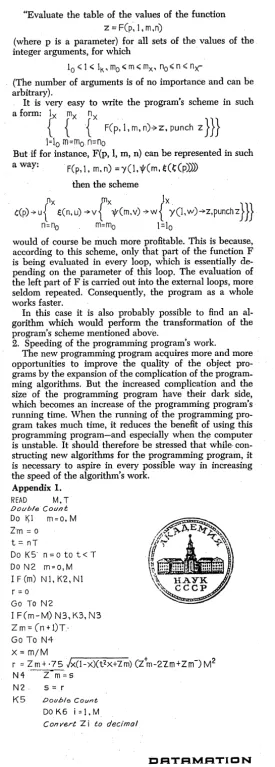
A "FORTRAN-like" expression of this program appears as ap-pendix 1 at the end of the article.18
new programming algorithms
From the broad field of problems of this kind, we shall consider only two, which are probably the most important from a practical point of view. These are (1) The analysis and transformations of the program's schemes and (2) speeding up of the programming program's work. 1. The analysis and transformations of the program's
schemes. "
The term "analysis of the program's scheme" denotes the construction of algorithms capable of obtaining various information from the programs scheme about the inter-connections between the operators forming the scheme.
Up to now, programming programs were constructed "in' such a way that every operator from the scheme was pro-grammed as much as possible independently from the other ones. For example, the economy of commands during the programming of arithmetical operators is performed only in one operator. In the programming of loops, it re-quires that all variable commands, depending on the loop's parameter, are to be placed in the scheme between the first operator of the loop and the last one. The independent programming of various operators permits the simplifica-tion of programming algorithms but avoids opportunities . of improving the constructed program. Here is an example