© 2019, IRJET | Impact Factor value: 7.211 | ISO 9001:2008 Certified Journal
| Page 876
Mixed Noble Metal Catalyst Development for Upgradation of
Diesel Index
Sayantan Ghosh
11
Department of Chemical Engineering, Jadavpur University, Kolkata-700032, India
---***---Abstract -With the Central Pollution Control Board (CPCB)and International Pollution Control Committee (IPCC) tightening the EPA laws, it is compulsory for the refineries to reduce unsaturates’ content in fuel blends as these aromatic compounds often go unburnt and are responsible for soot/smoke formation, which form major air pollutants. Conventional hydrotreating catalysts like Ni-Mo, Co-Mo suffer from limited conversion efficiencies, highly selective operating conditions and low selectivity. In order to deal with these drawbacks, a mixed noble metal catalyst Pt (0.25 wt%)-Pd (0.25 wt%) supported on zirconia-treated γ-Al2O3 has been
synthesized using the Glycine Nitrate Process (GNP) followed by Excess Solution Impregnation (ESI), and characterized by techniques like BET, XRD and Chemisorption to obtain various catalyst properties. Reactions carried out under similar conditions using three catalyst sets (Ni-Mo, Co-Mo and the synthesized catalyst) yield 99.8% conversion for the noble metal catalyst while the other catalysts can facilitate conversion close to 80% only. The results obtained for 3 trials showed reproducibility limits within ±3%. Finally, Aniline point tests for the reactant and various product diesel blends are discussed along with a comparative analysis of the increase in Diesel index for the different catalyzed hydrogenation reactions.
Key Words: Oil & Gas Industry, Aromatic Saturation, Catalysis, BS Regulations, Cetane No., High Speed Diesel, Mixed catalysts, Noble metals.
1. INTRODUCTION
With new Bharat Stage (BS) EPA regulations [1] imposing severe restrictions of the release of particulates and oxides of S & N, millions have been invested to abide by the BS-VI specifications laid down by CPCB, India. Presence of unsaturated hydrocarbons like Benzene, Toluene and Xylene (BTX) are hazardous and proven carcinogens beyond threshold limits.
Current BS-IV standards allow particulates upto 0.83 g/km mileage for diesel vehicles, which limit benzene emission to 25 ppm. Emerging standards further reduce the particulate content to 0.67 g/km mileage with 17 ppm restriction on benzene and derived unsaturates. Additionally, the presence of aromatic unsaturated compounds results in considerable ignition delay of the fuel, which is characterized by poor Cetane No. and Diesel Index. With increase in the extent of aromatic saturation, diesel blends have been found to ignite at lower compression ratios and with formation of low smoke/soot as residue.
Table -1: Risk of Benzene Exposure over Lifetime [1]
Cancer Risk Exposure over Lifetime
Benzene Concentration (μg/m3)
Chance of developing Cancer
0.15 - 0.45 1/1000000
1.5 - 4.5 1/100000
15 - 45 1/10000
150 - 250 1/1000
Above 500 Above 1/300
Already, several emerging techniques like blending with fuels derived from biological sources (palm oil, jatropha seeds) [2], [3] are being tried at laboratory or pilot scale across the country, but most of these experiments are not suitable for scaling up to industrial scale due to limited availability and inconsistency of the raw biological materials. Rapid growth for better quality diesel in commercial, domestic as well as large vehicles has created the urge for High Speed varieties of existing blends and thus, an improved aromatic saturation method is necessary.
© 2019, IRJET | Impact Factor value: 7.211 | ISO 9001:2008 Certified Journal
| Page 877
Though performed on laboratory scale, this experiment posesa feasible and economically viable alternative to any industry looking for scale-up of this synthesis route.
2. CATALYST PREPARATION
The first step in synthesis of the mixed noble metal catalyst includes preparation of the ZrO2/γ-Al2O3 support. The amount of support material is chosen to be 10 g with approximately 2 wt% ZrO2 in order to enhance microporous active site structure. 136.1 g of Al(NO3)3.9H2O and 0.546 g of
[image:2.595.38.559.240.402.2]ZrO(NO3)2.H2O are added to a 500 mL agitated vessel along with Glycine powder. The solution is stirred for 60 mins in order to facilitate homogenization of the materials. After settling, two distinct phases, one of the dispersed metals and the other of the Glycine-nitrate solution are formed. The resulting mixture is heated at 300°C for 2 hours. A semi-transparent viscous gel is formed, which is subjected to calcination at 500°C for 4 hours. Finally, the dried residue is subjected to reduction using Hydrazine at 170°C. Thus, the Zr-modified alumina support is obtained as a white powder.
Table -2: Analysis of Catalyst Preparation Techniques [6]
Technique
Factor ESI Precipitation Colloidal
(Sol-gel)
Vapor Deposition
Extent of
Dispersion ( %) 85 - 94 70 - 80 75 - 85 90 - 98 Additional Utility
Requirement Heat utility for solvent removal Additional injection of precipitant Sol and gel removal heat utility Plasma/laser and inert gas purge required
Product Versatility Not suitable for nano-catalysts Moderately suitable for nano-catalysts Suitable for nano-catalysts Preferred for carbon & iron nanotubes
Specificity Low Moderate High High
Cost Low Moderate Moderate High
For small-scale general purposes, we thus go for Excess Solution Impregnation (ESI) method because of its low cost, easy operation and wide range of usability. Precipitation techniques [6] are also preferred for mixed catalysts and acidic/amphoteric substrates of metals are used as the precursors. For micro and nano particles, we tend to go for colloidal (sol-gel) or vapor deposition methods, which can incur additional expenses. After the support has been prepared, the catalytic agent is synthesized using Excess Solution impregnation (ESI) or Incipient Wet Impregnation (IWI) technique. 0.058 g of H2PtCl6.6H2O and 0.047 g of PdCl2.2H2O are added to the pre-synthesized support and 50 mL distilled water in a 250 mL stirred vessel. The precursor salt solution is left to be stirred for 2 hours to facilitate porous adsorption of the solution. It is followed by heating at 120-130°C for 45 mins in order to remove entrapped water and volatiles like chlorine. Upon removal of the remaining solvent using vacuum effect evaporator, the dried catalyst is then calcined at 450°C for 4 hours to remove sulphides, nitrates and pertain a stable crystal morphology to the catalyst. The calcined catalyst is cooled to 150°C and then reduced using H2 to yield the final catalyst extrudates of roughly cylindrical shape (2.0 to 2.5 mm diameter and 4.5 to 4.8 mm length).
3. CHARACTERIZATION
Brunnaeur-Emmett-Teller (BET) Surface Area
The effective surface area of the catalyst available for adsorption was determined using Brunnaeur-Emmett-Teller (BET) technique. Surface area and pore volume was
measured with Autosorb-1C equipment using inert probing gas (N2) alternate adsorption-desorption isotherms. In the first step, the sample and the gassing tube were deprived of any residual air by vacuum suction at 180°C. The value of the probing gas molecule surface area is taken as 0.158 nm2, taking the radius of a single N atom as 155 pm. The isotherm data was obtained by varying partial pressure (P/P0) value from 0.01 to 0.25. Total pore volume has been calculated from the amount of N2 adsorbed near the isotherm asymptote of P/P0 = 0.95. Pore diameter has been calculated using empirical correlation once the BET surface area has been obtained. Concordant correlation coefficients of 0.9993 to 0.9996 were obtained for all the recorded isotherms.
X-Ray Diffraction (XRD) Analysis
© 2019, IRJET | Impact Factor value: 7.211 | ISO 9001:2008 Certified Journal
| Page 878
Chemisorption StudiesExtent of dispersion of Pt and Pd over the support can be determined by using volumetric CO chemisorption studies at room temperature of 25°C. The catalyst is subjected to a CO stream at temperature around 300 K and low pressures below 0.025 atm. The adsorption of CO in this operating condition follows monolayer Langmuir model [8] and thus, from the extrapolation of the linear intercept part, we can obtain the amount of CO adsorbed by the mixed catalyst.
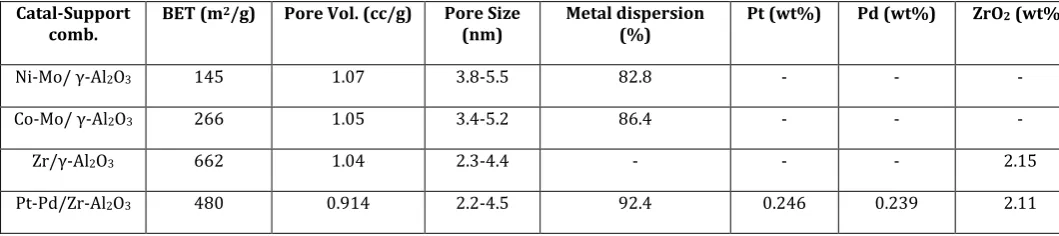
[image:3.595.26.556.235.353.2]Assuming uniform distribution of the bimetallic functional sites of both Pd and Pt, we obtain the active sites per unit area of catalyst and thus obtain the Turn Over Frequency (TOF) [8] of the 3 catalyst sets (Ni-Mo, Co-Mo and the synthesized noble metal catalyst) and found TOF of the synthesized catalyst to be highest. Further, assuming equivalent stoichiometry of CO towards both Pt and Pd, we have obtained the particle size of the dispersed metals for all the catalyst sets.
Table -3: Tabulation of Characterization Results
Catal-Support
comb. BET (m
2/g) Pore Vol. (cc/g) Pore Size
(nm) Metal dispersion (%) Pt (wt%) Pd (wt%) ZrO2 (wt%)
Ni-Mo/ γ-Al2O3 145 1.07 3.8-5.5 82.8 - - -
Co-Mo/ γ-Al2O3 266 1.05 3.4-5.2 86.4 - - -
Zr/γ-Al2O3 662 1.04 2.3-4.4 - - - 2.15
Pt-Pd/Zr-Al2O3 480 0.914 2.2-4.5 92.4 0.246 0.239 2.11
4. EXPERIMENTAL PROCEDURE
Aromatic saturation of the benzene feed was carried out in a continuous stainless steel (SS-316) fixed bed up-flow reactor of diameter 2.5 cm and length 60 cm. The reactor supports operating temperature and pressure upto 700°C and 200 bar respectively. Feed delivery was controlled through a high pressure peristaltic pump (Knauer, Germany) fitted with an electronic hatch sensor for flow control. The catalyst particles were placed near the centre of the reactor forming a catalyst bed of length 12.5 cm for 10 g of the prepared mixed catalyst. The rest of the reactor void was filled with glass Raschig ring packings (5 mm diameter and 1.5 cm height) to provide better interfacial contact between the reactants and to negate the entrance/exit effects in a fixed bed reactor. The hydrogenation reaction was carried out over a range of temperatures between 400 K and 550 K with variation in three additional operating parameters: a) H2 feed pressure into the reactor, b) Feed rate in form of Weight Hourly Space Velocity (WHSV), and c) H2 to feed ratio in subsequent runs. The reaction was allowed to go on for a period of 2 hours in case of all the 3 different catalyst packings. Finally, the liquid sample was withdrawn from the product-collecting vessel and analyzed by High Performance Liquid Chromatography (HPLC) for obtaining the conversion, selectivity and other reaction parameters for three different catalyst batches.
The temperature and pressure variations after a period of 40 mins were minimal and no differential temperature or pressure gradients were observed after a reaction time of 50 mins. Thus, 50 mins is taken as the steady state time. Saturation of benzene was found to readily take place within the chosen temperature range, with a product (cyclohexane)
selectivity of 99.6% to 99.9% for 3 different runs. Multi-site hydrogen addition [9], resulting in ortho, meta or para saturated products, were not observed and the results obtained for 3 consecutive runs showed fair convergence, proving the reproducibility of the experiment with an error limit of ± 3%.
5. RESULTS AND DISCUSSIONS
The 4 primary operating conditions which were varied during the course of the experiment to find out their correlation with benzene conversion are: a) Temperature of the reactor, b) H2 feed pressure, c) Feed Weight Hourly Space Velocity (FWHSV), and d) H2 to feed mole ratio. The observed conversion data for each varying parameter were carefully noted and plotted in Excel to find the dependence of degree of aromatic saturation on each of these 3 factors independently.
Effect of Temperature on Benzene Conversion
© 2019, IRJET | Impact Factor value: 7.211 | ISO 9001:2008 Certified Journal
| Page 879
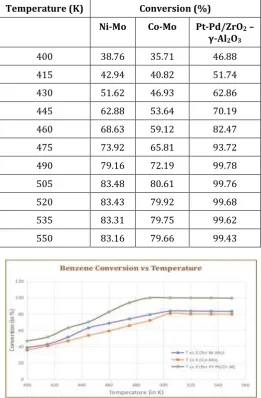
which provides optimum conversion upto 492 K. Though [image:4.595.304.563.113.458.2]close peak conversion temperature points were obtained for the other sulfide metal oxide catalyst as well, their activation energy is found to be much higher compared to the mixed noble metal catalyzed reaction pathway. While the activation energy for benzene hydrogenation reaction is reported , as 68.94 kJ/mol and 74.28 kJ/mol for Ni-Mo and Co-Mo respectively, the synthesized catalyst provides a low activation energy barrier to the saturation reaction, reported as only 53.89 kJ/mol [4]. Thus, use of mixed noble metal catalyst boosts the reaction rate, bringing about higher conversion under same operating conditions.
Table-4: Dependence of Benzene Conversion on Temperature
Temperature (K) Conversion (%)
Ni-Mo Co-Mo Pt-Pd/ZrO2 – γ-Al2O3
400 38.76 35.71 46.88
415 42.94 40.82 51.74
430 51.62 46.93 62.86
445 62.88 53.64 70.19
460 68.63 59.12 82.47
475 73.92 65.81 93.72
490 79.16 72.19 99.78
505 83.48 80.61 99.76
520 83.43 79.92 99.68
535 83.31 79.75 99.62
550 83.16 79.66 99.43
Fig -1: Benzene Conversion v/s Temperature for the 3 different catalyst sets (Ni-Mo, Co-Mo & Pt-Pd/Zr-Al)
Effect of H2 Feed Pressure on Benzene Conversion
H2 feed pressures were varied from 10 to 40 bar, keeping the temperature at 492 K, FWHSV at 3 hr-1 and H2 to feed mole ratio fixed at 10.
Table-5: Dependence of Benzene Conversion on H2 Feed Pressure
Pressure (bar) Conversion (%)
Ni-Mo Co-Mo Pt-Pd/ZrO2 – γ-Al2O3
10 46.94 42.18 55.48
15 67.16 58.61 78.24
20 80.46 73.52 99.80
25 80.17 72.86 98.36
30 79.48 71.48 97.15
35 79.03 70.13 94.72
40 78.22 68.52 93.94
Fig-2: Benzene Conversion v/s H2 Pressure for the 3 different catalyst sets (Ni-Mo, Co-Mo & Pt-Pd/Zr-Al)
The initial increase in conversion when the pressure was varied between 10 to 20 bar may be attributed to the fact that with increase in H2 pressure, the adsorption of the gas on the catalyst surface is enhanced and thus, the rate of reaction increases due to higher surface H2 concentration. Since H atoms are small and are easily subjected to intra and interporous diffusion, with sufficient time, most of the active sites in the catalyst reach the saturation extent for any particular reaction cycle. Thus, even after increasing pressure from 20 to 40 bar, no significant increase in benzene conversion was observed. With excess H2 pressure, the H atoms may also undergo reduced interporous diffusion rates, yielding competing rates [10] when compared to the benzene hydrogenation rate. Further, presence of H atoms leads to a decrease in the Lewis acidity [11] of the site-specific reaction core and thus, formation of benzyl carbocation intermediates is hindered, giving rise to lower conversion of benzene.
Effect of Feed Weight Hourly Space Velocity (FWHSV) on Benzene Conversion
[image:4.595.31.293.266.665.2]© 2019, IRJET | Impact Factor value: 7.211 | ISO 9001:2008 Certified Journal
| Page 880
dependence of Benzene conversion on the Feed WeightHourly Space Velocity. Using the flow controller, the rate was varied between 1 to 6 hr-1 and the observed data was carefully recorded. The extent of benzene conversion was found to increase between FWHSV of 1 and 3 hr-1, beyond which there is a rapid decline in benzene conversion when FWHSV is kept between 4 and 6 hr-1.
Table-6: Dependence of Benzene Conversion on Feed Weight Hourly Space Velocity (FWHSV)
FWHSV (hr-1) Conversion (%)
Ni-Mo Co-Mo Pt-Pd/ZrO2 – γ-Al2O3
1 75.92 68.13 96.25
2 78.43 71.86 98.17
3 80.49 73.54 99.79
4 76.11 72.28 99.62
5 70.27 64.26 90.84
6 62.31 57.19 77.46
Fig-3: Benzene Conversion v/s FWHSV for the 3 different catalyst sets (Ni-Mo, Co-Mo & Pt-Pd/Zr-Al)
With increase in the Weight Hourly Space Velocity (WHSV), the reactants are subjected to shorter residence times inside the fixed bed reactor, which may lead to partial conversion for a fraction of the product leaving the reactor, bringing down the value of overall benzene conversion. Further, at lower to medium WHSV values, due to partial wettability of the surface [12], direct gas to surface mass transfer takes place, which is not the case when monolayer is already formed by previous reactant cycles, thus leaving reduced active site for the remaining reactants.
Effect of H2 to Feed Mole ratio on Benzene Conversion
With 3 of the 4 operating variables optimized, we fix the temperature at 492 K, H2 pressure at 20 bar, FWHSV at 3 hr-1 to arrive at the dependence of benzene conversion on the final variable, H2 to Feed Mole ratio. Reactions were carried
out by altering H2 to feed (benzene) mole ratio over a range of 2 to 14.
Table-7: Dependence of Benzene Conversion on H2 to Feed (Benzene) Mole ratio
H2 to Feed mole
ratio Conversion (%)
Ni-Mo Co-Mo Pt-Pd/ZrO2 – γ-Al2O3
2 63.19 54.24 74.89
4 67.46 58.68 83.16
6 72.18 63.42 90.28
8 76.07 68.73 97.43
10 80.48 73.55 99.79
12 80.48 73.56 99.79
14 80.49 73.56 99.79
Fig-4: Benzene Conversion v/s H2 : Feed (Benzene) Mole ratio for the 3 different catalyst sets (Ni-Mo, Co-Mo &
Pt-Pd/Zr-Al)
From the observed data, it can be inferred that benzene conversion increases with increasing H2 to feed mole ratio from 2 to 10, but beyond 10, the conversion stagnates and forms an asymptotic dependence. Reaction rate increases due to higher H2 concentration near the active noble metal sites of the catalyst. However, beyond a certain value of H2 to feed mole ratio, the reaction sites get saturated [13] and the excess H2 is just passed out unreacted or often goes through negligible interfacial contact with the fractional unconverted benzene, which does not contribute to any significant increase in benzene conversion.
Table-8: Comparative Analysis of Reaction Parameters
Sl.
No. Parameter Ni-Mo Co-Mo ZrOPt-Pd/γ-2/Al2O3
1 Conversion
© 2019, IRJET | Impact Factor value: 7.211 | ISO 9001:2008 Certified Journal
| Page 881
2 Selectivity 0.925 0.896 0.996 -0.9993 Ea (kJ/mol) 68.94 74.28 53.89 4 Rate
[mol/gcat.min] 0.000135 0.000122 0.000187 5 TON (x 106) 3.68 4.06 5.57 6 Reproducibility
(%) ± 3 ± 3 ± 2
Thus, combining the results obtained through the detailed analysis of the above four operating variables, the optimum condition for carrying out the Benzene hydrogenation reaction using Pt (0.25 wt%) – Pd (0.25 wt%)/ZrO2-γ-Al2O3 comes out to be as follows: a) Temperature: 492 K, b) H2 Pressure: 20 bar, c) Feed Weight Hourly Space Velocity (FWHSV): 3 hr-1, and d) H2 to Feed mole ratio: 10.
Aniline Point Test for Diesel Index Validation
In order to determine the effect on benzene saturation on the diesel index and Cetane No. of a fuel blend, diesel sample of API (American Petroleum Institute) gravity 40.17. 100 mL of the liquid sample was mixed with equal volume of laboratory grade aniline [14] in a well-stirred apparatus. The temperature was allowed to increase until both aniline and test diesel samples were found to become completely miscible, thus signifying the end point of the experiment. Aniline point temperatures were carefully noted for the feed and samples of benzene conversion closest to 60, 70, 80, 90 and 100%. In order to create a uniformly distributed data set, the final reported values of Aniline point corresponding to 60, 70, 80, 90 and 100 % aromatic saturated samples were estimated by Interpolation for 60 to 90 % conversion and extrapolated for 100% conversion samples. Since the correlation coefficients were found to be very close to 1, the data arrangement can be assumed to fairly accurate for this experiment.
Table-9: Correlation between Benzene Conversion, Aniline point, Diesel Index and Cetane No. for diesel feed
Conversi
on (%) Aniline Point (℃)
(
Dies el Inde
x
Cetan e No.
Feed 54.06 54.62 53.51 129.31 51.94 47.40
60 63.09 63.65 62.53 145.56 58.47 52.10
70 65.78 66.33 65.22 150.40 60.42 53.50
80 67.32 67.87 66.76 153.17 61.53 54.30
90 69.24 69.79 68.68 156.63 62.92 55.30
100 71.63 72.34 71.23 161.21 64.72 56.60
Fig-5: Variation of Diesel Index and Cetane No. with Benzene Conversion (in %)
While the feed sample had a diesel index of 51.94, with increase in the extent of benzene saturation, the value of diesel index was found to increase. This can be explained by the fact that there is a considerable decrease in ignition delay with decrease in aromatic content of the fuel. As more paraffinic content is present in diesel, it requires a higher temperature for the aniline to completely mix with the sample. Thus, higher aniline point indicates a better degree of aromatic saturation, eventually leading to better Cetane No. and higher quality fuels.
6. CONCLUSION
© 2019, IRJET | Impact Factor value: 7.211 | ISO 9001:2008 Certified Journal
| Page 882
ACKNOWLEDGEMENTThis experiment would never have been possible without the help from my professors and various equipments in our departmental laboratories. I would also like to acknowledge Dr. S. Roy (Chemical Engineering Department, Jadavpur University) for useful inputs and discussion.
REFERENCES
1) Rich, A. L., & Orimoloye, H. T. (2016). Elevated Atmospheric Levels of Benzene and Benzene-Related Compounds from Unconventional Shale Extraction and Processing: Human Health Concern for Residential Communities. Environmental health insights, 10, 75-82. doi:10.4137/EHI.S33314
2) Kurnia, Jundika & Jangam, Sachin & Akhtar, Saad & Sasmito, A.P. & Mujumdar, A. (2016). Advances in biofuel production from oil palm and palm oil processing wastes: A review. Biofuel Research Journal. 3. 332-346. 10.18331/BRJ2016.3.1.3.
3) Tint Kywe, Tint & Mya Oo, Mya. (2009). Production of Biodiesel from Jatropha Oil (Jatropha curcas) in Pilot Plant. World Academy of Science, Engineering and Technology. 50.
4) Roy.S; Dutta.S. Hydrogenation of Toluene on Zirconium-Modified Hexagonal Molecular Sieve Supported Platinum and Palladium Catalyst, Ind. Eng. Chem. Res.
2013, 52, 17360-17368.
5) C. Song, X. Ma, Appl. Catal. B: Environ. 2003, 41, 207-238.
6) A. Schwarz, James & Contescu, Cristian & Contescu, Adriana. (1995). Methods for Preparation of Catalytic Materials. Chemical Reviews - CHEM REV. 95. 10.1021/cr00035a002.
7) G. Shi, H. Yano, D. A. Tryk, M. Matsumoto, H. Tanida, M. Arao, H. Imai, J. Inukai, A. Iiyama and H. Uchida, Catal. Sci. Technol., 2017, 7, 6124
8) Mulu Berhe Desta, “Batch Sorption Experiments: Langmuir and Freundlich Isotherm Studies for the Adsorption of Textile Metal Ions onto Teff Straw (Eragrostis tef) Agricultural Waste,” Journal of Thermodynamics, vol. 2013, Article ID 375830, 6 pages,
2013.
9) Sidhpuria, K. B.; Parikh, P. A.; Bahadur, P.; Jasra, R. V. Rhodium Supported Hβ Zeolite for the Hydrogenation of Toluene, Ind. Eng. Chem. Res. 2011, 47, 4034−4042. 10)Porous Metal–Organic Frameworks for Heterogeneous
Biomimetic Catalysis Min Zhao, Sha Ou, and Chuan-De Wu Accounts of Chemical Research201447 (4), 1199-1207.
11)Tianxiang Zhao, Xingbang Hu, Youting Wu and Zhibing Zhang, Hydrogenation of CO2 to Formate with H2: Transition Metal Free Catalyst Based on a Lewis Pair, Angewandte Chemie International Edition, 58, 3, (722-726), (2018).
12)Khanna, Rajesh & Nigam, K.D.P.. (2002). Partial Wetting in Porous Catalysts: Wettability and Wetting Efficiency. Chemical Engineering Science. 57. 3401-3405. 10.1016/S0009-2509(02)00211-7.
13)Keane, M. A. The hydrogenation of o-, m-, and p-xylene over Ni/SiO2. J. Catal. 2007, 166, 347.
14)National Center for Biotechnology Information. PubChem Compound Database; CID=6115, https://pubchem.ncbi.nlm.nih.gov/compound/6115 (accessed Feb. 16, 2019).
BIOGRAPHIES
![Table -2: Analysis of Catalyst Preparation Techniques [6]](https://thumb-us.123doks.com/thumbv2/123dok_us/9411541.442395/2.595.38.559.240.402/table-analysis-of-catalyst-preparation-techniques.webp)