A phenomenographic study of lecturers’ conceptions of using learning technology in a Pakistani context
Vivien Hodgson & Uzair Shah
Affiliations: Dr. Uzair Shah
Department of Management Learning & Leadership,
Lancaster University Management School Lancaster, UK. LA1 4YX
Prof. Vivien Hodgson Lancaster Leadership Centre
Lancaster University Management School Lancaster, UK. LA1 4YX
Corresponding author’s details: Dr. Uzair Shah
Department of Management Learning & Leadership, Lancaster University Management School
1 A phenomenographic study of lecturers’ conceptions of using learning technology in a
Pakistani context
Abstract
While there are many studies exploring the phenomenon of lecturers’ use of learning
technology within teaching practices in western higher education contexts, currently we know little about this phenomenon within less developed countries. In the paper we discuss the findings from a phenomenographic study of lecturers’ conceptions of using learning technology in a Pakistani university context. We describe how lecturers’ use of learning technology is underpinned by their pedagogical understanding. Further we show that prevailing contextual socio-economic and technological limitations affect lecturers’ daily pedagogical practices and use of learning technology. The results of the study demonstrate the importance and influence of lecturers’ pedagogical understandings and of contextual limitations within daily teaching practices on their experiences of using learning technology. The findings have wider implications for our understanding of the variation in ways learning technology is understood and used within pedagogical practice in other developing and more developed contexts.
Key words:
learning technology, pedagogical understanding, conceptions of teaching, phenomenography, developing contexts
Introduction
Many existing studies explore lecturers’ use of learning technology within teaching practices in western higher education contexts. However, few studies examine the use of learning technologies within less developed countries. In this paper we describe the findings from a phenomenographic study of lecturers’ conceptions of using learning technology in a Pakistani context. The findings from the study extend our understanding of the variation in experience of using learning technology in developing contexts. They are, however, also informative and relevant to other higher education contexts.
The study is located in Pakistan where, as well as in many similar contexts, learning
2 computer-based learning and multimedia materials, the use of networks and communications systems to support learning through to the use of power-point slides.
In general, while the use of learning technology continues to grow, there are conflicting views about its impact within higher education. For example, Harasim (2000) states that learning technology used particularly in online courses has impacted on education
significantly at all levels. However, there is also research suggesting otherwise and that its impact has not met expectations (see Kirkwood and Price 2014; González 2009). Kundi and Nawaz (2011) and Rosenberg (2007) suggest some lecturers may even find using learning technology intimidating and uncomfortable. Existing research has also shown that lecturers are using learning technology in different ways within their teaching practices. Some studies have reported the use of learning technology to facilitate students’ learning and meaning-making activities (Stein, Shephard, and Harris 2011; González 2009), while other lecturers are using learning technology in relatively traditional ways that support or sustain existing teacher-centred pedagogical practices (Kirkwood and Price 2014). Kirkwood and Price (2013) question the assumption made especially within technology-enhanced learning literature that technological interventions can lead to transformed teaching practices and students learning experiences.
The apparent differences in findings and views about lecturers’ use of learning technology has led to research calls to explore what is happening rather than what should be happening with ICT in higher education (Kirkwood and Price 2013; Lawless and Pellegrino 2007). Such calls stress the importance of exploring pedagogical use of learning technology rather than focusing on learning technology itself.
It seems to us that phenomenography can offer much to this call to explore the pedagogical use of learning technology. There already exists several phenomenographic studies that explore the phenomenon of lecturers’ experience of using learning technology; however they have been conducted largely within western contexts (see González 2010; Roberts 2003). We have little understanding of this phenomenon within less developed regions such as Pakistan. Exploring the use of learning technology within relatively less developed countries, with their different contextual challenges and limitations, offers an opportunity to generate fresh
insights and understanding. Insights that may well also have relevance to western contexts. Studies that have explored higher education in developing countries until now have tended to provide few insights into lecturers’ daily use of learning technology or their pedagogical orientations (see Larbi-Apau and Moseley 2012; Ngimwa and Wilson 2012). While these studies highlight the importance of mitigating contextual limitations affecting universities within developing countries little is known how these limitations are affecting and
3 In this paper we report the findings from a phenomenographic study that explored
conceptions of using learning technology in a Pakistani context.In the study we found that lecturers’ descriptions of their experience of using learning technology appeared to be
related, as we explain in more detail in the paper, to their pedagogical understanding. Further as a result of the contextual socio-economic and technological limitations they experienced within their teaching practices we found that lecturers described how they were frequently unable to use learning technology according to their intended practice. Based on the findings, we claim that lecturers’ experience of the contextual limitations when using learning
technology within their daily practices is influenced by and also related to their pedagogical understanding and their conception of using learning technology. As we will argue, this could very well be similar for many lecturers where ever their situated context.
Review of related phenomenographic studies
Numerous phenomenographic studies exist that have explored university teacher’s
conceptions of teaching and learning. Findings of these studies suggests that there is a limited number of variations in teachers’ conceptions of teaching, which range from essentially ‘teacher-centred/content-oriented’ to ‘student-centred/learning-oriented’ (see Åkerlind 2004; Dall’Alba 2005; Prosser and Trigwell 1999; Samuelowicz and Bain 2001). Åkerlind (2004) explains that the majority of phenomenographic studies of university teachers’ conceptions of teaching show that they understand the primary focus of teaching as either
- transmission of information to students or - facilitating students’ conceptual understanding;
Together with a focus towards either
- the teacher and their teaching strategies or
- the students, and their learning and development.
The studies imply that lecturers with ‘teacher-centred/content-oriented’ conception of teaching tend to position themselves as subject experts/authority figures, and students as passive recipients of academic information within student-teacher interactions. According to previous phenomenographic research, lecturers with such conceptions of teaching may take-for-granted the influence of their teaching on student learning experiences (Prosser and Trigwell 1999). The research suggeststhat such teaching-centred approaches are more likely to encourage students to adopt surface level or achieving approaches to learning. That is learning approaches where their intentions are to meet the requirements of the course and to ‘do enough’ to pass the modules (Biggs, Kember, and Leung 2001; Hockings 2005).
4 understanding of themselves and others (Åkerlind 2004). According to these studies, as Åkerlind (ibid) explains, lecturers with student-centered/learning-oriented’ conceptions of teaching are more inclined towards interactive teaching as they see themselves as facilitators encouraging and assisting students in learning to develop their own understandings and world-views
The existing literature suggests that lecturers’ conceptions of teaching and learning informs their use of learning technology within their pedagogical practices (Ertmer 2005; Sime and Priestley 2005). While there are overall less phenomenographic studies that examine the use of learning technology specifically, those that exist reveal variations in lecturers’ conceptions of using learning technology (González 2010; Lameras et al. 2012; Stein, Shephard, and Harris 2011; Zhao, McConnell, and Jiang 2009; Ellis, Steed, and Applebee 2006; Roberts 2003). These studies report more or less similar findings that can be grouped under three main categories of description, or conceptions of using learning technology which are for ‘providing information’; for ‘independent self-paced learning’; and for ‘engaging in communication-collaboration-knowledge building’ (González 2010).
These studies found that lecturers with teacher-centred/content-oriented conceptions of teaching were likely to use learning technology largely to transmit module related information in the form of teaching notes, lecture slides, website links or other online resources and/or to clarify concepts and ideas to students. On the other hand, lecturers with student-focused/learning-oriented conceptions of teaching are likely to use learning
technology in ways to encourage students to express and discuss their viewpoints with peers and teachers for developing their conceptual understanding.
However, the phenomenographic studies citedhave for the most part contributed to the body of research exploring use of learning technology within face-to-face and online teaching in western contexts. To the best of our knowledge, there is no phenomenographic research available exploring how lecturers understand the use of learning technology within a South Asian context. As Marton (1994) comments research in relatively unexplored contexts can contribute towards greater understanding of the phenomenon itself. The current study seeks to deepen our understanding of the phenomenon of using learning technology by exploring lecturers’ experiences of using learning technology within a less developed Pakistani context.
As well as phenomenographic studies of teachers’ conceptions of teaching and/or of using learning technology also relevant to this study are phenomenographic studies of professional practice. These studies suggest that we arrange, organize, apply our knowledge and skills and enact practices according to our understanding of professional practice (Dall’Alba and
5 assume that lecturers’ conceptions of teaching and learning, their understanding of the role and position of students and themselves within student-teacher interactions, along with teaching intentions, approach and strategy, and conceptions of using learning technology, when taken together, constitute and are reflective of their pedagogical understanding and are embedded within their daily teaching practices. Thus in this study we assume that
conceptions of using learning technology are reflected in lecturer’s use within their pedagogical (or professional) practice. Which in turn implies exploring how lecturers describe their experience of using learning technology in their daily pedagogical practice provides an opportunity to access their meaning and conceptions of using learning technology.
The Research Methodology and Context
In this study phenomenography was used to capture and illuminate the qualitative variation in participants’ experiences and conceptions of using learning technology. Adopting an
interpretivist research perspective, phenomenography assumes a non-dualistic, relational ontological position which views subject (individual) and object (world or phenomenon) as interlinked through experience (Marton and Booth 1997). Dall’Alba and Sandberg (2006, 389) claim that by taking a non-dualistic ontological position, phenomenographic studies overcome ‘the question of how the gap between contents of the mind and professional practice is bridged’. The epistemological assumption underpinning phenomenographic research is that there are limited variations in experiencing a phenomenon and that these variations can be identified, understood and communicated (Sjöström and Dahlgren 2002). The identified variation in experiences is presented in the form of categories of description as one of the main findings of a phenomenographic study. Within phenomenographic studies, words such as experiences, conceptions and understandings are used interchangeably (Marton 2000).
The research reported in the paper was located in the context of a regional, government-funded public Pakistani university. While many western universities may not experience issues such as availability of reliable technological infrastructure, access to academic information and/or electricity power shortages less developed countries (Pakistan being an example) are faced with challenges associated with ‘uneven modernisation’ and inequalities such as illiteracy, poverty, low per-capita income and access to quality education (Shafique and Mahmood 2008). This particularly affects relatively new, regional, public-funded universities as these universities rely significantly on government funding since tuition fees are kept low when compared to private universities. This is to encourage and increase wider enrolment and participation of students within higher education institutions.
The study discussed in this paper is based in such a university which is located in a rural, north-west region of Pakistan. The university was established nearly a decade ago, and hosts Faculties of Science, Health Sciences, Arts and Law & Administrative Sciences. The
6 of departments when compared to the other two faculties, and this reflected on the selection of the participants as shown in Table 1 below.
[Insert Table 1 here]
Phenomenographic interviews were conducted with twenty-nine participants, of which eight were female participants. The participants in the study had varying qualifications and years of teaching experiences, and included Assistant, Associate and full Professors. Such a range of participants was purposively chosen to meet an important requirement of phenomenographic research, which is to exhaust the variations in experience of the phenomenon (Marton and Booth 1997). As explained earlier within phenomenography it is assumed there are a limited number of ways a phenomenon can be experienced within a group of respondents,
irrespective of levels of experience, gender, ethnicity etc.In the paper, we thus refer to all the participants as lecturers. During the interviews lecturers were invited to describe fully their experience of the phenomenon of using learning technology within their teaching practices, along with their underpinning pedagogical understandings and intentions1. In line with phenomenographic interview approaches (Åkerlind, 2005) a number of pre-defined what and how questions were asked to all the lecturers. Follow-up questions varied according to the lecturers’ responses, however, they were simply intended to invite participants to clarify or elaborate on their responses to the questions asked below;
• With regards to the module you teach, what does student learning and teaching mean for you?
• Can you please describe your experience of using learning technology within your teaching?
• How do you think use of learning technology has affected you as a teacher?
• Would you like to summarize and/or provide any other details regarding your use of learning technology in teaching?
The interviews lasted approximately forty-five minutes. The ensuing data analysis was informed by previous phenomenographic studies (Bowden 2005; Åkerlind 2005) and is described and pictorially represented in Figure 1.
[Insert Figure 1 here]
Participant’s responses to the questions were first transcribed and the transcripts were initially grouped or piled together for each faculty along with answers to each of the questions. The transcripts within each pile were then analysed and quotes were grouped together according to similarities and differences that surfaced within the responses. These differences helped identify emerging themes and the utterances within.
1Participants used both English and Urdu languages in the interviews. Urdu interviews were translated into
7 For example, one of these emergent themes was ‘using learning technology for retaining student attention’. The utterances identified for this theme included ‘colourful diagrams and pictures’, ‘student attention’, also ‘access and/or availability of Multimedia’, ‘projectors’ and ‘white-boards’. Quotes from the transcripts which related to these utterances were grouped together under this emergent theme. Similarly, utterances for other emergent themes were identified. Original transcripts were repeatedly referred to in order to understand the context and meaning of the emergent themes. These themes were seen as the initial set of categories. Once a pile of transcripts was reviewed, transcripts in the other piles were interpreted for the similarities and differences in meanings described associated with using learning technology. If the themes emerging highlighted a different meaning to the earlier identified categories, then a new category was added to the initial set. Otherwise individual responses were included in one of the other categories previously identified in the analysis. Once all the transcripts had been analysed and grouped together, these formed ‘pools of data’.
Quotes from each pool of data were then analysed for participants’ actions and intentions in using learning technology. Original transcripts were again referred to in order to better understand the context of their use of learning technology described by the lecturers. Using again the example of the theme ‘using learning technology for retaining student attention’, intentions such as ‘giving out module related information’, ‘having students to keep listening to the lecturer’, ‘teachers as subject-experts’ were described in their experiences of using learning technology.
To further understand the variation in lecturers’ meanings and conceptions of learning technology, quotes describing their action and intentions within one pool of data were analysed and compared with descriptions from other pools of data. This helped identify a series of illustrative ‘utterances’ from each pool of data. Quotes from original transcripts were re-read against the selected representative utterances to better understand the meanings associated with these utterances.
The next stage of analysis involved a review of these utterances in terms of similarities and differences in meanings. If the representative utterances were similar in meaning, the utterances and related quotes were brought within one category of description.Each of the remaining utterances thus represented distinct meaning of using learning technology. The variations in meanings of the selected utterances formed the basis of 5 categories of description identified, as described next.
Categories of description
Categories of description, or conceptions of the phenomenon under investigation are seen as one of the main outcomes of phenomenographic research (Marton and Booth 1997). The categories of description identified in this study represent variation in participants’
8 categories of description identified, Information Enrichment and Connectivity closely relate to the categories of ‘providing information’ and ‘engaging in communication-collaboration-knowledge building’identified in previous phenomenographic studies.The other three categories of description however of, Retaining Attention, Professional Skills Development and Omnipotential were new categories.
As we will show the analysis of lecturers’ descriptions of experience indicated that their pedagogical understanding appeared to influence and inform their experiences of using learning technology. In this section we describe each category of description and the associated underpinning pedagogical intention and understanding found for each category. Each category of description is supported with selected quotes from the data that illustrate the kind and nature of variation identified between lecturers’ different conceptions of teaching and learning. Together with their understanding of the role and position of teachers and students as experienced within their specific learning context, all of which contribute to and reflect lecturers’ pedagogical understanding.
We found that when describing their use of learning technology all the lecturers also described experiencing contextual problematic limitations that they believed negatively affected their use of learning technology and teaching practice. The contextual limitations lecturers were faced with in the study ranged from disproportionate limited access to
academic information/journals to unreliable and limited technological infrastructure such as computers, the internet and technological research equipment, and irregular electric power supply. However, as we will show, how the lecturers experience these limitations within their teaching practices appeared to vary according to their pedagogical understanding and
conceptions of using learning technology.
A. Retaining Attention
The ‘Retaining Attention’ category of description presents a relatively simple conception of usinglearning technology, which is as a means to present and transmit module related information with the intentionto retain students’ attention. The lecturers described using technological facilities and equipment such as multimedia, over-head projectors, and power-point slides for this purpose. Such a use of learning technology appeared to be underpinned by a teacher-centred pedagogical understanding where lecturers described using learning technology to position themselves as the subject expert and students as generally passive and dependent recipients of information. As one lecturer explained:
‘You see it (using multimedia) is similar to when adults/parents take children to a park or to a colourful area, they are happy and involved. It is similar in the case of multimedia – there are many ways of presenting and giving information – with
9 Within this relatively simple conception of using learning technology, lecturers had to also contend with the vagaries of the socio-economic context of a developing country as one lecturer describes:
‘As our electricity system is not dependable all times, we cannot use PowerPoint slides as well in the teaching, although it is beneficial for us … we cannot do so every time; cannot do so because the system is not dependable and then we have to use the white-boards’. (Irfan)
As the lecturer explains, they were likely to revert to the use of white-boards when
confronted with the challenge of limited availability and access to Multimedia. What is more, as another lecturer elaborates, generally this return to the use of whiteboard was with the intention of using white-boards and/or printed slides to position lecturers as authority-figure as he describes:
‘I have studied in several universities in the UK as well but they do not use the whiteboard. Here, you see the student will get a sms [on a mobile phone] and he will be distracted. As Multimedia is not available here every time, I have to use the board and so face such problems. My effort is not to use the board much and give printed slides to them, so that I am able to see them face to face and so they learn something from me.’ (Saqib)
The Retaining Attention category of description thus appeared to be underpinned with a pedagogical understanding and intention that was teacher-centered and where technology is used with the intention to make teaching content more attractive for students. In addition the category also appeared to be associated with lecturers describing a relatively more compliant acceptance of the contextual problems and limitations of using learning technology within the socio-economic context of a developing country.
B. Professional Skills Development
In this category of description, lecturers described using learning technology as a means to increase their students’ knowledge and skill of using technological instruments and
application which they thought would be useful in working/organizational environments. This was with the intention to improve their students’ employability chances and
opportunities after graduation. The lecturers again described an essentially teacher-centred pedagogical understanding underpinning thisuse of learning technology. They perceived themselves as experts and/or authority figures and their students as ‘university products’. One of the lecturers described designing his module in ways to provide students greater exposure and familiarity in using computer-related applications which heperceived to be important for their professional careers.
10 computer history and others but more IT practicals really…(I)n these practicals they are shown how to use computers systems and software. The basic objective is that the students are able to use the computers when at work’. (Shehzad)
Another lecturer also described a teacher-centred pedagogical understanding that underpinned her approach. She perceived her role as expert and she designed teaching sessions in ways that were intended to use technology to transmit information to students about technological applications and to also show them how to use such applications:
‘I use the technology in such a way that manifests my approach, i.e. my concepts or ideas are 80% practical and the remainder are theory. Even in the those classes we have for theory, I have designed them in a way which is more towards the practical where I teach them (students) how to do this, how to do that on the (computer) application.’ (Saleha)
The contextual limitations encountered by the lecturers were however problematic to their intentions and ambitions to use learning technology in this way, as described below:
‘If you are to produce marketable professionals – you cannot produce professionals without giving them knowledge or without using technology during the process. They will not be able to do very well or contribute to practical life unless they have used some technology during the process of education…We want updated technologies here but what can we do - we have to use old ones here (in the institution)’. (Ehsan) Thus as in category A the category of Professional Skills Development also appeared to be underpinned with a pedagogical understanding and intention that was teacher-centered;where the lecturer assumes the role of expert and sees students as passive and dependent learners. Within this category of description the lecturers frequently appeared to be largely resigned to being unlikely to attain their intentions due to the inadequacy of the technological facilities and context within which they had to teach.
C. Information Enrichment
‘Information enrichment’ category of description highlights a more information/content-driven use of learning technology within the lecturer’sdescriptions of experience. Lecturers described using computers and the internet as a means to access different websites and databases for relevant academic information/publications. The intention being to help students to readily and quickly acquire current module-related information and concepts, as one lecturer described:
11 understand things but again I would say, with the help of modern technologies, role of teacher is a must as s/he has to make them understand the subject…I would say that modern technologies are very helpful for the teachers to teach students and give out information to them, and for the teachers and students to get information soon but the role of the teacher and the institution is a must.’ (Asad)
This category of description also had a teacher-centred pedagogical understanding
underpinning the use of learning technology. Lecturers described using learning technology as a means to support their work as subject experts tasked to help students understand the subject/topic. Secondly, they described using learning technology as a means for providing students with information about recent developments within their respective fields during their teaching. As one lecturer explained;
‘There are occasions when you are unable to find things in the books. Then we go to the Internet to get an immediate idea…For the latest information, we use journals and websites and also publications’. (Ahmed)
However due to the contextual limitations encountered this was also seen as problematic as Imran explained:
‘There are several journals which are not open (to us) and only give the abstract. So in our research, we often have to rely on the abstract only’. (Imran)
As well as also being underpinned with a teacher-centered pedagogical understanding we found that lecturers describing an Information Enrichment category of experience of using learning technology as in Category B, also appeared to be resigned to being unlikely to attain the key intentions associated with the category. For example, due to the inadequacy of the technological supported facilities and infrastructure of their institutional context, lecturers claimed they were unable to readily and quickly acquire relevant and current module-related information and concepts.
D. Connectivity
Within ‘connectivity’ descriptions of experience, lecturers described using learning
technology as a means to connect, discuss and collaborate with students and academics from within and outside the university. Such use of learning technologywas underpinned with a pedagogical understanding that was more student-centred; with the intention of providing online spaces for discussion about module related concepts with students and peers. The lecturers described using computers and the internet to enable access to online forums as well as social media platforms (e.g. discussion forums, Facebook, Google Groups). They
described viewing their students as independent learners who are actively involved in
12 ‘teaching is a two way communication between a teacher and student at university level - I always share my knowledge with the students but I also learn from my students...I use Internet for communication - I use my Facebook account and share it with my students and we get connected to each other and discuss and share
knowledge’. (Waqar)
As described above, lecturers understand using social media (due to non-availability of an institutional online learning space) in order to connect students/colleagues for the purpose of constructing own understanding and knowledge through processes of discussion and sharing. However, again the kind and level of learning technology available to them was problematic for these pedagogical intentions of the lecturers, as one lecturer elaborated:
‘I think we need more software here for teachers, which will allow more collaboration between students and faculty. For example, if I give an assignment, there should be a software/platform with which there could be a connection or collaboration. There is such software missing here to allow the collaboration of students with teachers’. (Sarfaraz)
However, lecturers who described more student-centered conceptions of teaching, associated with the Connectivity category of description appeared less likely to be resigned and
accepting of the contextual limitations they were confronted with in their daily practice. They described, for example, using social media in their attempts to circumvent the contextual limitations and challenges faced in their teaching as one lecture explained;
‘on the first day (of teaching term), I asked the students for their email addresses because I wanted those to set up a Google group account, you know, for class
discussions and sharing information - this university has no official platform for this, you see. But I was taken aback when I found out that only 10% of the students had emails and the rest did not and they were here doing undergraduate studies…so I had to give them some reward to encourage them to write emails. I told them that I would give extra marks to those who would write emails to me, which convinced them all. Then I also kept emailing them regularly about the course and assignments, and so they developed a habit of checking and sending emails. Now I am also starting
discussions on this email group and slowly will get better. You see I made an effort to direct them towards the use of computers. The issue is that we have students from far-flung areas where they probably have not even seen computers before, but now they have understood that computers are worth using and do actually use them for their work.’ (Ali)
13
E. Omnipotential
The ‘omnipotential’ category of description signified the most sophisticated conception of using learning technology within lecturers’ descriptions of experiences. Lecturers who described using learning technology omnipotentiallyunderstood it as a means for supporting a range of various opportunities and possibilities within teaching practices. This description of using learning technology was underpinned with the intention of developing teaching practices to enrich student learning experiences. Teachers describing an omnipotential conception appeared to understand their role to be primarilyas facilitators and students as independent co-constructors of knowledge. The category is underpinned essentially with a student centred pedagogical understanding and seen as inclusive of other categories of description. While still acknowledging contextual limitations, one lecturer elaborated on his intention to use different digital technologies such as computers, internet, multimedia more as a means to change things around so that the students are able to be more active and the
teacher less and instead act only as a guide within student-teacher interactions. He explains: There is a problem till now that we have generally not started to use technology in the way as it should have been. Yes, we have issues here but at least in the environment of university, we have internet available, also multimedia and lower level of facilities which we can use in our teaching. One must see that first our teaching has remained predominantly teacher-oriented. Teacher comes and delivers the lecture and leaves. Students are passive learners and the teacher is active. We need to change this and should be the other way round that the students should be active and teacher should remain as a guide only. This can be easily done with the help of these technologies that you provide an overview to the students and the students should study and write their assignments then give presentations, or do a small scale research and present and discuss it in class...I have managed to introduce this active learning in class - I always try to give them topics for which they should go to the internet much more, download material or use the library, and make their arguments and present in class for
discussions. (Qasim)
For the Omnipotential category of description lecturers described teaching that was more student-focused, aimed at contributing towards students’ learning and conceptual
development. They described designing their teaching sessions and course contents
purposively for students to be active independent learners. One lecturer described developing the module curriculum and incorporating FM radio programmes to provide students
opportunities to experience interviewing subject experts from different fields. The topics of these interviews that are broadcasted live are such that they are perceived to be of importance and benefit to the local community, for example, agriculture, education, health and/or social and ethical issues. He explains:
14 from health, education, social issues, and my students will manage all these sessions. Also, next year we will increase the coverage of our radio’. (Iqbal)
Another lecturer in highlighting her omnipotential meanings of using learning technology mentioned the contextual limitations affecting her teaching practices. However she described experiencing the internet as a way of attempting to circumvent the limitations. She elaborates that:
‘The benefits of internet are huge for teaching especially in our (rural, less developed) area and in such a newly born university and newly born department where there are not even enough books available, not even in the libraries. The biggest benefit here is the Internet. It is a tremendous thing – I think it is the biggest source to find
information, for talking to people and to students, getting knowledge and sharing it with others and getting references and ideas.
Within this conception of using learning technology, lecturers described not only a more student-centered pedagogical understanding but also a much more active and imaginative approach to overcoming the contextual and technological limitations they experienced and were faced with when teaching.
Discussion
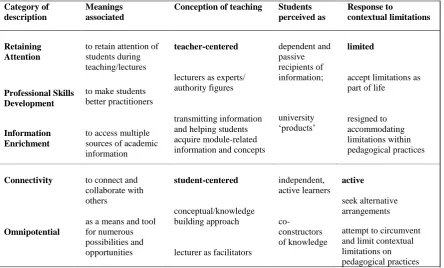
The 5 categories of description identified in this study reveal the variation in lecturers’ conceptions of using learning technology within the context of a Pakistani university. Two of the categories of description identified (Information Enrichment and Connectivity) are similar to those found in previous studies. The Retaining Attention conception also, in part, is related to the previous identified category of ‘providing information’. However, it constitutes a new conception as it has a different intention of presenting and transmitting module related information in ways to gain students’ attention. The remaining two conceptions of
Professional Skills Development and Omnipotential have not previously been identified in the literature. However, as summarised in Table 2, all 5 categories of description do have a similar relationship to teachers’ conceptions of teaching as previously identified by Åkerlind (2004) and others. Similarly, as in previous phenomenographic studies examining the
15 experiencing use of learning technology as a means for assisting and supporting learners to take a more independent and active role in their own learning.
In Table 2 the 5 different categories of description identified along with the pedagogical understanding for each category are presented. The tablegives the pedagogical meanings and underpinning lecturers’ conceptions of teaching, together with the understanding of the role and position of teachers and students associated with the different pedagogical meanings for each category of description. In addition, table 2 shows the relationship of lecturers’
experiences of contextual limitations to their conceptions of using learning technology and pedagogical understanding.
[Insert Table 2 here]
The 2 new categories of Retaining Attention and Professional Skills Development identified in this study thus share similar pedagogical characteristics and understanding to that of Information Enrichment. A category that has previously been identified and found to be associated with a teacher-centered conceptions of teaching and pedagogical understanding, as were these 2 new categories. Similarly, the category of Ominpotential while not previously identified was found to have similar pedagogical characteristics and understanding to that of Connectivity, which has previously been identified and found to be associated with student-centered conceptions of teaching.
16 On the other hand, we found that lecturers with student-centred pedagogical understandings were more likely to respond actively and make greater attempts to circumvent the contextual limitations they were confronted with on a daily basis. As was evident in Connectivity and Omnipotential conceptions, the lecturers described using learning technology within their teaching in apparently more complex ways to interact with students and other academics. They understood using ‘non-traditional’ digital technologies within their practices such as Facebook and other social media forums to not only connect and discuss academic concepts with students and other academics but also to attempt to overcome the challenges faced within their teaching. Within these categories of descriptions, lecturers with student-focused pedagogical understanding appeared to focus on using any available technological facilities to overcome the contextual limitations and to facilitate student learning.
The finding that student-centered orientated lecturers are more likely to respond actively to contextual limitations has some support in the existing literature. Entwistle and Walker (2002) for example suggest that student-centered pedagogical understanding encourage teachers to think creatively about their teaching and their use of learning technology. In our study, as already explained, lecturers with student-centred pedagogical understandings appeared more focused on finding creative and the most effective possible uses of learning technology. They were more likely to attempt to actively deal with contextual limitations than focus on poor availability of learning technology as was more evident within ‘retaining attention’, ‘professional skills development’ and ‘information enrichment’ categories of description.
This relationship between the categories of description of using learning technology, pedagogical understanding and contextual limitations is an interesting one and has not previously been reported in the literature. It offers some fresh insights into the issue of why learning technology has not always achieved its potential.
Conclusions
The findings of this study reveal a relationship between lecturers’ pedagogical understanding and their experiences of using learning technology. ‘Retaining Attention’, ‘Professional Skills Development’ and ‘Information Enrichment’ categories of description appear to be
underpinned predominantly by teacher-centered pedagogical understandings. On the other hand ‘Connectivity’ and ‘Omnipotential’ categories of description were underpinned by relatively more student-centered pedagogical understandings.
Further we found a close relationship to the lecturers’ pedagogical understanding and also their experience and response towards the impact of problematic contextual limitations on their use of learning technology in their daily teaching practice. Lecturers with student-centred pedagogical understandings appeared to be relatively more active in their response to the contextual problems that all the lecturers in the study encountered on a daily basis. It is not possible to generalise from this study to other contexts or assume other lecturers’
17 study do offer some interesting possibilities for thinking about the use of learning technology in their daily practices.
Further, Ngimwa and Wilson (2012), Kirkwood (2009) and Blin and Munro (2008) have all previously argued that the socio cultural and economic contexts of universities significantly impact pedagogical practices and use of learning technology. Our study highlights some of the ways socio-economic and technological limitations negatively affect lecturers’ teaching practices. However it goes further and reiterates in addition the importance and influence of lecturers’ pedagogical understandings on their teaching practices and, more specifically, on their use of learning technology. We found that despite the negative influence of contextual limitations, lecturers’ experiences of using learning technology and also their responses to contextual limitations were invariably informed by their pedagogical understandings. Our findings suggest that lecturers’ experience and response towards contextual (problematic) limitations within their daily practices is related to not only the institutional technological infrastructure and facilities available to them but also to their pedagogical understanding and conception of using learning technology.
While more research is needed, the findings of the study are potentially of relevance to other socio cultural and economic contextual settings, including for western or developed country higher education contexts. Existing research already suggests there are contextual influences on teaching practices (Norton et al. 2005; Leveson 2004) due to which lecturers often feel unable to teach according to their pedagogical understanding. Environmental and institutional issues, depleting resources, workload, lack of staff development opportunities and support have all previously been suggested as possible reasons for variation between lecturers’ conceptions of teaching and actual teaching practices.
What is more, existing literature as discussed at the beginning of the paper, has found that lecturers are not only using learning technology in different ways in their teaching practices but also some lecturers find using learning technology intimidating and uncomfortable. On the other hand, there are also lecturers who have found ways of bringing learning technology into their practice that facilitate student learning and meaning making activities.
Why there are such differences has not really been satisfactorily explained beyond unresolved assumptions about some lecturers feeling more comfortable and willing to develop and integrate learning technology into their pedagogical practice. However, the complexities involved in the relationship between variation in lecturers’ pedagogical understanding and conceptions of using learning technology and their teaching and learning and/or institutional context has not previously been considered as a potential contributing factor.
18 influenced by their pedagogical understanding and intentions. We recognize that a lecturer’s pedagogical understanding and intentions can not necessarily always overcome or resolve problems encountered (be it contextual or technological) it can however impact on the way they respond to them and bring learning technology into their practice. The study thus potentially offers new insights into why lecturers often feel unable or unwilling to either teach according to their pedagogical preferences or integrate well learning technology into their pedagogical practice.
Based on the findings of this study with its focus on lecturers’ conceptions of using learning technology, we argue that it is the lecturer and their pedagogical understanding and
relationship with technology that can contribute to or ‘enhance’ student learning and not technology per se. We believe lecturers’ pedagogical understanding assists and influences their use of learning technology in their daily teaching practice and also their experience of relationship with contextual socio-economic limitations. And no amount of investment of technological infrastructure alone will change this central and key consideration in the experience and pedagogical use of learning technology.
Acknowledgements:
The authors would like to thank the participants of this study, and also the host university. We would also like to thank the paper reviewers for their extensive and insightful comments on the original version of the paper.
References
Åkerlind, Gerlese. 2005. "Learning about phenomenography: Interviewing, data analysis and the qualitative research paradigm." In Doing Developmental Phenomenography, edited by John A Bowden and Pam Green, 63-74. Melbourne: RMIT University Press.
Åkerlind, Gerlese S. 2004. "A new dimension to understanding university teaching." Teaching in Higher Education no. 9 (3):363-375.
Biggs, John, David Kember, and Doris YP Leung. 2001. "The revised two‐factor study process questionnaire: R‐SPQ‐2F." British Journal of Educational Psychology no. 71 (1):133-149. Blin, Françoise, and Morag Munro. 2008. "Why hasn’t technology disrupted academics’ teaching
practices? Understanding resistance to change through the lens of activity theory." Computers & Education no. 50 (2):475-490.
Bowden, John A. 2005. "Reflections on the Phenomenographic Team Research Process." In Doing Developmental Phenomenography, edited by John A Bowden and Pam Green, 11-31. Melbourne: RMIT University Press, 2005.
Dall’Alba, Gloria. 2005. "Improving teaching: Enhancing ways of being university teachers." Higher Education Research & Development no. 24 (4):361-372.
Dall’Alba, Glória, and Jörgen Sandberg. 2006. "Unveiling professional development: A critical review of stage models." Review of Educational Research no. 76 (3):383-412.
Ellis, Robert A, Aliya F Steed, and Andrelyn C Applebee. 2006. "Teacher conceptions of blended learning, blended teaching and associations with approaches to design." Australasian Journal of Educational Technology no. 22 (3):312.
Ertmer, Peggy A. 2005. "Teacher pedagogical beliefs: The final frontier in our quest for technology integration?" Educational technology research and development no. 53 (4):25-39.
Gibbs, Graham. 2001. Analysis of strategies for learning and teaching: HEFCE.
19 González, Carlos. 2010. "What do university teachers think eLearning is good for in their teaching?"
Studies in Higher Education no. 35 (1):61-78.
Gow, Lyn, and David Kember. 1993. "Conceptions of teaching and their relationship to student learning." British Journal of Educational Psychology no. 63 (1):20-23.
Harasim, Linda. 2000. "Shift happens: online education as a new paradigm in learning." The Internet and Higher Education no. 3 (1–2):41-61.
Hockings, Christine. 2005. "Removing the barriers? A study of the conditions affecting teaching innovation 1." Teaching in Higher Education no. 10 (3):313-326.
Kirkwood, Adrian. 2009. "E-learning: you don't always get what you hope for." Technology, Pedagogy and Education no. 18 (2):107-121.
Kirkwood, Adrian, and Linda Price. 2013. "Missing: evidence of a scholarly approach to teaching and learning with technology in higher education." Teaching in Higher Education no. 18 (3):327-337. doi: 10.1080/13562517.2013.773419.
Kirkwood, Adrian, and Linda Price. 2014. "Technology-enhanced learning and teaching in higher education: what is ‘enhanced’ and how do we know? A critical literature review." Learning, Media and Technology no. 39 (1):6-36. doi: 10.1080/17439884.2013.770404.
Kundi, Ghulam Muhammad, and Allah Nawaz. 2011. "Predictor of E-Learning Development and Use Practices in Higher Education Institutions (HEIs) of NWFP, Pakistan." Turkish Online Journal of Distance Education no. 12 (1):108-125.
Lameras, Petros, Philippa Levy, Iraklis Paraskakis, and Sheila Webber. 2012. "Blended university teaching using virtual learning environments: conceptions and approaches." Instructional Science no. 40 (1):141-157.
Larbi-Apau, Josephine A, and James L Moseley. 2012. "Computer Attitude of Teaching Faculty: Implications for Technology-Based Performance in Higher Education." Journal of Information Technology Education no. 11.
Laurillard, Diana. 2002. "Rethinking teaching for the knowledge society." EDUCAUSE review no. 37 (1):16-24.
Lawless, Kimberly A, and James W Pellegrino. 2007. "Professional development in integrating technology into teaching and learning: Knowns, unknowns, and ways to pursue better questions and answers." Review of Educational Research no. 77 (4):575-614.
Leveson, Lynne. 2004. "Encouraging better learning through better teaching: a study of approaches to teaching in accounting." Accounting Education no. 13 (4):529-548.
Marton, Ference. 1994. Phenomenography. Vol. 8, International Encyclopaedia of Education. Oxford: Pergamon.
Marton, Ference. 2000. "The structure of awareness." Phenomenography:102-116.
Marton, Ference, and Shirley Booth. 1997. Learning and awareness, The educational psychology series. Mahwah, N.J.: L. Erlbaum Associates.
Ngimwa, Pauline, and Tina Wilson. 2012. "An empirical investigation of the emergent issues around OER adoption in Sub-Saharan Africa." Learning, Media and Technology no. 37 (4):398-413. doi: 10.1080/17439884.2012.685076.
Norton, Lin, TE Richardson, James Hartley, Stephen Newstead, and Jenny Mayes. 2005. "Teachers’ beliefs and intentions concerning teaching in higher education." Higher Education no. 50 (4):537-571.
Prosser, Michael, and Keith Trigwell. 1999. "Relational perspectives on higher education teaching and learning in the sciences."
Roberts, Gillian. 2003. "Teaching using the web: Conceptions and approaches from a phenomenographic perspective." Instructional Science no. 31 (1-2):127-150.
Rosenberg, WJ. 2007. "What's Needed for E-learning to Take Off?: Designing a Suitable National and Institutional Policy Runway." Journal of Distance Learning no. 11 (1):6.
Samuelowicz, Katherine, and John D Bain. 2001. "Revisiting academics' beliefs about teaching and learning." Higher Education no. 41 (3):299-325.
20 Shohel, M. Mahruf C., and Adrian Kirkwood. 2012. "Using technology for enhancing teaching and
learning in Bangladesh: challenges and consequences." Learning, Media and Technology no. 37 (4):414-428. doi: 10.1080/17439884.2012.671177.
Sime, Daniela, and Mark Priestley. 2005. "Student teachers' first reflections on information and communications technology and classroom learning: implications for initial teacher education." Journal of Computer Assisted Learning no. 21 (2):130-142.
Sjöström, Björn, and Lars Owe Dahlgren. 2002. "Applying phenomenography in nursing research." Journal of advanced nursing no. 40 (3):339-345.
Stein, Sarah J, Kerry Shephard, and Irene Harris. 2011. "Conceptions of e-learning and professional development for e-learning held by tertiary educators in New Zealand." British Journal of Educational Technology no. 42 (1):145-165.
21 Table 1: Number of participants from different Faculties
Faculty Departments Lecturers Interviewed
Sciences 7 12
Arts 12 12
Health Sciences 2 2
[image:22.595.68.513.276.544.2]Law & Administrative Sciences 2 3
Table 2: Categories of description and underpinning pedagogical understanding
Category of description
Meanings associated
Conception of teaching Students perceived as
Response to
contextual limitations
Retaining Attention
to retain attention of students during teaching/lectures
to make students better practitioners
teacher-centered
lecturers as experts/ authority figures
transmitting information and helping students acquire module-related information and concepts
dependent and passive recipients of information; university ‘products’ limited
accept limitations as part of life
resigned to accommodating limitations within pedagogical practices Professional Skills Development Information Enrichment
to access multiple sources of academic information
Connectivity
Omnipotential
to connect and collaborate with others
as a means and tool for numerous possibilities and opportunities student-centered conceptual/knowledge building approach
lecturer as facilitators
independent, active learners co-constructors of knowledge active seek alternative arrangements
attempt to circumvent and limit contextual limitations on pedagogical practices
Figure 1: Data Analysis Process