The best new idea in
core memory packaging
is a big one:
... and you can access it
in
500
nanoseconds,
full cycle
it
in 1.5 microseconds.
If you're designing digital systems for computing, automatic control, data communications or the like, you'll be glad to hear we've found a way to make your life easier. And your equipment more reliable.
Ampex RF core memories have improved the whole concept of memory system packaging. The large PCBA board you see above, dotted with all-silicon discrete and integrated circuits, is the nucleus of this new family of memory systems. Peak performance and reliability at
minimal cost are the major benefits you receive. MTBF for several sizes of the RF, for example, exceeds 5000 hours. Main-tenance is simple on this wide-open PCBA. The Ampex RF family offers a range of capacities from 2,000 to 590,000 bits, word lengths from 4 to 72 bits. Commonality of the three basic systems minimizes your training and spares logistics. The RF's modular packaging brings additional benefits: compactness-and a capability for expanding capacity.
The extra plus you receive is speed. CIRCLE 1 ON READER CARD
Access time is 500 nanoseconds; half-cycle, 850 nanoseconds; full cycle, 1.5 microseconds.
All units of the RF family are rac~
mountable. Prices are low. We'll be glad to send you complete information. Write Ampex Corporation, 401 Broadway, Redwood City, California 94063.
Our optical
reader can do
anything
your
keypunch
operators do.
(Well, almost.)
It can't goof off at the water cooler. Or file its nails. Or eat lunch. But it
can
read. And gobbie data at the rate of 2400 typewritten characters a second. And compute while it reads. And reduce errors from a keypunch operator's one in a thousand to an efficient one in a hundred thousand.Our machine reads upper and lower case characters in intermixed, standard type fonts. Handles intermixed sizes and weights of paper, including carbon-backed sheets. An ordinary computer program tells our reader what to do . . . to add, subtract, edit, check, and verify while it reads. Lets you forget format restrictions, leading and trailing zeros, skipped fields, and fixed record lengths. And our reader will not obsolete any of your present hardware be-cause it speaks the same output language as your computer.
Our Electronic Retina Computing Reader can replace all-or almost all-of your keypunch operators. At least that's what it is doing for the Chicago Board of Education. If you have a volume input application, it can do the same for you. Tell us your problem and we'll tell you how.
RECOGNITION EQUIPMENT
Incorporated
U.S. Headquarters: Dallas, Texas 214-823-8194 Offices in principal U.S. cities and Frankfurt, London, Milan, Paris and Stockholm
More than 500 scientists have one or another of the PDP-8 family computers in their laboratories. Physicists, chemists, life scientists, social scientists, mathematicians. For such a small family of ma-chines, that's an enormous family of users.
There are good reasons, of course.
Scientists like to tatk to each other. They like to exchange programs and ideas with other scientists - not accountants.
Then, too - scientists like to be able to change their minds. Family-.of-8 computers are approachable, variable, easy to talk
to, personal machines. They are easy to re-instruct half-way through an experiment, and they respond. For those who know how an investigation will begin - but not necessarily how it will end - they are ideal. That's also why so many scientific instrument and sys-tems makers build in one of the Family-of-8. That, and the proven reliability, and the price.
PDp·8
computer family:
approachable, friendly, personal.
$4.75 to $150,000.
L~stly, there are PDP-8 type computers for almost all types of investigations and for greatly varying budgets. All use the same set of instructions. All use the extensive PDP-8 programs. When we say they are compatible machines, we don't just mean format com-patibility. We mean programs. All programs. All instructions. With-out exception and withWith-out modification.
It started with the PDp·8 itself, the most popular computer ever made for the scientific community. 4K memory, expandable. 12 bit word. 1.5 J,l.sec cycle time. Fortran. Approachable. 30-day delivery of basic machines is now possible. $18,000. A ruggedized, portable . version is also available, and, of course, expanded versions, too.
The new $10,000 PDP-8/S is a near cousin. We call it the SMALL·8 because of its compact size. But it has the same general purpose, same real·time on-line computation, same size memory, same size word, same instructions as the PDP-8. Same Fortran. Same every-thing, in fact, except physically smaller, slower (36 J,l.sec add time), and less expensive.
The L1NC-8 is an ingenious combination of two computers: the famous MIT inspired L1NC, and the PDP-8. Two complete software packages. Built·in A to D conversion. Built-in oscilloscope display. Dual magnetic tape unit. Relay buffer. It is a completely integrated laboratory data handling system. $38,500.
The DISPLA Y-8 is a display terminal to large computers. It is the only standard display terminal with a built-in small cOl)lputer as an integral part. The PDP-8 is the buffer to a large machine or a generator for the display when on its own. The DISPLA Y-8 proves how easy it is to use small computers on the business end of time sharing. $55,000 to $150,000.
And. modules. DIGITAL is one of the world's leading suppliers of logic modules, each electrically; physically, and logically compati· ble with each other - and with each DIGITAL computer. For inter-facing. Many scientists consider this an important reason for buying DIGITAL'S computers. Module prices start at $4.75. A 350·page handbook describes the 101 FLIP CHlpTM modules and what you do with them. A 5OO-page Small Computer Handbook con· tains a computer primer and full descriptions of the Family-of·8 computers. Write for either, o~ both.
And if you have bigger problems than these, we have bigger an-. swersan-. PDP-9an-. PDP-9 Multianalyzeran-. And the soon·to-be-here PDP·1 0an-.
COMPUTERS· MODULES
DIGITAL EQUIPMENT CORPORATION, Maynard, Massachusetts 01754.' Telephone: (617) 897-8821 • Cambridge, Mass .• New Haven • Washington, D.C .• Parsippany, N.J . • Rochester, N.Y .• Philadelphia. Huntsville. Pittsburgh. Chicago. Denver. Ann Arbor. Houston. Los Angeles. Palo Alto. Seattle· Carleton Place and Toronto, Ont. • Reading, England. Paris, France. Munich and Cologne, Germany. Sydney and
West Perth, Australia. Modules distributed also through Allied Radio
Now ... save
programming
steps
Before: 450 program steps. Now: 300 Before: 1000 program steps Now: 700
Before: 600 program steps. Now: 500 Before: 54 program steps. Now: 14
• With the new Milgo Digital Plotting System. you output only the end pOints on lines to 42" long-the plotter does the rest ... with no deterioration of the plotter's normal dynamic accuracy. There is never a second tier sl1broutine to compute the length of a line! Result: re-duced computer programming, rere-duced computer output time, rere-duced plotting time.
The Milgo DPS-b includes a choice of off-line readers, plus either a vertical or horizontal plotter. And the system provides for all standard digital inputs plus straight analog. It accepts magnetic tapes recorded in either gapped, gap less or long record format. An optional core stor-age buffer allows up to 10,800 bits between gaps.
Send for a brochure-full of additional features on the Milgo DPS-6. Write or call Milgo Electronic Corporation 7620 N. W. 36th Avenue, Miami, Florida 33147.
SEE IT OPERATE AT FJCC
CIRCLE 6 ON READER CARD
4
october
volume 12
Publisher Editor
1966
number 10
GARDNER F. LANDON ROBERT B. FOREST
Managing Editor & Art Director
Associate Editors
CLEVE MARIE BOUTELL EDWARD K. Y ASAKI WILLIAM J. ROLPH HEIDE H. THORSTENSON ANGELINE PANTAGES CHARLES WHITE HOWARD BROMBERG ROBERT V. HEAD PHIL HIRSCH
Assistant Editor Eastern Editor European Editor Contributing Editors Washington Reporter Editorial Adviser Technical Consultant Production Manager
Director of Circulation Circulation Fulfillment
Eastern Oistrid Manage"
New England Oistrid Manager
& Vice President Midwest Oistrid Manager
ROBERT L. PATRICK LOWELL AMDAHL MARILEE PITMAN FRANK DeCARLO ALGENE TRAINA
JAMES M. MORRIS WARREN A. TIBBETTS
35 Mason Street, Greenwich, Conn. 08630 (203) 661-5400
WARREN A. TIBBETTS
112 West Haven Rd., Manchester, N.H., [603] NAtional .5-9498
JOHN BRENNAN
20.5 West Wacker Drive, Chicago, III. 60606 [312] financial 6-1026
Western Oistrid Manager -HAMILTON S. STYRON
& Vice President 1830 W. Olympic Blvd., Los Angeles, CaL, 90006 [213}.38.5-0474
EDITORIAL OFFICES 1830 WEST OLYMPIC BLVD. lOS ANGEL!S, CALIF. 90006
Circulation audited by Business Publications Audit
Member, American Business Press, Inc.
DATAMATION is published monthly on or about the tenth day of every month by F. D. Thompson Publications, Inc., Frank D. Thompson, Chairman; Gardner F. landon, Pres-ident; Gilbert Thayer, Senior Vice President. Executive, Circulation and Advertising offices, 35 Mason Street, Greenwich, Conn. 08630 (203) 661-5400. Editorial offices. 1830 W. Olympic Blvd., Los Angeles, California 90006. Published at Chicago, III. DATAMATION is circulated without charge by name and title to individuals who qualify by our standards and are employed by manufacturers or users of automatic information-handling equipment in all branches of business, industry, government and the milrtary. Available to others by subscription at the rate of $15.00 annually; single issues (when available) $1.50. Reduced rate for qualified stUdents. Foreig~ s~b
scriptions are on a paid basis only at a rate of $25.00 annually. No subSCription agency is authorized by us to solicit or take orders for subscriptions. Controlled circulation paid at Columbus, O. and Chicago, III. Form 3579 to be sent to F. D. Thompson Publications, Inc., 205 W. Wacker Dr., Chicago, III. 60606. Copyright 1966, F. D. Thompson Publications, Inc. Microfilm copies of DATAMATION may be obtained from University Microfilms, Inc.; 313 No. First St., Ann Arbor, Michigan. Printed by Beslow Associates, Inc.
This issue 72,561 copies
\
-A
real-time, tilDe-sharing
systelDs eomputer
and a ",ay to lDeasure volts
on
5
nanosecond
pulses-If you're in data acquisition,
you can get either or both from Raytheon Computer.
Using a new disc-oriented, real-time monitor, the Raytheon memory locations in 2000-word segments and automatically 520 can simultaneously acquire and process real-time data, assigns available memory to new programs.
control a data system from up to 20 remote display-control Besides FORTRAN IV and FLEXTRAN, 520 software stations and compile, assemble and execute FORTRAN IV includes Real-Time FORTRAN IV. This separate and distinct and FLEXTRAN programs on a job or batch basis. processor is based on Raytheon's exclusive one-pass And the new NANOVERTERTM input device for high speed FORTRAN IV which is language compatible with the data systems includes a remarkable 5-nanosecond sampling widely-used FORTRAN IV (version 13). Real-time device, and a 12-bit analog-to-digital converter for + 2% FORTRAN IV simplifies the programmer's handling of accuracy at 45KC throughput. real-time problems with features like RECURSIVE, PRO-With the monitor the 520 can respond to real-time inter- TE~T, CONNECT AND COUNT TIME Statements, and rupts, transfer data to core or disc via a direct memory useful debugging aids like TRACE mode, Memory Map access channel, transfer programs from disc to main memory and DUMP.
and then shunt processed data to disc, magnetic tape, printer The 520's one microsecond main memory boosts data ac-or other stac-orage ac-or output device.' quisition word transfer rates to IMe. Besides the NAN-The 520 monitor makes use of two unique features-direct OVERTER, other real-time systems hardware includes the memory access and dynamic memory protect including a Multidevice Controller for interfacing a,s many as 512 ex-memory map. ternal data systems devices and establishing up to 1024 Direct memory access switches main memory in four micro- levels of priority interrupt, and the unique Multiverter,TM seconds between external devices-either peripheral equip- which combines up to 96 channels of IC multiplexing, a ment or another computer-without interrupting the 520 50-nanosecond sample and hold amplifier and analog-to-central processor. digital conversion in a single 51
/4 inch chassis.
Memory protect prevents inadvertent loss or output of The Raytheon 520 is currently being specified and delivered stored real-time or batch processing data during for real-time
and
hybrid systems in the $100,000 interrupt program runs or job program compil- ~RAYTH'EO'
N~ class and up. Find out why by writing today ing, assembly or execution. A special memory ~ ~ for Data File C-132. Raytheon Computer, 2700 rnapkeeps track of occupied and available . S. Fairview Street, Santa Ana, California, 92704.Trademark of the Raytheon Company for its data system.
SEE RAYTHEON COMPUTER'S 5 NEW PRODUCTS AT FJCC, BOOTH 414-515
Support!
Usually, when you buy a reel of precision magnetic tape from somebody,
they thank you and wish you lots of luck.
When
itcomes to using
it,you're on your own.
Not so at Computron. We have a selfish interest in making sure that
Computape gives you a maximum performance in every application. That's
why qualified data recording engineers are available, in every Computron
regional office across the country, to give practical, technical advice and
assistance to Computape users.
We support Computape users all the way ... and vice versa.
We would like to tell you more about Computape and Computron
engi-neering support. Write today for the full story.
CIRCLE 8 o~ READER CARDoctober
1966
volume 12 number 10.
.
automatic
information
processing
for business
industry&> science
October
1966I
®
22
THE AMTRAN SYSTEM,
by
Robert
N.
Seitz, Juris Reinfelds, Paul
L.
Clem Jr., and Lawrence
H.
Wood.
Facilitating computer use by non-· programmer scientists and engineers, new conversational system also provides programmers with numerical analysis and Fortran-type programming operations.28
PERPETUAL USER STUDIES,
by
Lauren
B.
Doyle.
Without much better data on what users do with the information they retrieve, planning is handicapped for management of information on a national scale.31
PRODUCTIVE GRAPHIC DATA PROCESSING,
by
William
J.
Quirk.
Boeing-Huntsville has made effective use of graphics for man/machine interaction, finding a suitable division Cff labor between engineer and computer.
33
CREDIT CHECKING BY COMPUTER,
by
William Cole.
Credit-granters in a 4-county region are supplied appropriate histories of their applicants through a local phone number and a disc-oriented 1410.41
THE TEXT90 SYSTEM,
by
V.
S.
Mercer, F. Eugene Franklin,
and
R. S. Lowenstein.
Cutting lead time in publishing, system speeds documenta-tion, allows writers to incorporate changes with ease. .49
A PUT-LIST FOR ENHANCED COMMUNICATION,
by
Sam A. &
Anne
H.
Rosenfeld.
The new lexicographers bridge the technico-linguistical chasm.51
PRECISION MAGNETIC TAPE,
by
John M. Ricci.
With e'?1phasis on the base materials used for magnetic tape, the author explains in detail the nature of the medium, includes tables for exploring the cause of dropouts.65
BYPASSING PROFESSIONAL PROGRAMMERS,
by
Benson
H.
Scheff.
A user-oriented programming system (DIMATE) aids the engineer indirecting operation of his tests on automatic test equipment.
82
URBAN PLANNERS & INFORMATION,
by
William
H.
Mitchel.
Fourth annual conference of planners, sociologists, and computer specialists ends with formation of new Urban and Regional Systems Assn.
91
THE 1966 FALL JOINT COMPUTER CONFERENCE.
General informa-tion on the meeting-by-the-bay includes list of exhibitors, summaries of technical sessions.123
COMPUTER CHARACTERISTICS,
by
Roger
T.
Baust.
datamation departments
10 Calendar
14 Letters to the Editor 17 Look Ahead
21 The Editor's Readout
125 News Briefs 143 New Products 153 New Literature
163 World Report
169 Washington Report
175 Books
189 Datamart
193 People
196 Index to Advertisers
.202 The Forum
Size is allowable only if the compiler is fast. This one, from Digitek, is. Here is an all core FORTRAN IV G Level compiler
produced for IBM for their System 360 product line with 40K bytes total size
I
highcompilation speed
I
good object code efficiencyI
highly optimized subscript calculationsI
efficient use of multiple registersI
multiple in line-diagnosticsI
advanced debugging aidsI
predictable.8
- performance
I
excellent vehicle for future developmentI
that's big ~ews.ItIGITEI~RPORATION
6151 WEST CENTURY BOULEVARD, LOS ANGELES, CALIFORNIA 90045, (213) 670·9040 CIRCLE 9 ON READER CARD
Our mistake. This FORTRAN IV compiler was produced for
Compagnie Europeene O'Automatisme Electronique for the SOS 92 product line in Europe. Therefore, we should say, petit. Only 8K 12 bit words of core are required / no backup storage required / one pass / IBM FORTRAN IV Version IX / most arbitrary restrictions eliminated / no
reserve words / in line symbolic diagnostics / small object program size / compile and execute
309
statement programs / _ good compile andexe~ution speeds / Quel fortune.October 1966
ItIGITEI~RPORATION
6151 WEST CENTURY BOULEVARD, LOS ANGELES, CALIFORNIA 90045, (213) 670-9040
CIRCLE 10 ON READER CARD
DEPEND
UPON
DASHE1N ...
/ -/ / /' / ' L. ::E 0LLI C
0:::
I-LLI CJ) 0
I- >- >
CJ) CJ)
"
~
to-LLI 0:::
0::: 0
0
0::I- LLJ
CJ)
LLI
«
r- ~....J Cl
0
0«
00
I-....J
CJ)
«
D
en('/') > r- :::;)
LO @
0
c.:>CJ) en
CJ)
LO
CJ) e.,) C1
« z
....J Z
e.,) 0
0
D
oo:::::t :I:0::: 0::: ('V') 0
l-e.,) ....J C'-J ...
Z ::::>
0
0
for
ALL
of your
plastic card needs
•
...
Z fit C CIThe increasing demand for plastic credit and identification cards can only be met with automated equipment that produces cards of all types ••• in volume quantities, rapidly, and at a low cost per unit. Only Dashew can provide this service. The Dashew 465 Databosser® is the world's fastest automatic embossing, stamping, and code punching system. Utilizing punched tabulating cards as input, the 465 can selectively emboss, print, and code punch plastic cards containing vary· ing in"formation, and output them in quantities up to 3000 per hour. Dashew's total capability Is unmatched In ttle industry; your plastic card problems can be handled from design to mailing. This single·source responsibility means re4fuced handling, maximum security of ref0rds, and greater speed and efficiency.
N~ matter where you are, Dashew is only a 'phone call away. Service centers are cOn\ieniently located in Los Angeles, Chi· cago, and Toronto.
Remember - Dashew, and only Dashew, is your one complete source for plastic card seivlce!
[i)
DASHEW
.
BUSINESS
~
MACHiNES
Santa Monica - 2219 Main Street 213·392·39&4
---_
.._-_
.. _---[ Chicag~ - 319 North Albany Street 312.~33.14pO ]Toronto - 90 Thdrncliff Park Drive 416·421·9585 CIRCLE 90 ON READER CARD
10
~#
calendar
DATE TITLE
Oct. 27-28 ECHO Meeting
Oct. 31- Users'Meeting Nov. 3
Nov. 2-4 Electronics Research & E'ngineering Meeting
Nov. 4-5 Users'Meeting
Nov. 7 Workshop on User Groups
Nov. 7-9 Conference: Automatic Support Systems
Nov. 8-10 Fall Joint Computer Conference
Nov. 14-17 Course: Transmission, Display of
Management Information. $175.
Nov. 15-17 Symposium: Ship Control Systems
Nov. 15-18 Users' Meeting
Nov. 17-18 Conference: Computers in Humanistic Research
Nov.28-30 Users' Meeting
Dec. 5-6 Users' Exchange Meeting
LOCATION
American Hospital Assn. Chicago, III.
Vacation Village Hotel West Mission Bay San Diego, Calif.
Sheraton-Boston Hotel Boston, Mass.
Lawrence Radi~tion Labs. Laboratory Au itorium Berkeley, Calif.
Del Webb Town House San Francisco, Calif.
Colony Hotel Clayto[l, Missouri
Civic Center San Francisco, Calif.
Twin Bridges Marriott Motor Hotel
Washington, D.C.
Navy Marine Engineering Laboratory
Anapolis, Md.
Americana Hotel Miami Beach, Fla.
Texas A&M Univ. College Station, Texas
Jung Hotel New Orleans, La.
Room 158 Matomic Bldg. Washington, D.C.
SPONSORS Electronic Computing Hospital Oriented UAIDE Automatic Information Display Equipment IEEE NewE:ngland DECUS Digital Equipment Users Society ACM, JUG, and CAP Assns.
IEEE
AFIPS
American Univ~
U. S. Navy
GUIDE International
IBM Corp. & Texas A&M Univ. COMMON Transportation Planning Computer" Users' Group
Before
e
After
e
Statement Service Co. Uses Addressograph® Methods
to Increase Clerical Output
1/3
October 1966
to Save Valuable
E.D~P.
Machine Time
to Reduce Form Costs
"The use of Addressograph methods has increased clerical productivity by at least one-third", reports Mr. Wylie Adams, President of Statement Service Co., Los Angeles. Their services include computation of earnings, writing checks, maintaining payroll records and tax reporting. Mr. Adams gets optimum performance from his electronic accounting machines be-cause he uses an Addressograph machine. This Addressograph machine automatically imprints each client's name, address, the bank name, and MICR encodes bank and account numbers. Single continuous forms of blank checks are used for all clients, eliminating the need to change forms. The result? Major savings of labor and the cost of forms. And valuable E.D.P. machine time is saved, providing more earning power for the company. And Addressograph methods need only one easily trained operator. Increasing your E.D.P. output is a good reason to call your nearby Addressograph Representative !listed in the Yellow Pages!. Or write Addressograph Multigraph Corporation, Department T-6640, 1200 Babbitt Road, Cleveland, Ohio 44117.
e
AJc!!,!!5Dgraph
ADDRESSOGRAPH MUU/GRAPH CORPORATION
CIRCLE 11 ON READER CARD
12
machines that
make data
moveHOW TO
COLLECT!
INTEGRATE
AND DISTRIBUTE
DATA
If anyone symbol can represent the rapid changes of the "sizzling six-ties," it;s the computer. Data pro-cessing has won not only wide ac-ceptance as a vital function of efficient business operations, but is growing more sophisticated with greater reliance on real-time oper-ations.
In turn, this reliance on real-time processing has placed renevyed. em-phasis on data communications. Data must be available quickly for management to make timely, accu-rate decisions. And, regardless how sophisticated your data system may be, Teletype sets remain the simplest, most reliable and least costly ter-minai equipment for collecting, in-tegrating and distributing data. The integration of communications within data processing systems has helped solve many business prob-lems by:
• Assuring management of adequate, timely information to make accu-rate decisions,
• Eliminating the costly errors caused by duplicated paperwork,
• Speeding distribution by cutting costly paperwork,
• Reducing customer complaints, and
• Enabling management to commu-nicate quickly with remote com-puter centers.
Getting data in time for decisions Nothing can be as useless to you as information that arrives too late. Wrong decisions are made. Produc-tion is slowed. Deliveries are late. Customers are dissatisfied or lost. Yet, none of these situations need ever exist.
Using Teletype machines for co.m-. munications within a data processmg system, assures you of getting infor-mation where yoll need it - when you need it. You'll be able to make better informed, more timely deci-sions that could spell the difference between profit ahd loss.
This problem faced a New Jersey food processor, who had been re-ceiving sales and inventory statistics by mail from its two branch offices. By the time these reports were pro-cessed, the information was
too
old to use in reaching important man-agement decisions. The processor had Teletype ASR (automatic send-receive) sets installed at all three locations. Now, daily statistics ar~received in minutes and processed into up-to-date reports. This reduces inventory costs and enables the pro-cessor to close its books eight days earlier each month.
Eliminating duplicate paperwork er-rors How often do erer-rors in order processing result in producing the wrong size or quantity? How often have prices been misquoted or cus.;. tomers lost due to incorrect ship-ments? These are typical problems
resulting from errors caused by du-plicating data from one department to another. You can eliminate these situations with a system that speeds the handling and processing of data by including Teletype communica-tions equipment.
Sales order information can be ppared on Teletype machines, re-viewed,and transmitted directly to Teletype receiving sets in other de-partments. In addition to sending each department accurate informa-tion, Teletype sets can selectively "edit" this information. Thus, such data as order numbers can be sent to all departments, while cost data is directed only to accounting, bill-ing and management departments. This is what a metal products manu-facturer did to cut order processing time 75 percent. By using Teletype ASR sets, minutes after an order comes in the data is sent to shipping and production departments-each receiving only the data it needs. A few of the resulting benefits include in-stock items shipped the same day, production orders scheduled three
October 1966
to seven days faster, overtime re-duced, and errors greatly reduced.
Moving inventory faster Many companies are finding that profits are being eaten away by high inven-tory and distribution costs. They of-ten find themselves having to justify a high inventory oil the grounds it's needed to meet fluctuating customer requirements.
Yet, other companies have cut in-ventory costs while keeping a larger
TELETYPE
CIRCLE 12 ON READER CARD
selection of stock on hand. They have learned that an effective data . communications system eliminates inventory that stands idle waiting for slow-moving paperwork. By using Teletype equipment to link business machines with existing channels of communications, they are provided with instant, accurate data collec-tion, integracollec-tion, and distribution. Thus, they can handle a larger vol-ume of business faster with more efficiency and less error.
Due to the rapid decay of critical radioactive pharmaceuticals, a na-tional drug company had a serious inventory problem. To solve it, the firm had Teletype machines installed at all of its 26 branches to provide the necessary speed, efficiency and written verification required to plan production and delivery of these drugs. Now orders are instantly re-ceived by a Teletype set, and pre-pared, packaged and shipped almost immediately.
Reducing customer complaints To-day, customer service is often the deciding factor in who gets the or-der. Yet, rapid expansion has greatly strained the capacities of many com-panies to properly service their cus-tomers. This is why computers and data communications have become so important in speeding the order processing, production and shipping operations. And, regardless of the distance, Teletype equipment plays an important role in the gathering and forwarding of information needed for fast service.
Many banks are relying on data com-munications equipment to improve the efficiency of their customer ser-vices. A midwestern bank uses a Teletype ASR set to transfer fundsi
to notify customers when loan pay-ments are due, to speed transmittal of correspondence, and for many other related functions.
Solving your communications prob-lems There are many other appli-cations in which Teletype equipment helps improve business operations, such as using Teletype sets to link companies to a remote computer center on a time-sharing basis. You can see why Teletype equipment is made for the Bell System and others who require reliable, low cost com-munications.
Our brochure, "WHAT DATA COM-MUNICATIONS CAN DO FOR YOU," further explains how an ef-fective data communications system can cut your costs while building your profits. To obtain a copy, con-tact: Teletype Corpora tion, Dept. 81 K, 5555 Touhy Avenue, Skokie, Illinois 60076.
an operating olrt
Sir:
In the July issue (p. 83), you report Dick Brandon's comment that any on-line real-time systems planned for operation by 1970 must be in the first stages of implementation now. Your readers might be interested in know-ing that American Motors' OLRT sys-tem was conceptualized in April 1963 and put on the air in October 1964.
I. STEPHAN BLOCH
American Motors Corporation M ilwaukee, Wisconsin
sub-usee compacts
Sir:
In the August issue (p. 79), the SDS Sigma 2 computer was featured as the only machine in its competitive field to have a sub-usee cycle time. We take exception to that statement. The Advance 6130, mentioned in that group, has a 900-nanosecond cycle time-equal to that announced for the Sigma 2. This, however, is not the minimum time attainable.
J. O. PAIVINEN
ASI Computer Division
Electro-M echanical Research Inc. Minneapolis, Minnesota
We stand corrected. The 6130 was featured in our May '66 issue, p. 61, and we should've known better.
management systems
Sir:
Robert V. Head's ill-tempered attack (August Forum, p. 124) on Professor John Dearden for his Harvard Business Review article (May/June '66) con-tributes little to the subject of real-time management information sys-tems. While Professor Dearden's views were highly controversial, they were neither "crude" nor "grumpy."
Mr. Head seems to have a penchant for confusing noise with signal. One recalls that his excessive enthusiasm for the checkless society (March, p. 22, and May, p. 13) led him to feel that the views of the Messrs. Watson and Sarnoff represented unbiased sup-port for his position on that subject.
If DATAMATION feels it is
publish-14
ing quality articles, it ought to have its Head examined.
CHARLES BLOCK Chase Manhattan Bank New York, New York
Editor's Note: We feel that Mr. Head did
con-tribute to the subject of real-time management inform~tion systems: he pointed out in a lively (not ill-tempered) fashion some of the inade-quate and false definitions, straw men and questionable rhetorical techniques used by a critic of real-time MIS writing in the pages of a respected journal. Mr. Head, by the way, declines to comment on this latest jab by his friend at Chase Manhattan, thus hopefully end-ing what one observer has labelled the Block-Head debate.
the missing caption
Before we receive a torrent of letters from avocational caption writers, the editors of
Data-mation are reprinting the cartoon below, which
appeared last month on p. 69 without its cap-tion. We trust that the feelings of our Humor Editor and his followers are hereby salved.
"What the hell's that?" Datamation welcomes your correspondence concerning articles or items appearing in this magazine. letters should be double spaced . . . and the briefer the better. We re-serve the right to edit letters submitted to us.
Acme Super-Visible System
lets operators find ... feed ..•
refile cards gunfighter fast!
fast. because it's Super-Visible. Keeps the identification edge of every card visible to the operator's eye, in quick-flip hinged aluminum frames. Cards slip out, slip back in a flash, faster than most machines can use them. Guarantees you the full productive power of your investment in office automation. To see how, send coupon today.
WS.tiUJ
VIS I B LE
I
I
I
I
I
I
I
I
I
ACME VISIBLE RECOROS, INC. 7510 West Allview Drive, Crozet, Va. Please send facts showing how Super-Visible and other Acme Super-Visible systems untangle the finding and filing snags in
office automation. '
NAME _ _ _ _ _ _ TITLE _ _ _ _ COMPANY _ _ _ _ _ _ _ _ _ _ _ _ _ _ _ _ ADDRESS ________________ __
I
CITY ZONE_S TATE _ _L _ _ _ _ _ _ _ _ _ _ _ _ _ _ _ _ _ ~
CIRCLE 13 ON READER CARD
DRTRMRTION
COLLINS' TE-216A-4D DATA MODEM
DOUBLESTHE SPEED ON YOUR EXISTING VOICE DATA
LINE. AVAILABLE
NOWDemonstrations of the new modem are being conducted in major cities. Write for date and place nearest you. Address communication to Manager, Data Equipment Sales, Collins Radio Company, Newport Beach, California 92663.
CIRCLE 14 ON READER CARD
COMMUNICATION/COMPUTATION/CONTROL
~
COLLINS
~
COLLINS RADIO COMPANY / DALLAS, TEXAS • CEDAR RAPIDS, IOWA • NEWPORT BEACH, CALIFORNIA • TORONTO, ONTARIO
The new
ADVANCE 6130,
ready for
delivery at
$34,500 ...
. . . we used to call it the Ipaper tigerll
16
Last July we announced the
ADVANCE
6130, specially designed for real-time data acquisition and control applications.At that time we couldn't promise immediate delivery and frankly called it our "paper tiger".
Right now our tiger is all hardware and purring smoothly. Software is also ready with FORTRAN, symbolic translator, and a real-time and batch processing monitor. With a 900 nanosecond memory cycle time and 16-bit data word (plus parity and memory protect hits), the all integrated circuit 6130 computer can show its teeth in outperforming all competitive machines, including those most recently announced.
The
ADVANCE
6130 will be uncaged for the first time at the Fall Joint Computer Conference, San Francisco, November 8-10, Booths 119-121. Should you like more information beforehand, please call or write: Computer Division,Electro-Mechanical Research, Inc. 8001 Bloomington Freeway, Minneapolis, Minn. 55420. Phone: (612) 888-9581.
COMPUTER DIVISION
.U'
CIRCLE 15 ON READER CARD
CATAMATICJN
i
I
-
I
I
"55
I
30151I
III.
I
-
I
I
-
I
-
I
-
I
-
t
-
I
I
-
I
-
I
-
J
I
-
I
-
I
I
1
• _ _ _ _ .1
who reads
·DRTRMRTICN~·
?
•
DATAMATION
look~ahead
MISERIES AT MARTIN
The big systems blues which have plagued IBM and CDC
have hit GE's 600 series.
Problems, including slow
performance, excessive downtime, have caused the
withdrawal (by Nov. 25) of three dual-processor 635's
at the Martin Co.
Uptime at one Martin 10-month-old
installation has averaged only 70% and speed
-reportedly has been slower than the 7094.
To blame:
software complexity and overhead.
But GE points out
that three government 635's, all accepted, have been
averaging 85, 92
&
99% uptime, with better times at
other installations. Martin is in the throes of
re-evaluating replacement gear, but we hear that
360/60-40 AST systems are on order at all three
plants. Meanwhile, GE -- one of the few companies
big enough to swallow such a disaster -- is moving
"rapidly" to correct the problem.
NCR READIES
THIRD GENERATION ENTRY
NCR's new 615 series computers, we understand, will
consist of the 615-100, 200 and 400.
All will use rod
memories and have 800-nsec cycle times, the 100
accessing one byte at a time, the 200 two bytes, the
400 four.
Optional are 1401 and NCR 315 emulators.
Instruction lengths are eight or four bytes; 63 index
registers are in main memory; 256-character coding
set.
Some models will have integrated processor/
peripherals in one cabinet, obviating need for raised
floors.
Also new: CRAM clusters, 3,000-lpm printer,
disc files.
The mod 100, with 8-16K bytes, is for batch
processing with limited real-time applications.
System rentals are from $1500-6K.
The 200 has
32-256K bytes, is for business and scientific
com-putation, real-time environments, has optional
multiprogramming.
Rentals range from $4-25K.
The
400 is a time-sharing model, has 64-512K bytes,
rents from $7-55K.
Software will include Fortran, assembly system,
Neat Autocoder and exec system.
Deliveries are slated
to begin sometime in 1968 •
PROPOSED TAX LAW
FURROWSFOREHEADS
Users and
manufactur~rsalike are concerned about the
proposed legislation that would remove the present 7%
tax credit on capital expenditures, probably for 16
months.
The Investment Incentive Tax Credit went
into effect Jan. 1, 1962 -- leading computer
manufacturers, among others, to point out to
prospects that there was money to be saved by acting.
One point to consider in
evaluatin~thepossible
effects of removing the credit: it doesn't apply to
government and nonprofit organizations anyway.
A second area is lease vs. purchase.
Here it
might have some effect, because -- with the tax
credit available -- there is a fair amount of money
to be saved: 7% of the total price on an outright
purchase.
But there are two offsetting factors here.
One is that the manufacturers are able to pass along
COBOL /
AUTO FLOW
*
NOW
Available!
COBOL SOLVES HALF YOUR DOCUMENTATION PROBLEMS.
WHAT ABOUT THE OTHER HALF?
Users are switching into COBOL because the language gives them
more understandable code than assembly listings. This is a big step.
It
doesn't, however, do anything about the flowchart, the other
fun-damental piece of documentation required for a computer program.
Now, Applied Data Research proudly announces AUTOFLOW for
IBM
360COBOL Programs. This new ADR documentation system
produces superior flowcharts directly from COBOL source language.
This means that COBOL users can enjoy the same advantages of
complete, accurate, up-to-date and economic flow charts which have
proved so successful for assembly language users.
Some of the nationally recognized users of AUTOFLOW include:
American Express Company, the Federal Government, First National
City Bank of New York, International Minerals
&Chemical Corp.,
Johnson
&Johnson, Mellon National Bank, Montgomery Ward,
Motorola, National Dairy Products, and Western Electric Company.
If
you are using COBOL, why wait to find out what
COBOLIAUTOFLOW could do to save you money and increase the
effi-ciency and control of your computer installation? Write today for
detailed information on
COBOLIAUTO FLOW or other AUTO FLOW
Systems listed below.
Other editions of AUTOFLOW include:
FORTRAN / AUTOFLOW for the IBM 7090/94
ADR's new IBM
7090/94FORTRAN/ AUTOFLOW directly accepts
FORTRAN II and IV, F AP and MAP and produces flow charts on
the HSP and S.C.
4020display.
ASSEMBLY / AUTOFLOW SYSTEMS CURRENTLY AVAILABLE ARE:
IBM
1401, 1410, 1460(Min. configuration
8K-4tapes)
RCA SPECTRA
70(except Model
15)IBM SYSTEM
360(except Model
20)For your convenience, AUTOFLOW will be demonstrated at both:
1966 Fall International Fall Joint Computer Data Processing Conference
Management Conference
Biltmore Hotel Los Angeles, Calif.
Oct. 25-28, 1966 Booths #32 & 33
Brooks Hall
San Francisco, Calif.
Nov. 8-10, 1966 Booths # 51 9 & 521
ADR is an equal opportunity employer and offers challenging
po-sitions at all of its offices. Please write for employment information.
~
APPLIED DATA RESEARCH, INC.
~ Route 206 Center, Princeton, New Jersey 609-921-8550 with offices in Washington, D.C., Los Angeles, Calif., and New York _ City.
';'Patent Pending, Trademark CIRCLE 16 ON READER CARD
18 CATAMATION
Moving?
If you're going to have a new business address, please fill out the form at the right now and return it to us. We'll make sure that DATAMA-TION keeps up with you. To save time, we need your old address, just as it's printed on the mailing label, (or the whole label is better yet) as well as your new address.Name_ Title _ _ Company_
Address_ City _ _
NEW AD
Name __ Title _ _ Company.
Address_ City _ _ What is e'
'~iiiiiiiiiiiiiiiiiiiiiiiii~~
___ iiiiiiiiiiiiiiiiiiiiiiiiiii7"/_~~~S~:
an intrc
DA1
This 62-pc of technic essing. It , tronics, cc This gloss~ ("
¢O¢
") as a refelfamiliarit)
define
as a cony, responsibl Please USEyour terms,
----_.
please
:01=
35 MascWhatever your work in
in-Please s.
formation processing, you'll communicate better with the
Name_
help of this authoritative
glossary. Address.
,
/ City _ _~
Please a,
'\
look ahead
OPEN-ENDED ASCII
KEEPING UP WITH KAP
GOOD NEWS FOR UNIVAC:
- - SPACE SALES NOW,
~ASER MEMO~X
MANANA
October 1966
some of the tax saving to lease customers, although
not all of it ••• and especially not all of it in the
first year, as could be elected by the customer with
outright purchase.
The second factor has to do with
the typical behavior of users: often they like to get
the machine on rent, try it out for several months
before making a purchase deciSion.
Under these
conditions, there is so much more money to be saved
by exercising the purchase option early that the tax
benefit seems minor.
There is still another way of looking at the
problem though -- and some medium-sized users may
have this viewpoint.
Suppose you want to buy a nice
new tape system in the middle range ••• for, say,
$300K.
But you've got an older model that still seems
to be running even if it takes multiple shifts to do
the job.
The tax credit would come to $21K.
But
this is real money -- $40K of profits at present tax
rates.
If your company is making about 5% on sales,
that's some $800K worth of extra widget 'sales to come
out even ••• and 16 months may not seem so long.
For researchers in fields like biomed, geophysics and
airframe testing, a time-series analysis computer is
under development at Palo Alto, Calif.
According to
Time/Data Corp., the model 100 processor has wired
programs that reportedly give it speeds comparable to
such giants as
the'7094~yet cost fractionally.
Wired
in are the basic algorithms of time-series analysis,
such as spectral analysis, correlation, convolution,
averaging, and histograms.
The device can stand alone
or work on-line to a general-purpose digital computer.
SHARE members, with IBM support, are appealing to ASA
to rejsct the revised ASCII code, which was approved
by a 21-5 X3 vote last ·month.
While the technical
argument is over two symbols missing from the central
54 characters (different symbols must be used for
logical OR and NOT than those in the
60-character-set PLjI compiler), the real gripe is that ASCII is
communications-oriented and downgrades programmers'
preferences.
At this late date, ASA is not expected
to turn thumbs down on the code, but the programming
community can still offer amendments.
Rumored to be doing $3-4 million of business, and in
the black, is one-year-old Information Systems Co.,
an L.A. subsidiary of Lear Siegler.
Heading the works
is M.O. Kappler, ex-president of System Development
Corp., who oversees a worldwide bodyshop operation
and now is starting an on-line service bureau in L.A.
With a 4-disc 131K 360/40 due in December, Kap
plans to go after medium-sized manufacturers.
Through
a terminal of their own choosing, they'll be able to
develop a data base to generate marketing and
accounting reports, perform materials and
manufac-turing control and engineering computation.
First
teleprocessing is due next February.
ISC also has a booming Far East Div., including
'40-50 people in Saigon doing Pert and related project
management work with a dual CDC 3100.
A similar job,
for another construction project, goes on in Bangkok
with a single 3100.
Starting with a 490 communications processor a couple
of years ago, Univac penetration of the NASA Manned
Spacecraft Center is leading to a total installation
(Continued on page 159)
Just as we expected,
Sigma
7
is 30% faster
than we promised.
When we put the first Sigma 7 together, we found
that its cycle time was 850 nanoseconds.
So why had we promised 1.2 microseconds?
Because we wanted to wait and be sure. And
1.2 microseconds is impressive enough.
So much for cycle time. Sigma 7 is an
inte-grated system of hardware and software, and raw
speed is a poor way to describe how fast it gets
the jobs done.
Take input/output. Most computers have to
take time to do it. Sigma 7 doesn't.
It
has two
processors - one for computing, another for
input/ output.
Sigma 7 was designed from the beginning to
do real-time on-line control, conversational time
sharing, batch processing, and high-speed input/
output all at the same time. With full protection
for everybody. And every job done as fast as the
user wants it done.
We're delivering both hardware and software
a little ahead of schedule. Two Sigma 7's in our
plant are busy full time checking out software.
When you get your software packages you know
they'll run.
So far we're keeping all our
promises. Except the one
about the cycle time.
Sorry about that.
Scientific I)ata Systems, Santa Monica, CaliforniaCIRCLE: 17 ON READER CARD
October 1966
editor's
read~ut
LEARNING A TRADE
One of Bill Mauldin's great World War II cartoons shows a line of infantrymen slogging along past a soldier, on his knees in the mud, constructing a crude path. Looking down at this muddy wreck, one of the footsoldiers says, "At least you're learning a trade."
Pushing aside his template 'and his Go board temporarily to scan the recruit-ment ads in the New York Times, Village Voice or Wall Street Journal, today's programmer must feel a delicious sense of being wanted, of learning a trade , which is in high demand.
The feeling may be short lived. Higher level languages have helped to shove aside the programmer as middleman in the problem solving circle, and time-sharing, when it gets here, may hasten that delightful day when T. C. Mits poses his prosaic problems directly to the computer in everyday English.
Programmers who expect to float effortlessly up into systems programming-and systems programmers who expect to stay there forever - may be disil-lusioned. As Ascher Opler points out (July, p. 105), systems programming, becoming' increasingly complex, may leave mentally sluggish or lazy systems programmers behind. And as software costs skyrocket and hardware costs con-tinue to collapse, ifs natural to expect an attempt to find a way for hardware to take over some of the tasks now handled by software. Here's another frightening thought: the punks coming out of college today may know damn near as much as you do.
Lest these remarks trigger a wave of programmers leaping despondently from the tops of their Porsches, we'll hasten to add that there are solutions. You could go to real estate school. Or you can start to develop a sensible professional development plan.
There are books available. Most large universities offer graduate courses in information processing. Most of the software houses conduct short courses and seminars. Your local ACM chapter usually offers stimulating speakers, and DPMA chapters often sponsor reviews for the DPMA certificate exam, which is
one way to find out how much (or little) you know. User group meetings may offer some brain-stretching sessions. The Joint Computer and DPMA
Con-ference are possibilities, and DPMA has sponsored roving seminars on COBOL,
may offer others. Soon a comprehensive programming correspondence course will be available.
While all of these can help you maintain a nodding acquaintance with the technology, there's no substitute for solid on-the-job experience. But you might ask yourself the question many employers ask as they review a resume: Do I have seven years experience . . . or one year's experience seven times? What you may need is the solid foundation of edp theory which can help you translate today's experience into the ability to master new skills.
There are other considerations. Although you may now be performing more difficult and complex work than you were, say, five years ago, you may also have narrowed the scope of your skills. Or you may not have had a chance to develop skills in subtechnologies which have grown up around you. One way to look at it: are you ready to manage the full range of activities being conducted at the level at which you now work?
We hope ifs clear that these remarks apply not only to the neophyte, but to the experienced professional as well. We know several experts of yesteryear who are experts no longer. And there's no assurance that today's expert will . be one tomorrow.
And we hope that edp management is listening, too. The best way to attract and to keep top-level talent is to offer challenge and growth . . . the opportunity to really learn a trade.
THE
AMTRAN
SYSTEM
by LAWRENCE H. HOOD, JURIS REINFELDS, ROBERT N. SEITZ
and
PAULL.
CLEM, JR.D
The advent of third-generation, time-sharing computer systems with on-line re~ote termi~a.lsmakes it technically and economIcally feasIble . for human beings to communicate directly with computers in a conversational mode. At the same time, as the computer becomes directly accessible to Mr. Everyman, there is great incentive to develop interactive conversa-tional-mode languages which lean heavily upon large disc file libraries of pre-designed procedures and which per-mit the user to converse with the computer in the nat-ural language of his field. In view of this technical oppor-tunity, it is not surprising that a number of new computer languages, designed specifically for conversation-mode pro-gramming, are now under active development in many parts of the country.
Several of the new conversational-mode languages con-sist of streamlined and simplified blends of FORTRAN and ALGOL. However, this approach does nothing to simplify the programming process for the professional, and, in addi-tion, it encourages scientists and engineers to waste b?th their time and that of the computer on a programmmg task for which, in many cases, they may have neither the background nor the inclination. These considerations have led the authors to feel that another approach to this prob-lem consists of the development of new highly-advanced computer languages compatible with the conversational mode and which conform as nearly as possible to the natural language of the scientific world. This article de-scribes a system which represents an attempt at such an arrangement for scientific computation.
This system is called AMTRAN, for Automatic
Mathemat-ical Translation. I It is designed to permit the user to enter mathematical equations in their natural textbook for-mat and to receive immediate graphical and alphanumer-ic displays of the results on a cathode ray scope and a
1 Seitz, R. N., "AMTRAN: D'o-It-Yourself Computing", Astronautics and Aeronautics, June, 1965.
2 Reinfelds, J., Seitz, R. N., Wood, L. H., and Ely, C. A., "AMTRAN Hard-ware-An Electronic Interface to Simplify and Speed Up Man Machine Communication", NASA Technical Memorandum X-553343, May 1966.
.22
pushbutton math
typewriter. For example, a nonlinear differential equation such as
d2 Y
=
y3+
Y EXP(-Y)+
2X2d X2
can be entered as the series of slips
d2 y/dx2 Y POWER 3
+
Y EXP(-Y)+
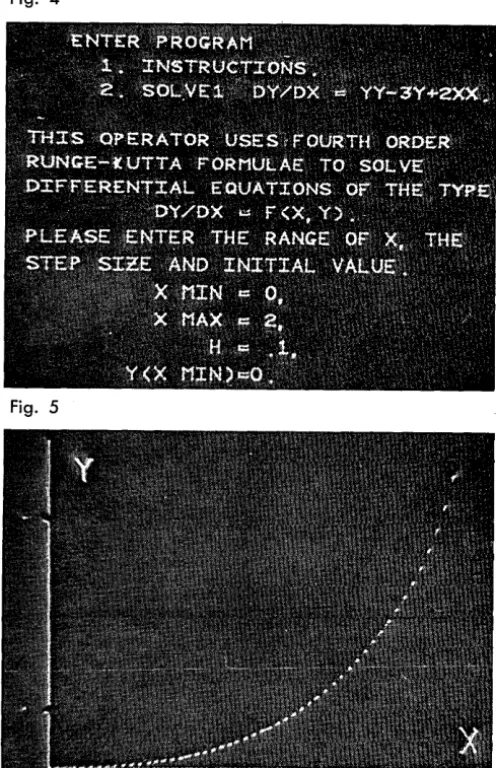
2 X POWER 2.and will be typed out by AMTRAN'S special typewriter in the format shown in the original equation. This equation can be entered and solved . within seconds to minutes, depending upon the speed of the computer. At the same time, the system' also provides the Rexibility required to enable an experienced programmer or a numerical analyst to solve problems of a nonroutine nature. Generally speak-ing, AMTRAN provides an order-of-magnitude improvement in convenience and turnaround time in mathematica1 prob-lem solving.
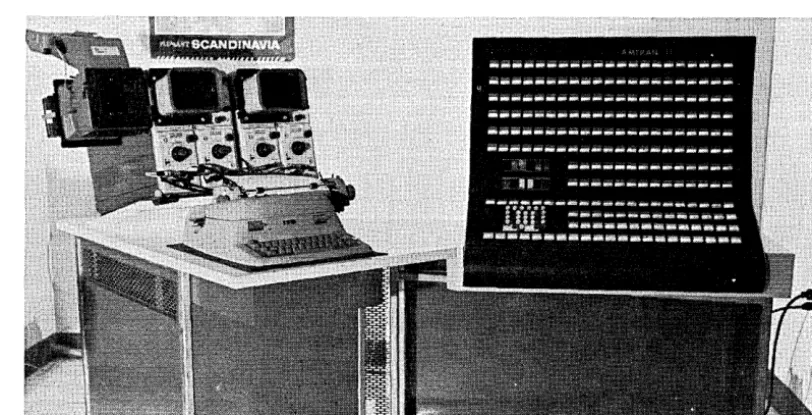
The full AMTRAN system employs remote terminals (Fig.
1) which communicate with the computer over voice grade telephone lines. The terminals2 consist of a large keyboard,
Mr. Wood is a research phys-icist in the space sciences lab-oratory of NASA's George C.
Marshall Space Flight Center. A principal contributor to the development of AMTRAN hard-ware, he holds a B.s. in
elec-trical engineering and an M.S. in physics.
Fig. 1
two 5-inch cathode ray storage oscilloscopes for graphical and alphanumeric display, and a typewriter to provide a permanent record of displayed information, when this is desired. Of course, the usual plotting and printing capa-bilities can be used at a central location although these tend to be too bulky and expensive for desktop computer terminals. The typical cost of such a terminal runs $5,000 to $10,000, depending upon whether several terminals share a common multiplexer.
general philosophy
AMTRAN is a multi-level language. It can be used by the
systems programmer at the level of bit manipulation or
October 1966
A former member of the AMTRAN development team,
Dr. Reinfe/qs is currently with the computer sciences dept. of the Univ. of Georgia. He holds
a Ph.D. in physics from the Univ. of Adelaide, and has
done postdoctoral research at the Tait Institute of Mathemat-ical Physics.
by the applied mathematician with no prior knowledge of computing, or by practitioners at any intermediate level. The system can be used in an on-line, conversational mode or in an off-line, batch-processing rrode or in any combina-tion of the two. The keyboards, cathode ray scopes and typewriters provide low-cost adjuncts to the usual card, printer, tape, and plotter attachments.
Three objectives have been of primary importance in the development of the AMTRAN system.
First, a scientist or an engineer with no background in computer techniques should be able to solve relatively straightforward mathematical problems with little or no instruction in the use of the AMTRAN system. For this pur-pose, the system has standard "convenience" operators in the language of classical mathematics, such as
S,
tx'
MINI-MAX, etc., which suffice for a large fraction of the problems commonly encountered by the scientist or engIneer.Also, the AMTRAN language has been considerably streamlined to permit the user to "converse" with the com-puter in the natural language of mathematics. For example, the system provides automatic array arithmetic, automatic dynamic dimensioning of arrays, no declaration of vari-ables, automatic assignment of working storage, implied multiplication, natural-English input and output, "picture" formatting, and other adjuncts to natural mathematics.
Second, the programmer and the more experienced user should be provided with the capability to construct their own programs and operators at the keyboard so that they can handle problems for which the standard set of opera-tors is inadequate and so that they can take advantage of the extremely short turnaround times which are character-istic of conversation-mode programming. This requirement has been met by including ALGOL 60 programming capa-bilities with certain programming extensions-e.g.,
[image:25.623.122.528.182.389.2]