BaMn
II2Mn
III(PO
4)
3Abderrazzak Assani, Mohamed Saadi, Ghaleb Alhakmi,* Elham Houmadi and Lahcen El Ammari
Laboratoire de Chimie du Solide Applique´e, Faculte´ des Sciences, Universite´ Mohammed V-Agdal, Avenue Ibn Battouta, BP 1014, Rabat, Morocco Correspondence e-mail: [email protected]
Received 8 August 2013; accepted 16 August 2013
Key indicators: single-crystal X-ray study;T= 296 K; mean(P–O) = 0.002 A˚; Rfactor = 0.020;wRfactor = 0.055; data-to-parameter ratio = 15.3.
The title compound, barium trimanganese tris(ortho-phosphate), was synthesized hydrothermally. Its structure is isotypic with the lead and strontium analoguesAMnII2Mn
III -(PO4)3 (A = Pb, Sr). Except for two O atoms on general positions, all atoms are located on special positions. The Ba and one P atom exhibit mm2 symmetry, the MnII atom 2/m symmetry, the MnIIIatom and the other P atom .2. symmetry and two O atoms are located on mirror planes. The crystal structure contains two types of chains running parallel to [010]. One chain is linear and is composed of alternating MnIIIO6 octahedra and PO4tetrahedra sharing vertices; the other chain has a zigzag arrangement and is built up from two edge-sharing MnIIO6octahedra connected to PO4tetrahedra by edges and vertices. The two types of chains are linked through PO4 tetrahedra into an open three-dimensional framework which contains channels parallel to [100] and [010] in which the BaIIions are located. The alkaline earth cation is surrounded by eight O atoms in the form of a slightly distorted bicapped trigonal prism.
Related literature
For the isotypic lead and strontium analogues, see: Alhakmiet al. (2013a) and (2013b), respectively. For related structures, see: Adam et al. (2009); Assani et al. (2011a,b). For bond-valence analysis, see: Brown & Altermatt (1985). For the by-product phase, see: Moore & Araki (1973).
Experimental
Crystal data
BaMn3(PO4)3 Mr= 587.07
Orthorhombic,Imma a= 10.3038 (7) A˚
b= 14.0163 (11) A˚
c= 6.7126 (4) A˚
V= 969.44 (12) A˚3 Z= 4
MoKradiation
= 8.39 mm 1 T= 296 K
0.290.170.13 mm
Data collection
Bruker X8 APEX diffractometer Absorption correction: multi-scan
(SADABS; Bruker, 2009)
Tmin= 0.164,Tmax= 0.376
3968 measured reflections 811 independent reflections 732 reflections withI> 2(I)
Rint= 0.032
Refinement
R[F2> 2(F2)] = 0.020 wR(F2) = 0.055 S= 1.09 811 reflections
53 parameters
max= 1.86 e A˚ 3 min= 0.78 e A˚ 3
Data collection:APEX2(Bruker, 2009); cell refinement:SAINT
(Bruker, 2009); data reduction:SAINT; program(s) used to solve structure:SHELXS97(Sheldrick, 2008); program(s) used to refine structure: SHELXL97 (Sheldrick, 2008); molecular graphics:
ORTEP-3 for Windows (Farrugia, 2012) and DIAMOND (Bran-denburg, 2006); software used to prepare material for publication:
publCIF(Westrip, 2010).
The authors thank the Unit of Support for Technical and Scientific Research (UATRS, CNRST) for the X-ray measurements.
Supplementary data and figures for this paper are available from the IUCr electronic archives (Reference: WM2767).
References
Adam, L., Guesdon, A. & Raveau, B. (2009).J. Solid State Chem.182, 2338– 2343.
Alhakmi, G., Assani, A., Saadi, M. & El Ammari, L. (2013a).Acta Cryst.E69, i40.
Alhakmi, G., Assani, A., Saadi, M., Follet, C. & El Ammari, L. (2013b).Acta Cryst.E69, i56.
Assani, A., El Ammari, L., Zriouil, M. & Saadi, M. (2011a).Acta Cryst.E67, i41.
Assani, A., El Ammari, L., Zriouil, M. & Saadi, M. (2011b).Acta Cryst.E67, i40.
Brandenburg, K. (2006).DIAMOND. Crystal Impact GbR, Bonn, Germany. Brown, I. D. & Altermatt, D. (1985).Acta Cryst.B41, 244–247.
Bruker (2009).APEX2,SAINTandSADABS. Bruker AXS Inc., Madison, Wisconsin, USA.
Farrugia, L. J. (2012).J. Appl. Cryst.45, 849–854. Moore, P. B. & Araki, T. (1973).Am. Mineral.58, 302–307. Sheldrick, G. M. (2008).Acta Cryst.A64, 112–122. Westrip, S. P. (2010).J. Appl. Cryst.43, 920–925.
Acta Crystallographica Section E Structure Reports Online
supporting information
Acta Cryst. (2013). E69, i60 [doi:10.1107/S1600536813023106]
BaMn
II2Mn
III(PO
4)
3Abderrazzak Assani, Mohamed Saadi, Ghaleb Alhakmi, Elham Houmadi and Lahcen El Ammari
S1. Comment
Investigating functional compounds by means of the hydrothermal process, particularly phosphates, we have succeeded
to synthesize and structurally characterize new mixed-cation orthophosphates with open frameworks, e.g. the isotypic
pair Ag2M3(HPO4)(PO4)2 (M = Co, Ni) (Assani et al., 2011a,b) that is closely related to the alluaudite structure. Others
investigated phosphates include compounds crystallizing in the AMnII
2MnIII(PO4)3 (A = Pb, Sr) structure type (Alhakmi et al. (2013a,b) with rarely observed mixed-valent MnII/III cations (Adam et al., 2009). The present article reports on
synthesis and crystal structure of the isotypic barium analogue, BaMnII
2MnIII(PO4)3.
All atoms of this structure are in special positions, except two oxygen atoms (O3, O4) in general position of space
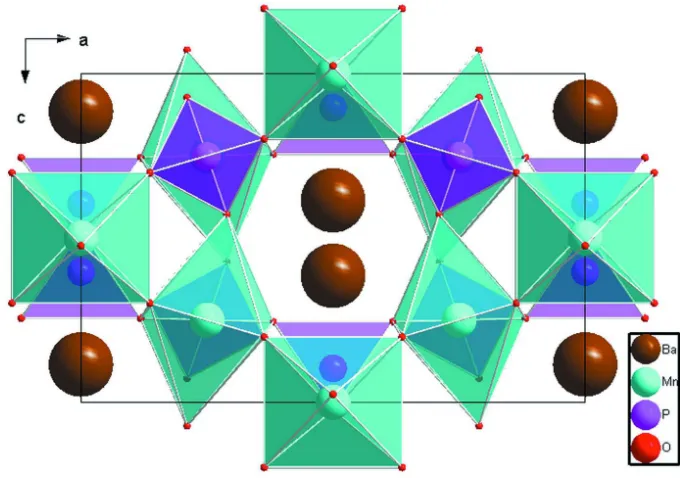
group Imma. The connection of the metal-oxygen polyhedra, viz. BaO8 polyhedra, MnO6 octahedra and PO4 tetrahedra is
shown in Fig. 1. The framework of the crystal structure consists of two isolated PO4 tetrahedra linked to MnO6 octahedra,
building two types of chains running along [010]. The first chain is formed by alternating MnIIIO
6 octahedra and PO4
tetrahedra sharing vertices. The second chain is built up from two edge-sharing MnIIO
6 octahedra leading to the formation
of MnII
2O10 dimers that are connected to two PO4 tetrahedra by a common edge. These two types of chains are linked
together by common vertices of PO4 tetrahedra to form an open three-dimensional framework that delimits two types of
tunnels parallel to [100] and [010] where the BaII ions are located (Fig. 2). The coordination sphere of the BaII ion is that
of a bicapped trigonal prism.
Bond valence sum calculation (Brown & Altermatt, 1985) of BaMnII
2MnIII(PO4)3 resulted in expected values (in valence
units) for the ions Ba1II (2.26), Mn1III (3.01), Mn2II (2.09), P1V (4.99), and P2V (4.87). The three-dimensional framework
of BaMnII
2MnIII(PO4)3 and its isotypic AMnII2MnIII(PO4)3 (A = Pb, Sr) analogues, resemble that of the Ag2M3(HPO4)(PO4)2
type with M = Ni or Co, whereby the two Ag+ cations in the channels are replaced by BaII, PbII or SrII.
S2. Experimental
The hydrothermal treatment of a reaction mixture of barium, manganese and phosphate precursors in a proportion
corresponding to the molar ratio Ba: Mn: P = 1: 3: 3 has allowed to isolate brown block-shaped crystals corresponding to
the title compound as well as a parallelepipedic colourless crystals which were identified to be the known manganese
phosphate Mn5(HPO4)2(PO4)2.4H2O (Moore & Araki, 1973). The hydrothermal reaction was conducted in a 23 ml
Teflon-lined autoclave, filled to 50% with distilled water and under autogeneous pressure at 463 K for five days.
S3. Refinement
Figure 1
The main building units of the crystal structure of the title compound. Displacement ellipsoids are drawn at the 50%
probability level. [Symmetry codes: (i) x, -y + 1, -z; (ii) -x, y - 1/2, -z; (iii) x, y - 1/2, -z; (iv) -x, -y + 1, -z; (v) x, y, z - 1;
(vi) -x, -y + 1/2, z - 1; (vii) -x, -y + 1/2, z; (viii) -x + 1/2, y - 1/2, z + 1/2; (ix) x - 1/2, -y + 1/2, -z + 1/2; (x) -x + 1/2, -y +
1/2, -z + 1/2; (xi) x - 1/2, y - 1/2, z + 1/2; (xii) -x, -y, -z + 1; (xiii) -x + 1/2, -y + 1, z + 1/2; (xiv) -x + 1/2, y, -z + 1/2.]
Figure 2
[image:3.610.133.473.415.654.2]Barium trimanganese tris(orthophosphate)
Crystal data
BaMn3(PO4)3 Mr = 587.07
Orthorhombic, Imma
Hall symbol: -I 2b 2
a = 10.3038 (7) Å
b = 14.0163 (11) Å
c = 6.7126 (4) Å
V = 969.44 (12) Å3 Z = 4
F(000) = 1088
Dx = 4.022 Mg m−3
Mo Kα radiation, λ = 0.71073 Å Cell parameters from 811 reflections
θ = 3.4–30.5°
µ = 8.39 mm−1 T = 296 K Block, brown
0.29 × 0.17 × 0.13 mm
Data collection
Bruker X8 APEX diffractometer
Radiation source: fine-focus sealed tube Graphite monochromator
φ and ω scans
Absorption correction: multi-scan (SADABS; Bruker, 2009)
Tmin = 0.164, Tmax = 0.376
3968 measured reflections 811 independent reflections 732 reflections with I > 2σ(I)
Rint = 0.032
θmax = 30.5°, θmin = 3.4° h = −14→13
k = −19→20
l = −9→7
Refinement
Refinement on F2
Least-squares matrix: full
R[F2 > 2σ(F2)] = 0.020 wR(F2) = 0.055 S = 1.09 811 reflections 53 parameters 0 restraints
Primary atom site location: structure-invariant direct methods
Secondary atom site location: difference Fourier map
w = 1/[σ2(F
o2) + (0.0353P)2]
where P = (Fo2 + 2Fc2)/3
(Δ/σ)max < 0.001
Δρmax = 1.86 e Å−3
Δρmin = −0.78 e Å−3
Special details
Geometry. All s.u.'s (except the s.u. in the dihedral angle between two l.s. planes) are estimated using the full covariance matrix. The cell s.u.'s are taken into account individually in the estimation of s.u.'s in distances, angles and torsion angles; correlations between s.u.'s in cell parameters are only used when they are defined by crystal symmetry. An approximate (isotropic) treatment of cell s.u.'s is used for estimating s.u.'s involving l.s. planes.
Refinement. Refinement of F2 against all reflections. The weighted R-factor wR and goodness of fit S are based on F2,
conventional R-factors R are based on F, with F set to zero for negative F2. The threshold expression of F2 > σ(F2) is used
only for calculating R-factors(gt) etc. and is not relevant to the choice of reflections for refinement. R-factors based on F2
are statistically about twice as large as those based on F, and R- factors based on all data will be even larger.
Fractional atomic coordinates and isotropic or equivalent isotropic displacement parameters (Å2)
x y z Uiso*/Ueq
Ba1 0.0000 0.2500 −0.11499 (4) 0.01125 (10)
Mn1 0.0000 0.5000 0.5000 0.00794 (15)
Mn2 0.2500 0.36758 (4) 0.2500 0.01092 (13)
P1 0.0000 0.2500 0.39677 (16) 0.0078 (2)
P2 0.2500 0.57094 (6) 0.2500 0.00851 (17)
O2 0.1185 (2) 0.2500 0.2553 (3) 0.0107 (4) O3 0.21046 (19) 0.63040 (12) 0.0721 (3) 0.0133 (3) O4 0.36337 (16) 0.49927 (12) 0.1983 (2) 0.0103 (3)
Atomic displacement parameters (Å2)
U11 U22 U33 U12 U13 U23
Ba1 0.01480 (16) 0.01187 (15) 0.00707 (14) 0.000 0.000 0.000 Mn1 0.0102 (3) 0.0081 (3) 0.0056 (3) 0.000 0.000 −0.0001 (2) Mn2 0.0154 (3) 0.0063 (2) 0.0110 (2) 0.000 −0.00074 (18) 0.000 P1 0.0104 (5) 0.0065 (5) 0.0066 (5) 0.000 0.000 0.000 P2 0.0121 (4) 0.0064 (4) 0.0071 (3) 0.000 0.0010 (3) 0.000 O1 0.0166 (12) 0.0049 (9) 0.0129 (11) 0.000 0.000 0.0014 (8) O2 0.0121 (11) 0.0103 (11) 0.0098 (10) 0.000 0.0035 (8) 0.000 O3 0.0183 (8) 0.0114 (8) 0.0100 (7) 0.0027 (6) 0.0006 (7) 0.0033 (6) O4 0.0123 (8) 0.0087 (7) 0.0100 (7) 0.0014 (6) 0.0016 (6) 0.0009 (5)
Geometric parameters (Å, º)
Ba1—O1i 2.734 (2) Mn2—O2 2.1337 (16)
Ba1—O1ii 2.734 (2) Mn2—O2xiii 2.1337 (16)
Ba1—O3iii 2.7560 (18) Mn2—O3iii 2.2006 (17)
Ba1—O3iv 2.7560 (18) Mn2—O3ix 2.2006 (17)
Ba1—O3v 2.7560 (18) Mn2—O4 2.2117 (17)
Ba1—O3vi 2.7560 (18) Mn2—O4x 2.2117 (17)
Ba1—O2 2.769 (2) P1—O1 1.523 (2)
Ba1—O2vii 2.769 (2) P1—O1vii 1.523 (2)
Mn1—O4viii 1.9377 (17) P1—O2vii 1.547 (2)
Mn1—O4ix 1.9377 (17) P1—O2 1.547 (2)
Mn1—O4x 1.9377 (17) P2—O3x 1.5119 (17)
Mn1—O4xi 1.9377 (17) P2—O3 1.5119 (17)
Mn1—O1vii 2.248 (2) P2—O4x 1.5792 (17)
Mn1—O1xii 2.248 (2) P2—O4 1.5792 (17)
O1i—Ba1—O1ii 54.97 (9) O4ix—Mn1—O1vii 87.51 (6)
O1i—Ba1—O3iii 111.92 (5) O4x—Mn1—O1vii 92.49 (6)
O1ii—Ba1—O3iii 79.16 (5) O4xi—Mn1—O1vii 87.51 (6)
O1i—Ba1—O3iv 79.16 (5) O4viii—Mn1—O1xii 87.51 (6)
O1ii—Ba1—O3iv 111.92 (5) O4ix—Mn1—O1xii 92.49 (6)
O3iii—Ba1—O3iv 168.02 (7) O4x—Mn1—O1xii 87.51 (6)
O1i—Ba1—O3v 79.16 (5) O4xi—Mn1—O1xii 92.49 (6)
O1ii—Ba1—O3v 111.92 (5) O1vii—Mn1—O1xii 180.0
O3iii—Ba1—O3v 74.93 (8) O2—Mn2—O2xiii 78.86 (10)
O3iv—Ba1—O3v 103.78 (8) O2—Mn2—O3iii 84.77 (8)
O1i—Ba1—O3vi 111.92 (5) O2xiii—Mn2—O3iii 96.38 (8)
O1ii—Ba1—O3vi 79.16 (5) O2—Mn2—O3ix 96.38 (8)
O3iii—Ba1—O3vi 103.78 (8) O2xiii—Mn2—O3ix 84.77 (8)
O3v—Ba1—O3vi 168.02 (7) O2—Mn2—O4 169.28 (7)
O1i—Ba1—O2 142.77 (4) O2xiii—Mn2—O4 107.86 (7)
O1ii—Ba1—O2 142.77 (4) O3iii—Mn2—O4 86.16 (6)
O3iii—Ba1—O2 63.86 (5) O3ix—Mn2—O4 92.61 (7)
O3iv—Ba1—O2 104.67 (5) O2—Mn2—O4x 107.86 (7)
O3v—Ba1—O2 63.86 (5) O2xiii—Mn2—O4x 169.28 (7)
O3vi—Ba1—O2 104.67 (5) O3iii—Mn2—O4x 92.61 (7)
O1i—Ba1—O2vii 142.77 (4) O3ix—Mn2—O4x 86.16 (6)
O1ii—Ba1—O2vii 142.77 (4) O4—Mn2—O4x 66.86 (9)
O3iii—Ba1—O2vii 104.67 (5) O1—P1—O1vii 111.94 (19)
O3iv—Ba1—O2vii 63.86 (5) O1—P1—O2vii 110.09 (7)
O3v—Ba1—O2vii 104.67 (5) O1vii—P1—O2vii 110.09 (7)
O3vi—Ba1—O2vii 63.86 (5) O1—P1—O2 110.09 (7)
O2—Ba1—O2vii 52.33 (10) O1vii—P1—O2 110.09 (7)
O4viii—Mn1—O4ix 180.0 O2vii—P1—O2 104.27 (19)
O4viii—Mn1—O4x 93.19 (10) O3x—P2—O3 113.10 (14)
O4ix—Mn1—O4x 86.81 (10) O3x—P2—O4x 112.12 (9)
O4viii—Mn1—O4xi 86.81 (10) O3—P2—O4x 108.95 (10)
O4ix—Mn1—O4xi 93.19 (10) O3x—P2—O4 108.95 (10)
O4x—Mn1—O4xi 180.0 O3—P2—O4 112.12 (9)
O4viii—Mn1—O1vii 92.49 (6) O4x—P2—O4 100.99 (13)
Symmetry codes: (i) x, y, z−1; (ii) −x, −y+1/2, z−1; (iii) x, −y+1, −z; (iv) −x, y−1/2, −z; (v) x, y−1/2, −z; (vi) −x, −y+1, −z; (vii) −x, −y+1/2, z; (viii) x−1/2,