
[4-(Allyloxy)phenyl](phenyl)methanone
Richard F. D’Vries,a* Carlos D. Grande,b Manuel N. Chaur,cJavier A. Ellenaaand Rigoberto C. Advinculad
a
Instituto de Fı´sica de Sa˜o Carlos, Universidade de Sa˜o Paulo, Av. Trabalhador sa˜o-carlense 400, Sa˜o Carlos, SP, 13566-590, Brazil,bPrograma de Ingenieria Agroindustrial, Universidad San Buenaventura, AA 7154, Santiago de Cali, Colombia,cDepartamento de Quı´mica, Facultad de Ciencias, Universidad del Valle,
AA 25360, Santiago de Cali, Colombia, anddCase Western Reserve University,
Department of
Macromolecular Science and Engineering, 2100 Adelbert Road, Kent Hale Smith Bldg, Cleveland, Ohio 44106, USA
Correspondence e-mail: [email protected]
Received 22 May 2014; accepted 18 June 2014
Key indicators: single-crystal X-ray study;T= 293 K; mean(C–C) = 0.004 A˚; Rfactor = 0.049;wRfactor = 0.133; data-to-parameter ratio = 9.6.
The structure of the title compound, C16H14O2, features a
dihedral angle of 54.4 (3) between the aromatic rings. The
allyl group is rotated by 37.4 (4) relative to the adjacent
benzene ring. The crystal packing is characterized by numerous C—H O and C—H interactions. Most of these interactions occur in layers along (011). The layers are linked by C—H interactions along [100], forming a three-dimensional network.
Related literature
For more details of the synthesis, see: Pruckeret al.(1999). For photoreactive properties of benzophenone derivates, see: Shirahata & Kishimoto (1984); Dorman & Prestwich (1994); Beckett & Porter (1963); Kubo et al.(2010); Balakirevet al. (2005); Ferreira et al. (1995); Matsushita et al. (1992). For related structures, see: Schlemper (1982); Norment & Karle (1962); Guoet al.(1992).
Experimental
Crystal data
C16H14O2
Mr= 238.27
Monoclinic,P21
a= 6.0141 (5) A˚
b= 7.8839 (8) A˚
c= 13.5992 (14) A˚
= 94.442 (6) V= 642.86 (11) A˚3
Z= 2
MoKradiation
= 0.08 mm1
T= 293 K
0.120.080.06 mm
Data collection
Nonius KappaCCD diffractometer 1609 measured reflections 1603 independent reflections
1021 reflections withI> 2(I)
Rint= 0.065
Refinement
R[F2> 2(F2)] = 0.049
wR(F2) = 0.133
S= 1.01 1603 reflections 167 parameters 1 restraint
H atoms treated by a mixture of independent and constrained refinement
max= 0.17 e A˚
3
min=0.16 e A˚
[image:1.610.313.565.279.346.2]3
Table 1
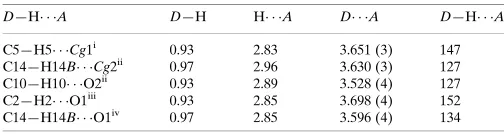
Hydrogen-bond geometry (A˚ ,).
Cg1 andCg2 are the centroids of the C1–C6 and C8–C13 rings, respectively.
D—H A D—H H A D A D—H A
C5—H5 Cg1i
0.93 2.83 3.651 (3) 147 C14—H14B Cg2ii
0.97 2.96 3.630 (3) 127 C10—H10 O2ii 0.93 2.89 3.528 (4) 127 C2—H2 O1iii
0.93 2.85 3.698 (4) 152 C14—H14B O1iv
0.97 2.85 3.596 (4) 134
Symmetry codes: (i)xþ1;yþ1
2;zþ2; (ii)xþ2;yþ 1
2;zþ1; (iii)xþ1;y;z; (iv) xþ1;yþ1
2;zþ1.
Data collection: COLLECT (Nonius, 1998); cell refinement: SCALEPACK (Otwinowski & Minor, 1997); data reduction:
DENZO (Otwinowski & Minor, 1997) and SCALEPACK;
program(s) used to solve structure:SHELXS2013(Sheldrick, 2008); program(s) used to refine structure:SHELXL2013(Sheldrick, 2008); molecular graphics:ORTEP-3 for Windows (Farrugia, 2012); soft-ware used to prepare material for publication: WinGX (Farrugia, 2012), DIAMOND (Brandenburg, 2006), Mercury (Macrae et al., 2008) andPARST(Nardelli, 1995).
RFD acknowledges a CAPES/PNPD scholarship from the Brazilian Ministry of Education (MEC) and the Crystal-lography Group of the Instituto de Fı´sica de Sa˜o Carlos, Universidade de Sa˜o Paulo. MNC acknowledges the Centro en Excelencia en Nuevos Materiales (CENM), the Vice-rrectorı´a de Investigaciones of Universidad del Valle, Banco de la Repu´blica and Colciencias from Colombia for partial financial support. CDG acnowledges the Universidad de San Buenaventura Cali for partial financial support.
Supporting information for this paper is available from the IUCr electronic archives (Reference: LD2129).
References
Balakirev, M. Y., Porte, S., Vernaz-Gris, M., Berger, M., Arie, J.-P., Fouque, B. & Chatelain, F. (2005).Anal. Chem.77, 5474–5479.
Beckett, A. & Porter, G. (1963).Trans. Faraday Soc.59, 2038–2050. Brandenburg, K. (2006).DIAMOND. Crystal Impact GbR, Bonn, Germany. Dorman, G. & Prestwich, G. D. (1994).Biochemistry,33, 5661–5673. Farrugia, L. J. (2012).J. Appl. Cryst.45, 849–854.
Ferreira, L. F. V., Netto-Ferreira, J. C., Khmelinskii, I. V., Garcia, A. R. & Costa, S. M. B. (1995).Langmuir,11, 231–236.
Guo, S., Su, G., Pan, F. & He, Y. (1992).Acta Cryst.C48, 576–578.
organic compounds
o814
D’Vrieset al. doi:10.1107/S1600536814014342 Acta Cryst.(2014). E70, o814–o815Acta Crystallographica Section E Structure Reports
Online
Sci. Technol.23, 83–86.
Macrae, C. F., Bruno, I. J., Chisholm, J. A., Edgington, P. R., McCabe, P., Pidcock, E., Rodriguez-Monge, L., Taylor, R., van de Streek, J. & Wood, P. A. (2008).J. Appl. Cryst.41, 466–470.
Matsushita, Y., Kajii, Y. & Obi, K. (1992).J. Phys. Chem.96, 6566–6570. Nardelli, M. (1995).J. Appl. Cryst.28, 659.
Nonius (1998).COLLECT. Nonius BV, Delft, The Netherlands. Norment, H. G. & Karle, I. L. (1962).Acta Cryst.15, 873–878.
Macromolecular Crystallography, Part A, edited by C. W. Carter Jr & R. M. Sweet, pp. 307–326. New York: Academic Press.
Prucker, O., Naumann, C. A., Ruhe, J., Knoll, W. & Frank, C. W. (1999).J. Am. Chem. Soc.121, 8766–8770.
supporting information
sup-1 Acta Cryst. (2014). E70, o814–o815
supporting information
Acta Cryst. (2014). E70, o814–o815 [https://doi.org/10.1107/S1600536814014342]
[4-(Allyloxy)phenyl](phenyl)methanone
Richard F. D
′
Vries, Carlos D. Grande, Manuel N. Chaur, Javier A. Ellena and Rigoberto C.
Advincula
S1. Introduction
The title compound C16H14O2, is based on a photoreactive benzophenone derivative that can be bound to SiO2 surfaces via
a silane anchor. This substrate is a compound that has a benzophenone moiety which exhibits a known photoreactivity
and is particularly useful in photopolymerizable organopolysiloxane and silicone resins Prucker et al., (1999); Shirahata
& Kishimoto, (1984); Dorman & Prestwich, (1994); Beckett & Porter, (1963). When triggered by UV light (λ = 365 nm),
a biradical triplet state is formed, which is able of abstracting a proton from any neighboring aliphatic C—H group to
form a C—C bond (Ferreira et al., (1995); Balakirev et al., (2005); Kubo et al. (2010)) and as a result of the
photochemical reaction, a thin layer of the polymer is covalently bound to the surface (Prucker et al. (1999); Shirahata &
Kishimoto, (1984); Dorman & Prestwich, (1994); Matsushita et al. (1992)). This molecule can be also copolymerized
with other polymer molecules and will not migrate out through its double bond.
S2. Experimental
Synthesis of (4-Allyloxy-phenyl)-phenyl-methanone. This compound was synthesized by a procedure already reported.
A mixture of 4-hydroxybenzophenone (39.6 g, 0.2 mol) and allyl bromide (26.6 g, 0.22 mol) were dissolved in 120 mL of
acetone and 28 g of potassium carbonate. The mixture was heated to reflux for 8 h and then cooled down to room
temperature. Water (80 mL) was added and the resulting solution was extracted twice with 100 mL of diethyl ether. The
combined organic phases were washed with 100 mL of aqueous NaOH (10%) and dried over Na2SO4, and the solvent was
evaporated. The resulting yellowish product was purified from methanol to yield 40 g (89%) of pure product as
confirmed by NMR. FTIR (KBr): 3081, 3059, 3022, 2939, 2865, 1650, 1600 cm-1. 1H NMR (CDCl
3, δ(ppm): 4.6 (m, 2H,
OCH2), 5.3-5.5 (m, 2H, CH2=), 6.1 (m, 1H,=CH-), 7.21 (2H, m); 7.44 (2H, m); 7.56 (1H, m); 7.77 (2H, m); 7.88 (2H, m).
13C NMR: δ(ppm) in CDCl
3: 195.13 (C=O), 162.14 (OCarom), 149.12, 137.60, 135.94, 132.78, 131.93, 130.19, 128.35,
118.29, 115.91, 69.34 (OCH2).
S2.1. Refinement
All H atoms were placed in idealized positions, with C—H bond lengths fixed to 0.93 (aromatic C—H) or 0.97 Å
(terminal methylene), and refined as riding with displacement parameters calculated as Uiso(H) = xUeq(carrier C) where
x = 1.2.
S3. Results and discussion
The compound C16H14O2 is a benzophenone derivate formed by two aromatic rings linked by a ketone funtion. The
presence of the ketone funtion and an allyloxy group make of this molecule particularly useful in photopolymerizable
organopolysiloxane and silicone resins, and a excellent substrate for selective catalysis. The rings are twisted with a
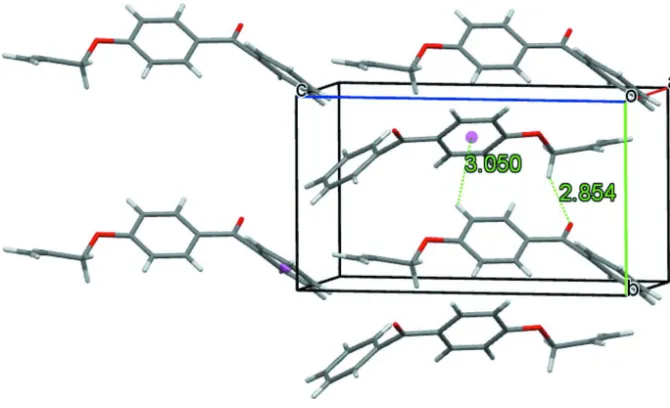
C5—H5···π = 3.651 (3) , C14—H14B···O1 = 3.596 (4) and C10—H10··O2 = 3.528 (4) Å giving rise to supramolecular
layers in the plane (011). C14—H14B···π = 3.698 (2) Å interaction join the layers along [100] to obtain the
[image:4.610.135.469.131.326.2]supra-molecular crystal packing.
Figure 1
The ORTEP structure of the title compound with displacement ellipsoid plot drawn at the 50% probability level.
Figure 2
[image:4.610.135.470.363.567.2]supporting information
[image:5.610.130.471.74.273.2]sup-3 Acta Cryst. (2014). E70, o814–o815
Figure 3
Crystal packing view of the title compound along [001] direction. The hydrogen bonds are shown as dashed lines.
[4-(Allyloxy)phenyl](phenyl)methanone
Crystal data
C16H14O2 Mr = 238.27
Monoclinic, P21
Hall symbol: P 2yb
a = 6.0141 (5) Å
b = 7.8839 (8) Å
c = 13.5992 (14) Å
β = 94.442 (6)°
V = 642.86 (11) Å3 Z = 2
F(000) = 252
Dx = 1.231 Mg m−3
Mo Kα radiation, λ = 0.71073 Å Cell parameters from 1583 reflections
θ = 3.0–27.9°
µ = 0.08 mm−1 T = 293 K Prism, colourless 0.12 × 0.08 × 0.06 mm
Data collection
Nonius KappaCCD diffractometer
Radiation source: Enraf–Nonius FR590 Horizonally mounted graphite crystal
monochromator
Detector resolution: 9 pixels mm-1
CCD rotation images, thick slices scans 1609 measured reflections
1603 independent reflections 1021 reflections with I > 2σ(I)
Rint = 0.065
θmax = 27.8°, θmin = 3.0° h = 0.000000→7.000000
k = 0.00000→10.000000
l = −17.00000→17.000000
Refinement
Refinement on F2
Least-squares matrix: full
R[F2 > 2σ(F2)] = 0.049 wR(F2) = 0.133 S = 1.01 1603 reflections 167 parameters 1 restraint 0 constraints
Hydrogen site location: inferred from neighbouring sites
H atoms treated by a mixture of independent and constrained refinement
w = 1/[σ2(F
o2) + (0.0858P)2]
where P = (Fo2 + 2Fc2)/3
(Δ/σ)max < 0.001
Δρmax = 0.17 e Å−3
Experimental. The absence of some reflections of the data sets is due to merged them. The 001 reflection was removed because it intensity was affect by the beam stop.
Geometry. All e.s.d.'s (except the e.s.d. in the dihedral angle between two l.s. planes) are estimated using the full
covariance matrix. The cell e.s.d.'s are taken into account individually in the estimation of e.s.d.'s in distances, angles and torsion angles; correlations between e.s.d.'s in cell parameters are only used when they are defined by crystal symmetry. An approximate (isotropic) treatment of cell e.s.d.'s is used for estimating e.s.d.'s involving l.s. planes.
Fractional atomic coordinates and isotropic or equivalent isotropic displacement parameters (Å2)
x y z Uiso*/Ueq
C16 1.2957 (8) 0.3081 (6) 0.2215 (3) 0.1064 (13)
H16A 1.4203 0.317 0.2662 0.128*
H16B 1.3132 0.2899 0.155 0.128*
H15 0.960 (6) 0.322 (7) 0.199 (3) 0.119 (14)*
C1 0.5814 (4) 0.3364 (4) 0.8323 (2) 0.0589 (7)
C2 0.7988 (4) 0.3074 (4) 0.8703 (2) 0.0660 (8)
H2 0.8946 0.2419 0.8356 0.079*
C3 0.8714 (5) 0.3768 (5) 0.9602 (2) 0.0780 (9)
H3 1.0159 0.3552 0.9867 0.094*
C4 0.7337 (6) 0.4775 (5) 1.0114 (2) 0.0846 (10)
H4 0.7851 0.5244 1.0717 0.102*
C5 0.5206 (6) 0.5084 (5) 0.9730 (3) 0.0825 (9)
H5 0.4277 0.5779 1.0068 0.099*
C6 0.4430 (5) 0.4374 (5) 0.8849 (2) 0.0732 (8)
H6 0.2967 0.457 0.8601 0.088*
C7 0.4818 (4) 0.2537 (4) 0.7404 (2) 0.0618 (7)
C8 0.6023 (4) 0.2502 (3) 0.64903 (19) 0.0551 (6)
C9 0.7921 (4) 0.3450 (4) 0.63562 (19) 0.0558 (6)
H9 0.8546 0.4107 0.6874 0.067*
C10 0.8906 (4) 0.3438 (3) 0.54670 (18) 0.0577 (6)
H10 1.0187 0.4071 0.5394 0.069*
C11 0.7969 (4) 0.2475 (4) 0.46872 (19) 0.0570 (6)
C12 0.6079 (4) 0.1514 (4) 0.4819 (2) 0.0666 (8)
H12 0.5458 0.0852 0.4302 0.08*
C13 0.5125 (4) 0.1529 (4) 0.5696 (2) 0.0656 (7)
H13 0.3855 0.0881 0.5767 0.079*
C14 1.0531 (5) 0.3498 (4) 0.3553 (2) 0.0700 (8)
H14A 1.1858 0.3269 0.3984 0.084*
H14B 1.0095 0.4668 0.3647 0.084*
C15 1.0986 (7) 0.3210 (6) 0.2518 (2) 0.0848 (10)
O1 0.2952 (3) 0.1918 (4) 0.74038 (17) 0.0906 (8)
O2 0.8762 (3) 0.2378 (3) 0.37801 (13) 0.0715 (6)
Atomic displacement parameters (Å2)
U11 U22 U33 U12 U13 U23
supporting information
sup-5 Acta Cryst. (2014). E70, o814–o815
C1 0.0556 (14) 0.0588 (16) 0.0637 (14) −0.0029 (13) 0.0135 (12) 0.0036 (14)
C2 0.0571 (15) 0.0756 (19) 0.0663 (17) 0.0002 (13) 0.0116 (13) 0.0027 (15)
C3 0.0674 (16) 0.103 (3) 0.0636 (17) −0.0109 (17) 0.0026 (14) 0.0057 (17)
C4 0.098 (2) 0.093 (2) 0.0655 (18) −0.0230 (19) 0.0192 (18) −0.0085 (18)
C5 0.089 (2) 0.077 (2) 0.084 (2) 0.0005 (18) 0.0283 (18) −0.0107 (18)
C6 0.0629 (15) 0.0760 (19) 0.083 (2) 0.0060 (15) 0.0220 (14) 0.0025 (18)
C7 0.0487 (14) 0.0666 (16) 0.0700 (16) 0.0002 (13) 0.0041 (12) 0.0027 (14)
C8 0.0513 (13) 0.0511 (14) 0.0624 (15) 0.0022 (12) 0.0006 (11) 0.0025 (13)
C9 0.0535 (13) 0.0560 (14) 0.0570 (14) −0.0015 (12) −0.0011 (11) −0.0035 (13)
C10 0.0563 (13) 0.0584 (15) 0.0584 (15) −0.0056 (13) 0.0038 (12) 0.0000 (14)
C11 0.0617 (14) 0.0521 (13) 0.0568 (15) 0.0042 (13) 0.0017 (12) 0.0011 (14)
C12 0.0700 (16) 0.0608 (16) 0.0671 (18) −0.0082 (14) −0.0076 (14) −0.0089 (15)
C13 0.0603 (15) 0.0614 (16) 0.0751 (19) −0.0101 (14) 0.0055 (14) −0.0019 (16)
C14 0.0773 (18) 0.0667 (18) 0.0672 (17) 0.0032 (15) 0.0133 (14) −0.0003 (16)
C15 0.099 (2) 0.092 (2) 0.0645 (17) 0.001 (2) 0.0139 (18) 0.0056 (18)
O1 0.0605 (12) 0.121 (2) 0.0911 (15) −0.0256 (13) 0.0138 (11) −0.0100 (15)
O2 0.0857 (13) 0.0694 (12) 0.0600 (11) −0.0070 (11) 0.0099 (9) −0.0039 (11)
Geometric parameters (Å, º)
C16—C15 1.289 (5) C8—C9 1.388 (4)
C16—H16A 0.93 C8—C13 1.399 (4)
C16—H16B 0.93 C9—C10 1.387 (4)
C1—C2 1.387 (3) C9—H9 0.93
C1—C6 1.390 (4) C10—C11 1.387 (4)
C1—C7 1.494 (4) C10—H10 0.93
C2—C3 1.379 (4) C11—O2 1.359 (3)
C2—H2 0.93 C11—C12 1.389 (4)
C3—C4 1.375 (5) C12—C13 1.363 (4)
C3—H3 0.93 C12—H12 0.93
C4—C5 1.368 (5) C13—H13 0.93
C4—H4 0.93 C14—O2 1.435 (3)
C5—C6 1.371 (5) C14—C15 1.472 (4)
C5—H5 0.93 C14—H14A 0.97
C6—H6 0.93 C14—H14B 0.97
C7—O1 1.224 (3) C15—H15 1.06 (4)
C7—C8 1.486 (4)
C15—C16—H16A 120 C13—C8—C7 118.1 (2)
C15—C16—H16B 120 C8—C9—C10 121.5 (2)
H16A—C16—H16B 120 C8—C9—H9 119.3
C2—C1—C6 119.2 (3) C10—C9—H9 119.3
C2—C1—C7 123.1 (3) C11—C10—C9 119.6 (2)
C6—C1—C7 117.6 (2) C11—C10—H10 120.2
C3—C2—C1 119.3 (3) C9—C10—H10 120.2
C3—C2—H2 120.3 O2—C11—C10 125.1 (2)
C1—C2—H2 120.3 O2—C11—C12 115.7 (2)
C2—C3—H3 119.5 C13—C12—H12 119.6
C5—C4—C3 119.5 (3) C11—C12—H12 119.6
C5—C4—H4 120.3 C12—C13—C8 121.1 (2)
C3—C4—H4 120.3 C12—C13—H13 119.4
C6—C5—C4 120.5 (3) C8—C13—H13 119.4
C6—C5—H5 119.8 O2—C14—C15 107.8 (3)
C4—C5—H5 119.8 O2—C14—H14A 110.1
C5—C6—C1 120.4 (3) C15—C14—H14A 110.1
C5—C6—H6 119.8 O2—C14—H14B 110.1
C1—C6—H6 119.8 C15—C14—H14B 110.1
O1—C7—C8 120.0 (3) H14A—C14—H14B 108.5
O1—C7—C1 118.8 (3) C16—C15—C14 124.2 (4)
C8—C7—C1 121.2 (2) C16—C15—H15 119 (2)
C9—C8—C13 117.8 (2) C14—C15—H15 117 (2)
C9—C8—C7 124.0 (2) C11—O2—C14 118.6 (2)
Hydrogen-bond geometry (Å, º)
Cg1 and Cg2 are the centroids of the C1–C6 and C8–C13 rings, respectively.
D—H···A D—H H···A D···A D—H···A
C5—H5···Cg1i 0.93 2.83 3.651 (3) 147
C14—H14B···Cg2ii 0.97 2.96 3.630 (3) 127
C10—H10···O2ii 0.93 2.89 3.528 (4) 127
C2—H2···O1iii 0.93 2.85 3.698 (4) 152
C14—H14B···O1iv 0.97 2.85 3.596 (4) 134
![Figure 3Crystal packing view of the title compound along [001] direction. The hydrogen bonds are shown as dashed lines](https://thumb-us.123doks.com/thumbv2/123dok_us/472794.545499/5.610.130.471.74.273/figure-crystal-packing-title-compound-direction-hydrogen-dashed.webp)
![Tetrakis(μ 2 phenylacetato κ2O:O′)bis{[4 (dimethylamino)pyridine κN1]cobalt(II)}](data:image/gif;base64,R0lGODlhAQABAIAAAP///wAAACH5BAEAAAAALAAAAAABAAEAAAICRAEAOw==)