In recent years, the growing of the poppy (Papaver somniferum L.) has obtained the importance because it is possible to produce not only poppy seeds but also morphine as a source of raw material for the pharmaceutical industry.
The poppy as a plant species is characterised with a relatively short growing season and a shallow root system. Regarding these facts, it is therefore necessary to assure good reserves of nutrients in the soil in the course of all stages of its growth. In such a situation its nutritional status can be held on an optimal level. In this respect, the most important is a good balance of these macro- and microbiog-enous elements, which show a positive effect both on yields and quality of production (Costes et al. 1976, Ramanathan 1979, Chizzola 2001, Kadar et al. 2001). In poppy growing, the supply of nitro-gen plays a decisive role and, in this respect, the most imporant factors are the following: its supply, form, and date of application (Yadav et al. 1984). Pavlíková et al. (1994) concluded that it was also important to choose a suitable form of N fertilis-ers, especially as far as the uptake of this nutrient from soil and the seed yield are concerned. The need of an optimal supply of nitrogen for poppy plants begins shortly after germination and lasts till the stage of formation of the generative organs. The above authors (Pavlíková and Tlustoš 1994) also mentioned that a slow release of N fertiliser
showed a positive effect not only on the habitus of the poppy plants but also on the yield of seeds. Jain et al. (1990) and Kharwara et al. (1988), and also some other authors mentioned that splitting doses of N influenced above all the yield of the seed and the content of alkaloids.
MATERIAL AND METHODS
The experiment was established using pots with a medium heavy soil classified as a fluvisol; its agrochemical characteristics are presented in Table 1.
The soil pH was neutral, contents of P and Ca were high, content of K satisfactory and content of Mg good. On 27 March 2003, plastic pots were filled up with 9.5 kg of soil each and poppy seeds of the cultivar Opál were sown and thinly covered with soil. Seeds germinated at relatively low tem-peratures (0–6°C) at the beginning of April. The treatments of nitrogen doses, supplied in the form of ammonium nitrate are presented in Table 2. Each treatment was repeated four times.
Plants used for chemical analyses were sampled during the whole growing season, in growth stages DC 35 (leaf rosette), DC 41 (stem elongation growth) and DC 49 (flowering). N was determined accord-ing to Kjeldahl. In treatments 2 and 4, the second
Split nitrogen doses and their efficiency in poppy
(
Papaver somniferum
L.) nutrition
T. Lošák, R. Richter
Mendel University of Agriculture and Forestry in Brno, Czech Republic
ABSTRACT
The efficiency of partial doses of nitrogen applied to poppy (Papaver somniferum L.) plants, cv. Opál, was followed in a pot experiment. The ammonium nitrate was applied either in a single dose at the beginning of growing season or in two split doses with the second application at the stage of flowering. With the increasing dose of nitrogen the number of capsules per a plant during the harvest and their volume increased irregularly. The separated application of an op-timum dose of N (i.e. 0.9 g N/pot) showed a statistically highly significant positive effect on the yield of poppy seeds compared to the same single dose of N made this figure increased by 25.6%. The morphine content in the capsules in-creased with the increasing supply of N from 0.85 to 1.01%. The term of nitrogen application influenced the number of capsules per a plant and their volume and morphine content irregularly.
Keywords: poppy; nitrogen; split application; seed; yield; morphine
484 PLANT SOIL ENVIRON., 50, 2004 (11): 484–488 PLANT SOIL ENVIRON., 50, 2004 (11): 484–488 485 application of N in the form of ammonium nitrate
was carried out in the stage of flowering (DC 49) on 13 June 2003. Plants were irrigated with deminer-alised water to reach 60% of the maximum water capacity and treated with insecticides (Sumithion, Karate 2.5 EC) against aphids.
Experimental plants were harvested in the stage of full ripeness on 22 July 2003 and the following parameters were evaluated: yields of seeds per a pot (4 plants), total yield of straw per a pot, volume of poppy capsules and content of mor-phine in the capsule. The alkaloid mormor-phine itself was determined polarographically by means of morphine-hydrochloride using the Polarograph OH-102 according to the methodics of the Research Institute Opava. Seed yields were evaluated using statistical methods with the expression of minimum significant differences.
RESULTS AND DISCUSSION
The optimal supply of N is (together with a balanced content of other nutrients in soil) an
important presupposition of required yields and quality of poppy seeds. After the first and the sec-ond samplings (DC 35 = leaf rosette a DC 41 = stem elongation growth) there were no marked differ-ences among individual experimental treatments in plant nitrogen concentration (Table 3) although its relative contents decreased due to a dilution effect. In the stage of flowering (DC 49), however, the differences were already greater and in treat-ments with an increased initial level of N in soil (treatments 3 and 4) the increase in N content in plants was higher than in treatments 1 and 2.
Yields (Figure 1) indicate that a single application of N (treatments 1 and 3) resulted in the lowest seed yields and that there were no statistically sig-nificant differences between both treatments. The application of 0.3 g N/pot (treatments 2 and 4) in the period of flowering (DC 49), increased highly significantly the yield of seeds (by 23.2–27.6%) compare to the lowest nitrogen dose (treatment 1). However, there were no significant differences be-tween treatments 2 and 4 and the highest dose of N (1.2 g N/pot) resulted in a slight yield depression in treatment 4 compared to treatment 2.
The most significant differences in seed yields were observed between treatments 2 and 3. Although the total dose of N was the same in both cases (i.e. 0.9 g N/pot), the obtained yields were significantly different.
[image:2.595.65.534.85.139.2]A separated application of nitrogen (treat-ment 2) resulted in a highly significant increase in seed yield (i.e. by as much as 25.6%) compared to an identical single dose (treatment 3). This ob-servation corresponds with results published by Solanki et al. (1998) who demonstrated that split doses of nitrogen showed a positive effect on the seed yield. Laughlin and Chung (1992), as well, mentioned that a partial application of N before the stage of flowering resulted under optimal moisture conditions in an increase in seed yields by 20–40%. Jain (1990) recorded the highest seed yield after the application of N in three splitted doses – 1/4 as sowing, 1/2 in the stage of leaf ro-sette, and 1/4 before flowering. With the increasing dose of N (from 30 to 90 kg N/ha) recorded Jain et al. (1990) an increase in the seed yield by 37.5%. Kharwara et al. (1988), as well, observed higher seed yield and morphine content after an increase in N supply from 75 to 150 kg N/ha. Gupta (1984) obtained the highest yields after 3 splitted doses Table 1. Agrochemical characteristics of soil (Mehlich III)
pH/KCl Content of available nutrients (mg/kg) Total S (mg/kg)
P K Ca Mg Sws S-SO42–
[image:2.595.63.291.180.302.2]6.75 120 166 3377 224 9.1 6.0
Table 2. Experimental scheme
Treatment
N-dose (g/pot) DC 22
(2 pairs of leaves)
DC 49
(flowering) total
1 0.6 – 0.6
2 0.6 0.3 0.9
3 0.9 – 0.9
4 0.9 0.3 1.2
Table 3. Concentrations of N in plants after individual sam-plings (% of dry matter)
DC 35 (leaf rosette)
DC 41 (stem elongation
growth)
DC 49 (flowering)
1 4.93 3.49 1.83
2 4.96 3.66 1.94
3 4.84 4.05 2.85
[image:2.595.64.290.646.761.2]of calcium nitrate applied (i) at the momment of sowing, (ii) 30–40 days later, and (iii) 60–65 days thereafter. In dependence on the dose of organic dressing, the total dose of nitrogen ranged from 60 to 90 kg N/ha.
The total yield of straw per a pot ranged from 25.08 to 37.92 g/pot (Figure 2) and compare to all other treatments, the statistically highest yield (P = 99%) was obtained in treatment 3 a�er a single dose of nitrogen.
The lowest volume of capsules per a plant (9.1 ml/ plant) was recorded in treatment 1 with the lowest dose of N (Figure 3). In this case, the volume of capsules was highly significantly lower than in all other variants. In treatments 2–4, the increasing supply of nitrogen resulted in an increase in the volume of capsules by 37.6 to 44.2% compared to treatment 1 and there were no statistical differences among treatments 2–4. Jain et al. (1990) observed, after a change of N dose from 30 to 90 kg N/ha, an increase in the volume of capsules by as much as 58%. Solanki et al. (1998), as well, mentioned that splitting the N supply into three doses was positively manifested in the highest total volume of capsules. However, the highest volume of capsules (13.1 ml/plant) did not correspond with the highest yield of seeds (treatment 3). This means that the volume of capsules cannot be related directly to the yield of poppy seeds.
After a single dose of N, the average number of capsules per a plant in treatment 3 was 1.54 while after the splitted application of the same amount of N (treatment 2) the average number of capsules was only 1.0 (Figure 4). The highest splitted dose of N (treatment 4) resulted in 1.31 capsules per a plant. As compared with treatments 1 and 2, the increase in the number of capsules per a plant was highly significant. According to Kadar and Foldesi (2001) the volume of capsules and their number per a plant was affected not only by nitrogen but also by the increased doses of phosphorus and potassium.
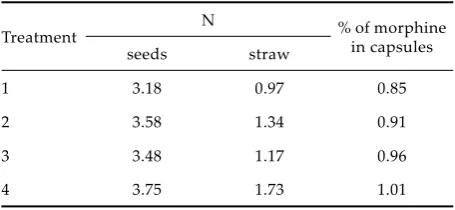
The content of N in poppy seeds and straw in-creased with its increasing doses (Table 4) and the highest N concentrations, both in seeds and straw,
Yi
el
d
(g
/p
ot
)
0.0 5.0 10.0 15.0
1 2 3 4
Treatment
0.0 10.0 20.0 30.0 40.0 50.0
1 2 3 4
Treatment
Yi
el
d
(g
/p
ot
)
C
ap
su
le
s
(n
um
be
r/
pl
an
t)
0.0 0.5 1.0 1.5 2.0
1 2 3 4
Treatment
[image:3.595.66.519.66.361.2] [image:3.595.64.275.66.360.2]Figure 4. Number of capsules per plant Figure 1. Seed yields (g/pot) Figure 2. Total yields of straw (g/pot)
Figure 3. Volume of capsules (ml/plant)
V
ol
um
e
(m
l/p
la
nt
)
0.0 5.0 10.0 15.0 20.0
1 2 3 4
[image:3.595.322.510.235.353.2]Treatment
Table 4. Concentration of N in seeds and straw and the content of morphine in capsules (% of dry matter)
Treatment N % of morphinein capsules
seeds straw
1 3.18 0.97 0.85
2 3.58 1.34 0.91
3 3.48 1.17 0.96
[image:3.595.304.532.657.762.2]486 PLANT SOIL ENVIRON., 50, 2004 (11): 484–488 PLANT SOIL ENVIRON., 50, 2004 (11): 484–488 487 were found in treatment 4 (i.e. after the highest
supply of this element). There was also a high cor-relation (r2 = 0.85) between N content in straw and
morphine content in capsules.
According to Nemeth et al. (2002) the main in-fluence on the content of morphin has the chosen cultivar. Concentrations of morphine in the capsules increased with the level of N supply. In spite of the fact that Opál is rated as a cultivar with a medium content of morphine (Cihlář et al. 2003 mentioned 0.56%), its content in the control treatment was 0.85%. An increased doses of nitrogen increased its concentrations to 0.91–1.01% (i.e. by 7.1–18.8%) compare to controls. This finding corresponded with a number of literary data, which mentioned that the concentration of morphine increased with the increasing N supply (Yadav et al. 1984, Kadar et al. 2001). Prasad (2002) presented the increasing content of morphine according to the increasing dose of N from 50 to 100 kg N/ha in a form of am-monium sulphate nitrate. Kharwara et al. (1988) wrote that the content of morphine increased if the the dose of 75 kg N/ha was doubled. Schrodter (1965) demonstrated a higher content of morphine at doses of 50–60 kg N/ha provided that the supply of P and K was sufficient. Laughlin and Chung (1992) observed, in dependence on the amounts of precipitation, an increase in morphine content by 10–24% and mentioned that, under conditions of a moisture deficit, the supply of N did not show to be statistically significant on the content of this alkaloid, however, under conditions of full water capacity, its content was increased by 8.8%. According to Kapoor (1995) a high correlation ex-isted between weight of plants, leaf area index and chlorophyl content on one hand and morphine concentration on the other. In our experiment, the application of N in the period of flowering reduced the fall of leaves and made the colour of plants much more intensive.
REFERENCES
Chizzola R. (2001): Micronutrient composition of Pa-paver somniferum L. grown under low cadmium stress condition. J. Plant Nutr., 24: 1663–1677.
Cihlář P., Vašák J., Kosek Z. (2003): Technologie máku setého pro dvoutunové výnosy semen. In: Sbor. mezin. Konf. Řepka, mák, hořčice, ČZU, Praha: 134–141. Costes B., Milhet Y., Candillon C., Magnier G. (1976):
Mineral nutrition in Papaver Somniferum L. Physiol. Plantarum, 36: 201–207.
Gupta R. (1984): Improved production methods for opium poppy. Indian Hort., 9: 23–28.
Jain P. M. (1990): Effect of split application of nitrogen on opium poppy. Indian J. Agron., 35: 240–242. Jain P.M., Gaur B.L., Gupta P.C. (1990): Response of
opium poppy varieties to nitrogen. Indian J. Agron., 35: 243–245.
Kadar I., Foldesi D. (2001): Mineral fertilisation of poppy (Papaver somniferum L.) on calcareous loamy chernozem soil. I. Novenytermeles, 50: 453–465. Kadar I., Foldesi D., Voros J., Szilagyi J., Lukacs D.
(2001): Mineral fertilisation of poppy (Papaver som-niferum L.) on calcareous loamy chernozem soil. II. Novenytermeles, 50: 467–478.
Kapoor L.D. (1995): Opium poppy, botany, chemistry and pharmacology. Haworth Press, New York: 67–69. Kharwara P.C., Awasthi O.P., Sing C.M. (1988): Effect
of sowing dates, nitrogen and phosphorus levels on yield and quality of opium poppy. Indian J. Agron., 33: 159–163.
Laughlin J.C., Chung B. (1992): Nitrogen and irrigation effects on the yield of poppies (Papaver somniferum L.). Acta Hort., 306: 466–473.
Nemeth E., Bernath J., Sztefanov A., Petheo F., Craker L., Kock O. (2002): New results of poppy (Papaver somni-ferum L.) breeding for low alkaloid content in Hungary. Acta Hort., 576: 151–158.
Pavlíková D., Balík J., Vaněk V., Vostál J., Borin M., Sattin M. (1994): Influence of different forms of N fertilizers on N uptake by poppy (Papaver somni-ferum L.). Proc. 3rd Congr. Eur. Soc. Agron., Padova Univ., Abano-Padova, Italy: 204–205.
Pavlíková D., Tlustoš P. (1994): Vliv pozvolna působícího dusíkatého hnojiva a inhibitoru nitrifikace na habitus a výnos máku setého. In: Sbor. VŠZ Praha, Fak. Agron. Ř. A, Rostl. Výr.: 71–77.
Prasad S.V.K. (2002): Effect of nitrogenous fertilizers on the yield of opium and seed in opium poppy crop. J. Phytol. Res., 15: 77–80.
Ramanathan V.S. (1979): Effect of micronutrients on the yield of opium and its morphine contents in opium poppy. Indian J. Agric. Res., 13: 85.
Schrodter H. (1965): Untersuchungen über Verände-rung des Morphingehalts reifender Mohnkapseln. Pharmazie, 20: 169.
Solanki N.S., Sahu M.P., Sharma O.L., Arunabh J., Jo-shi A. (1998): Comparative efficency of top dressing and foliar spray of nitrogen for improving nitrogen use efficency and productivity of opium-poppy (Papaver somniferum L.). Indian Agr., 42: 181–184.
Yadav R.L., Mohan R., Singh R., Verma R.K. (1984): The effect of application of nitrogen fertilizer on the growth of opium poppy in north central India. J. Agr. Sci. Camb., 102: 361–366.
ABSTRAKT
Dělené dávky dusíku a jejich účinnost ve výživě máku setého (Papaver somniferum L.)
Ve vegetačním nádobovém pokusu byla porovnávána účinnost dělené aplikace dusíku ve výživě máku setého odrůdy Opál. Dusičnan amonný byl aplikován buď jednorázově na počátku vegetace, nebo dvakrát s druhou aplikací v době květu. Počet tobolek na rostlinu při sklizni stejně jako jejich objem narůstal s dávkou dusíku nepravidelně. Dělená aplikace N v jeho optimální dávce (0.9 g N na nádobu) se statisticky vysoce průkazně uplatnila především u výnosu semene jeho zvýšením o 25.6 % oproti shodné výši jednorázové dávky N. Obsah morfinu v makovině narůstal se stupňující se úrovní dusíkaté výživy z 0.85 na 1.01%. Termín aplikace dusíku ovlivnil nepravidelně počet tobolek na rostlinu, jejich objem i koncentraci morfinu.
Klíčová slova: mák setý; dusík; dělená aplikace; semeno; výnos; morfin
Corresponding author:
Ing. Tomáš Lošák, Ph.D., Mendelova zemědělská a lesnická univerzita v Brně, Zemědělská 1, 613 00 Brno, Česká republika