Application of phosphorus (P) fertilizer is essen-tial for optimal crop yields when soils are P-limited. The agronomic efficiency of inorganic P fertiliz-ers has been reported to be only 10–25% within the first year of application, as a large portion of applied fertilizer P is fixed by soil and therefore unavailable to plant. Thus a large pool (up to 2 t P/ha) of P that is less plant-available exists in the soil. Plant survival and reproduction rely on effi-cient strategies in exploiting soil P (Thierry 2008). Selection of crop species with high P efficiency will increase utilization of soil P, increase fertilizer use efficiency, and consequently reduce fertilizer input requirements.
The capacity of plants to access P under limiting conditions depends on some important adaptive traits, including organic acid excretion (Zhang et al. 1997, Schachtman et al. 1998), alteration of
rhizosphere pH (Lopez et al. 2000, Hinsinger 2001), increased root surface area (Liao and Yan 2000, Sas et al. 2001). Even though some researchers did work on these regulations of plant to exploit soil fixed P source, there were few reports on the adaptive mechanisms involved in P acquisition by soybean under P-limiting conditions.
Variations in root morphology and physiology were shown to be correlated with genotypic differences in the plant utilization ability of soil available P (Cynthia and Ângela 2004). In Arabidopsis, low phosphate availability favored lateral root growth over primary root growth, through increased lateral root density and length (Lisa et al. 2001). In sorghum, P-efficient inbred lines under low P developed larger root sys-tems (Furlani et al. 1984). In maize, Ciarelli et al. (1998) observed inverse relation between P-uptake rate and the length of root system.
Effects of phosphorus concentration on adaptive mechanisms
of high- and low-P efficiency soybean genotypes when grown
in solution
M. Shujie, Q. Yunfa
Northeast Institute of Geography and Agro-Ecology, Chinese Academy of Sciences,
Harbin, P.R. China
ABSTRACT
Low availability of phosphorus (P) in soil is a major constraint for crop production in agricultural ecosystems. Therefore, it is very important to explain the adaptive mechanism of crops under low P conditions. The response of high- and low-P efficient soybean (Glycine max L.) genotypes to various external P level was carried out in nutrient solution culture. Results showed that Dongnong1031 (low P-efficient genotype) undergoes major changes in terms of dry mass, root length, root number and root surface, while these response of Hai 616 (high P-efficient genotype) was lower after five weeks of growth. The higher P level in solution, the smaller difference between the two geno-types in these parameters. The amount of H+ released by root of Dongnong1031 was lower than that of Hai 616,
ex-cept when supplied with 50 μmol external P. There was a positive relationship between RPAE (relative phosphorus absorption efficiency) and P concentration in shoot and root material at all P levels, irrespective of soybean geno-type. An exponential relationship was found between PUE (phosphorus utilization efficiency) and P concentrations in shoots and roots. These results suggested that an increase in measured root parameters coupled with H+ release
by roots were key mechanisms for soybean genotypes with high-P efficiency to cope with low P conditions when grown in solution. In order to best select high soybean genotype with high-P efficiency one should pay attention to PUE combined with high RPAE.
Keywords: soybean; phosphorus; P efficiency; adaptive mechanism
Miao et al. (2007a,b) evaluated root characters varieties under internal and external P conditions and observed differences among them in relation to root length, root surface, and P concentration in soybean plant parts. As a subsequent study, the present research was to investigate the responses of soybean genotypes considered to have either high or low P-efficiency to fertilizer P input. We hypothesised that there are different regulations for them to adapt to P deficiency. Specifically, we wanted to determine differences in soybean genotypes in root characteristics, H+ release from root, relative phosphorus absorption efficiency (RPAE), which is an indicator that reflects the capacity of root acquiring phosphorus from the soil solution, and phosphorus use efficiency (PUE) indicating internal P requirement for a given dry matter formation. Our study also aimed to analyze the adaptive mechanisms of soybean plants to phosphorus when grown hydroponically and to define parameters that may be used as indicators when selecting or breeding P-efficient genotypes.
MATERIAL AND METHODS
To determine the adaptation of soybean geno-types to P conditions, two kinds of P efficiency genotypes of soybean were used, Dongnong 1031 was low-P efficient genotype and Hai616 was high-P efficient genotype. Uniform-sized soybean seeds (Glycine max L.) of the genotypes Dongnong1031 and Hai616 were soaked in water overnight and then transferred onto a mesh above an aerated solution of 1 mmol CaC12 and 5 μmol H3BO3, pH 6.0. The seeds were allowed to germinate until the radicals were about 4 cm in length (about 4 to 5 days). Eighteen uniform seedlings were
trans-ferred into 5-L pots containing either 1.0 (P1), 4.0 (P2), 16.0 (P3), or 50 (P4) μmol of KH2PO4 in full nutrient solution. The composition of the nutri-ent solution and culture method were the same as described by Miao et al. (2007a,b). The treatment was arranged with three replications.
Five weeks after planting, solution pH was measured with pH meter F-22, H+ release was calculated with the amount of acid or alkali to adjust pH everyday, and plants were harvested. The plant material was separated into shoots and roots, and oven-dried at 80°C until a constant weight. Root and shoot P content was determined colorimetrically following digestion with H2SO4 and H2O2 using an ultraviolet spectrophotometer (UV2500 Japan) (Tan et al.2006). N content was calculated with HCl titration the digestion solu-tion for P. Root length, root area and root number were measured with Win-RHIZO LA1600+ soft-ware (Regent Instruments, Quebec, Canada). In this study they were calculated according to the following formulae, respectively:
RPAE = P content of the whole plant/root dry weight
PUE = dry weight of whole plant/P content of the whole plant
A t-test was used to identify the statistically sig-nificant differences. The data were subjected to a two-way statistical analysis of variance (ANOVA). The least significant difference (LSD) at P = 0.05 was used to compare the means between treatments.
RESULTS
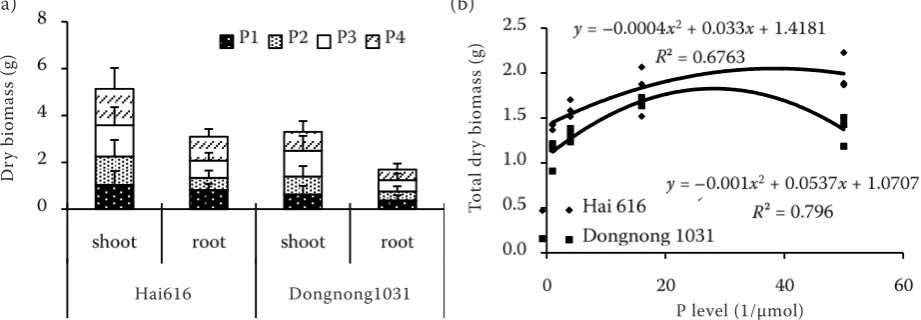
[image:2.595.67.528.567.727.2]Plant growth. The dry biomass of both root and shoot of Hai616 was greater than that of Dongnong1031 (Figure 1a). Although dry biomass
Figure 1. Dry biomass accumulation in shoot and root (a); the relationship between total dry biomass and P level (b). Plants were supplemented with either 1.0 (P1), 4.0 (P2), 16.0 (P3), or 50 (P4) μmol P as KH2PO4
(a) (b)
To
ta
l d
ry
b
io
m
as
s
(g
)
D
ry
bi
om
as
s
(g)
of root or shoot increased with P level increase in both soybean genotypes, the accumulation per unit P of Hai 616 was larger than that of Dongnong 1031 (data no shown). The greatest difference between the genotypes was seen with 50 μmol P (P4), as root and shoot biomass of Dongnong1031 were 44.1% and 51.6% of Hai616, respectively. From the relationship between total biomass and P concentration, we found the optimum P concentration for Hai616 growth was close to 40 μmol, which was greater than which of 30 μmol for Dongnong1031 (Figure1b). This re-sulted in more growth potential for Hai616 than Dongnong1031. The two-way ANOVAs for the dry biomass of Hai616 and Dongnong1031 are shown in Table 1 and indicate a significant dif-ference between plant biomass of Hai616 and Dongnong1031 at all P levels investigated.
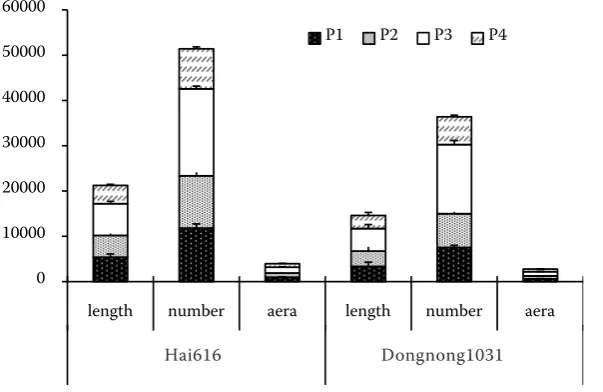
Root growth. The average proportion of total dry biomass allocated to roots was about 30–44% in Hai616, and about 31–37% in Dongnong1031 at all P level (calculated from Figure 1). The pro-portion of total biomass to root material supplied with 1 μmol (P1) was about 6% greater in Hai616 than in Dongnong1031. With P concentration from 1 to 4 µmol, which resulted in changes in root length, root number and root area of 12.3%, 2.5% and 4.6% in Hai616, and 0.7%, 0.9% and –3.9% in
Dongnong1031, The values of above root parameter changes were 42.85%, 31.46% and 45.88% in Hai616, 0.87%, –48.85% and 9.12% in Dongnong1031 from 16 to 50 μmol P level, respectively (Figure 2). All of these parameters in Hai 616 were larger than those in Dongnong3013. These parameters were affected by genotype and P level at P < 0.05 (Table 1).
H+ release and pH. After five weeks of plant growth, the pH of nutrient solution-grown Hai616 was much lower than that of Dongnong1031 (Figure 3a). We calculated the amount of H+ re-lease from both soybean genotype roots, and found that Hai616 released more H+ than Dongnong1031 (Figure 3b). At 30 μmol P level, the amount of H+ release by Hai616 roots was larger by 416 μmol/ plant/week than that released by Dongnong1031 root (P < 0.05). In total, the amount of H+ release from Hai616 root increased with solution P level up to 16 µmol increase, however, H+ efflux from Dongnong1031 decreased with increasing P levels (P < 0.05, Figure 3).
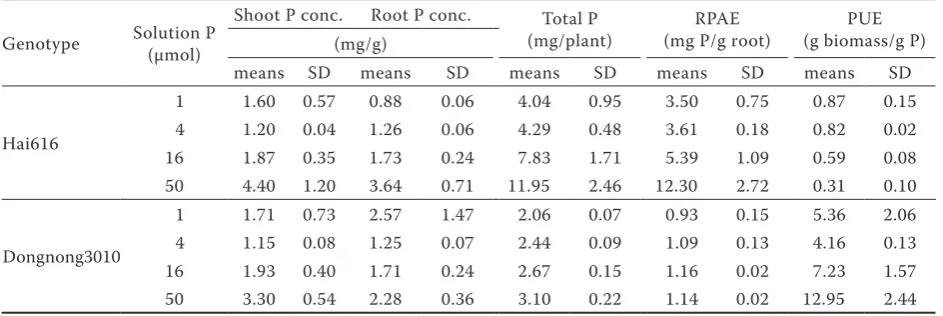
[image:3.595.63.533.100.169.2]P concentration and P efficiency.The P con-centration of shoots and roots, and total P content (mg P per plant) increased with increasing solution P for both soybean genotypes when solution P was higher than 4 µmol (Table 2). The total P content of Hai616 was higher than that of Dongnong1031. In particular, when plants were grown in solution
Table 1. Influence of genotype and phosphorus (P) levels on dry biomass, root length, root surface area, root number, pH and H+ release, relative phosphorus absorption efficiency (RPAE) and phosphorus use effi-ciency (PUE). F-ratios from two-way ANOVA are shown with accompanying measures of statistical significance
Dry
biomass lengthRoot numberRoot Root area H+ release pH RPAE PUE Genotype < 0.0001 0.0002 0.0032 0.0008 0.0003 0.6571 0.9297 0.5748 P level 0.0002 0.0256 0.0090 0.0003 0.3809 0.0104 < 0.0001 < 0.0001
G × P 0.0208 0.7379 0.6408 0.1378 0.0914 0.3850 0.1022 0.4512
0
10000 20000 30000 40000 50000 60000
length number aera length number aera
海616 东农1031
P1 P2 P3 P4
Figure 2. Root length (cm), root num-ber, and root area (cm2) of Hai616 and
Dongnong1031 at 5 weeks growth. Plants were supplemented with either 1.0 (P1), 4.0 (P2), 16.0 (P3), or 50 (P4) μmol P as KH2PO4
[image:3.595.69.371.569.765.2]containing 50 μmol P, total P content of Hai616 was about 3.8 times higher than that of Dongnong1031. From Table 2, RPAE increased with P level increase for the two genotypes, while PUE decreased as P level increase for Hai616. In addition, we did the regression analysis. Results showed that there was a negative relationship between RPAE and PUE (r = –0.8976). The RPAE of Hai616 was higher than that of Dongnong1031 genotype, while PUE was opposite (P < 0.05).
DISCUSSION
Phosphorus supply and root growth. The bio-availability of nutrients in culture may determine root growth, root proliferation and specific func-tional responses that depend on the prevailing
nutrient status of the plant (Lopez et al. 2003). In this experiment, we found a higher proportion of root biomass in the high P-efficient soybean genotype, Hai616, than the lower-P efficiency genotype Dongnong1031. This coincided with an increase in root parameters, including root length and number, with decreasing solution P concentra-tion, indicating that P deficiency stimulated root growth in the high-P efficiency soybean genotype. This is similar to the report of Cynthia and Angela (2004), where variations in root morphology and physiology correlated with genotypic differences in the plant utilization ability of soil available P.
[image:4.595.67.531.57.210.2]Reports from the studies on model plants to determine the effects of nutrient stress on root development suggested that white lupin (Lupinus albus L.) formed proteoid roots and increased their absorptive surface (Neumann et al. 2000,2002).
Table 2. Effects of soybean genotype and solution phosphorus (P) concentration on plant P uptake and RPUE and PUE
Genotype Solution P (µmol)
Shoot P conc. Root P conc. Total P
(mg/plant) (mg P/g root)RPAE (g biomass/g P)PUE (mg/g)
means SD means SD means SD means SD means SD
Hai616
1 1.60 0.57 0.88 0.06 4.04 0.95 3.50 0.75 0.87 0.15
4 1.20 0.04 1.26 0.06 4.29 0.48 3.61 0.18 0.82 0.02
16 1.87 0.35 1.73 0.24 7.83 1.71 5.39 1.09 0.59 0.08
50 4.40 1.20 3.64 0.71 11.95 2.46 12.30 2.72 0.31 0.10
Dongnong3010
1 1.71 0.73 2.57 1.47 2.06 0.07 0.93 0.15 5.36 2.06
4 1.15 0.08 1.25 0.07 2.44 0.09 1.09 0.13 4.16 0.13
16 1.93 0.40 1.71 0.24 2.67 0.15 1.16 0.02 7.23 1.57
50 3.30 0.54 2.28 0.36 3.10 0.22 1.14 0.02 12.95 2.44
[image:4.595.63.535.572.730.2]RPAE – relative phosphorus absorption efficiency; PUE – phosphorus utilization efficiency. Data are the means ± the standard deviation
Figure 3. The amount of H+ efflux (a) and nutrient solution pH (b) at various P levels. Plants were supplemented
with either 1.0 (P1), 4.0 (P2), 16.0 (P3), or 50 (P4) μmol P as KH2PO4
5.4 5.5 5.6 5.7 5.8 5.9 6.0 6.1 6.2
P1 P2 P3 P4
海616 东农1031
0 100 200 300 400 500 600 700 800
P1 P2 P3 P4
(a) (b)
Hai616 Dongnong 1031
pH
A
m
ou
nt
o
f H
+ re
le
as
e
(µ
m
ol
/p
la
nt
/w
ee
k)
5.4 5.5 5.6 5.7 5.8 5.9 6.0 6.1 6.2
P1 P2 P3 P4
海616 东农1031
0 100 200 300 400 500 600 700 800
P1 P2 P3 P4
However, in the current experiment, we found that root length, root number and root surface area of soybean grown in 16 μmol P were larger than those of plants grown in 1, 4 and 50 μmol P level for both soybean genotypes. This indicates that soybean species respond differently to P deficient condition. When P availability was lower than this level, root growth parameters developed as P decrease. However, further P decrease cannot induce root growth parameter changes as P lower than 16 μmol for soybean. Once the P was more than optimum level, root growth parameters will be limited, as root number decreased by 48% and 60% in Hai616 and Dongnong1031, respectively, when the solution P concentration ranged from 16 μmol to 50 μmol. This suggested a constitutive P-deprivation response while growing under high P conditions (Lopez et al. 2003). These results were supported by Singh et al. (2003) who reported that at low and medium P levels, soil solution concentration is more important in determining P uptake than the ability of the roots to absorb P. Vice versa, at high P level, the ability of the roots to absorb P is more important than P supplying characteristics of the soil solution.
Phosphorus efficiency. Plants facing a with-drawal of inorganic P can adapt their physiology and development in order to efficiently use the lower supply of P (Thierry 2008). High P-efficient genotype in particular has great ability to grow and yield in P-deficient soils (Hash et al. 2002, Yan et al. 2004). Thus, it is very important to evaluate plant P efficiency characteristics in order to reduce fertilizer application and increase P resources globally (Vance
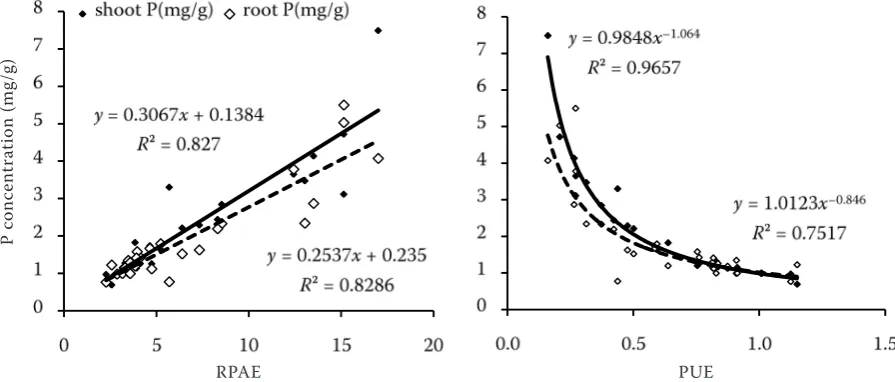
[image:5.595.74.522.61.252.2]et al. 2003). In previous reports, various strategies were used to evaluate genotypes for P-efficiency, including biomass, P content in various tissues, total P uptake, root surface area, PUE, H+ release, organic acid exudation and acid phosphatase activity (Pan et al. 2008). In this experiment, results showed that some of these parameters were not significantly different between high and low P-efficiency geno-types. While PUE and RPAE were good indexes for evaluating P-efficiency of soybean genotypes, there are also good relationships with P concentration in soybean tissues. There was a positive correlation between P concentration and RPAE in shoot (r = 0.9094) and root (r = 0.9103). While an exponential relationship was found between PUE and P concen-tration in shoot (r = 0.9827) and root (r = 0.8670) (Figure 4). In addition, we found that there were large differences in root parameters, H+ release and pH between the high-P efficiency genotype, Hai616, and the lower-efficiency, Dongnong1031, when grown in various P levels. Pan et al. (2008) reported that ideal defining parameters for breed-ing a P-efficient soybean genotype were shoot dry weight and relative shoot dry weight at soybean seedling stage. In the future, it is needed to build an evaluating system, including the optimum P level, growth index and stage.
Acknowledgement
We are grateful to Dr. Pan Xiangwen for provid-ing the soybean seeds. Two anonymous referees are thanked for their helpful comments.
Figure 4. The relationship between P concentration and relative phosphorus absorption efficiency or phosphorus utilization efficiency of both soybean genotypes. Plants were supplemented with either 1.0 (P1), 4.0 (P2), 16.0 (P3), or 50 (P4) μmol P as KH2PO4
P
co
nc
en
tr
at
io
n
(m
g/
g)
Corresponding author:
Qiao Yunfa, Ph.D, Northeast Institute of Geography and Agro-Ecology, CAS, 138 Code, Haping Road, Heilongjiang Province, 150081 Harbin, P.R. China
phone: + 86 451 866 012 86, fax: + 86 451 866 037 36, e-mail: [email protected] REFERENCES
Ciarelli D.M., Furlani A.M.C., Dechen A.R., Lima M. (1998): Ge-netic variation among maize genotypes for phosphorus-uptake and phosphorus-use efficiency in nutrient solution. Journal of Plant Nutrition, 21: 2219–2229.
Cynthia T.T.M., Ângela M.C.F. (2004): Kinetics of phosphorus uptake and root morphology of local and improved varieties of maize. Scientia Agricola, 61: 69–76.
Furlani A.M.C., Clark R.B., Maranville J.W., Ross W.M. (1984): Sorghum genotype differences in phosphorus uptake rate and distribution in plant parts.Journal of Plant Nutrition, 7: 1113–1126.
Hash C.T., Schaffert R.E., Peacock J.M. (2002): Prospects for us-ing conventional techniques and molecular biological tools to enhance performance of ‘orphan’ crop plants on soils low in available phosphorus. Plant and Soil, 245: 135–146.
Hinsinger P. (2001): Bioavailability of soil inorganic P in the rhizosphere as affected by root-induced chemical changes: A review. Plant and Soil, 237: 173–195.
Lopez B.J., Cruz R.A., Herrera E.L. (2003): The role of nutrient availability in regulating root architecture. Plant Biology, 6: 280–287.
Liao H., Yan X.L. (2000): Root architectural responses to low P of bean genotype. Acta Botanica Sinica, 42: 158–163.
Lisa C.W., Sebastien P.C.P.R., Alastair H.F., Ottoline L.H.M. (2001): Phosphate availability regulates root system architecture in arabidopsis. Plant Physiology, 126: 875–882.
Lopez B.J., Vega O.M., Guevara G.A., Herrera E.L. (2000): En-hanced phosphorus uptake in transgenic tobacco plants that overproduce citrate. Nature Biotechnology, 18: 450–453. Miao S.J., Qiao Y.F., Han X.Z., M A.N. (2007a): Nodule formation
and development in soybeans (Glycine rnux L.) in response to phosphorus supply in solution culture. Pedosphere, 17: 36–43. Miao S.J., Qiao Y.F., Han X.Z. (2007b): Relationship between root
characters and phohphorus absorption in soybean. Soybean Science, 26: 16–20.
Neumann G., Martinoia E. (2002): Cluster roots – an underground adaptation for survival in extreme environments. Trends in Plant Science, 7: 162–167.
Neumann G., Massoneau A., Langlade N., Dinkelaker B., Hengeler C., Romheld V., Martinoia E. (2000): Physiological aspects of cluster root function and development in phosphorus-deficient white lupin (Lupinus albus L.). Annals of Botany, 85: 909–919. Pan X.W., Li W.B., Zhang Q.Y., Li Y.H., Liu M.S. (2008): Assess-ment on phosphorus efficiency characteristics of soybean genotypes in phosphorus deficient soils. Scientia Agricultura Sinica, 7: 958–969.
Sas L., Rengel Z., Tang C. (2001): Root morphology, excess cation uptake, and extrusion of proton and organic acid anions in Lupinus albus L. under phosphorus deficiency. Plant Science, 160: 1191–1198.
Schachtman D.P., Reid R.J., Ayling S.M. (1998): Phosphorus uptake by plants: from soil to cell. Plant Physiology, 116: 447–453. Singh A., Bhadoria P.B.S., Rakshit A. (2003): Simulation of
phos-phorus uptake by peanut in low phosphos-phorus supplying soil. Italian Journal of Agronomy, 7: 65–71.
Tan W.F., Liu F., Li Y.H., Hu H.Q., Huang Q.Y. (2006): Elemental composition and geochemical characteristics of iron-manganese nodules in main soils of China. Pedosphere, l6: 72–81. Thierry D. (2008): Root branching responses to phosphate and
nitrate. Current Opinion in Plant Biology, 11: 82–87. Vance C.P., Stone C.U., Allan D.L. (2003): Phosphorus acquisition
and use: critical adaptations by plants for securing a nonrenew-able resource. New Phytologist, 157: 423–447.
Yan X.L., Liao H., Beebe S.E., Blair M.W., Lynch J.P. (2004): QTL mapping of root hair and acid exudation traits and their re-lationship to phosphorus uptake in common bean. Plant and Soil, 265: 17–29.
Zhang F.S., Ma J., Cao Y.P. (1997): Phosphorus deficiency enhances root exudation of low-molecular weight organic acids and utilization of sparingly soluble inorganic phosphorus by rad-ish (Raghanus sativus L.) and rape (Brassica napus L.) plants. Plant and Soil, 196: 261–264.