Matrix Solid Phase Dispersion
Matrix Solid Phase Dispersion (MSPD) was developed in 1989 (B����� et al. 1989) and, dur-ing recent years, this method has found again its important place among the preparation techniques applied in the analysis of plant and food samples (without or with the fat contents and with different amounts of water). This assay is also suitable for solid, semi-solid, and viscous matrices that often cause problems in other common preparation pro-cedures. The classical preparation and clean-up methods often include more steps such as mincing and/or mechanical homogenisation, the additions of bases, acids, or abrasives, centrifugation, the transfer of the supernatant, pH adjustment, extrac-tion, and in many cases complicated purification
procedures. The last steps are dependent on the analytical method that is applied for the analyte determination. When HPLC is used, the compat-ibility of the solvents residues with the mobile phases is necessary.
MSPD is based on the solid phase dispersion of the sample matrix for the subsequent isolation of various analytes. By blending a matrix with a solid support, a semi-dry material is obtained. It is used as a pre-column packing from which analytes possessing various chemical properties can be isolated by the elution profile of solvents (or their mixtures) with different elution powers and polarities. The main advantage is the fact that this technique allows to perform several steps in the sample preparation simultaneously. It can be used for a multiresidual isolation from a single
R�����
Matrix Solid Phase Dispersion as an Effective Preparation
Method for Food Samples and Plants before HPLC Analysis
G������� KARASOVÁ, E�� BRANDŠTETEROVÁ and M�������� LACHOVÁ
Department of Analytical Chemistry, Faculty of Chemical and Food Technology, Slovak University of Technology in Bratislava, Bratislava, Slovak Republic
Abstract
K������� G., B������������� E., L������ M. (2003): Matrix solid phase dispersion as an effective preparation
method for food samples and plants before HPLC analysis. Czech J. Food Sci., 21: 219–234.
This review deals with a preparation technique – Matrix Solid Phase Dispersion (MSPD) and its possibilities in the HPLC analysis for contaminants, pesticides, drug residues, and natural compounds in food samples. The main principle of MSPD is explained, the important factors influencing the effectivity and recovery of this technique are discussed. The advantages and disadvantages of MSPD and other classical extraction, isolation, and purifica-tion procedures are compared. The present article provides a bibliography of MSPD applicapurifica-tions in food sample matrices during last years for various analytes and different sample matrices.
220 221 matrix. MSPD is a simple approach to the
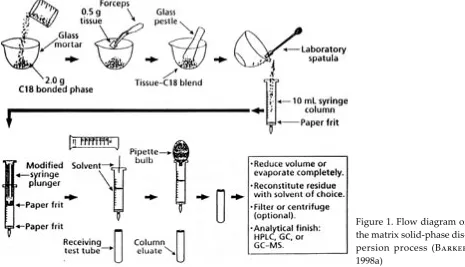
disrup-tion of biological materials. It combines the use of mechanical forces generated from the grinding of samples with irregularly shaped particles (silica or polymer based solid supports) to produce a sample/column material from which the dispersed matrix components can be selectively isolated (B����� et al. 1993). This isolation is different for animal cells and plant cells. Plant cell walls often require more physically and chemically dynamic procedures to achieve complete cellular disrup-tion. Barker and co-workers developed a generic MSPD assay which can be modified according to the analytes and sample matrices. The scheme of the MSPD process is illustrated in Figure 1. The sample is placed in a glass mortar containing a solid support material and is blended with a glass pestle. The bonded phase-support acts as an abrasive, lipophilic bound solvent that assists in the sample disruption and lysis of the cell mem-branes. The blended material is packed as an SPE cartridge and the analytes are eluted sequentially with solvents. The sample material is distributed onto a solid support and produces a unique col-umn material that allows a new degree of sample fractionation (B����� et al. 1989, 1993; B����� & F���� 1996). MSPD is a technique very similar to SPE but the separation principle is completely different. The bound phase in the solid support
provides an added dimension to the MSPD proc-ess. It acts as a solvent or detergent that dissolves and disperses the sample components. This greatly enlarges the surface area for the extraction and the sample components are distributed over the surface according to their relative polarities. It has been observed that certain analytes tend to be eluted in fractions that are not readily predictable by their relative distribution in the solid phase or eluting solvents. This can be explained by the possibility of co-elution with some matrix components in the given fraction. The retention properties of MSPD present a mixture of partition, adsorption, and ion-paired chromatography which is unique. There are many factors that affect the MSPD procedure (B����� 1998a): the solid support and the bound phase used, the nature of the sample matrix, the sample to solid support ratio, the solvent elution sequence performed, the use of matrix modifiers, the blending of the sample with acids, bases, che-latores, preservatives, or other modifiers.
[image:2.595.63.529.490.757.2]The interactions between the individual com-ponents and the analysed compounds in MSPD involve the analyte with the solid support, the analyte with the bonded phase, the analyte with the dispersed matrix, the matrix with the solid sup-port, the matrix with the bonded phase; all above components interact with the elution solvents, and these dynamic interactions act simultaneously. It is
obvious that the solid support affects the retention-elution of the analytes and the dispersed sample components. Although a volume of 8 ml is often reported to be sufficient for generic MSPD proce-dure, it was found that this is not always true for all eluting solvents tested and all analytes studied. It was also observed, however, that the sufficient elution is finished in 4 ml of the elution mixture which is equal to one column volume. As in SPE, the solid support, the possible bonded phase, and the elution profile are important but the effect of the sample matrix dispersed from the top to the bottom of the column is more important in MSPD. It creates a new phase. This new phase and its new interactions, in combination with the analyte distribution and its interactions, are the most con-trolling factors in MSPD (B����� 2000b).
Some studies confirmed the suggestion that the pore size of the sorbents is of little importance in MSPD but could vary with the sample matrix and should be considered. The particle size is a more important factor. Particles less than 20 µm can pro-long the procedure time and they decrease the flow rate through the MSPD column. The particle size of 40–60 µm is optimal but sorbents with the size of about 100 µm can also be used. These materi-als are often less expensive. The carbon loading is recommended in the range of 8–18%. The generic sample/sorbent ratio is approximately 1:4 but it can be modified according to the chemical properties of the analytes and the consistency of the sample matrix. Similarly to SPE assay, the conditioning is very important. Precleaning of the sorbent can diminish the interferences. Sometimes the addi-tion of acids, bases, of chelating agents can influ-ence the washing and elution steps in the whole MSPD method. Especially in such cases where the analytes have an acidic or a basic character and/or are very polar.
The choice of the washing and eluting solvents is very important. If an additional cleaning step is necessary, it is possible to use the MSPD column with another sorbent (Florisil, Silica, Alumina) at its bo�om (co-column) or to elute analytes directly from the MSPD column into a second SPE column. A simple injection without additional purification is used e.g. in the case of some pesticides or other less polar pollutants. Such isolations make MSPD suitable for the multiresidual analysis (B����� 1998b).
MSPD has already found its place as an effective preparation technique in the food analysis. S. A. Barker summarised the application of MSPD in food
analysis up to the year 2000 in a review (B����� 2000a). All important facts for the practical moni-toring of the biologically important compounds in real samples are given in it.
The aim of our review was to provide the informa-tion about this renovating preparainforma-tion technique, dealing especially with HPLC analysis for con-taminants, pesticides, drugs, and in recent years also for natural biologically active compounds present in plants and food samples. MSPD has a generic character for many analytes in different sample matrices. It provides results equivalent to other classical pre-separation methods. However, MSPD generally requires by 95% less solvent, and by about 90% less time than these classical meth-ods. It is the main reason why this method has also found its important place in the food analysis, especially in the connection with the very effective and universal HPLC technique. The applications of MSPD in this field are summarised in the fol-lowing text, and MSPD and HPLC conditions are listed in Tables 1–3.
Ta bl e 1. T he c on di tio ns o f M SP D a nd H PL C a na ly si s of c on ta m in an ts in fr ui ts a nd v eg et ab le s Compound Matrix MSPD HPLC References sorbent elution agent stationary phase mobile phase detection Abamectin orange C18
methylene chloride
C18
MeOH/w
ater
ESI-MS
V��������� et al
. (2000)
Abamectin
citrus fruit
C18
methylene chloride
C18 MeOH/w ater , ACN/ w ater , MeOH/w ater UV , FL, ESI-MS
V��������� et al.
(2001a)
Diflubenzuron, hexaflumuron, flufenoxuron, hexathiazox, benfuracarb
orange
C8
methylene chloride
C18 ACN/w ater MeOH/w ater UV , APCI-MS
V��������� et al
. (2001b)
Carbamate, benfuracarb, diflubenzuron, flufenoxuron, hexaflumuron
citrus fruit
C8, C18
methylene chloride
C18
ACN/w
ater
UV
V��������� et al
. (1999)
Carbamates
orange, grape, onion, tomato
C8
methylene
chloride/ACN (3:2, v/v)
C8 MeOH/w ater , ACN/ w ater
, w
ater/acetic
acid, w
ater/NaCl
APCI-MS, ESI-MS F�������� et al
. (2000)
Cichloran, flutriafol,
o
-phenyl-phenol, prochloraz, tolcofos methyl
orange, lemon, banana, pepper
, chard, onion
C8
methylene chloride
C18 MeOH/w ater APCI-MS B����� et al . (2002a)
Bitertanol, carbendazim, fenthion, flusilazole, hexythiazox, imidacloprid, methidathion, metho- carb, pyriproxyfen, trichlorfon
orange
C8, C18
methylene chloride
C18 MeOH/w ater APCI-MS B����� et al . (2002b)
Imidacloprid, metalaxyl, myclo- butanil, thiabendazole, propham
strawberry
, orange, potato,
pear
, melon
C8
methylene chloride
C18
MeOH/ammonium formate
APCI-MS
P���
et al
.
(2001)
Flupoxam, linuron, rimsulfuron, diflubenzuron, fenoxycarb, metho- myl, tetradifon, benomyl, carben- dazim, thiophanate methyl
broad bean, carrot, celery
,
green pea, leek, potato, champignon, apple, le�uce, strawberry
, ry
e, black currant,
cherry
, cucumber
, cereals
silica gel
n
-hexane/diethyl ether
, methanol/
methylene chloride in clean up columns: phenyl; C8;
C18;
in analytical columns: C18;
C8 ACN/w ater MeOH/ w ater UV -DAD M����� & B������� (2002) Carbendazim careals
silica gel methanol/ methylene chloride (1:5, v/v)
in clean up column: C8; in analytical column: C18
MeOH/w ater UV -DAD M����� & B������� (2003)
Aflatoxins: B1, B2, G1, G2
[image:4.595.81.532.89.762.2]Another problem is caused by the fact that all fractions of the MSPD assay can contain groups of analytes with different chemical properties and, of course, at different concentration levels, too. It means that the development for more groups of analytes in one-matrix samples is much more complicated and only the realisation of blank ex-periments can increase the demands for the time of the preparation process.
RESIDUES OF CONTAMINANTS IN FOOD SAMPLES
Pesticides in fruit and vegetables
Non-modified as well as modified supports were applied in the MSPD assay for different fruits and vegetables in recent years (S����� 1997). Accord-ing to the author, the pesticide isolation from these matrices is not very complicated. The differences in the results obtained with various sorbents were not very great and, consequently, only some small corrections of the original MSPD procedure had to be realised also for different kinds of fruits and vegetables using methylene chloride as the eluting solvent. HPLC has been recommended as the best method of the choice for the subsequent analysis (MSPD and HPLC conditions are mentioned in Table 1).
Abamectin residues in citrus fruits were analysed by HPLC after the MSPD preparation step (V����-����� et al. 2000, 2001a). Also in this case methylene chloride was sufficient for the quantitative elution of contaminants with a high recovery of bout 94%. The combinations of UV, fluorescence, and MS (with electrospray interface) detectors were compared after the HPLC analysis. The quantification limit was 0.5 µg/kg. The same authors (V��������� et al. 2001b) tested also different supports for the MSPD assay for the determination of the residues of benzoylphenylurea and carbamate insecticides in fruits. More than 150 orange fruit samples were analysed and LC/UV and LC/APCI/MS were ap-plied for their determination. C8 was evaluated as the more efficient sorbent and methylene chloride as the eluting solvent. The extraction recoveries varied from 74% to 84% and the detection limits were better with LC/APCI/MS than with LC/UV.
Previously, the same authors obtained very interesting results in the optimisation assays for different parameters, such as the type of solid sup-port for MSPD during the determination of some
urea and carbamate insecticides also in citrus fruits (V��������� et al. 1999). They tested cellulose, silica, C2, C8, C18, CN bonded phase, graphitised carbon black (GCB), and they slightly modified the MSPD conditions. The authors recommended C8 and C18 as the main sorbents while some other sorbents were placed at the bottom of the glass column for MSPD (cellulose, silica, GCB, CN).
The efficiencies of different solid phases (C8, C18, CN, NH2, and phenyl) in MSPD were also tested and compared in LC/MS analysis of 13 carbamates in oranges, grapes, onions, tomatoes (F�������� et al. 2000). The mixture of methylene chloride and acetonitrile (3:2, v/v) was used for the elution. The use of silica at the bottom of the glass column for MSPD was also tested. The main recoveries using C8 varied from 64% to 106%.
HPLC of five fungicide residues in oranges, lemons, bananas, peppers, chards and onions was described (B����� et al. 2002a). The residues were extracted by MSPD using C8 sorbent and the recoveries were 52.5%–91.1%. The same authors developed an LC/MS for the determination of bitertanol, carbendazim, fenthion, flusilazole and other pesticides in oranges (B����� et al. 2002b). Two preparation procedures were tested and com-pared; one of them was MSPD, which provided high recoveries of 47%–96% in a wide range of the concentrations of the analytes. The results were also compared with those of the liquid extraction (ethyl acetate).
Many pesticides are compounds with hetero-geneous structures. One insecticide (imidaclo-prid), three fungicides (metalaxyl, myclobutanil, thiabendazole) and one herbicide (propham) were analysed simultaneously in strawberries, oranges, potatoes, pears, and melons by MSPD followed by LC/APCI/MS. C8 sorbent and methylene chloride were used for MSPD (P��� et al. 2001).
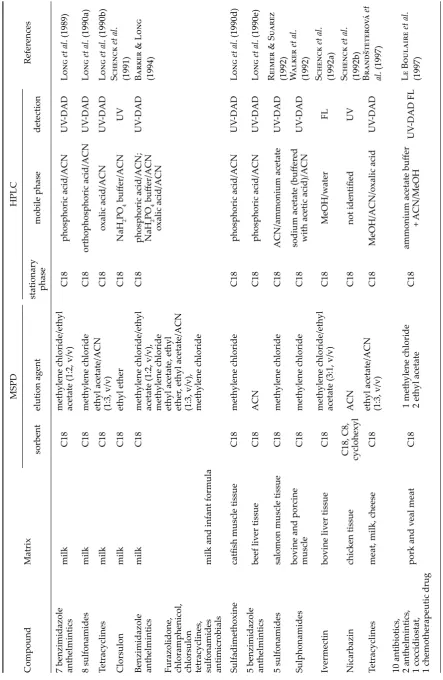
Ta bl e 2. T he c on di tio ns o f M SP D a nd H PL C a na ly si s of d ru g re si du es a nd e nv ir on m en ta l p ol lu ta nt s in m ilk a nd ti ss ue s Compound Matrix MSPD HPLC References sorbent elution agent
stationary phase
mobile phase
detection
7 benzimidazole anthelmintics
milk
C18
methylene chloride/ethyl acetate (1:2, v/v)
C18 phosphoric acid/ACN UV -DAD L��� et al . (1989) 8 sulfonamides milk C18 methylene chloride C18 orthophosphoric acid/ACN UV -DAD L��� et al . (1990a) Tetracyclines milk C18
ethyl acetate/ACN (1:3, v/v)
C18 oxalic acid/ACN UV -DAD L��� et al . (1990b) Clorsulon milk C18 ethyl ether C18 NaH 2 PO 4 buffer/ACN UV S������ et al . (1991)
Benzimidazole anthelmintics Furazolidone, chloramphenicol, chlorsulon tetracyclines, sulfonamides antimicrobials milk milk and infant formula
C18
methylene chloride/ethyl acetate (1:2, v/v), methylene chloride ethyl acetate, ethyl ether
, ethyl acetate/ACN
(1:3, v/v), methylene chloride
C18
phosphoric acid/ACN; NaH
2 PO 4 buffer/ACN oxalic acid/ACN UV -DAD B����� & L��� (1994) Sulfadimethoxine
catfish muscle tissue
C18 methylene chloride C18 phosphoric acid/ACN UV -DAD L��� et al . (1990d)
5 benzimidazole anthelmintics
beef liv er tissue C18 ACN C18 phosphoric acid/ACN UV -DAD L��� et al . (1990e) 5 sulfonamides
salomon muscle tissue
C18 methylene chloride C18 ACN/ammonium acetate UV -DAD R����� & S����� (1992) Sulphonamides
bovine and porcine muscle
C18
methylene chloride
C18
sodium acetate (buffered with acetic acid)/ACN
UV -DAD W ����� et al . (1992) Iv ermectin bovine liv er tissue C18
methylene chloride/ethyl acetate (3:1, v/v)
C18 MeOH/w ater FL S������ et al . (1992a) Nicarbazin chicken tissue
C18, C8, cyclohexyl
ACN C18 not identified UV S������ et al . (1992b) Tetracyclines
meat, milk, cheese
C18
ethyl acetate/ACN (1:3, v/v)
C18 MeOH/ACN/oxalic acid UV -DAD B������������ � et al . (1997)
10 antibiotics, 2 anthelmintics, 1 coccidiostat, 1 chemotherapeutic drug
pork and v
eal meat
C18
1 methylene chloride 2 ethyl acetate
C18
ammonium acetate buffer
[image:6.595.78.522.83.764.2]Compound
Matrix
MSPD
HPLC
References
sorbent
elution agent
st
at
io
na
ry
phase
mobile phase
detection
10 antibiotics, 2 anthel- mintics, 1 coccidiostat, 1 chemotherapeutic drug
pork and v
eal meat
C18
1 methylene chloride
2 ethyl acetate
C18
ammonium acetate buffer +
ACN/MeOH
UV
-DAD FL
L�
B�������
et al
.
(1997)
Clenbuterol
bovine liv
er
C18
ACN with 1% (v/v) acetic
acid
RP
w
ater/MeOH with TF
A
ECD IT-MS
C��������
et al
.
(2001)
6 sulfonamides
chicken muscle tissue
neutral
aluminium oxide 70% (v/v) aqueous e thanol solution
silica
based RP
acetic acid solution in w
ater/ACN/DMF
UV
-DAD
K������
&
F�����
��
(2001)
Linear alcohol ethoxylates
fish tissue
C18
1 hexane, 2 ethyl acetate and ethyl acetate/MeOH (1:1, v/v), 3 MeOH
C18
ACN/w
ater
FL
T����
et al
. (1999a)
Alkylbenzenesulfonate (LAS), sulfophenyl- carboxylic acids (SPC)
fish tissue
C18
1 hexane, 2 ethyl acetate, 3 et
hy
l a
ce
ta
te
/M
eO
H
(1
:1
, v
/v), 4 MeOH,
5 MeOH/ w
ater (1:1, v/v)
C18
ACN/w
ater/NaClO
4
ACN/TBA-HSO
4
FL
T����
et al
. (1999b)
Alkylphenol ethoxylates, alkylphenols fish and muscle samples
C18
MeOH
C18
MeOH/w
ater
FL
Z���
et al
. (1999)
DBP
rainbow-trout diet
C18
hexane/benzene (4:1, v/v)
C8
ACN/w
ater
FL
L�������
et al
.
(2001)
Ta
bl
e
2
to
b
e
co
nt
in
ue
[image:7.595.79.364.107.756.2]required for the sample preparation was very short and the consumption of solvents was very low in comparison with LLE and SPE. Column switching technique enables to simplify the whole assay and this technique is more and more frequently applied in the routine HPLC analysis.
M����� and B�������� (2003) coupled MSPD with HPLC and column switching for the determina-tion and quantificadetermina-tion of the systemic fungicide – carbendazim residue in cereals. Silica was used for MSPD and was modified by the addition of HCl. The analyte was eluted from the extraction column with methanol-methylene chloride mixture (1:5, v/v). The recoveries ranged from 84% to 90.7%. The application and the mechanism of sorption on the modified silica gel for the sampling of carbendazim from cereals were also discussed.
Aflatoxins are toxic metabolites produced dur-ing food spoilage by the fungi Aspergillus. MSPD extraction was used to determine aflatoxins B1, B2, G1 and G2 from peanuts (B���� et al. 2003). Opti-misation was carried out of different parameters such as the type of solid support for the matrix dispersion and the eluting solvents. The extraction method used 2 g of peanut sample, 2 g of solid-phase, and acetonitrile (20 ml) as the eluting solvent. Various solid phases were tested for MSPD (silica, phenyl, C8 and C18). The best recoveries for all aflatoxins (between 78% and 86% with RSD 4–7%) were obtained using C18 bonded silica. The limits of quantification ranged from 0.125 to 2.5 ng/g us-ing LC with fluorescence detection. In addition, LC coupled to mass spectrometry with an electro-spray interface was used for the confirmation of the presence of aflatoxins in real samples.
Drug residues in milk and animal tissues
In 1989–1994, the MSPD method was widely used for the isolation of drug residues from milk and animal tissues prior to HPLC analysis.
Benzimidazole anthelmintics (L��� et al. 1989), sulfonamides (L��� et al. 1990a), tetracyclines (L��� et al. 1990b) and clorsulon (S������ et al. 1991) were extracted from milk. The extraction was performed by a slightly modified MSPD method using C18 sorbent proposed by B����� et al. (1989). The eluates were analysed using HPLC with UV detection.
Benzimidazole anthelminitics were eluted from C18/milk matrix column with methylene chloride-ethyl acetate (1:2, v/v). The recoveries ranged from 70% to 107%. Eight sulfonamides
were eluted with methylene chloride achieving recoveries of 73.1%–93.7%. Oxytetracycline, tet-racycline, and chlortetracycline were eluted with ethyl acetate-acetonitrile (1:3, v/v) with recoveries of 63.5%–93.3%. The elution of chlorsulon from C18/milk matrix cartridge was achieved with ethyl ether. The eluate was cleaned with Florisil SPE and the overall recovery was 93%. B����� and L��� (1994) used the generic extraction procedure for several drugs (benzimidazole anthelmintics, chlo-ramphenicol, chlorsulon, furazolidone, sulfona-mide antimicrobials in milk and infant formula, tetracyclines) used in dairy production. In all cases the sorbent Bulk C18 was used and the analytes were eluted from the extraction cartridge with an appropriate solvent.
This generic method was also applied for the sample preparation in HPLC/UV analysis of drugs in animal tissues. Long and co-workers used it for the isolation of oxytetracycline (L��� et al. 1990c) and sulfadimethoxine (L��� et al. 1990d) from catfish muscle tissue. Oxytetracycline was eluted from MSPD column with acetonitrile-methanol (1:1, v/v) and sulfadimethoxine with methylene chloride. The recovery was 80.9% and 101.1%, re-spectively. Also five benzimidazole anthelmintics were extracted from fortified beef liver with the eluting solvent acetonitrile; the recoveries ranged between 62.0%–86.8% (L��� et al. 1990e).
Sulfonamides were isolated from salmon muscle tissue (R����� & S����� 1992) and bovine and porcine muscle (W����� et al. 1992). The elution solvent was methylene chloride and the extraction recoveries were 66%–82% with the salmon tissue and 37%–85% with bovine and porcine muscle, respectively.
Ivermectine residues were extracted from bovine liver tissue (S������ et al. 1992a). Elution was per-formed with methylene chloride-ethyl acetate (3:1, v/v) and, after purification with alumina SPE, the analysis was carried out using HPLC with fluores-cence detection. The recovery was 74.6%.
results showed that the recoveries of nicarbazin from liver tissue were the same regardless of the sorbent used.
In the last seven years, only few works were fo-cused on the HPLC determination of drug residues in food samples using MSPD as the sample prepara-tion method. In 1997, Solid Phase Extracprepara-tion (SPE) and MSPD were tested as pre-separation techniques for HPLC determination of tetracycline antibiot-ics (TCs) in our laboratory (B������������� et al. 1997). The aim of the study was to compare these two methods as the pre-concentration possibilities prior to HPLC monitoring of TCs in meat, milk and cheese. MSPD-HPLC was recommended as an alternative to SPE-HPLC for the determination of TCs in milk. Milk samples were blended with C18 sorbent in the presence of oxalic acid and ethyl-enediamine disodium tetraacetic acid. TCs were eluted with 10 ml ethyl acetate-acetonitrile (1:3, v/v). The extraction recoveries were 63.5–93.3%, i.e. higher than when using SPE but the detection limit for TCs using MSPD was a little lower than for other pre-separation techniques. The compari-son of SPE and MSPD confirmed the advantages of MSPD for TC determination in milk.
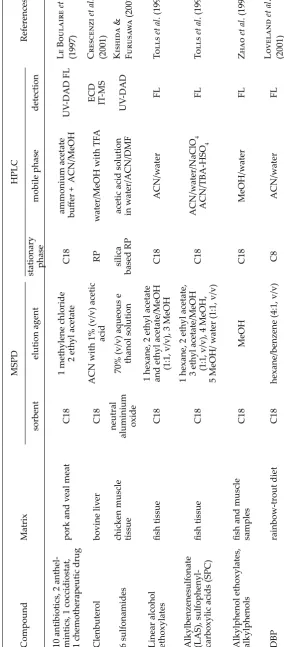
L� B������� et al. (1997) made a comparison be-tween the MSPD technique with solvent or buffer extraction and liquid/liquid transfer, usually prac-tised in the residue analysis. 14 veterinary drug residues (10 antibiotics, 2 anthelmintics, 1 coccidi-ostat, and 1 other chemotherapeutic drug) were determined by HPLC in pork and veal. Analytes were extracted using C18 sorbent. Two fractions were collected by elution with 1-methylene chlo-ride and 2-ethyl acetate. UV and fluorescent de-tections were used. The recoveries were 40–60%. Many advantages of MSPD in comparison to LLE were mentioned: higher extraction yields, a lower solvent consumption, time saving, a lower need of laboratory equipment, and also the possibility of the automation of the method.
A few years later, C�������� et al. (2001) inves-tigated the possibility of combining MSPD with molecularly imprinted solid-phase extraction (MISPE). They determined clenbuterol in bovine liver. C18 sorbent was used for MSPD. The mix-ture of C18 and the liver sample was packed into an SPE cartridge and placed on the top of MISPE cartridge. Clenbuterol was eluted from the MSPD cartridge into the MISPE cartridge using acetonitrile containing 1% acetic acid. The ability of the mo-lecularly imprinted polymer to selectively adsorb
the analyte in acetonitrile was exploited for re-ex-tracting clenbuterol directly from this acetonitrile extract via the double cartridge tandem system. The analyte was eluted from the MISPE cartridge with acidified methanol. A clear eluate was evapo-rated, redissolved, and analysed by HPLC using electrochemical detection (ECD) or ion trap mass spectrometry (LC/IT-MS). The complete extraction was rapid, and recoveries exceeded 90%.
The neutral aluminium oxide was used for MSPD isolation of 6 sulphonamides (SAs) from chicken prior to HPLC analysis (K������ & F������� 2001). Other polar sorbents were also tested (basic and acid aluminium oxide, silica gel, and Florisil). Ethanol was used as the eluting solvent because of low toxicity. The sorbents were deactivated by the addition of water to the eluent. SAs were isolated in only one step, i.e. elution with a 70% (v/v) aqueous ethanol solution. The recoveries were higher than 80% while low recoveries were obtained using a non-polar sorbent C18. In addi-tion, the C18-MSPD technique required sorbent conditioning and C18-tissue matrix washing for the isolation of SAs from animal tissues. MSPD and HPLC conditions are listed in Table 2.
Environmental pollutants in animal tissues
MSPD was also applied as a sample prepara-tion method in the analysis of some environmental pollutants (surfactants from laundry detergents, polycyclic aromatic hydrocarbons PAHs). T���� et al. (1999a) described the isolation of surfactants – alcohol ethoxylates from fish using MSPD. The extraction with C18 sorbent and aluminium oxide purification allowed the recoveries to reach 75% plus. The eluting solvents were 1-hexane, 2-ethyl acetate and ethyl acetate-methanol (1:1, v/v), and 3-methanol. Three fractions were obtained. After purification and derivatisation, the extracts were analysed by HPLC using fluorescent detection.
a simultaneous determination of LAS and SPC, MSPD was used with subsequent isolation of SPC with graphitised carbon black SPE and IP-LL of LAS. The recoveries were 84% for LAS and 65% for SPC. HPLC with fluorescent detector was used for the quantification.
MSPD with sequential purification was devel-oped to isolate and purify non-ionic surfactants alkylphenol ethoxylates (APEs) and alkylphenols in both fish and muscle samples (Z��� et al. 1999). The elution profile, sequential purification, and experimental set up were optimised. C18 was used as the solid-phase for the matrix dispersion. Methanol was found to be the optimal eluting solvent for APEs. Aluminium oxide was quite efficient for the removal of the coeluting inter-ferences. The recoveries were higher than 92%. Quantitative analysis was done using RP-HPLC with fluorescent detection.
Dibenzo[a,l]pyrene (DBP), one of the polycy-clic aromatic hydrocarbons was determined in experimental rainbow-trout diets (L������� et al. 2001). The sample was blended with C18 sorb-ent and benzo[a]pyrene internal standard was added to the mixture. Extraction and purification were accomplished in a single step by extracting the sample mixture with hexane-benzene (4:1, v/v) from a cartridge containing 2 g Florisil. The determination was performed with HPLC on C8 bonded phase column with fluorescent detection. The mean analytical recovery of DBP from spiked samples was 101–107% (RSD 1–7%).
Natural compounds in food and plant samples
Not many papers dealing with the application of MSPD as a pre-separation technique for the analysis for natural compounds present in food and plant samples were published. Especially in such cases where more polar analytes are monitored and so more individual steps or different combinations of washing and eluting solvents are required. Moreo-ver, a lot of less polar interferences can occur in sample matrices and often many other purification steps are necessary to be included. But, in recent years, the use of MSPD occurred in the procedures developed for the naturally present analytes in these kinds of samples.
The determination of β-carotene in medical food was described with the use of HPLC with MSPD (C���� et al. 1999a). The nutrient was extracted from the medical food without saponification by
MSPD and quantified by isocratic normal-phase chromatography using silica column and n-hex-ane modified by isopropyl alcohol as the mobile phase. There are no current official methods for such kind of analysis, of carotene in medical food; AOAC Method 941.14 is available for carotenes in fresh plant material. But in this method carotene is extracted with acetone and hexane using an open-column chromatography technique. Some European procedures are also applicable to complex foods and to total carotenoids in fruit, vegetables and beverages (E���������� & L����� 1998). The sorb-ent Bondesil C18 was used for MSPD assay (2 g) with 0.5 g of sample applied in the procedure. The MSPD cartridge was washed with 7 ml of n-hexane containing 0.5% (v/v) isopropyl alcohol, followed by 7 ml of methylene chloride-ethyl acetate-n -hex-ane mixture (3:3:4, v/v/v) containing 0.5% (v/v) isopropyl alcohol. After the evaporation of the combined extracts to dryness, the residue was dissolved in 1 ml of n-hexane and injected onto the HPLC column. Extraction recovery was about 91.2%, CV 0.50–3.10%.
LC and MSPD were recommended for the anal-ysis of all-rac-α-tocopheryl-acetate and retinyl palmitate in milk-based infant formula (C���� & L��� 1998). The vitamins were extracted without saponification by means of MSPD and determined also by means of normal HPLC with fluorescence detection. Retinyl palmitate and vitamin E were analysed using isocratic elution with n-hexane with the addition of isopropyl alcohol. Recover-ies were 96.8% for retinyl palmitate and 91.5% for all-rac-α-tocopheryl acetate, respectively. The Bondesil C18 was used for the MSPD assay. The authors added 100 µl of isopropyl palmitate gently blended with a pestle. This addition to C18 as a modifier was necessary for the efficient elution of retinyl palmitate from MSPD cartridge. The first elution step was realised with 7 ml of 0.5% (v/v) isopropanol in n-hexane and 7 ml of methylene chloride. After evaporation and dissolution of the residue in n-hexane, the residue was analysed by HPLC with the fluorescence detection.
ab le 3 . T he c on di tio ns o f M SP D a nd H PL C a na ly si s of n at ur al c om po un ds in fo od a nd p la nt s am pl es Compound Matrix MSPD HPLC References sorbent elution agent
stationary phase
mobile phase detection β -carotene medical food C18
hexane with 0.5% (v/v) isopropanol; methylene chloride/ethyl acetate/hexane (3:3:4, v/v/v) with 0.5% (v/v)
isopropanol Si 60 hexane/isopropanol UV C���� et al . (1999a) All-rac-α -tocopheryl
acetate, retinyl palmitate milk-based infant formula
C18
hexane with 0.5% (v/v) isopropanol; methylene
chloride
Si 60
hexane with 0.5% (v/v) isopropanol or with 0.125% (v/v) isopropanol
FL C���� & L��� (1998) Retinyl acetate
soy-based infant formula
C18
hexane with 0.5% (v/v) isopropanol; methylene
chloride
Si 60
hexane with 0.28% (v/v) isopropanol
FL C���� et al . (1999b) V itamin K1
milk-based infant formula
C18
hexane with 0.5% (v/v) isopropanol; ethyl acetate
C8
reductiv
e ionic solution
* in MeoH/hexane FL C���� et al . (1999b) V itamin K1
soy-based infant formula
C18
hexane with 0.5% (v/v) isopropanol; ethyl acetate
C8
reductiv
e ionic solution
* in MeoH/hexane FL C���� et al . (2000a) V itamin K1 medical food C18
hexane with 0.5% (v/v)
isopropanol, ethyl acetate,
methylene chloride
C18
reductiv
e ionic solution
* in MeoH/hexane FL C���� et al . (2000b) V itamin K1 medical food C18
ethyl acetate (ASE extr
.
parameters)
C18
reductiv
e ionic solution
* in MeoH/hexane FL C���� & T������� (2000) Asterosaponin starfish-Asterias rubens C18 w
ater/ACN (1:1, v/v)
C18
ammonium formate in D
2
O/ACN
UV
, ESI-MS, NMR
S������� et al . (2001) Lutein, zeaxanthin spinach leav es C30 acetone C30 acetone/w ater UV
, APCI-MS, NMR
G����� et al . (2003) Rosmarinic, caff eic
and protocatechuic acid plant Melissa
officinalis
C18
MeOH/w
ater pH 2.5
(4:1, v/v)
C18
MeOH/w
ater pH 2.5
for the analysis of vitamin A in milk-based infant formula are often applied, however, matrix differ-ences exist and thus the validation of this method for soy-based infant formula was required. The MSPD procedure was the same as in the analysis of retinyl palmitate (C���� & L��� 1998). Extrac-tion recoveries were 94.7%.
The same authors (C���� et al. 1999c) published also HPLC determination of vitamin K1 in milk-based infant formula. Vitamin K1 is converted to a fluorescent hydroquinone with a post-column zinc reductive reactor. Vitamin K1 is unstable under alkaline conditions and cannot, consequently, with-stand the saponification (E���������� & L����� 1999). The use of postcolumn chemical reduction of the quinone to the fluorescent hydroquinone allows selective and sensitive quantification of vitamin K1 after SPE on silica and/or C18 and re-versed-phase HPLC. The current AOAC Method 992.27 based on the pre-treatment with ammonium hydroxide and methanol followed by the extraction with methylene chloride-isooctane (2:1) and open column chromatography on silica is required for the purification of the extracts. MSPD procedure is a very slightly modified generic MSPD assay discussed till now. The first elution solvent was again 0.5% (v/v) isopropanol in n-hexane (9 ml), the second one ethyl acetate (9 ml). Both eluates were combined, evaporated, and the residue was reconstituted in 1 ml of n-hexane. The extraction recoveries for vitamin K1 were in the range of 86.4–101%, CV 0.5–6.7%.
The same method was used for the determina-tion of vitamin K1 in soy-based infant formula (C���� et al. 2000a). The current AOAC International Method 992.27 for the determination of vitamin K1 suffers from high CVs and cannot be used for infant formula samples containing corn oil. The MSPD procedure and HPLC analysis as applied for milk-based infant formula were validated for soy-based infant formula. The recoveries obtained were 92.5%.
Vitamin K1 was analysed also in medical food samples again using MSPD for the extraction (C���� et al. 2000b). Recoveries were on averaged 97.9%, the limit of detection was 6.6 pg and that of quanti-fication 22 pg on column. Due to the sample matrix differences related to the milk-based infant formula (lipid interference), the method has to be modified. Thus the issues of solvent polarity, miscibility, or partitioning characteristics become critically im-portant in the MSPD method development. The
medical food matrix is highly complex and may contain different protein and fat combinations and amounts. This study differed from the earlier work by incorporating the addition of two drops of a reductive ion solution to the sample once it was weighed onto the C18/isopropyl palmitate mix. This addition precipitated the proteins, allowing the eluting solvents to flow freely through the cartridge.
Accelerated Solvent Extraction (ASE) was used in a combination with MSPD assay for the deter-mination of vitamin K1 in medical food (C���� & T������� 2000). The medical food sample was treated equally as in the MSPD procedure, followed by ASE for the hands-free automated extraction. Vitamin K1 in the ASE extract was then determined by HPLC using fluorescence detection. ASE is a relatively newly developed technology that can reduce the extraction time and the solvent con-sumption as well as to increase the yield. Samples are loaded onto the ASE system and the solvent is pumped into an extraction cell which is then pressurised and heated for several minutes. The coupling of these two techniques automates the MSPD assay and makes the whole preparation procedure much more selective and sensitive. The extraction recoveries were nearly 100% in all analytical experiments. This method provides a completely new area of the isolation possibili-ties, as the necessity of using 3 different solvents is eliminated with ASE in which one solvent only is applied.
nitro-gen. The fraction containing asterosaponins was eluted with water-acetonitrile (1:1, v/v). From 5 g starfish material, 11 mg of asterosaponin fraction was obtained. MSPD is much more simple than the authors’ initial procedure which consisted of a two-fold 16 h acetonitrile extraction, ultrasonic treatment, centrifugation and preparative chro-matographic purification (S������� et al. 2000). Furthermore, MSPD allows a miniaturisation of the extraction step, complementing the analytical scale LC-NMR-MS hyphenation.
Qualitative and quantitative determination of carotenoid stereoisomers in a variety of spinach samples using MSPD before UV, HPLC-APCI-MS and HPLC-NMR on-line coupling was described by G����� et al. (2003). Carotenoids lutenin and zeaxanthin were isolated by MSPD and then determined using C30 HPLC column. These carotenoids can be found in many dark-green vegetables as spinach, broccoli, and kale; they are not produced in the human body. Recent studies revealed that the bio availability of β -caro-tene from spinach is low and highly dependent on the food matrix. Spinach leaves were washed by deionised water, frozen in liquid nitrogen and ground with a pestle. Spinach (0.5 g) was then mixed with 1.5 g of MSPD C30 sorbent (30–50 µm). MSPD cartridge was conditioned with 15 ml of wa-ter and polar impurities were eluted with another 5 ml of water-methanol mixture. After drying the column, carotenoids were eluted with acetone until the extract became colourless (less than 500 µl). Recoveries were about 98%. Chromatograms were artefact free.
The first paper concerning the application of MSPD as an effective preparation technique for the monitoring of phenolic acids in medical plants was published in 2003 (Ž������ et al. 2003). Three phenolic acids (rosmarinic, caffeic, and protocate-chuic) were isolated by MSPD with about 90% ex-traction from Melissa officinalis and determined by HPLC-DAD. Different MSPD sorbents and various elution agents were tested and optimal extraction conditions were evaluated. Many other preparation techniques were studied by the authors as prepara-tion procedures (LLE, SPE, ASE, SFE) (Č������ & B������������� 2001, 2002) and the results were compared. Seven different sorbents and their com-binations were chosen for the MSPD development. Dried plant tops were ground to powder and an aliquot was mixed with 2 g of previously cleaned sorbent and 1 ml n-hexane. The mixture was
ho-mogenised and transferred into a 10 ml syringe. The interfering compounds were washed out with 10 ml of n-hexane, followed by 10 ml of methylene chloride, and after drying the syringe for 5 min under vacuum phenolic acids were eluted with eluting mixtures tested (methanol, methanol and 0.2% v/v HCOOH, methanol-water, pH 2.5, 80:20 v/v, methanol-water 60:40 v/v, and ethylacetate). After the evaporation to dryness, the residues were dissolved in methanol-water, pH 2.5, (80:20 v/v), and injected onto the HPLC column. Gradi-ent elution was applied for the quantitation. The extraction recoveries of all compounds analysed were evaluated for various volumes of different eluting solvents. Although, the volume of 10 ml is often reported to be sufficient for generic MSPD procedure, it was found that this is not always true for all eluting solvents tested and all analytes studied. In some cases more than 20 ml of elution mixtures was necessary to obtain a higher recovery. In these cases the eluates have to be preconcen-trated, especiallly for the analytes present in low concentrations in the medical plants analysed.
MSPD has been demostrated to be a suitable preparation technique, a simple alternative to LLE, SPE and SFE, for the isolation of phenolics from natural plant materials. No homogenisation, grinding or milling steps are necessary. It is only recommended to select suitable eluting agents giving the highest yields of the analytes, and to optimise the volume of the eluting medium. The washing step can be modified according to the amounts of the interfering and co-eluting com-pounds. The MSPD procedure can be modified very simply for the isolation of another pheno-lics in other plant materials. HPLC conditions are showed in Table 3.
Abbreviations
ACN acetonitrile
APCI atmospheric pressure chemical ionisation APE alkylphenol ethoxylate
grad. gradient elution
HPLC high performance liquid chromatography IP-LL ion-pair liquid-liquid partition
IT/MS ion trap mass spectrometry LAS linear alkylbenzensulfonate LC liquid chromatography LLE liquid-liquid extraction MeOH methanol
MISPE molecularly imprinted solid-phase extraction MS mass spectrometry
MSPD matrix solid-phase dispersion NMR nuclear magnetic resonance PAH polyaromatic hydrocarbon RP reversed phase
RSD relative standard deviation SFE supercritical fluid extraction
SPC sulfophenylcarboxylic acid metabolite SPE solid phase extraction
TC tetracycline UV ultraviolet
References
B����� S.A. (1998a): Matrix solid-phase dispersion. Current Trends and Developments in Sample Pre-paration LC-GC Int.: 37–40.
B����� S.A. (1998b): Matrix solid-phase dispersion. LC-GC Int.: 719–724.
B����� S.A. (2000a): Applications of matrix solid-phase dispersion in food analysis. J. Chromatogr. A, 880: 63–68.
B����� S.A. (2000b): Matrix solid-phase dispersion. J. Chromatogr. A, 885: 115–127.
B����� S.A., F���� Z.E. (1996): Recent Developments. In: P���� J., M������ M., A��������� R. (eds): Chemi-cally Modified Surfaces. Royal Society of Chemistry, Cambridge: 66–71.
B����� S.A., L��� A.R., S���� C.R. (1989): Isolation of drug residues from tissues by solid-phase dispersion. J. Chromatogr., 475: 353–361.
B����� S.A., L��� A.R., H���� M.E.H. II. (1993): Di-sruption and fractionation of biological materials by matrix solid-phase dispersion. J. Chromatogr., 629: 23–34.
B����� S.A., L��� A.R. (1994): Preparation of milk samples for immunoassay and liquid chromatogra-phic screening using Matrix solid-phase dispersion. J. AOAC Int., 4: 848–854.
B����� C., F��� G., P��� Y. (2002a): Comparison of microextraction procedures to determine pesticides in oranges by liquid chromatography-mass spectro-metry. J. Chromatogr. A, 970: 201–212.
B����� C., P��� Y., M���� J., F��� G. (2002b): De-termination of fungicide residues in fruits and vegetables by liquid chromatography-atmospheric pressure chemical ionization mass spectrometry. J. Chromatogr. A, 947: 227–235.
B���� J., S������ J.M., M���� J.C., M���� R., M���� J. (2003): Determination of aflatoxins in peanuts by matrix solid-phase dispersion and liquid chromato-graphy. J. Chromatogr. A, 1011: 49-54.
B������������� E., K������ P., B������� Ľ., S���� P., B���������� A., M��������� Ľ. (1997): SPE and MSPD as pre-separation techniques for HPLC of te-tracyclines in meat milk and cheese. Z. Lebensm. Unters For., 205: 311–315.
C���� G.W. Jr., L��� A.R. (1998): Liquid chromato-graphic method for analysis of all-rac-α-tocopheryl acetate and retinyl palmitate in milk-based infant formula using Matrix solid-phase dispersion. J. AOAC Int., 81: 582–586.
C���� G.W. Jr, E���������� R.R., L��� A.R. (1999a): Analysis of β-carotene in medical food by liquid chro-matography with Matrix solid-phase dispersion. J. AOAC Int., 82: 663–665.
C���� G.W. Jr, E���������� R.R., L��� A.R. (1999b): A liquid chromatographic method for the analysis of retinyl acetatein soy based infant formula using Matrix solid-phase dispersion. J. Liq. Chrom. Rel. Technol., 23: 423–432.
C���� G.W. Jr, E���������� R.R., L��� A.R. (1999c): Liquid chromatographic analysis of vitamin K1 in milk-based infant formula with Matrix solid-phase dispersion. J. AOAC Int., 82: 1140–1145.
C���� G.W. Jr, ����������� R.R., L��� A.R. (2000a): The liquid chromatographic analysis of vitamin K1 in soy based infant formula using Matrix solid-phase dispersion. J. Liq. Chrom. Rel. Technol., 23: 423–432.
C���� G.W. Jr, E���������� R.R., L��� A.R. (2000b): Liquid chromatographic analysis of vitamin K1 in medical foods using Matrix solid-phase dispersion. J. Food Comp. Anal., 13: 765–771.
C���� G.W. Jr., T������� B. (2000): Accelerated sol-vent extraction of vitamin K1 in medical foods in conjunction with Matrix solid-phase dispersion. J. AOAC Int., 83: 407–410.
Č������ A., B������������� E. (2001): HPLC analysis of phenolic acids in Melissa officinalis. J. Liq. Chrom. Rel. Technol., 24: 2647–2659.
Č������ A., B������������� E. (2002): Application of different preparation techniques for extraction of phenolic antioxidants from lemon balm (Melissa officinalis) before HPLC analysis. J. Liq. Chrom. Rel. Technol., 25: 3017–3032.
E���������� R.R., L����� W.O. Jr. (1998): Vitamin Analysis for the Health and Food Sciences. CRC Press, Boca Raton.
E���������� R.R., L����� W.O. Jr. (1999): Vitamin K in Vitamin Analysis for the Health and Food Sciences. CRC Press, Boca Raton: 149–184.
F�������� M., P��� Y., M���� J. (2000): Determina-tion of carbamate residues in fruits and vegetables by matrix solid-phase dispersion and liquid chro-matography-mass spectrometry. J. Chromatogr. A, 871: 43–56.
G����� T., L����� A., Z��� D., K������ M., D������� M., A����� K. (2003): Quantitative and qualitative determination of carotenoid stereoisomers in a variety of spinach samples by use of MSPD before HPLC-UV, HPLC-APCI-MS, and HPLC-NMR on-line coupling. Chromatographia Suppl., 57: 19–25.
K������ K., F������� N. (2001): Matrix solid-phase dispersion extraction and high-performance liquid chromatographic determination of residual sulfon-amides in chicken. J. Chromatogr. A, 937: 49–55. L� B������� S., B������� J.C., A���� F. (1997):
Veteri-nary drug residues survey in meat: An HPLC method with a Matrix solid-phase dispersion extraction. J. Agr. Food. Chem., 45: 2134–2142.
L��� A.R., H���� L.C., M�������� M.S., S���� C.R., B����� S.A. (1989): Multiresidue method for isolation and liquid chromatographic determination of seven benzimidazole anthelmintics in milk. J. Assoc. Off. Anal. Chem., 72(5): 739–741.
L��� A.R., S���� C.R., B����� S.A. (1990a): Method for the isolation and liquid chromatographic determina-tion of eight sulfonamides in milk. J. Chromatogr., 502: 87–94.
L��� A.R., H���� L.C., M�������� M.S., S���� C.R., B����� S.A. (1990b): Matrix solid-phase dispersi-on (MSPD) isolatidispersi-on and liquid chromatographic determination of oxytetracycline, tetracycline and chlortetracycline in milk. J. Assoc. Off. Anal. Chem., 73: 379–384.
L��� A.R., H���� L.C., M�������� M.S., S���� C.R., B����� S.A. (1990c): Matrix solid-phase dispersion isolation and liquid chromatographic determination of oxytetracycline in catfish (Ictalurus punctatus) muscle
tissue. J. Assoc. Off. Anal. Chem., 73: 864–867. L��� A.R., H���� L.C., M�������� M.S., S���� C.R.,
B����� S.A. (1990d): Matrix solid-phase dispersion isolation and liquid chromatographic determination of sulfadimethoxine in catfish (Ictalurus punctatus) muscle tissue. J. Assoc. Off. Anal. Chem., 73: 868–871. L��� A.R., H���� L.C., M�������� M.S., S���� C.R.,
B����� S.A. (1990e): Matrix solid-phase dispersion isolation and liquid chromatographic determination of five benzimidazole anthelmintics in fortified beef liver. J. Assoc. Off. Anal. Chem., 73: 860–863. L������� P.M., R���� A.P., P������ C.B., F���� J.A.,
B����� G.S. (2001): Application of Matrix solid-phase dispersion in the determination of dibenzo[a,l]pyrene content of experimental animal diets used in a large-scale tumor study. J. Chromatogr. A, 932: 33–41. M����� M., B�������� B. (2002): HPLC determination
of pesticide residue isolated from food matrices. J. Liq. Chrom. Rel. Technol., 25: 2293–2306.
M����� M., B�������� B. (2003): Optimization of matrix solid-phase dispersion method for the determination analysis of carbendazim residue in plant material. J. Chromatogr. B (in press).
P��� X., R��� M. J., P��� Y., F��� G. (2001): Determi-nation of imidacloprid, metalaxyl, myclobutanil, propham and thiabendazole in fruits and vegetables by liquid chromatography-atmospheric pressure chemical ionization-mass spectrometry. Fresenius J. Anal. Chem., 371: 182–189.
R����� G.J., S����� A. (1992): Liquid chromatogra-phic confirmatory method for five sulfonamides in salmon tissue by matrix solid-phase dispersion. J. AOAC Int., 75: 979–981.
S������� M., P��� L.H., P����� A., L����� K., M���� C., W����� G. (2000): Isolation and structural eluci-dation of stereoid oligoglycosides from the Starfish Asterias rubens by means of direct online LC-NMR-MS hyphenation and one and two dimensional NMR Investigations. Eur. J. Org. Chem.: 1253–1262. S������� M., W������� A., P����� A., L����� K.,
W����� G. (2001): Combination of Matrix solid-phase dispersion extraction and direct on-line li-quid chromatography-nuclear magnetic resonance spectroscopy-tandem mass spectrometry as a new efficient approach for the rapid screening of natu-ral products: Application to the total asterosaponin fraction of the starfish Asterias rubens. J. Chromatogr. A, 917: 75–86.
S������ F.J., B����� S.A., L��� A.R. (1992a): Matrix solid-phase dispersion extraction and liquid chro-matographic determination of ivermectin in bovine liver tissue. J. AOAC Int., 75: 655–658.
S������ F.J., B����� S.A., L��� A.R. (1992b): Matrix solid-phase dispersion extraction and liquid chro-matographic determination of nicarbazin in chicken tissue. J. AOAC Int., 75: 659–662.
S����� J. (1997): Current status of pesticide residue analysis. J. AOAC Int., 80: 283–288.
T���� J., H����� M., S�� D.T.H.M. (1999a): Extraction and isolation of linear alcohol ethoxylates from fish. J. Chromatogr. A, 839: 109–117.
T���� J., H����� M., S�� D.T.H.M. (1999b): Extraction and isolation of linear alkylbenzensulfonate and its sulfophenylcarboxylic acid metabolites from fish. Anal. Chem., 71: 5242–5247.
V��������� A.I., L�������� R., R������ M.J., F��� G. (1999): Matrix solid-phase dispersion microextraction and determination by high-performance liquid chro-matography with UV detection of pesticide residues in citrus fruit. J. Chromatogr. A, 839: 101–107. V��������� A.I., R������ M.J., P��� Y., F��� G.
(2000): Determination of abamectin in citrus fruit by liquid chromatography-electrospray ionization mass spectrometry. J. Chromatogr. A, 871: 57–65.
V��������� A.I., P��� Y., F��� G. (2001a): Determina-tion of five pesticide residues in oranges by Matrix solid-phase dispersion and liquid chromatography to estimate daily intake of consumers. J. AOAC Int., 84: 901–909.
V��������� A.I., P��� D.S., R������ M.J., M���� J. (2001b): Comparison of various liquid chromatogra-phic methods for the analysis of avermectin residues in citrus fruits. J. Chromatogr. A, 918: 59–65. W����� L.V., W���� J.R., W����� J.J. (1992):
High-per-formance liquid chromatography of sulphonamides extracted from bovine and porcine muscle by solid-phase dispersion. J. Chromatogr., 595: 179–184. Z��� M., V�� D�� W����� F., D� V���� P. (1999):
Optimization of Matrix solid-phase dispersion me-thod with sequential clean-up for the determination of alkylphenol ethoxylates in biological tissues. J. Chromatogr. A, 837: 129–138.
Ž������ A., B������������� E., B������ E. (2003): Matrix solid-phase dispersion for the liquid chroma-tographic determination of phenolic acids in Mellisa
officinalis. J. Chromatogr. A, 983: 271–275.
Received for publication August 20, 2003 Accepted a�er corrections November 5, 2003
Súhrn
K������� G., B������������� E., L������ M. (2003): Matrix solid phase disperzia – efektívna metóda pre úpravu
potravinových a rastlinných vzoriek pre HPLC analýzu. Czech J. Food Sci., 21: 219–2340.
Prehľadný článok sa zaoberá technikou úpravy vzorky – Matrix solid phase disperziou (MSPD) a možnosťami jej využitia v HPLC analýze kontaminantov, pesticídov, rezíduí liečiv a prírodných látok v potravinových vzorkách. V práci je vysvetlený princíp MSPD, zhodnotené sú tu hlavné faktory ovplyvňujúce efektívnosť a výťažnosť tejto metódy, ako aj výhody a nevýhody MSPD v porovnaní s inými klasickými metódami extrakcie, izolácie a prečis-tenia analytov. Uvádza sa tu tiež prehľad aplikácií MSPD pri analýze rôznych analytov v rôznych potravinových vzorkách, publikovaných v posledných rokoch.
Kľúčové slová: matrix solid phase disperzia; vysokoúčinná kvapalinová chromatografia; potravinové vzorky; kon-taminanty; pesticídy; rezíduá liečiv; prírodné látky
Corresponding author:
Ing. G������� K�������, Slovenská technická univerzita v Bratislave, Fakulta chemickej a potravinárskej technológie, Katedra analytickej chémie, Radlinského 9, 812 37 Bratislava, Slovenská republika