Pepper (Capsicum annuum L.) is sensitive to drought stress and is moderately sensitive to salt stress (Rhoades et al. 1992). Under greenhouse conditions pepper will accumulate salt ions such as Na, K, P and Cl, particularly under conditions of water deficit and over supply of fertilizer (Günes et al. 1996). This leads to over-absorption and an imbalance of mineral elements. As a result, plants affected by salinity can suffer from membrane destabilization (Hasegawa et al. 2000), inhibition of the photosynthetic machinery (Munns and Termaat 1986) and general nutrient imbalance (Munns 1993).
Boron (B) is one essential micronutrient, which is immobile in the plant and therefore greatly in-fluenced by transpiration rates (Shelp et al. 1995, Alpaslan and Gunes 2001). B uptake differs among plant species and cultivars (Hu and Brown 1997). High concentrations of B may occur naturally in the soil or ground water, or be added to the soil through fertilizers, mining, and municipal and other wastewater effluents used for irrigation water (Nable et al. 1997). Interactions between salinity and B have been observed for some plants. Alpaslan and Gunes (2001) reported increases in B concentration in tomato and decreased B uptake
under saline conditions, when compared to non-saline conditions. Conversely, the B concentration of cucumber increased as a result of increasing levels of applied B and elevated salinity. Excessive B levels can limit plant growth, or damage to the photosynthesis system, and can cause severe physi-ological responses, such as the disruption auxin biosynthesis, leading to reduction in fruit or crop yield. Furthermore, membrane permeability in-creases with the increasing levels of applied B in the presence of salinity. Plant growth and yield are reduced in salt-affected soils because of the excess uptake of potentially toxic ions (Gupta et al. 1985). Grieve and Poss (2000) reported that the excess external salinity and B interact to limit growth and yield of wheat. Ben-Gal and Shani (2002) also reported that yield and transpiration of tomatoes decreased with excess B, but the response to B was inhibited when plants were exposed to simultaneous B and salinity stress.
Little is known about the effects of combined salinity and high levels of B on antioxidant enzymes and stomatal resistance of hot pepper. Oxidative stress is mediated by active oxygen species
in-cluding superoxide (O2–), hydroxyl radicals (OH),
hydrogen peroxide (H2O2), and singlet oxygen
Hot pepper response to interactive effects of salinity
and boron
Supanjani, K.D. Lee
Department of Plant Science, McGill University, Macdonald Campus, Quebec, Canada
ABSTRACT
An excess of salinity and boron (B) can limit production of hot pepper (Capsicumannuum L.), but little is known about the physiological responses, including antioxidant activities, in response to these excesses. We investigated the physiological responses and defense mechanisms of hot pepper grown under salinity (NaCl) stress at 3 and 6 dS/mand B stress at 15 and 30 mg/kg. Dry weight and the total chlorophyll content decreased with increasing sa-linity and B levels.The toxic effect of B was greater under saline conditions. Higher levels of salinity and B resulted in increased B concentrations in leaves. The stomatal resistance values increased as the combined levels of salinity and B increased. Furthermore, increasing salinity, B or both increased activities of H2O2, SOD, POX, APX and GR, which increased oxidative stress, compared to the control plants. Increases in combined salinity and B levels di-srupted plant nutrient balance and water use, and induced production of secondary toxic substances leading to an increased plant tissue concentration of H2O2, and suppression of growth in hot pepper.
(1O
2) (Wise and Naylor 1987). The superoxide
radical is produced at the membrane level in most plant cell organelles and hydrogen peroxide is the product of superoxide dismutase (SOD) and several oxidases of the preoxisomes (Del Rio et al. 1992).
Detoxification of cellular H2O2 through the
activ-ity of the Asada-Halliwell scavenging cycle is an important element of defense mechanisms against
active oxygen species (Lee and Lee 2000). H2O2
plays an important role in salt stress (Singha and Choudhuri 1990, Hernández et al. 1995). Ascorbate peroxidase (APX) is part of the scavenging cycle and catalyzes the reaction of ascorbic acid with
H2O2, while glutathione reductase (GR) catalyzes
the regeneration of ascorbic acid (Smirnoff 1993).
Catalase (CAT) reduces H2O2 to water, but has
a very low affinity for H2O2, as compared with
APX (Graham and Patterson 1982). Most publica-tions regarding plant stress tolerance mechanisms indicate a correlation between the resistance to environmental stresses and more effective anti-oxidative systems (Bor et al. 2003).
In this paper, we report a detailed study of the effect of long-term stress due to salinity, B or both, on the antioxidant level, mineral content and stomatal resistance of hot pepper.
MATERIAL AND METHODS
Hot pepper seeds (Capsicum annuum L.) of
cv. Nokkwang were sown in washed, fine sand watered with half strength Hoagland’s solution (Hoagland and Arnon 1950). They were germi-nated in a greenhouse under natural light condi-tions, a daytime temperature of 25°C and relative humidity of 65–70%. After the second true leaves appeared, the seedlings were transplanted at a rate of one plant per Wagner pot containing 1 kg of dried sandy loam soil. The soil characteristics were pH (1:5 water) 6.0, EC 0.45 dS/m, organic
matter 8 g/kg, total nitrogen 0.7 g/kg, CEC: Ca3.8,
K 0.5, Na 0.4 cmol+/kg, and B 1.0 cmol+/kg. A basal
fertilizer was applied N–P2O5–K2O = 100–80–
50 kg/ha. The collective effect of salinity and B was investigated by combining 2 salinity (NaCl at 3 and 6 dS/m) and 2 boron levels (15 and 30 mg/kg
H3BO3), plus controls. All plants were harvested
3 weeks after transplanting. There were four rep-licates of each treatment, and the experiment was structured following a randomized complete block design (RCBD). To analyze antioxidative enzymes, fresh leaves were put immediately into a liquid N deep-freeze (–70°C).
To analyze mineral elements, plant materials were first air-dried at 70°C to constant weight. Dried leaf material was digested using a ternary solution
(HNO3:H2SO4:HClO4 = 10:1:4 by volume) for the
determination of Na, Cl and K. These solutions were determined by atomic absorption spectro-photometry (Perkin-Eler Analyst 300, USA). Boron analysis was determined spectrophotometrically by the azomethine-H method (Wolf 1974). All spectrophotometric analyses were conducted on a Shimaszu (UV-Vis 1600, Japan) spectropho-tometer. The chlorophyll content of fresh leaves was determined by acetone extraction (Arnon 1949). Stomatal resistance was determined by using a porometer (EA 540-026 AP4 model, air temperature 36°C, light intensity 350–400 µmol/
m2/s, and relative humidity 60%).
The H2O2 level and leaves were measured
color-imetrically following the procedure described by Anderson (2002). To determine the levels of antioxidant enzymes fully expanded leaves were homogenized in 50mM phosphate buffer (pH 7.5) containing 1% (w/v) polyvinyl-pyrrolidone (PVP), 0.1mM EDTA and 0.5% (v/v) Triton X-100. Using an ascorbate peroxidase (APX) assay leaves were homogenized in 50mM phosphate buffer (pH 7.0) containing 5mM ascorbate and 1mM EDTA. The homogenate was filtered through four layers of muslin cloth and centrifuged at 12 000 × g for 10 min. All assays were conducted at 4°C. The supernatant was used for determination of anti-oxidant enzyme activities: CAT (Aebi 1983), POX (Pütter 1974), SOD (Beyer and Fridovich 1987), APX (Chen and Asada 1989), GR (Rao et al. 1996). The oxidation rate of ascorbate was estimated by following the decrease in absorbance at 290 nm for 3 min. Protein contents were determined accord-ing to the Bradford (1976) method usaccord-ing bovine serum albumin (BSA) as standard.
All data were analyzed statistically by analy-sis of variance using CoStat software (CoHort softwate, Monterey, USA). Means comparisons were conducted using an ANOVA protected the
least significant difference (LSD) (P < 0.05) test.
Salinity and B treatments were compared using a randomized complete block model with four replications of each treatment.
RESULTS AND DISCUSSION
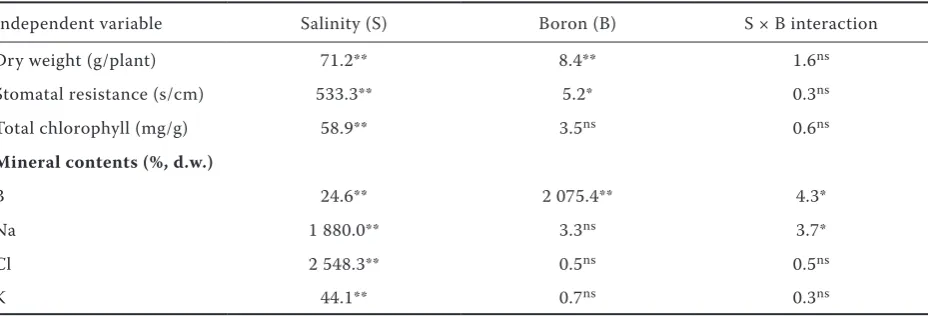
treat-ment was 21.2% less than the 0 dS/m control, whereas the 30 mg B/kg treatment only slightly decreased dry matter as compared to the control treatment (0 mg B/kg). When salinity was added in the presence of B, the maximum reduction occurred with the combination of 6 dS/m and 30 mg B/kg, increasing the toxic effects to a growth reduction of 33.8%, compared to the control (0 dS/m and 0 mg B/kg). There was an interaction between salin-ity and B for plant dry matter production (Table 2) in that the toxic effect of salinity was greater in the presence of B. Similar results have been reported by Alpaslan and Gunes (2001) for tomato plants. They found that the toxic effects of B were less limiting than salinity treatment in tomato.
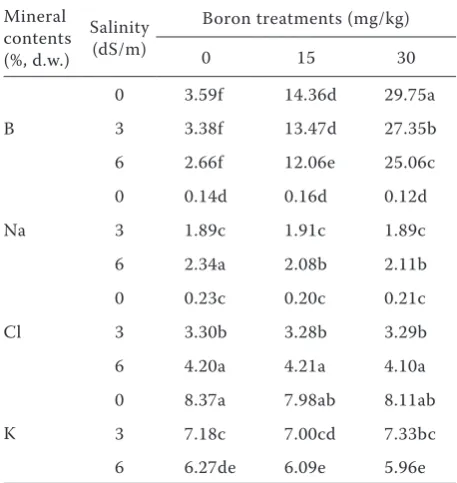
The effects of salinity and B concentrations on B, Na, Cl and K contents of the hot peppers are shown in Table 3. Increasing levels of applied B increased the B concentrations of leaves. When salinity was 0 dS/m, B in leaves reached a maximum concentration at the 30 mg/kg treatments. A salinity × B interaction occurred because the increase in leave B concentration as medium B concentration increase tended to decrease with increased salinity levels. This result is in agreement with Alpaslan
and Gunes (2001) and Ben-Gal and Shani (2002) who showed that increases in B concentrations of tomato decreased under salinity conditions, when compared to non-saline conditions. Increasing lev-els of salinity accelerated a progressive absorption of Na and Cl ions, although the two were increased to different degrees. At a salinity of 0 dS/m, Na and Cl contents of leaves were similar between 0–30 mg B/kg. High B treatments accumulated less Na and Cl than the control B treatment (0 mg B/kg). A similar result was reported by Ben-Gal and Shani (2002) who showed that tomato plants irrigated with high B containing solutions accu-mulated less Cl than plants irrigated with lower B concentrations. At 6 dS/m Na and Cl contents in leaf tissue were 2.2 mg/kg and 4.2 mg/kg, re-spectively. This may indicate that the damage to the pepper leaves at high salinity was exacerbated by salinity stress. K content was decreased with increasing salinity levels. This result is in agree-ment with the findings of Alfocea et al. (1993) and Alpaslan and Gunes (2001) who suggested that K nutrition is not affected by excessive Na in salt tolerant tomato plants, while K uptake is strongly inhibited by ionic compositions containing Na with K in salt sensitive tomato plants. Other researchers reported antagonistic interactions between Na and K, especially under salinity stress conditions (Alpaslan et al. 1999, Grieve and Poss 2000). Our results indicate that hot pepper plants grown under salinity stress, and with B, induced B accumulation and unbalanced the uptake of other inorganic elements.
Total chlorophyll contents of plants exposed to increasing levels of salinity and B are given in Table 4. The total chlorophyll content decreased with increases in combined salinity and B
concen-Table 1. Dry matter biomass (g/plant) of shoots of green-house grown hot pepper plants treated with increasing salinity and boron at 3 weeks after transplanting
Salinity (dS/m)
Boron treatments (mg/kg)
0 15 30
0 3.01ab 3.08a 2.96ab
3 2.77bc 2.65c 2.36d
[image:3.595.63.289.106.193.2]6 2.37d 2.12de 1.96e
Table 2. F-ANOVA values and level of significance of independent variables
Independent variable Salinity (S) Boron (B) S × B interaction
Dry weight (g/plant) 71.2** 8.4** 1.6ns
Stomatal resistance (s/cm) 533.3** 5.2* 0.3ns
Total chlorophyll (mg/g) 58.9** 3.5ns 0.6ns
Mineral contents (%, d.w.)
B 24.6** 2 075.4** 4.3*
Na 1 880.0** 3.3ns 3.7*
Cl 2 548.3** 0.5ns 0.5ns
K 44.1** 0.7ns 0.3ns
[image:3.595.67.532.584.742.2]tration, as compared to the control plants. Other researchers (Perolino and Leone 1980, Grant and Summers 1981) report that plants grown under high salinity conditions had lower chlorophyll contents. Decreases in chlorophyll content un-der stress conditions could be one of the major factors leading to leaf senescence, which is cor-related with increased membrane permeability and with accumulated aminolevulinic acid (ALA), an initial precursor of chlorophyll, at high salt concentrations. Tewari and Tripathy (1998) re-ported that inhibition of chlorophyll biosynthesis in temperature stressed cucumber seedlings was partly due to impairment of ALA biosynthesis. It is important to understand exactly how
salin-ity and B stress impair chlorophyll biosynthesis, and how it could be improved for crop varieties resistant to stress conditions. Stomatal resistance (Table 4) provides information to allow sensitive comparisons of genotypic water-use efficiency under salinity stress conditions. In this study, the stomatal resistance values were increased as levels of combined salinity and B increased. Thus, the water potential of hot pepper cells was affected by stress conditions and was decreased by over-absorption of other inorganic ions such as B, Na, Cl and K. As a result, plant growth and yield were reduced. Our results show responses similar to those reported by Günes et al. (1996).
In order to understand the protective action of antioxidants against salinity and B stress, we mea-sured the level of antioxidant activities and also
measured leaf injury. H2O2 levels of hot pepper
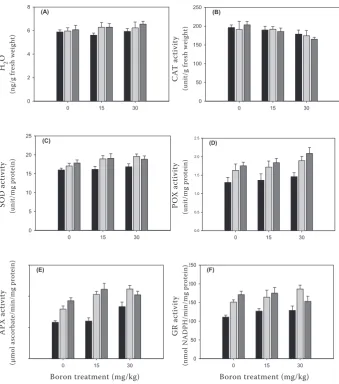
are shown in Figure 1a. The H2O2 levels increased
minimally during the 3 weeks of experimentation,
and tissue levels of H2O2 were not affected by
salinity and B treatments. Similar results were reported by Anderson (2002) for hot pepper leaves under salinity stress, and by Dat et al. (1998), who found that mustard and pepper leaves under heat stress had elevated. SOD activity, responsible for the elimination of superoxide radicals in cells, however, in our study the activity decreased at 6 dS/m and 30 mg B/kg, but remained higher than the control treatment, 0 dS/m and 30 mg B/kg (Figure 1c). The activity of CAT, the enzyme
re-sponsible for eliminating H2O2, decreased with
increasing salinity and B concentrations (Figure 1b)
and POX, which decomposes the H2O2 produced
by SOD, increased with increasing salinity and B concentrations (Figure 1d). Under long-term stress, POX activity generally follows a pattern that is the reverse CAT activity. Increases in B levels, when salinity was 0 dS/m, resulted in slightly in-creased POX activity, whereas increases in salinity levels increased oxidative stress. The combination of B and salinity increased the oxidative response. POX activity at 3 dS/m and 30 mg B/kg was 13.7% greater than at 3 dS/m and 0 mg B/kg, whereas CAT activity at 6 dS/m and 30 mg B/kg decreased POX activity 23.0%, compared to 6 dS/m and 0 mg B/ kg. Anderson (2002) reported similar results for pepper under temperature stress. APX activity,
which causes conversion of H2O2 to water, and
GR activity, also an enzyme in the Asada-Halliwell pathway, increased in pepper leaves under high salinity and B stress (Figure 1e, f ). Although APX
plays an important role in the conversion of H2O2
[image:4.595.62.291.106.348.2]to water, GR is also an essential enzyme in this
Table 3. Interactive effects of salinity and B on B, Na, Cl and K contents of greenhouse grown hot pepper plants
Mineral contents (%, d.w.)
Salinity (dS/m)
Boron treatments (mg/kg)
0 15 30
B
0 3.59f 14.36d 29.75a
3 3.38f 13.47d 27.35b
6 2.66f 12.06e 25.06c
Na
0 0.14d 0.16d 0.12d
3 1.89c 1.91c 1.89c
6 2.34a 2.08b 2.11b
Cl
0 0.23c 0.20c 0.21c
3 3.30b 3.28b 3.29b
6 4.20a 4.21a 4.10a
K
0 8.37a 7.98ab 8.11ab
3 7.18c 7.00cd 7.33bc
6 6.27de 6.09e 5.96e
Table 4. Total chlorophyll content and stomatal resist-ance of hot pepper grown for 3 weeks under combined boron and salinity stress
Items Salinity (dS/m) Boron treatments (mg/kg)
0 15 30
Total chlorophyll (mg/g)
0 2.29ab 2.32a 2.1bc
3 2.15c 2.11c 2.10c
6 1.88d 1.87d 1.77d
Stomatal resistance (s/cm)
0 2.34d 2.65d 2.65d
3 4.83c 5.08bc 5.41b
[image:4.595.65.291.622.762.2]reaction, and plays a role in maintaining the redox states of ascorbate and glutathione (Foyer et al. 1994). APX activity of plants treated with 3 dS/m and 30 mg B/kg was increased 28.9% compared to 3 dS/m and 0 mg B/kg, whereas 6 dS/m and 30 mg B/kg decreased APX activity by 9.3% compared to 3 dS/m and 30 mg B/kg. GR activity responded to B and salinity stress treatments in the same way as APX activity. GR activity increased most under high salinity and B stress, but 6 dS/m and 20 mg B/kg provoked a decrease as compared to 0 dS/m and 20 mg B/kg. Lin and Kao (2000) re-ported that POD, APX and GR activities increased in rice leaves in the presence of NaCl. Gossett et al. (1996) suggest that protection from oxidative damage by a more reactive ascorbate-glutathione cycle and higher levels of antioxidants such as CAT and SOD are involved in the development of salt tolerance in cotton plants. In the present study, we have shown that stressful levels of B and
salinity increased the levels of H2O2, POD, SOD,
APX and GR, leading to an overall increase in oxidative activity, whereas CAT activity decreased as salinity and B levels increased.
In conclusion, this study demonstrated that an increase of salinity and B concentration causes a physiological response or disorder in hot pepper plants and that, combined salinity and B could ac-celerates uptake of potentially toxic ions, increases water deficit and increases oxidative system activ-ity. As a result, stressful levels of combined salinity and B restrict hot pepper plant growth and do so to a greater degree than either alone.
REFERENCES
Aebi H. (1983): Catalase. In: Bergmeyer H.U. (ed.): Methods of Enzymatic Analysis. Verlag, Wainheim: 273–286.
0 15 30
H2 O2
(
ng
g
-1 f.
w .) 0 2 4 6 8 (A)
0 15 30
C A T a ct iv ity ( un it g
-1 f.
w .) 0 50 100 150 200 250 (B)
0 15 30
S O D a ct iv ity ( un it m g pr ot ei n -1) 0 5 10 15 20 25 (C)
0 15 30
P O X a ct iv ity ( un it m g pr ot ei n -1) 0.0 0.5 1.0 1.5 2.0 2.5 (D)
Boron treatment (mg kg-1)
0 15 30
A P X a ct iv ity (u m ol a sc or ba te m in
-1 m
g pr ot ei n -1) 0 5 10 15 (E)
Boron treatment (mg kg-1)
0 15 30
G R a ct iv ity (n m ol N A D P H m in
-1 m
[image:5.595.125.465.58.443.2]g pr ot ei n -1) 0 50 100 150 200 250 (F)
Figure 1. CAT, an H2O2, POX, SOD, APX and GR activity of hot pepper leaves in response to boron and salinity concentrations; (∎) 0 dS/m, (∎) 3 dS/m, (∎) 6 dS/m; data are mean ± SE (n = 3)
A PX a ct iv ity SO D a ct iv ity H2 O (µ m ol a sc or ba te /m in /m g pr ot ei n) (u ni t/ m g pr ot ei n) (n g/ g fr es h w ei gh t)
Boron treatment (mg/kg) Boron treatment (mg/kg)
Alfocea F.P, Estan M.T, Caro M., Bolarin M.C. (1993): Response of tomato cultivars to salinity. Plant Soil,
150: 203–211.
Alpaslan M., Gunes A. (2001): Interactive effects of born and salinity stress on the growth, membrane permeability and mineral composition of tomato and cucumber plants. Plant Soil, 236: 123–128.
Alpaslan M., Gunes A., Taban S. (1999): Salinity resis-tance of certain rice (Oryza sativa L.) cultivars. Tr. J. Biol., 23: 499–506.
Anderson J.A. (2002): Catalase activity, hydrogen per-oxide content and thermotolerance of pepper leaves. Sci. Hortic., 95: 277–284.
Arnon D.K. (1949): Copper enzymes in isolated chloro-plasts. Phenoloxidase in Beta vulgaris. Plant Physiol.,
24: 1–15.
Ben-Gal A., Shani U. (2002): Yield, transpiration and growth of tomatoes under combined excess boron and salinity stress. Plant Soil, 247: 211–221.
Beyer W.F., Fridovich I. (1987): Assaying for superox-ide dismutase activity: some large consequences of minor changes in conditions. Anal. Biochem., 161: 559–566.
Bor M., Özdemir F., Türkan I. (2003): The effect of salt stress on lipid peroxidation and antioxidants in leaves of sugar beet Beta vulgaris L. and wild beet
Beta maritime L. Plant Sci., 164: 77–84.
Bradford M.M. (1976): A rapid and sensitive method for the quantitation of microgram quantities of protein utilizing the principle of protein-dye binding. Anal. Biochem., 72: 248–254.
Chen G.X., Asada K. (1989): Ascorbate peroxidase in tea leaves: occurrence of two isozymes and the dif-ferences in their enzymatic and molecular properties. Plant Cell Physiol., 30: 987–998.
Dat J.F., Lopez-Delgado H., Foyer C.H., Scott I.M. (1998): Parallel changes in H2O2 and catalase dur-ing thermo-tolerance induced by salicylic acid or heat acclimation in mustard seedlings. Plant Physiol.,
116: 1351–1357.
Del Rio L.A., Sandalio L.M., Palma J.M., Bueno P., Corpas F.J. (1992): Metabolism of oxygen radicals in peroxisomes and cellular implications. Free Radicals Bio. Med., 13: 557–580.
Foyer C.H., Lelandais M., Kenert K.J. (1994): Photooxi-dative stress in plants. Physiol. Plant, 92: 696–717. Gossett D.R., Banks S.W., Millhollon E.P., Lucas C.
(1996): Antioxidant response to NaCl stress in a con-trol and a NaCl-tolerant cotton cell line grown in the presence of paraquat, buthionine sulfoximine, and exogenous glutathione. Plant Physiol., 112: 803–809.
Graham D., Patterson B.D. (1982): Responses of plants to low non-freezing temperatures: proteins,
metabo-lism and acclimation. Ann. Rev. Plant Physiol., 33: 347–372.
Grant D.M., Summers G.F. (1981): Salinity, aeration and the growth of Kosteletzkya virginica. Plant Physiol.,
67: 18–23.
Grieve C.N., Poss J.A. (2000): Wheat response to in-teractive effects of boron and salinity. J. Plant Nutr.,
23: 1217–1226.
Günes A., Inal A., Alpaslan M. (1996): Effect of salinity on stomatal resistance, proline and mineral composi-tion of pepper. J. Plant Nutr., 19: 389–396.
Gupta U.C., James Y.W., Cambell C.A., Leyshon A.J., Ni-cholaichuk W. (1985): Boron toxicity and deficiency: a review. Can. J. Soil Sci., 65: 381–409.
Hasegawa P.M., Bressan R.A., Zhu J.K., Bohnert H.J. (2000): Plant cellular and molecular responses to high salinity. Ann. Rev. Plant Physiol. Plant Mol. Biol., 51: 463–499.
Hernández J.A., Olmos E., Corpas F.J., Sevilla F., Del Rio L.A. (1995): Salt-induced oxidative stress in chlo-roplast of pea plants. Plant Sci., 105: 151–167. Hoagland D.R., Arnon D.I. (1950): A Water Culture
Method for Growing Plants without Soil. Calif. Agric. Exp. Stat. Circular: 347.
Hu H., Brown P.H. (1997): Absorption of Boron by Plant Roots. In: Boron in Plants and Soils. Kluwer Acad. Publ., Dordrecht, The Netherlands: 49–58.
Lee D.H., Lee C.B. (2000): Chilling stress-induced changes of antioxidant enzymes in the leaves of cu-cumber: in gel enzyme activity assays. Plant Sci.,
159: 75–85.
Lin C.C., Kao C.H. (2000): Effect of NaCl stress on H2O2 metabolism in rice leaves. Plant Growth Regul.,
30: 151–155.
Munns R. (1993): Physiological processes limiting plant growth in saline soils: Some dogmas and hypotheses. Plant Cell Environ., 16: 15–24.
Munns R., Termaat A. (1986): Whole-plant response to salinity. Aust. J. Plant Physiol., 13: 143–160.
Nable R.O., Banuelos G.S., Paull J.G. (1997): Boron toxicity. Plant Soil, 193: 181–198.
Perolino J.F., Leone I.A. (1980): Saline aerosol: Some effects on the physiology of Phaseolus vulgaris (Cul-tivar Toporop). Phytopathology, 70: 225–232. Pütter J. (1974): Peroxidases. In: Bergmeyer H.U. (ed.):
Methods of Enzymatic Analysis. Vol. 2, Acad. Press, NY, USA: 673–684.
Rao M.V., Paliyath G., Ormrod D.P. (1996): Ultravio-let-B- and ozone-induced biochemical changes in antioxidant enzymes of Arabidopsis thaliana. Plant Physiol., 110: 125–136.
Shelp B.J., Marentes E., Kitheka A.M., Vivekanandan P. (1995): Boron mobility in plants. Physiol. Plant., 94: 356–361.
Singha S., Choudhuri M.A. (1990): Effect of salinity (NaCl) stress on H2O2 metabolism in Vigna and Oryza seedlings. Biochem. Physiol. Pfl., 186: 69–74. Smirnoff N. (1993): The role of active oxygen in the
response of plants to water deficit and desiccation. New Phytol., 186: 69–74.
Tewari A.K., Tripathy B.C. (1998): Temperature-stress induced impairment of chlorophyll biosynthesis
re-actions in cucumber and wheat. Plant Physiol., 117: 851–858.
Wise R.R., Naylor A.W. (1987): Chilling-enhanced per-oxidation: the peroxidative construction of lipids during chilling injury to photosynthesis and ultra-structure. Plant Physiol., 83: 272–277.
Wolf B. (1974): Improvements in the Azomethine-H method for the determination of boron. Comm. Soil Sci. Plant Anal., 5: 39–44.
Received on February 5, 2005
Corresponding author:
Dr. Kyung Dong Lee, Department of Plant Science, Macdonald Campus, McGill University, 21111 Lakeshore Road, Ste-Anne-de-Bellevue, QC Canada H9X 3V9