One of the most important problems in cyprinid aquaculture is to obtain good-quality gametes (Kulikovsky et al., 1996; Horvath et al., 1997). For this reason many hormonal treatments are used to stimulate gamete maturation in com-mercial cyprinids. One of the most commonly applied spawning agents is carp pituitary extract (CPE) (Yaron et al., 1984; Thalathiah et al., 1988), in same cases with addition of human chorionic gonadotropin (hCG) (Kucharczyk et al., 1997a). The good results of induced ovulation in cyprinid fish were also obtained after hormonal stimula-tion by a synthetic analogue of gonadotropin-re-leasing hormone (GnRH), frequently with strong dopamine antagonists (Yaron, 1995; Barth et al., 1997). Recently, Horvath et al. (1997) proposed a new technique of ovulation stimulation in commer-cial cyprinids using pellets containing GnRH
ana-logue (ovopel). One ovopel pellet (average weight about 25 mg) contains mammalian GnRH analogue (D-Ala6, Pro9Net-mGnRH at a dose of 18–20 µg)
and dopamine antagonist: metoclopramide (dose 8–10 mg).
The above-mentioned problem of artificial spawning is much better visible in the case of wild cyprinids, mostly captured from natural popula-tions. Since many cyprinid wild stocks become extinct, there is a need for fast development of techniques of controlled propagation of these fish. Generally, the papers describing methods of artificial spawning of wild cyprinids are very scarce as well as data on reproductive biology of wild cyprinids and hatchery techniques (Penaz and Gajdusek, 1979; Kucharczyk et al., 1997c; Babiak et al., 1998). Some of the presented methods of artificial propagation are finished at the moment
Induced spawning in bream (
Abramis brama
L.)
using pellets containing GnRH
D. KUCHARCZYK
1, R. KUJAWA
1, A. MAMCARZ
1, K. TARGOŃSKA-DIETRICH
1,
E. WYSZOMIRSKA
2, J. GLOGOWSKI
3, I. BABIAK
1, T. SZABÓ
41Department of Lake and River Fisheries, Department of Animal Biochemistry, Warmia
and Mazury University in Olsztyn, Olsztyn-Kortowo, Poland
2Institute of Public Health, Warsaw, Poland
3Institute of Animal Reproduction and Food Research of Polish Academy of Sciences, Olsztyn,
Poland
4Institute of Animal Husbandry, Gödöllö University of Agricultural Sciences, Gödöllö, Hungary
ABSTRACT: Wild spawners of common bream, Abramis brama, were caught in the Kortowskie Lake (north Poland) and transported to a hatchery for artificial spawning. Fish were hormonally induced using GnRH analogue combined with metoclopramide (ovopel). The results of bream reproduction in captivity were compared with fish treated with the combination of hCG and CPE and with control group injected saline. Males from treated groups produced significantly more milt (over 4.3 ml/kg vs. 2.1) of better qualities: spermatozoon concentration (over 9.3 × 10⁹ vs. 6.8) and motility (over 85% vs. 62). Females from the control group did not spawn whereas those from
hormonally induced groups ovulated: 62% after CPE treatment and 100% after GnRHa treatment. Generally, the fish after ovopel stimulation showed the best hatchery parameters.
of ovulation (Glubokov et al., 1991). Our earlier re-searches on wild cyprinids showed that the problem of the biological quality of gametes was also very important (Kucharczyk et al., 1997b). On the other hand, the development of controlled reproduction of wild cyprinids is still needed as an integral com-ponent of ongoing conservation efforts (Wildt et al., 1993).
Bream (Abramis brama L.) is one of the most important freshwater species in Poland and some other European countries (Glubokov et al., 1991); average annual bream catch in Poland ranged from 20 (Szczerbowski, 1985) to 50 kg/ha (Brylińska and Tadajewska, 1986). Artificial spawning is necessary to develop techniques of genome engineering and banking in bream (Kucharczyk, 2002). The aim of the present study was to test ovopel as a spawning agent in artificial reproduction of wild matured common bream (Abramis brama L.), in compari-son with CPE and hCG stimulation which worked for common bream very well (Kucharczyk et al., 1997a).
MATERIAL AND METHODS
Fish
Bream spawners were obtained in the spring season from Kortowskie Lake (Olsztyn District, Poland). Fish were selected according to the fol-lowing criteria: the belly of females had to be fully distended and bulging, soft and resilient to touch; males had to be little spermiating. The size of spawners ranged from 0.8 to 1.2 kg. The water tem-perature in a hatchery was gradually raised from 15 to 20°C. Selected males and females were kept in separate 1 000-litre tanks in a hatchery with con-trolled temperature (20°C) and photoperiod (18 hrs light and 6 hrs dark).
Checking the oocyte maturation
All fish were individually marked using floy tags, weighed, and oocytes were taken from females using the method described by Kujawa and Kucharczyk (1996). Oocytes were sampled in vivo and placed in Serra’s solution for clarification of the cytoplasm. After 5 minutes, the position of oocyte nucleus was determined using a 4–stage scale:
stage 1 – germinal vesicle in the central position (CGV)
stage 2 – early migration of germinal vesicle (less than a half of the radius – MGV)
stage 3 – late migration of germinal vesicle (more than a half of the radius – PGV)
stage 4 – peripheral germinal vesicle or germinal vesicle breakdown (GVBD)
Only those females were used for further experi-ments in which oocyte maturation was between 2–3 and 3 division, which is the best moment for hormonal stimulation in cyprinids (Kozlowski, 1994).
Hormonal treatment
[image:2.595.67.534.650.737.2]Fish were divided into three groups: two experi-mental groups and control one. After five days of acclimation to 20°C, the fish were treated with respective hormonal injections of common carp pituitary (Argent, USA) extract with the addition of hCG (Biomed, Poland) or ovopel (Table 1). All spawning agents were prepared with 0.9% NaCl: the pituitary extract was homogenized, hCG dissolved and ovopel pellets were pulverised in a mortar and then dissolved. Injections of hCG were intramuscu-lar in the dorsal region of the body (Thalathiah et al., 1988). Injections of pituitary (Kucharczyk et al., 1997a) and ovopel (Horvath et al., 1997) extracts were intraperitoneal at the base of the pelvic fin.
Table 1. The doses of hormones applied in artificial spawning of common bream (Abramis brama L.)
Group Males
hormonal dose
Females
priming dose resolving dose 1 2.0 mg CPE 1 000 IU hCG 0.4 mg CPE 3.6 mg CPE 2 1/2 ovopel pellet 1/10 ovopel pellet 1 ovopel pellet
3 (control) + + +
Before manipulations fish were anaesthetised with 2-phenoxyethanol (0.5 ml per l). Time intervals be-tween respective injections are shown in Table 1. Additionally, thirty males were divided into three groups (Table 2) to obtain hormones every three days to induce spermiation.
Collection of gametes and incubation
Ripe gamete donors were anaesthetized in a solu-tion of 2-phenoxyethanol (0.5 ml/l). Milt was col-lected with plastic syringes and kept at 4°C until further treatment. Within 30 min after collection spermatozoon motility was estimated subjectively under a microscope (× 500) in 0.5% solution of NaCl; such solution ensured intensive motility of sperma-tozoa (Kucharczyk et al., 1996). Concentration of spermatozoa was assessed by a cytometric method (Bürker chamber) (Glogowski et al., 1997).
Females were checked each hour between 12 and 24 hours after resolving injections. Eggs were stripped into a plastic vessel and were fertilized using a “dry method” (Kucharczyk et al., 1997a). Only those sperms were taken for egg fertiliza-tion that showed the motility of more than 80% of spermatozoa. Two egg samples (250–300 eggs each) from each female were mixed with 0.5 ml of pooled milt sample. Eggs were incubated on Petri dishes at 20–21°C, which was found as an optimal temperature for bream embryonic development (Kucharczyk et al., 1997d). The incubation time to mass hatching was 90–100 degree-days (D°).
Milt from males induced to spermiate was col-lected one day after hormonal stimulation. All treatments with these samples were the same as described above.
All spawners were kept one week after the end of the experiment (time of obtaining gametes) to observe their survival.
Statistical analysis
Statistical differences between groups (spermia-tion success and incuba(spermia-tion success) were analysed with Duncan’s multiple range test (P < 0.05) (Platt, 1977).
RESULTS
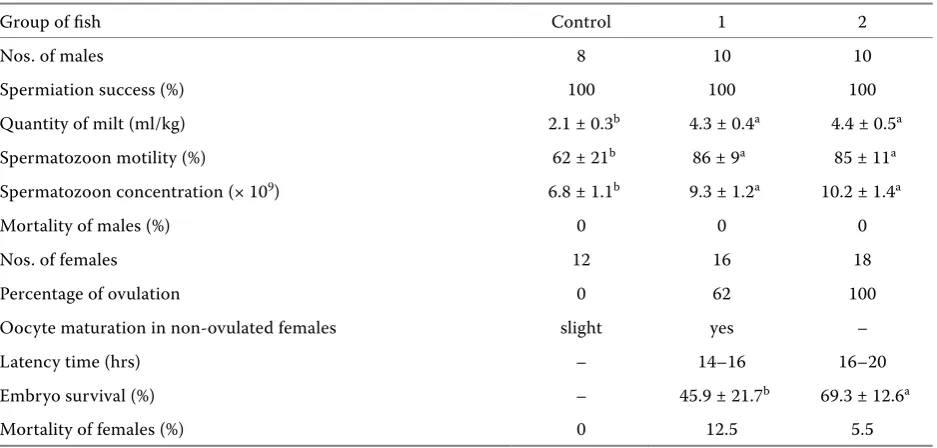
Males from the control group produced a smaller volume of milt with lower spermatozoon concentra-tion and motility than those after hormonal stimu-lation (Table 3). Generally, there were no statistical differences between milt parameters collected from males after hormonal stimulation. Survival of males used in this experiment was excellent.
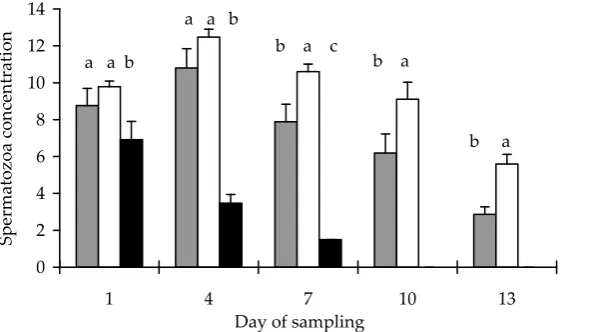
[image:3.595.63.537.654.738.2]In the experiment when the fish were induced every three days, the situation was similar as de-scribed above. Males from treated groups produced milt during thirteen days (Figure 1), in contrast to them the control ones gave milt only by the 7th day of the experiment. On all days the highest quan-tity of milt was recorded in the group stimulated with ovopel (group 2); the maximum quantities (about 6 ml/kg) were observed on days 4 and 7. In all collected milt samples the semen obtained from control males (group 3) was characterized by lower spermatozoon motility (Figure 2) and concentration (Figure 3). The highest percent-age of motile spermatozoa in treated groups was observed on day 4. Except the last days of the ex-periment, there were no statistical differences in spermatozoon motility between treated groups. Generally, the highest spermatozoon motility was found out in the sperm obtained from fish treated with ovopel. The highest spermatozoon concentra-tion was noted on day 4 in group 2. From the 7th day statistical differences in spermatozoon con-centration between treated groups were observed.
Table 2. The doses of hormones applied to involve spermiation of common bream (Abramis brama L.). Numbers of males in each group was 10
Group Days of applied hormonal stimulation
0 3 6 9 12
1 3 mg CPE 3 mg CPE 3 mg CPE 3 mg CPE 3 mg CPE 2 1 ovopel pellet 1 ovopel pellet 1 ovopel pellet 1 ovopel pellet 1 ovopel pellet
3 + + + + +
Table 3. The results (± SD) obtained in artificial spawning of common bream (Abramis brama L.). Data marked with the same letter do not differ statistically. The data characterizing semen and egg qualities were acquired from all males and from the females that ovulated. Groups are described in Material and Methods
Group of fish Control 1 2
Nos. of males 8 10 10
Spermiation success (%) 100 100 100
Quantity of milt (ml/kg) 2.1 ± 0.3b 4.3 ± 0.4a 4.4 ± 0.5a
Spermatozoon motility (%) 62 ± 21b 86 ± 9a 85 ± 11a
Spermatozoon concentration (× 109) 6.8 ± 1.1b 9.3 ± 1.2a 10.2 ± 1.4a
Mortality of males (%) 0 0 0
Nos. of females 12 16 18
Percentage of ovulation 0 62 100
Oocyte maturation in non-ovulated females slight yes –
Latency time (hrs) – 14–16 16–20
Embryo survival (%) – 45.9 ± 21.7b 69.3 ± 12.6a
Mortality of females (%) 0 12.5 5.5
0 1 2 3 4 5 6 7
1 4 7 10 13
Day of sampling
M
ilt
qu
an
tit
y
(m
l/k
g)
b a c
b a c b a c
b a
b a Figure 1. The quantity of milt (ml/kg)obtained from common bream (Abramis
brama L.) males during 13 days after hor-monal stimulation. Vertical bars show SD. Data marked with the same letter do not differ statistically. Groups are described in Table 2
0 20 40 60 80 100
1 4 7 10 13
Day of sampling
Sp
er
m
at
oz
on
(%
) a a a a a b a a b a a
[image:4.595.64.344.462.751.2]b a
Figure 2. The spermatozoon motility col-lected from common bream (Abramis brama L.) males during 13 days after hor-monal stimulation. Vertical bars show SD. Data marked with the same letter do not differ statistically. Groups are described in Table 2
Generally, the best results of bream milt qualities were obtained when the males were treated with ovopel. There were no problems with fish survival used in this experiment.
was noted. Oocytes collected from non-ovulated females after hormonal stimulation with hCG and CPE showed significant maturation: from stages 2–3 and 3 to 3–4 and 4. In oocytes sampled from control fish only limited (slight) maturation was observed. Fish from group 2 ovulated earlier than those from group 3. Better biological quality of eggs, expressed as an embryo survival to the eyed stage, was observed in group 3. A low level of mor-tality was generally observed after spawning.
DISSCUSION
In many papers dealing with artificial spawning of cyprinids the problem of spermiation was not the aim of the study (Thalathiah et al., 1988; Glubokov et al., 1991; Drori et al., 1994; Barth et al., 1997; Horvath et al., 1997; Fornies et al., 2001; Dumas et al., 2004). Only a limited number of papers studied this problem (Takashima et al., 1984; Kucharczyk et al., 1997a). It is well known from hatchery practice of cyprinids, especially from wild stocks or popula-tions, that one of the main problems is not ovula-tion but a small volume of sampled milt, in many cases with low spermatozoon concentration and bad spermatozoon motility (Kucharczyk, 2002).
As in the previous study (Kucharczyk et al., 1997a) common bream males after hormonal stimulation produced significantly more milt than those from the control group with better spermatozoon mo-tility. The volumes of collected sperm in Eurasian perch (Perca fluvaitilis L.) (Kucharczyk et al., 1998), yellow perch (Dabrowski et al., 1994) and com-mon carp (Takashima et al., 1984) treated with hor-mones were also significantly higher in contrast with control groups. In gudgeon (Gobio gobio L.) the injection of LHRH with addition of pimozide
did not result in more milt than from “control” males (Kestemont, 1989).
Males used for continuous sampling of milt (every three days) initially produced a higher volume of sperm than those hormonally stimulated. On the other hand, the dose of applied hormones was also higher. It is very interesting that common bream males produced high quality milt for thirteen days. Probably, this phenomenon is strictly connected with spawning behaviour of this species. Brylinska and Tadajewska (1986) informed that bream males were the first to be present on spawning grounds and were kept there by the end of the spawning season. In Kortowskie lakes, from which spawn-ers were taken, bream can spawn from April to July, which is in contrast with other neighbour-ing populations (Kucharczyk, 1996). The time of spawning depends on water temperatures. The results obtained in this study show that hormonal stimulation increases production of semen as well as spermatozoon concentration and motility. It is important not only for artificial propagation of this species under hatchery conditions but also for any restoration programs, i.e. gene bank or cryopreser-vation (Wildt et al., 1993; Glogowski et al., 1997; Babiak et al., 1998).
The GnRH analogues, combined with strong dop- amine antagonists, were generally very good in wild and cultured species stimulation (Barth et al., 1997; Horvath et al., 1997; Brzuska, 1999, 2000). However, discussion about these data is rather dif-ficult because different forms of GnRH analogues have usually been used, and also in different doses. Different forms of GnRH-a, sometimes from dif-ferent sources, e.g. mammalian, fish, chicken, etc., have different activity. Important differences were observed in latency time after the application of dif-ferent spawning media. The shortest time between 0
2 4 6 8 10 12 14
1 4 7 10 13
Day of sampling
Sp
er
m
at
oz
oa
co
nc
en
tr
at
io
n
a a b
a a b
b a c
b a
[image:5.595.66.361.86.252.2]b a
injections and ovulation was noted when CPE with hCG was used as a spawning agent, in contrast to the fish stimulated with ovopel. The differences in latency in females treated with CPE and GnRH were reported in many papers. It may be explained by the fact that GnRH release from the pituitary and the ovarian response to the released hormones is a sequential process while in fish injected with carp pituitary extract the ovarian response to the exogenous GtH was a single process.
The application of ovopel (GnRHa with dopamine antagonist) influenced high spawning success. All females ovulated, which is in contrast with the re-sults of the other groups. The percentage of ovula-tion using hCG and CPE was much lower than in a previous study (Kucharczyk et al., 1996). Probably this difference is a result of high water tempera-ture fluctuation in the Kortowskie Lake before the spawning season. Temperature is the main envi-ronmental factor that strongly influenced gamete development, maturation and spawning success (Tveiten and Johnsen, 1999). The differences in tolerated temperature in spawning success and survival rate of embryos and larvae and their de-velopment were observed not only in different fish species but also in different populations (Leskalä and Kucharczyk, 1995). Kokurewicz (1971) re-ported that the range of spawning temperatures experienced by bream throughout its geographic distribution area is quite wide (between 10 and 27°C). This range of temperatures is very similar to the temperatures observed in May and June on bream spawning grounds in the Kortowskie Lake, inhabited by the studied bream population. Our five years observations showed that the tempera-tures during the spawning time (May and June) of bream fluctuated on spawning grounds between 13.5 and 26.5°C (Kucharczyk, 2002). The chang-es in water temperature strongly influenced the spawning success of bream using CPE and hCG. But ovopel, a spawning agent containing GnRHa and metoclopramide works very well, significantly better. It is concluded that this kind of hormonal stimulation might be successfully used for artificial propagation of wild cyprinid fish.
REFERENCES
Babiak I., Glogowski J., Kujawa R., Kucharczyk D., Mam-carz A. (1998): Cryopreservation of asp, Aspius aspius (L.) sperm. Progr. Fish-Cult., 6, 146–148.
Barth T., Kouril J., Hamackova J., Velek J., Barthova J., Hulowa I., Jezek J., Pospisek J. (1997): Induced ovula-tion and artificial stripping in tench (Tinca tinca L.) and other freshwater fish species by means of GnRH analogues, Czech experiences 1980–1996. A minire-view. Pol. Arch. Hydrobiol., 44, 183–190.
Brylinska M., Tadajewska M. (1986): Bream (Abramis brama L.). In: Brylińska M. (ed.): Freshwater Fish of Poland (in Polish). Państwowe Wydawnictwo Naukowe, Warszawa. 267–273.
Brzuska E. (1999): Artificial spawning of herbivorous fish: use of an LHRH-a to induce ovulation in grass carp Ctenopharyngodon idella (Valenciennes) and silver carp Hypophthalmichthys molitrix (Valenciennes). Aquacult. Res., 30, 849–856.
Brzuska E. (2000): Artificial spawning of carpCyprinus carpio L.: Differences between the effects on reproduc-tion in females of Polish and Hungarian provenance treated with carp pituitary and (D-Ala6) GnRH
ProN-HEt (Kobarelin). Aquacult. Res., 31, 457–465. Dabrowski K., Ciereszko A., Ramseyer L., Culver D.,
Kes-temont P. (1994): Effects of hormonal treatment on induced spermiation and ovulation in the yellow perch (Perca flavercens). Aquaculture, 12, 171–180.
Drori S., Ofir M., Levavi-Sivan B., Yaron, Z. (1994): Spawning induction in common carp (Cyprinus carpio) using pituitary extract or GnRH superactive analogue combined with metoclopramide: analysis of hormone profile, progress of oocyte maturation and dependence on temperature. Aquaculture, 119, 393–407.
Dumas S., Rosales-Velázquez M.O., Contreras-Olguín M., Hernández-Ceballos D., Silverberg N. (2004): Go-nadal maturation in captivity and hormone-induced spawning of the Pacific red snapper Lutjanus peru. Aquaculture, 234, 615–623.
Fornies M.A., Mananos E., Carrillo M., Rocha A., Laureau S., Mylonas C.C., Zohar Y., Zanuy S. (2001): Spawning induction of individual European sea bass females ( Di-centrarchus labrax) using different GnRHa-delivery systems. Aquaculture, 202, 221–234.
Glogowski J., Babiak I., Kucharczyk D., Luczynski M. (1997): The effect of individual male variability on cryopreservation of bream (Abramis brama L.) sperm. Pol. Arch. Hydrobiol., 44, 281–285.
Glubokov A.I., Motloch N.N., Sedova M.A. (1991): Effect of a synthetic LHRH analogue and dopamine antago-nists on the maturation of bream, Abramis brama L., Aquaculture, 95, 373–377.
Kestemont P. (1989): Hormonal induction of the ovula-tion and spermiaovula-tion of the gudgeon Gobio gobio L. Aquaculture. In: De Pauw N., Jespers E., Ackerfors H., Wilkins N.A. (eds.): Biotechnology in Progress. Bre- dene, Belgium. 527–536.
Kokurewicz B. (1971): Thermal conditions for spawning and development for chosen fish species (in Polish). Broszura Instytutu Rybactwa Śródlądowego, Olsztyn. 47, 1–18.
Kozlowski B. (1994): Practise of hormonal stimulation of artificial spawning in cyprinid fishes (in Polish). Bro- szura Instytutu Rybactwa Śródlądowego, Olsztyn, 162, 41 pp
Kucharczyk D. (1996): Genome engineering in bream, Abramis brama (L.) (in Polish). [Ph.D. Thesis.] Olsztyn University of Agriculture and Technology, Olsztyn, Poland. 93 pp.
Kucharczyk D. (2002): Artificial spawning and androgen-esis of chosen cyprinids (in Polish). Dissertations and monographs 63, Wyd. UWM, Olsztyn. 80 pp.
Kucharczyk D., Luczynski M.J., Luczynski M., Babiak I., Glogowski J. (1996): Genetic inactivation of bream (Abramis brama L.) sperm with UV irradiation. Cyto-bios, 86, 211–219.
Kucharczyk D., Kujawa R., Luczynski M., Glogowski J., Babiak. I., Wyszomirska E. (1997a): Induced spawning in bream, Abramis brama (L.), using carp pituitary extract and hCG. Aquacult. Res., 28, 139–144. Kucharczyk D., Kujawa R., Mamcarz A., Wyszomirska E.
(1997b): Artificial spawning in bream (Abramis brama L.). Pol. Arch. Hydrobiol., 44, 201–205.
Kucharczyk D., Kujawa R., Mamcarz A., Wyszomirska E. (1997c): Induced spawning in rudd (Scardinius eryth-rophthalmus L.). Pol. Arch. Hydrobiol., 44, 207–211. Kucharczyk D., Luczynski M., Kujawa R., Czerkies P.
(1997d): Effect of temperature on embryonic and larval development of bream (Abramis brama L.). Aquatic. Sci.,59, 214–224.
Kucharczyk D., Kujawa R., Mamcarz A., Skrzypczak A., Wyszomirska E. (1998): Induced spawning in perch, Perca fluviatilis L., using FSH+LH with pimozide or metoclopramide. Aquacult. Res., 29, 131–136. Kujawa R., Kucharczyk D. (1996): A method of in vivo
designating oocytes from cyprinid and percid fish
us-ing catheter (in Polish). Komunikaty Rybackie, Olsztyn. 4, 20–21.
Kulikovsky Z., Martin F.J.B., Yaron Z. (1996): A com-parison of two spawning-inducing agents for common carp. Isr. J. Aquacult. – Bamidgeh, 48, 108–111. Leskelä A., Kucharczyk D. (1995): The effect of
tempera-ture on the growth of three forms of European white-fish (Coregonus lavaretus L.) larvae. Arch. Hydrobiol. Spec. Issues Advanc. Limnol., 46, 147–152.
Penaz, M., Gajdusek, J. (1979): Early development of bream, Abramis brama from the water reservoir Mos-tiste, CSSR. Folia Zool., 28, 347–360.
Platt C. (1977): Problems with calculus of probability and statistical mathematics (in Polish). 2nd ed. Państwowe Wydawnictwo Naukowe, Warszawa.
Takashima F., Weil C., Billard R., Crim L.W., Fostier A. (1984): Stimulation of spermiation by LHRH analogue in carp. Bull. Japan. Soc. Sci. Fish, 50, 1323–1329. Szczcerbowski J.A. (1985): Bream (Abramis brama L.).
In: Szczcerbowski J.A. (ed.): Lake and River Fisheries (in Polish). 2nd ed. Państwowe Wydawnictwo Rolnicze i Lesne, Warszawa. 148–151.
Thalathiah S., Ahmad A.O., Zaini M.S. (1988): Induced spawning techniques practised at Batu Berendam, Melaka, Malaysia. Aquaculture, 74, 23–33.
Tveiten H., Johnsen H.K. (1996): Temperature experi-enced during vitellogenesis influences ovarian matura-tion and the timing of ovulamatura-tion in common wolffish. J. Fish Biol., 55, 809–819.
Wildt D.E. Seal U.S., Rall. W.F. (1993): Genetic resources banks and reproductive technology for wildlife. In: Cloud J.G., Thorgaard G.H. (eds.): Genetics Conserva-tion of Salmonid Fishes. Plenum Press, New York. 159–174.
Yaron Z., Bogomolnaya A., Levavi B. (1984): A calibrated carp pituitary extract as a spawning – inducing agent. Rosental H., Sarig S. (eds.): Research on Aquaculture, 8, 151–168.
Yaron Z. (1995): Endocrine control of gametogenesis and spawning induction in the carp. Aquaculture, 129, 49–73.
Received: 04–08–05 Accepted after corrections: 05–01–14
Corresponding Author
Dariusz Kucharczyk, Department of Lake and River Fisheries, Warmia and Mazury University in Olsztyn, ul. Oczapowskiego 2, 10-718 Olsztyn-Kortowo, Poland