JOURNAL OF FOREST SCIENCE, 58, 2012 (11): 503–512
Early-arriving saproxylic beetles developing
in Scots pine stumps: effects of felling type and date
J. Foit
Department of Forest Protection and Wildlife Management, Faculty of Forestry and Wood Technology, Mendel University in Brno, Brno, Czech Republic
ABSTRACT: A total of 320 Scots pine (Pinus sylvestris L.) low stumps were analysed within two stands (one stand
was thinned, and the other stand was subjected to clear-cut final felling) in the Drahanská Highlands in the Czech Republic. Each stand was divided into four parts, and the felling of each part was performed on different dates during 2006 (February, May, August and November). The fauna of early-arriving saproxylic beetles inhabiting the stumps was investigated by peeling the bark in two vegetation periods after the felling. A total of 17 species of beetles were found. The felling type and date affected the species composition of the recorded assemblages, with the felling date being considerably more important than the type. The species richness and diversity did not differ significantly between the felling types, but significant differences were found among the felling dates. Several associations of particular species with certain felling types or dates were also found.
Keywords: phloem- and wood-feeding beetles; thinning; final felling; month of felling
Saproxylic beetles are an endangered group of or-ganisms in European managed forests (Wallenius et al. 2010) and have been investigated extensively during recent decades. Stumps are a substantial part of dead wood in managed forests (up to 80% of dead wood remaining in clear-cuts) and support a remarkable number of saproxylic species (Hjältén et al. 2010). During recent decades, an effort has been made to improve the conditions for saprox-ylic beetles by creating high stumps that provide a suitable substrate for the development of even more species than those found in ordinarily cut low-stumps (Abrahamsson, Lindbladh 2006). To maximise the positive effects of such efforts, we must first understand the factors influencing the colonisation of stumps by saproxylic beetles. In view of this need for additional information and in view of the current tendency to harvest stumps as a renewable energy source, research on stump fauna is highly relevant.
It is known from many previous studies that the species composition, richness and diversity of sap-roxylic beetle assemblages on stumps are affected by an array of factors, such as the surrounding stand characteristics (Abrahamsson et al. 2009), position of the stumps in a closed stand, forest-edge environment or clear-cut ( Abrahamsson et al. 2008; Fossestøl, Sverdrup-Thygeson 2009), tree species represented by the stump (Jonsell et al. 2004, 2007; Lindhe et al. 2005; Lindbladh et al. 2007), stump diameter (Jonsell et al. 2004; Lindhe et al. 2005), stump height (Abrahams-son, Lindbladh 2006; Hedgren 2007), sun ex-posure (Jonsell et al. 2004; Lindhe, Lindelöw 2004; Lindhe et al. 2005), moisture level (Wal-lace 1953), stage of dieback or decomposition (Krogerus 1927; Wallace 1953) and presence of certain fungi or other organisms (Jonsell et al. 2005; Abrahamsson et al. 2008; Weslien et al. 2011). Most of the above-cited studies were
ducted on Norway spruce (Picea abies [L.] Karsten) stumps in Northern Europe, whereas the saproxylic fauna of Scots pine (Pinus sylvestris L.) stumps was investigated in a few cases only (Wallace 1953; Schroeder et al. 2006).
No study to date has addressed the effects of the felling date (date of stump origination) on the sap-roxylic beetle fauna occurring in stumps. Sapsap-roxylic beetles have certain requirements for the condition of their substrate tissues, particularly the phloem (e.g. Rudinsky 1962; Schwenke 1974), and they mate and lay eggs during particular phases of the vegetation period (e.g. Schwenke 1974). These observations suggest that the felling date could be an important variable affecting the occurrence of particular species developing in stumps and, there-fore, the overall composition of the species assem-blages. However, the effects of felling date have been documented only for the logging residues excluding stumps: Norway spruce stems from pre-commercial thinning (Kula, Kajfosz 2007) and Scots pine twigs and branches (Foit 2011).
The purpose of this study was to explore the early-arriving saproxylic beetle fauna of Scots pine stumps in the study area and to assess possible ef-fects of the felling date and felling type (thinning or final felling) on the composition of assemblages and on the occurrence of particular species.
MATERIAL AND METHODS
Study site
The research was conducted in the southern part of the Drahanská Highlands in the Czech Repub-lic, where two suitable stands were chosen for the study. The sites had almost the same ecotope char-acteristics and were separated by an approximate distance of only 700 m. In the first site, Scots pine stumps produced during thinning were investi-gated under the conditions of a relatively closed stand, whereas the stumps produced during the main felling operation were studied in a clear-cut area in the other site. The climate of the study area was characterised by mean annual temperatures of 8.5°C and an average annual rainfall amount of ap-proximately 580−590 mm (long-term mean values (1971−2000) from Brno-Žabovřesky climatological station (49°13'00''N, 16°33'58''E) corrected for el-evation differences).
The first study stand (i.e. the thinned stand) (49°15'38''N, 16°36'52''E) had an area of 1.6 ha and was situated between 350 m and 380 m a.s.l. on
a south- to southwest-facing slope with a gradi-ent of approximately 5−10%. This even-aged stand had been experimentally thinned in 2006, when it was 61 years old. The main canopy was composed primarily of Scots pine (60%) and European larch (Larix decidua Miller) (20%), however, sessile oak (Quercus petraea [Mattuschka] Liebl) and Norway spruce were also present.
The second study site (i.e. the felled stand) (49°16'01''N, 16°37'15''E) had an area of 0.99 ha and was situated between 370 m and 400 m a.s.l. on a southeast- to southwest-facing slope with a gradi-ent of approximately 10%. This even-aged stand had been 114 years old in 2006, when the experimental main felling was conducted. The main canopy was composed primarily of Scots pine (78%), European larch, sessile oak, Norway spruce, European horn-beam (Carpinus betulus L.) and European birch (Betula pendula Roth) were also present.
The forests in the study area have traditionally been managed by the clear-cutting system with prevailing artificial regeneration.
Sampling
Both study sites were divided into four parts, each of the same area, and the experimental fell-ing was conducted on a different date in each part. The dates on which the felling occurred were Feb-ruary 10, May 11, August 14 and November 10 (all 2006). Within each felling, 40 (or slightly more) pine stumps of approximately 25 cm height were produced by manual felling. The stumps had a diameter of approximately 20–30 cm within the thinned stand; the final felling produced stumps of approximately 30–45 cm in diameter.
A 22% decrease in the number of trees per hect-are resulted from the thinning (the number of pine trees decreased from approximately 450 per ha to 350 per ha), but the shady microclimate of the for-est stand was retained. In contrast, the final felling removed all of the trees from the felled site. The stumps produced were exposed completely to the sun in the clear-cut area created by the felling.
The entire aboveground part of each stump (down to the level of the mineral soil) was debarked, and all of the early-arriving (phloemo-, and xylo-mycetophagous) beetle species were identified using gallery characteristics or the morphological traits of imagoes or larvae (Pfeffer 1955; Švácha, Dani-levsky 1986, 1987, 1988; Bílý 1989, 1999; Bense 1995). Furthermore, the impact of each species was evaluated on a semi-logarithmic six-degree scale ac-cording to the visually estimated percentage of area exploited by the species within the stump mantle (< 1%, 1−5%, 6−25%, 26−50%, 51−75%, and > 75%). This scale was adapted from the Braun-Blanquet cover-abundance scale (Braun-Blanquet 1964), which is widely used in phytocoenology.
Statistical analysis
The frequency of occurrence of each species was expressed as the proportion of stumps occupied. For each stump, the number of species and the Shannon diversity index of the recorded assem-blage were assessed. The differences in these values and in the occurrences of particular species among the stumps produced in diverse months and under different stand conditions (thinning or final felling) were tested using an analysis of variance (ANOVA) calculated in STATISTICA 8.0 (StatSoft 2007).
Canonical correspondence analysis (CCA) was used to assess the effects of the felling date (month) and felling type (thinning or final felling) on the species composition of the beetle assemblages. CCA does not require normally distributed data and assumes uni-modal models for the relationships between the re-sponses of each species to the habitat variables. This approach was appropriate for this data set because the preliminarily detrended correspondence analysis showed long gradient lengths (> 3 SD) (ter Braak 1986, 1987). In the CCA, the Monte Carlo permuta-tion test (Manly 1991) with 999 permutapermuta-tions was used to compute the significance of the relationships between the species response and the habitat factors. All of these analyses were performed in CANOCO for Windows (ter Braak 1987). All of the recorded cies were included in the analyses, however, rare spe-cies were down-weighted in CANOCO to decrease the impact of the random occurrences of rare species.
RESULTS
[image:3.595.126.469.455.732.2]Among the 17 species of early-arriving saproxylic beetles found (Fig. 1), the families Curculionidae (11 species) and Cerambycidae (5 species) were the most abundant. Most of the curculionids (9 species) were bark beetles (Scolytinae), and Tomicus pini-perda (L.) was encountered most frequently (Fig. 1).
Fig. 1. Number of stumps with the occurrence of recorded species and their frequencies of occurrence
Fr
equenc
y of o
cc
ur
enc
e (%)
No. of st
um
ps w
ith o
cc
ur
enc
No significant differences were found out in the number of species and in the diversity of the beetle fauna developing on the stumps in the clear-cut area after the final felling and within the closed stand after thinning (ANOVA – number of species: F1, 318 = 1.332,
P < 0.251; Shannon diversity index: F1, 318 = 3.735,
P = 0.054). However, both of these variables were slightly higher in the case of thinning and the dif-ference in Shannon diversity index was close to significant.
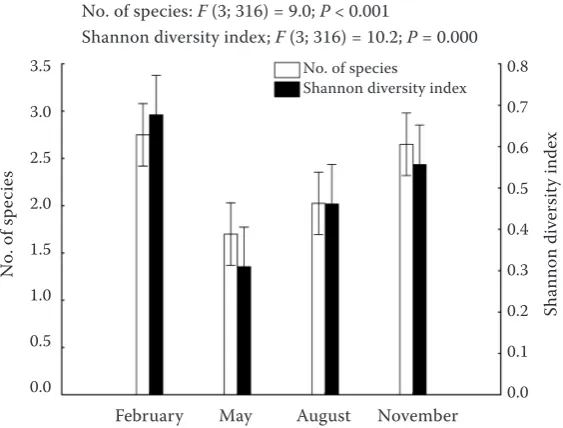
Both the number of species and the Shannon diversity indices differed significantly among the various felling dates (date of stump origination) (Fig. 2). The highest values were recorded on the stumps from the autumn (November) and winter (February) fellings, whereas the lowest values were recorded on the stumps from the spring (May) fellings.
The results of the CCA showed that the felling date and felling type had significant impacts on the species composition of the communities, and these results held even when the sampling date was treat-ed as a covariable (Table 1, Figs. 3 and 4). Together, these factors accounted for 14.5% of the variance in the species structure of the assemblage. The felling date was clearly the most important factor, explain-ing approximately 10% of the variance in the spe-cies occurrences (Table 1, Fig. 4).
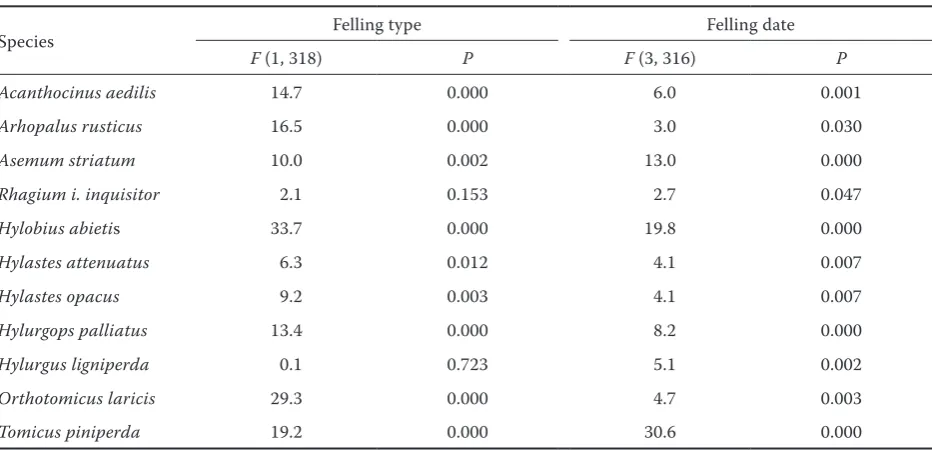
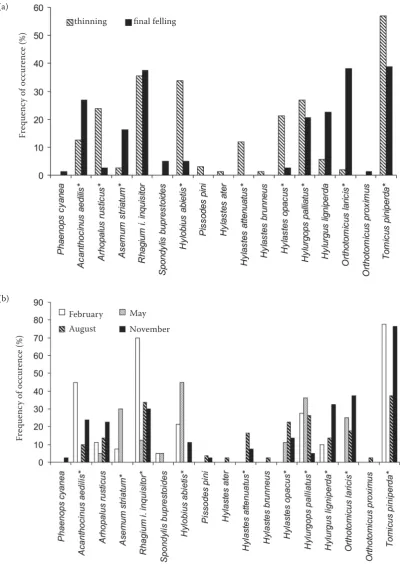
[image:4.595.157.439.55.269.2]Particular species were associated with certain felling types and felling dates (Figs. 5a, b), and many of these associations were statistically significant (Table 2). Thus, certain species were significantly more abundant on the stumps from thinning: Ar-hopalus rusticus (L.), Hylobius abietis (L.), Hylastes attenuatus Erichson, Hylastes opacus Erichson, Hy-lurgops palliatus (Gyllenhal), and Tomicus piniper-Fig. 2. Mean values of the number of species and Shannon diversity index recorded on stumps originated from fell-ings conducted on different dates. Vertical lines show 95% confidence intervals for the estimated mean values. The results of ANOVA tests for the significance of the differences among particular dates of felling are also presented
Table 1. CCA – results of the Monte Carlo permutation tests for the significance of the studied habitat factors. The percentages of variance in species occurrence explained by the factors studied are included for particular cases
Factor Covariables F P Explained species data (%)
Sampling date – 7.4 0.001 2.6
Felling type (thinning/final felling) sampling date 13.1 0.001 4.6 Felling type (thinning/final felling) sampling date, felling date 14.8 0.001 5.2 Felling date (February/May/August /November) sampling date 9.6 0.001 9.7 Felling date (February/May/August /November) sampling date, felling type 10.3 0.001 10.3 Felling type and date together sampling date 11.3 0.001 14.5
All factors together – 9.4 0.001 17.4
No. of sp
ec
ie
s
No. of species: F (3; 316) = 9.0; P < 0.001
Shannon diversity index; F (3; 316) = 10.2; P = 0.000
Shannon diversity inde
x
No. of species
Shannon diversity index
February May August November 3.5
3.0
2.5
2.0
1.5
1.0
0.5
0.0
0.8
0.7
0.6
0.5
0.4
0.3
0.2
0.1
[image:4.595.64.531.620.758.2]da. In contrast, other species were more frequent on the stumps in the clear-cut area after the final felling: Acanthocinus aedilis (L.), Asemum stria-tum (L.), and Orthotomicus laricis (F.). Differences in the colonisation of stumps created in different months were not as easily generalised because
each species exhibited a specific pattern. The most evident contrasts in the colonisation of stumps by particular species were recorded in the case of the stumps from the May fellings. Many species avoid-ed the colonisation of such stumps (Acanthocinus aedilis, Arhopalus rusticus, Rhagium inquisitor in-Fig. 3. CCA – Impact of felling type on the species
[image:5.595.66.290.53.221.2]com-position of saproxylic beetle assemblages (covariables: sampling date, felling date; sum of eigenvalues of the first and second axes = 1.070; sum of all eigenvalues after fit-ting the covariables = 5.578; see also Table 1). Species are denoted as triangles with abbreviations of their names: Ac_a (Acanthocinus aedilis); Ar_r (Arhopalus rusticus); As_s (Asemum striatum); Ha_a (Hylastes attenuatus); Ha_o (Hylastes opacus); Hg_p (Hylurgops palliatus); Hu_l (Hylurgus ligniperda); Hy_a (Hylobius abietis); Or_l (Orthotomicus laricis); Rh_i (Rhagium i. inquisitor) and To_p (Tomicus piniperda). Only the species recorded on five stumps at least are shown
[image:5.595.306.527.54.279.2]Fig. 4. CCA – Impact of the felling date on the species composition of saproxylic beetle assemblages (covari-ables: sampling date, felling type; sum of eigenvalues of the first and second axes = 0.553; sum of all eigenvalues after fitting the covariables = 5.893; see also Table 1). Spe-cies are denoted as triangles with abbreviations of their names (see Fig. 3). Only species recorded on five stumps at least are shown.
Table 2. ANOVA – significance of the differences in gallery coverage on the stumps originating from various felling types and felling dates (only the species recorded on 10 stumps at least were tested)
Species Felling type Felling date
F (1, 318) P F (3, 316) P
Acanthocinus aedilis 14.7 0.000 6.0 0.001
Arhopalus rusticus 16.5 0.000 3.0 0.030
Asemum striatum 10.0 0.002 13.0 0.000
Rhagium i. inquisitor 2.1 0.153 2.7 0.047
Hylobius abietis 33.7 0.000 19.8 0.000
Hylastes attenuatus 6.3 0.012 4.1 0.007
Hylastes opacus 9.2 0.003 4.1 0.007
Hylurgops palliatus 13.4 0.000 8.2 0.000
Hylurgus ligniperda 0.1 0.723 5.1 0.002
Orthotomicus laricis 29.3 0.000 4.7 0.003
[image:5.595.65.532.533.758.2]quisitor [L.], Hylurgus ligniperda [F.], and Tomicus piniperda), whereas other species preferred or at least did not avoid stumps originating from this felling date (Asemum striatum, Hylobius abietis
and Hylurgops palliatus).
DISCUSSION
In total, 17 early-arriving saproxylic beetle species were found developing in recently produced Scots pine stumps (Fig. 1); however, it is probable that
ad-Fr
equenc
y of o
cc
ur
enc
e (%)
thinning final felling
Fr
equenc
y of o
cc
ur
enc
e (%)
February August
[image:6.595.90.491.54.624.2]May November
Fig. 5. Frequencies of occurrence of recorded species with respect to the type of felling (a) and to the felling date (b) *indicates the species with significant differences in gallery coverage between the stumps originating from thinning and final felling (a) and among the stumps originating from particular months (b) (Table 2)
(a)
ditional rare species were not recorded. Only four species (24% of all the recorded taxa) were found in less than five stumps and could be considered rare in the data set (Fig. 1). Wallace (1953) found only eight phloemophagous (possibly xylo- or xy-lomycetophagous) beetle species developing in 200 pine stumps in various stages of decomposition in Northwest England. The markedly higher number of species recorded in the present study is likely to result from the overall higher species richness of saproxylic beetle fauna in the Czech Republic com-pared to England (Nieto, Alexander 2010).
The species recorded included several pests, chiefly Hylobius abietis and Tomicus piniperda. It is widely known that H. abietis multiplies on co-nifer stumps (Schwenke 1974). Because T. pini-perda was the most frequent species in the present study, it is obvious that this pest can also multiply significantly on Scots pine stumps. Notably, no red-listed species were found. However, because only the aboveground part of the stumps was sampled in the first and second growing seasons after fell-ing, this finding cannot be viewed as evidence that Scots pine stumps are relatively unimportant for nature conservation.
Because the greater sun exposure (Lindhe, Lin-delöw 2004; Lindhe et al. 2005) and the larger diameter (the surface area of the stump habitat) (Lindhe, Lindelöw 2004) have positive effects on the species richness and the diversity of sap-roxylic fauna, we could expect higher species rich-ness and diversity on larger stumps in clear-cut areas after the final felling than on shaded stumps of smaller diameter resulting from thinning. This difference was previously shown by Fossestøl and Sverdrup-Thygeson (2009) in a study of Norway spruce stumps in Central Norway. However, in the present study no significant differences were found either in the number of species or in the Shannon diversity index between stumps from different felling types. Moreover, both these variables had slightly higher values for the stumps resulting from thinning. Similarly, Lindbladh and Abrahams-son (2008) studied Norway spruce high stumps in Southern Sweden and found no significant differ-ences in the species number or species densities between stumps from thinning and stumps from final felling.
In the present study, significant and conspicuous differences in the number of species and in species diversity were found between the stumps from dif-ferent felling dates (Fig. 2). The highest number of species and the highest Shannon diversity indices were recorded on the stumps from the February
and November fellings. These stumps entered the next growing season with fresh phloem and other tissues and could be colonised by a number of spe-cies that mate and lay eggs during any part of the growing season, including those reproducing in the spring. In contrast, the lowest values for the num-ber of species and the Shannon diversity index re-corded on the stumps from the May fellings could have two explanations. First, limited numbers of species are available to colonise the stumps during the year of origin (it is probable that the stumps do not become suitable as breeding material imme-diately after felling but are suitable several weeks later – in the summer). In addition, the desiccation and degradation of the tissues of such stumps dur-ing the next growdur-ing season could disfavour po-tential colonisers. Similarly, a study conducted on logging residues (Foit 2011) in the Czech Republic revealed a significant effect of the felling date on the species richness and diversity. However, the lowest diversity and species richness recorded by that study was found for the summer (August) fell-ings. This result may reflect faster desiccation and degradation of the phloem and other tissues in log-ging residues than in the stumps.
of logging residues, such as thin stems, branches and twigs (Kula, Kajfosz 2007; Foit 2011) in which it was similarly much more important than the felling type. It is probable that the substantial impact of the felling date was associated with different require-ments of particular species for certain conditions of the phloem (or also of other tissues) (Rudinsky 1962; Schwenke 1974) and with the timing of the mating and egg-laying of the species (Schwenke 1974). Although the present study has documented the impact of the felling date only for the early-arriv-ing saproxylic beetles, in view of the priority effects of the first-colonising species (Weslien et al. 2011) we can expect that the saproxylic fauna would also be affected in subsequent years.
Many species were significantly associated with certain felling types and felling dates (Table 2, Figs. 5a, b), and it is probable that the species as-sociated with the stumps from thinning require a more humid and stable microclimate provided by a closed stand. The majority of those species are actually known to prefer the moist underground parts of stumps (Hylobius abietis, Hylastes at-tenuatus and Hylastes opacus) or are known to require breeding material that is high in moisture content (Arhopalus rusticus and Hylurgops pal-liatus) (Pfeffer 1955; Schwenke 1974; Sláma 1998). In contrast, it is probable that the species associated with stumps from the final felling (e.g.
Acanthocinus aedilis and Orthotomicus laricis) are more thermophilic and prefer sun-exposed wood habitats and higher temperatures. More species were found to be associated with thinning (6) than with final felling (3); however, this result is surpris-ing because higher amounts of sun exposure and higher temperatures might increase the species richness of saproxylic assemblages (Lindhe, Lin-delöw 2004; Fossestøl, Sverdrup-Thygeson 2009). In their extensive study of the stumps of var-ious tree species in Sweden, Lindhe et al. (2005) found only 13 saproxylic species favoured by shade, compared to 29 favoured by sun exposure. This dis-crepancy probably arose from higher requirements of saproxylic beetles for microhabitat sun exposure and temperature in the colder climate of Northern Europe, where all the aforementioned studies were conducted. The associations found in the pres-ent study between particular species and felling dates showed various patterns and frequently cor-responded to the mating and egg-laying period of the species and requirements for the condition of the tissue used as breeding substrate listed in sev-eral monographs (Pfeffer 1955; Schwenke 1974; Bílý 1989; Sláma 1998). However, certain
associa-tions were not as readily explained. In view of the limited scope of this paper, not all of these associa-tions can be discussed in detail.
CONCLUSIONS
Scots pine stumps from classical commercial fi-nal felling and thinning operations are important substrates for the development of a substantial number of early-arriving saproxylic beetle species. Several of these species are considered pests, but the majority of the species are not economically harmful. The occurrence of particular species and, thus, the overall composition of the assemblages, including their species richness and diversity, are strongly affected by the date of stump origination (felling date) and, to a lesser extent, are also affect-ed by the type of felling that producaffect-ed the stumps (thinning or final felling).
The artificial creation of high stumps in managed forests is frequently recommended to enhance the overall diversity of saproxylic beetles and to sup-port particular endangered species (Jonsell et al. 2004; Lindhe, Lindelöw 2004). Many factors can influence the colonisation of such stumps by saproxylic beetles (see the Introduction) and can, therefore, affect the results of these conservation efforts. The present study suggests that the date of the stump origination is one of the most important of these factors: stumps created during the winter (February) and autumn (November) hosted the early-arriving beetle assemblages with the highest species richness and diversity. The effects of this factor should be examined from a nature conser-vation perspective in future studies. Such studies should investigate all (not only early-arriving) sap-roxylic beetles or even all sapsap-roxylic insects.
Acknowledgements
I very much appreciate the assistance of I. Březina with the experimental fellings.
References
Abrahamsson M., Lindbladh M. (2006): A comparison of saproxylic beetle occurrence between man-made high- and low-stumps of spruce (Picea abies). Forest Ecology and Management, 226: 230−237.
cre-ated high-stumps of Norway spruce. Forest Ecology and Management, 255: 3396−3403.
Abrahamsson M., Jonsell M., Niklasson M., Lindbladh M. (2009): Saproxylic beetle assemblages in artificially cre-ated high-stumps of spruce (Picea abies) and birch (Betula pendula/pubescens) – does the surrounding landscape matter? Insect Conservation and Diversity, 2: 284−294. Bense U. (1995): Longhorn Beetles – Illustrated Key to the
Cerambycidae and Vesperidae of Europe. Weikersheim, Margraf Verlag: 512.
Bílý S. (1989): Krascovití – Buprestidae. [Buprestid Beetles (Buprestidae).] Prague, Academia: 111.
Bílý S. (1999): Larvae of buprestid beetles (Coleoptera: Bu-prestidae) of Central Europe. Acta Entomologica Musei Nationalis Pragae, 9 (Supplementum): 1-45.
Braun-Blanquet J. (1964): Pflanzensoziologie. Grundzuge der Vegetationskunde. New York, Springer: 865.
Foit J. (2011): Kambioxylofágní hmyz na borovici lesní se zvláštním přihlédnutím k jeho vývoji na těžebním odpadu. [Cambioxylophagous Insects on the Scots Pine Trees with Special Focus on the Insects‘ Development on Logging Residues.] [Ph.D. Thesis.] Brno, Mendel University in Brno: 182.
Fossestøl K.O., Sverdrup-Thygeson A. (2009): Saproxylic beetles in high stumps and residual downed wood on clear-cuts and in forest edges. Scandinavian Journal of Forest Research, 24: 403-416.
Hedgren P.O. (2007): Early arriving saproxylic beetles (Co-leoptera) and parasitoids (Hymenoptera) in low and high stumps of Norway spruce. Forest Ecology and Manage-ment, 241: 155−161.
Hjältén J., Stenbacka F., Andersson J. (2010): Saproxylic beetle assemblages on low stumps, high stumps and logs: Implication for environmental effects of stump harvesting. Forest Ecology and Management, 260: 1149−1155. Jonsell M., Nittérus K., Stighäll K. (2004): Saproxylic
beetles in natural and man-made decidious high stumps retained for conservation. Biological Conservation, 118: 163−173.
Jonsell M., Schroeder M., Weslien J. (2005): Saproxylic beetles in high stumps of spruce: Fungal flora important for determining the species composition. Scandinavian Journal of Forest Research, 20: 54-62.
Jonsell M., Hansson J., Wedmo L. (2007): Diversity of saproxylic beetle species in logging residues in Sweden – Comparisons between tree species and diameters. Biologi-cal Conservation, 138: 89-99.
Krogerus R. (1927): Beobachtung über die Succession ei-niger Insektenbiocoenosen in Fichtenstümpfen. Notulae Entomologicae, 7: 121−126.
Kula E., Kajfosz R. (2007): Colonization of spruce logging debris from summer and autumn cleaning by cambioxy-lophagous insect at higher locations of the Beskids. The Beskids Bulletin, 20: 193−198.
Lidbladh M., Abrahamsson M. (2008): Beetle diversity in high-stump from Norway spruce thinnings. Scandinavian Journal of Forest Research, 23: 339−347.
Lindbladh M., Abrahamsson M., Seedre M., Jonsell M. (2007): Saproxylic beetles in artificially created high-stumps of spruce and birch within and outside hotspot areas. Biodiversity Conservation, 16: 3213−3226.
Lindhe A., Lindelöw Å. (2004): Cut high stumps of spruce, birch, aspen and oak as breeding substrates for saproxylic beetles. Forest Ecology and Management, 203: 1−20. Lindhe A., Lindelöw Å., Åsenblad N. (2005): Saproxylic
beetles in standing dead wood density in relation to sub-strate sunexposure and diameter. Biodiversity and Con-servation, 14: 3033−3053.
Manly B.F.J. (1991): Randomization and Monte Carlo meth-ods in Biology. London, Chapman & Hall: 281.
Nieto A., Alexander K.N.A. (2010): European Red List of Saproxylic Beetles. Luxembourg, Publication Office of the European Union: 45.
Pfeffer A. (1955): Kůrovci – Scolytoidea. [Bark Beetles – Scolytoidea.] Fauna, ČSR, Volume 6. Prague, ČSAV: 324. Rudinsky J.A. (1962): Ecology of Scolytidae. Annual Review
of Entomology, 7: 327−348.
Schwenke W. (eds.). (1974): Die Forstschädlinge Europas. Bd. II. Berlin, Paul Parey: 500.
Schroeder L.M., Ranius T., Ekbom B., Larsson S. (2006): Recruitment of saproxylic beetles in high stumps created for maintaining biodiversity in a boreal forest landscape. Canadian Journal of Forest Research, 36: 2168−2178. Sláma M.E.F. (1998): Tesaříkovití – Cerambycidae České
a Slovenské republiky. [Longhorn Beetles – Cerambyci-dae of the Czech and Slovak Republic.] Krhanice, Milan Sláma: 383.
StatSoft Inc. (2007): Electronic Statistics Textbook. StatSoft, Tulsa. Available at http://www.statsoft.com/textbook/ stathome.html (accessed August 28, 2011).
Švácha P., Danilevsky M.L. (1986): Cerambycoid larvae of Europe and Soviet Union (Coleoptera, Cerambycidae). Part I. Acta Universitatis Carolinae – Biologica, 30: 1−176. Švácha P., Danilevsky M.L. (1987): Cerambycoid larvae of Europe and Soviet Union (Coleoptera, Cerambycidae). Part II. Acta Universitatis Carolinae – Biologica, 31: 121−284.
Švácha P., Danilevsky M.L. (1988): Cerambycoid larvae of Europe and Soviet Union (Coleoptera, Cerambycidae). Part III. Acta Universitatis Carolinae – Biologica, 32: 1−205. ter Braak C.J.F. (1986): Canonical correspondence analysis:
a. new eigenvector technique for multivariate direct gradi-ent analysis. Ecology, 67: 1167−1179.
Wallace H.R. (1953): The ecology of the insect fauna of pine stumps. Journal of Animal Ecology,22: 154−171.
Wallenius T., Niskanen L., Virtanen T., Hottola J., Bru-melis G., Angervuori A., Julkunen J., Pihlström M. (2010): Loss of habitats, naturalness and species diversity in Euroasian forest landscapes. Ecological Indicators, 10: 1093−1101.
Weslien J., Djupström L. B., Schroeder M., Widenfalk O. (2011): Long-term priority effects among insects and fungi colonizing decaying wood. Journal of Animal Ecol-ogy, 80: 1155−1162.
Received for publication July 5, 2012 Accepted after corrections October 18, 2012
Corresponding author:
Ing. Jiří Foit, Ph.D., Mendel University in Brno, Faculty of Forestry and Wood Technology, Department of Forest Protection and Wildlife Management, Zemědělská 3, 613 00 Brno, Czech Republic